

If you struggle with a strong or reactive dog, the right prong collar can help you manage walks and training sessions more predictably. When fitted and used correctly, a prong collar dog owners use for short, supervised training can provide clear, consistent pressure signals that many handlers find useful for redirecting unwanted behaviors. This guide covers seven shortlisted prong collars, chosen for fit, construction, and safety-focused features. We evaluated how each option addresses common concerns such as comfort, adjustability, and ease of use, so you can decide which design best suits your dog and training plan.
Top Picks at a Glance
| Best Overall Prong Collar A balanced, reliable pick that suits most training situations | Herm Sprenger Ultra-Plus Prong Collar 16in Small |  |
| Best Budget Prong Collar A low-cost option that still provides basic training control | Aheasoun Prong Dog Collar Large |  |
| Best Premium Prong Collar Higher-end materials and finish for long-term performance | Herm Sprenger NeckTech Sport 23in |  |
| Best Heavy‑Duty Prong Collar Built for strong dogs and frequent, intensive use | Downtown Pet Supply Prong Collar Large |  |
| Best Adjustable Prong Collar Easy to size for a precise, secure fit on any dog | Supet Prong Training Collar Medium |  |
| Best Stainless‑Steel Prong Collar Corrosion-resistant metal for longevity and low maintenance | STEHEALTH Dog Prong Collar 3.0mm |  |
| Best Compact/Portable Prong Collar Lightweight, easy-to-store design for travel and classes | Kitys Fatch Prong Collar M/L | 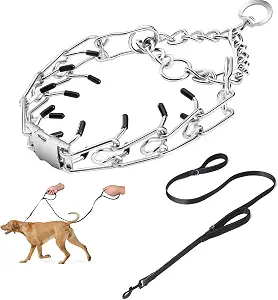 |
Herm Sprenger Ultra-Plus Prong Collar 16in Small
Best Overall Prong Collar
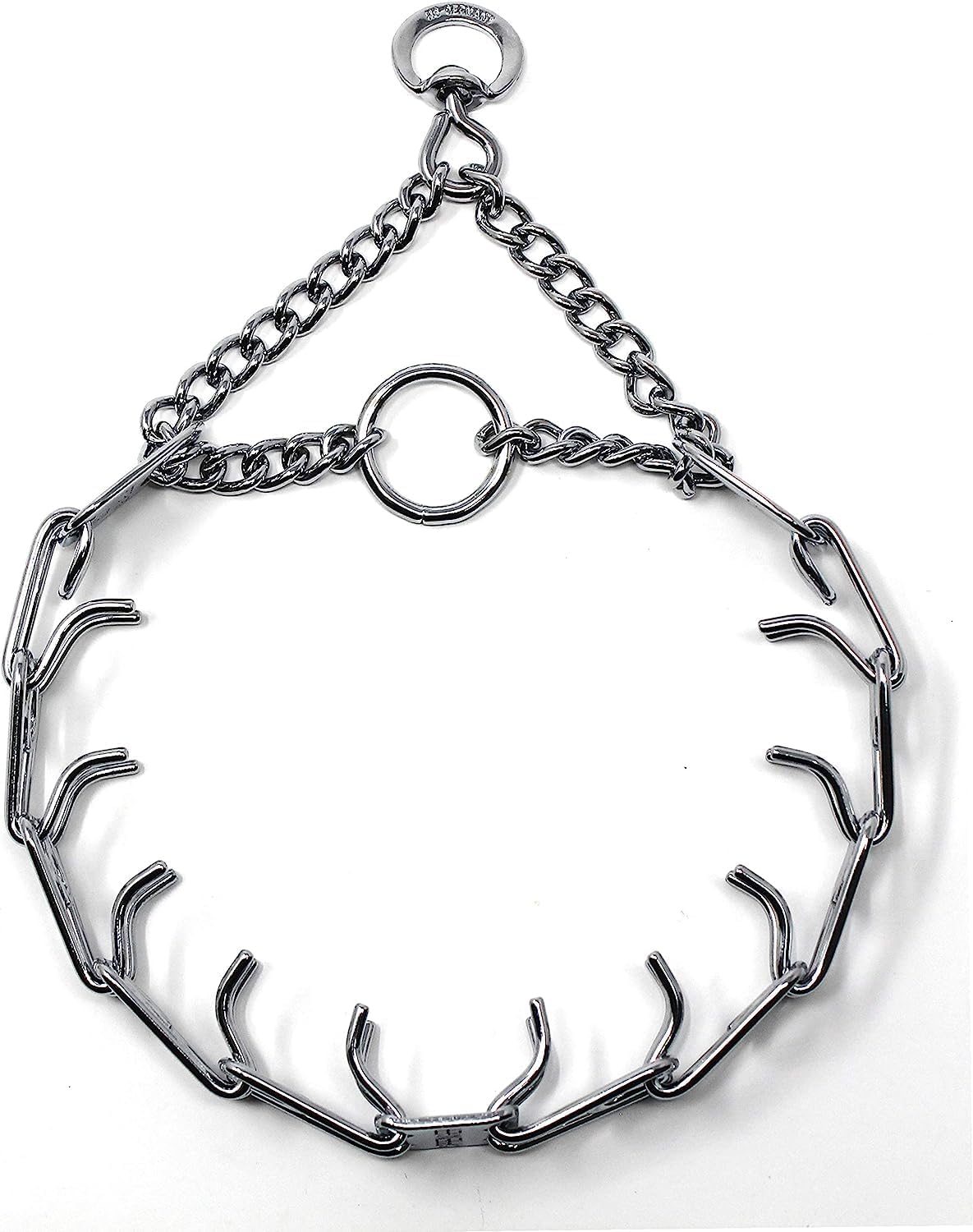
| Material Type | Alloy Steel |
|---|---|
| Item Length | 16 inches |
| Prong Gauge | 2.25mm |
| Fits Neck | 13 to 19 inches |
| Closure Type | Double Ring |
This Herm Sprenger Ultra-Plus prong collar is a factory-quality training chain made from chrome-plated alloy steel with the brand's specialty prong shape intended to distribute pressure evenly. It is sized as the 16-inch small variant and ships in a base configuration that fits roughly 13-inch necks out of the box and can be extended to about 19 inches by adding prong links. Typical use is as a high, snug training collar placed behind the ears for leash corrections during obedience work; the double-ring closure and included swivel make leash attachment straightforward. The Ultra-Plus center plate and precision links give a secure, consistent feel and the metal construction should resist bending or rusting under normal use. Limitations are that proper sizing and placement are essential for safe use, additional links are required for some neck sizes and those links are sold separately, and prong collars are a specialized tool that need knowledgeable handling to avoid misuse. For everyday obedience training where firm, repeatable control and durable materials matter, this collar performs well.
Best for: Buyers who want a dependable, well-made prong collar for regular obedience work and prioritize consistent control and build quality.
Less Ideal for: Owners who prefer gentler training tools, are inexperienced with corrective collars, or need a non-metal or decorative everyday collar.
- Chrome-plated alloy steel construction is durable and corrosion-resistant
- Ultra-Plus prong shape designed to distribute pressure more evenly
- Double-ring closure with swivel for reliable leash attachment and control
- Ships in a base size that fits many small dogs and can be extended with extra links
- Additional prong links required separately for larger neck sizes
- Requires correct placement and experienced handling to be used safely
Verdict: The best overall prong collar offers dependable training control, comfortable fit, and durable construction for most dog owners and everyday obedience work.
Aheasoun Prong Dog Collar Large
Best Budget Prong Collar

| Size | Large, 4.0mm, 23.6-Inch |
|---|---|
| Material Type | Rubber, Stainless Steel |
| Included Components | dog prong collar |
This Aheasoun prong collar is a straightforward, budget-minded training collar that uses interlocking stainless steel links with rubber tips to apply even pressure to the sides of the neck. It is sized for larger dogs and can be shortened or lengthened by removing or adding links, and it includes spare rubber tips for the prongs. In use it functions like most pinch collars: clipped on with the D-ring for leash attachment and tightened to provide quick corrective signals during leash training or to stop hard pulls. The chrome plating and rubber tips help reduce sharp contact and the manufacturer notes trainers recommend stainless steel construction for durability. Limitations are typical for this category: it is meant for short training sessions rather than constant wear and requires correct sizing and fitting to avoid misuse, and the simple pull-on closure offers no micro-adjustments compared with specialized mechanisms. For someone wanting an economical, serviceable prong collar for periodic correction, this model delivers the basics without extras.
Best for: Buyers who need a low-cost, no-frills training collar to deliver effective leash corrections during short training sessions and are comfortable fitting and using a prong-style tool safely.
Less Ideal for: Owners looking for a collar for continuous everyday wear, or those who prefer softer, non-aversive training tools and precise adjustment mechanisms.
- Adjustable link design lets you customize fit by adding or removing chain links.
- Made from chrome-plated stainless steel for acceptable corrosion resistance and strength.
- Rubber-tipped prongs reduce sharp contact and include extras in the package.
- Simple D-ring closure is quick to attach and works with standard leashes.
- Not intended for continuous wear; designed for short training sessions only.
- Pull-on closure offers limited fine-tuning compared with some locking or quick-release systems.
Verdict: The best budget prong collar gives affordable, functional correction and acceptable durability for owners who need effective training gear without spending much.
Herm Sprenger NeckTech Sport 23in
Best Premium Prong Collar

| Material Type | Stainless Steel |
|---|---|
| Size | 23in (neck size up to 20in) |
| Closure Type | Buckle |
The Herm Sprenger NeckTech Sport is a premium prong-style training collar built from rust-resistant stainless steel and finished in black matte for a low-profile look. It uses interlocking flat links with short prongs and a central plate to distribute pressure more evenly across the neck, and an assembly chain tightens when the dog pulls so it functions like a traditional pinch collar. The side ClicLock buckle makes putting the collar on and taking it off quicker than fully linked collars, and the swivel D-ring gives a secure, tangle-free leash attachment. Construction and materials emphasize durability and resistance to corrosion, and links can be removed to shorten the collar while additional links are available separately to lengthen it. Practical limitations include the need to fit and use a prong collar correctly for safe training and the extra cost of replacement links if sizing changes. This collar is best for owners who want a long-lasting, factory-quality training tool and are comfortable with prong-style corrections.
Best for: Buyers who prioritize high-quality materials and refined construction in a training collar and are willing to pay extra for durable, factory-quality hardware.
Less Ideal for: Owners who prefer fully hands-off or painless training alternatives or who are uncomfortable using prong-style collars should consider non-prong training tools instead.
- Rust-resistant stainless steel construction for long-term durability
- ClicLock side buckle for faster application and secure closure
- Flat links with short prongs and central plate for more even pressure distribution
- Swivel D-ring provides convenient, tangle-free leash attachment
- Sizing adjustments require removing or buying individual links separately
Verdict: The best premium prong collar prioritizes superior materials, refined construction, and lasting durability for owners willing to invest in top-quality training hardware.
Downtown Pet Supply Prong Collar Large
Best Heavy‑Duty Prong Collar

| Breed Recommendation | All Breed Sizes |
|---|---|
| Dog Breed Size | Large |
| Material Type | Alloy Steel |
| Item Length | 22 inches |
This chrome-plated prong collar is a metal training collar with removable links so you can size it to your dog and use it to correct strong pulling and lunging during walks. It is designed for large dogs over 50 pounds and up to a 22 inch neck, and the flat-tipped, rounded prongs aim to apply even pressure without cutting or causing injury. The collar is chrome-plated alloy steel, which resists rust and provides a heavier, more robust feel suitable for repeated use and outdoor training. Links are removable and reattach by pinching the prongs, allowing incremental adjustments for a closer or looser fit. The collar uses a pull-on closure rather than a buckle, so it functions more like a traditional correction collar and requires correct placement and handler skill to be effective and safe. Limitations include the need for careful fitting and supervised use since this style is only appropriate for training corrections and not for everyday, unattended wear. Novice handlers should learn proper technique before using this on a strong or reactive dog.
Best for: Buyers seeking a rugged, metal training collar for powerful or hard-pulling large dogs who plan to use it as an occasional training aid with proper technique and supervision.
Less Ideal for: Owners who want an everyday, hands-off collar or who are uncomfortable with correction-style training should consider harnesses or positive-reward tools instead.
- Chrome-plated alloy steel construction resists rust and feels durable for heavy use
- Removable links let you fine-tune the fit for incremental sizing
- Flat-tipped, rounded prongs designed to distribute pressure without cutting
- Designed for large, powerful dogs with a 22 inch neck width and pull-on correction closure
- Requires correct fit and experienced handling to avoid misuse
- Not intended for continuous or unsupervised wear
Verdict: The best heavy-duty prong collar is designed with reinforced links, thicker metal, and rugged hardware to handle powerful dogs and demanding training sessions.
Supet Prong Training Collar Medium
Best Adjustable Prong Collar
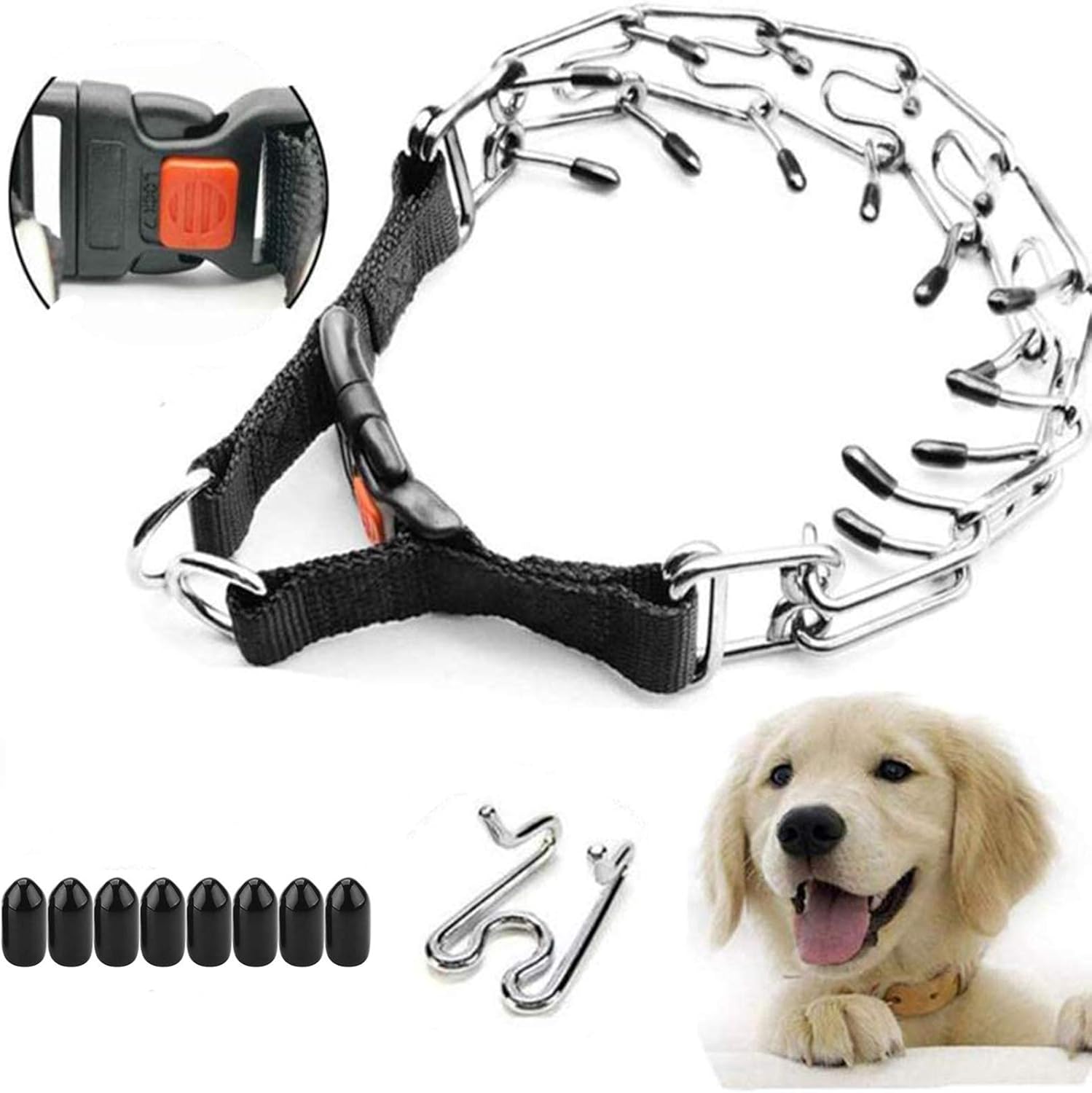
| Material Type | Stainless Steel |
|---|---|
| Included Components | Links, Rubber Caps |
| Closure Type | Buckle |
| Size | M (Neck: 16"–18'') |
The Supet prong training collar is a metal-link pinch collar meant for short, supervised training sessions and daily walks to reduce pulling and improve leash communication. It fastens with a quick-release plastic buckle and uses interlocking chrome-plated links that can be removed or added to fine-tune fit; rubber caps cover the contact points for a gentler feel and can be removed if a firmer correction is needed. Use it high on the neck, just below the ears and under the jaw, for brief cueing rather than continuous wear. Practical benefits include clear, consistent feedback to the dog, durable stainless steel construction, and included extra links so the collar can be adjusted across several neck sizes. Limitations are that pinch-style collars require careful, experienced handling and supervision, and the plastic quick-release buckle, while convenient, is less robust than an all-metal closure. This collar is best treated as a training tool used intermittently rather than an everyday fastening collar.
Best for: Buyers who want an adjustable prong-style training tool that can be finely sized for different necks and used for short, supervised leash training sessions.
Less Ideal for: Owners looking for a daily, hands-off collar solution or users unfamiliar with safe prong collar handling should consider alternative no-pull harnesses or consult a trainer first.
- Adjustable metal links allow precise sizing by adding or removing links
- Rubber caps on contact points reduce sharpness for gentler guidance
- Includes extra links to fit a range of neck sizes
- Chrome-plated stainless steel construction offers strength and corrosion resistance
- Quick-release buckle makes putting on and removing the collar fast and convenient
- Plastic quick-release buckle is less durable than an all-metal closure
- Not intended for unsupervised or continuous wear and demands correct handling
Verdict: The best adjustable prong collar makes precise fitting simple, so owners can achieve a secure, comfortable fit across a range of neck sizes for safer training.
STEHEALTH Dog Prong Collar 3.0mm
Best Stainless‑Steel Prong Collar

| Material | Stainless Steel |
|---|---|
| Tip Thickness | 3.0mm |
| Neck Size | 22"-24" |
| Closure Type | Buckle |
This stainless steel prong collar is built for training large dogs and uses rounded prong tips and removable links to adjust fit. In normal use you add or remove links to size the collar, clip the quick-release buckle, and attach a leash to the swivel D-ring for walks or obedience sessions. The stainless steel construction and smooth link finish make it resistant to rust and simple to wipe clean, which is useful if you train outdoors or in humid conditions. Rounded tips and smooth edges reduce the chance of chafing compared with sharper designs, and the quick-release buckle speeds on/off when you need to remove it quickly. Expect effective, consistent corrections when the collar is fitted properly, but it does require correct sizing and handling to be humane and safe; inexperienced users should review sizing guidance and training technique before use. The collar is basic but durable, focused on function rather than extra comfort features.
Best for: Owners who prioritize a durable, rust-resistant metal training collar for outdoor or humid environments and who are comfortable using a prong design as a corrective tool.
Less Ideal for: Pet owners looking for a comfort-first everyday collar, or those unfamiliar with prong collar fitting and correction techniques.
- Stainless steel construction resists rust and holds shape for outdoor use
- Removable links allow fine adjustment for a custom fit
- Rounded prong tips and smooth links reduce potential skin chafing
- Swivel D-ring and quick-release buckle improve leash attachment and speed of removal
- Requires correct sizing and handling to be used safely
- No padded or comfort-focused components for prolonged wear
Verdict: The best stainless-steel prong collar uses rust-resistant metal and solid finishes for long-lasting performance, especially in humid or outdoor conditions.
Kitys Fatch Prong Collar M/L
Best Compact/Portable Prong Collar
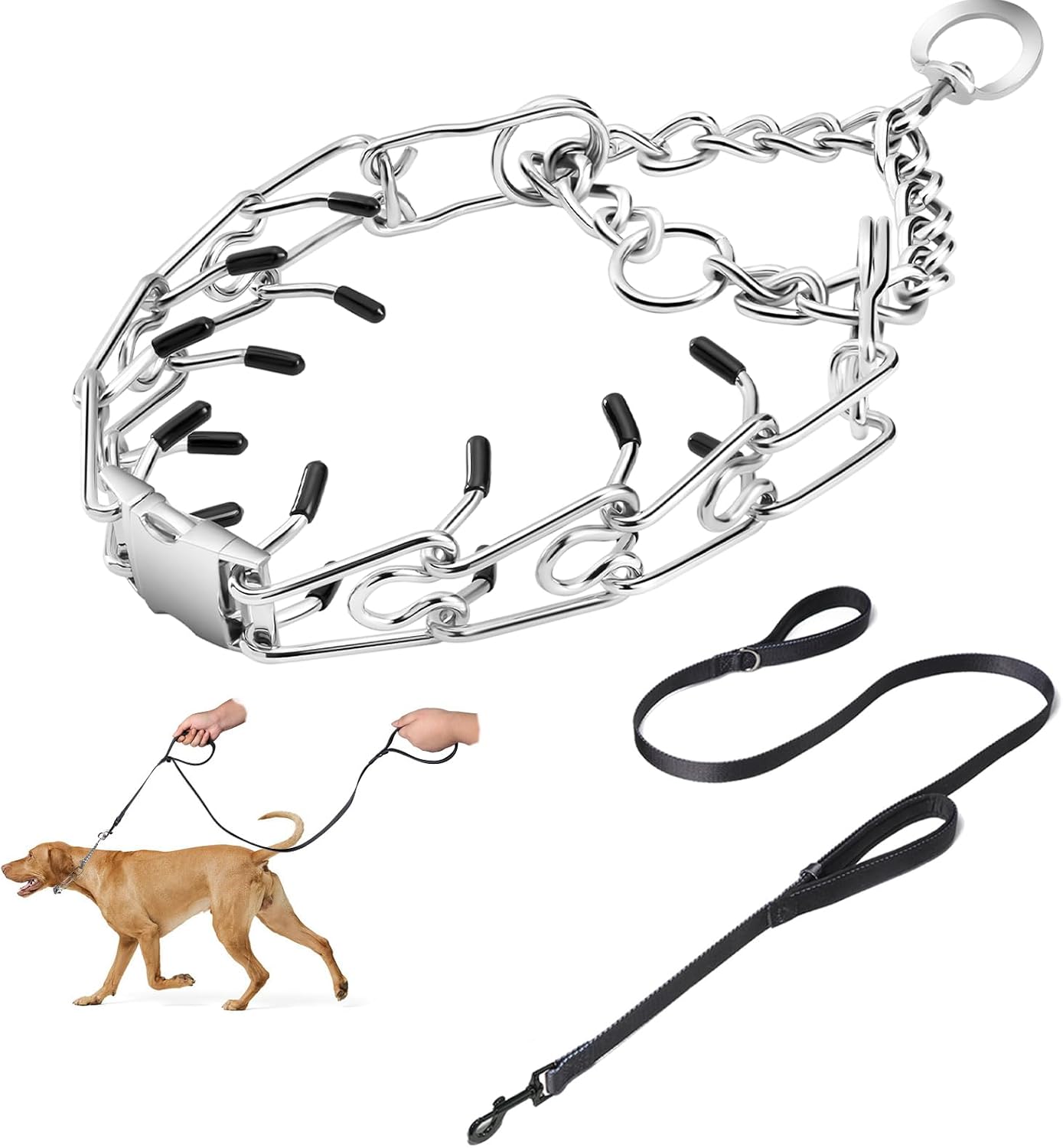
| Material Type | Stainless Steel |
|---|---|
| Size | M/L (Neck: 16"-22", 3mm) |
| Included Components | Professional 5 ft training leash |
This prong collar is a compact, travel-friendly training tool that uses linked stainless steel prongs to deliver quick, uniform reminders when a dog pulls. It ships with a 5 ft professional training leash and a silicone protective cap over the prongs to reduce sharp contact against the neck. The collar uses polished 304 stainless steel and a quick-release fastening clip for rust resistance and easier on/off in the field. Its link design lets you add or remove links to fine-tune fit for neck sizes listed in the M/L range, and the included leash makes it ready to use for classes or short trips. Practical benefits include a small folded footprint for packing, durable metal construction for repeated use, and a smoother polished finish to limit skin pinching. Important limitations are that prong collars require correct fitting and handling to be safe and effective, and some owners prefer positive-reinforcement-only tools; the collar is not a gentle deterrent for every dog or situation and should be used under guidance if you are inexperienced.
Best for: Owners who need a lightweight, easy-to-pack training collar for travel, classes, or occasional field use and who are comfortable applying corrective tools responsibly.
Less Ideal for: People seeking only positive-reinforcement tools or those unwilling to learn proper fit and cue timing should consider alternative headcollars or harnesses instead.
- Compact metal links fold small for easy packing and storage
- Includes a 5 ft professional training leash for immediate use
- 304 stainless steel construction resists rust and holds up to frequent handling
- Silicone protective caps and polished finish reduce direct sharp contact and smoothing of edges
- Requires correct sizing and handling knowledge to avoid misuse
- Not suitable as a standalone solution for dogs that need behavior modification via reward-based methods
Verdict: The best compact prong collar is lightweight and easy to pack or carry, ideal for owners who travel, attend training classes, or need a space-saving option.
Choosing the Right Prong Collar Dog: Key Factors to Consider
Correct Fit and Sizing
Getting the right fit is essential for both safety and effectiveness. A prong collar that is too loose can slide out of position and fail to provide the intended pressure cues, while one that is too tight can place excess force on the neck and increase the risk of injury.
Look for collars with clear sizing charts and multiple adjustment points so you can achieve a snug placement high on the neck behind the ears. Consider whether links can be added or removed without tools and how easy it is to check fit while the dog is relaxed. Proper fit also changes with coat thickness, so allow for seasonal variation and check fit after grooming or weight changes.
Link Construction and Finish
The way prongs and links are made determines how pressure is distributed and how comfortable the collar feels on contact. Smooth, well-finished links reduce the chance of pinching or catching fur while still providing the necessary tactile feedback.
Inspect whether the prongs have rounded tips and whether link joints are free of burrs. Some finishes better resist corrosion and maintain a smooth surface over time. Poorly finished metal or poorly cast links can develop rough edges that irritate skin or compromise function, so construction quality directly affects long-term safety and usability.
Materials and Corrosion Resistance
Materials affect weight, durability, and how the collar stands up to moisture or outdoor use. Stainless steel or nickel-plated steels typically resist rust and require less frequent maintenance, whereas lower-grade metals may discolor or corrode faster.
Consider also the weight of the material relative to your dog's size; heavy metals can be uncomfortable for small dogs, while lightweight alloys may not be sturdy enough for large, strong dogs. Finishes that repel moisture and are easy to wipe clean make regular maintenance simpler and reduce the chance of skin irritation from trapped dirt or sweat.
Ease of Adjustment and Emergency Release
A practical prong collar should be easy to put on, adjust, and remove quickly. Quick detachment matters for safety if a dog becomes entangled or panics, and simple link adjustment helps you fit the collar precisely without tools.
Evaluate whether the closure hardware is intuitive to operate with one hand and whether links can be removed or reattached securely. Some collars use O-rings or carabiner-style clips; others rely on snap links. The method you can operate reliably under stress is the preferable option, especially for owners who may need to release the collar in an emergency.
Comfort and Fur Protection
While prong collars are designed to deliver corrective pressure, minimizing discomfort and protecting the coat and skin should be a priority. Look for designs whose contact surface is broad enough or curved to avoid sharp, focal pressure points.
Consider features such as link shape that follows neck contours and finishes that glide through fur without excessive snagging. Some collars include sleeves or cover options to reduce direct metal-to-skin contact during transitions, which can be helpful for sensitive dogs or those with thin coats.
Instruction and Safety Guidance
A collar is only as safe as the way it is used, so clear manufacturer instructions and recommended usage guidelines are important. Good guidance explains correct placement, how long a collar should be worn, and best practices for combining the collar with positive reinforcement methods.
Prefer options that include clear fitting instructions and basic training tips or links to reputable training resources. Absence of guidance increases the risk of improper use, which is why instruction quality should factor into the purchase decision.
How Should a Prong Collar Be Positioned on My Dog?
Position the collar high on the neck, just behind the ears, where it rests on the widest part of the neck base. This placement uses the neck anatomy to provide the clearest, least intrusive pressure cue when needed.
Make sure the collar sits snugly but not constricting. You should be able to fit one finger between the collar and the neck when the dog is relaxed. Check positioning regularly, especially after activity and grooming.
- High placement gives better control with less force.
- Avoid low placement over the trachea, which can apply focal pressure on the throat.
- Confirm fit after the dog shakes or rolls, as the collar can shift.
Are Prong Collars Humane and Safe to Use?
When used correctly and for short, supervised training sessions, prong collars can provide consistent feedback without causing lasting harm. Safety depends heavily on fit, the handler's technique, and the training context.
They are not intended for continuous wear. Proper training emphasizes short, paired cues with positive reinforcement so the collar becomes a communication tool rather than a punishment device. If you are unsure about technique, seek guidance from a qualified trainer who uses force-reduction approaches.
- Use prong collars only during active training or walks, not as everyday collars.
- Combine use with reward-based teaching for best results.
- Monitor the dog's neck for redness or hair loss and stop use if irritation appears.
How Do I Choose the Right Link Style for My Dog?
Link styles vary in profile and curvature. Low-profile, rounded links tend to distribute pressure more evenly and are less likely to catch fur. Heavier, thicker links may be sturdier for large dogs but can be too heavy for small breeds.
Consider whether you need links that are easy to add or remove without tools, and whether the closure mechanism is secure under tension. A balance between smooth operation and a secure lock is the ideal choice.
- Rounded links for smoother contact and less fur snagging.
- Thicker links for heavy pullers; lighter links for small dogs.
- Tool-free link adjustment is convenient but verify locking security.
What Maintenance Does a Prong Collar Require?
Routine maintenance keeps the collar functioning and minimizes skin irritation risks. Wipe the collar after wet walks and inspect links for bending, corrosion, or burrs. Regularly check the closure mechanism for wear.
Occasional deeper cleaning with a mild soap and water will remove oils and dirt. Dry the collar thoroughly and store it in a dry place to prevent rust. Replace any link or closure that shows deformation or reduced locking reliability.
- Wipe dry after exposure to water or mud.
- Inspect link integrity monthly for active dogs.
- Clean with mild soap; avoid harsh chemicals that strip protective finishes.
When Should I Stop Using a Prong Collar and Seek Alternatives?
Stop use if your dog shows persistent neck soreness, hair loss, or skin lesions in contact areas. Also consider alternatives if the dog reacts with fear, avoidance, or escalating aggression when the collar is applied.
Behavioral goals can often be achieved with force-reduction strategies and specialized training tools when a prong collar is not suitable. If in doubt, consult a qualified trainer or behaviorist who can recommend a step-down plan and safer tools for your dog.
- Cease use immediately if you observe physical irritation.
- Reevaluate if behavior worsens or the dog avoids the handler.
- Seek professional help to transition to gentler methods when needed.
How Do Coat Type and Neck Shape Affect Collar Choice?
Dogs with thick or double coats need collars that do not excessively wedge into fur or cause matting. Low-profile links and smoother finishes are less likely to snag dense coats. For dogs with thin fur or delicate skin, choose rounded, polished links and limit wear time.
Neck shape changes with age and body condition, so measure regularly. A deep-chested dog with a fuller neck may need a different link count than a slim dog of the same breed. Adjustability is important to maintain correct placement across body changes.
- Thick coats benefit from smoother, rounded links.
- Thin-coated dogs need extra care to avoid irritation.
- Measure neck circumference at the intended high-placement point.
How We Chose the Best Prong Collar Dog
We focused on practical, safety-minded criteria that matter for prong collars. Primary filters included build quality, prong and link construction, and materials that affect durability and skin contact. We prioritized collars that allow reliable sizing and adjustability, straightforward removal and attachment, and designs that minimize sharp edges or rough seams. Another key dimension was how well a collar distributes pressure across links rather than concentrating force on a single point. We excluded any products that lacked clear sizing options or had components that could bend or deform easily under normal use. We also set aside collars with ambiguous instructions or that required invasive modifications to fit. Our shortlist emphasizes collars with documented user-adjustment features and clear guidance on safe application. Evaluation criteria used across every pick included link construction and finish, sizing accuracy and adjustability, material durability against rust or corrosion, and user-focused safety features such as rounded link ends and secure closures. We also considered how easily the collar can be removed in an emergency and whether basic maintenance is straightforward.
Our full evaluation process is outlined in our review methodology.
FAQ
Can a prong collar damage my dog's trachea?
A properly fitted prong collar sits high on the neck behind the ears, not over the trachea. When positioned correctly and used for short training sessions, it is designed to avoid focal pressure on the throat. Incorrect placement or constant tight wear increases risk, so fit and supervised use are essential.
How long should a dog wear a prong collar during training?
Limit wear to active training or supervised walks. Sessions should be short and focused, typically a few minutes up to the length of a walk, and not left on between activities. Continuous wear raises the chance of irritation and reduces the training signal's effectiveness.
Are there dogs that should not use a prong collar?
Yes. Puppies with developing necks, dogs with preexisting neck or spinal issues, and dogs with thin or damaged skin may be poor candidates. Also avoid using them on dogs that respond with fear or aggression to collar application. Consult a veterinarian or qualified trainer if you are unsure.
How do I know if the collar is fitted correctly?
A correctly fitted collar sits high behind the ears and is snug without constriction. You should be able to fit one finger between the collar and the neck when the dog is relaxed. Recheck fit after the dog moves, as the collar can shift during activity.
Can I combine prong collar use with positive reinforcement?
Yes. Prong collars work best when paired with reward-based training that reinforces desired behaviors. Use the collar to deliver brief, consistent cues and immediately follow with praise or treats when the dog responds correctly to encourage learning.
What signs indicate the collar is causing harm?
Look for redness, hair loss, open sores, or consistent neck sensitivity when touched. Behavioral signs such as avoidance, flinching, or aggression in response to collar application also signal a problem. If you see these signs, stop use and seek professional advice.
Final Verdict
Choose a prong collar based on fit, construction quality, and how easily you can use it safely. Prioritize collars that allow precise adjustment, have smooth, well-finished links, and include clear guidance on placement and removal. Balance the need for control with the goal of minimizing discomfort by using the collar only during supervised training and combining it with positive reinforcement. When you apply these criteria consistently and monitor your dog's physical and behavioral response, you can select a prong collar that serves as a clear communication tool while keeping safety and welfare at the forefront.

