

Training a puppy with the right collar makes daily lessons easier, safer, and less stressful for both of you. The right training collar helps you communicate clear cues, protects your puppy's neck and skin, and supports consistent behavior work at home and on walks. This guide shortlists the top collars chosen for effectiveness, comfort, and safety so you can focus on progress without guessing which features matter. Below you will find the top picks and a detailed look at the features that impact real-world training. We evaluated fit, adjustability, materials, and control options to arrive at the selections included here.
Top Picks at a Glance
| Best Overall Collar for Training Puppy A top pick that balances control, comfort, and durability | Starmark Pro-Training Collar Small |  |
| Best Budget Collar for Training Puppy A low-cost training collar that still performs reliably | Joytale Martingale Collar M |  |
| Best Premium Collar Higher-end materials and features for long-term performance | Garmin Sport PRO Training Collar |  |
| Best Reflective Collar Improved nighttime visibility and safety for evening outings | ladoogo Reflective Padded Dog Collar Medium |  |
| Best Adjustable Collar Easy-to-fit designs that grow with a puppy's changing size | MOZETO Adjustable Stainless Steel Dog Collar |  |
| Best Lightweight Collar Low-bulk, comfortable collars suited to small or sensitive pups | Jeyihka Small Shock Collar 704sh |  |
Starmark Pro-Training Collar Small
Best Overall Collar for Training Puppy

| Breed Recommendation | Small-medium Breeds |
|---|---|
| Item Type Name | dog training collar |
| Material Type | Polymer |
| Closure Type | Snap |
| Included Components | Safety Clip |
The Starmark Pro-Training Collar is a compact martingale-style training collar made for small dogs that uses high-strength links you add or remove to size the loop precisely. It is intended for supervised training and walking to discourage pulling and lunging by applying gentle, distributed pressure around the neck rather than a hard pinch. Rounded link tips and a humane patented design make corrections less abrupt, and the included safety clip and backup nylon slip collar increase security during sessions. In practice the collar is lightweight and unobtrusive for everyday walks and travel, and the link system makes fitting straightforward without bulky hardware. Limitations include that it is a training tool meant to be used under supervision and should not be left on an unattended dog, and it does not replace a secure everyday buckle collar or harness for dogs that pull strongly or for long off-leash use.
Best for: Owners of small or lightweight dogs who want a low-profile training collar for walks and short supervised training sessions and prioritize a compact, travel-friendly option.
Less Ideal for: People needing a primary everyday restraint for strong pullers, large breeds, or off-leash control should choose a sturdier buckle collar or harness instead.
- Adjustable link system for a precise, low-profile fit
- Patented humane martingale design provides gentler corrections than metal prongs
- Lightweight and compact for travel and everyday wear on small dogs
- Includes safety clip and backup nylon slip collar for added security
- Not intended to be left on an unattended dog and requires supervised use
- Not suitable as the sole restraint for dogs that pull heavily or escape-minded
Verdict: The best overall collar for training a puppy that balances secure control, comfortable fit, durable construction, and ease of daily use for most owners.
Joytale Martingale Collar M
Best Budget Collar for Training Puppy

| Material Type | Nylon |
|---|---|
| Animal Collar Type | Martingale Collar |
| Closure Type | Buckle |
| Size | M |
The Joytale Martingale Collar is a no-slip, adjustable nylon collar built for dogs that pull or back out of standard collars. It uses a cinch-style loop that tightens to provide gentle correction without choking, and a tri-glide slider plus a quick-release buckle lets you fine-tune the fit for growing or oddly shaped necks. Reflective stitching runs around the collar for night visibility and a rust-proof D-ring offers a solid attachment point for leashes or tags. The high-density ripstop nylon is machine washable and designed to resist fading and abrasion on hikes and everyday walks. Expect reliable escape-prevention for sighthounds and other Houdini dogs, though the corrective action is not the same as a harness for heavy pullers and you may need to readjust sizing as your dog moves through growth stages. The collar balances safety, visibility, and easy fit adjustments for routine training and urban outings.
Best for: Buyers who need a collar that is easy to resize and secures dogs that tend to slip out of traditional collars, especially during training or active outdoor use.
Less Ideal for: Owners whose dogs are extremely strong pullers or who need full-body control should consider a dedicated no-pull harness instead.
- Adjustable cinch and tri-glide slider for precise fit adjustments
- Quick-release buckle with secure lock for fast on/off
- Reflective stitching for improved low-light visibility
- Durable high-density ripstop nylon and rust-proof D-ring
- Machine washable and resists fading and abrasion
- Provides gentle correction but is not a substitute for a no-pull harness on very strong pullers
- Sizing may require periodic readjustment for fast-growing dogs
Verdict: The best budget collar for puppy training that delivers dependable fit and basic control features without extra cost or fragile materials.
Garmin Sport PRO Training Collar
Best Premium Collar
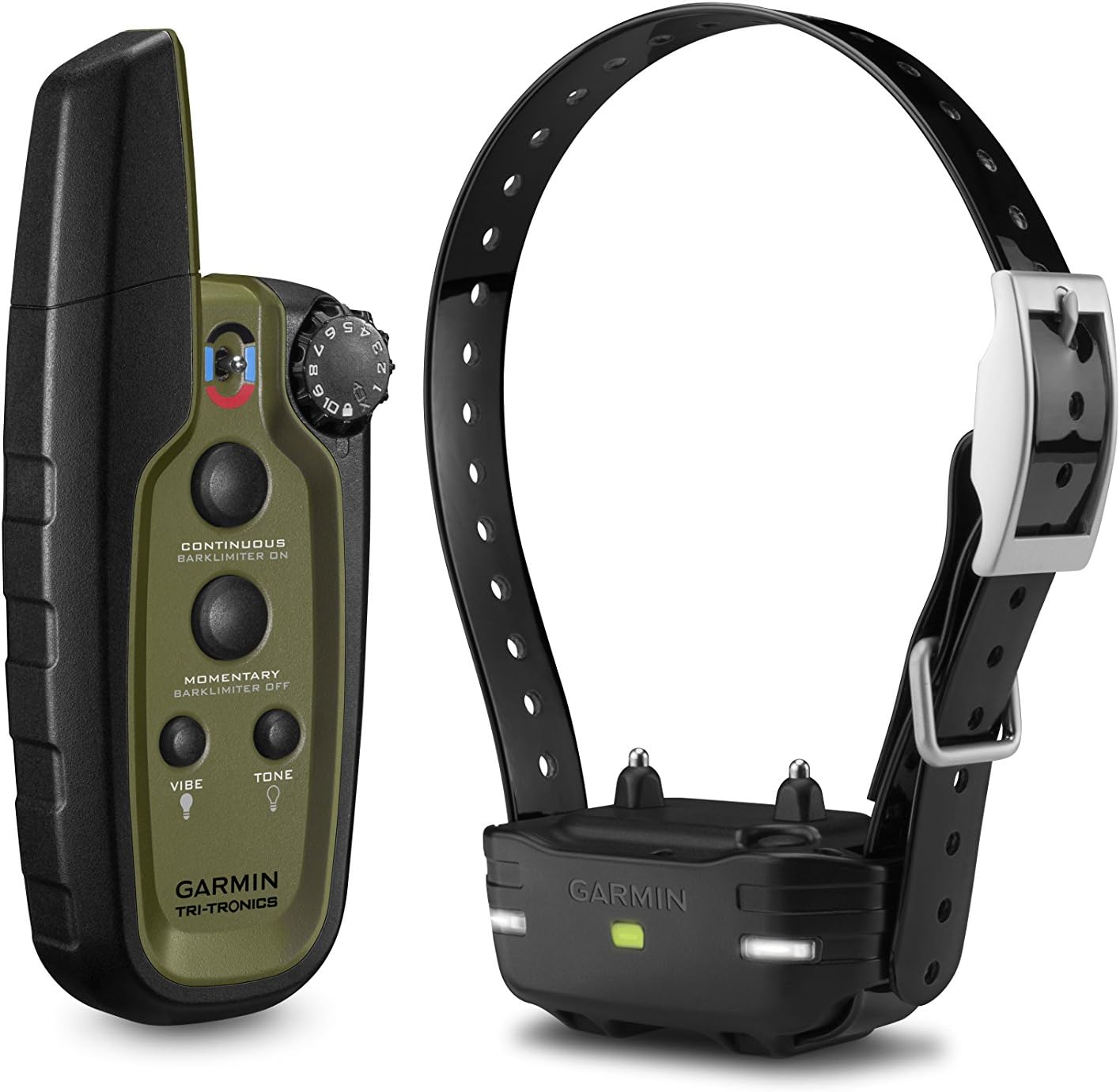
| Range | 3/4 mile |
|---|---|
| Training modes | Tone, Vibration, 10 stimulation levels |
| Dog capacity | Up to 3 dogs |
| Handheld battery life | Up to 60 hours |
| Handheld water rating | IPX7 |
The Garmin Sport PRO bundle pairs a one-handed handheld transmitter with a rechargeable dog device to deliver tone, vibration and 10 levels of static stimulation for training at distances up to three quarters of a mile. The handheld is ergonomically shaped for one-handed, no-look operation and uses a quick-turn dial with positive clicks to step through stimulation levels and auxiliary functions, while four buttons provide momentary and continuous corrections plus vibration and tone. Built-in LED beacon lights help locate a dog in low light and a settable BarkLimiter offers automatic barking control. Both units use rechargeable lithium-ion batteries and the handheld floats, adding practical durability for field use. The dog device accepts long and short stainless steel contact points for wet conditions and the system is rated water-resistant for rugged outdoor use. Limitations include no GPS tracking or advanced smartphone integration and the dog device water rating is lower than the handheld, so fully submerged use is limited.
Best for: Buyers who need a rugged, easy-to-operate remote trainer for active outdoor work and want reliable controls and durable contact hardware for strong, energetic dogs.
Less Ideal for: If you require GPS tracking, smartphone integration, or full waterproofing for underwater use, consider alternatives with those specific features.
- One-handed ergonomic handheld with quick-turn dial for easy level changes
- Up to 3/4 mile range suitable for open-field training
- Rechargeable, user-replaceable lithium-ion batteries for long runtimes
- Interchangeable long and short stainless steel contact points for wet use and durability
- Built-in LED beacon lights and settable BarkLimiter for locating and barking control
- Dog device has lower water rating than the handheld, limiting submerged use
- No GPS location tracking or smartphone app integration
Verdict: The best premium collar for owners who want superior build quality, premium hardware, and lasting comfort that stands up to frequent training sessions.
ladoogo Reflective Padded Dog Collar Medium
Best Reflective Collar

| Size | Medium |
|---|---|
| Material Type | Metal, Neoprene, Nylon |
| Closure Type | Buckle |
| Included Components | Dog Leash |
| Breed Recommendation | Medium Breeds |
This ladoogo collar pairs a soft neoprene padded lining with durable nylon webbing and a metal D-ring to serve as an everyday collar for medium dogs. It is intended for walks and general wear, offering reflective stitching that boosts visibility in low light and a quick-release buckle for fast on/off. The padding keeps the collar comfortable on longer walks and reduces rubbing on active breeds like Australian Shepherds, while the rust-resistant metal hardware stands up to outdoor use. The package also includes a 5 ft leash with a foam handle and tangle-resistant hook, so you get a ready-to-go walking setup. Limitations: the buckle-style closure and single-width design mean it functions as a basic collar rather than a training or no-pull solution, and sizing depends on the medium fit so measure your dog's neck for a secure fit. Machine-washable materials make cleaning easy after muddy outings but heavy chewers may wear the nylon faster than purpose-built chew-resistant collars.
Best for: Owners who walk their Australian Shepherds in early morning or evening and want a more comfortable, visible everyday collar for regular walks and outdoor play.
Less Ideal for: Owners seeking a training, no-pull, or heavy-duty chew-resistant collar should look at specialized training harnesses or reinforced collars instead.
- Soft neoprene padding for added comfort during long walks
- Reflective threads for improved low-light visibility
- Durable nylon webbing with rust-resistant metal D-ring
- Quick-release buckle for easy on and off
- Includes a 5 ft leash with foam handle for immediate use
- Basic buckle collar design is not suited for no-pull control or training
- Medium size requires checking measurements for a proper fit
Verdict: The best reflective collar for owners who train or walk puppies in low light and need enhanced visibility without compromising fit or comfort.
MOZETO Adjustable Stainless Steel Dog Collar
Best Adjustable Collar
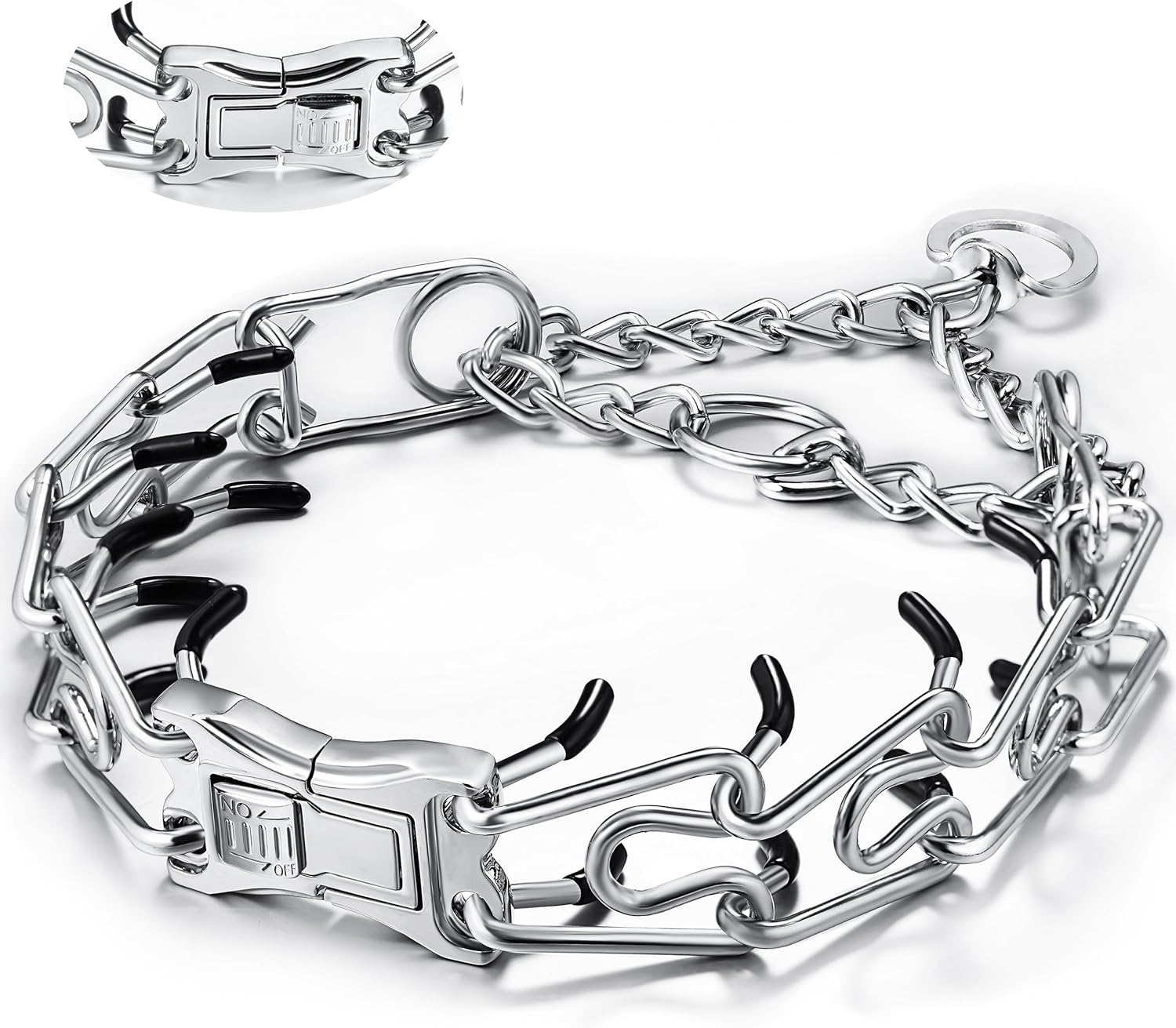
| Size | Neck Girth 16.9"-22.2" |
|---|---|
| Closure Type | Buckle |
| Material | Stainless steel (chrome-plated) |
This MOZETO adjustable pinch-style training collar is built from chrome-plated stainless steel links with rubber tips and a quick-release front buckle to apply a gentle corrective cue during walks and training sessions. It is typically used for leash training and correcting pulling or nuisance barking by imitating the natural correction mother dogs give puppies, and the included extra link lets you fine-tune fit as a puppy grows. The stainless construction and rubber covers make the collar rust-resistant and more comfortable against the skin than bare metal, while the rounded heads and smooth edges reduce the chance of pinching. The front quick-release buckle speeds leash attachment and removal compared with threaded pinch collars. Trade-offs are that this is a training-style pinch collar rather than a flat everyday collar, so it requires proper fitting and supervised use and may not be suitable for continuous wear or very young fragile puppies. Expect useful adjustability for growing necks but plan to transition to a regular flat collar once basic leash manners are established.
Best for: Buyers teaching leash manners who need a training collar that can be adjusted frequently as a puppy’s neck grows and that provides quick on-off access during supervised sessions.
Less Ideal for: Owners who want a daily-wear flat collar, very small or fragile puppies, or anyone uncomfortable with pinch-style correction should choose a different collar type.
- Adjustable metal link design lets you add or remove links for a closer fit as a puppy grows
- Quick-release front buckle simplifies attaching and removing the leash during training sessions
- Rubber-covered link heads and rounded edges reduce discomfort and lower the risk of pinching
- Chrome-plated stainless steel construction is rust-resistant and durable for outdoor use
- Not intended for constant wear; designed for training sessions under supervision
- Requires correct sizing and fitting knowledge to be safe and effective
Verdict: The best adjustable collar for puppies whose neck size is rapidly changing, offering secure fit adjustments and consistent control as they grow.
Jeyihka Small Shock Collar 704sh
Best Lightweight Collar

| Breed Recommendation | Small |
|---|---|
| Included Components | Remote Control |
| Range | 2000 ft |
| Water Resistance (Receiver) | IPX7 |
| Power | USB rechargeable |
This compact Jeyihka 704sh training collar is built for small dogs and travel use, pairing a tiny, lightweight receiver with a handheld remote. It provides beep, vibration and adjustable static stimulation across 0–99 levels plus a light mode, so you can escalate corrections gradually during sessions. The unit supports two receivers on one remote for training two dogs and claims a 2000 ft range for off-leash recall or boundary work. The receiver is IPX7 waterproof so it withstands wet conditions, while the remote is splash resistant and includes a built-in flashlight and a one-click safety lock to prevent accidental pulses. Battery life is strong for this class with fast USB charging and long standby times for both devices. Important limits are the collar sizing and intended breed focus: it is targeted at small dogs and the tiny receiver may not suit larger or heavy-chewing dogs, and the remote is not fully waterproof. Training benefits depend on responsible, graduated use of the adjustable levels rather than relying on high static settings.
Best for: Owners of small-breed dogs who need a travel-friendly, lightweight training collar that prioritizes adjustable, safety-focused correction options and easy outdoor use.
Less Ideal for: People with large or heavy-chewing dogs or owners who need a fully waterproof remote for frequent water exposure should consider more robust alternatives.
- Extremely lightweight and compact receiver suitable for small breeds
- Multiple correction modes (beep, vibration, static) with precise 0–99 level adjustment
- IPX7 waterproof receiver for use in rain or near water
- 2000 ft claimed range and dual-channel remote for training two dogs
- Fast USB charging and long standby battery life for remote and receiver
- Remote is only splash-proof rather than fully waterproof
- Receiver may be too small or fragile for larger or very active chewers
Verdict: The best lightweight collar for puppies that need minimal bulk and maximal comfort during training, reducing irritation while maintaining basic control.
Choosing the Right Collar Training Puppy: Key Factors to Consider
Fit and Adjustability
A proper fit is the single most important factor for a puppy training collar. Puppies grow quickly and have different neck shapes, so a collar that adjusts across a wide range keeps it comfortable and effective over several months. Too loose causes slipping and loss of control; too tight risks chafing, restricted breathing, and stress.
Look for collars with marked size ranges and multiple adjustment points. Sliding adjusters and extra-length webbing are helpful for temporary growth spurts. If the collar will be used for leash work, ensure there is room for two fingers between the collar and the puppy's neck when adjusted for daily wear. Regularly recheck fit as the puppy grows.
Material and Skin Comfort
Material choice affects both durability and how the collar feels against a puppy's skin and coat. Soft, tightly woven nylon and cotton blends resist rubbing, while padded or neoprene-backed collars reduce pressure on the throat during short corrections or leash tension. Stiff materials can cause fur wear or hotspots on sensitive skin.
Also consider breathability and ease of cleaning. Puppies play in dirt and water, so materials that dry quickly and can be wiped or machine-washed maintain hygiene and reduce odor. Avoid rough edges or exposed seams that could irritate developing skin.
Closure and Safety Features
Closure type determines how quickly you can put on or remove the collar and how secure it stays. Quick-release buckles are convenient for everyday use and emergency removal, while metal buckles offer higher security but may be slower to open. For very young puppies or unsupervised wear, breakaway options can reduce strangulation risk but may not be appropriate when secure leash attachment is needed.
Examine the strength of any hardware, stitch reinforcement at stress points, and whether the collar includes redundant safety features such as secondary loops for tags. Safety features should match how you plan to use the collar: supervised training sessions require different priorities than continuous home wear.
Control Style and Training Compatibility
Different collars provide different kinds of control. Flat collars offer gentle steady guidance, martingale-style designs reduce slipping without full choke action, and specialized training collars provide graduated cues. Choose a style that complements your training method and the puppy's temperament. Gentle, incremental control is better for young dogs and for methods based on positive reinforcement.
Consider whether the collar allows clear, consistent signals that you can pair with treats and praise. Overly abrupt or unpredictable corrections confuse puppies and slow learning. Match the control style to the handler's experience and the puppy's size and sensitivity.
Hardware and Leash Attachment Points
Strong, well-placed attachment hardware is essential for safe leash work. A D-ring positioned so the leash pulls evenly helps avoid twisting and uneven pressure on the neck. Reinforced stitching around attachment points prevents sudden failures during energetic pulls or play.
Consider whether the collar offers multiple attachment points for different training exercises, and whether the hardware is rust-resistant for outdoor use. Lightweight metal or high-strength polymer rings strike different balances between durability and overall collar weight, which matters for very small puppies.
Weight and Balance
Collar weight affects comfort, especially for small or toy-breed puppies. Heavy buckles, thick hardware, or multiple attachments can make a collar feel bulky and interfere with natural head movement. Lighter collars reduce fatigue and make wearing the collar for longer periods more tolerable.
Balance is also important: distributed padding and low-profile fittings keep the collar from sliding to one side, and a centered D-ring prevents awkward leash angles. For puppies still growing into their proportions, prioritize lightweight designs that still meet durability needs.
How Tight Should a Puppy Training Collar Be?
A training collar should fit snugly enough that it cannot slip over the puppy's head but loose enough to allow comfortable breathing and swallowing. A common practical check is to slide two fingers between the collar and the neck; this ensures the fit is not overly restrictive while remaining secure.
Recheck the fit after active play and again after each growth phase. If you feel resistance when sliding two fingers in, loosen the collar slightly. Conversely, if you can fit three or more fingers easily, the collar may be too loose for effective leash guidance.
- Perform the two-finger test daily during growth spurts
- Adjust before and after longer training sessions
- Mark adjustment positions to return to a known safe fit
When Should You Switch Collar Styles as Your Puppy Grows?
Switch collar styles when the current option no longer meets training needs or when the puppy's size or behavior changes. For example, very young puppies often do best with soft flat collars for identification and gentle guidance. As their strength and responsiveness increase, you may move to a collar that offers more control or specific training features.
Transition gradually and monitor how the puppy responds. Keep training cues and rewards consistent so the new collar does not confuse the dog. If the puppy shows signs of discomfort, return to the previous style while adjusting fit and technique.
- Move to more structured control as leash skills improve
- Avoid sudden changes during important behavioral training phases
- Use the change as an opportunity to retrain basic leash manners
Are Training Collars Safe for Very Young Puppies?
Training collars can be safe for young puppies when used appropriately. The priority is to use the gentlest effective option and focus on short, positive training sessions. Harsh corrections or heavy choke-style actions are unnecessary and can harm a developing neck.
Supervise puppy wear and limit training collar use to active sessions rather than continuous wearing. For unsupervised time, a soft flat collar or breakaway design may be safer, depending on whether you need secure leash attachment.
- Prefer short, reward-based sessions for puppies under four months
- Avoid high-tension corrections on delicate necks
- Check skin and coat regularly for irritation
How to Care for a Puppy Training Collar
Regular cleaning extends the life of the collar and prevents skin problems. Wipe down nylon or fabric collars after muddy outings and launder removable padding according to care instructions. Metal hardware can be dried and wiped with a light lubricant if it begins to stiffen.
Inspect the collar often for signs of wear: fraying webbing, loose stitching, or bent hardware can indicate it is time to replace the item. Rotate collars if you use one for training and another for everyday identification to balance wear.
- Spot-clean daily, machine-wash occasionally if allowed
- Air-dry to prevent deformation of padding
- Inspect hardware and stitching monthly
How to Introduce a New Collar to a Puppy
Introduce a new collar slowly and positively. Let the puppy sniff the collar, then put it on for short periods while offering treats and praise. Gradually increase the wear time as the puppy remains relaxed. Pair initial sessions with familiar, low-pressure activities such as feeding or gentle play.
Avoid using a new collar for the first intense training session. Instead, let the puppy become comfortable wearing it so that the collar itself does not trigger anxiety or distract from learning.
- Use treats and calm praise during the first fittings
- Keep initial wear sessions under 10 minutes
- Combine collar introduction with a favorite routine
How We Chose the Best Collar Training Puppy
Our selection process focused on the features that consistently matter when training young dogs. We prioritized collars that allow precise, predictable cues while minimizing discomfort or injury risk. Key evaluation points included fit range and adjustability to suit rapidly changing puppy sizes; material durability and skin-friendly construction to prevent irritation during daily wear; and control options that match common positive-reinforcement training methods. We also examined safety-focused details such as breakaway or quick-release mechanisms where appropriate, hardware quality for secure attachment of leashes and ID tags, and ease of cleaning for items that see frequent outdoor use. Usability was another filter: collars had to be straightforward to put on and adjust, with clear sizing guidance. Excluded from consideration were collars intended for aversive or punitive use only, products with poor build quality, and items lacking clear sizing information. The final list represents collars that balance humane handling, practical adjustability, and reliable construction for puppy training.
Our full evaluation process is outlined in our review methodology.
FAQ
How often should I check a puppy's collar fit?
Check fit daily during rapid growth phases and at least weekly once growth slows. Adjust whenever you notice slipping, chafing, or if the puppy gains weight.
Can a puppy wear a training collar all day?
It depends on the collar type and purpose. For supervised training sessions short wear is fine, but continuous all-day use is not recommended for collars that apply pressure. For identification, a separate soft collar is usually better for extended wear.
What collar material is best for puppies with sensitive skin?
Soft, padded materials and tightly woven natural blends tend to be gentler on sensitive skin. Avoid rough or stiff webbing and check regularly for redness or hair loss where the collar contacts the neck.
Is a breakaway collar safer for young puppies?
Breakaway collars reduce entanglement risk during unsupervised time, but they may not be suitable when a secure leash attachment is needed. Choose breakaway designs for home wear and use a separate secure collar for walks if required.
When should I replace a training collar?
Replace the collar if you see frayed webbing, damaged hardware, or if the fit no longer reaches a safe adjustment range. Regular inspection prevents sudden failures during training or walks.
Final Verdict
Prioritize fit, comfort, and safety when choosing a collar for training a puppy. A well-adjusted, lightweight collar that matches your training style makes cues clearer and reduces the chance of irritation or injury. Balance control needs with gentle methods: choose collars that provide consistent, predictable signals rather than abrupt force. Ultimately, pick the collar that fits the puppy now with room to adjust, supports the kind of training you plan to do, and is built for regular use. Focus on gradual progress and monitoring comfort to make confident training choices.

