

If you care for two or more dogs, consistent portions and reliable schedules matter for behavior, digestion, and weight management. An automatic feeder designed for multiple dogs can simplify daily routines, reduce mealtime conflicts, and help you stick to portion plans even when your schedule changes. This guide shortlists the top automatic feeders suited for households with multiple dogs and explains the features that matter most for multi-dog feeding scenarios. Below you will find our top picks followed by practical buying guidance and answers to common questions to help you choose the right feeder for your home.
Top Picks at a Glance
| Best Overall Automatic Feeder for Multiple Dogs A dependable all-around feeder built for multi-dog households | PETKIT Automatic Pet Feeder YUMSHARE DUAL-HOPPER |  |
| Best Premium Automatic Feeder High-end features, advanced programming, and superior build quality | PiCOOP 35L Automatic Dog Feeder |  |
| Best Large-Capacity Automatic Feeder Bigger hopper and bowls to serve multiple or large dogs longer | Gwozn Automatic Dog Feeder 30L |  |
| Best Programmable Automatic Feeder Flexible scheduling and precise portion control for complex feeding plans | ChiPak 16L Automatic Dog Feeder |  |
| Best Durable Automatic Feeder Rugged construction and reliable mechanics for heavy daily use | Pet Lodge Chow Hound Feeder 25 lb |  |
PETKIT Automatic Pet Feeder YUMSHARE DUAL-HOPPER
Best Overall Automatic Feeder for Multiple Dogs
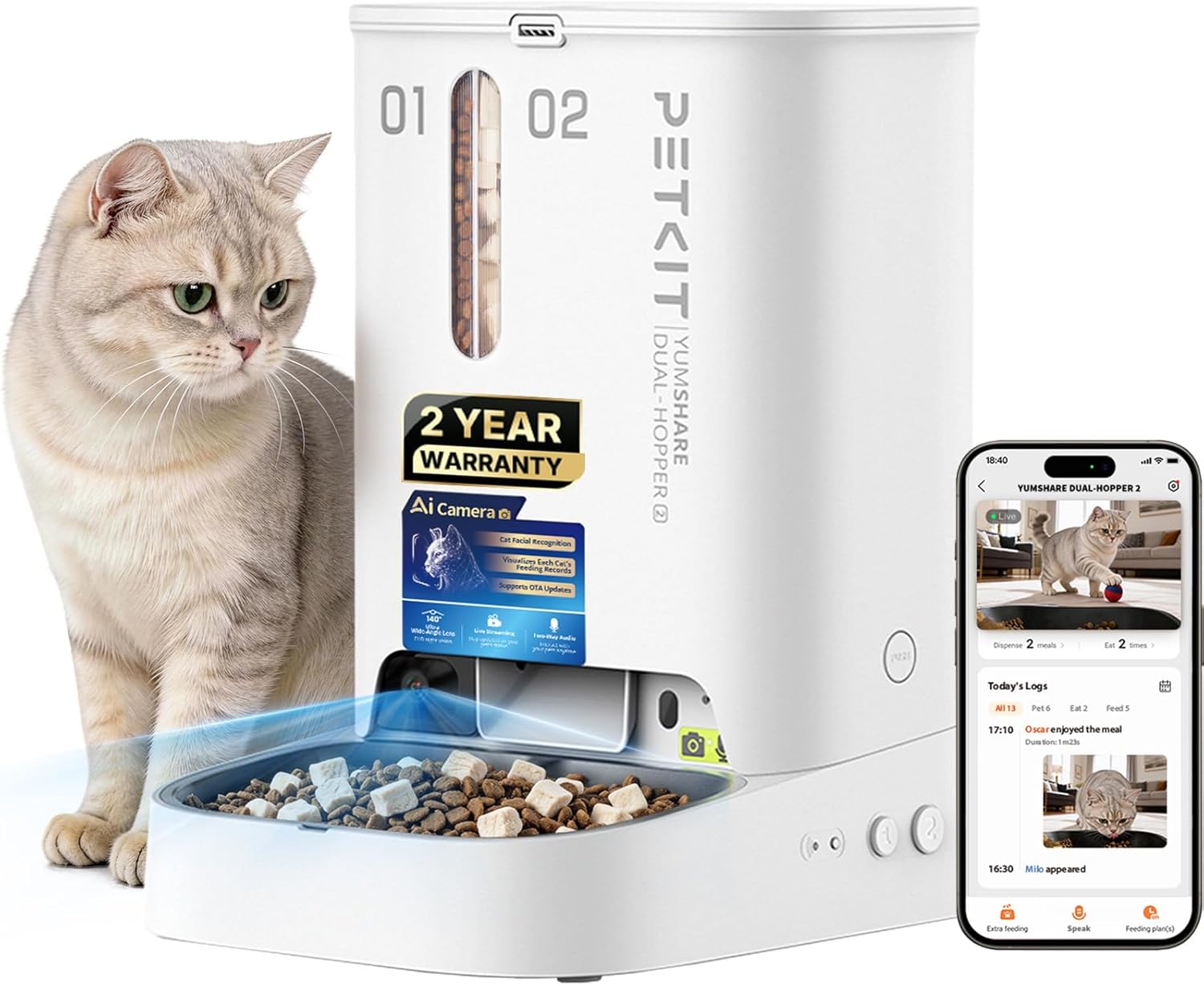
| Capacity | 5 liters |
|---|---|
| Camera resolution | 1080P HD |
| Connectivity | WiFi (2.4G & 5GHz) |
| Power source | Corded electric and battery backup |
The PETKIT YUMSHARE Dual-Hopper feeder is a smart automatic feeder designed for multi-pet homes that need reliable scheduled portions and remote monitoring. It dispenses measured portions (1–5 portions per feeding) from two fully separated compartments so you can run independent meal plans or keep prescription/freeze-dried foods separate. Setup uses the PETKIT app over 2.4GHz or 5GHz Wi‑Fi to schedule feedings, record personalized meal calls, and receive alerts for low food or power events. The built-in 1080p camera with night vision and two-way audio lets you check who is at the bowl and save clips to cloud storage if desired. Practical touches include a 5L capacity (enough for weeks for a single pet), four-layer fresh-lock sealing, a nonstick stainless bowl for easy cleaning, and a battery backup so the schedule continues during outages. Limitations to note: although the dual hopper and AI recognition support multiple pets, portion sizes are oriented toward dry kibble and very large-breed dogs may require larger single portions or a different high-capacity unit; cloud services for video may require subscription. For everyday multi-dog feeding where separate foods and remote monitoring matter, this feeder offers a strong, feature-rich solution.
Best for: Buyers who need a dependable everyday feeder for households with multiple dogs and who value separated food compartments, remote scheduling, and camera monitoring to ensure each pet gets the right meal.
Less Ideal for: Owners who need very large single-meal portions for giant breeds or who prefer a purely offline mechanical feeder without app or camera features.
- Dual separated hoppers let you serve two different foods or separate regular and prescription diets
- 1080p camera with night vision and two-way audio for remote monitoring and interaction
- App scheduling over 2.4G/5GHz Wi‑Fi with portion control and pop-up notifications
- 5L capacity and four-layer fresh-lock system keep food dry and reduce refill frequency
- Battery backup and dual power options maintain feeding schedule during outages
- Portion sizes and dispenser are optimized for dry kibble and may not suit very large-breed dogs needing bigger single meals
- Cloud video storage and some camera features may require a paid subscription
Verdict: The best overall automatic feeder for multiple dogs that balances reliable multi-portion scheduling, easy programming, decent capacity, and consistent portion control for everyday use.
PiCOOP 35L Automatic Dog Feeder
Best Premium Automatic Feeder

| Capacity | 35 liters |
|---|---|
| Material | Stainless steels |
| Power | Plug in |
| Timer Function | Supports 4 timed feeding groups |
The PiCOOP 35L Automatic Dog Feeder is built for owners who need a large-capacity, low-maintenance dispenser for big-breed dogs or multiple pets. It holds 35 liters of dry food in an all-stainless steel hopper with an anti-rodent mesh and dispenses on a timer in four programmable groups while also allowing manual feedings. The oversized tray and a water outlet keep kibble drier and reduce the frequency of refills, and the wall-mountable design saves floor space and resists being tipped by active animals. Setup and daily use are straightforward, though portions are divided evenly by the mechanism so you cannot vary one portion relative to another. Power-off memory is supported by a CR1220 battery, but if that fails you will need to replace the battery to retain schedule memory. The unit favors durability and capacity over fine-grained portion customization, making it a practical choice for multi-pet households and large dogs that eat generous servings.
Best for: Owners of large-breed dogs or multi-pet households who prioritize a high-capacity, durable feeder that minimizes refills and resists tipping.
Less Ideal for: People who need highly variable portion sizes per meal or precision portion control for weight-managed pets should consider other feeders with adjustable per-meal portioning.
- Very large 35L hopper reduces refill frequency for large dogs or multiple pets
- All-stainless-steel construction and anti-rodent mesh improve hygiene and durability
- Programmable timed feeding with up to four scheduled groups and manual feed option
- Wall-mountable design saves floor space and helps prevent tipping
- Oversized tray with water outlet helps keep food dry and accessible for big-breed pets
- Portions are fixed to equal divisions and cannot be adjusted independently
- Relies on a small backup battery for memory retention if power is lost
Verdict: The best premium automatic feeder for owners who want advanced programming, robust materials, and extras like app control or backup power for the smoothest day-to-day feeding.
Gwozn Automatic Dog Feeder 30L
Best Large-Capacity Automatic Feeder

| Capacity | 126 cups |
|---|---|
| Kibble size supported | 2-23 mm |
| Connectivity | WiFi (2.4/5 GHz) |
| Power source | Corded electric and battery backup |
| Camera | 1080p with night vision |
This Gwozn automatic feeder is designed for large-breed households that want fewer refills and remote monitoring. The 30L (about 126 cups) hopper holds enough dry kibble to cover many dogs for days, and the removable top and lower sections make filling and hand-washing straightforward while keeping the motor housing dry. You can program up to 15 timed feedings via the Wi‑Fi app and use the 1080p camera with night vision and two-way audio to check the bowl and interact with pets from your phone; camera and Wi‑Fi disable on battery backup to preserve power. The unit accepts larger kibble up to 23 mm and includes an anti-clog design to help consistent dispensing. Practical touches include a freshness lock and a drying accessory to protect food, plus three D-cell battery backup for outages. Expect to sacrifice full camera function during battery operation and to rely on dry kibble only, but for busy owners of large or multiple dogs this feeder reduces refill frequency and adds useful remote monitoring features.
Best for: Households with large or multiple dogs that need a high-capacity feeder to stretch time between refills and want remote camera monitoring and scheduling convenience.
Less Ideal for: People who need wet-food compatibility or who require full camera and connectivity during long power outages should consider other solutions.
- Very large 30L/126-cup hopper significantly reduces refill frequency
- 1080p camera with night vision and two-way audio for remote monitoring
- App control with Wi‑Fi scheduling up to 15 feedings per day
- Accepts kibble up to 23 mm and includes an anti-clog dispensing design
- Battery backup keeps scheduled feedings running during power outages
- Camera and Wi‑Fi functions turn off when running on battery backup
Verdict: The best large-capacity automatic feeder for pet owners who need longer intervals between refills and reliable portioning for multiple or large-breed dogs.
ChiPak 16L Automatic Dog Feeder
Best Programmable Automatic Feeder

| Capacity | 16 liters |
|---|---|
| Material Type | Stainless Steel |
| Operation Mode | Automatic |
| Additional Features | Feeding Schedule |
The ChiPak 16L Automatic Dog Feeder is a large-capacity dispenser designed to handle extended feeding for big dogs. It holds 16 liters of dry food and offers four programmable feed times so you can schedule 1 to 4 daily portions and control the dispense duration to suit your dog's appetite. Built from stainless steel, the hopper and parts are corrosion-resistant and meant for longer service than galvanized alternatives, and the unit can be mounted to a wall or used on the floor to fit different homes. It runs on plug-in power and uses an independent control chamber to make it suitable for indoor or sheltered outdoor placement. For buyers seeking a premium option, its sizable capacity and metal construction reduce refill frequency and improve durability, though setup may require wall anchors and the dispenser relies on a timer-based dispense duration rather than weight-based portioning so you may need to calibrate for kibble size and texture. Noise levels are reasonable but not explicitly measured in the specifications.
Best for: Buyers who want a long-lasting, higher-end automatic feeder for large dogs and prioritize a large hopper and durable stainless steel construction over minimal cost.
Less Ideal for: People who need precise weight-based portion control or fully battery-operated placement far from outlets should consider other options.
- Large 16 liter capacity supports multi-day feeding for large breeds
- Stainless steel construction resists rust and is more durable than galvanized feeders
- Programmable 1-4 timed feeding groups for scheduled meals
- Can be wall-mounted or placed on the floor for flexible installation
- Designed with an independent control chamber for indoor or sheltered outdoor use
- Portioning is time-based dispense duration rather than measured by weight, requiring calibration for different kibble types
- Requires plug-in power which may limit placement without a nearby outlet
Verdict: The best programmable automatic feeder for owners who require fine-grained meal timing and portion customization to manage multiple dogs' different dietary needs.
Pet Lodge Chow Hound Feeder 25 lb
Best Durable Automatic Feeder

| Capacity | 25 pounds |
|---|---|
| Power Source | manual |
| Material Type | Metal |
| Operation Mode | automatic |
The Pet Lodge Chow Hound is a heavy-duty, manual-power automatic feeder built from galvanized steel for long life in high-use or outdoor situations. It mounts to a wall or frame and holds up to 25 pounds of dry kibble in a chew-resistant container with a magnetized access door and angled chute that helps regulate flow and keep pests out. Because it is metal and requires no assembly, it is simple to install and easy to clean by hand, and the rugged construction stands up to enthusiastic dogs and rough environments that plastic dispensers struggle with. The mechanism is basic rather than smart, so you will not get timed programming, portion control electronics, or battery/AC operation; instead this feeder relies on gravity and the chute design to deliver food. That makes it extremely reliable and low maintenance, but less flexible for scheduled or measured feeding needs. If you need a straightforward, sturdy dispenser that resists chewing and weather, this model performs well; if you need automated scheduling or precise portions, look elsewhere.
Best for: Buyers who need a rugged, low-maintenance feeder for heavy use or outdoor conditions and prioritize durability and chew resistance over fancy automation.
Less Ideal for: Households that require scheduled, portion-controlled feeding or remote programming should consider an electronic feeder instead.
- Galvanized steel construction for durability and rust resistance
- Large 25 pound capacity reduces refill frequency
- Magnetized door and angled chute help secure food from pests and control flow
- Arrives fully assembled and can be mounted on a wall or frame
- Simple, low-maintenance gravity operation with no electronics to fail
- No programmable timer or portion-control features
- Hand wash only care and metal finish may show wear over time
Verdict: The best durable automatic feeder for households where sturdiness, long-term reliability, and resilience to rough handling or curious pets are top priorities.
Choosing the Right Automatic Dog Feeder Multiple Dog: Key Factors to Consider
Hopper Capacity and Refill Frequency
Larger hoppers reduce the need to refill when you have multiple dogs. Capacity matters because small bins can force daily refills that undermine the convenience of automation. Consider how much dry food your dogs eat per day and choose a capacity that covers at least several days of feeding to minimize maintenance.
Also think about food shape and density. Some feeders handle kibbles more efficiently than others, so a larger capacity is only useful if the dispenser reliably moves the food. If you travel frequently or have variable feeding patterns, prioritize a combination of high capacity and consistent dispensing.
Portion Control and Dispensing Accuracy
Precise portion control helps manage weight and maintain consistent nutrition for every dog. Look for feeders that allow small, repeatable portion increments and that test for actual dispensing accuracy. In multi-dog settings, slight overdispensing compounds quickly across pets and meals, so tighter tolerances are valuable.
Also review how the feeder measures portions: volume-based hoppers can vary with kibble size, while weight-based dispensers tend to be more accurate. Choose the method that suits your dogs' diets and your tolerance for manual calibration.
Programming Flexibility and Scheduling
Multi-dog feeding often requires staggered meals, multiple daily feedings, or feeding different portion sizes for each pet. A feeder with flexible scheduling that supports several meals per day and fine-grained timing makes it easier to match each pet's routine. Look for intuitive programming interfaces or companion apps that let you set meal times quickly.
Additional useful options include randomization or gradual dispensing to prevent resource guarding, and the ability to cancel or delay a meal remotely. For households where one dog needs to eat separately, consider how the schedule interacts with access control features.
Access Control and Anti-hogging Features
When multiple dogs share a feeding area, dominant pets can eat more than their share. Anti-hogging features such as locking compartments, dog-specific access tags, or slow-release dispensers help ensure fair distribution. Consider whether the feeder can be integrated with microchip readers or RFID tags to limit access to the correct animal.
If technology-based access control is not required, look for physical designs that create separate bowls or that make it harder for one dog to eat another's meal. Placement strategies also help, but an integrated anti-hogging system provides the most reliable outcome.
Power Options, Battery Backup, and Reliability
Power interruptions have a greater impact in multi-dog homes because missed meals affect multiple animals. Choose feeders that offer reliable mains power with a battery backup or models that run on batteries with long life. Check how the unit behaves during power loss: does it retain settings, queue missed meals, or require manual reset?
Also consider build quality and user feedback on long-term reliability. Frequent mechanical failures or jamming are especially disruptive when feeding multiple dogs, so prioritize robustness and simple maintenance.
Cleaning, Maintenance, and Food Compatibility
Frequent use increases the need for easy cleaning and straightforward maintenance. Look for hoppers and bowls that are dishwasher-safe or have wide openings for quick hand washing. Removable components make it easier to inspect for jams and to switch foods if dietary needs change.
Food compatibility matters because wet mixes, irregular kibble shapes, or treats can jam some dispensers. Verify the feeder supports the type and size of kibble your dogs eat and whether any special cleaning steps are required for oily or flavored formulas.
How Can I Make Separate Meals for Two Dogs with One Feeder?
It is possible to manage separate meals using a single programmable feeder by scheduling distinct portions at different times. Program the feeder to release the first dog's portions at one time and the second dog's portions shortly after, placing bowls in separate areas to reduce conflict.
If the feeder supports portion locking or timed compartment releases, use those features to ensure each dog gets just their share. When using staggered schedules, test the timing a few days to confirm both dogs respond and to adjust placement to prevent one dog from reaching both bowls.
- Place bowls apart or in different rooms to discourage scavenging.
- Use staggered release times with a short buffer to avoid overlap.
- Consider an anti-hogging gate or barrier during feeding times if needed.
Will Different Kibble Sizes Cause Dispensing Problems?
Kibble size and shape directly affect how smoothly a feeder dispenses. Narrow, uniform kibbles flow more consistently than large or irregular pieces. If your dogs eat different kibbles, choose a feeder known for wide compatibility or one with adjustable portion settings.
Some feeders allow you to test dispensing behavior with small trial portions. Run a few tests with the actual food you use to confirm reliability before relying on the feeder for unattended meals.
- Test with the real kibble to verify consistent dispensing.
- Adjust portion increments if the feeder measures by volume rather than weight.
- Choose hoppers with agitation or anti-bridge designs to reduce clogs.
How Do I Prevent One Dog From Eating the Other's Food?
Physical separation is the simplest tactic: place bowls in locations the other dog cannot easily access. If that is not feasible, use anti-hogging features like microchip or RFID access that only open the bowl for the intended dog. Another approach is to feed dogs in separate rooms for a short time until they learn their own schedule.
Training can complement equipment. Reinforce sit-and-wait behavior before activating the feeder so both dogs learn to wait for their cue. Combining behavioral training with mechanical access control gives the most reliable results.
- Use gates or barriers for temporary separation.
- Employ access tags if your feeder supports them.
- Train consistent pre-feeding cues to reduce scramble behavior.
What Maintenance Schedule Keeps a Feeder Working Well?
Perform a quick visual check daily to confirm the hopper has food and sensors are unobstructed. Empty and wash removable parts weekly or more often if food is oily or prone to sticking. Inspect dispensing components for wear every month, especially in high-use multi-dog households.
Keep dust and residue out of sensors and electrical contacts, and replace batteries proactively if the unit runs on battery power. Regular maintenance prevents jamming and extends the life of the feeder.
- Daily: check food level and clear obvious blockages.
- Weekly: wash bowls and removable hopper pieces.
- Monthly: inspect motors, seals, and any access-control tags.
Is a Smart App Necessary for Multi-dog Feeding?
A companion app can be helpful but is not strictly necessary. Apps simplify scheduling, let you monitor feeding history, and can send alerts for missed meals. They are especially useful when you manage multiple pets remotely or need to adjust portions often.
If you prefer minimal tech, choose a unit with an intuitive local interface that supports the scheduling and portion control you require. For households that value remote alerts and detailed logs, app-enabled feeders add convenience.
- Use app features to review meal history and detect missed feedings.
- Ensure the app supports multiple user permissions if several caregivers feed the dogs.
- Consider privacy and network reliability when relying on app features.
How to Set Up a Feeder for Travel or Temporary Absence
When you will be away, test the feeder for several days beforehand to confirm schedules and portions work reliably. Top up the hopper to cover the entire absence and enable any battery backup. Ask a neighbor to check in on the first day if the feeder has not been used for a long period.
Leave clear feeding instructions and contingency plans for caregivers, and program slightly conservative portions if you are unsure how pets will respond while you are gone. Avoid changing diets or feeding patterns immediately before travel to reduce digestive upset.
- Run a full-day simulation before departure.
- Top up hopper and check battery backup.
- Provide a contact person and simple troubleshooting notes for caregivers.
How We Chose the Best Automatic Dog Feeder Multiple Dog
We prioritized features that directly affect performance in multi-dog households. Key evaluation criteria included hopper capacity and refill frequency so the feeder can cover multiple meals; feeding accuracy and portion size granularity that prevent overfeeding or underfeeding each dog; programmable schedules and multi-meal programming to support staggered or shared feeding times; durable materials and easy-to-clean design for frequent use; and anti-jamming mechanisms and reliable dispensing to avoid missed meals. We also considered power options and battery backup for uninterrupted operation during outages, and whether the feeder supports portion locking or dog-specific access methods to reduce hogging. We excluded units intended only for single small-dog use or devices lacking clear portion control. Products that required extensive manual intervention or frequent refills relative to typical multi-dog needs were not considered. The final list reflects a balance of real-world usability, durability, and functional features that matter most when feeding more than one dog.
Our full evaluation process is outlined in our review methodology.
FAQ
Can one automatic feeder serve two dogs reliably?
Often yes. With careful scheduling, proper portion settings, and physical separation or access control, one feeder can handle two dogs reliably. Success depends on the dogs' behavior, the feeder's dispensing accuracy, and whether anti-hogging measures are in place.
How do I handle different calorie needs for each dog?
Program different portion sizes and staggered meal times to match each dog's caloric requirements. If the feeder cannot distinguish between animals, use separate bowls placed apart or feed the higher-need dog first and the other shortly after while supervising to prevent grabbing.
Will a power outage stop scheduled feedings?
It depends on the model's power design. Feeders with battery backup retain schedules and can continue dispensing during outages, while mains-only units will stop. Choose a feeder with reliable backup or plan for manual feeding as a contingency.
Is it safe to leave two dogs on automated feeding long-term?
Automated feeding is safe for long-term use when portions are monitored and diets are appropriate. Regular checks for weight changes, dental issues, and behavior shifts are important, and periodic in-person feeding can help maintain routines and bonding.
How do I stop one dog from stealing food during unattended feedings?
Combine physical separation, training, and anti-hogging technology. Gates or separate rooms during meal times, consistent feeding cues, and access control features like RFID or microchip recognition reduce the risk of one dog stealing another's food.
Final Verdict
For multi-dog homes, prioritize feeders that combine accurate portion control, sufficient hopper capacity, and reliable dispensing. Think through how you will separate meals physically or with access control, and choose a unit with scheduling flexibility that matches your dogs' routines. Balance the convenience of app features against reliability and maintenance needs. Ultimately, pick the feeder that best matches your dogs' behavior and dietary requirements while minimizing daily upkeep. Focus on consistent portions, dependable operation, and anti-hogging measures to keep mealtimes calm and predictable.

