

If you own a chihuahua, picking the right bark collar matters because small dogs need a device sized and tuned for their physiology and temperament. The wrong collar can be ineffective or uncomfortable, while the right one reduces excessive barking without causing stress. This guide shortlists seven top bark collars for Chihuahua and explains the key features we considered, like strap size, stimulation settings, and safety cutoffs. Use the tips below to match a collar to your dog's size, barking pattern, and training goals before you try a selected model.
Top Picks at a Glance
| Best Overall Bark Collar for Chihuahua The best all-around collar for small-breed bark control | ELECANE Tiny Bark Collar Small |  |
| Best Budget Bark Collar for Chihuahua A low-cost option that still controls barking reliably | Honeynet Q10 Dog Bark Collar |  |
| Best Premium Bark Collar Higher-end features and build quality for committed owners | PetSafe NanoBark 2.0 Bark Collar Small |  |
| Best Compact Bark Collar A small, lightweight collar made for tiny necks and comfort | MariMoki Tiny Bark Collar DB200 |  |
| Best Gentle-Training Bark Collar Designed for minimal, gradual correction and sensitive dogs | DogRook No-Shock Bark Collar Medium |  |
| Best Waterproof Bark Collar Resists moisture for walks, baths, and outdoor playtime | Oliry S1 P Bark Collar |  |
ELECANE Tiny Bark Collar Small
Best Overall Bark Collar for Chihuahua
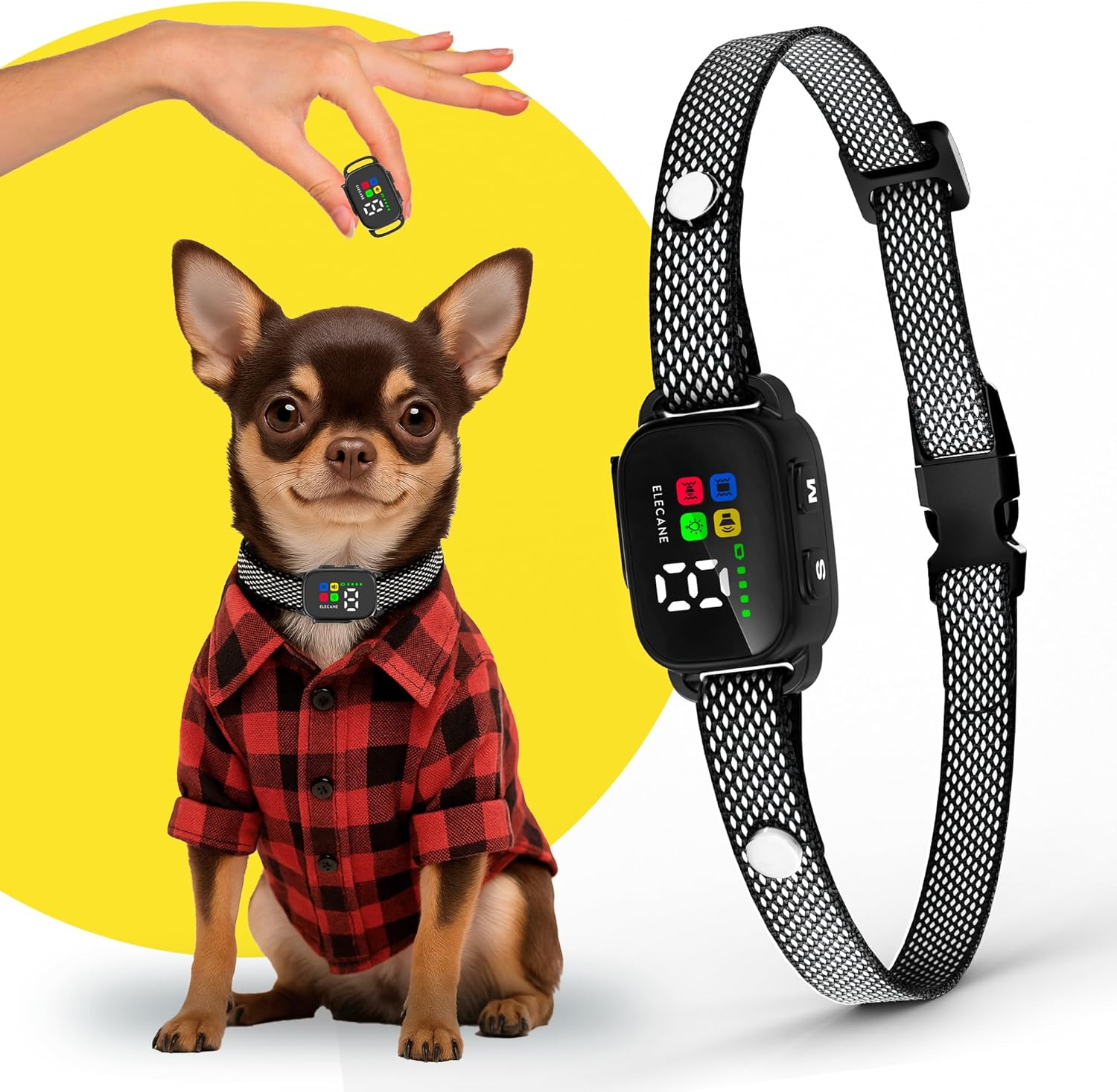
| Dog weight recommendation | 5-15 lbs |
|---|---|
| Neck size fit | 6-20 inches |
| Training modes | 3 Modes |
| Sensitivity levels | 7 levels |
| Water resistance | IP67 |
The ELECANE Tiny Bark Collar is a compact, rechargeable anti-bark device made for small breeds and puppies, using beeps and vibrations instead of electric shocks. It is typically worn like a regular collar and is aimed at everyday bark management—daytime training sessions and continuous wear for behavior reinforcement. The collar offers seven sensitivity levels and three training modes so you can tune detection to your dog's voice and environment, and a chip-based false-alarm filter helps reduce reactions to background noise. Its clear LED display and lightweight nylon strap make it simple to adjust and comfortable for tiny necks, while IP67 water resistance means it stands up to rain and outdoor play. Charging is fast and convenient via USB. Limitations include the reliance on vibration/sound only, which may be less effective on highly distracted or very stubborn dogs, and the provided strap and buckle style may need swapping for specialty harness setups. Read the instructions to set sensitivity and mode for best results with puppies and tiny breeds.
Best for: Owners of small-breed dogs or puppies who prioritize a humane, lightweight collar that is easy to fit and adjust for daily bark management.
Less Ideal for: People who need strong aversive correction for chronic, high-intensity barking or handlers who require collar integration with nonstandard harness systems.
- No-shock correction using sound and vibration for humane training
- Seven sensitivity levels and three modes for fine tuning detection
- Lightweight, compact design suited to small dogs and puppies
- USB rechargeable with quick charge time
- IP67 water resistance for outdoor use
- May be less effective on very stubborn dogs compared with stronger correction methods
- Strap uses a buckle style that might not suit all harness or collar setups
Verdict: The best overall bark collar for a Chihuahua balances effective bark reduction, a comfortable small fit, adjustable sensitivity, and safe training features for everyday use.
Honeynet Q10 Dog Bark Collar
Best Budget Bark Collar for Chihuahua

| Power source | Rechargeable battery |
|---|---|
| Sensitivity levels | 8 levels |
| Modes | 4 working modes |
| Waterproof rating | IP67 |
| Strap length | 27 inches |
The Honeynet Q10 is a straightforward rechargeable bark collar that detects barking and applies one of three correction options to deter the behavior. It offers 8 sensitivity levels and four working modes so you can tune detection to a small dog's voice and reduce false triggers, and the unit includes a visible color display that shows status and battery level. The collar charges in about two hours and the company claims 15 to 20 days of run time on a full charge, which makes it convenient for busy owners. IP67 waterproofing means it can be worn for outdoor play or light swimming without worry, and the included silicone conductive contacts and adjustable 27 inch strap aim to fit a wide range of neck sizes. The device also has a built-in protect mode that pauses corrections after repeated activations to avoid overstimulation. This is a budget-focused option, so it lacks advanced remote controls or app integration and some users may need time to find the right sensitivity setting for very small or soft-voiced dogs.
Best for: Owners who want a low-cost, no-frills electronic collar that reduces barking and can be tuned to a small dog’s voice rather than a feature-packed training system.
Less Ideal for: People who need app control, multi-dog management, or a collar specifically tailored for very young puppies or dogs under six months of age.
- Adjustable 8-level sensitivity to better match small dog vocal patterns
- Rechargeable battery with roughly 15–20 days claimed runtime per charge
- IP67 waterproof rating suitable for outdoor use and light swimming
- Protect mode that temporarily stops corrections after repeated activations to prevent overstimulation
- No remote control or smartphone app for distance or multi-dog management
- May require careful sensitivity tuning for very small or soft-barked dogs
Verdict: The best budget bark collar for a Chihuahua offers dependable bark correction and a secure small-dog fit at a lower price, sacrificing few essential features.
PetSafe NanoBark 2.0 Bark Collar Small
Best Premium Bark Collar

| Fits neck size | 4–15 inches |
|---|---|
| Correction levels | 10 auto-adjusting levels |
| Battery life | Up to 7 days per charge |
| Waterproof | Yes |
| Included components | Charging Cable, Test light tool |
The PetSafe NanoBark 2.0 is a slim, low-profile bark collar built specifically for small breeds with necks 4 to 15 inches. It detects and responds only to the voice of the dog wearing it using PetSafe's Perfect Bark detection, and applies one of 10 auto-adjusting static correction levels that alternate with Variable Pulse technology to reduce desensitization. Typical use involves fitting the lightweight collar snugly and letting it run in automatic mode so it escalates correction until barking stops, while the rechargeable battery provides up to seven days between charges. The waterproof housing and durable strap let small, active dogs wear it during outdoor play and in wet conditions. Limitations include the use of static correction, which some owners may prefer to avoid, and the collar's fit and correction style are tailored to small breeds so it is not appropriate for larger dogs; effectiveness also depends on consistent, humane introduction and proper fit. The unit ships with a charging cable and a test light tool to verify contact and operation before regular use.
Best for: Owners of small-breed dogs who prioritize a purpose-built, feature-rich collar with precise bark detection and a long-lasting rechargeable battery for regular training sessions.
Less Ideal for: People who want non-static correction methods or need a solution for medium and large dogs should consider different products.
- Compact, lightweight design sized for small breeds
- Perfect Bark detection reduces false triggers from other dogs or background noise
- Ten auto-adjusting static levels with Variable Pulse to help prevent desensitization
- Rechargeable battery lasting up to 7 days per charge
- Waterproof construction suitable for rain and puddles
- Uses static correction only, which some owners may find harsh or unsuitable
- Fit range limited to necks 4–15 inches so not for larger dogs
Verdict: The best premium bark collar delivers superior materials, more refinement in correction settings, longer battery life, and advanced safety features for owners who want the best.
MariMoki Tiny Bark Collar DB200
Best Compact Bark Collar

| Fits neck sizes | 4.7-23.6 inches |
|---|---|
| Weight | 0.6 ounces |
| Waterproof rating | IP67 |
| Charging time | 2 hours |
| Sensitivity levels | 5 levels |
The MariMoki Tiny Bark Collar is built specifically for very small breeds and puppies, trading size for targeted functionality. It uses an AI recognition chip to distinguish the dog's bark from background noise, and responds with vibration and beep corrective cues across five sensitivity levels rather than static shock. The unit is extremely light and slim so it sits unobtrusively on tiny necks and short coats, and the adjustable nylon strap covers a wide range of neck sizes. IP67 waterproofing means you can use it outdoors in wet conditions, and the rechargeable battery charges in about two hours with claimed long standby and daily-use runtimes. Practical benefits include minimal bulk for puppies, fewer false triggers thanks to AI detection, and a washable wipe-clean exterior. Limitations are that it only offers vibration and beep (no higher-intensity modes), the smallest form factor may be less durable under rough play, and effectiveness depends on consistent, humane training practices rather than being a standalone cure for excessive barking.
Best for: Buyers of small-breed puppies or adult tiny dogs who prioritize minimal weight and low bulk in a corrective collar and want a humane, vibration-and-beep approach backed by smarter bark detection.
Less Ideal for: Owners of large or very stubborn dogs that need stronger corrective stimulation or who want collars built for heavy-duty durability and rugged play.
- Very small, lightweight profile tailored for tiny breeds and puppies
- AI-based bark detection reduces false triggers from other dogs or background noise
- Rechargeable battery with fast two-hour charge and long claimed runtime
- IP67 waterproof rating suitable for outdoor use and rainy walks
- No shock option or more intensive correction modes for hard-to-train dogs
- Compact plastic housing may be less impact-resistant during rough activity
Verdict: The best compact bark collar is optimized for tiny dogs with a low-profile design and lightweight construction to stay comfortable and unobtrusive on a Chihuahua.
DogRook No-Shock Bark Collar Medium
Best Gentle-Training Bark Collar

| Power | USB rechargeable |
|---|---|
| Training modes | 2 vibration modes, 7 sound levels |
| Sensitivity levels | 5 levels |
| Fit | Adjusts up to 22 inches |
| Water resistance | Waterproof |
The DogRook No-Shock Bark Collar is a rechargeable anti-barking device that trains dogs using vibration and beep sound rather than shock. It mounts on an adjustable nylon strap and is typically used during supervised training sessions indoors or outdoors to reduce excessive barking. Key features include a microphone-based smart sensitivity adjustment, two vibration modes, seven sound levels, five sensitivity settings, and USB recharging that the brand says can deliver up to 14 days of use per charge. Practical benefits are simple controls, included prong covers to accommodate long-haired dogs, and waterproofing for outdoor use. Important limitations are that it is intended for training use only (no leash ring and should be repositioned every 2–4 hours and not worn over 12 hours a day), and some buyers may prefer collars with remote control or automatic logging features that this unit lacks. The collar is sized to fit necks up to 22 inches and targets dogs in the small-to-medium weight range, making it straightforward for owners who want a low-stress, rechargeable option for bark management.
Best for: Buyers who prioritize a rechargeable, low-stress training tool and want dependable run time between charges for regular supervised bark control sessions with puppies or small dogs.
Less Ideal for: Owners seeking a collar for unsupervised all-day wear, integrated remote training, or those who prefer shock-based deterrents should consider other options.
- Rechargeable via USB for repeated use without replacing batteries
- Multiple vibration modes and seven sound levels for progressive, non-shock correction
- Smart microphone sensitivity with adjustable levels to reduce false triggers
- Waterproof design suitable for indoor and outdoor training
- Includes prong covers for long-haired dogs to improve contact
- Not intended for continuous wear; requires repositioning every few hours and limited daily wear time
- No leash attachment or remote feature for off-collar control
Verdict: The best gentle-training bark collar uses low-intensity or progressive correction modes and humane design choices for Chihuahuas that are sensitive or new to collars.
Oliry S1 P Bark Collar
Best Waterproof Bark Collar

| Training modes | 5 modes |
|---|---|
| Sensitivity levels | 5 levels |
| Charge time | Approximately 2 hours |
| Waterproof rating | IP67 |
| Neck fit | 8 to 25 inches |
The Oliry S1 P is a rechargeable bark collar built for everyday use across small, medium, and large dogs. It uses an AI chip and voiceprint recognition to detect barking in about 0.01 seconds and offers five training modes — from beep and vibration up to combined boost static — plus five sensitivity levels so you can tune responses to your dog and environment. The collar includes an LCD that shows mode and battery level and charges via USB-C in roughly two hours; the manufacturer claims up to 18 days of use between charges depending on settings. IP67 waterproofing and removable prong covers make it suitable for outdoor wear and more comfortable for longer sessions, while a safety pause after six continuous triggers helps prevent over-correction. Expect reliable detection and flexible correction options, but note that static stimulation may not be suitable for every dog and effective training still requires consistent use and adjustment of sensitivity and mode.
Best for: Buyers who want a reusable, easy-to-charge bark collar with adjustable correction options and reliable detection for daily indoor and outdoor use.
Less Ideal for: Households that refuse any form of static correction or need a quick-fix solution without ongoing training should consider non-static or behavior-based alternatives.
- Fast 0.01s response with AI voiceprint detection to reduce false triggers
- Five training modes and five sensitivity levels for customizable correction
- Rechargeable USB-C battery with roughly 2-hour charge time and long claimed runtime
- IP67 waterproof rating allows outdoor use in wet conditions
- Clear LCD shows mode, sensitivity, and battery status for easy monitoring
- Includes static stimulation which some owners may prefer to avoid
- Effectiveness depends on proper fit and consistent training rather than being an instant fix
Verdict: The best waterproof bark collar keeps working through rain, puddles, and humid conditions while protecting electronics and maintaining a reliable fit on a small dog.
Choosing the Right Bark Collar Chihuahua: Key Factors to Consider
Size and Fit
A secure, comfortable fit is essential for a chihuahua because their necks are small and delicate. Look for collars with very short minimum circumference and multiple adjustment holes so the device sits snugly without sliding.
Proper fit affects sensor accuracy and consistent contact with the skin. A collar that shifts can trigger false corrections or fail to register vocalizations. Also consider overall weight; bulkier housings can be cumbersome for tiny dogs and may change posture or behavior.
Adjustable Stimulation Levels
Chihuahuas need lower-intensity settings than medium or large breeds. Collars with many incremental levels let you start at the gentlest option and only increase if necessary. Multiple modes, such as vibration, tone, or low electrical stimulation, give non-aversive alternatives.
Gradual adjustment helps you find the minimum effective intervention to stop nuisance barking without causing fear. A good control scheme is clear and repeatable so owners can reliably set and remember the level that worked.
Sensor Type and False-trigger Prevention
How a collar detects barking influences both effectiveness and comfort. Voice-activated sensors respond to vocalizations, while dual-sensor systems combine sound and vibration to distinguish barking from other noises or dog movement.
False triggers can lead to unnecessary corrections and increased anxiety. Look for collars that allow sensitivity adjustments or feature automatic calibration to reduce activations from ambient sounds, toys, or other animals.
Safety Features and Automatic Cutoffs
Safety mechanisms protect a small dog from prolonged or excessive stimulation. Important features include automatic timeout after repeated activations, lockout periods, and clear low-intensity defaults for initial use.
Also check for certifications or stated testing against over-stimulation, and ensure the device has visible indicators for active correction. These features reduce the risk of accidental harm and give owners confidence during training.
Battery Life and Charging Method
Reliable battery performance matters because inconsistent power can make a collar fail at critical moments. For chihuahuas, lighter batteries and compact charging ports are preferable to bulky solutions.
Consider how long a full charge lasts under normal use, whether there is a low-battery indicator, and how fast charging is. Removable batteries or easy replacement options can be helpful for owners who prefer not to wait between charges.
Materials, Durability, and Skin Safety
Contact materials should be hypoallergenic and corrosion-resistant because thin chihuahua skin is more prone to irritation. Silicone-coated or stainless contact points reduce risk of rashes, while soft straps prevent chafing.
Durable housings stand up to daily wear and make the collar a long-term solution. Also pay attention to ease of cleaning, because dirt and moisture buildup at the contact area can cause skin problems if left unaddressed.
How Do I Size a Bark Collar Correctly for a Chihuahua?
Measure your dog's neck where the collar will sit, usually just below the jawline. Leave room for two fingers between the strap and the neck to ensure a snug but not tight fit.
If the collar lists minimum and maximum circumferences, compare those with your measurement and favor options that still have extra adjustment holes toward the smaller end. For very young or tiny chihuahuas, check whether the manufacturer lists a size specifically for toy breeds.
- Check strap width; narrower straps are generally more comfortable for small necks.
- If possible, weigh the collar to ensure it is light enough for daily wear.
- Confirm the contact point spacing matches your dog's facial structure so it makes consistent skin contact.
Which Correction Modes Should I Try First?
Start with the least invasive mode available, usually vibration or an audible tone. These modes can interrupt nuisance barking without applying electrical stimulation.
If those do not work after consistent trials, increase intensity slowly and monitor your dog's reaction. Use short test sessions and observe body language for signs of stress.
- Begin at the lowest setting and proceed gradually.
- Use vibration or tone as a first option when possible.
- Avoid multiple high-intensity activations in a single session.
How Can I Reduce False Activations From Other Noises or Movement?
Choose collars with sensitivity adjustment or dual-sensor detection that requires both sound and throat vibration to activate. Calibration routines that adapt to your dog's vocal profile can also cut down false triggers.
When testing a new device, try it in different environments such as indoors, near traffic, and during play to gauge how often it misfires. Adjust sensitivity between sessions rather than during active corrections.
- Use lower sensitivity in noisy environments.
- Pair sensor adjustments with behavior training to reduce reliance on correction.
- Check for firmware updates or manufacturer guidance that refines detection algorithms.
Should Chihuahuas Wear a Bark Collar All Day?
Avoid continuous all-day wear initially. Short supervised sessions let you evaluate fit and your dog's reaction without prolonged exposure. Many owners use collars during specific problem windows such as when left alone or during known triggers.
Follow safety guidance on maximum daily usage for any collar. Breaks prevent skin irritation and reduce the chance of the dog associating the collar with stress during unrelated activities.
- Inspect the contact area daily for redness or hair loss.
- Rotate collars with harness use when going on walks to minimize constant neck pressure.
- Remove the collar during sleep or extended unsupervised periods unless specifically designed for 24/7 wear.
How to Combine a Bark Collar with Positive Training
Use the collar as one tool within a broader training plan that praises quiet behavior. Reward-based reinforcement helps the dog learn the desired behavior rather than simply suppressing barking.
Time rewards immediately after quiet moments so the dog associates silence with positive outcomes. Consistency between the collar's activation pattern and your reinforcement cues improves long-term results.
- Pair corrections with a calm verbal cue and immediate reward for quiet.
- Avoid using the collar as the sole training method.
- Consult a professional trainer if barking is tied to fear or medical issues.
How We Chose the Best Bark Collar Chihuahua
We prioritized collars that meet the physical and behavioral needs of chihuahuas rather than general-purpose devices. Evaluation focused on fit and ergonomics, adjustable stimulation levels, safety features, sensor accuracy for voice vs. activity, battery life and charging convenience, and how intuitive the controls are for typical pet owners. We also considered durability of straps and housings for small-breed activity levels and how easy it is to clean contact points. Products were excluded if they lacked clear size adjustments for very small necks, did not offer low-intensity or humane correction modes, or if technical specs omitted information about sensor type or safety shutoffs. We favored collars that let owners fine-tune sensitivity to avoid false activations and that include fail-safes to prevent continuous stimulation. Practical checks included whether replacement parts are accessible and whether the design minimizes weight on a small dog's neck.
Our full evaluation process is outlined in our review methodology.
FAQ
Will a bark collar hurt my chihuahua?
Most collars offer adjustable levels and non-aversive modes like tone or vibration so they do not have to be painful. Start at the lowest setting and watch your dog's behavior; persistent signs of distress indicate the device is unsuitable.
How long should I leave the collar on my chihuahua each day?
Limit initial sessions to short, supervised periods and follow the device's recommended maximum daily usage. Many owners use it only during known problem times and remove it for sleep and extended unsupervised stretches.
Can a bark collar trigger on other dogs or background noise?
Yes. Single-sensor sound-only collars can activate from other dogs or loud noises. Dual-sensor systems or sensitivity adjustments reduce false triggers by requiring throat vibration or stricter voice patterns to activate.
What signs show the collar fits correctly?
A correct fit sits snugly without digging in, maintains contact with the skin under the jaw, and does not slide when the dog moves. You should be able to insert two fingers comfortably between strap and neck.
Are contact materials safe for sensitive chihuahua skin?
Many collars use hypoallergenic coatings or stainless contacts to limit irritation. Inspect the contact area regularly and choose models that list skin-safe materials and corrosion-resistant finishes.
Final Verdict
For chihuahuas, prioritize a collar that offers an accurate, low-intensity response and a secure, lightweight fit. Balance sensor reliability with humane modes like vibration or tone, and always start at the gentlest setting while pairing the device with positive reinforcement. The right choice minimizes false activations, protects sensitive skin, and supports gradual behavior change. Focus on fit, adjustable controls, and safety cutoffs to pick a collar that helps manage barking without causing stress.

