

If you want a dog that is mentally engaged and less prone to destructive or hyperactive behavior, the right brain training toys make a big difference. These toys are designed to challenge problem-solving skills, extend independent playtime, and channel energy into productive tasks. In this guide we narrowed the field to the top shortlisted options that reliably deliver puzzle variety, adjustable difficulty, and robust construction. You will find picks that suit different skill levels, chewing tendencies, and training goals, plus the evaluation criteria we used to select them and practical buying advice.
Top Picks at a Glance
| Best Overall Brain Training Toy The top all-around puzzle toy that suits most dogs | Outward Hound Nina Ottosson Dog Brick |  |
| Best Budget Brain Training Toy An inexpensive puzzle toy that still stimulates and entertains | Joansan Dog Puzzle Toy Small |  |
| Best Premium Brain Training Toy A higher-end, feature-rich toy for serious enrichment play | West Paw Zogoflex Toppl Small |  |
| Best Interactive Brain Training Toy Designed for two-way play or owner-guided puzzle interaction | Arf Pets Memory Training Treat Dispenser |  |
| Best Compact Brain Training Toy A small-footprint puzzle ideal for travel and limited space | Petration Dog Snuffle Ball Small |  |
| Best Durable Brain Training Toy Built to withstand chewing and rough, repeated use | M.C.works Pineapple Chew Toy Large |  |
| Best Multi-Stage Brain Training Toy Adjustable difficulty levels for long-term learning and growth | KADTC Dog Puzzle Toy Level 3 |  |
Outward Hound Nina Ottosson Dog Brick
Best Overall Brain Training Toy

| Pet Toy Type | Puzzle |
|---|---|
| Recommended Uses For Product | Indoor, Mental Health, Playing, Training |
| Additional Features | Lightweight, Portable |
| Water Resistance Level | Not Water Resistant |
| Material Type | Plastic |
The Outward Hound Nina Ottosson Dog Brick is a Level 2 interactive puzzle that challenges dogs to lift lids, slide red sliders, and remove bone covers to find hidden treats or kibble. Designed for supervised indoor play, it has multiple treat compartments and several ways to increase or decrease difficulty so you can match the puzzle to your dog's skill level. The plastic construction is lightweight and portable, and the food-safe materials are BPA, PVC, lead, and phthalate-free, making it simple to fill, clean, and reuse. It also doubles as a slow feeder for dogs that bolt their food, turning mealtime into an enrichment session. Limitations include the plastic pieces which are not chew-proof, so the toy requires supervision and is unsuitable for heavy chewers who may disassemble components. For many owners the adjustable challenge, clear learning curve for dogs, and moderate treat capacity make this one of the most versatile puzzle toys available.
Best for: Owners who want a single, versatile puzzle that provides adjustable mental stimulation and can double as a slow feeder during supervised indoor play.
Less Ideal for: Dogs that are aggressive chewers or owners who need an unsupervised, indestructible toy should consider more rugged options.
- Adjustable difficulty with lids, sliders, and removable covers to tailor challenge level
- Multiple treat compartments that also allow use as a slow feeder
- Made from food-safe materials and easy to clean
- Lightweight and portable for indoor supervised play
- Plastic construction is not chew-proof and requires supervision to prevent damage
Verdict: The best overall brain training toy for owners who want a balanced pick that combines challenge, durability, and engagement suitable for most dogs.
Joansan Dog Puzzle Toy Small
Best Budget Brain Training Toy
| Pet Toy Type | Puzzle |
|---|---|
| Breed Recommendation | Small dogs, media dogs |
| Recommended Uses For Product | Training |
| Material Type | Plastic |
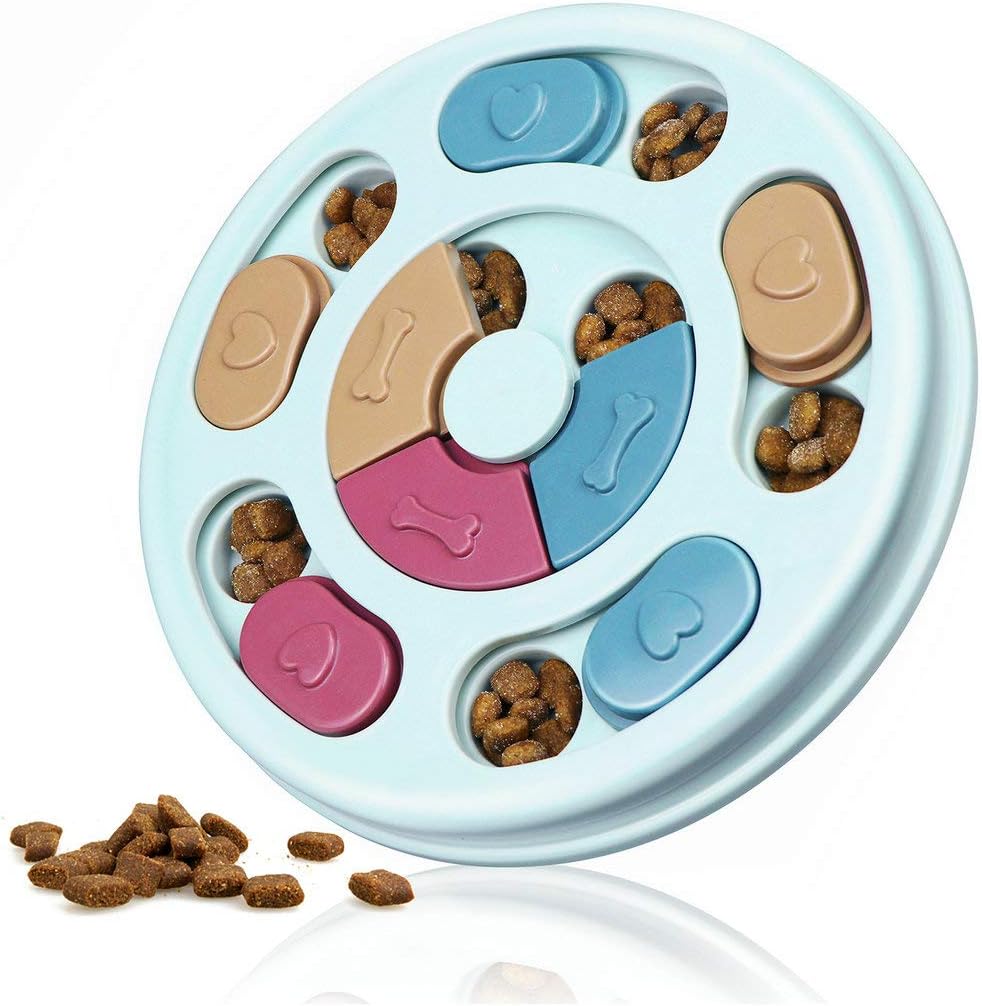
This plastic sliding-puzzle treats toy gives small dogs a nose-and-paw challenge that rewards problem solving with food. The board uses movable sliders and multiple holes where you hide kibble or small treats, so puppies learn to nudge pieces to reveal rewards and slow down fast eaters. It is lightweight, water resistant, and advertised as easy to wash, which makes it convenient for daily use and messy treat sessions. The toy is intended for supervised mental exercise and training rather than heavy chewing, and the seller warns to remove it if damaged and not allow it as a chew toy. You can adjust a screw on the back to change slider tension and raise difficulty as your puppy improves. Limitations are that it is plastic and not meant to withstand strong chewers, and very food-motivated pups may figure the puzzles out quickly, which reduces long-term novelty. For short interactive training sessions and to slow feeding while boosting problem solving, this puzzle performs well for toy breeds.
Best for: Buyers looking to give a toy poodle puppy short, focused mental workouts and slow-feed sessions using a portable treat-dispensing puzzle.
Less Ideal for: Owners who need a chew-proof or long-lasting durable toy for aggressive chewers should choose a sturdier option made for chewing.
- Provides nose-and-paw puzzle play with multiple treat compartments
- Double duty as a slow feeder to reduce gulping
- Adjustable slider tension lets you increase difficulty as puppy learns
- Lightweight, water resistant and easy to clean for everyday use
- Made of plastic and not intended for heavy chewers
- Can lose novelty for very food-savvy puppies once solved
Verdict: The best budget brain training toy for owners seeking an affordable way to introduce mental enrichment without sacrificing basic durability or challenge.
West Paw Zogoflex Toppl Small
Best Premium Brain Training Toy

| Pet Toy Type | Puzzle |
|---|---|
| Recommended Uses For Product | Chewing, Playing, Treat Dispensing |
| Indoor Outdoor Usage | Indoor, Outdoor |
| Material Type | Plastic |
The West Paw Zogoflex Toppl is a premium treat-dispensing puzzle that converts snack time into focused play. Its bowl-like design and interior rubber prongs hold kibble, soft fillings, or freezable mixtures so dogs must work to extract rewards, which promotes problem-solving and slows fast eaters. Made from West Paw's Zogoflex material, the Toppl is lightweight, water resistant, floatable, and dishwasher safe for easy cleaning, and the manufacturer highlights recyclable, non-toxic construction. In practice the small Toppl is best for light to moderate chewers and toy-motivated dogs that enjoy manipulating pieces to reach food; it is portable for indoor or outdoor use and works well for supervised solo play or food-based training. Important limits are its intended size and chew tolerance — truly aggressive chewers may damage it over time and the small size holds a relatively modest amount of food compared with larger puzzles. For owners prioritizing longevity, safe materials, and a toy that can accept wet or frozen fillings, the Toppl is a top-tier option that encourages longer engagement than basic dispensers.
Best for: Buyers who want a high-quality, safe puzzle toy that uses premium materials and supports longer, more complex food-based enrichment sessions for their dog.
Less Ideal for: Owners seeking a large-capacity slow feeder or an indestructible option for power chewers should consider different products.
- Holds kibble, wet food, or freezable mixes for longer-lasting engagement
- Made from BPA-free, non-toxic Zogoflex that is dishwasher safe and recyclable
- Design includes internal prongs to slow food release and increase challenge
- Floats and is water resistant so it can be used outdoors or near water
- Lightweight and portable for indoor or outdoor supervised play
- Small size holds only a modest amount of food compared with larger puzzle toys
- Not intended for heavy or determined chewers who may damage the toy
Verdict: The best premium brain training toy for owners willing to pay more for superior materials, refined mechanics, and longer-lasting challenge.
Arf Pets Memory Training Treat Dispenser
Best Interactive Brain Training Toy

| Pet Toy Type | Treat Dispenser Toy |
|---|---|
| Recommended Uses For Product | Exercise, Playing, Training, Treat Dispensing |
| Indoor Outdoor Usage | Outdoor |
| Dog Breed Size | Medium |
| Unit Count | 1 Count |
The Arf Pets Memory Training Treat Dispenser is an interactive puzzle toy that teaches pets to press a separate remote button or the main unit to earn treats, combining memory work with physical activity. It is typically used in short training sessions or as a supervised play activity: set treats or kibble inside, place the detachable remote where your dog can find it, and encourage presses with the built-in dog-friendly sounds. The dispenser randomizes the number of treats released which keeps the play unpredictable and motivating, and the remote can be attached to the main unit or left in another room for distance training. Practical benefits include reinforced positive behavior, extra exercise during play, and the option to use outdoors via the included stake or on glass with a suction cup. Important limitations are that it requires multiple batteries (C and AAA) to operate and that very determined chewers could try to dismantle it, so supervision is recommended for aggressive chewers or heavy chewing sessions.
Best for: Owners who want a hands-on training aid to teach button-pressing, cooperative play, and memory-based tasks with their dog during short, guided sessions.
Less Ideal for: People seeking a durable chew or unsupervised puzzle for heavy chewers or owners who prefer completely passive, no-battery toys.
- Encourages memory-based training with a separate remote button for cooperative play
- Randomized treat release keeps dogs engaged and reduces predictability
- Includes mounting options (suction cup and stake) for indoor or outdoor placement
- Plays dog-friendly sounds to prompt interaction and reward behavior
- Requires 4 C batteries and 3 AAA batteries not included
- Not intended as a chew toy so may need supervision with strong chewers
Verdict: The best interactive brain training toy for owners who want toys that encourage cooperative play or hands-on puzzle teaching with their dog.
Petration Dog Snuffle Ball Small
Best Compact Brain Training Toy

| Pet Toy Type | Treat Dispenser Toy |
|---|---|
| Breed Recommendation | All Breed Sizes |
| Indoor Outdoor Usage | Outdoor |
| Material Type | Natural Rubber |
| Additional Features | Lightweight, Portable |
The Petration Dog Snuffle Ball is a portable treat-dispensing puzzle that uses thick cloth strips and a hollow core so you can tuck snacks inside for dogs to sniff out. You use it by stuffing small treats into the fabric folds or the central opening, then handing the ball to the dog or placing it on the floor for supervised solo play. The design slows down eaters, encourages natural foraging and scent work, and keeps dogs engaged during short periods at home or on the go. It is made from fleece-like fabric and TPR rubber with a small squeaky carrot included for added interest, and the toy is machine- or hand-washable for simple cleanup. Important limitations are that it is labeled as not a chew toy and requires supervision with heavy chewers, and it is not water resistant so it is best kept dry. Overall it is a lightweight, easy-to-pack enrichment toy that delivers scent-driven engagement for travel and downtime.
Best for: Buyers who want a compact, easy-to-pack enrichment toy to occupy dogs with scent work and slow-feeding while traveling or during short absences.
Less Ideal for: Owners looking for a heavy-duty chewable or a waterproof outdoor toy should choose a different, more robust option.
- Portable and lightweight for travel or quick outings
- Thick cloth strips hide treats to encourage sniffing and slow feeding
- Machine- and hand-washable for easy cleaning
- Includes a small squeaky carrot to boost interest during play
- Not intended as a chew toy and may not withstand aggressive chewers
- Not water resistant which limits use in wet conditions
Verdict: The best compact brain training toy for owners needing a portable, space-saving option that still delivers meaningful mental stimulation.
M.C.works Pineapple Chew Toy Large
Best Durable Brain Training Toy

| Material Type | Natural Rubber |
|---|---|
| Pet Toy Type | Chew Toy |
| Additional Features | Chew Guard Technology, Heavy Duty, Interactive, Stuffed |
| Indoor Outdoor Usage | Indoor, Outdoor |
| Water Resistance Level | Waterproof |
This pineapple-shaped chew toy is built from natural, industrial-strength rubber and is designed for aggressive chewers who need a toy that lasts. It functions as a chew, training, interactive and treat-dispensing toy thanks to a hollow cavity you can stuff with kibble or pastes to extend play and slow eating. The textured surface helps scrape plaque and tartar while providing oral stimulation, and the glue-free dual-color injection molding means there is no paint or external adhesives that could flake off. It is dishwasher-safe for easier cleaning and is sized and recommended for large and giant breeds. Practical limitations are that no toy is truly indestructible so supervision is required with power chewers, and the manufacturer recommends limiting play sessions to avoid wear concentrated in one session. For buyers prioritizing longevity and challenge for smart, strong chewers, this toy combines toughness with treat-dispensing features that support brain work and dental benefit.
Best for: Owners who need a long-lasting, tough toy that can be used for treat-stuffing and training to occupy large dogs and heavy chewers and who prioritize durability over plush or fragile novelty toys.
Less Ideal for: People wanting delicate puzzle toys, very small-breed dogs, or owners who prefer soft toys that are gentle on teeth should consider alternate options designed for those uses.
- Made from natural, industrial-strength rubber designed for aggressive chewers
- Hollow cavity allows stuffing treats to create puzzle-like, slow-feeding play
- Textured surface helps scrape plaque and tartar for basic dental benefit
- Glue-free dual-color injection molding avoids paint or adhesive hazards
- Dishwasher-safe for easier cleaning after messy treat use
- Not truly indestructible so requires supervision with extreme chewers
Verdict: The best durable brain training toy for heavy chewers or households where longevity and toughness are top priorities.
KADTC Dog Puzzle Toy Level 3
Best Multi-Stage Brain Training Toy

| Pet Toy Type | Puzzle |
|---|---|
| Breed Recommendation | All Breed Sizes |
| Indoor Outdoor Usage | Indoor |
| Water Resistance Level | Waterproof |
This KADTC Level 3 puzzle is a premium-feeling brain game and slow feeder that combines adjustable challenge with easy cleanup. The 16.7-inch board holds nine sliding treat discs, four flip-lid cups and four sliding doors plus maze paths so you can dial difficulty from beginner to advanced as a puppy learns. It works as a treat puzzle for short training sessions and as a slow feeder for kibble, encouraging hunting behavior rather than gulping a meal. Food‑grade ABS construction, built-in storage under the board for extra pieces, non‑slip pads, and dishwasher-safe drain holes make it durable and convenient for regular use. For very determined chewers it is a puzzle rather than a chew toy, so supervision is advised and the manufacturer recommends removing it after play. The board typically occupies a pup 10 to 15 minutes on full setup but you can shorten or lengthen sessions by removing or adding pieces and using smellier rewards. Overall it is a thoughtful, well-made option for owners who want a long-lasting, adjustable toy to develop a puppy's problem solving and slow-eating habits.
Best for: Owners who prioritize durability, thoughtful features, and an adjustable challenge while training a puppy’s problem solving and slowing down mealtimes.
Less Ideal for: People wanting a toy that doubles as a chew or heavy-duty gnawing solution should choose a dedicated chew toy instead.
- Adjustable three-level design lets you increase challenge as a puppy learns
- Food-grade ABS construction and dishwasher-safe parts simplify cleaning and durability
- Built-in storage for extra pieces prevents losing components between sessions
- Non-slip pads keep the board steady on hardwood, tile, and carpet
- Not designed as a chew toy so supervised use is required for teething puppies
Verdict: The best multi-stage brain training toy for owners who want a single toy that scales in difficulty to match a dog's improving skills.
Choosing the Right Brain Training Toy Dog: Key Factors to Consider
Puzzle Complexity and Adjustable Difficulty
Dogs vary widely in problem-solving skill. A toy with multiple difficulty settings or interchangeable puzzle pieces lets you start easy and increase complexity as the dog learns. Toys that offer gradual progression help prevent early frustration while keeping the stimulation fresh over weeks or months.
Consider whether the challenge rewards logical steps or relies on chance. Mechanisms that teach sequence, memory, or scent-work tend to produce longer-lasting engagement than single-step puzzles. Adjustable difficulty also extends the usable life of the toy for multi-dog households with different skill levels.
Durability and Chew Resistance
Brain toys are often used repeatedly and can attract chewing during moments of boredom or excitement. Choose materials and construction that withstand scratching, nudging, and occasional chewing without breaking into small parts. Hard plastics, reinforced silicone, and thick rubber are common durable materials.
Durability affects both safety and value. A toy that falls apart exposes dogs to choking hazards and shortens enrichment time. If your dog is a heavy chewer, prioritize solid, one-piece designs and avoid intricate removable parts that can be torn off.
Cleaning and Maintenance
A toy that traps food or has hard-to-reach crevices quickly becomes unsanitary. Look for designs that disassemble easily or are dishwasher-safe to simplify cleaning. Smooth surfaces and wide openings reduce residue buildup and help prevent mold or bacterial growth.
Routine maintenance also preserves the mechanism. Toys with moving parts may need periodic inspection to remove lodged kibble or replace worn seals. Consider how effortful regular cleaning will be versus the frequency of use.
Safety and Material Non-toxicity
Safety is critical because dogs will mouth and sometimes ingest small bits. Verify that materials are marketed as food-safe or non-toxic and that any adhesives or paints are fully sealed. Avoid toys with small detachable components for dogs that swallow objects or for households with puppies that explore with their mouths.
Also consider mechanical safety: springs, pins, and sharp edges increase injury risk. Favor rounded designs and enclosed mechanisms that minimize pinch points and exposed hardware.
Versatility for Treats and Training Styles
Owners use different rewards in enrichment sessions, from dry kibble to soft pastes. Toys that accept a range of treat sizes and textures are more flexible. Some toys also double as slow feeders or scent-work platforms, broadening their usefulness for training and mealtime enrichment.
A versatile toy can be used for impulse control drills, scent games, and reward-based learning. If you work on specific behaviors, confirm the toy's format supports the type of reinforcement you prefer without constant modification.
Ease of Setup and User Friendliness
If a toy is complicated to prepare, busy owners are less likely to use it consistently. Simple setup, clear instructions, and intuitive operation reduce friction for regular enrichment sessions. Toys that require lengthy preparation or constant resetting often see less frequent use despite good design.
Consider whether a toy needs special tools or replacement parts. Straightforward refill and reset procedures support consistent daily practice and help establish enrichment as a regular habit.
How Do I Introduce a Brain Training Toy to an Overwhelmed Dog?
Start with the easiest setting or a partially loaded toy so the dog experiences early success. Guide your dog through the first few solves with a leash, hand signals, or by letting them observe you demonstrate the reward being retrieved. Keep sessions short and positive, ending while the dog is still engaged.
If the dog shows anxiety or disinterest, reduce the difficulty or toss small treats nearby to build positive association. Gradually increase complexity as confidence grows and always supervise early attempts to prevent accidental ingestion of small parts.
- Begin with 3–5 minute sessions several times a day.
- Use high-value treats for the first introductions.
- Reward effort, not just successful solves, to encourage exploration.
What Treats Work Best for Puzzle-based Enrichment?
Dry kibble is convenient and works well for simple dispensing toys, while softer treats or pastes are better for sticky compartments and sliding puzzles. Choose a treat that fits the toy's wells or chambers without jamming the mechanism. Break larger rewards into smaller pieces to prolong the activity.
Consider calorie control if you use toys daily: reduce meal portions to account for treat calories or use a portion of the regular kibble to fill the toy. Always watch for residue buildup from sticky treats and clean accordingly.
- Use kibble for frequent, low-calorie sessions.
- Reserve soft treats for higher-value, targeted training sessions.
- Test treat size beforehand to ensure smooth dispensing.
How Often Should I Use Brain Training Toys?
Short daily sessions are more effective than occasional long ones. Aim for two to three sessions of 10–15 minutes spread across the day, depending on your dog's attention span. Frequent, predictable enrichment supports routine and reduces boredom.
Vary the toy type and difficulty to prevent habituation. Combine active training days with lighter puzzle sessions so mental work complements physical activity rather than replacing needed exercise.
- Two to three short sessions daily is a good starting point.
- Adjust frequency based on your dog's interest and fatigue.
- Rotate toys weekly to maintain novelty.
Can Brain Training Toys Help with Separation Anxiety or Nuisance Behaviors?
These toys can reduce boredom-driven nuisance behaviors by keeping a dog occupied, which may indirectly ease mild separation anxiety. However, they are not a cure for severe anxiety and should be part of a broader behavior plan that can include counterconditioning and professional guidance.
For nuisance behaviors like chewing or inappropriate digging, enrichment gives the dog an acceptable outlet for energy and foraging instincts. Pair enrichment with consistent management and training to address underlying causes.
- Use toys as part of a behavior modification plan, not a standalone solution.
- Provide safe chews alongside puzzles for dogs with strong oral needs.
- Monitor whether the toy reduces specific unwanted behaviors over time.
How to Maintain and Store Puzzle Toys for Longevity?
Disassemble and clean toys regularly according to the manufacturer's guidance, focusing on removing trapped food and moisture. Inspect seams and moving parts for wear and replace components or retire the toy if pieces crack or loosen.
Store toys in a dry, ventilated area between uses to prevent mold or unpleasant odors. Rotate toys so each one gets downtime and thorough cleaning, which extends service life and keeps engagement high.
- Clean after heavy use or sticky treats.
- Air-dry completely before reassembly.
- Inspect weekly for signs of damage or loose parts.
How We Chose the Best Brain Training Toy Dog
We focused on attributes that directly affect how well a brain training toy works for daily enrichment. Primary evaluation criteria included puzzle complexity and scalability, to ensure the toy can grow with a dog's ability; durability and chew resistance, because many enrichment toys see heavy use; ease of cleaning, since hygiene matters for long-term play; safety of materials and presence of small parts, to avoid swallowing hazards; and adaptability for different treat types, because some owners prefer kibble while others use pastes or larger treats. We also considered how intuitive the toys are for owners to set up and whether the mechanism risks frustration rather than constructive challenge. Excluded from the shortlist were toys that rely solely on sounds or lights without genuine problem-solving, items with unclear material safety, and products with poor maintenance access that trap food. Our final selection favors durable designs with adjustable difficulty or multiple puzzle layers, clear cleaning paths, and mechanisms that reward persistence rather than accidental succeeds. The choices reflect practical tradeoffs between challenge, longevity, and day-to-day usability.
Our full evaluation process is outlined in our review methodology.
FAQ
Will all dogs enjoy brain training toys?
Not all dogs will take to puzzle toys immediately. Interest depends on age, temperament, and past experiences. Many dogs become more engaged with gentle introduction and reward shaping, but highly food-motivated or scent-driven dogs often adapt fastest.
Are brain training toys safe for puppies?
Puppies can benefit from age-appropriate puzzles as long as the toy is sized correctly and free of small parts. Supervise early use to prevent chewing or swallowing, and choose softer materials for teething mouths. Adjust difficulty to match shorter attention spans.
How do I know when a toy is too easy or too hard?
A toy is too easy if the dog solves it in seconds without effort; it is too hard if the dog loses interest or shows signs of stress. Aim for a challenge level that prompts problem-solving while allowing intermittent successes to maintain motivation.
Can puzzle toys replace daily walks and play?
No. Mental enrichment complements physical exercise but does not replace it. Dogs still need regular walks, play, and social interaction for overall health. Use brain toys to supplement energy outlets, especially during bad weather or rest periods.
How should I handle a toy that gets stuck or jammed?
Stop the session and remove the toy from the dog. Clear the jam while the toy is not in the dog's mouth and inspect for damage. If pieces are deformed or sharp edges appear, retire the toy. Regular cleaning helps prevent common jams.
Final Verdict
Prioritize toys that match your dog's current skill level and that can be adjusted as they improve. The best choices balance engaging puzzle mechanics with durable, easy-to-clean construction so sessions stay productive and safe. Expect to rotate toys and vary treats to maintain novelty, and treat enrichment as a complement to exercise and training rather than a replacement. With realistic expectations and regular use, brain training toys can be a reliable tool to reduce boredom, build focus, and support desirable behaviors.

