

If you train dogs with leash corrections, choosing the right choke collar can make sessions more effective and less stressful for both of you. The correct choke collar sits comfortably, offers predictable pressure and release, and lets you deliver concise cues without excessive force. This guide shortlists the top options for dog training and explains the features that matter most to handlers focused on obedience, walking manners, and controlled corrections. Below you will find our selected options and the criteria used to evaluate fit, safety, and handling so you can choose the collar that matches your training style and your dog's needs.
Top Picks at a Glance
| Best Overall Choke Collar The best all-around choke collar for most training needs | Herm Sprenger Stainless Steel Choke Chain 20in |  |
| Best Budget Choke Collar A low-cost choke collar that still provides reliable basic performance | SGODA Chain Dog Training Choke Collar 24 in |  |
| Best Premium Choke Collar A higher-end choke collar with superior materials and finish | Herm Sprenger Choke Chain 22in 3mm |  |
| Best Heavy-Duty Choke Collar Built for strong pullers and frequent, rugged use | Hamilton Metal Slip Link Choke Chain 30" |  |
| Best Coated Choke Collar A coated or padded choke collar that reduces direct metal contact | Ximipet Snake P Chain Collar 21.5in |  |
| Best Adjustable Choke Collar Easily adjustable fit for precise sizing and comfort | 1TO3GO Adjustable Training Collar |  |
| Best Lightweight Choke Collar A lighter, lower-profile option for smaller dogs or beginners | SGODA Chain Dog Choke Collar 18in |  |
Herm Sprenger Stainless Steel Choke Chain 20in
Best Overall Choke Collar
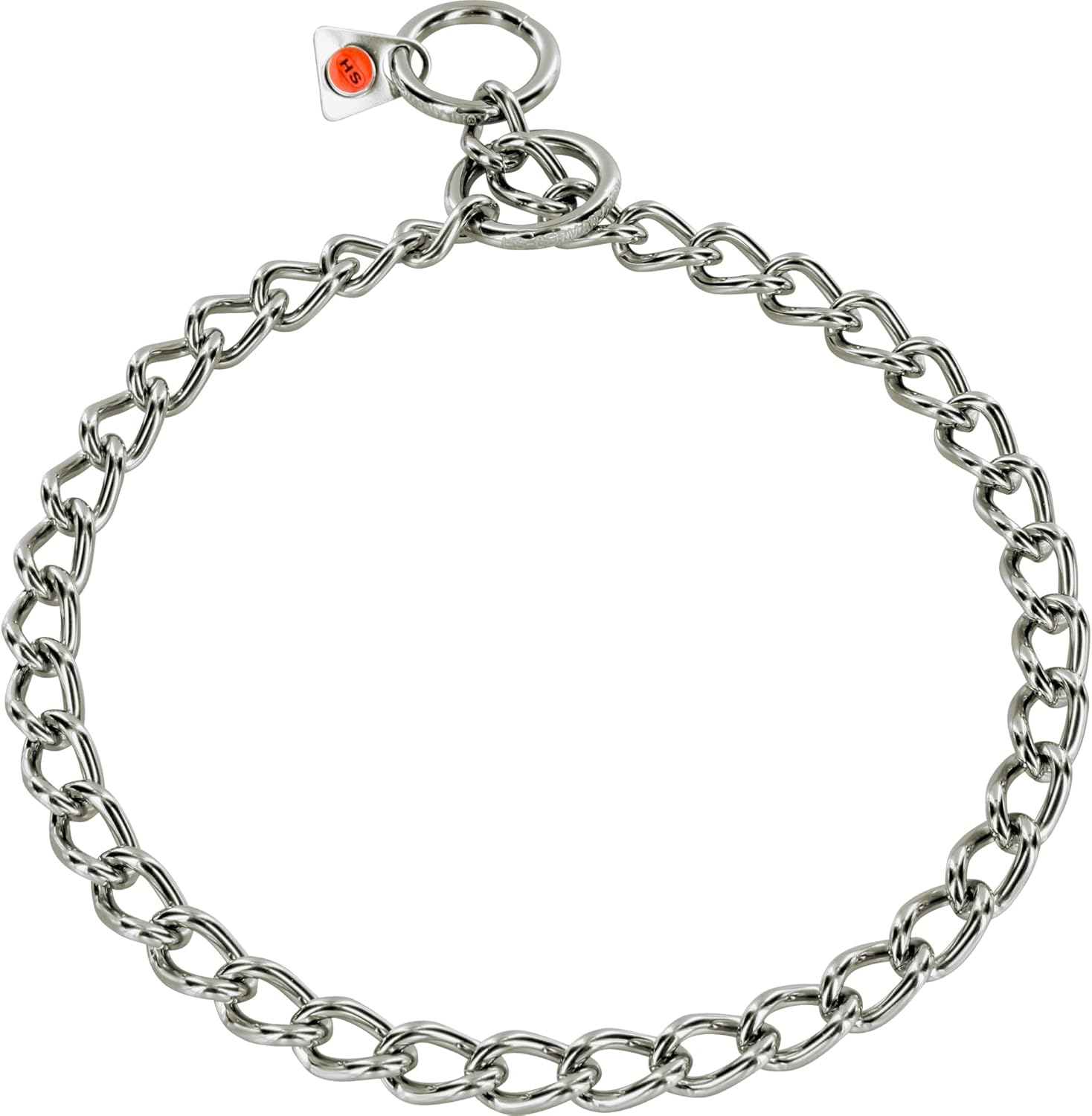
| Material Type | Stainless Steel |
|---|---|
| Size | 20in (Neck Size up to 17in) |
| Wire Gauge | 3 mm |
| Closure Type | Pull On |
This Herm Sprenger stainless steel choke chain is a straightforward training collar built from round links and two O-rings so the chain forms a loop that slips over the dog's head. It is typically used for leash training and short-term correction: attach the leash to the live O-ring for a tightening response or to the dead O-ring to use it as a regular collar. The 3 mm wire gauge and welded link construction give it a durable, rust-resistant feel that holds up to wet conditions and frequent use. Because it is a slip-on style it is not adjustable and must be sized to the dog's head and neck so it fits and slips on cleanly; owners should practice safe handling and avoid prolonged use as a permanent restraint. Made in Germany with stamped Sprenger O-rings, the collar delivers a professional-grade, no-frills tool for handlers who want reliable mechanical performance rather than padding or decorative features.
Best for: Buyers who want a simple, professional-quality training collar that offers dependable mechanical control for leash training and short corrective cues.
Less Ideal for: Owners seeking a padded, forgiveness-oriented collar for daily wear, or first-time trainers uncomfortable with choke-style corrections should consider alternatives.
- Durable stainless steel construction resists rust and holds up to wet conditions.
- Welded links and 3 mm wire gauge provide reliable strength for training use.
- Dual O-ring design allows quick switch between slip/choke and regular collar functions.
- Made in Germany with Sprenger-stamped O-rings indicating factory-quality manufacturing.
- Slip-on design is not adjustable and must be sized carefully to fit the dog’s head and neck.
- Provides correction via tightening which requires experienced, controlled handling to avoid misuse.
Verdict: The best overall choke collar balances effective control, durable materials, and a predictable fit that suits the majority of pet owners and common training situations.
SGODA Chain Dog Training Choke Collar 24 in
Best Budget Choke Collar
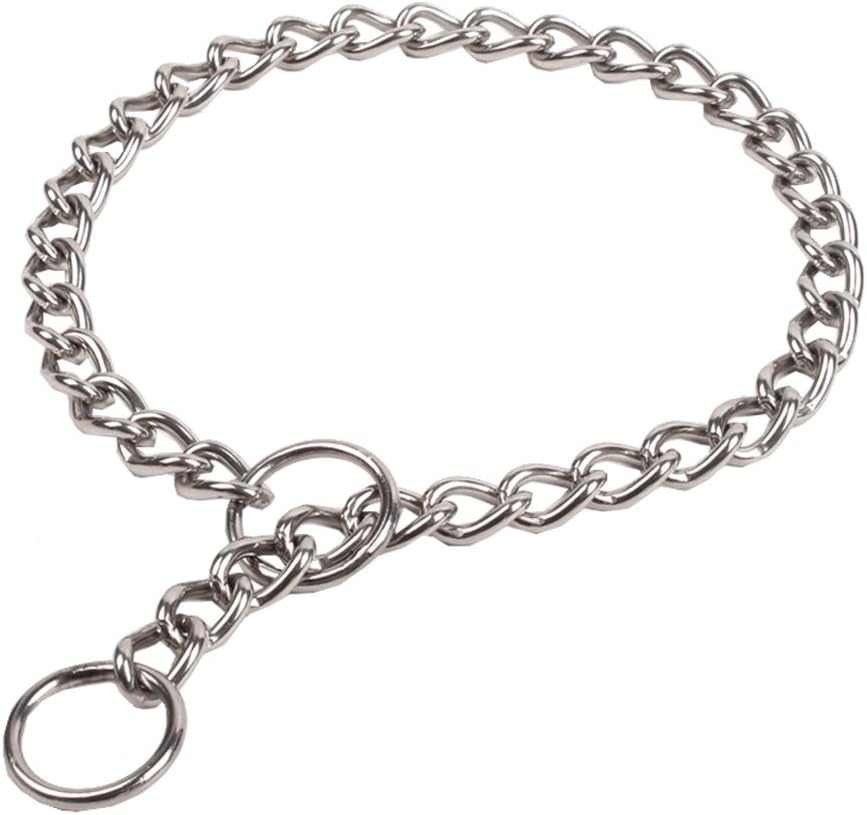
| Material | 304 stainless steel |
|---|---|
| Closure Type | Pull On |
| Item Length | 24 inches |
| Breed Recommendation | Large |
This SGODA chain dog training choke collar is a basic stainless steel slip collar intended for leash corrections during training. It is made from 304 stainless steel for durability and uses a simple pull-on closure with an O-ring for leash attachment, so it tightens under tension to provide immediate feedback when a dog pulls or breaks commands. Typical use is short training sessions on leash where a handler needs a firm, mechanical cue; sizing guidance and a straightforward sliding-ring setup let you size it to the dog's neck with about two inches of slack for proper fit. The collar is low-tech and rugged, which is useful for regular handling and outdoor use, but it requires careful, experienced handling to avoid excessive force and is not a substitute for positive-reward training. The product does not include padding or quick-release hardware, so handlers should be comfortable with choke-style correction methods and follow the sizing instructions to reduce discomfort.
Best for: Owners who want an inexpensive, no-frills mechanical collar for short leash training sessions and are comfortable using choke-style corrections under controlled conditions.
Less Ideal for: First-time trainers who prefer reward-based methods, handlers who need quick-release or padded collars, and households that want a gentler training tool for anxious or small dogs.
- 304 stainless steel construction resists rust and adds strength
- Simple slip-on design with O-ring makes leash attachment quick
- Multiple lengths and chain thicknesses available to fit larger breeds
- Durable, low-tech design suited for frequent outdoor training use
- No padding or quick-release feature can make corrections harsh if used improperly
- Requires knowledge of proper fitting and handling to avoid injury
Verdict: The best budget choke collar is the most affordable option that still offers safe, consistent correction and acceptable durability for owners on a tight budget.
Herm Sprenger Choke Chain 22in 3mm
Best Premium Choke Collar

| Wire gauge | 3 mm |
|---|---|
| Length | 22 in (55 cm) |
| Material Type | Stainless Steel |
| Closure Type | Slip On |
This Herm Sprenger choke chain is a factory-made stainless steel training collar built for frequent use and long service life. The 3 mm wire gauge and 22 inch overall length (including end O-rings) give it substantial strength suited to larger dogs, and the black German stainless finish resists rust and is advertised as hypoallergenic for most dogs. It is a slip-on choke style that must slide over the dog's head and is commonly used for leash control and obedience correction during training sessions. The collar's simple slip-on closure and solid O-rings mean it moves smoothly and sits flat against the neck rather than twisting, and the stainless construction wipes clean easily after outdoor use. Limitations are inherent to the choke design: it is not adjustable in use, requires correct sizing to fit over the head, and should be used only by owners experienced with corrective collars to avoid unintended pressure or injury. For handlers seeking a durable, factory-quality metal training chain, this model delivers reliable performance.
Best for: Owners who prioritize a heavy-duty, factory-quality training chain for regular use and want a collar that holds up to repeated outdoor and training sessions.
Less Ideal for: First-time trainers or owners who prefer adjustable, no-pull alternatives and those who are uncomfortable using corrective choke-style collars.
- Durable 3 mm stainless steel construction resists rust for long-term use
- Factory-made in Germany with consistent quality control
- Smooth O-ring ends and slip-on closure allow the chain to move freely
- Hypoallergenic raw material minimizes allergic reactions in most dogs
- Non-adjustable slip-on design requires correct sizing to fit over the head
- Choke-style collars demand experienced handling to avoid excessive pressure
Verdict: The best premium choke collar is for owners willing to pay more for top-quality metals, refined craftsmanship, smoother action, and longer-lasting performance.
Hamilton Metal Slip Link Choke Chain 30"
Best Heavy-Duty Choke Collar
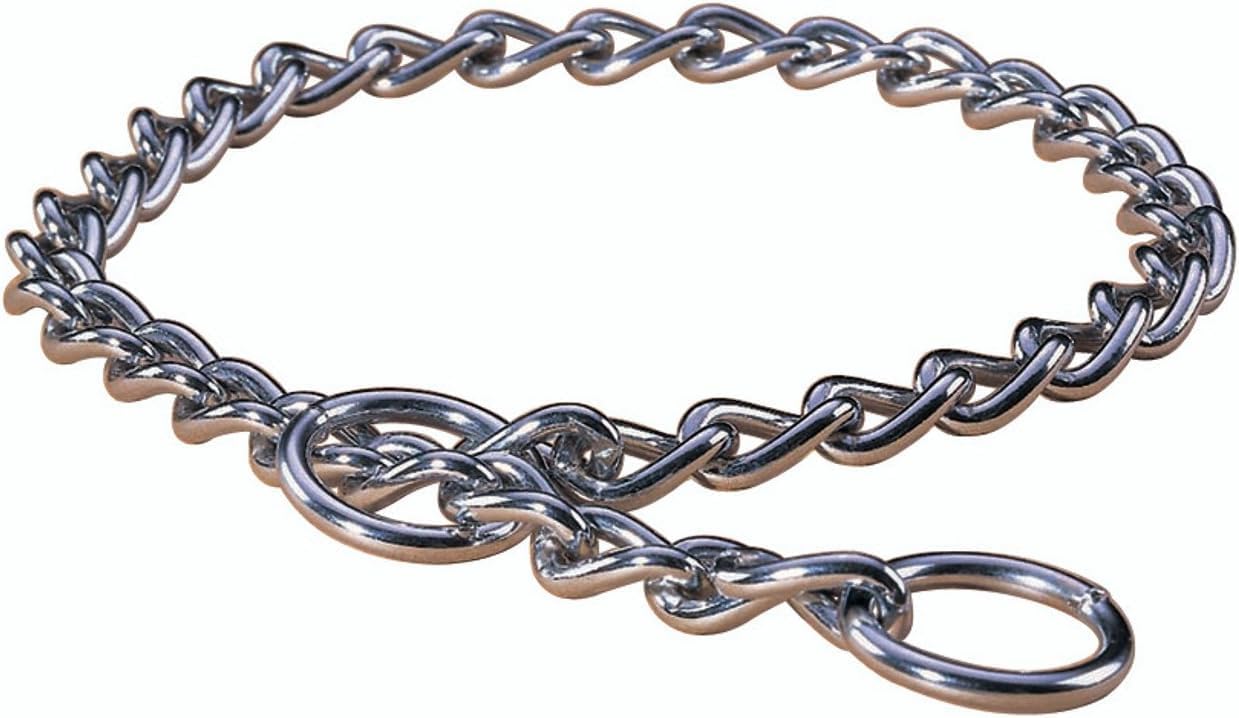
| Material Type | Steel |
|---|---|
| Item Type Name | Extra Heavy Choke Chain |
| Item Length | 30 inches |
| Item Width | 4 millimeters |
The Hamilton Metal Slip Link Choke Chain is a straightforward heavy-duty training collar built from 4.0mm steel links and a 30 inch length for larger necks. It works as a slip collar that tightens evenly when the leash is pulled to give a quick, consistent correction used during heel and leash-training sessions. The steel construction and chrome plating make it durable for frequent outdoor use and resistant to day-to-day wear, while the simple chain design is easy to put on and adjust by sliding through the ring. Practical benefits include reliable strength for strong dogs and a slim profile that is unlikely to snag under most conditions. Important limitations are that choke chains require correct fitting and handler experience to avoid discomfort or injury, and they are not a stop-gap for dogs that lunge or react unpredictably without additional training. Use this as a training tool with positive reinforcement and appropriate precautions.
Best for: Buyers who need a rugged, no-frills training collar for strong or large dogs and who are comfortable using slip collars as part of a structured training plan.
Less Ideal for: Owners who prefer force-free training tools or who lack experience fitting and using choke chains should consider alternative training collars or consult a trainer.
- 4.0mm steel links provide strong, heavy-duty construction for powerful dogs
- 30 inch length fits larger necks and gives room for proper slip action
- Chrome plated finish improves corrosion resistance for outdoor use
- Simple slip-link design is easy to put on and offers consistent, even pressure
- Requires knowledgeable fitting and handling to be used safely
- Not suitable as a standalone solution for behavior problems that need training beyond leash corrections
Verdict: The best heavy-duty choke collar is designed for large or powerful dogs and frequent use, with thicker links and reinforced construction to withstand heavy stress.
Ximipet Snake P Chain Collar 21.5in
Best Coated Choke Collar

| Material Type | Brass, Plated |
|---|---|
| Closure Type | Double Ring |
| Size | 21.5in |
| Breed Recommendation | All Breed Sizes |
This Ximipet snake P chain is a brass‑plated choke-style training collar intended to give handlers quick, direct control during walks, training, or shows. It is used as a slip/choke collar: the chain tightens when the dog pulls or lunges and relaxes when the dog is at heel, so it is typically worn during structured training sessions or supervised walks rather than continuously. The collar's brass construction with plated finish and seamless welded rings aims to resist rust and improve durability, and the polished snake chain provides a smooth, low-profile surface that reduces snagging. Practical benefits include a range of sizes to match neck circumference and a double‑ring closure for straightforward on/off use. Limitations are inherent to choke chains: they require knowledgeable handling to avoid excessive pressure and are not a substitute for positive reinforcement training, and the plated finish may wear over time with heavy use or exposure to moisture. For dogs with reactive pulling, this collar offers immediate correction, but it is best used by experienced handlers who monitor fit and timing closely.
Best for: Buyers who need a training collar that offers direct, immediate correction and want a smoother, plated finish that is easier on the coat and skin than rougher chains.
Less Ideal for: Owners who prefer fully hands-off, force-free training methods or who cannot supervise use closely should consider alternative training tools.
- Brass plated construction with seamless welded rings for improved strength and rust resistance
- Polished snake chain surface reduces snagging and offers a smooth contact point
- Available in eight sizes and multiple colors to match neck circumference and preferences
- Double ring closure makes it quick to put on and remove during training
- As a choke-style collar, it requires experienced handling to avoid overcorrection
- Plated finish can wear with heavy use or if not cleaned after exposure to moisture
Verdict: The best coated choke collar minimizes neck abrasion and offers gentler contact while retaining correction control, making it a good fit for dogs with sensitive skin.
1TO3GO Adjustable Training Collar
Best Adjustable Choke Collar

| Material Type | Metal, Plastic |
|---|---|
| Size | 16 Inches or Larger |
| Number of Items | 1 |
| Closure Type | Pull On |
This 1TO3GO adjustable training collar is a plastic pinch/prong-style collar designed to give quick correction through gentle pressure when the handler pulls the leash. It is sold with four extra links so you can add or remove segments to fit growing dogs or a range of neck sizes without tools. Made primarily from ABS plastic and metal components, the collar is corrosion-resistant and intended for outdoor use in varied weather. Typical use is short training sessions on leash to discourage pulling, jumping, or other unwanted behaviors while teaching alternative responses. The practical benefits are easy, tool-free length adjustment, a lightweight construction that is gentler than some full-metal pinch collars, and a simple pull-on closure that is familiar to many trainers. Limitations include the inherent aversive nature of pinch collars which requires careful, experienced handling and the plastic construction which may feel less durable than all-metal alternatives for very strong chewers or extremely powerful breeds. Follow fitting and safety guidance closely and use it as part of a broader, reward-based training plan.
Best for: Buyers who need an inexpensive, easily adjustable training collar that can be resized for growing dogs or several animals and value a lighter, weather-resistant alternative to metal pinch collars.
Less Ideal for: Owners of very large, extremely strong breeds or dogs that chew hardware should consider heavier-duty, reinforced training options or professional training instead.
- Includes four extra removable links for adjustable fit across growth stages or multiple dogs
- ABS plastic construction resists rust for all-weather outdoor use
- Lightweight and designed to deliver gentler corrections than some all-metal pinch collars
- Plastic parts may be less durable than full-metal collars for very strong chewers or powerful pullers
- Aversive correction method requires experienced, careful use to avoid misuse
Verdict: The best adjustable choke collar allows quick, accurate fit adjustments so owners can achieve the right balance between control and comfort for their dog’s neck size.
SGODA Chain Dog Choke Collar 18in
Best Lightweight Choke Collar

| Material Type | Stainless Steel |
|---|---|
| Closure Type | Pull On |
| Size | Total Length: 18 in, 2.5mm |
| Breed Recommendation | small dog |
This SGODA chain choke collar is a lightweight stainless steel training collar intended to deliver quick corrective feedback when a dog pulls. It is made from SUS304 stainless steel and uses an O-ring attachment for the leash, so it slips and tightens under tension and releases when pressure is removed. The 2.5 mm thickness and 18 inch length make this SKU suitable for smaller breeds that need a less bulky correction tool, and hand-wash care keeps the finish looking clean. Typical use is short-session leash training where the handler applies a brief tug to redirect behavior rather than prolonged wear; the pull-on closure and adjustable loop let you size it to the recommended neck circumference plus about 2 to 3 inches. Important limitations are that choke collars require correct fitting and experienced handling to avoid causing discomfort, and metal chain can be noisy and show wear over time even if stainless. This model is practical for owners wanting a simpler, lower-weight correction collar but is not a substitute for positive reinforcement training or professional guidance.
Best for: Owners of small-breed dogs or handlers new to correction collars who want an effective but lower-weight training tool for short leash-training sessions.
Less Ideal for: Families seeking an everyday collar for constant wear or first-time trainers who prefer only reward-based methods should consider alternative training tools.
- Lightweight stainless steel construction suitable for smaller breeds
- Slim 2.5 mm chain profile reduces bulk on the neck
- O-ring leash attachment for straightforward on/off use
- Adjustable loop allows modest size tuning for a closer fit
- Corrosion-resistant SUS304 material for durability
- Requires knowledgeable, careful use to avoid causing pain or injury
- Not intended for continuous wear or unsupervised use
Verdict: The best lightweight choke collar is ideal for smaller breeds or owners new to correction collars who want effective but less intrusive control with reduced weight on the neck.
Choosing the Right Choke Collar Dog Training: Key Factors to Consider
Fit and Sizing
A correct fit is the foundation of safe, effective choke collar use. The collar should sit high on the dog's neck where a correction transmits to the head rather than the throat. Proper sizing prevents the collar from slipping off during a correction or constricting the trachea when the dog bends or turns.
Adjustability matters because dogs vary widely in neck shape and coat thickness. Choose collars that allow fine adjustments and that keep contact points even so pressure distributes predictably. Poor fit increases the risk of injury and makes cues harder to interpret, which undermines training progress.
Material and Build Quality
Materials determine how the collar behaves under tension and how long it lasts. Solid, corrosion-resistant metal links retain shape and provide consistent action, while weak or brittle materials can deform and create abrupt, unpredictable pressure.
Finishes and link construction also affect comfort. Smooth, rounded links that are well-polished reduce hair pinching and skin abrasion. Hardware quality, such as secure rings and strong joining welds, prevents sudden failures that could interrupt training or allow an escape.
Action and Responsiveness
How the collar tightens and releases governs the clarity of your corrective cues. A smooth, immediate action transmits a concise message; a jerky or slow response can confuse the dog and encourage counterproductive behaviors.
Handlers should look for collars that offer a crisp but controllable closure and a quick, complete release when tension is eased. Consistent action supports timing, which is critical for teaching associations between the cue and the behavior you want to change.
Safety Features
Safety features help minimize collateral harm during corrections. Look for collars with rolled or rounded edges, links that do not pinch, and finishes that reduce skin irritation. Some collars include a stop or limiter to prevent over-tightening, which is useful for handlers still refining their timing.
Consider how the collar behaves during sudden movements, like pulling or lunging. A design that prevents snagging and that maintains a predictable pressure profile reduces the risk of acute injury and long-term tissue stress.
Handler Ergonomics and Leash Attachment
Ease of use affects how confidently and consistently you can train. A collar that is simple to open, place, and connect to the leash saves time and reduces handling errors. Leash attachment points should be secure and sit where the collar's action will be reliable and repeatable.
Ergonomics also includes how the collar feels in your hands when you give corrections. Smooth surfaces, predictable geometry, and accessible rings help maintain precise timing and reduce fumbling during crucial training moments.
How Tight Should a Choke Collar Sit and How to Check Fit
The correct tightness is snug enough that the collar stays high on the neck but loose enough that the dog can pant and move without airway restriction. To check fit, place the collar where it naturally rests when the dog looks forward, then ensure you can slide the tip of a finger under the links comfortably. The collar should not dig into tissue when the dog turns its head or pulls lightly.
- Position the collar high on the neck, just behind the jawline.
- Slide one finger under the collar to confirm clearance.
- Observe the dog walking with the collar to ensure it does not shift downward.
When Should You Use a Choke Collar Vs. a Flat Collar
Choke collars are training tools intended for short, focused sessions where brief corrective cues improve leash manners or recall. They are not ideal for unsupervised wear or for use during free play. Flat collars are suitable for identification tags and long-term wear because they distribute pressure more evenly and do not constrict.
- Use choke collars during controlled training walks or correction drills.
- Remove choke collars after the session and switch to a flat collar for everyday wear.
- Avoid using a choke collar if the dog shows respiratory problems or neck pain.
Common Mistakes Handlers Make and How to Avoid Them
Timing and excessive force are the two most common errors. Corrections must be immediate and proportional; delayed or repeated tight jerks teach the dog to tolerate the pressure rather than change behavior. Practice giving short, light corrections and follow immediately with a release to mark the end of the cue.
Another frequent mistake is poor placement. If the collar sits too low or is too loose, corrections become ineffective or dangerous. Regularly check fit, especially after feeding or vigorous play, when neck girth can change slightly.
- Train yourself on timing by practicing with an assistant before working alone.
- Keep corrections brief and never use the collar as a punishment beyond a single cue.
- Reassess fit monthly and after significant weight or coat changes.
How to Introduce a Choke Collar to a Dog Safely
Start in a calm environment and allow the dog to wear the collar loosely while you feed and play briefly so the dog forms a neutral association. Use positive reinforcement for calm behavior and practice simple cue-response drills with a short leash to build timing. Keep initial sessions short and reinforce correct behavior with treats or praise immediately after a release.
Monitor the dog for signs of discomfort such as coughing, gagging, or reluctance to turn the head. If those signs appear, stop the session and reassess placement, technique, or whether the tool is appropriate for that dog.
- Begin with very low-intensity corrections to establish signal clarity.
- Pair corrections with immediate release and reward to build correct associations.
- Limit early sessions to a few minutes as the dog adapts.
Maintenance and Care Tips to Extend Collar Life
Regular cleaning prevents corrosion and keeps action smooth. Wipe metal links after wet outings and inspect welds and joints for early signs of wear. Replace or retire a collar that shows bent links, rough edges, or stiff movement that cannot be restored with cleaning.
Store collars dry and away from corrosive chemicals. Periodically oil moving connections sparingly if the manufacturer's materials are metal; avoid heavy lubricants that attract grit which can accelerate wear.
- Inspect before each training session for damage or sharp edges.
- Clean with a mild soap and water solution, rinse and dry thoroughly.
- Replace collars showing permanent deformation or compromised movement.
How We Chose the Best Choke Collar Dog Training
We evaluated collars using criteria directly tied to safe, effective training. First, we prioritized construction and materials that withstand repeated use and resist deformation under tension, since metal links and hardware quality affect both durability and consistent action. Second, we tested for fit and sizing flexibility to ensure collars can be adjusted to a snug but non-restrictive position for different neck shapes. Third, we considered control and action: how smoothly the collar tightens and releases, whether the movement is predictable, and how clearly corrections transmit to the dog. Fourth, we assessed safety features such as rolled edges, rounded links, and hardware finishes that reduce chafing and hair damage. Finally, we judged ease of use for everyday handling, including how simple the collar is to put on, adjust, and attach to a leash. We excluded collars designed exclusively for long-term restraint or veterinary use and any devices that rely on electric stimulation. We also filtered out options with known material failures or inconsistent action. The remaining picks scored well across durability, fit range, consistent control, and handler ergonomics.
Our full evaluation process is outlined in our review methodology.
FAQ
Are choke collars safe for all dog breeds?
Safety depends on correct fit, proper use, and the individual dog's health. Some breeds with delicate tracheas or short skulls may be more vulnerable, so consult a veterinarian if you are unsure. Use gentle timing and avoid prolonged or heavy force.
Can puppies wear choke collars during training?
Puppies are generally better served with flat collars or harnesses until their necks are sufficiently developed and they have basic impulse control. If you introduce a choke collar, keep sessions extremely short and use very light corrections under close supervision.
How often should I check the collar for wear?
Inspect the collar visually before each training session and perform a more thorough check monthly. Look for bent links, sharp edges, loose welds, or any stiffness in action that signals replacement is needed.
What should I do if the dog coughs after a correction?
Stop training immediately and check collar placement and fit. If coughing continues or you see signs of injury, seek veterinary advice. Consider alternative training tools and adjust technique to reduce throat pressure.
Is there a safer alternative to a choke collar for reactive dogs?
Often, options that avoid neck compression, such as head halters or front-clip harnesses, reduce airway pressure and can offer better control for reactive dogs. The right choice depends on the dog's behavior, size, and medical history.
Final Verdict
Choose a choke collar only if you are comfortable with timing and brief, consistent corrections. Prioritize a collar that fits well, has reliable action, and includes safety-minded construction to reduce skin and airway risk. Balance control needs with the dog's health and temperament, and be ready to switch to a less constrictive option if the dog shows signs of distress or if training goals can be met with gentler tools. With correct use and regular inspection, a choke collar can be an effective tool for improving leash manners and responsiveness.

