

If you manage a strong or sizable dog, the right collar can make daily walks and training far safer and less stressful. You need gear that gives you reliable control without causing pain or long-term harm, and that holds up to the force a large dog can produce. This guide shortlists the top collars designed specifically for controlling large dogs and explains the practical tradeoffs between restraint, comfort, durability, and handler safety. We evaluated options that suit different training stages and walking styles, so you can choose a collar that fits your dog and your control needs.
Top Picks at a Glance
| Best Overall Collar for Controlling a Large Dog The best all-around collar for reliably managing strong, large dogs | HapTop Shock Collar AC132 |  |
| Best Budget Collar for Controlling a Large Dog A low-cost collar that still stands up to strong-pull behavior | Joytale Tactical Dog Collar Large |  |
| Best Heavy-Duty Collar Built from tough materials to withstand strong pullers and rough use | CANISALFA 4" Tactical Dog Collar Large |  |
| Best Training Collar Designed to give trainers better control during obedience and correction work | Dogtra 280X E-Collar 1-Dog |  |
| Best Padded Comfort Collar Extra padding to reduce chafing while maintaining control and security | KONG Ultra Padded Comfort Handle Collar Large |  |
| Best Quick-Release Safety Collar Secure control with an easy-release mechanism for fast emergency removal | MADE TO ROAM Explorer Control Collar | 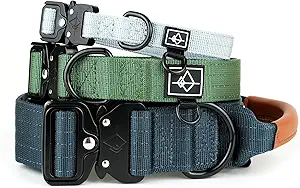 |
HapTop Shock Collar AC132
Best Overall Collar for Controlling a Large Dog

| Breed Recommendation | All Breed Sizes for 10-120lbs |
|---|---|
| Range | 4500FT |
| Waterproof Rating | IPX8 |
| Modes | Beep, Vibration, Safe Static |
| Battery | Rechargeable (fast 1.5-hour charging) |
This HapTop AC132 training collar is built for multi-dog households and for working with larger, stronger dogs thanks to a wide range of correction options and a claimed long radio range. The single remote pairs to two receivers so you can control two dogs independently during walks or recall practice, and modes include beep, vibration, adjustable Safe Static levels, plus a shock boost for stronger response when needed. The unit is marketed as IPX8 waterproof with an adjustable nylon strap that fits a broad neck range, and the receivers are rechargeable with long standby times and fast charging via the included USB cable. Practical benefits include the ability to start with low-impact cues and progress to static only when necessary, the memory function that keeps settings between sessions, and a safety lock to avoid accidental activation. Trade-offs are typical for powerful e-collars: accurate fit and skin contact are required for consistent stimulation, some owners prefer dedicated training vibration-only systems for sensitive dogs, and real-world range can vary with terrain and interference despite the 4500 foot claim.
Best for: Owners who need a single, versatile system to manage and train large, active dogs and who value multi-dog control with progressive correction options.
Less Ideal for: People who want a purely vibration-only trainer for very sensitive dogs or who prefer non-electronic training methods for everyday behavior control.
- Remote controls two receivers independently for simultaneous multi-dog training
- Multiple modes (beep, vibration, adjustable static levels) support progressive training
- Long claimed signal range suitable for off-leash recall and open-area work
- IPX8 waterproof receivers and adjustable nylon strap for active outdoor use
- Long standby battery life and fast charging with included USB cable
- Real-world range and reliability depend on terrain and can be less than the claimed maximum
- Requires correct fit and consistent skin contact for reliable static stimulation
Verdict: The best overall collar for controlling a large dog balances strength, secure fit, handling control, and comfort for daily walks and training.
Joytale Tactical Dog Collar Large
Best Budget Collar for Controlling a Large Dog

| Material Type | Nylon |
|---|---|
| Included Components | 2 free patches |
| Dog Breed Size | Large |
| Closure Type | Buckle |
This Joytale Tactical Dog Collar is built for strong, active dogs that need extra on-collar control. It combines double-layer 1000D reinforced nylon and heavy stitching for durability, a reinforced quick-release zinc alloy buckle to handle high loads, and a raised control handle with Velcro keeper so you can grab and stabilize your dog in tight situations. Inside the collar is a breathable padded lining to reduce chafing during longer wear, and a Velcro ID panel comes with two small patches for identification or signaling "in training." Typical use is walking, training, or outdoor activities where extra stopping power and a reliable attachment point are required. Practical benefits include the tougher-than-standard construction, easy-access handle for short-range control, and a metal buckle that reduces breakage risk compared with plastic closures. Limitations are that sizing is fixed to the listed size options so correct fit is important, and the tactical style is bulkier than slim everyday collars which may be overkill for calm or small-breed dogs.
Best for: Buyers who need a low-cost, tough collar that gives strong, short-range control during walks, training, or outdoor work with large, powerful dogs.
Less Ideal for: Owners seeking a minimalist, lightweight everyday collar for calm or small dogs should look for slimmer alternatives with less bulk.
- Reinforced 1000D nylon and heavy stitching for high durability
- Reinforced metal quick-release buckle designed to bear heavy loads
- Integrated control handle gives immediate short-range control in traffic or training
- Breathable padded inner lining reduces chafing for extended wear
- Velcro ID panel with two included patches for clear identification
- Tactical build is bulkier than slim collars and may feel heavy on less active dogs
- Size must be matched carefully since fit options are limited to listed sizes
Verdict: The best budget collar for controlling a large dog offers reliable control and durability at a lower price without major compromises in safety.
CANISALFA 4" Tactical Dog Collar Large
Best Heavy-Duty Collar

| Material Type | Nylon |
|---|---|
| Item Width | 4 inches |
| Closure Type | Buckle |
| Size | Large |
This wide tactical collar is built for control and durability with heavy 1000D nylon, neoprene padding, reinforced stitching, a metal quick-release buckle, and a sturdy D‑ring for leash or GPS attachment. Designed for large, powerful breeds, the 4-inch width spreads pressure across the neck and the padded interior reduces chafing during long walks or active play. The integrated handle gives instant manual control in crowded or emergency situations while the reflective stitching improves visibility on evening outings. In real-world use it performs like a training and working collar rather than a lightweight fashion collar: the hardware and reinforced construction withstand repeated pulling and rough handling but add weight and bulk compared with narrow collars. Expect a firmer, more secure feel at the cost of a larger profile around the neck, so check fit and comfort before extended wear.
Best for: Buyers who need a rugged, control-focused collar for large, powerful or very active dogs and prioritize strength and quick manual control during walks, training, and outdoor activities.
Less Ideal for: Owners seeking a lightweight, low-profile everyday collar for small or short-necked dogs or those wanting a minimalist appearance should consider narrower alternatives.
- Extra-wide 4 inch profile distributes pressure for better control of strong dogs
- 1000D nylon with reinforced stitching for long-term durability
- Neoprene padding reduces rubbing for more comfortable extended wear
- Integrated control handle provides quick manual restraint or guidance
- Quick-release metal buckle and sturdy D‑ring for secure attachments
- Bulky and heavier than standard collars which may feel large on some dogs
- Wide profile may limit comfort for dogs that prefer minimal neck coverage
Verdict: The best heavy-duty collar is made from reinforced materials and robust hardware to resist wear and keep large, powerful dogs secure.
Dogtra 280X E-Collar 1-Dog
Best Training Collar

| Range | 1/2 Mile |
|---|---|
| Output Levels | 100 Levels |
| Functions | Tone, Vibration, Boost |
| Waterproof | Yes |
| Expandability | Up to 3 Dogs |
The Dogtra 280X is a compact, trainer-focused remote e-collar built for everyday use with medium and large dogs. It provides tone, XPP vibration, and 100 graduated stimulation levels so handlers can fine-tune corrections, plus a front-mounted nick/continuous button for fast, single-handed response. The BOOST function lets you instantly raise output for immediate recall without turning the dial, and a safety level lock reduces accidental activations. The receiver is fully waterproof and includes a high-lumen LED for visibility during low-light outings, while removable contact points and multiple levels support coat and skin sensitivity. The system is expandable to control up to three dogs and comes with a USB-C charging splitter and practical accessories. Trade-offs are that it is a single-dog kit by default and relies on proper fit and responsible use to be effective and humane, so new trainers should review safe stimulation practices before use.
Best for: Handlers and trainers who need reliable, adjustable remote control for teaching and managing large, active dogs during off-leash work and outdoor training sessions.
Less Ideal for: Owners who want a non-stimulus-only approach or who are inexperienced with e-collars and prefer clicker-based or purely reward-driven training methods.
- Wide 100-level output lets you precisely match stimulation to a dog’s sensitivity
- BOOST quick-increase feature for immediate recall without adjusting the dial
- Waterproof receiver and durable construction suited for outdoor use
- Bright LED on the receiver improves visibility for night or low-light training
- Expandable system supports up to three dogs with additional receivers
- Listed as a 1-dog kit by default, additional receivers are required to train multiple dogs
- Requires responsible setup and training knowledge to avoid misuse
Verdict: The best training collar provides practical control features that help owners and trainers manage and teach large dogs safely and effectively.
KONG Ultra Padded Comfort Handle Collar Large
Best Padded Comfort Collar

| Breed Recommendation | Large Breeds |
|---|---|
| Material Type | Metal, Neoprene |
| Closure Type | Buckle, Snap |
| Size | Large |
This KONG padded comfort handle collar combines durable hardware with a soft neoprene interior to protect a large dog's neck during walks and quick corrections. It is designed with an integrated handle positioned near the buckle so you can grab and steady an excited or strong dog without reaching for the leash, and the sturdy metal snap buckle and D‑ring keep attachments secure. The neoprene padding reduces rubbing and pressure points compared with plain webbing, which helps on longer walks or for dogs that pull intermittently. It is fully adjustable across common large-dog neck ranges so you can get a snug fit, though the wider profile and metal hardware make it bulkier than minimalist collars. The collar works best as a control-oriented every-day collar rather than a training-only tool and requires proper fit to avoid transferring leash forces to the neck in heavy pullers.
Best for: Buyers who want a sturdy everyday collar that cushions the neck while giving immediate manual control of a large, active dog during walks and short interventions.
Less Ideal for: Owners looking for a lightweight, low-profile collar or those who need a primary solution for constant pullers should consider a padded harness instead.
- Neoprene interior padding reduces rubbing and increases comfort during walks
- Integrated handle offers quick, close control for managing a large dog
- Durable metal snap buckle and D‑ring hardware for secure leash attachment
- Fully adjustable sizing for common large-dog neck ranges
- Wider, heavier construction is bulkier than minimalist collars
- Not a substitute for a properly fitted harness for dogs that consistently pull
Verdict: The best padded comfort collar cushions the neck and prevents rubbing while still offering firm control for large, active dogs.
MADE TO ROAM Explorer Control Collar
Best Quick-Release Safety Collar

| Material Type | Nylon |
|---|---|
| Closure Type | Buckle |
| Breed Recommendation | All Breed Sizes |
| Dog Breed Size | Large |
The MADE TO ROAM Explorer Control Collar is built for active dogs and handlers who need dependable control and fast-release capability. It pairs double-layer heavy-duty nylon with reinforced stitching and rust-resistant metal hardware to withstand hiking, swimming, and daily wear. A built-in vegan leather control handle gives a handy grip point for close control in crowded or training situations, and the cobra-style quick-release metal buckle offers secure fastening with smooth one-handed opening when you need to remove the collar quickly. The collar is adjustable across multiple size ranges so it fits small to large dogs, and the weatherproof hardware reduces corrosion on wet outings. Expect a rugged collar that prioritizes reliability and easy handling, though its substantial hardware and construction make it heavier than lightweight fashion collars and may be more than some casual walkers need.
Best for: Buyers who prioritize secure control and quick removal for large, active dogs and who need a rugged collar that stands up to outdoor use and training.
Less Ideal for: Owners seeking an ultra-lightweight or breakaway safety collar for unsupervised wear should consider other options.
- Durable double-layer nylon with reinforced stitching for long-term outdoor use
- Rust-resistant metal hardware and cobra-style buckle for secure, reliable fastening
- Integrated vegan leather control handle for quick close control in crowded or training situations
- Adjustable sizing that fits small through large dogs for broad fitment
- Heavier, more robust construction than minimalist or fashion collars which may be unnecessary for low-activity pets
- No padded or quick-release breakaway option for dogs that need a safety breakaway feature
Verdict: The best quick-release safety collar combines secure control for managing large dogs with a reliable release feature for fast removal in emergencies.
Choosing the Right Collar Controlling Large Dog: Key Factors to Consider
Restraint Mechanism and Control Points
How a collar redirects or distributes force directly affects control and safety. Different designs use front attachment points, dual hardware, or limited-slip action to reduce pulling while avoiding sudden hard pressure on the trachea. For large dogs you need a mechanism that allows the handler to manage strong lunges without losing leverage or forcing excessive force into a small area. A collar with multiple attachment options can let you switch between gentle guidance and firmer control during training sessions.
Consider whether the mechanism offers progressive correction rather than a single sudden jolt. Smooth, predictable feedback makes it easier to teach desired behavior without escalating resistance from the dog. The placement of control points also matters for leash handling and the handler's balance during a walk.
Fit, Sizing, and Adjustability
A collar must fit snugly yet comfortably across a range of neck shapes and seasonal coat changes. For large dogs, small fit errors are amplified because higher forces can shift or loosen a poorly sized collar. Look for broad adjustment ranges, clearly marked sizing guides, and the ability to micro-adjust so the collar sits correctly without sliding toward the throat or shoulders.
Good adjustability also helps accommodate growth, weight fluctuation, or the extra bulk of a winter coat. Consider how easily you can put the collar on or take it off a reactive dog, and whether the design prevents the animal from slipping out when startled.
Material Strength and Hardware Durability
Durable materials matter more as dog size increases because tensile loads and abrasion rise with stronger dogs. High-strength webbing, reinforced stitching, and welded or heavy-duty metal rings resist deformation and failure under load. Corrosion-resistant hardware helps maintain safety if the collar gets wet or is used near water.
Also consider abrasion resistance against constant contact with fur and the environment. Softer padding can increase comfort but must be secured so it does not tear away under stress. Longevity is a value factor: a well-built collar reduces downtime from repairs and lowers the chance of sudden breakage while walking or training.
Comfort and Pressure Distribution
How a collar spreads pressure across the neck determines whether control comes at the cost of pain or tissue damage. Wide contact surfaces and padded liners reduce pressure peaks and chafing, which is particularly important for large dogs because handlers often need firmer control. Designs that funnel force across a broader area or redirect it to the shoulders can reduce throat compression.
Comfort also affects behavioral outcomes. Dogs that associate collars with pain are more likely to resist or develop anxiety. Choose collars that balance necessary control with soft contact points and materials that breathe and drain moisture to avoid skin irritation.
Handler Safety and Ergonomics
A collar should make it easier for a handler to maintain balance and control when a large dog pulls or lunges. Attachment placement and leash hardware orientation affect leverage and where corrective force is applied. Easy-to-reach buckles and low-profile clips help during quick adjustments, and reflective trims or high-visibility options support safer evening walks.
Consider how the collar integrates with your preferred leash styles. Some collars work better with short control leads, others with longer training lines. The ideal collar reduces the chance of sudden jerks transferring to the handler's arm or shoulder while allowing reliable release and reattachment when needed.
Training Compatibility and Behavioral Impact
Not every control collar is appropriate for every training goal. Some designs are intended for gradual behavioral shaping and pair well with positive reinforcement, while others offer stronger, immediate correction for reactive or high-drive dogs. Think about how the collar fits into your overall training plan, including whether you will use it during walks, in training sessions, or both.
The wrong tool can slow progress by increasing stress or resistance. Choose a collar that gives you the control you need while still allowing clear, repeatable cues that the dog can learn from. Also consider whether your training approach requires professional guidance for safe, effective use.
How Do I Size a Collar for a Large Dog Correctly?
Measure the neck at the base where the collar will sit using a flexible tape measure. Allow space for two fingers between the tape and the skin to ensure the collar will be snug but not constricting. Many large dogs have deep chests or thick necks, so check that the collar will not ride up toward the throat when the dog looks down or pulls.
If your dog is between sizes, choose the larger setting and adjust it down to fit. Verify fit after the dog has moved for a few minutes; some collars shift as fur settles or the dog changes posture. Recheck sizing seasonally, especially before cold months when the dog's coat will thicken.
- Measure snugly and then allow two fingers of clearance
- Try the collar on and observe while the dog walks and sits
- Re-measure after grooming or seasonal coat changes
Can Collars Reduce Pulling Without Causing Pain?
Yes, certain collar designs reduce pulling by redirecting force rather than concentrating it on the trachea. Front-attachment points and broader contact surfaces spread pressure across the neck and shoulders, offering control with less risk of sharp, painful pressure. Consistent, predictable feedback trains animals more effectively than sudden, high-intensity corrections.
Training methods play a major role: pair a control collar with positive reinforcement for best results. Use progressive steps to teach loose-leash walking so the dog learns that pulling removes reinforcement rather than triggers harsh correction.
- Prefer designs that distribute force across a wider area
- Combine collar use with reward-based training
- Avoid sudden, excessive force that can cause injury
What Safety Checks Should I Perform Before Each Walk?
Inspect hardware and webbing for cracks, fraying, or loose stitching. Check that buckles click securely and that the leash attachment point is not bent or worn. For collars with padding, ensure the liner has not separated or torn away from the shell.
Quickly confirm fit at the start of every outing by slipping two fingers under the collar. If the dog is particularly active or reactive, consider using a secondary safety leash or a harness as a backup while the dog is learning to accept the collar.
- Visual check for wear and damage
- Functional test of buckles and attachment points
- Confirm fit and clearance before leaving the house
Which Collars Pair Well with Training Programs?
Collars with adjustable control points and predictable restriction are easiest to integrate into stepwise training. Tools that allow short, clear corrections and immediate return to neutral foster better learning. For dogs in early training, choose collars that give you the option to start with gentler guidance and increase control as needed.
Collars that are comfortable enough for longer wear are useful when you need to practice behaviors throughout the day. Avoid devices that cause chronic discomfort, as these can undermine progress and create negative associations with handlers.
- Start with gentler settings and progress as behavior improves
- Use collars that allow quick transitions between training and casual walks
- Prioritize designs that encourage repeatable, clear signals
How to Maintain and Clean a Heavy-duty Collar
Regular maintenance extends a collar's service life and keeps it safe. Hand-wash webbing and padding with mild soap and warm water, rinse thoroughly, and air-dry away from direct heat. Metal hardware can be wiped and dried to prevent corrosion; test moving parts to ensure smooth operation.
Replace collars showing significant wear, such as stretched webbing, cracked hardware, or detached padding. Periodic checks after outdoor activities like swimming or muddy walks help catch issues before they become safety hazards.
- Wash and rinse thoroughly, air-dry completely
- Inspect hardware and stitching after heavy use
- Replace worn collars rather than attempting risky repairs
How We Chose the Best Collar Controlling Large Dog
We prioritized features that matter most when managing large dogs in everyday situations. Our selection criteria focused on restraint effectiveness, fit and adjustability, materials and construction, safety features, and handler ergonomics. Restraint effectiveness covers how well the collar lets you manage pulling and sudden movements without relying on excessive force. Fit and adjustability ensure a secure, comfortable contact across different body shapes and seasonal coat changes. Materials and construction looked at webbing strength, stitching quality, and corrosion-resistant hardware suitable for heavy use. Safety features included breakaway options where appropriate, padding to reduce chafing, and designs that minimize pressure on the throat or spine. Handler ergonomics considered attachment placement, control points, and how easily the leash clips engage or release. We excluded collars intended exclusively for very small dogs, decorative-only designs, or lightweight fashion collars that do not provide reliable restraint for larger breeds. Products that required specialist knowledge or professional-only use were also set aside. The final list emphasizes practical, durable collars that offer predictable control while reducing injury risk for both dog and handler.
Our full evaluation process is outlined in our review methodology.
FAQ
Can a specialized collar make a reactive large dog calmer?
A collar can help you manage a reactive dog by giving you more predictable control, but it does not replace behavior modification. Pair collar use with consistent training and, if necessary, professional guidance to address the underlying triggers of reactivity.
Is it safe to leave a control collar on all day?
Generally no. Control collars that apply constant pressure or restrict movement should not be worn continuously. Use them for walks or training sessions and switch to a comfortable everyday collar for unsupervised periods.
What if my dog slips its collar during a walk?
If a collar slips, stop in a safe area, secure the dog, and adjust to a tighter, comfortable fit. Consider a wider collar or one with non-slip liners and always have a backup plan such as a second leash or temporary tether during training.
Do larger dogs need thicker or wider collars?
Wider collars distribute pressure better and are often a safer choice for larger dogs because they reduce localized pressure on the neck. Material strength and proper fit are equally important to prevent slippage and ensure durability.
When should I consult a trainer or veterinarian about collar use?
Consult a professional if your dog consistently resists every collar, shows signs of pain, or is highly reactive despite management attempts. A trainer can advise on safe training strategies and a veterinarian can rule out medical causes for neck sensitivity or behavior changes.
Final Verdict
Prioritize safety, fit, and predictable control when choosing a collar for a large dog. Balance restraint strength with comfort by selecting a design that spreads pressure, offers reliable attachment points, and allows micro-adjustment for a secure fit. Think about how the collar will be used in training and daily walks, and accept reasonable tradeoffs between immediate control and long-term well-being. With attention to materials, sizing, and your training approach, you can pick a collar that helps you manage a large dog confidently and responsibly.

