

When you live with a reactive dog, the right collar can make daily outings safer and less stressful for both of you. A well-chosen collar helps you manage sudden lunges, provides predictable handling, and reduces strain on the dog's neck when used correctly. This guide shortlists the top collars for reactive dogs so you can focus on features that truly matter for control, comfort, and durability. We evaluated options using practical handling criteria, material performance, and adjustability to highlight collars suited to different training approaches and dog sizes. Read on to see which styles meet common needs for reactive-dog management.
Top Picks at a Glance
| Best Overall Collar for Reactive Dog The best all-around collar that balances control and comfort | PetSafe Gentle Leader Headcollar Medium |  |
| Best Budget Collar for Reactive Dog A low-cost option that still delivers reliable control and durability | Joytale Martingale Collar Large |  |
| Best Premium Collar A higher-end collar with upgraded materials and refined features | Educator ET-300 Mini E Collar |  |
| Best No-Pull Collar Designed to reduce forward lunging and improve leash manners quickly | Starmark Pro-Training Collar Large |  |
| Best Padded Collar Extra cushioning to minimize neck irritation during walks and training | Tacticollar Do Not Pet Collar Large |  |
| Best Quick-Release Collar A collar with fast-release hardware for safety and easy on/off | DEYACE Stainless Steel Training Collar XL |  |
| Best Reflective Collar High-visibility materials for safer evening and low-light outings | Joytale Reflective Neoprene Padded Collar Large |  |
PetSafe Gentle Leader Headcollar Medium
Best Overall Collar for Reactive Dog

| Breed Recommendation | Medium Breeds |
|---|---|
| Material Type | Neoprene, Nylon |
| Closure Type | Snap |
| Size | Medium |
The PetSafe Gentle Leader is a simple, behavior-focused headcollar that redirects a dog's forward momentum by guiding the head toward the handler, which reduces pulling on walks. It is typically used in place of a standard collar: fit the neck strap high behind the ears, slip the padded neoprene loop over the snout, clip the quick-snap buckle, and attach a leash to the center ring under the chin. Notable features include a quick-snap buckle for fast on and off, an adjustable nose loop with a snap clamp for secure fit, and minimal straps to keep the dog cool while wearing it. In practice the Gentle Leader lets dogs eat, pant, and play normally while giving owners clearer control and making training walks calmer. Limitations are that it requires careful measuring and fitting to avoid rubbing or rotation, and it will not work for dogs with very short snouts like pugs and bulldogs. New users should acclimate their dog off-leash to the nose loop first and follow the fitting directions for the best results.
Best for: Buyers who want a reliable everyday no-pull solution that prioritizes control and comfort for routine walks and training sessions.
Less Ideal for: Owners seeking a hands-off anti-pull device for brachycephalic breeds or those who do not want to fit and train a head-based tool.
- Effectively reduces pulling by guiding the head rather than forcing the neck
- Padded neoprene nose loop improves comfort during extended wear
- Quick-snap buckle and adjustable nose loop make fitting and removal fast
- Minimal strap design keeps the dog cooler and reduces bulk
- Requires careful measurement and fitting to avoid chafing or rotation
- Not suitable for breeds with very short snouts
Verdict: The best overall collar for reactive dogs that provides effective, humane control while staying comfortable for everyday walks and training.
Joytale Martingale Collar Large
Best Budget Collar for Reactive Dog

| Material Type | Nylon |
|---|---|
| Closure Type | Buckle |
| Size | L |
| Reflective | Yes |
The Joytale Martingale Collar is a budget-friendly nylon training collar designed to give owners more control over dogs that back out of standard collars or pull. It uses a cinch loop that tightens gently when the dog pulls, providing a corrective cue without a choke-chain feel, while a tri-glide slider and quick-release buckle make it easy to size and remove. Reflective stitching runs around the collar for added nighttime visibility and a rust-proof D-ring provides a leash attachment point. The collar is machine washable and made from high-density ripstop nylon, so it stands up to outdoor use and muddy walks. On the downside the corrective action is modest compared with heavier training systems, so very strong or highly reactive dogs may still require a harness or stronger head-control option, and the nylon hardware is basic compared with metal-only trainers. For owners on a tight budget who need a dependable escape-proof collar with decent durability and visibility, this is a practical choice.
Best for: Owners looking for an affordable, escape-resistant collar that gives gentle corrective feedback and improves visibility during everyday walks and basic leash training.
Less Ideal for: Handlers needing strong forceful control for very large, power-pulling or dangerously reactive dogs should consider a sturdier head halter or certified training harness instead.
- Cinch-style martingale provides gentle correction without a choke-chain effect
- Reflective stitching improves night visibility up to road headlight range
- Machine washable ripstop nylon holds up to outdoor use and mud
- Safety quick-release buckle and tri-glide slider allow easier on/off and a more precise fit
- Not as strong or forceful as specialty head-control collars or heavy-duty training gear
- Basic hardware may wear faster under extreme pulling or very large, highly reactive dogs
Verdict: The best budget collar for reactive dogs that offers dependable restraint and reasonable build quality for owners on a tighter budget.
Educator ET-300 Mini E Collar
Best Premium Collar

| Dog weight recommendation | 15+ lbs |
|---|---|
| Stimulation levels | 100 adjustable levels |
| Modes | Stimulation, Tone, Vibration |
| Water resistance | Waterproof |
| Included components | Receiver, Remote, Two contact point sets, Dual charger |
The Educator ET-300 Mini is a compact e-collar system designed for focused obedience and behavior work with dogs 15 pounds and up. The kit pairs a lightweight waterproof receiver with a floating remote and delivers 100 adjustable blunt stimulation levels along with tone and vibration modes, letting trainers dial responses to an individual dog rather than relying on a single intensity. The receiver and remote are built to withstand wet conditions and include an integrated LED for night visibility, and the package ships with two sets of contact points and a dual charger to keep both units ready. In practice the unit is suited to frequent outdoor training and real-world distraction management because of the long range and durable construction, and the multiple stimulation settings make it usable across a wide temperament range. Expect a premium feel and dependable electronics, but be prepared for a learning curve when setting the correct stimulation level and for paying more than budget alternatives for the refined controls and build quality.
Best for: Owners who prioritize dependable, durable training equipment and want precise, adjustable controls for intensive or long-term behavior work.
Less Ideal for: Casual owners seeking a low-cost, no-frills training aid or those uncomfortable using stimulation-based collars should consider alternative training tools.
- Very wide adjustment range with 100 stimulation levels for fine tuning
- Waterproof receiver and remote suitable for outdoor training in wet conditions
- Includes tone and vibration modes as non-shock communication options
- Built-in LED improves visibility during low-light sessions and tracking
- Kit includes extra contact points and a dual charger for continuous use
- Higher priced than basic training collars
- Requires time and care to find the correct stimulation level for each dog
Verdict: The best premium collar for owners who want top-tier materials, superior hardware, and extra comfort or adjustability for frequent use.
Starmark Pro-Training Collar Large
Best No-Pull Collar

| Breed Recommendation | Large, Medium |
|---|---|
| Material Type | Nylon, Polymer |
| Item Length | 20 inches |
| Size | Large |
| Included Components | Safety Clip |
The Starmark Pro-Training Collar is a martingale-style training collar that uses high-strength polymer "watchband" links to deliver gentle, distributed pressure for discouraging pulling and teaching leash manners. You size it by adding or removing links so the fit can be adjusted precisely, and the rounded link tips and martingale action reduce sharp pinching compared with metal chain collars. It includes a backup nylon slip collar and is intended for supervised training sessions rather than continuous wear. In practice the collar works well for owners doing short leash training sessions, handling lunging and sudden pulls more humanely than choke chains while offering enough control for large and strong dogs. Limitations are that it requires correct fitting to function and must not be left on an unattended dog, and the polymer links can be bulkier than a flat nylon collar which some dogs may find unfamiliar at first.
Best for: Owners focused on improving leash manners who want a humane, controllable training tool for short supervised sessions with medium to large dogs.
Less Ideal for: People seeking a collar for all-day wear, passive identification, or for unsupervised use should choose a regular flat collar or harness instead.
- Adjustable watchband-style links allow precise sizing for a snug training fit
- Polymer link construction provides distributed, rounded pressure that is gentler than metal choke chains
- Martingale design helps prevent slipping over the head while giving corrective leverage
- Includes a backup nylon slip collar for safety during training sessions
- Not intended for unsupervised or continuous wear and must be removed after training
- Requires proper fit and handling to be effective and safe
Verdict: The best no-pull collar for reactive dogs that need gentle redirection to discourage lunging while maintaining safety and control.
Tacticollar Do Not Pet Collar Large
Best Padded Collar

| Material Type | Nylon |
|---|---|
| Closure Type | Buckle |
| Inner Lining | Neoprene |
| Size (Large) | 20-26in neck, 2in width |
| Included Components | Leash |
This Tacticollar Do Not Pet collar is a rugged, visibly embroidered nylon collar with a soft neoprene inner lining designed to reduce chafing for reactive or easily stressed dogs. It is meant to be used as an everyday walking/training collar to signal others and limit unwanted approach, and it includes a quick-release metal buckle plus a strong metal D-ring and additional V-ring for secure leash attachment. The neoprene padding helps protect the neck from rubbing during prolonged wear or active outings, while the 2-inch width on medium/large sizes gives extra surface area for the message and distributes pressure more evenly than narrower collars. Its sturdy construction makes it suitable for working dogs and reactive dogs that need clear visual cues, but the collar is relatively heavy compared with thin webbing and is not a substitute for a properly fitted harness when you need serious control or to reduce pulling forces. Buyers should measure carefully for fit because the collar is firm and sized by neck circumference.
Best for: Someone who prioritizes comfort for a reactive dog while wanting a clear, durable visual warning to prevent unwanted interactions during walks and public outings.
Less Ideal for: Owners who need maximum control for large strong pullers or who prefer ultra-light minimalist collars for very small breeds should consider harnesses or lighter alternatives.
- Visible embroidered "Do Not Pet" message reduces unwanted interactions by pedestrians and other dogs
- Neoprene padded inner lining reduces chafing during extended wear
- Sturdy metal quick-release buckle and D-ring provide reliable leash attachment
- Wide 2-inch profile distributes pressure and supports clear messaging area
- Heavier and firmer than lightweight collars, which may feel bulky on very small dogs
- Not a replacement for a harness when needing to manage strong pulling or escape risks
Verdict: The best padded collar for reactive dogs prone to chafing or discomfort, offering soft, protective cushioning without sacrificing control.
DEYACE Stainless Steel Training Collar XL
Best Quick-Release Collar

| Size | XL Neck Girth 16.9"-22.2" |
|---|---|
| Material Type | Stainless Steel |
| Included Components | Additional 10 rubber covers and 1 link |
| Closure Type | Buckle |
This DEYACE stainless steel training collar is built as a quick-release pinch-style tool for obedience work and managing strong pullers. It uses interlocking metal links that can be added or removed to size the collar and a high-strength tactical-style quick-release buckle so the collar can be taken off fast without disassembling links. Rubber tip covers and slightly beveled link ends reduce sharp contact while the collar's even link distribution helps apply pressure around the neck rather than focusing on the trachea. The collar is intended for supervised training sessions rather than continuous wear and cleans easily with a damp cloth. Trade-offs are that it is a metal training device requiring owner knowledge and careful use to avoid causing discomfort, and it does not replace positive-reinforcement training tools like harnesses for long-term loose-leash walking. For reactive dogs this collar gives a quick-escape option and controlled correction when handled by someone who understands how to use pinch-style collars safely.
Best for: Owners who need a collar that can be removed instantly in tense moments and want a metal training tool that provides even, controllable corrections during supervised sessions.
Less Ideal for: People seeking a hands-off solution for long daily walks or owners who prefer purely positive reinforcement tools without pressure-based corrections.
- Quick-release tactical buckle allows fast on/off without removing links
- Adjustable by adding or removing interlocking links for a custom fit
- Rubber covers and beveled link tips reduce sharp contact against the neck
- Stainless steel construction increases rust resistance and is easy to wipe clean
- Designed to distribute pressure evenly around the neck rather than on the trachea
- Requires correct fitting and experienced handling to avoid misuse
- Not intended for unattended or continuous wear
- Metal pinch-style design may be uncomfortable for dogs not accustomed to correction collars
Verdict: The best quick-release collar for reactive dogs when you need the convenience of rapid removal and an added safety option in tense situations.
Joytale Reflective Neoprene Padded Collar Large
Best Reflective Collar
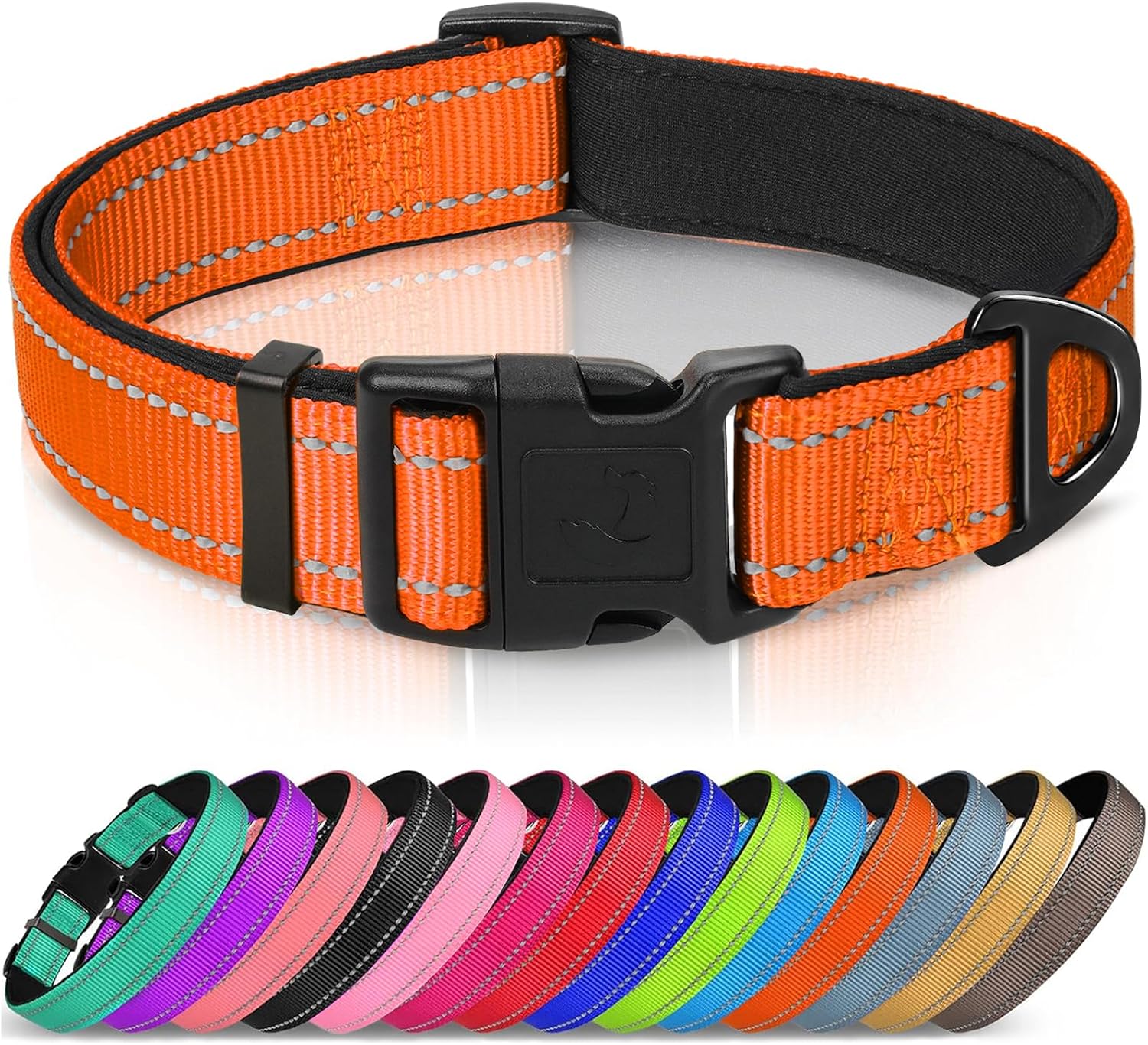
| Material Type | Metal, Neoprene, Nylon |
|---|---|
| Closure Type | Buckle |
| Size | Large (Pack of 1 |
| Breed Recommendation | Rottweiler Golden Retriever Pitbull Bulldog |
This Joytale collar combines reflective nylon webbing with a neoprene-padded lining and a metal D-ring to deliver a comfortable, visible option for nighttime or low-light walks. You attach a leash to the solid metal D-ring; the reflective threads around the collar increase 360° visibility to drivers and other pedestrians, which is helpful when walking along roads or through dimly lit areas. The neoprene padding reduces chafing and hair loss during extended wear, and the quick-release snap buckle makes putting the collar on and off fast. It is fully adjustable so it can fit growing dogs or be tightened for a snug fit on reactive dogs who need consistent control. Practical limitations: it is a basic buckle collar rather than a no-pull harness or head-collar, so it does not provide the mechanical braking advantages of those alternatives for strong pullers, and reflective threads improve visibility but are not a substitute for an illuminated light in very dark conditions. For owners who want a comfortable, visible everyday collar with a secure metal attachment point, this model is a straightforward choice.
Best for: Buyers who prioritize improving nighttime visibility and comfortable everyday wear for a reactive dog while keeping a simple, secure leash attachment.
Less Ideal for: Owners who need strong braking or redirection for powerful pullers should consider a no-pull harness or head-collar instead.
- 360° reflective nylon webbing increases visibility in low-light conditions
- Neoprene padded lining reduces neck chafing for all-day wear
- Solid metal D-ring provides a durable, secure leash attachment
- Quick-release buckle allows fast on/off and a locked fit
- Adjustable sizing accommodates growing or changing necks
- Basic buckle collar does not offer no-pull control or force distribution like a harness or head-collar
- Reflective threads enhance visibility but are less effective than active lights in complete darkness
Verdict: The best reflective collar for reactive dogs whose walks include low-light conditions, improving visibility to drivers and other pedestrians while retaining control features.
Choosing the Right Collar Reactive Dog: Key Factors to Consider
Control and Handling
How a collar affects your ability to manage sudden reactive behavior is central. Look for collars that allow you to guide the dog predictably without jerky corrections. Features such as low-stretch webbing, solid attachment points for leashes, and options for multiple leash positions can improve mechanical advantage and reduce surprises during a lunge.
Control design also interacts with training approach. A collar that gives consistent, proportional feedback helps you reinforce calm responses. Consider whether you want a fixed-point attachment or a front-clip option to redirect attention; either choice should let you maintain a steady, comfortable hold without causing the dog to choke or panic.
Fit and Adjustability
A proper fit keeps the collar secure and prevents slipping off during reactive episodes. Choose collars with a wide adjustment range and multiple sizing increments so you can fine-tune tension around the neck without over-tightening. Measure the neck at rest and allow room for two fingers under the collar as a starting point, then adjust for activity and coat thickness.
Adjustability matters for growing dogs and for thicker or thinner coats. Look for buckles and sliders that hold their position under load rather than creeping loose. A collar that sits correctly will reduce rubbing and improve leash control during sudden movements.
Material Durability and Hardware
Reactive dogs can put extra stress on collars through sudden pulls or repeated wear. Strong, abrasion-resistant webbing, corrosion-resistant metal hardware, and reinforced stitching extend service life and prevent failures at critical moments. Materials that resist fraying and hardware that resists bending or opening under load are essential for safety.
Consider the long-term environment too. If the dog swims, plays in mud, or spends time outdoors, select materials that tolerate moisture and clean easily without losing strength. Hardware placement and design should avoid weak points where a strap passes through a small buckle under high tension.
Comfort and Skin Protection
Comfort reduces stress and the chance of skin irritation that can worsen reactive behavior. Padding or soft backing can prevent chafing, especially on dogs with sensitive skin or thin coats. Rounded edges and smooth hardware reduce pressure points that might distract or inflame the dog during walks.
Breathable materials help prevent trapped moisture and hotspots, while hypoallergenic fabrics reduce the risk of contact dermatitis. Comfort also includes weight: heavy metal components may feel burdensome on smaller dogs, so balance robustness with the dog's size and strength.
Safety Features and Failure Modes
Understand how the collar behaves under stress so you can avoid accidental release or dangerous restraint. Check that buckles and attachment rings remain secure under load and that stitching is reinforced at stress points. Some collars include breakaway elements intended for emergency release; know whether that feature is appropriate for your use, since it can prevent entanglement but also allow a reactive dog to slip free.
Anticipate failure modes such as buckle fatigue, webbing abrasion, and metal deformation. Choosing a collar with quality hardware and redundant attachment points reduces the chance of catastrophic failure during an intense episode.
Visibility and Identification Options
When a reactive dog pulls away or becomes loose, quick identification and visibility matter. Collars that support reflective trim or high-visibility colors improve sightlines during low-light walks and busy areas. Secure ID tag attachment points and the ability to affix a microchip marker or phone number make reunification easier if the dog escapes.
Also consider whether the collar design interferes with tags or creates noise that could trigger the dog. A tidy attachment that keeps tags from clattering against the collar helps reduce extra stimuli that might worsen reactivity.
How Should I Fit a Collar on a Reactive Dog to Avoid Escapes?
Fitting is both a safety and control task. Start by measuring your dog's neck at the base where a collar normally sits. Adjust the collar so it is snug enough to prevent slipping but still allows you to comfortably slide two fingers between the collar and the dog's neck. For dogs with thick fur, check fit with the coat in its usual condition so the collar does not become loose once fur compresses during activity.
After initial fitting, test the collar with short controlled walks. If the dog can back out of the collar during a simulated tug, the fit needs tightening or a different closure type. Remember that some reactive dogs will try to wriggle free; a properly adjusted collar combined with a secondary safety measure, like a harness or a martingale-style loop used temporarily, can reduce escape risk while you work on behavioral strategies.
- Measure at the base of the neck, not the narrowest point.
- Allow two fingers under the collar as a baseline.
- Recheck fit regularly for weight or coat changes.
When Is a Front-clip Attachment Preferable for Reactive Dogs?
A front-clip leash attachment redirects a dog's forward momentum toward you, which can make it easier to steer attention away from triggers and reduce pulling. For dogs that lunge forward at visual or scent triggers, a front-clip option often gives more immediate leverage to pivot the dog back toward you without relying solely on neck pressure.
However, front-clip setups are a tool, not a cure. They work best when combined with training that teaches the dog to respond to body position, verbal cues, and rewards. If you need immediate redirection during a reactive episode, a front-clip attachment can provide more predictable mechanical advantage than a rear D-ring alone.
- Use front-clip for easier redirection of lunging dogs.
- Combine with reinforcement training for lasting change.
Can Padding or Wider Collars Reduce Neck Injury Risk?
Padded and wider collars spread contact over a larger area, which lowers localized pressure on the trachea and soft tissues. For dogs that frequently brace or lunge, this distribution can reduce the chance of sudden soft-tissue injury compared with narrow, thin collars. Padding also reduces rubbing and chafing that can occur during repeated movements.
That said, padding does not eliminate all risk. If a dog repeatedly experiences high-force pulls, consider using a collar for identification and a properly fitted harness designed for reactive management during walks. The collar should remain comfortable while the harness handles the majority of control.
- Wider collars distribute force and reduce pressure points.
- Padding improves comfort but not necessarily overall control.
What Maintenance Keeps a Reactive Dog's Collar Safe and Reliable?
Regular inspection prevents failures. Check webbing for frays, stitching for loosening, and hardware for bending, rust, or cracks. Replace any collar showing significant wear before it fails during a reactive incident. Clean materials per manufacturer guidelines to remove salt, mud, or chemicals that accelerate degradation.
Also confirm that buckles and sliders still hold under load. Some plastic buckles can weaken over time from UV exposure or repeated stress. Test attachment points by applying steady pull pressure to ensure rings and anchors remain secure. Routine maintenance extends service life and reduces the chance of unexpected release or breakage.
- Inspect for wear weekly if the dog is active outdoors.
- Clean and dry collars after exposure to moisture or salt.
- Replace collars with compromised hardware immediately.
How Can You Use a Collar Alongside Training to Manage Reactivity?
A collar is a management tool that should support training techniques. Use the collar to maintain safe distance and steady contact while you work on desensitization, counterconditioning, and impulse-control cues. Short, structured sessions where the dog is rewarded for calm orientation away from triggers make the collar's job easier.
Avoid relying on a collar alone to suppress reactive responses. Pair collar-based control with consistent training plans that build alternative behaviors. Over time, the goal is to reduce the frequency and intensity of reactive episodes so the collar becomes less of a restraint and more of a regular identification and safety device.
- Use the collar for safe, controlled practice sessions.
- Pair handling with reward-based training to change responses.
Are Breakaway or Quick-release Features Appropriate for Reactive Dogs?
Breakaway or quick-release elements can prevent entanglement in some situations, but they may also allow a reactive dog to free itself at a critical moment. Evaluate the environment and typical behaviors before choosing a collar with a breakaway. For dogs that bolt into traffic or are prone to escaping, a non-breakaway collar combined with other safety measures may be safer during walks.
If you select a quick-release feature, ensure it is robust enough to avoid accidental openings under normal handling forces but will release under extreme, hazardous snags. Understand the trade-off between emergency release and secure control before relying on this feature.
- Breakaway helps prevent entanglement but may permit escape.
- Balance emergency-release needs against control requirements.
How We Chose the Best Collar Reactive Dog
To assemble this list we applied clear, category-specific filters that reflect real-world needs for owners of reactive dogs. First, we prioritized collars that offer reliable control without encouraging gagging or airway restriction, favoring designs that distribute pressure and allow consistent handling. Second, durability was important: materials had to resist chewing, abrasion, and weather while retaining hardware integrity. Third, fit and adjustability were judged to ensure a secure, customized fit across neck shapes and coat types. Fourth, we considered user safety features such as breakaway options where appropriate, reinforced attachment points, and hardware that minimizes slipping or accidental release. Fifth, we looked at comfort-related traits like padding, rounded edges, and fabrics that reduce rubbing or hair matting. We excluded any collars intended primarily for punishment, those that rely on sudden shocks, or designs known to cause airway trauma when misused. We also filtered out options that lacked basic durability or had unsafe hardware. The final selection reflects a balance of control, comfort, and longevity suitable for reactive-dog management, emphasizing practical handling features, material quality, adjustability range, and attachment security.
Our full evaluation process is outlined in our review methodology.
FAQ
Should reactive dogs wear collars all the time or only during walks?
Usually a collar is worn for identification and short supervised periods, but many owners remove collars when the dog is unattended to prevent snags and injuries. For reactive dogs, use the collar during supervised outings and consider removing it when the dog is playing off-leash or confined unsupervised, unless the collar includes essential ID that must remain on.
Is a harness better than a collar for reactive dogs?
A harness can be better for distributing force and reducing neck strain during strong pulls, but collars still serve important roles for identification and quick handling. Many owners use a combination: a harness for daily walks and a well-fitted collar for ID and short-term control depending on the situation. Choice depends on the dog's size, lunging behavior, and training plan.
How often should I replace a collar used by a reactive dog?
Replace a collar immediately if you observe fraying, bent or cracked hardware, or any loss of integrity. Even without visible damage, inspect the collar regularly and plan to replace it sooner than for less active dogs, since repeated stress accelerates wear. Typical replacement intervals vary widely based on activity and materials.
Will a wider collar stop my dog from pulling?
A wider collar spreads pressure and can reduce localized discomfort, but it does not inherently prevent pulling. Pulling is a behavior issue that benefits from training and appropriate mechanical choices like front-clip attachments or harnesses designed to discourage pulling. Use collar features in combination with behavior modification for best results.
Can tags and dangling hardware make reactivity worse?
Yes, noisy or loose tags can add an extra stimulus that startles or distracts a reactive dog. Secure tags close to the collar and use quiet attachments if tag noise seems to trigger responses. Minimizing unnecessary stimuli on the collar can help keep the dog focused during walks.
Final Verdict
Prioritize secure fit, reliable hardware, and comfort when choosing a collar for a reactive dog. Think of the collar first as a safety and handling tool that supports training rather than as a standalone solution. Balance control needs against the risk of neck injury by selecting materials and designs that distribute force and provide stable attachment points. Ultimately, pair the right collar with consistent behavior work and regular inspections so you can manage reactive episodes safely while working toward calmer outings.

