

Getting the right collar to train puppy changes how quickly and cleanly basic commands take hold. A good training collar helps you steer attention, deliver consistent cues, and protect a puppy's neck while they learn. This guide shortlists the top collar options for training puppies and explains the practical tradeoffs between fit, material, and control features. We evaluated collars for secure, adjustable fit, gentle but effective control, and durability so you can choose a reliable option for leash work, name recall, and basic manners. Read on for the picks and the decision criteria that matter most when training a young dog.
Top Picks at a Glance
| Best Overall Collar A well-rounded choice that fits most puppies and owners | PaiPaitek No Shock Training Collar |  |
| Best Budget Collar A low-cost option that still holds up for everyday use | Starmark Pro-Training Collar Small |  |
| Best Training Collar Designed specifically to aid leash work and basic obedience training | HapTop AC131 Dog Shock Collar |  |
| Best Adjustable Collar Wide range of sizing for growing puppies and perfect fit | MOZETO Adjustable Stainless Steel Dog Collar |  |
| Best Heavy-Duty Collar Reinforced construction for strong pullers and active dogs | Xqpetlihai Tactical Dog Collar Large |  |
| Best Smart Collar Tech-enabled option with GPS or activity tracking features | Halo Collar 5 Wireless Dog Fence |  |
PaiPaitek No Shock Training Collar
Best Overall Collar

| Range | 3300 ft |
|---|---|
| Waterproof | IPX7 |
| Intensity levels | 9 vibration, 9 beep |
| Channels | 3 |
| Battery life | 20 days |
The PaiPaitek No Shock Training Collar is a vibration-and-beep e-collar designed for gentle, positive reinforcement training rather than static correction. It pairs a small receiver worn on the dog with an ergonomic remote that locks to avoid accidental signals and includes a wrist strap for on-the-go handling. You can select from nine vibration levels and nine beep patterns, so it is simple to find a setting that gets a French Bulldog's attention without causing fear. The system supports one remote controlling up to three receivers, useful if you train multiple dogs, and the advertised 3300 ft range makes it usable in yards or parks. IPX7 waterproofing and a rechargeable battery that the listing says lasts up to 20 days reduce interruptions during outdoor sessions. Limitations to note are typical of vibration-only collars: they rely on consistent timing and rewards from the handler and may be less effective on dogs that ignore vibration cues or are highly food- or distraction-driven, and very short-faced breeds like French Bulldogs need careful fit and monitoring to avoid rubbing or discomfort. For novices the intuitive controls, safety lock, and stepped intensity levels make the unit easy and confidence-building to use.
Best for: Owners new to electronic training who want an intuitive, low-stress collar with clear stepped intensity settings and simple setup to build safe training habits for a compact, brachycephalic breed.
Less Ideal for: Handlers who need immediate deterrence of high-risk behaviors or dogs that consistently ignore vibration cues should consider alternative training tools or professional guidance.
- No-shock vibration and beep modes with 9 adjustable intensity levels for gentle, customizable cues
- Safety lock and grippy remote design reduce accidental activations for beginner confidence
- Supports up to 3 receivers per remote for training multiple dogs independently
- IPX7 waterproof receiver and long advertised battery life simplify outdoor use
- Vibration-only stimulation can be ignored by some dogs and may be less effective than other modalities for stubborn behaviors
Verdict: The best overall collar balances comfort, adjustability, secure fastening, and training-friendly features to suit most puppy-training needs.
Starmark Pro-Training Collar Small
Best Budget Collar

| Breed Recommendation | Small-medium Breeds |
|---|---|
| Item Type Name | dog training collar |
| Material Type | Polymer |
| Closure Type | Snap |
| Included Components | Safety Clip |
The Starmark Pro-Training Collar is a compact martingale-style training collar made for small dogs that uses high-strength links you add or remove to size the loop precisely. It is intended for supervised training and walking to discourage pulling and lunging by applying gentle, distributed pressure around the neck rather than a hard pinch. Rounded link tips and a humane patented design make corrections less abrupt, and the included safety clip and backup nylon slip collar increase security during sessions. In practice the collar is lightweight and unobtrusive for everyday walks and travel, and the link system makes fitting straightforward without bulky hardware. Limitations include that it is a training tool meant to be used under supervision and should not be left on an unattended dog, and it does not replace a secure everyday buckle collar or harness for dogs that pull strongly or for long off-leash use.
Best for: Owners of small or lightweight dogs who want a low-profile training collar for walks and short supervised training sessions and prioritize a compact, travel-friendly option.
Less Ideal for: People needing a primary everyday restraint for strong pullers, large breeds, or off-leash control should choose a sturdier buckle collar or harness instead.
- Adjustable link system for a precise, low-profile fit
- Patented humane martingale design provides gentler corrections than metal prongs
- Lightweight and compact for travel and everyday wear on small dogs
- Includes safety clip and backup nylon slip collar for added security
- Not intended to be left on an unattended dog and requires supervised use
- Not suitable as the sole restraint for dogs that pull heavily or escape-minded
Verdict: The best budget collar offers reliable fit and basic durability for owners seeking an affordable, functional training collar.
HapTop AC131 Dog Shock Collar
Best Training Collar

| Training modes | Beep, Vibration, Safe Shock, Shock Boost |
|---|---|
| Range | 4500 ft |
| Fit neck | 7.8"-24.4" (10-120 lb) |
| Waterproof rating | IPX8 |
| Charging | USB-C |
The HapTop AC131 is a rechargeable e-collar kit designed for everyday obedience and distance work. It uses a 2-channel remote to control up to two dogs and offers four training modes: beep, vibration, safe shock (0–99 levels) and a shock boost, with the shock function optional for no-shock training. The remote's long 4500 foot range and memory for individual dog settings make it useful for off-leash recall, boundary training, and reinforcing commands across yards or trails. The receiver is IPX8 waterproof and the kit includes multiple prong lengths, silicone covers, a test light tool, and USB-C charging for practical field use. Safety-oriented features include an adjustable low-to-high stimulation range, a security lock to prevent accidental corrections, and a manufacturer guideline limiting continuous wear to 12 hours. Trade-offs are typical for this class: it relies on batteries and correct fitment to be effective, and some owners prefer vibration or beep-only methods before adding shock. The unit's feature set and range make it a strong daily trainer for owners willing to follow safe use guidelines.
Best for: Owners who want a versatile, safety-minded e-collar for regular obedience and distance work and who plan to use multiple training modes progressively.
Less Ideal for: People who want a purely non-aversive training tool or who are uncomfortable using shock-style corrections should choose vibration- or treat-based training alternatives.
- Very long 4500 ft remote range for off-leash training
- Multiple modes (beep, vibration, adjustable shock) for progressive training
- IPX8 waterproof receiver suitable for wet outdoor use
- Includes extra prongs, silicone covers, test light tool, and USB-C charging
- 2-channel remote controls two dogs and remembers individual settings
- Shock feature requires careful adjustment and responsible use to avoid misuse
- Not intended for continuous wear longer than 12 hours per day
Verdict: The best training collar prioritizes control, consistent feedback, and safe design to help owners teach leash manners and basic commands.
MOZETO Adjustable Stainless Steel Dog Collar
Best Adjustable Collar
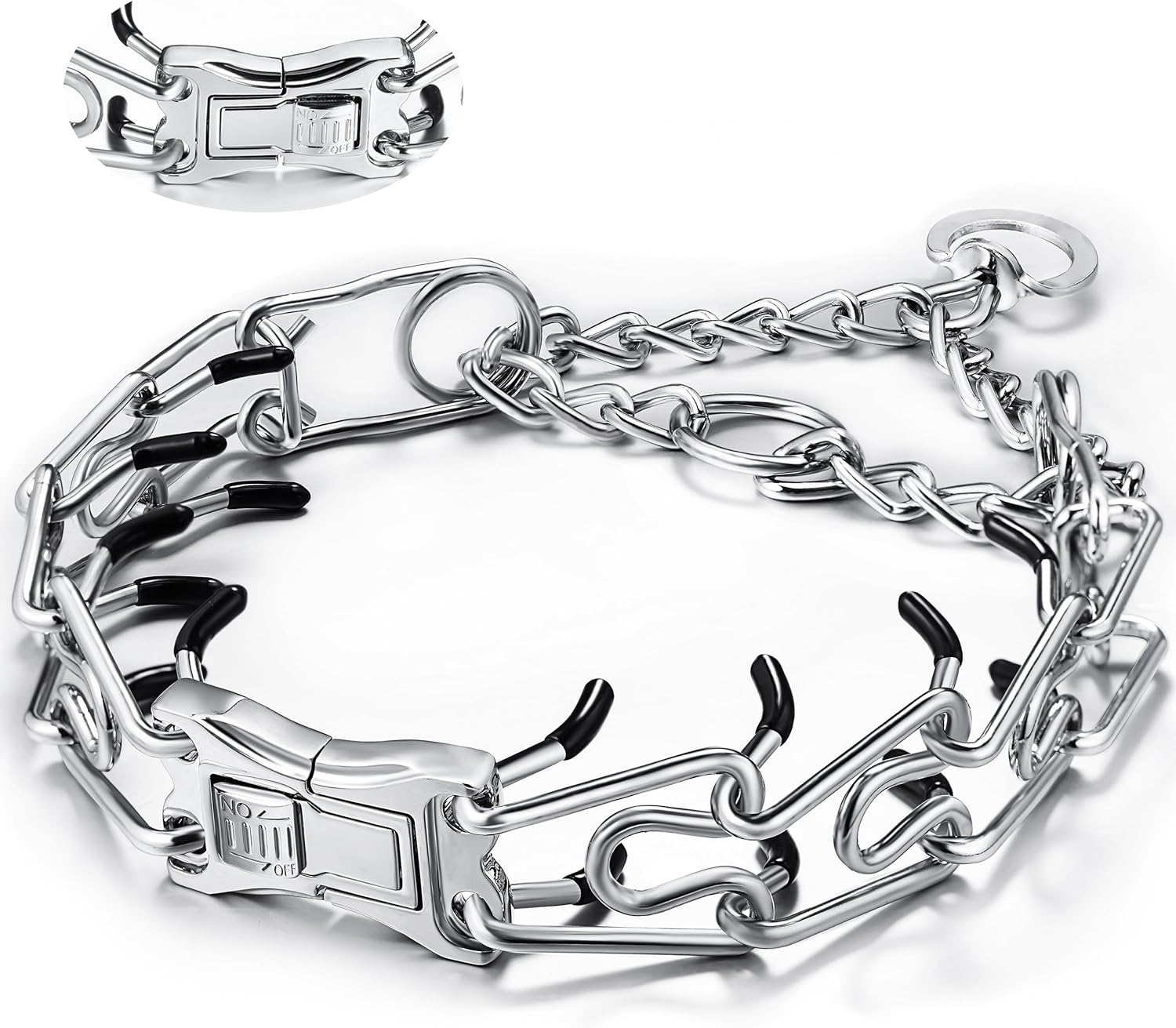
| Size | Neck Girth 16.9"-22.2" |
|---|---|
| Closure Type | Buckle |
| Material | Stainless steel (chrome-plated) |
This MOZETO adjustable pinch-style training collar is built from chrome-plated stainless steel links with rubber tips and a quick-release front buckle to apply a gentle corrective cue during walks and training sessions. It is typically used for leash training and correcting pulling or nuisance barking by imitating the natural correction mother dogs give puppies, and the included extra link lets you fine-tune fit as a puppy grows. The stainless construction and rubber covers make the collar rust-resistant and more comfortable against the skin than bare metal, while the rounded heads and smooth edges reduce the chance of pinching. The front quick-release buckle speeds leash attachment and removal compared with threaded pinch collars. Trade-offs are that this is a training-style pinch collar rather than a flat everyday collar, so it requires proper fitting and supervised use and may not be suitable for continuous wear or very young fragile puppies. Expect useful adjustability for growing necks but plan to transition to a regular flat collar once basic leash manners are established.
Best for: Buyers teaching leash manners who need a training collar that can be adjusted frequently as a puppy’s neck grows and that provides quick on-off access during supervised sessions.
Less Ideal for: Owners who want a daily-wear flat collar, very small or fragile puppies, or anyone uncomfortable with pinch-style correction should choose a different collar type.
- Adjustable metal link design lets you add or remove links for a closer fit as a puppy grows
- Quick-release front buckle simplifies attaching and removing the leash during training sessions
- Rubber-covered link heads and rounded edges reduce discomfort and lower the risk of pinching
- Chrome-plated stainless steel construction is rust-resistant and durable for outdoor use
- Not intended for constant wear; designed for training sessions under supervision
- Requires correct sizing and fitting knowledge to be safe and effective
Verdict: The best adjustable collar is easy to resize and stays secure as a puppy grows, preventing chafing while ensuring a proper fit.
Xqpetlihai Tactical Dog Collar Large
Best Heavy-Duty Collar

| Material Type | Nylon |
|---|---|
| Included Components | Tactical Dog Collar and Leash |
| Breed Recommendation | Medium, Large Breeds |
| Closure Type | Buckle, Button |
This Xqpetlihai tactical collar and leash set is built from 1000D reinforced nylon with a padded lining, a thick D-ring, and a heavy-duty metal buckle, making it suitable for training, walking, and outdoor work. It is typically used as a primary collar for medium to large dogs during training sessions or active outings; the stitched control handle gives a secure grip for close control and quick corrections. The padded lining and rounded 1.6-inch width help keep the collar comfortable during extended wear while the integrated buckle plus Velcro strap adds an extra layer of retention so the collar stays put under load. The included leash and robust hardware translate into a durable setup that tolerates frequent pulling and rough use better than cheaper webbing collars. Expect a rugged, utilitarian fit rather than a decorative collar, and be sure to measure your dog carefully since fit is important for both comfort and effective control. The collar is not a specialized shock-absorbing or hands-free design, so handlers who need stretch or shock mitigation may prefer a dedicated bungee leash or harness for high-impact pulling dogs.
Best for: Buyers who need a rugged, reliable collar for training and active outdoor use with medium or large dogs and prioritize strong hardware and control over decorative features.
Less Ideal for: People seeking a shock-absorbing, hands-free, or fashion-first collar should consider specialized leashes or harnesses instead.
- 1000D reinforced nylon construction for high abrasion resistance
- Heavy-duty metal buckle and thick D-ring for secure attachment under load
- Reinforced control handle with sturdy stitching for close handling during training
- Padded breathable lining improves comfort for extended wear
- Not designed to absorb shock or reduce impact from sudden pulls
Verdict: The best heavy-duty collar is built with tough materials and strong hardware to withstand pulling and active outdoor use without failing.
Halo Collar 5 Wireless Dog Fence
Best Smart Collar

| Battery | 1 Lithium Ion battery (included) |
|---|---|
| Waterproof rating | IP67 waterproof housing |
| Feedback modes | Sound, vibration, optional static |
| Included components | Contact tips, magnetic charger, Perfect Fit Kit, Pro Case + Strap |
| Breed recommendation | Dogs over 10 lbs (small to large) |
The Halo Collar 5 is a GPS wireless containment system built around Precision+ dual-frequency positioning and AI drift prevention to keep dogs inside app-defined virtual boundaries without wires or installation. You set fences in the Halo app, fit the collar with the included perfect-fit kit, and the collar provides graduated feedback — sound, vibration, and optional static — as the dog approaches a boundary while sending instant alerts and live location tracking if they exit. It includes activity monitoring and real-time location updates, and the waterproof housing plus magnetic charger make everyday use straightforward. The system requires a subscription to enable GPS, cellular data, and fence features, and nightly charging is recommended for best performance. Buyers should also expect a learning curve during guided training so dogs reliably respond to the cues, and occasional GPS limitations can occur in very dense urban canyons or heavy tree cover despite the improved accuracy.
Best for: Owners who prioritize top-tier containment accuracy and advanced safety features and are willing to invest in a subscription and premium hardware for reliable long-term performance with small dogs.
Less Ideal for: People seeking a one-time purchase, fully offline fence with no recurring fees or those who prefer a completely maintenance-free collar that never needs nightly charging.
- High-accuracy dual-frequency GPS with ground-station corrections for tighter virtual boundaries.
- No-install wireless fences that work across varied terrain and remote locations.
- Multiple feedback modes (sound, vibration, optional static) and guided training program to teach boundary behavior.
- Real-time location tracking and instant alerts for escapes plus activity insights.
- Waterproof housing and included fit kit, magnetic charger, and protective case options.
- Subscription required to activate GPS, fence, and tracking features.
- Requires nightly charging for best performance which adds routine maintenance.
- GPS can still be challenged in extremely dense urban or heavily forested areas despite improved accuracy.
Verdict: The best smart collar adds GPS tracking or activity monitoring for owners who want location safety and insight into a puppy’s daily activity.
Choosing the Right Collar Train Puppy: Key Factors to Consider
Fit and Sizing Range
A correct fit is the single most important factor when choosing a training collar for a puppy. Puppies grow quickly, so a collar with a wide adjustable range or straightforward sizing increments lets you tighten the fit as the neck expands without changing hardware. A snug fit prevents the collar from slipping over the head during training and keeps leash pressure centered on the neck rather than the throat.
Look for collars with clear neck-girth measurements and easy micro-adjustments. If a collar is too loose it can allow the puppy to back out or create inconsistent cue delivery, which confuses learning. If it is too tight it can irritate skin and interfere with breathing and swallowing.
Material and Padding
Material affects comfort, durability, and grip. Soft, breathable webbing with a smooth lining reduces chafing on delicate puppy skin, while neoprene or foam padding eases pressure during short training sessions. Heavier nylon or leather can be long-lasting but may be rigid on very young puppies until broken in.
Consider whether the material will cause rubbing during active play or when wet. Water-friendly fabrics and quick-dry linings are helpful for puppies that like to explore outdoors. Also factor in ease of cleaning, since puppy collars pick up drool, dirt, and fur.
Control Features and Cue Clarity
Training collars should help you deliver a clear, consistent cue without excessive force. Design elements that influence control include leash attachment placement, whether the collar is intended for steady-leash work or short leash cues, and any built-in features that moderate pressure distribution.
Avoid designs that create unpredictable pressure spikes. For basic obedience with puppies, look for collars that keep leash force centered and allow you to apply brief, repeatable guidance. The goal is predictable feedback that the puppy can link to a command, not prolonged discomfort.
Closure Type and Hardware
The closure and hardware affect safety and convenience. Quick-release buckles speed on and off and are helpful when puppies wriggle, but they must be sturdy enough to avoid accidental openings. Metal D-rings provide reliable leash attachment; plated or stainless finishes resist corrosion from outdoor exposure.
Check stitching quality at stress points and whether the buckle and ring are sized for a puppy's activities. Weak hardware can fail during a sudden pull, while overly large metal parts may be heavy for a small puppy.
Safety and Visibility Features
Visible collars and reflective trim make it easier to keep an eye on a puppy during low-light walks and early socialization outings. Some collars have breakaway elements designed to release under extreme force, which can be useful for certain environments but may not be appropriate for leash-controlled training sessions.
Evaluate whether reflective stitching or bright colors would help you locate your puppy and whether any release mechanism interferes with consistent cueing during training. Safety also includes non-toxic materials and hardware without sharp edges that could irritate the neck.
Adjustability for Growth and Leash Work
Because puppies change size rapidly, adjustability is essential. Collars with multiple adjustment points or sliding hardware let you fine-tune fit between growth stages. Some designs are intentionally minimal to prevent over-tightening, while others offer larger ranges to serve a puppy into adolescence.
Think about whether you want a collar that will last through several growth phases or a simpler, smaller option intended only for the earliest weeks. The right choice reduces the need to buy replacements frequently and helps maintain consistent training cues as the puppy matures.
How Tight Should a Training Collar Be on a Puppy?
Aim for a fit that allows two fingers to slide comfortably under the collar when the puppy is standing. This ensures the collar is snug enough to stay in place without compressing the neck or restricting breathing.
Check the fit again when the puppy is sitting or lying down, and after any adjustments are made. Reassess fit weekly during growth spurts and after grooming sessions that remove fur, since neck circumference can change noticeably.
- Two-finger rule for daily checks
- Reassess fit during growth spurts
- Avoid overly loose or overly tight adjustments
When Should I Switch From a Puppy-sized Collar?
You can switch once the collar is consistently near the end of its adjustment range or when the puppy's neck has reached a more stable circumference, usually after the first several months depending on breed. If the collar starts to chafe or slips over the head, it is time to replace it.
Monitor behavior and fit rather than strictly age. Some puppies will need a larger, more adult-oriented collar earlier if they grow quickly, while smaller breeds may stay in puppy sizes longer.
- Replace when adjustment range is nearly maxed out
- Watch for chafing or slippage as signs to change size
What's the Safest Way to Use a Training Collar During Leash Lessons?
Use short, frequent practice sessions and keep tension brief and purposeful. Apply leash pressure as a single, clear cue and immediately reward correct responses with praise or treats. This helps the puppy associate the physical cue with the command and the positive outcome.
Avoid leaving a training collar under constant tension and remove it for supervised off-leash play. If the collar includes a breakaway element, do not rely on it as a substitute for careful supervision during training.
- Short sessions with clear, brief leash cues
- Reward correct responses immediately
- Remove collar for unsupervised play when appropriate
Can I Use a Training Collar for Other Everyday Tasks?
Many training collars double as everyday collars for leash walks and identification tags, provided they are comfortable and durable. If you plan to attach ID tags, ensure the hardware is rated for the weight and that tags do not rub the puppy's neck.
For puppies that swim or play in mud, choose materials that dry quickly and do not retain odor. If a collar is primarily for training, consider a secondary, softer option for prolonged wear to reduce skin irritation.
- Check hardware for tag attachment suitability
- Consider a separate softer collar for long wear
- Prefer quick-dry fabrics for water play
How to Measure Your Puppy for the Right Collar Size
Use a flexible measuring tape around the base of the neck where the collar will sit, ensuring the tape is snug but not tight. Record the measurement and compare it to a collar's size guide, allowing room for two fingers under the collar for comfort.
If your puppy is between sizes, choose the larger size and tighten for a secure fit. Always remeasure after a growth spurt or seasonal coat changes.
- Measure at the base of the neck
- Allow two-finger space when checking fit
- When in doubt, opt for the larger adjustable size
How We Chose the Best Collar Train Puppy
We focused on features that directly affect training outcomes with puppies. Key evaluation criteria included fit adjustability and sizing options to get a snug, safe fit as a puppy grows; control and cue delivery, meaning how the collar helps you provide clear, repeatable signals without causing harm; material and comfort, including breathable webbing, soft padding, and hardware that resists rust and abrasion; ease of use for handlers, such as quick-release buckles or simple slide adjustments; safety features like reflective elements or breakaway designs where appropriate; and durability so the collar keeps its shape and function through washes and daily wear. We excluded collars intended solely for adult dogs without puppy sizing or those that rely on high-intensity correction methods that are inappropriate for developing bodies. We also filtered out products lacking clear sizing guidance or adjustable ranges unsuitable for common puppy weights and neck girths. The selections emphasize humane control, predictable cueing, and long-term fitability.
Our full evaluation process is outlined in our review methodology.
FAQ
Are training collars safe for very young puppies?
Training collars can be safe for young puppies when used appropriately with gentle, brief cues and correct sizing. Avoid high-intensity correction methods and choose collars designed for small necks with soft materials.
How often should I check a puppy's collar fit?
Check fit at least once a week and after any grooming or rapid growth periods. Puppies change quickly, so frequent checks prevent chafing and slipping and keep cues consistent.
Can I leave a training collar on all day?
It is usually better to remove training collars for unsupervised rest or play, especially if the collar applies pressure during leash work. For everyday identification, use a comfortable alternative collar when you are not actively training.
What collar features help with recall training?
A lightweight collar with a secure leash attachment and minimal bulk helps with recall training by allowing quick, clear signals. High-visibility colors and reflective trim make it easier to track the puppy at a distance.
Should I choose a breakaway collar for a puppy?
A breakaway collar can reduce entanglement risk in unsupervised environments, but it may release unexpectedly during training. Evaluate whether the breakaway mechanism conflicts with your training goals before choosing that design.
Final Verdict
Prioritize fit, gentle control, and durable, soft materials when choosing a collar to train puppy. A well-fitting collar that delivers predictable cues will speed learning while protecting delicate neck tissues. Balance the need for control with everyday comfort and adjustability for growth. Choose a collar that you can reliably fit and use for short, consistent training sessions, and plan to re-evaluate sizing as your puppy matures.

