

Teaching a puppy to walk politely on a leash starts with the right collar. The collar you choose affects comfort, learning speed, and how much control you have on daily outings. A good training collar helps communicate cues clearly without causing pain, stays secure through energetic behavior, and resists wear from damp or dirty conditions. This guide highlights seven shortlisted collars that perform well for teaching puppies to walk. We evaluate comfort, fit, adjustability, and control options so you can pick a collar that supports steady progress and safe walks. Read on for practical buying guidance and answers to common puppy walking questions.
Top Picks at a Glance
| Best Overall Collar A reliable, well-rounded collar that suits most puppies and owners | Joytale Reflective Padded Dog Collar Small |  |
| Best Budget Collar An affordable, no-frills collar that still performs reliably for daily walks | BOUMUSOE Puppy Collar and Leash Set |  |
| Best Premium Collar A higher-end collar with superior materials, finish, and long-term durability | Herm Sprenger Ultra-Plus Prong Collar 3.25mm 22" |  |
| Best Adjustable Collar A collar with wide size range and easy adjustments for growing puppies | MOZETO Adjustable Stainless Steel Dog Collar |  |
| Best Heavy-Duty Collar A rugged collar built to withstand strong pullers and active play | HONGSAGE Stainless Steel Chain Collar Small |  |
| Best Reflective Collar A collar with reflective detailing for better visibility on evening walks | ladoogo Reflective Padded Dog Collar Medium |  |
| Best Quick-Release Collar A collar with fast-release hardware for quick removal and safe handling | Erbine Padded Martingale Collar S |  |
Joytale Reflective Padded Dog Collar Small
Best Overall Collar

| Material Type | Metal, Neoprene, Nylon |
|---|---|
| Closure Type | Buckle |
| Size | Small (Pack of 1) |
| Age Range Description | All Life Stages |
This Joytale collar combines reflective nylon webbing, a neoprene-padded lining, and a metal D-ring to create a comfortable, visible, and durable everyday collar. It is used as a standard neck collar for walking, training, and general daily wear; the reflective threads improve visibility in low light while the soft neoprene lining helps reduce chafing and hair loss during extended use. The metal D-ring and solid snap buckle give a sturdier leash attachment than plastic hardware, so it holds up to energetic play while remaining easy to put on and remove. Because it is adjustable, the collar can accommodate a growing puppy over multiple months, though buyers should measure the neck to pick the correct size. The collar is lightweight and easy to clean, but small sizes are intended for small-breed necks so fit must be checked for broader-chested or fast-growing puppies. For a GSP puppy this collar offers a reassuring balance of comfort, visibility, and durable hardware for everyday use.
Best for: Owners who want a comfortable, visible everyday collar that adjusts as a puppy grows and uses it for walking and light training.
Less Ideal for: People needing a heavy-duty training or no-pull solution for strong pullers should choose a harness or specialized training collar instead.
- Reflective threads provide 360° visibility in low-light conditions
- Neoprene padding reduces neck chafing and protects sensitive skin
- Solid metal D-ring offers a durable, secure leash attachment
- Quick-release snap buckle makes on/off fast and convenient
- Size labeling targets small dogs so frequent resizing may be needed as a fast-growing GSP puppy matures
Verdict: The best overall collar balances comfort, adjustability, durability, and training-friendly features to work for the widest range of puppies and walking styles.
BOUMUSOE Puppy Collar and Leash Set
Best Budget Collar

| Number of Packs | 2 |
|---|---|
| Dog Breed Size | Small |
| Material Type | Metal, Nylon, Polyester |
| Closure Type | Snap |
This BOUMUSOE set pairs a soft nylon collar with a matching 120 cm leash and is built for everyday puppy use. The collar is adjustable from about 19 to 30 cm and uses a quick-release snap for fast on and off, while the leash attaches with a metal clip for secure walks. The materials listed are nylon, polyester, and metal, which makes the set lightweight, easy to clean, and wear resistant for active play and training sessions. You get two matching collars and leads in the pack, which is handy for backups or rotating while one is being washed. The high-visibility pattern adds a bit of style and helps with low-light visibility, but the set does not include padding or a training handle and the thinner webbing is best suited to small breeds and puppies rather than strong pullers. For basic daily walks, house training, and short outings this set delivers dependable function at a low cost.
Best for: Buyers seeking an inexpensive, no-frills collar and leash for puppies or small dogs who need a reliable everyday set for walks and basic training.
Less Ideal for: Owners of large, powerful dogs or anyone needing advanced training tools, heavy-duty hardware, or extra padding for long walks should look elsewhere.
- Includes both collar and 120 cm leash for immediate use
- Adjustable collar with quick-release buckle for easy on/off
- Lightweight nylon construction that is easy to clean
- Two-pack provides a spare or rotation option
- Narrow webbing and minimal padding make it unsuitable for large or strong pullers
- No extra training features such as padded handle or reflective strips beyond the pattern
Verdict: The best budget collar gives owners a low-cost option that still provides safe fit, basic durability, and dependable control during leash training.
Herm Sprenger Ultra-Plus Prong Collar 3.25mm 22"
Best Premium Collar

| Material Type | Stainless Steel |
|---|---|
| Size | 3.25 mm x 18" -22" (Pack of 1) |
| Closure Type | Slip On |
| Included Components | Ultra-Plus Stainless Dog Prong Training Collar 3.25mm 22" |
The Herm Sprenger Ultra-Plus prong collar is a heavy-duty stainless steel training collar intended for walking and obedience work with large dogs. It is used by slipping the collar on and adjusting fit by adding or removing individual links until the collar sits correctly on the neck; the patented center plate and symmetrical prong layout deliver uniform contact intended to mimic a maternal correction. In practice the collar offers precise, immediate feedback that helps during leash correction and handler communication, and the stainless construction resists rust and holds up to repeated outdoor use. Because it is a prong-style device, it is most effective when paired with consistent, trained handling and short, corrective cues rather than constant tension. The collar is not an electronic device and has no padding or shock features, so handlers should learn proper fitting and timing to avoid causing discomfort. Fit is straightforward for buyers who measure neck circumference and allow for link adjustments, but some owners will need to remove or add links to get a perfect fit.
Best for: Owners who prioritize a high-quality, factory-built training tool for firm, reliable leash corrections during walks and structured obedience sessions.
Less Ideal for: Owners who prefer non-aversive or hands-off training tools, first-time trainers unfamiliar with prong collars, or those who want a padded or electronic alternative.
- Durable stainless steel construction resists corrosion for long-term outdoor use
- Patented center plate and symmetric prong placement for even, predictable contact
- Adjustable by adding or removing links to achieve a precise fit
- Designed specifically for large, strong breeds and heavy-duty training scenarios
- Prong-style action can cause discomfort if misused and requires knowledgeable handling
- No cushioning or alternative correction modes for owners seeking gentler options
Verdict: The best premium collar is for owners willing to pay more for top-quality materials, craftsmanship, and features that last through intensive training and daily use.
MOZETO Adjustable Stainless Steel Dog Collar
Best Adjustable Collar
| Size | Neck Girth 16.9"-22.2" |
|---|---|
| Closure Type | Buckle |
| Material | Stainless steel (chrome-plated) |
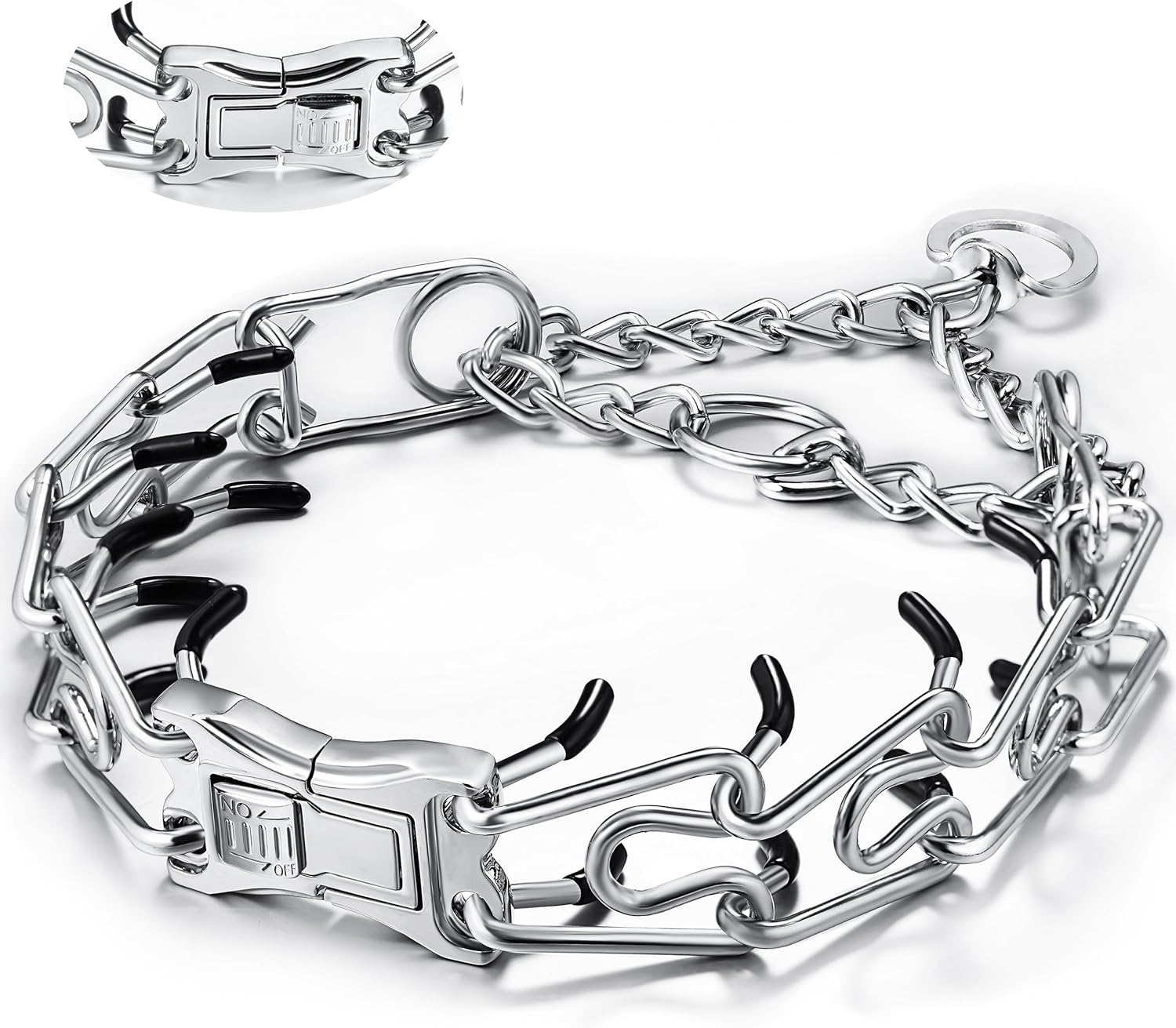
This MOZETO adjustable pinch-style training collar is built from chrome-plated stainless steel links with rubber tips and a quick-release front buckle to apply a gentle corrective cue during walks and training sessions. It is typically used for leash training and correcting pulling or nuisance barking by imitating the natural correction mother dogs give puppies, and the included extra link lets you fine-tune fit as a puppy grows. The stainless construction and rubber covers make the collar rust-resistant and more comfortable against the skin than bare metal, while the rounded heads and smooth edges reduce the chance of pinching. The front quick-release buckle speeds leash attachment and removal compared with threaded pinch collars. Trade-offs are that this is a training-style pinch collar rather than a flat everyday collar, so it requires proper fitting and supervised use and may not be suitable for continuous wear or very young fragile puppies. Expect useful adjustability for growing necks but plan to transition to a regular flat collar once basic leash manners are established.
Best for: Buyers teaching leash manners who need a training collar that can be adjusted frequently as a puppy’s neck grows and that provides quick on-off access during supervised sessions.
Less Ideal for: Owners who want a daily-wear flat collar, very small or fragile puppies, or anyone uncomfortable with pinch-style correction should choose a different collar type.
- Adjustable metal link design lets you add or remove links for a closer fit as a puppy grows
- Quick-release front buckle simplifies attaching and removing the leash during training sessions
- Rubber-covered link heads and rounded edges reduce discomfort and lower the risk of pinching
- Chrome-plated stainless steel construction is rust-resistant and durable for outdoor use
- Not intended for constant wear; designed for training sessions under supervision
- Requires correct sizing and fitting knowledge to be safe and effective
Verdict: The best adjustable collar fits growing puppies securely over time, offering easy size changes and consistent, comfortable control during walks and training.
HONGSAGE Stainless Steel Chain Collar Small
Best Heavy-Duty Collar

| Material Type | Metal, Stainless Steel |
|---|---|
| Size | Small: 18in x 2.5mm (neck max 16in) |
| Closure Type | Snap |
This stainless steel chain collar is built from 304 stainless links, O-ring hardware and a spring snap hook so it functions as a collar, a leash extension, and a connector for walking multiple dogs. In use it fits by clipping the snap hook to the appropriate chain link to size the neck, and the rounded, mirror-polished links reduce sharp edges for more comfortable wear. The metal construction resists rust and chewing better than fabric collars, so it is useful for training, gentle correction, and handling active puppies that pull. Because it is metal, it does not absorb dirt or odors and pairs easily with existing leashes, harnesses, or carriers. Trade-offs are that the chain style offers less padding than soft collars and can be heavier than webbing for very small or very young puppies, and sizing requires measuring the neck and adjusting links for a correct fit.
Best for: Buyers who prioritize a chew-resistant, low-maintenance collar for training and active walks and who want a metal option that doubles as a leash extension or multi-dog connector.
Less Ideal for: Owners seeking a soft, lightweight everyday collar for very young puppies or dogs that need padding and long-term continuous wear should consider a fabric or padded option instead.
- Made from 304 stainless steel for rust resistance and durability
- Multi-function design that serves as collar, leash extension, and multi-dog connector
- Rounded, mirror-polished links reduce sharp edges for more comfortable wear
- Spring snap hook and O-ring hardware work with most leashes and harnesses
- Chain style is less comfortable than padded or fabric collars for continuous wear
- May be relatively heavy for very small or very young puppies
Verdict: The best heavy-duty collar is designed for puppies who pull or play rough, with reinforced materials and hardware that resist wear and breakage.
ladoogo Reflective Padded Dog Collar Medium
Best Reflective Collar

| Size | Medium |
|---|---|
| Material Type | Metal, Neoprene, Nylon |
| Closure Type | Buckle |
| Included Components | Dog Leash |
| Breed Recommendation | Medium Breeds |
This ladoogo collar pairs a soft neoprene padded lining with durable nylon webbing and a metal D-ring to serve as an everyday collar for medium dogs. It is intended for walks and general wear, offering reflective stitching that boosts visibility in low light and a quick-release buckle for fast on/off. The padding keeps the collar comfortable on longer walks and reduces rubbing on active breeds like Australian Shepherds, while the rust-resistant metal hardware stands up to outdoor use. The package also includes a 5 ft leash with a foam handle and tangle-resistant hook, so you get a ready-to-go walking setup. Limitations: the buckle-style closure and single-width design mean it functions as a basic collar rather than a training or no-pull solution, and sizing depends on the medium fit so measure your dog's neck for a secure fit. Machine-washable materials make cleaning easy after muddy outings but heavy chewers may wear the nylon faster than purpose-built chew-resistant collars.
Best for: Owners who walk their Australian Shepherds in early morning or evening and want a more comfortable, visible everyday collar for regular walks and outdoor play.
Less Ideal for: Owners seeking a training, no-pull, or heavy-duty chew-resistant collar should look at specialized training harnesses or reinforced collars instead.
- Soft neoprene padding for added comfort during long walks
- Reflective threads for improved low-light visibility
- Durable nylon webbing with rust-resistant metal D-ring
- Quick-release buckle for easy on and off
- Includes a 5 ft leash with foam handle for immediate use
- Basic buckle collar design is not suited for no-pull control or training
- Medium size requires checking measurements for a proper fit
Verdict: The best reflective collar improves nighttime and low-light visibility to help keep puppies safer on walks without sacrificing comfort or fit.
Erbine Padded Martingale Collar S
Best Quick-Release Collar

| Size | S:width 3/4"neck 12-14.5" |
|---|---|
| Material Type | Alloy Steel, Neoprene, Nylon, Plastic |
| Closure Type | Buckle |
This Erbine padded martingale collar combines the gentle tightening action of a martingale with a plastic quick-release buckle for fast on/off in urgent situations. You use it like a normal collar for leash walks and training sessions: it tightens slightly when the dog pulls to discourage backing out, then relaxes when pressure is released. The neoprene-padded interior increases comfort during longer walks and the reflective stitching helps visibility in low light. A metal D-ring provides a reliable leash attachment for daily use, and the collar is adjustable and available in multiple sizes so you can fine-tune fit for a puppy. Important limits to note are that martingales are meant for supervised use only and should be removed for crate time, play with other dogs, or unattended wear; the plastic quick-release buckle is convenient but should be checked periodically for wear if your puppy is particularly strong or active. Machine-washable materials make cleanup straightforward after muddy training outings.
Best for: Puppy owners focused on leash training who need a collar that stays secure during walks but can be removed quickly between outings or in emergencies.
Less Ideal for: Owners who want a collar for constant, unattended wear, tie-outs, or for dogs that frequently chew hardware should consider other options.
- Martingale design prevents slipping without harsh choke corrections
- Quick-release plastic buckle allows rapid removal in emergencies
- Neoprene padding improves comfort on the neck during walks
- Reflective stitching increases visibility for early morning or evening outings
- Metal D-ring offers a secure leash attachment for daily training
- Not intended for unsupervised wear such as crate time or tie-outs
- Plastic buckle may require periodic inspection with very strong chewers or pullers
Verdict: The best quick-release collar lets owners remove the collar rapidly in emergencies or between outings while still providing secure attachment during walks and training.
Choosing the Right Collar Train Puppy Walk: Key Factors to Consider
Fit and Adjustability
A properly fitting collar is essential for safety and effective training. Puppies grow quickly, so adjustable range matters more than rigid sizing. Look for collars with clear measurement guidelines and multiple adjustment points to ensure a snug, non-restrictive fit that still prevents slipping over the head.
A collar that is too loose can allow the puppy to back out or twist the leash in ways that hinder learning, while a collar that is too tight can cause irritation and discourage the dog. Consider collars with easily operated buckles or slides so you can make small size changes as the puppy gains weight or length.
Control Mechanism and Cue Delivery
Different collars transmit handler cues in distinct ways. Flat buckle collars give steady contact for attaching a leash, while limited-slip or martingale-style collars tighten slightly under tension to prevent slipping. Some training collars use short, directional correction to interrupt pulling without prolonged pressure. Evaluate how a collar communicates a cue and whether that cue matches your training philosophy and skill level.
The ideal mechanism lets you deliver consistent, repeatable signals so the puppy can link the handler action with the desired behavior. Avoid collars that produce unpredictable pressure points or that require excessive force to be effective.
Material and Durability
Puppy collars need to withstand chewing, rough play, and exposure to water or dirt. Materials such as woven nylon, soft yet strong synthetic webbing, or flexible leather vary in durability, drying time, and maintenance needs. Hardware quality matters: rust-resistant D-rings and sturdy buckles reduce the risk of failure during walks.
Choose materials that hold up to the puppy's typical activity level and your care routine. If you expect frequent wet-weather outings, prioritize quick-drying synthetics. For puppies prone to chewing, a tougher weave or reinforced stitching will extend the collar's usable life.
Safety Features
Safety features protect the puppy during exploratory behavior and accidental snags. Breakaway buckles can prevent strangulation risks for very curious puppies, though they are less suitable when you need guaranteed retention on leash. Reflective trims or high-visibility colors improve visibility on low-light walks.
Think about your environment: busy streets call for high retention and visible collars, while supervised backyard play may allow for a lighter breakaway design. Ensure any safety feature does not undermine the collar's primary training function.
Comfort and Skin Sensitivity
Puppies have sensitive skin and fine coats that can irritate with rough materials or poorly placed hardware. Look for collars with soft edges, smooth hardware contact areas, and breathable materials to reduce chafing. Padding can help for longer leash sessions, but it also adds bulk that may trap moisture.
Comfort influences how willing a puppy is to wear the collar and how readily they accept training. If your puppy shows rubbing or hair loss, switch materials or trim the wearing time to let the skin recover while continuing short supervised sessions.
Ease of Cleaning and Maintenance
Training collars often pick up dirt, saliva, and odors. Materials that are machine washable or that rinse clean easily keep a collar sanitary and comfortable. Hardware that resists corrosion makes cleaning more effective and preserves function.
Regular inspection and cleaning also reveal early wear or damage that could compromise safety. Select collars with low-maintenance finishes if you plan frequent outdoor walks or messy training sessions.
How Tight Should a Puppy Collar Be for Walking?
Aim for a fit where you can slide two fingers comfortably between the collar and the puppy's neck. This provides a secure feel without constriction and allows for breathing and panting. Check the fit when the puppy has a full coat and again after grooming to account for changes in thickness.
Reassess the fit weekly for young puppies, especially during growth spurts. If the collar shifts excessively or the puppy can slip a paw between the collar and their neck in a way that twists the collar, tighten slightly or choose a different style with better retention.
- Two-finger rule for a baseline fit
- Recheck fit after grooming and during growth
- Adjust before long walks or training sessions
When Should You Switch to a Different Collar Type?
Switching collar types is a judgment call based on behavior and training progress. If the puppy consistently pulls despite consistent training, consider a collar that offers more control while you work on loose-leash skills. Conversely, if a corrective-style collar causes distress or confusion, move to a gentler option and consult a training plan that emphasizes positive reinforcement.
Also change collar type if the current collar no longer fits properly or shows wear that could fail during a walk. As the puppy grows, you may also graduate to sturdier hardware and wider webbing to match increased strength.
- Move to higher control for persistent pulling
- Return to gentler designs if the puppy shows stress
- Upgrade hardware and width as strength increases
Can a Collar Alone Solve Leash Pulling?
A collar is a tool for cue delivery, not a standalone solution. Consistent training, timing, and reward-based reinforcement are necessary to change a puppy's walking behavior. Using a collar that communicates cues clearly makes training more efficient, but success depends on repetition and handler consistency.
Combine collar use with short, frequent practice sessions, rewards for loose-leash periods, and simple redirection techniques. If pulling persists, review your handling technique and consider professional advice rather than relying solely on equipment.
- Collars assist cue delivery but do not replace training
- Pair with rewards and consistent timing
- Seek coaching if progress stalls
How to Introduce a Collar to a Young Puppy
Introduce the collar gradually and positively. Start by letting the puppy sniff and examine the collar, then briefly place it on for a minute or two while offering treats and praise. Increase wearing time in short increments until the puppy is comfortable wearing it during supervised indoor activity.
Once the puppy tolerates the collar, attach a lightweight leash and practice walking indoors before moving outside. Keep early sessions short and upbeat so the puppy forms a positive association with wearing a collar and taking steps on a leash.
- Allow sniffing and short wear periods
- Use treats and praise to build positive associations
- Practice indoors before outdoor walks
What to Look for in Hardware and Attachments
Look for a solid D-ring or attachment point that resists twisting and stays centered on the neck. Buckles should be easy to fasten and unfasten with one hand, yet robust enough to withstand sudden tugs. Smooth, rounded hardware reduces the chance of catching fur or skin.
If you plan to add ID tags, ensure the attachment point does not allow tags to hang so close to the leash connection that they cause noise or distraction during training. For visibility, consider reflective stitching or a loop for a clip-on light.
- Centered, sturdy D-ring for leash attachment
- One-hand-operable buckles with secure locking
- Consider reflective details or tag placement
When to Consult a Trainer About Collar Choices
Consult a trainer if the puppy displays fear, aggression, or sustained distress when wearing a collar or when corrections are applied. A trainer can help tailor equipment choices to your puppy's temperament and your training goals and demonstrate safe handling techniques.
Also seek guidance if leash reactivity or chronic pulling persists despite consistent training with an appropriate collar. A professional can diagnose underlying causes and recommend a course of action that may include alternative equipment or behavior modification strategies.
- Get help if the puppy shows fear or aggression
- Trainer can advise on equipment and handling
- Consider professional guidance for persistent pulling
How We Chose the Best Collar Train Puppy Walk
We shortlisted collars that balance control with puppy comfort and clear cueing. Our selection process emphasized collars designed for training small, growing dogs and those offering secure, adjustable fit so a collar can be resized as a puppy grows. Key evaluation criteria included adjustability and fit range, construction materials and durability, the collar's control mechanics and how they transmit cues, safety features such as quick-release or breakaway options when appropriate, and ease of cleaning for everyday use. We excluded collars intended only for adult dogs or specialized sport applications that require advanced handling skills. We also omitted products that lack sizing information or fail basic safety features. For each candidate, we prioritized items that make consistent cueing simple, allow incremental tightening or leverage without pain, and hold up to typical puppy wear. The result is a group of collars suited to building reliable loose-leash walking, with options that favor either minimal interference or a bit more corrective control depending on training approach.
Our full evaluation process is outlined in our review methodology.
FAQ
What size collar should I buy for a puppy?
Choose a collar that lists an adjustable range including your puppy's current neck measurement plus room to grow. Look for clear sizing charts and select a size that lets you adjust down as the puppy fills out. If in doubt, pick a smaller range with good adjustability rather than an oversized collar.
Are breakaway collars safe for walking a puppy?
Breakaway collars reduce strangulation risk during unsupervised play but are not ideal for walking because they can release under leash tension. Use a breakaway only for supervised time when you want safety from catches, and use a retention-focused collar for controlled walks.
How often should I check my puppy's collar fit?
Check the fit weekly for young puppies and before each long walk. Adjust the collar more frequently during growth spurts or after grooming. Regular checks help prevent slipping and rubbing as the puppy changes size.
Can collars cause skin irritation in puppies?
Yes, rough materials, tight fit, or trapped moisture can cause rubbing and irritation. Choose soft-edged collars, rinse and dry the collar regularly, and limit wearing time while you identify a comfortable material. If irritation persists, remove the collar and consult a veterinarian.
Should I use a training collar for daily walks?
Many owners use a training collar during daily training sessions and a simpler flat collar for nontraining outings. The best approach depends on your training goals and the puppy's response. Keep sessions short and consistent, and avoid leaving corrective-style collars on for extended unsupervised wear.
Final Verdict
Pick a collar that balances secure fit and gentle, repeatable cueing. Prioritize adjustability and comfort for a growing puppy, and choose materials and hardware suited to your typical walking environment. Remember that a collar is an aid to training rather than a quick fix; pair the right collar with consistent, reward-based practice to see steady improvement. If you face persistent problems or worry about welfare, seek professional guidance to match tools and techniques to your puppy's needs.

