

Getting the right crate for a Boston terrier puppy matters for training, safety, and everyday comfort. A properly sized crate gives your puppy a secure den-like space, helps with house training, and reduces stress during alone time or travel. This guide shortlists seven top options suited to Boston terrier puppies and explains the practical features that matter, from internal dimensions to ventilation and cleaning ease. We evaluated each crate against key criteria so you can pick one that fits your puppy's current size and growth expectations.
Top Picks at a Glance
| Best Overall Crate The best all-around choice for most Boston Terrier puppy owners | MidWest iCrate 24-Inch Single Door |  |
| Best Budget Crate A low-cost option that still meets basic safety and training needs | DUMOS 24 Inch Dog Crate |  |
| Best Compact Crate A smaller-footprint crate suited to apartments and limited indoor spaces | MidWest iCrate 18-Inch |  |
| Best Heavy-Duty Crate Built from stronger materials for chewers and long-term use | Homey Pet 37" Dog Crate |  |
| Best Travel-Friendly Crate Lightweight, portable design that’s easy to move and store | Petmate Vari Dog Kennel 24in |  |
| Best Easy-Clean Crate Designed for quick cleanup after accidents and everyday messes | Amazon Basics Foldable Metal Dog Crate 24" |  |
| Best Premium Crate A higher-end pick with extra features and refined build quality | Diggs Evolv Dog Crate Small |  |
MidWest iCrate 24-Inch Single Door
Best Overall Crate
| Breed recommendation | Small (12-20 lbs) |
|---|---|
| Included components | Divider, Removable Tray |
| Number of doors | 2 |
| Gap size | 1.5 inches |
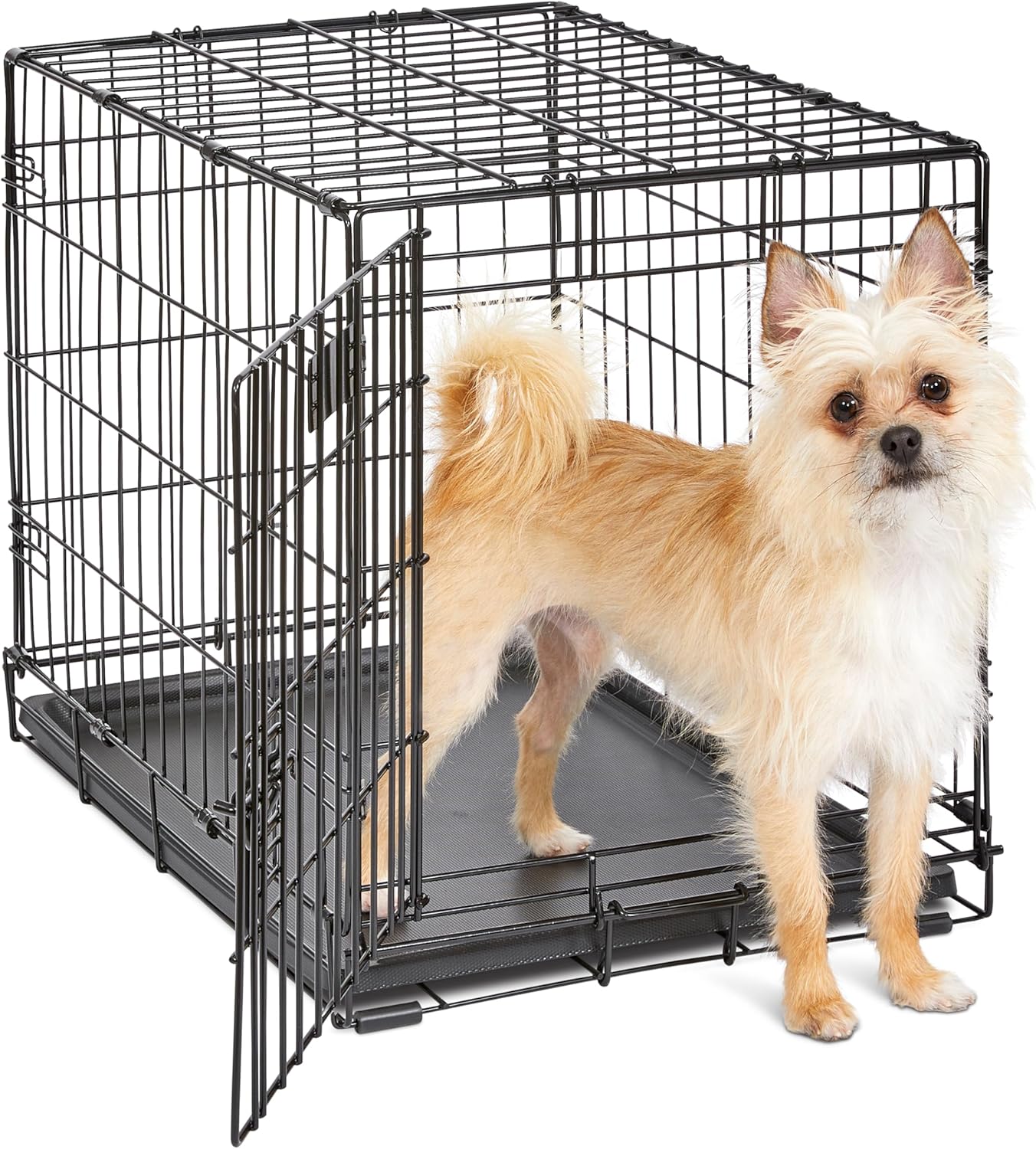
The MidWest iCrate is a straightforward, durable wire crate designed for puppy and small-dog use. It folds flat for storage and travel, sets up without tools, and includes a removable leak-proof tray and rubber feet that make daily cleanup and floor protection simple. Security features such as a slide-bolt latch with a patented Paw Block and locking tips improve escape resistance compared with basic wire crates, and the divider panel lets you shrink the interior for a growing puppy. The low threshold and larger openings make it easier for puppies to enter and exit during crate training, while the carry handle and relatively lightweight construction help with moving the crate between rooms. Trade-offs are the basic metal-wire styling and lack of sound-absorbing panels, so it will not mask noise as well as soft-sided or more heavily padded options, and very active chewers may eventually damage the wire. For everyday house training and short-term confinement, the iCrate balances safety, convenience, and value.
Best for: Buyers who want a practical, durable crate for everyday crate training and short-term confinement that can grow with a puppy and is easy to clean and move around the home.
Less Ideal for: People seeking a noise-dampening, heavily padded den-style crate or a solution for dogs that are destructive chewers should consider other crate types.
- Fold-flat, tool-free setup and portable carry handle for easy moving and storage
- Divider panel included to adjust interior space as a puppy grows
- Leak-proof removable tray makes cleaning fast and sanitary
- Slide-bolt latch with Paw Block and locking tips increases escape resistance
- Precision-welded metal wire with black e-coat finish resists rust for long-term use
- Metal wire construction offers minimal sound insulation or cushioning
- Not suited for heavy chewers who can bend or damage wire panels
Verdict: The best overall crate that balances size, durability, ventilation, and ease of use for everyday training and home use with a Boston Terrier puppy.
DUMOS 24 Inch Dog Crate
Best Budget Crate

| Material Type | Metal |
|---|---|
| Number of Doors | 1 |
| Additional Features | Easy to Clean, Foldable, Portable |
| Specific Uses For Product | Indoor, Outdoor |
This DUMOS 24-inch dog crate is a straightforward, no-frills option for house training and short-term containment. Its metal wire frame with a black protective finish and rounded corners gives a basic level of durability while reducing sharp edges that could injure a curious puppy. The single large door and low threshold make access easy, and the heavy-duty sliding bolt latch holds the door closed against pawing. Cleaning is simplified by a removable plastic tray with a raised lip to help contain messes, and the whole unit wipes clean. The crate folds flat to under 3 inches and includes a carrying handle, so it is easy to store or move between rooms and to bring on short trips. Expect a simple, lightweight kennel suited to small breeds rather than a heavy-duty long-term solution, and note there are no divider panels or extra accessories for extended confinement or multiple growth stages.
Best for: Owners who want an affordable, portable crate for house training and short-term use with small puppies and dogs, prioritizing easy cleaning and simple secure containment.
Less Ideal for: People who need a long-term, heavy-duty kennel, chewer-proof solution, or a crate that accommodates a growing puppy through divider adjustments.
- Foldable design collapses flat for easy storage and transport
- Removable plastic pan with deep lip simplifies cleanup and contains spills
- Rounded corners and protective finish reduce sharp edges and resist rust
- Single large door with heavy-duty sliding bolt latch for secure closure
- No divider panel for adjusting interior space as a puppy grows
- Basic metal wire construction is lightweight and not intended for heavy chewers
Verdict: The best budget crate that provides reliable containment and basic comfort for a puppy without extra features, ideal for cost-conscious owners.
MidWest iCrate 18-Inch
Best Compact Crate

| Breed Recommendation | Extra Small |
|---|---|
| Included Components | Divider, Removable Tray |
| Number of Doors | 2 |
| Material Type | Metal |
| Gap Size | 37.5 millimeters |
The MidWest iCrate 18-inch is a compact folding metal dog crate intended for extra small dogs and crate training in tight spaces. It folds flat for storage and travel, includes a divider panel so it can be used for puppies as they grow, and has a leak-proof removable tray that makes cleanup simple. The slide-bolt latch has added safety features such as a Paw Block and locking tips to reduce escapes, and rubber feet protect floors while a carry handle helps move the crate between rooms or on trips. Built from precision-welded wire with a black e-coat finish, it resists rust and is durable for everyday indoor use. Limitations are its small internal space — dogs near the 10 lb limit may need the next size up for comfortable long-term housing — and the metal wire design offers no built-in padding, so a separate bed or mat is necessary for comfort. For apartment or travel use the iCrate balances security, portability, and easy cleanup in a compact footprint.
Best for: Buyers who need a space-saving, portable crate for apartment living or short-term confinement of very small dogs and puppies prioritizing easy cleanup and transport.
Less Ideal for: Owners of medium or larger dogs or anyone wanting a plush, padded crate where pets will spend long unsupervised periods should choose a larger or more cushioned option.
- Compact fold-flat design for easy storage and travel
- Includes divider panel to adapt as a puppy grows
- Leak-proof removable tray speeds cleanup
- Slide-bolt latch with Paw Block and locking tips for added security
- Durable welded wire with rust-resistant e-coat finish
- Small interior best suited to extra small dogs and short-term use
- No built-in bedding so a separate pad is required
Verdict: The best compact crate for owners who need a secure, space-saving containment solution for a Boston Terrier puppy in tighter living areas.
Homey Pet 37" Dog Crate
Best Heavy-Duty Crate

| Material Type | Alloy Steel, Metal |
|---|---|
| Gap Size | 0.5 inches |
| Number of Doors | 2 |
| Included Components | Bowl, Lockable Caster Wheels, Removable Floor Grid, Removable Tray |
This Homey Pet 37" crate is a sturdy steel wire kennel built for everyday kenneling and tougher dogs that push or paw at their enclosure. It uses a steel tube frame with powder-coated finish, a crescent auto-lock and secure door latches to reduce escape risk, and comes with two removable floor grids plus a slide-out leakproof tray for easier cleaning and to keep the dog elevated from waste. Lockable 360° caster wheels make it simple to move between rooms and then secure in place, and included bowls and a bowl holder add basic feeding convenience. The open-top design and side door give easy access for training, checking the dog, and loading bedding. Expect a solid, heavy-feeling crate that resists rust and handles regular use, but it is relatively large and built-heavy which can make it awkward to lift without wheels and may be more crate than some households need for occasional use or very small dogs.
Best for: Buyers who need a durable, escape-resistant crate for medium dogs and prioritize secure latches, rust resistance, and easy cleaning in daily or multi-dog use.
Less Ideal for: People looking for a lightweight travel crate or owners of very large, exceptionally strong dogs who need an industrial-grade kennel should consider other options.
- Heavy steel tube frame and powder-coated finish for durability and rust resistance
- Crescent auto-lock and secure latches designed to reduce escape attempts
- Removable metal floor grids plus a slide-out leakproof tray for easier cleaning and hygiene
- Lockable 360° caster wheels for easy relocation and stable positioning
- Open-top and side door access simplify training, feeding, and cleaning
- Bulky and heavy when wheels are removed, making manual lifting awkward
- Not designed for very large or extra-powerful escape artists beyond medium-breed strength
Verdict: The best heavy-duty crate for puppies that need more robust construction and security to resist chewing and frequent use.
Petmate Vari Dog Kennel 24in
Best Travel-Friendly Crate

| Recommended weight range | 10–20 lbs |
|---|---|
| Exterior dimensions | 24.1 x 16.7 x 14.5 inches |
| Material Type | Plastic |
| Maximum weight recommendation | 9 pounds |
The Petmate Vari Dog Kennel is a sturdy plastic travel crate intended for small dogs and puppies and is used for car trips, vet visits, and most airline travel. It assembles without tools and secures with a durable wire door that includes an easy-open latch and tamper-proof holes for added security during transport. The shell offers four-sided ventilation and a stay-dry moat to pull fluids away from the pet, which simplifies cleanup and helps with housebreaking. Because it is made from molded plastic and includes airline-friendly design cues, it is a practical option when you need a rugged, wipe-clean carrier that meets common cargo requirements. The kennel is not collapsible or fabric-based, so it does not fold flat for packing and is bulkier to store or carry compared with soft-sided travel crates; you should also confirm specific airline rules before flying. For everyday travel and short trips where a durable, easy-to-clean carrier is needed, this kennel performs well.
Best for: Buyers who prioritize a rugged, airline-friendly kennel for short trips, vet visits, or housebreaking small puppies and who want a crate that is easy to clean and secure.
Less Ideal for: Owners who need a lightweight, foldable carrier for frequent airline gate checks or who require a crate sized for medium to large dogs should consider other options.
- Sturdy molded plastic construction for durable, wipe-clean use
- Wire door with easy-open latch and tamper-proof holes for secure transport
- Four-sided ventilation keeps pets cool and visible
- Stay-dry moat directs fluids away from the pet for easier cleanup and housebreaking
- Rigid hard-sided design does not fold flat for compact storage or packing
- Size targets small dogs only, so not suitable for larger breeds
Verdict: The best travel-friendly crate for owners who need a collapsible or lightweight option for car trips, visits, and easy storage.
Amazon Basics Foldable Metal Dog Crate 24"
Best Easy-Clean Crate

| Specific Uses For Product | Indoor |
|---|---|
| Breed Recommendation | Small Breeds |
| Number of Doors | 1 |
| Included Components | Divider |
| Material Type | Metal |
This Amazon Basics 24" foldable metal wire crate is a straightforward, space-conscious option for housing a small dog or puppy indoors. It assembles quickly, folds flat for storage or transport, and includes a top handle so you can move it without disassembly. The removable plastic tray makes spot cleaning simple, while the included divider lets you shrink the interior for younger pups as they grow. The manual door latch is secure for everyday containment and the crate's metal construction uses a high proportion of recycled material. On the practical side it is basic rather than plush: there is no padding or full enclosure for added warmth and the single-door layout limits placement flexibility. The 15 mm gap between wires suits small breeds but would not contain persistent escape artists or larger dogs. For small-space homes this crate balances durability, portability, and easy cleaning, but expect to add bedding or a mat for comfort and consider heavier-duty hardware if your puppy chews or pushes aggressively.
Best for: Buyers needing a compact, easy-to-store containment solution for a small puppy in apartments or homes with limited floor space who prioritize portability and simple cleaning.
Less Ideal for: People who need a heavy-duty crate for larger or destructive dogs, or those who want an insulated, fully enclosed den-style crate without adding bedding or accessories.
- Compact, foldable design for easy storage and transport
- Removable plastic tray speeds up cleaning
- Included divider lets you reduce interior space for young puppies
- Durable metal wire construction with manual latch for secure containment
- Top handle simplifies carrying when folded flat
- Single-door layout can limit placement options in tight rooms
- No built-in padding or insulation so bedding is required for comfort
- Wire gap size and lightweight latch may not deter very persistent chewers
Verdict: The best easy-clean crate for households that prioritize simple maintenance, with removable trays or wipeable surfaces to handle puppy messes efficiently.
Diggs Evolv Dog Crate Small
Best Premium Crate

| Number of Doors | 4 |
|---|---|
| Included Components | Removable Tray |
| Material Type | Mesh |
| Breed Recommendation | Small Breeds |
The Diggs Evolv is a premium indoor dog crate that combines a furniture-forward look with practical crate features for daily home use. It is built as a modular system: the crate ships with two doors and allows repositioning or adding up to four doors to create an open playpen or change traffic flow. Safety features include dual-lock doors, rounded corners, and diamond mesh that reduces the risk of jaw or paw entrapment, and the finish is free of phthalates and heavy metals. Assembly is tool-friendly and the included removable tray makes cleaning straightforward. The Evolv is intended as a room-facing, stationary crate rather than a travel kennel, so its focus is on aesthetics, durability, and comfort compatibility — Diggs offers fitted accessories such as an orthopedic Bolstr bed and clip-on crate bowl to complete the setup. Limitations are that additional doors and some accessories require separate purchase and the mesh/mesh construction and design prioritize indoor style over packable portability.
Best for: Buyers who prioritize a high-quality, home-friendly crate that looks like furniture and will be used daily as a permanent indoor space for their dog.
Less Ideal for: People who need a lightweight, portable travel kennel or a budget metal wire crate for occasional use should consider other options.
- Modular door system lets you reposition doors or convert into a playpen for flexible use.
- Dual-lock doors and rounded corners improve security and reduce pinch risk.
- Removable tray simplifies cleaning and maintenance.
- Designed to pair with fitted comfort accessories like an orthopedic bed and clip-on bowl.
- Additional doors and some accessories are sold separately, increasing total cost.
- Not designed for travel or outdoor use due to its furniture-style construction.
Verdict: The best premium crate for owners willing to invest in superior materials, added comfort features, and long-term durability for their puppy.
Choosing the Right Crate Boston Terrier Puppy: Key Factors to Consider
Correct Sizing and Growth Allowance
Choosing the right internal dimensions is the most important factor for a Boston terrier puppy because the crate should feel snug but not cramped. Puppies need enough room to stand up, turn around, and lie down comfortably; a crate that is too large can undermine housetraining by allowing a separate potty area. Consider crates with adjustable dividers or multiple size options so the same unit works through growth stages. Measure your puppy from nose to tail and floor to shoulder and compare those figures against the crate's usable interior space rather than external dimensions.
Also think about future needs. Boston terriers grow quickly in the first months, so a crate that accommodates an adult's body length while using a divider for puppyhood saves you from replacing units later. Ensure the door height and floor area match the breed's proportions rather than general small-dog dimensions.
Material Durability and Chew Resistance
Puppies explore with their mouths, so the crate's construction must resist chewing and rough handling. Metal wire crates offer strong structure and teeth-resistant borders, while reinforced plastic or heavy-duty fabric options should use thick panels and robust stitching. Check that corners and latches are solidly made and that welds or seams will hold up to repeated opening and closing.
Material choice also affects longevity and safety. Smooth finishes and rounded edges reduce the risk of cuts or snags on a wriggling puppy. If the crate includes coatings or paint, ensure they are advertised as pet-safe or non-toxic to avoid ingestion risks if a puppy chews coated surfaces.
Ventilation and Visibility
Proper airflow keeps a confined puppy comfortable and prevents overheating, especially in warmer climates or indoor spaces with limited circulation. Look for crates with multiple vent openings or wire panels that promote cross-ventilation. Visibility matters for both the puppy and the owner: wire or slatted sides help reduce anxiety by allowing the puppy to see the environment and let owners check on the puppy without opening the door.
However, consider placement: a crate with high visibility may not provide the den-like enclosure some puppies prefer. Many owners balance this by using a cover over part of the crate to create a darker, cozier area while keeping vents open for airflow.
Door Design and Latch Security
Door placement, size, and latch design affect safety and convenience. A front- or side-mounted door should open smoothly and latch securely without complicated mechanisms that are hard to operate with one hand. For a curious puppy, a reliable latch prevents accidental escapes; dual-latch systems or secondary locks are useful if the puppy learns to manipulate a simple latch.
Also consider how the door affects placement in a room. Sliding or folding doors save space in tight areas. If you plan to carry the crate or move it frequently, a door that locks flat for transport prevents rattling and keeps the puppy secure.
Cleanability and Maintenance
House training creates inevitable messes, so choose a crate that is easy to clean. Removable trays, waterproof bases, or wipeable surfaces simplify cleanup of accidents and shedding. Materials that withstand repeated washing or disinfecting without degrading will keep the crate sanitary over time.
Also look for features that reduce trapped dirt, such as raised floors or smooth seams. If the crate has fabric components, check whether covers or pads are machine-washable. Easy disassembly helps with thorough cleaning and storage between uses.
Portability and Setup Simplicity
How often you will move the crate and how easy it is to assemble matter for busy owners. Lightweight, folding designs with quick-release latches are helpful for travel, visits to the vet, or rearranging rooms. Conversely, very lightweight crates may be less stable if the puppy becomes active inside, so consider a balance between portability and sturdiness.
A crate that folds flat or breaks down into a few panels saves storage space. Clear, tool-free assembly instructions reduce setup time and frustration. If you plan to transport the crate in a vehicle, check its folded dimensions to ensure it fits easily in your trunk.
How Big Should a Crate Be for a Boston Terrier Puppy and when Should You Size Up?
A properly sized crate allows a Boston terrier puppy to stand, turn, and lie down without excess space that could encourage soiling. Start by measuring the puppy's standing length and height; choose a crate whose usable interior length exceeds the puppy's body length by a few inches. Many owners use dividers to make a larger crate puppy-appropriate and then remove the divider as the dog grows.
Size up when your puppy consistently seems cramped, has difficulty turning around, or reaches a weight or length close to the crate's interior limits. Watch behavior: if the puppy refuses to enter, scratches incessantly, or sleeps near the door instead of on a bed, the crate may be too small or poorly arranged.
- Measure nose-to-tail and shoulder height for an accurate fit
- Use a divider to adapt a larger crate for puppyhood
- Re-evaluate size every few months during rapid growth
What Bedding and Accessories Work Best for Confined Puppies?
Choose bedding that is comfortable, washable, and sized to leave some floor area exposed for easy cleaning. Thin, low-profile pads prevent instability and reduce the chance a puppy drags bedding into a soiled corner. Waterproof liners under bedding protect the crate base and simplify accident cleanup.
Include a chew-safe toy or a comfort item that smells like the owner to reduce anxiety. Avoid heavy or loose fillings that a determined puppy could pull apart. If you use a cover, ensure it does not block ventilation or create overheating risks.
- Machine-washable pads with waterproof liners
- Low-profile bedding to avoid crowding
- One or two sturdy, safe chew toys
Can a Crate Help with Separation Anxiety and Housetraining?
Yes. When used correctly, a crate can become a predictable, calming space that reduces separation anxiety by providing routine and a secure spot to rest. Gradual crate training with positive reinforcement teaches the puppy that the crate is a safe place rather than punishment.
For housetraining, limiting accessible space helps puppies learn bladder and bowel control. Combine consistent scheduling, frequent outdoor breaks, and immediate praise when the puppy eliminates outside. Avoid leaving a puppy confined for too long, as that can lead to accidents and stress.
- Use short, supervised crate sessions at first
- Pair crate time with treats or quiet toys
- Maintain a tight bathroom schedule for housetraining
Where Should You Place the Crate in Your Home?
Place the crate in a quiet, temperature-stable area where family activity is visible but not overwhelming. Boston terrier puppies often prefer to be near people, especially during early nights, so a corner of a common room or a bedroom can help reduce anxiety. Avoid direct sunlight, drafty spots, or near heaters where temperatures fluctuate.
If using the crate for travel, practice in the chosen home location first so the puppy associates the crate with calm experiences rather than car rides alone. Keep the crate on a stable surface and ensure doors can open freely without obstruction.
- Choose a spot with moderate household traffic
- Avoid extreme temperatures and direct sunlight
- Keep the crate accessible for quick checks and cleanups
Do Crate Covers Help and How Should You Use Them Safely?
Covers can create a den-like atmosphere that helps some puppies relax by reducing visual stimulation. Use covers that allow airflow and do not fully enclose the crate, especially in warm conditions. Secure the cover so it cannot be pulled into the crate by a curious puppy.
Rotate between covered and uncovered sessions so the puppy remains comfortable with both conditions. If the puppy shows signs of overheating, remove the cover and ensure adequate ventilation and hydration.
- Use breathable covers that still permit airflow
- Monitor puppies closely when first introducing a cover
- Avoid covering in hot rooms or when the puppy is panting
How We Chose the Best Crate Boston Terrier Puppy
We selected crates based on criteria that reflect real-life needs for Boston terrier puppies and their owners. First, correct internal dimensions and adjustability were required to ensure a secure fit now and within months of growth. Second, structural durability and material safety were prioritized to withstand chewing and regular handling while using non-toxic finishes. Third, ventilation and visibility were evaluated to keep puppies comfortable and to let owners monitor behavior. Fourth, ease of cleaning and water-resistance were considered for housetraining practicality and long-term hygiene. Fifth, portability and setup simplicity mattered for owners who travel or move the crate between rooms. Sixth, included safety features and latch reliability were checked to prevent escapes and accidental openings. We excluded products designed only for adult dogs where size or door placement would not suit a puppy, and units that lack basic safety or assembly instructions. Our shortlisting filtered out crates with questionable materials or poor reviews for structural failures. The final list focuses on options that balance sizing, durability, ventilation, and cleaning in ways that help with training and everyday use.
Our full evaluation process is outlined in our review methodology.
FAQ
How long can I safely leave a Boston terrier puppy in a crate?
Young puppies should not be left crated for long stretches. Typically, a puppy can hold their bladder roughly one hour per month of age, so plan short, supervised crate sessions and frequent bathroom breaks. For overnight, ensure the crate is comfortable and that the puppy had a recent walk and bathroom opportunity.
What crate features reduce chewing and escape attempts?
Look for sturdy materials, reinforced latches, and minimal gaps where a puppy could get teeth or paws. Metal wire frames with solid welds or thick panels and secure, child-resistant latches help prevent escapes. Providing chew-appropriate toys also redirects mouthing from the crate itself.
Should I crate my Boston terrier puppy at night?
Crating at night can be helpful for housetraining and safety. Place the crate near you initially so the puppy feels secure and can be taken out for middle-of-the-night bathroom breaks. Gradually move the crate if you prefer the puppy to sleep elsewhere once housetraining is established.
Are soft-sided crates okay for a Boston terrier puppy?
Soft-sided crates can be suitable for very young, calm puppies under supervision and for short-term travel. However, for teething or more active puppies prone to chewing or pushing, sturdier wire or reinforced plastic crates offer better durability and escape resistance.
How do I introduce my puppy to a crate without causing fear?
Start by placing treats and toys in the crate and leaving the door open so the puppy explores voluntarily. Use short, positively reinforced sessions and gradually increase time spent inside. Never use the crate as punishment and keep initial sessions brief and calm.
Final Verdict
Prioritize a crate that fits your Boston terrier puppy's current dimensions while allowing space for growth with a divider or adjustable interior. Balance durability, ventilation, and easy cleaning so the crate supports housetraining, safety, and daily comfort. Tradeoffs are common: ultra-portable models are convenient but may sacrifice long-term sturdiness; heavier, more durable crates last longer but weigh more and take up space. Final verdict guidance: choose the smallest crate that comfortably fits your puppy now with the option to expand as they grow, focus on secure latches and washable interiors, and introduce the crate gradually so it becomes a positive refuge rather than a stressor.

