

If you live with a long-haired dog, regular deshedding is one of the fastest ways to keep fur off furniture, lower loose-hair tumble, and prevent coat mats. Picking the right deshedding tool matters because long coats need a balance of aggressive undercoat removal and surface gentleness to avoid irritation and breakage. This guide shortlists the top deshedding tools for long-haired dogs and explains how we evaluated them across usability, blade performance, and comfort for both pet and owner. Read on to find the style of tool that fits your grooming routine and your dog's coat type.
Top Picks at a Glance
| Best Overall Deshedding Tool The top all-around deshedding option for most long-haired dogs | FURminator Undercoat deShedding Tool Large |  |
| Best Budget Deshedding Tool A low-cost option that still removes loose undercoat effectively | Maxpower Planet Grooming Rake |  |
| Best Premium Deshedding Tool A higher-end model with superior materials, performance, and comfort | Chris Christensen Big G Slicker Brush Large |  |
| Best Electric Deshedding Tool A motorized option for faster grooming and less manual effort | Neakasa P1 Pro Dog Grooming Vacuum |  |
| Best Heavy-Duty Deshedding Tool Built to tackle very thick, matted, or double coats efficiently | KIZO ESLO XL Undercoat Rake |  |
| Best Gentle Deshedding Tool Designed for sensitive skin and dogs prone to irritation | Swihauk Self Cleaning Slicker Brush |  |
| Best Compact Deshedding Tool A small, portable groomer convenient for travel and quick touch-ups | BOTH WINNERS Dual-Sided Shedding Blade |  |
FURminator Undercoat deShedding Tool Large
Best Overall Deshedding Tool

| Item model number | P-92926-5 |
|---|---|
| Manufacturer | SPECTRUM BRANDS PET LLC |
| Suitable for | Large dogs with long hair |
The FURminator Undercoat deShedding Tool for large long-haired dogs is built to reach through the topcoat and pull out loose undercoat hair without cutting the topcoat when used as directed. You use it weekly as part of a grooming routine to reduce household shedding and keep coats cleaner; the curved edge follows your dog's contours and the ergonomic handle makes longer sessions easier on your hands. The FURejector button is a practical convenience that releases collected hair with a single push, speeding cleanup between passes. In practice this tool removes noticeably more loose hair than a standard brush or comb, which can cut down on vacuuming and lint-rolling. It is intended for dogs over 50 pounds with long coats and works best when combined with regular brushing and periodic bathing. The blade is effective but requires care around sensitive skin and should be used only as directed to avoid overworking the coat; it is not a replacement for detangling mats or trimming severely matted fur.
Best for: Owners of large, long-haired dogs who want a tool that aggressively reduces loose undercoat hair and cuts down on household shedding through regular at-home use.
Less Ideal for: People who primarily need a detangling tool for mats, owners of small or short-coated breeds, or those seeking a gentler daily brush for frequent stroking.
- Designed to remove loose undercoat hair effectively, reducing visible shedding
- Curved edge conforms to the dog’s body for more comfortable grooming
- Ergonomic handle reduces hand fatigue during longer sessions
- FURejector button quickly releases collected hair for easy cleanup
- Not suitable for detangling or removing mats
- Requires careful use on sensitive skin and should be used as directed
Verdict: The best overall deshedding tool balances shedding removal, ease of use, comfort for the dog, and durable construction to suit most long-haired pets and owners.
Maxpower Planet Grooming Rake
Best Budget Deshedding Tool

| Item model number | PGT-002 |
|---|---|
| Manufacturer | Maxpower Planet |
| UPC | 850050643067 |
| ASIN | B07P2N8HQH |
The Maxpower Planet Grooming Rake is a two-sided deshedding tool that combines a nine-teeth side for breaking up mats and tangles with a 17-teeth side for thinning and removing loose undercoat. It is used on dry coats and is intended primarily for pets with dense or double fur; start with the coarser side to work through problem areas, then finish with the finer side for overall deshedding. The teeth are sharpened but rounded, which lets the rake lift loose hair and trapped dirt while minimizing irritation when used with light, short strokes. A rubber-coated, non-slip handle keeps the tool comfortable and controllable during longer sessions, and the design sheds fur cleanly instead of packing it into the teeth. Important limitations: the rake is not effective on very short, fine coats because the teeth will glide over the surface, and it requires gentle technique around sensitive areas to avoid catching skin. For heavy shedders with thicker coats this rake is an efficient, handheld solution that reduces loose undercoat when used regularly.
Best for: Buyers who need a handheld deshedding solution for dogs or cats with thick fur or dense double coats and who prioritize removing undercoat to cut down on loose hair around the home.
Less Ideal for: Owners of short-haired breeds with fine coats or people wanting a tool that works aggressively without careful technique should consider alternatives designed for short coats or softer contact.
- Dual-sided heads for dematting (9 teeth) and deshedding (17 teeth) provide a clear workflow for mats then undercoat
- Sharpened yet rounded teeth lift loose hair and dander while reducing surface irritation when used gently
- Non-slip rubber-coated handle makes longer grooming sessions easier to control
- Design sheds hair out of the teeth rather than packing it, simplifying cleanup
- Not effective on very short, fine coats where teeth cannot engage hair
- Requires careful, gentle technique near sensitive areas to avoid catching loose skin
Verdict: The best budget deshedding tool gives reliable shedding control and a decent build for owners who need an affordable, effective grooming solution.
Chris Christensen Big G Slicker Brush Large
Best Premium Deshedding Tool

| Bristle Material | Stainless Steel |
|---|---|
| Handle Material | Wood |
| Hair Type | All |
| Additional Features | Ergonomic Grip |
The Big G Teal Slicker is a pared-down, consumer-focused version of Chris Christensen's professional Big G designed to make at-home grooming faster and gentler on dogs. It uses extra-long, angled stainless-steel pins set at higher density to reach deep into curly, cottony, or double coats and pull out loose undercoat while flexing to avoid skin scratching. The curved head and flexible cushioned pad follow the dog's contours, and the long ergonomic wooden handle gives reach and leverage for thick bodies and heavy coats. In use it excels at detangling small mats, reducing brushing time compared with basic slickers, and producing a fluffy, finished look for doodles and poodles between salon visits. This teal consumer model lacks the professional non-slip grip, so it is tuned for occasional home sessions rather than heavy daily salon work, and buyers should still work slowly through dense mats to avoid pulling. For owners who value build quality and efficient shedding performance, it performs like a premium everyday brush without professional extras.
Best for: Owners who want a durable, salon-inspired slicker that speeds up shedding and detangling for doodles, poodles, and double-coated dogs and are willing to invest in higher-quality grooming tools.
Less Ideal for: People who need a brush for daily heavy professional use or who prefer tools with specialized non-slip grips and salon features.
- High pin density removes more undercoat per stroke for faster deshedding.
- Extra-long, angled stainless-steel pins reach deep into curly and double coats without scratching.
- Curved body and flexible cushioned pad follow coat contours for smoother brushing.
- Ergonomic long wooden handle reduces wrist strain when working through thick coats.
- Does not include the professional non-slip grip found on salon models, so it can be less secure during very long sessions.
Verdict: The best premium deshedding tool is for owners willing to invest in top-tier materials, refined ergonomics, and maximum undercoat removal with long-term durability.
Neakasa P1 Pro Dog Grooming Vacuum
Best Electric Deshedding Tool

| Suction levels | 3000 / 6000 / 9000 Pa |
|---|---|
| Dust cup capacity | 1 L |
| Guide combs included | 3mm, 6mm, 12mm, 18mm, 24mm |
| Kit type | 6-in-1 grooming vacuum kit |
The Neakasa P1 Pro is a grooming vacuum kit designed to let you brush, detangle, trim, and collect loose fur in a single session. It pairs a detangling brush and combs with an electric clipper and a vacuum that offers three suction levels (3000/6000/9000 Pa) to capture hair as you work, plus a crevice tool for tight spots. In practice the vacuum keeps shedding under control while you trim, and the five guide combs (3–24 mm) give usable length control for different body areas. The 1 L detachable dust cup is easy to empty and washable, which helps after grooming dense coats. The low-noise design and multiple suction settings make it easier to acclimate noise-sensitive dogs. Important limits: the unit is a consumer handheld system rather than a heavy-duty salon tool, so sessions on very large double-coated breeds require patience and occasional breaks, and you may need sharper or professional blades for heavy-duty clipping tasks. For regular deshedding and mid-length trims at home the P1 Pro is a capable, tidy solution.
Best for: Owners who prioritize a tidy at-home grooming routine and want a premium-feeling deshedding tool that captures hair as you work, especially for regular maintenance on medium to thick coats.
Less Ideal for: Owners seeking a heavy-duty, continuous-use grooming solution for frequent full-body clipping of very large double-coated dogs should consider a professional salon-grade clipper instead.
- Integrated vacuum captures loose hair during brushing and trimming to reduce cleanup
- Three adjustable suction levels let you match suction to coat thickness and pet comfort
- Five guide combs (3–24 mm) provide a wide range of trim lengths for different body areas
- 1 L detachable, washable dust cup simplifies emptying and maintenance
- Includes crevice and cleaning tools to reach tight spots and remove hair from furniture
- Handheld consumer system not intended for continuous, salon-level clipping on very large double-coated breeds
- May need professional-grade blades for heavy-duty or frequent full-body clipping
Verdict: The best electric deshedding tool is ideal for owners who prefer a powered groomer to speed up sessions and reduce hand fatigue while maintaining safe coat removal.
KIZO ESLO XL Undercoat Rake
Best Heavy-Duty Deshedding Tool
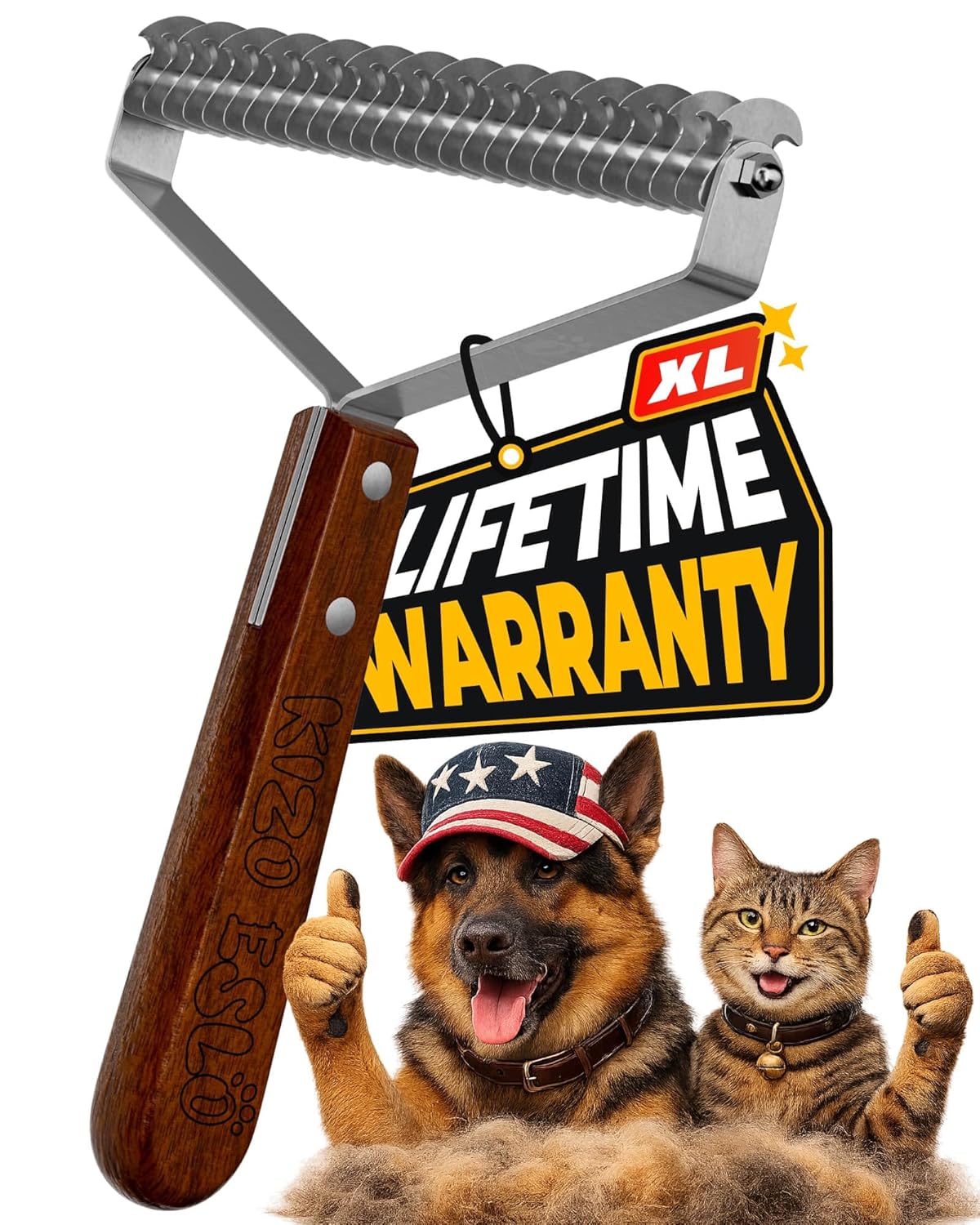
| Head type | Dual-sided 14/27 teeth |
|---|---|
| Intended coats | Long, thick, double coats |
| Handle | Solid wood |
| Blade material | Stainless steel (rounded edges) |
This XL two-sided undercoat rake pairs a wide-tooth side for detangling and a fine-tooth side for deshedding, making it a practical heavy-duty grooming tool for coarse, wiry coats. The extra-large head covers more fur per stroke so grooming goes faster on big dogs, while the rounded stainless-steel teeth are shaped to reduce pulling when used gently. It is intended for regular home use during shedding season and for breaking up mats after loosening them by hand or with scissors. The solid wood handle and metal frame give the tool a sturdy, durable feel that stands up to frequent use, though the aggressive blades mean you must follow the brand cautions to avoid sensitive areas and work carefully on tight mats. For short-coated dogs with minimal undercoat this rake is more than needed and it is not designed to be forced through severe tangles without pre-cutting. Used properly, it speeds up undercoat removal and leaves thicker coats looking neater with fewer passes.
Best for: Owners who groom frequently or manage coarse, resilient double coats and want a stout, efficient tool to remove undercoat, reduce shedding, and break up light mats at home.
Less Ideal for: People with short-haired, sensitive, or light-shedding dogs who need a softer, less aggressive brush or for users unwilling to work carefully around mats and skin.
- Dual-sided head combines wide teeth for dematting and fine teeth for deshedding in one tool
- Extra-large head covers more coat per stroke for faster grooming on large or thick-coated dogs
- Rounded stainless-steel teeth designed to glide with less pulling when used gently
- Solid wood handle and metal frame provide a durable, heavy-duty build suited to frequent use
- Aggressive blade teeth require careful technique and pre-loosening of severe mats to avoid discomfort
- Not ideal for short coats or very sensitive skin where a softer brush would be gentler
Verdict: The best heavy-duty deshedding tool is designed to handle dense undercoats and stubborn shedding without clogging or wearing out quickly during regular use.
Swihauk Self Cleaning Slicker Brush
Best Gentle Deshedding Tool

| Item model number | DB-202301 |
|---|---|
| Manufacturer | Swihauk |
| UPC | 649762637279 |
The Swihauk Self Cleaning Slicker Brush is a lightweight, self-cleaning grooming tool aimed at removing loose fur and detangling coat without irritating the skin. It uses fine, round-tipped metal bristles set in a flexible pad to catch undercoat and surface hair, then a bottom release button retracts the bristles for a quick wipe-away of collected fur. The TPR handle and compact stainless steel construction make it comfortable to hold for longer sessions and durable for regular use. In practice this brush works well for routine maintenance on medium to long coats, breaking mild mats and reducing shedding between baths. The soft rounded tips help prevent scratching, so it is suitable for dogs with sensitive skin when used gently. Limitations are that very dense undercoats or severely matted areas may require a de-matting tool or comb to finish the job, and the brush is manually operated so thorough sessions still take time on a large, heavily shedding dog.
Best for: Owners who want a balanced, easy-to-maintain slicker that handles regular de-shedding and light detangling with comfort for both pet and groomer.
Less Ideal for: People needing aggressive de-matting tools or very rapid grooming solutions for heavily matted coats should consider specialized de-matters or rakes instead.
- Self-cleaning release button that retracts bristles for fast fur removal
- Rounded plastic-tipped metal bristles designed to be gentle on skin while removing loose hair
- Lightweight ergonomic TPR handle for comfortable, extended grooming sessions
- Sturdy stainless steel construction for long-term durability
- Not optimized for cutting through very heavy mats or extremely dense undercoats
- Manual brushing can be time-consuming on large, heavily shedding dogs
Verdict: The best gentle deshedding tool prioritizes soft contact, rounded edges, and lower aggression on the coat to reduce irritation for dogs with sensitive skin.
BOTH WINNERS Dual-Sided Shedding Blade
Best Compact Deshedding Tool

| Product Benefits | Undercoat Removal |
|---|---|
| Hair Type | All, Coarse |
| Additional Features | Non Slip |
| Material Type | Metal, Plastic |
This compact dual-sided shedding blade is a travel-friendly grooming tool that removes loose undercoat and surface fur from a wide range of coat types. It has two blade edges — a coarse side for longer coats and a finer side for short coats — so you can switch quickly between thicker and finer shedding without swapping tools. The soft, ergonomic non-slip handle gives good control for short touch-ups or quick de-shedding sessions, and the looped blade design traps loosened hair as you glide it along the coat. Typical use is simple: hold handles apart to cover larger areas or together for focused spots, and use light pressure to avoid irritating the skin. Limitations are that the metal edges can feel sharp if pressed too hard and it is not a substitute for a full brush or professional grooming on dense double coats like a Husky's when deeper undercoat removal is needed. For quick trips, travel, or keeping loose hair down between full groomings this tool is effective and easy to pack.
Best for: Owners who need a small, portable grooming tool for quick de-shedding and touch-ups while traveling or between full grooming sessions.
Less Ideal for: Homeowners seeking a primary grooming tool for heavy double-coated breeds that require deep undercoat removal and regular professional-level grooming.
- Two-sided stainless steel blade offers coarse and fine edges for different coat lengths
- Soft ergonomic non-slip handle provides secure grip for quick touch-ups
- Compact, lightweight design is easy to pack for travel or on-the-go grooming
- Looped blade traps and lifts loose fur for efficient shedding control
- Metal blade edges can irritate skin if too much pressure is applied
Verdict: The best compact deshedding tool is for owners who need a lightweight, easy-to-store option for quick maintenance, travel, or spot grooming between full sessions.
Choosing the Right Deshedding Tool Long Hair Dog: Key Factors to Consider
Blade Design and Material
The blade determines how effectively a tool removes loose undercoat without cutting the topcoat. Stainless steel blades resist rust and hold an edge longer, while rounded or beveled tips reduce the risk of scratching skin.
For long-haired dogs, look for blades sized to reach the undercoat depth typical of the breed you own. Deeper teeth or multi-angle edges can lift and collect more loose fur, but overly aggressive blades increase the chance of pulling or creating frayed ends.
Tooth Spacing and Depth
Tooth spacing affects how much fur is removed with each pass. Wider spacing can be better for heavy, dense undercoats because it clears more material without clogging. Narrower spacing provides a gentler finish and is useful near sensitive areas like the tail base or flanks.
Depth control or adjustable blades let you tune how far the tool reaches into the coat, which matters when switching between seasonal shedding or working around thin-skinned zones. Correct spacing and depth reduce mats by removing loose fibers before they tangle with the topcoat.
Ergonomics and User Comfort
Deshedding a long-haired dog can take time, so handle shape, weight, and grip texture are important. A well-designed handle reduces wrist strain and makes longer sessions more manageable, especially for large dogs or for owners with limited hand strength.
Look for features like non-slip rubberized grips, balanced weight distribution, and a comfortable length. Tools with quick-release mechanisms for fur removal also save repetitive scraping motions, which lowers user fatigue during extended grooming.
Coat Safety and Skin Protection
Long coats hide sensitive skin and thin patches, so tools should minimize contact that could nick or irritate. Rounded tips, protective guards, and shallow blade settings help prevent accidental scraping while still removing loose undercoat.
Owners should also consider whether the tool works through tangles without pulling. A design that detangles gently or can be used after a preliminary combing step is usually safer for skin and helps keep the topcoat smooth and intact.
Maintenance and Ease of Cleaning
Grooming tools collect a lot of hair, so choices that make cleaning quick and hygienic encourage more frequent use. Removable heads, push-button fur ejectors, and smooth blade housings reduce the time needed to clear trapped fur.
Durable materials and replaceable blades extend the life of a tool, while designs that resist hair buildup avoid rust or trapped oils that can transfer back into the coat. Regular cleaning also prevents bacteria or odors from developing on the tool between sessions.
Versatility for Coat Types and Grooming Routines
Long-haired dogs include many coat textures, from single-layer silkiness to dense double coats. A versatile tool performs acceptably across those variations or offers attachments/settings for different needs.
Consider whether you want a single-purpose deshedding blade or a multi-function grooming tool that also brushes, demats, or finishes the topcoat. Versatility can reduce the number of tools you need but may trade off some specialized performance.
How Often Should I Deshed My Long-haired Dog?
Frequency depends on coat density and the dog's shedding cycle. Many long-haired breeds benefit from a focused deshedding session once a week during normal seasons and more frequently during seasonal blowouts. For dogs with exceptionally dense undercoats, two to three short sessions per week can prevent mats from forming.
Short, regular sessions are generally better than infrequent long ones because they reduce the risk of hair pulling and keep the topcoat tidy. Always check skin condition during grooming and stop if you see irritation; follow with a gentle brush to smooth the topcoat.
- Weekly maintenance for most long-coated dogs
- Increase to multiple sessions per week during heavy shedding seasons
- Short 10–20 minute passes reduce stress and pulling
What Grooming Steps Should Come Before and After Deshedding?
Begin with a quick detangling pass using a wide-tooth comb or dematting tool to remove surface tangles. This prevents the deshedding tool from snagging on mats and reduces discomfort for the dog. For very knot-prone areas, treat mats gently or trim only the mat rather than forcing the blade through it.
After deshedding, follow with a soft-bristle brush or finishing rake to realign the topcoat and remove fine residual hairs. A light wipe with a microfiber cloth helps pick up loose fur from the skin surface and leaves the coat looking tidy. Consider a short treat break to reward calm behavior during the routine.
- Pre-brush to remove tangles
- Use the deshedding tool in the direction of hair growth
- Finish with a soft brush to smooth the coat
How to Use a Deshedding Tool Safely on Sensitive Areas?
Sensitive spots include the belly, groin, armpits, face, and tail base. Use the gentlest blade setting available and shorter, lighter strokes in these zones. Hold the skin taut with a free hand to avoid pinching and watch the dog's body language for signs of discomfort.
If your tool has interchangeable heads, switch to a fine-toothed or comb attachment for these areas. Work slowly and with patience; it is better to do several light passes than one heavy pass that might pull or irritate the skin.
- Use lighter pressure and shorter strokes
- Hold skin taut to prevent pinching
- Switch to gentler attachments for delicate zones
Can Deshedding Tools Help with Mat Prevention?
Yes. Regular removal of loose undercoat reduces the volume of hair that can tangle and form mats. By removing loose fibers before they interlock with the topcoat, deshedding tools lower the chance of dense mats forming in high-friction zones like behind the ears and under the legs.
However, deshedding is most effective as part of a broader routine that includes detangling, spot checks, and occasional trimming. No tool eliminates the need to check and address small tangles before they develop into full mats.
- Regular use reduces loose hair that forms mats
- Combine with detangling and spot checks
- Target high-friction areas frequently
Should I Choose a Manual or Powered Deshedding Tool?
Manual tools offer precise control and are usually lighter and quieter, which helps anxious dogs stay calm. They are often simpler to clean and maintain and are suitable for most home grooming needs. Powered tools can speed up the process on very large or extremely dense coats but may be heavier and noisier.
If your dog is sensitive to noise or you prefer a slower, more controlled approach, a manual tool is usually the safer choice. If speed is a priority and your dog tolerates vibration, a powered option may reduce session time while still removing loose undercoat.
- Manual: more control, quieter, lighter
- Powered: faster for large coats, noisier
- Match tool type to your dog's tolerance and coat density
When Should I Consult a Professional Groomer or a Veterinarian?
Seek professional help if mats are very tight or close to the skin, because improper at-home removal can cause cuts or tears. A professional groomer can safely de-mat or advise on trimming strategies tailored to your dog's coat structure. If grooming consistently reveals reddened, scaly, or patchy skin, consult your veterinarian as these signs can indicate underlying medical or dermatological issues.
A vet or groomer can also recommend a deshedding frequency and technique adapted to health conditions, age-related skin sensitivity, or coat changes that come with seasonal or life-stage variation.
- Professional groomer for tight mats or complex trims
- Veterinarian for irritated, patchy, or abnormal skin
- Ask a pro if you are unsure about technique or tool aggressiveness
How We Chose the Best Deshedding Tool Long Hair Dog
We selected products based on a practical set of criteria that matter for long-haired dogs and typical at-home grooming routines. Key evaluation dimensions included blade design and material for safe undercoat removal, handle ergonomics and grip to reduce fatigue during longer sessions, ease of cleaning and maintenance for hygiene, and features that protect the topcoat and skin such as rounded teeth or adjustable depth. We also considered compatibility with different long-hair textures, from silky single coats to dense double coats, by looking for tools that offer controlled undercoat access without excessive surface damage. Excluded from consideration were tools intended only for short-haired breeds, purely cosmetic devices that do not remove undercoat, and heavy-duty professional equipment that is impractical for regular home use. The final short list favors versatility, durable construction, and intuitive use so owners can maintain coats effectively while minimizing stress for their dogs.
Our full evaluation process is outlined in our review methodology.
FAQ
How long does a typical deshedding session last for a long-haired dog?
Sessions usually run 10 to 30 minutes depending on coat density and how much loose undercoat is present. Short, frequent sessions are less stressful and more effective than occasional long sessions.
Will deshedding tools damage the topcoat?
When used correctly, deshedding tools remove only loose undercoat fibers and should not damage the healthy topcoat. Choose the appropriate blade depth and use gentle strokes to avoid fraying or breakage.
Can I use a deshedding tool on a dog with sensitive skin?
Often yes, but you should use the gentlest setting, shorter strokes, and check the skin frequently. If the dog has known skin conditions or shows discomfort, consult a veterinarian before regular use.
How do I clean and store a deshedding tool?
Remove hair after each session, wipe blades with a damp cloth, and dry thoroughly to prevent corrosion. Store the tool in a dry place and replace blades or heads according to the manufacturer's maintenance guidance.
Will deshedding reduce the amount of fur my dog sheds in the house?
Regular deshedding significantly reduces loose hair you find around the home by removing undercoat fibers before they detach and spread. It helps, but does not stop natural shedding entirely.
Final Verdict
Prioritize blade safety, tooth spacing, and user comfort when choosing a deshedding tool for a long-haired dog. Regular, gentle sessions prevent matting and keep the topcoat healthy while minimizing stress for your pet. Balance aggressiveness with skin protection and choose a tool that fits your routine and strength so grooming stays effective and manageable.

