

If you want tighter control over when and how your dog is corrected, a bark collar with remote gives you an immediate, repeatable response option. Choosing the right remote-enabled collar matters because it affects your ability to communicate timing, intensity, and consistency without causing stress or accidental activation. This guide shortlists the top remote-capable bark collars across practical use cases and owner needs, focusing on correction modes, fit, and safety features. Below you will find the best options we vetted for reliability, usability, and humane correction options, plus the buying factors that matter most when you shop for a remote bark collar.
Top Picks at a Glance
| Best Overall Bark Collar A reliable all-around pick that balances performance and ease of use | FAFAFROG Dog Bark Collar S1 |  |
| Best Budget Bark Collar An affordable option that covers basic bark control needs reliably | Asrcs X13 Dog Shock Collar |  |
| Best Premium Bark Collar A higher-end model with advanced features and refined build quality | Garmin BarkLimiter Deluxe |  |
| Best Rechargeable Bark Collar A cordless, USB-rechargeable unit for frequent use and convenience | MrSpark HQ01 Shock Training Collar |  |
| Best Lightweight Bark Collar A compact, low-profile collar designed for small or sensitive dogs | koikvs Small Dog Training Collar YM2 |  |
| Best Waterproof Bark Collar Water-resistant construction for wet-weather play and easy cleaning | MrSpark Shock Collar HQ01 |  |
| Best Heavy-Duty Bark Collar A tougher, more durable unit built for large or active dogs | PAWPRO Dog Shock Collar Ultimate |  |
FAFAFROG Dog Bark Collar S1
Best Overall Bark Collar

| Battery type | Rechargeable (magnetic charging cable) |
|---|---|
| Waterproof rating | IP67 |
| Sensitivity levels | 5 adjustable levels |
| Suitability | Dogs 8 to 150 lbs, neck 8 to 25 inches |
The FAFAFROG S1 is a rechargeable bark collar designed to reduce nuisance barking during everyday training. It uses a smart recognition chip that responds to sustained barking and vocal-cord vibrations, and offers five sensitivity levels plus four operating modes so you can tune how it reacts to your dog. The collar includes a digital color display that shows mode and battery level, a protect mode that pauses after repeated activations, and an IP67 waterproof rating for use around water. Charging is fast and the manufacturer claims roughly 15 to 20 days of runtime on a full charge depending on use, which makes it convenient for owners who train regularly and do not want to swap disposable batteries. Practical limitations include the need to fit and position the metal prongs correctly for reliable sensing, and that vibration or beep-only modes may be less effective on some dogs compared with stronger corrections. The unit is lightweight and adjustable to fit a wide range of small to large dogs, but owners should follow the manual on placement and start at gentle settings when introducing it to a small dog.
Best for: Owners who prefer a rechargeable collar they can charge quickly and use repeatedly for ongoing training sessions with small dogs, and who want configurable sensitivity and waterproofing.
Less Ideal for: People seeking a fully passive solution who will not commit to proper fitting and gradual training, or owners of very young puppies under six months who need gentler behavior methods.
- Rechargeable with fast charge and long claimed runtime for frequent training
- Adjustable sensitivity and multiple modes let you tailor correction level
- IP67 waterproof rating permits use during wet play or light swimming
- Protect mode pauses after repeated activations to avoid overstimulation
- Digital display shows mode and battery level for straightforward monitoring
- Effectiveness depends on correct collar fit and prong contact with the dog’s skin
- Some dogs may not respond to beep or vibration modes and need stronger correction
Verdict: The best overall bark collar is the go-to choice for most dog owners who want an effective, easy-to-use unit that balances reliable bark detection, humane correction options, and solid battery life.
Asrcs X13 Dog Shock Collar
Best Budget Bark Collar

| Range | 2000FT |
|---|---|
| Waterproof rating | IPX7 |
| Dog size range | 8-150 lbs |
| Power | Rechargeable batteries (included) |
The Asrcs X13 is a no-frills remote training collar that combines adjustable shock with vibration, beep, and a built-in flashlight so you can use progressively stronger cues without swapping devices. It is sold as a single-dog system with dual-channel support for additional receivers, and typical use cases are basic obedience, boundary reinforcement, and off-leash recall at distance. Practical benefits include an IPX7 waterproof receiver for wet conditions, a compact rechargeable design that claims long standby on a short charge, and multiple contact point options for different coat lengths. The 2000 ft range and lightweight handset make it suitable for park or trail training, while included accessories like extra contacts, a test light, and charging cables simplify setup. Important limitations are that intensity control granularity and actual maximum range can vary with terrain and interference, and the product focuses on corrective signals rather than positive-only methods. For buyers wanting a budget-minded but capable electronic trainer, the X13 delivers core functionality without advanced telemetry or smartphone integration.
Best for: Owners who need an affordable, functional training collar that provides dependable corrective signals for basic obedience and off-leash recall without extra smart features.
Less Ideal for: People who want app control, advanced logging, or a strictly reward-based training approach should consider other options.
- Multiple stimulus modes (shock, vibration, beep) for stepwise training
- IPX7 waterproof receiver suitable for wet use
- Includes spare contact points and test light for easier fit and setup
- Rechargeable batteries with claimed long standby and quick charge
- Actual range and shock strength can be affected by terrain and may not meet the maximum in all environments
- No smartphone app or advanced telemetry; basic handset-only controls
Verdict: The best budget bark collar is for owners who need dependable bark reduction on a tight budget, offering acceptable detection and safe correction without premium features or high-end materials.
Garmin BarkLimiter Deluxe
Best Premium Bark Collar
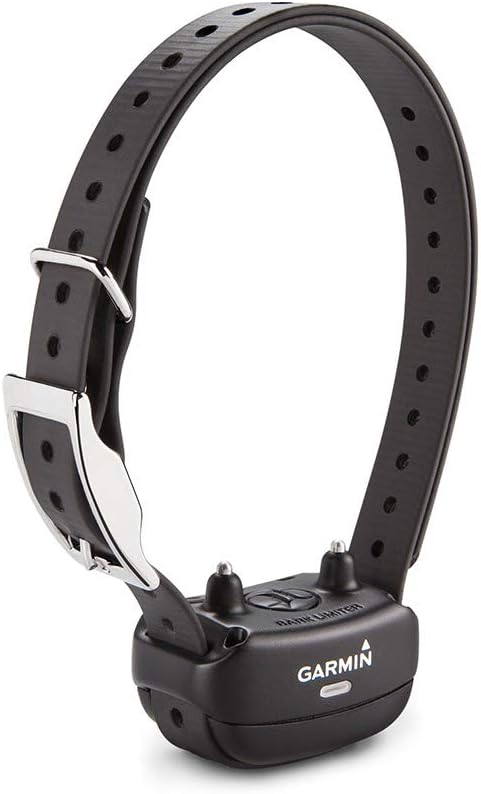
| Included Components | Bark |
|---|---|
| Breed Recommendation | All Breed Sizes |
| Material Type | Stainless Steel |
| Warranty Description | 1 year |
The Garmin BarkLimiter Deluxe is a compact, rechargeable bark-control collar that uses motion-based sensors to identify barking and deliver correction automatically or by manual selection. It is typically worn on the dog's neck and used to reduce nuisance barking at home or in the yard; the unit offers an Auto Rise setting that programs stimulation intensity based on each dog's barking, plus vibration and manual stimulation options. Notable features include advanced bark-differentiation to reduce false triggers, a bark odometer that tracks barking events, integrated stainless steel contact points sized to work across coat types, and a long-lasting rechargeable battery rated up to three months per charge. In practice the device is easy to fit with a buckle closure and stays lightweight for daily wear, and the rechargeable design avoids frequent battery swaps. Limitations are that effective and humane use requires correct fit and gradual training, and the collar focuses solely on bark correction rather than broader training functions or multi-dog remote control capabilities.
Best for: Owners who prioritize a refined, durable bark-specific solution and are willing to invest in a premium, rechargeable collar with advanced false-trigger protection.
Less Ideal for: Owners seeking a multifunction remote training system, multi-dog controller, or a collar that focuses on obedience beyond barking should consider other training tools.
- Advanced bark identification reduces false corrections from non-bark noises
- Auto Rise feature automatically adjusts stimulation level to the dog’s barking pattern
- Rechargeable lithium-ion battery with long run time up to three months per charge
- Stainless steel contact points designed to work across coat types and integrated for durability
- Bark odometer provides measurable feedback on effectiveness
- Device is single-purpose for barking correction and lacks broader remote-training features
- Needs correct fit and responsible, gradual use to avoid overcorrection
Verdict: The best premium bark collar suits owners willing to pay more for top-tier detection accuracy, multiple training modes, durable construction, and extra conveniences like long battery life or refined fit.
MrSpark HQ01 Shock Training Collar
Best Rechargeable Bark Collar

| Training modes | Beep, Vibration, Shock (adjustable levels) |
|---|---|
| Waterproof rating | IP68 receiver |
| Remote range | 4500ft |
| Recharge time | 2 hours |
The MrSpark HQ01 is a rechargeable e-collar designed for remote obedience and bark control using three modes: beep, vibration and adjustable shock levels. You use the handheld remote to send instant corrections up to 4,500 feet away, which makes it practical for off-leash field work, recall training, and perimeter control. Notable features include an IP68 waterproof receiver that can be rinsed after swims or muddy sessions, a built-in LED collar light and a remote flashlight for night visibility, and a safety lock plus automotive-grade safety chip to reduce accidental stimulation. Battery life is strong: the receiver claims up to about 20 days between charges and the remote up to 90 days with a two-hour full charge time. The collar ships with short and long metal prongs and silicone covers to fit different coat types and has an adjustable buckle fit. Limitations to be aware of are that the remote is not waterproof and users must follow the daily-wear and skin-inspection guidance to avoid irritation from sustained contact; effective, humane use requires gradual level setting and monitoring during training.
Best for: Pet owners who prioritize a durable, moisture-resistant training collar for frequent outdoor use, night walks, and water activities and who want a long-range remote for off-leash correction.
Less Ideal for: Owners who need a fully waterproof remote or who prefer passive bark-only collars without user-controlled correction should consider other options.
- IP68-rated receiver that can be rinsed after swimming or muddy play
- Long 4,500 ft RF range with adaptive frequency hopping for stable response
- Multiple training modes with adjustable levels for gradual, precise corrections
- Long battery runtime and 2-hour fast recharge to minimize downtime
- Included hardware (short/long prongs and silicone covers) for fit across coat types
- Remote unit is not waterproof which limits use in wet conditions
- Requires careful daily-wear management and periodic skin checks to prevent irritation
Verdict: The best rechargeable bark collar is ideal for owners who want the convenience and lower running cost of a built-in battery and quick recharging rather than replacing disposable cells.
koikvs Small Dog Training Collar YM2
Best Lightweight Bark Collar

| Breed Recommendation | Small |
|---|---|
| Included Components | Remote Control |
| Animal Collar Type | Electronic Training Collar |
| IP Rating | IP67 (receiver) |
This compact koikvs training collar is built specifically for small breeds and travel use, combining a lightweight receiver with a simple two-button remote for everyday corrections. The receiver is very light and low-profile, with removable contact points and silicone covers to reduce irritation on sensitive necks, and the nylon strap adjusts from very short to 25 inches to fit tiny puppies through small adult dogs. Controls are straightforward: two large front buttons for beep and vibration and side controls for 1–16 shock levels so you can reserve stimulation for moments that require firm correction. The receiver is rated IP67, so it tolerates rain and submersion, while the remote is rainproof only. Battery life is strong on paper, with long standby and multi-day use between charges, and the remote claims up to a 1000 ft range in open areas which is useful for recall practice in yards. Expect a learning curve dialing in the right stimulation level for a very small dog and keep the remote dry; otherwise this is a sensible, travel-friendly option for focused training with compact breeds.
Best for: Buyers of small-breed dogs or frequent travelers who want a genuinely lightweight, low-profile training collar that is easy to carry and simple to operate for routine behavior shaping.
Less Ideal for: Owners who need multi-dog simultaneous control, advanced programmable schedules, or a fully submersible remote should consider other systems designed for those capabilities.
- Very lightweight, low-profile receiver suited to small breeds
- Removable contact points with silicone covers to protect sensitive skin
- Simple remote layout with dedicated beep and vibration buttons for everyday use
- IP67 waterproof receiver for swimming and wet-weather use
- Long battery standby and claimed range up to 1000 ft for outdoor training
- Remote is only rainproof and should not be submerged
- Shock levels require careful adjustment on tiny or very young puppies
Verdict: The best lightweight bark collar is aimed at owners of small or easily stressed dogs who need a low-mass, comfortable unit that minimizes bulk while still detecting and deterring barking.
MrSpark Shock Collar HQ01
Best Waterproof Bark Collar

| Training modes | Beep, Vibration, Shock |
|---|---|
| Waterproof rating | IP68 |
| Wireless range | 4500ft |
| Power | Rechargeable; 2-hour charge |
The MrSpark HQ01 is a rechargeable e-collar intended for remote training and bark control in outdoor conditions. It provides three user-selectable modes—beep, vibration, and adjustable shock—with multiple intensity levels so you can scale corrections from gentle cues to firmer feedback. The remote uses a military-spec RF chip and adaptive frequency hopping to deliver responsive commands up to the advertised 4,500 foot range, which expands usable training scenarios outdoors. IP68 construction and a sealed, nano-coated board let the receiver be rinsed and submerged without harming electronics, and the built-in safety light improves visibility during low-light walks. Battery life is strong for everyday use, with the receiver reportedly lasting up to 20 days and the remote many weeks between charges; charging times are about two hours. Important limits are that effective fit and contact depend on correct prong length and placement, so very short-haired or very small dogs may need attention to fit, and the system still requires adult supervision and gradual conditioning to avoid misuse. For active outdoor households this unit focuses on durability and range more than cosmetic refinement.
Best for: Households with active dogs that spend time outdoors, owners who prioritize a rugged, waterproof trainer with long range and visible nighttime safety.
Less Ideal for: Owners looking for a purely vibration-or-tone-only bark solution or those uncomfortable with collars that include an electric correction option should consider alternatives.
- IP68 waterproof receiver and nano-coated electronics that can be rinsed and submerged
- Long 4,500 ft wireless range with adaptive frequency hopping for stable, interference-resistant signaling
- Multiple training modes with graduated intensity for stepped, humane correction
- Long battery runtimes with about a 2-hour recharge time
- Integrated safety light on the collar for night visibility
- Requires correct prong length and placement for reliable contact, which may need adjustments for some dogs
- Includes shock mode which demands careful, experienced use and progressive conditioning
Verdict: The best waterproof bark collar is for active dogs and outdoor households that need reliable performance in rain, puddles, or bath situations without risking damage to electronics.
PAWPRO Dog Shock Collar Ultimate
Best Heavy-Duty Bark Collar

| Range | Up to 4 miles (open terrain) |
|---|---|
| Stimulation levels | Beep 1–8, Vibration 1–16, Static 1–99 |
| Waterproof rating | IPX7 |
| Battery life | Up to 15 days (per listing) |
The PAWPRO Dog Shock Collar is built for long-distance off-leash training, pairing a dual-channel remote with an advertised 4-mile open-terrain range. You use the remote to deliver beep, vibration, or adjustable static stimulation and to activate a built-in LED for low-light visibility; the unit supports two dogs with the dual-channel function. Practical features include an IPX7 waterproof receiver, hypoallergenic adjustable strap, multiple contact points for size tuning, and a 30-day step-by-step training guide to help beginners start gently. The controls offer fine-grained adjustment across beep, vibration and 99 static levels so you can find an appropriate response for different dogs and distractions. Battery life and fast charging are convenient for multi-day outings, and the collar is made to handle rain and trails. The main compromises are that real-world effective range depends on terrain and obstacles, and static stimulation requires careful, informed use so you can train safely and humanely. For owners who need extended remote control, this package gives versatile modes and practical outdoor readiness.
Best for: Owners who need dependable remote control across large open areas and want a feature-rich collar that balances long range with adjustable stimulation and outdoor durability.
Less Ideal for: People who only train indoors or in small fenced yards where extreme range is unnecessary, or those unwilling to learn responsible use of static stimulation methods.
- Very long advertised open-terrain range up to 4 miles for wide-area recall and off-leash training
- Multiple stimulation modes with wide adjustment (beep, vibration, 1–99 static) for precise responses
- IPX7 waterproof receiver and reflective adjustable strap for outdoor use in wet conditions
- Dual-channel remote supports training two dogs with a single transmitter
- Includes step-by-step 30-day training guide and multiple contact points for fit and beginner support
- Effective range will be reduced by trees, buildings, and terrain so 4-mile performance is situational
- Static stimulation requires careful, informed use and gradual introduction to avoid misuse
Verdict: The best heavy-duty bark collar fits owners of larger, stronger, or very active dogs who require rugged construction, secure straps, and reliable detection under demanding daily use.
Choosing the Right Dog Bark Collar Remote: Key Factors to Consider
Correction Modes and Adjustability
Different dogs respond to different stimuli, so collars that offer multiple correction modes matter. Look for devices that provide a range of intensities within each mode so you can start low and increase only if needed. Having more than one type of stimulus, such as vibration plus static or beep plus vibration, helps you find a nonpainful yet effective option for your individual dog.
Adjustability reduces the chance of overcorrection and supports gradual training progress. If a collar forces a single, strong correction, it can create fear or avoidance rather than teach desired behavior. Controls that are easy to access and clearly labeled on both the transmitter and receiver make on-the-fly adjustments practical during real-life training sessions.
Remote Range and Signal Reliability
How far and how reliably the remote communicates with the collar changes where you can train and how confident you feel when issuing corrections. A remote should work consistently at the distances you expect to use it, whether that is across a yard or through common household obstacles. Intermittent signals or short range lead to missed corrections, which undermines timing and training clarity.
Signal reliability also affects safety. Latency, dropouts, or accidental double triggers can confuse a dog. Look for clear specifications on effective range and, when possible, user feedback about real-world performance in similar settings.
Fit, Contact Points, and Comfort
Contact design determines both effectiveness and animal welfare. The collar should maintain good skin contact without excessive pressure or pinching. Replaceable contact points and different length options help accommodate short- and long-haired dogs. A poorly fitting collar either fails to deliver consistent signals or irritates the skin, both of which compromise training and comfort.
Consider band width and material too. Wider bands distribute pressure more evenly while softer materials reduce chafing. Check that the receiver housing sits flush and does not rotate or press unevenly when the dog moves.
Battery Life and Charging Convenience
A remote-enabled collar is only useful when both the transmitter and receiver are powered. Long battery life reduces interruptions to training and the need to remember frequent charging cycles. Fast charging or simple removable batteries can be an advantage for busy owners.
Also consider how battery level is reported. Clear indicators on both devices prevent unexpected dead batteries during a session. If batteries are nonremovable, ensure the charging port is protected from moisture and debris to maintain long-term reliability.
Safety Features and User Controls
Safety-oriented design minimizes the risk of accidental or excessive correction. Features such as automatic cutoff after a series of activations, progressive correction that increases intensity gradually, and clearly labeled buttons reduce user error. A lock function on the transmitter can prevent unintentional activations when the remote is carried in a pocket or bag.
Good user controls also include tactile differentiation so you can operate the remote without looking, and a way to test corrections at very low levels before regular use. Documentation that explains safe setting choices and training tips is part of a responsible product package.
Durability and Weather Resistance
Remote collars are often used outdoors, so resistance to water, dirt, and impact lengthens the useful life of the device. Look for sealed housings, coated electronics, and durable strap materials that tolerate regular exposure to the elements. Corroded contacts or failed seals are common failure modes in lower-quality units.
Durability also matters for active dogs that swim, dig, or play roughly. A collar that can withstand daily wear without loosening, cracking, or failing keeps training consistent and reduces replacement needs.
How Do I Decide Which Correction Mode to Start With?
Begin with the least intrusive option and observe your dog's response over several controlled repetitions. For many dogs, vibration or a short beep may be sufficient to interrupt barking and redirect attention. If there is no response after multiple attempts, incrementally increase intensity rather than jumping to the highest setting.
Watch for stress signals such as flattened ears, tucked tail, or avoidance. If those appear, reduce intensity or switch to a different mode. Combine collar use with positive reinforcement so the dog learns the desired behavior rather than just avoiding the stimulus.
- Start low and increase slowly over sessions
- Prefer vibration or sound first for sensitive dogs
- Use consistency and follow-up with positive reinforcement
Where Does the Remote Collar Belong on the Dog During Use?
Place the receiver high on the neck, just below the jawline, where contact is reliable and the device stays in position. The band should be snug enough to keep contact but not tight enough to pinch; you should be able to slide one finger between the strap and the dog's neck. Recheck fit after the dog moves or plays, because collars can shift.
If the collar includes removable contact points, choose the length that clears the coat but does not press excessively against the skin. For long-haired dogs, trimming a small patch at the contact site may improve consistency, but do so carefully and only if comfortable for both you and your dog.
- Position receiver under the jaw for reliable contact
- Check fit often and replace contact studs as needed
- Avoid over-tightening to prevent chafing
Can I Use a Remote-enabled Bark Collar During Training Walks?
Yes, remotes are particularly helpful during walks because they let you time corrections precisely when barking happens in context. Ensure the transmitter fits comfortably in your hand or pocket and that you can operate it without losing grip. Practice issuing single, well-timed corrections while keeping control of the leash and your dog.
Be mindful of range limitations when using the remote in large parks or areas with obstacles. If you expect to train at greater distances, verify the remote's effective range in the environment you will use most often before relying on it for critical corrections.
- Keep one hand free to operate the remote safely
- Confirm range in the actual walk environment
- Use brief, well-timed corrections rather than prolonged activation
How Often Should I Charge or Check Batteries?
Check battery indicators before each training session and establish a routine charging schedule based on typical usage. For daily short sessions, charging once or twice a week may be sufficient; heavier use requires more frequent charging. Replace or recharge batteries promptly when indicators show low levels to avoid incomplete corrections during training.
If your system uses removable batteries, keep spares on hand and swap them regularly. Avoid leaving a collar unused for long periods with depleted batteries, as that can lead to corrosion at contact points.
- Check battery levels before each session
- Charge according to usage intensity
- Keep spare batteries or a charging plan ready
How to Integrate the Remote Collar Into a Broader Training Plan?
Use the remote as one tool within a consistent training routine that includes positive reinforcement, redirection, and predictable consequences. The goal is to teach an alternative behavior such as a quiet cue or moving to a mat, not just to stop a sound. Pair brief remote corrections with immediate praise and reward when the dog complies.
Gradually phase reductions in remote use as the dog learns the cue and responds reliably. Replace some remote-triggered sessions with reward-based practice to maintain motivation and reinforce the desired behavior without constant external correction.
- Combine corrections with immediate positive reinforcement
- Teach an alternate behavior to replace barking
- Fade reliance on the remote as compliance improves
What Maintenance Keeps a Remote Collar Reliable?
Regularly clean contact points and the strap to prevent build-up that can interfere with signal delivery. Inspect the housing, strap fastenings, and contacts for signs of corrosion or wear. Store the transmitter and receiver in a dry place and avoid exposing charging ports to water or dirt.
Test the system periodically at low settings to confirm operability. Tighten loose screws, replace worn straps, and follow manufacturer guidance for contact replacement intervals to maintain consistent performance.
- Wipe contacts and strap after outdoor use
- Inspect for wear and replace parts when needed
- Run periodic low-level tests to confirm function
How We Chose the Best Dog Bark Collar Remote
We evaluated potential picks using criteria specific to remote-enabled bark collars to ensure practical, humane, and dependable performance. First, we prioritized correction modes and adjustability, looking for collars that offer multiple levels and clear mode selection so owners can tailor responses to a dog's size and sensitivity. Second, we assessed remote range and responsiveness, because a usable handheld transmitter must trigger corrections reliably across the distances and environments owners commonly encounter. Third, fit and contact design were key: sensors that maintain consistent contact without pinching or excessive pressure reduce false triggers and improve comfort. Fourth, battery life and charging method factored into selection since frequent downtime undermines training consistency. Fifth, we considered build quality and water resistance to ensure the collar can withstand outdoor use. Finally, we checked safety features such as automatic shutoff, progressive correction, and clear user controls. We excluded devices that lack adjustable settings, offer only a single extreme-level correction, or fail to document safe usage instructions. Units with questionable contact quality or unreliable wireless performance were not considered. The final list balances usability, humane training principles, and dependable electronics rather than marketing claims or isolated specifications.
Our full evaluation process is outlined in our review methodology.
FAQ
Are remote bark collars safe for all dogs?
Safety often depends on appropriate settings and use. Many dogs tolerate low-level vibration or sound without stress, but some dogs with medical sensitivities or extreme anxiety may react poorly. Start at the lowest setting, monitor behavior closely, and consult a veterinarian if you have concerns about your dog's response.
How soon should I expect to see results with a remote collar?
Results typically vary. Some dogs show rapid response within days when corrections are timed consistently, while others need several weeks of consistent training. Outcomes depend on the dog's history, frequency of unwanted barking, and how well the collar is integrated into a broader training plan.
Can the remote trigger accidentally from other devices?
Most modern remotes use dedicated radio frequencies or pairing to prevent cross-activation, but interference is possible if a product lacks proper pairing or shielding. Choose systems that require explicit pairing between transmitter and receiver and test them in environments similar to where you will use them.
Is it okay to leave a remote collar on my dog all day?
Leaving any corrective device on for long periods is not recommended. Limit continuous wear time and follow guidelines in the product documentation. Remove the collar periodically to check the skin, allow the dog a break, and prevent pressure sores or irritation.
Will a remote collar damage my dog's skin or coat?
When properly fitted and maintained, collars should not cause damage. However, poor fit, dirty contacts, or overly frequent use can cause irritation. Regular inspection, cleaning, and correct strap tension reduce the risk of skin issues.
Can I use a remote collar on puppies or small dogs?
Many remotes include low-intensity settings suitable for smaller or younger dogs, but puppies are still learning and may respond differently. Consider gentler modes like beep or vibration and consult a trainer or veterinarian before using correctional devices on very young dogs.
Final Verdict
Choose a remote-enabled bark collar by prioritizing humane correction modes, reliable remote range, and a comfortable fit. Balance the desire for quick intervention with settings that allow you to start low and increase only as needed. Regular maintenance and consistent, reward-based training will improve outcomes and reduce the need for stronger corrections. The right device supports clear timing and consistent consequences without causing distress. Focus on signal reliability, adjustable settings, and safety features to select a collar that helps you train confidently and responsibly.

