

If your dog lurches or pulls on leash, the right collar can make walks safer and more manageable for both of you. This guide focuses on collars designed specifically for dogs that pull, outlining how design, fit, and materials affect control and comfort. We shortlisted seven top options suited to different sizes and pull styles and evaluated them for control effectiveness, durability, and wearer comfort. Read on to find a collar that balances reliable handling with safe, humane restraint.
Top Picks at a Glance
| Best Overall Collar for Dogs That Pull Top choice for controlling pulling without sacrificing comfort or safety | PetSafe Gentle Leader Headcollar Large |  |
| Best Budget Collar for Dogs That Pull An affordable option that still helps manage leash pulling | PetSafe Martingale Quick-Snap Collar Medium |  |
| Best Premium Collar Higher-end materials and construction for long-lasting performance | Herm Sprenger Prong Collar 20in |  |
| Best Heavy-Duty Collar Extra-strong build for strong pullers and rugged use | Carhartt Nylon Wide Dog Collar Large |  |
| Best Padded Collar Soft-lined design to reduce neck strain during pulls | Erbine Padded Martingale Collar M |  |
| Best Reflective Collar High-visibility trim for safer walks in low light | Hikiko Martingale Dog Collar Large |  |
| Best Training Collar Designed to assist with leash manners and controlled correction | Starmark Pro-Training Collar Large |  |
PetSafe Gentle Leader Headcollar Large
Best Overall Collar for Dogs That Pull

| Size | Large |
|---|---|
| Material Type | Nylon |
| Included Components | PetSafe Gentle Leader Head Collar |
| Closure Type | Snap |
| Breed Recommendation | Large Breeds |
The PetSafe Gentle Leader is a no-pull headcollar that redirects a dog's forward momentum by guiding the head toward the handler, which helps interrupt the instinct to pull and improves leash manners. It is typically used during walks and training sessions: you fit the nose loop over the dog's snout and fasten the quick-snap neck strap high behind the ears so the centerbar rests under the chin, then apply gentle leash pressure to steer. Notable features include a padded neoprene nose loop for comfort, a quick-snap buckle that makes on-off fast, and nylon construction for durability. In practice the Gentle Leader offers clearer, immediate control without using force on the neck, and because the dog can still pant, eat treats, and play it is usable for everyday walks and reinforcing training. Important limitations are that it requires careful fitting and a short acclimation period so dogs do not paw or resist, and it is not suitable for short-snouted breeds like pugs or bulldogs. For owners willing to invest a little time in proper fitting and training, it is an effective, reliable solution for pullers.
Best for: Owners who want a practical, behavior-focused tool to stop pulling during everyday walks and strengthen leash training without choking or constant correction.
Less Ideal for: People seeking a harness-style solution or those with short-faced breeds should consider alternative no-pull products instead.
- Directs the head to interrupt pulling for clearer control
- Padded neoprene nose loop improves comfort during use
- Quick-snap neck buckle makes fitting and removal fast
- Durable nylon construction suited to regular walks
- Allows eating, panting, and play while worn so it is not a muzzle
- Requires careful measurement and fitting to be comfortable and effective
- Not appropriate for short-snouted breeds such as pugs or bulldogs
Verdict: The best overall collar for dogs that pull, balancing effective control, secure fit, and comfort for everyday walks and training.
PetSafe Martingale Quick-Snap Collar Medium
Best Budget Collar for Dogs That Pull

| Material | Nylon |
|---|---|
| Closure Type | Snap |
| Breed Recommendation | Medium Breeds |
| Included Components | Martingale Collar with Quick Snap Buckle |
The PetSafe Martingale Quick-Snap Collar is a simple, budget-friendly option for dogs that tend to pull or slip out of regular collars. It combines a limited tightening martingale loop with a quick-snap plastic buckle so you can put the collar on and remove it quickly without threading it over the head. Made from nylon, the collar is lightweight and holds up to everyday walks and play. In use it provides modest control by tightening under tension to discourage backing out while distributing pressure across the neck to avoid sharp pinching. The quick-snap closure is convenient but is not as rugged as metal hardware, so it suits dogs that pull moderately rather than extremely strong pullers. Sizing choices and the straightforward design make it easy to fit most medium-breed necks, and the collar cleans quickly with soap and water. Expect good basic escape-prevention and leash control for the price, but consider a harness or heavier-duty collar if your dog is very strong or frequently lunges hard.
Best for: Buyers looking for an inexpensive, easy-to-use collar that improves security and gives gentle control on walks with a dog that pulls moderately.
Less Ideal for: Owners of very large or extremely strong dogs that lunge or pull hard should choose a reinforced collar or a dedicated no-pull harness instead.
- Martingale design tightens to help prevent dogs slipping out of the collar
- Quick-snap buckle for fast on/off convenience
- Durable nylon construction that is easy to clean
- Lightweight and comfortable for everyday wear
- Plastic snap buckle is less durable than metal hardware for very strong pullers
- Provides modest control only; not a substitute for training or specialized no-pull gear
Verdict: The best low-cost collar for dogs that pull that provides reliable control and a secure fit without a high price tag.
Herm Sprenger Prong Collar 20in
Best Premium Collar

| Material Type | Chrome Plated Steel |
|---|---|
| Size | 20in x 3.0mm (neck size up to 16in) |
| Closure Type | Pull On |
| Included Components | Collar |
The Herm Sprenger Prong Collar is a professional-grade chrome plated steel training collar designed to give handlers precise, even pressure around a dog's neck when correcting pulling or leash-reactive behavior. It is built with interlocking short links and a center plate so the links tighten symmetrically; links can be added or removed to fine-tune fit. The Ultra-Plus style uses blunt, slightly beveled prongs intended to avoid direct trachea pressure while still providing a clear feedback cue, and a swivel D-ring lets the leash move freely. In practice this collar is used for on-leash obedience sessions under supervision, fitted just below the ears and adjusted so it sits snugly. The German-made construction and solid hardware make it durable for frequent use, and the removable links allow precise sizing for many neck circumferences. Important limitations are that it requires knowledgeable, careful handling and is not appropriate for casual or unsupervised wear, and some owners prefer gentler alternatives for sensitive or light-colored dogs.
Best for: Owners who prioritize premium materials and refined hardware and who plan to use a high-quality training tool under guided, on-leash training to manage pulling.
Less Ideal for: Owners seeking a purely gentle or hands-off solution, first-time trainers unfamiliar with prong collar use, or those who need an everyday identification collar.
- Durable chrome plated steel construction and German engineering
- Interlocking short links and center plate deliver symmetrical, even pressure
- Removable links allow precise size adjustment for a snug fit
- Swivel D-ring reduces leash twist for smoother handling
- Requires experienced handling and proper fitting to be safe and effective
- Not suitable for unsupervised wear or as an everyday collar for all dogs
Verdict: The best premium collar for owners who want superior materials, refined hardware, and a comfortable, durable design that stands up to frequent use.
Carhartt Nylon Wide Dog Collar Large
Best Heavy-Duty Collar

| Material Type | Nylon |
|---|---|
| Closure Type | Buckle |
| Breed Recommendation | Large |
| Size | Large |
The Carhartt Nylon Wide Dog Collar is built to handle strong, active large breeds that pull or spend long hours outdoors. It uses extra-wide, heavy-duty nylon webbing to spread pressure across the neck for greater comfort during extended wear, and a double-prong metal buckle with metal grommets keeps the collar from slipping under load. A slotted metal D-ring gives a sturdy leash attachment point and the reflective stitched wordmark improves visibility in low light. You typically use it as an everyday collar for walking, training, hiking, or barn and field work where durability matters more than lightweight styling. Practical benefits include robust hardware that resists bending, an adjustable fit with predictable holes, and a construction meant to resist fraying and deformation over seasons of use. Limitations are that the wide, stiff nylon is less flexible than softer collars so it can feel bulky on some dogs and the collar is not a no-pull training solution by itself, so pairing it with a front-clip harness or trainer is advisable for heavy pullers.
Best for: Owners of large, powerful dogs who need a durable, everyday collar that stands up to pulling, outdoor work, and frequent use and who prioritize long-lasting hardware and visible safety features.
Less Ideal for: Owners seeking a lightweight, soft comfort collar for small breeds or those who want an integrated no-pull control solution should look elsewhere.
- Extra-wide heavy-duty nylon webbing distributes pressure for more comfortable all-day wear
- Double-prong metal buckle with metal grommets offers a secure, non-slipping closure under load
- Sturdy metal D-ring provides a reliable leash attachment point
- Reflective stitched wordmark increases low-light visibility for early morning or evening walks
- Stiffer, wider construction can feel bulky and less flexible on some dogs
- Not a substitute for no-pull training hardware or behavior modification tools
Verdict: The best heavy-duty collar for powerful dogs or outdoor use, offering reinforced webbing and hardware to resist stretching and wear.
Erbine Padded Martingale Collar M
Best Padded Collar
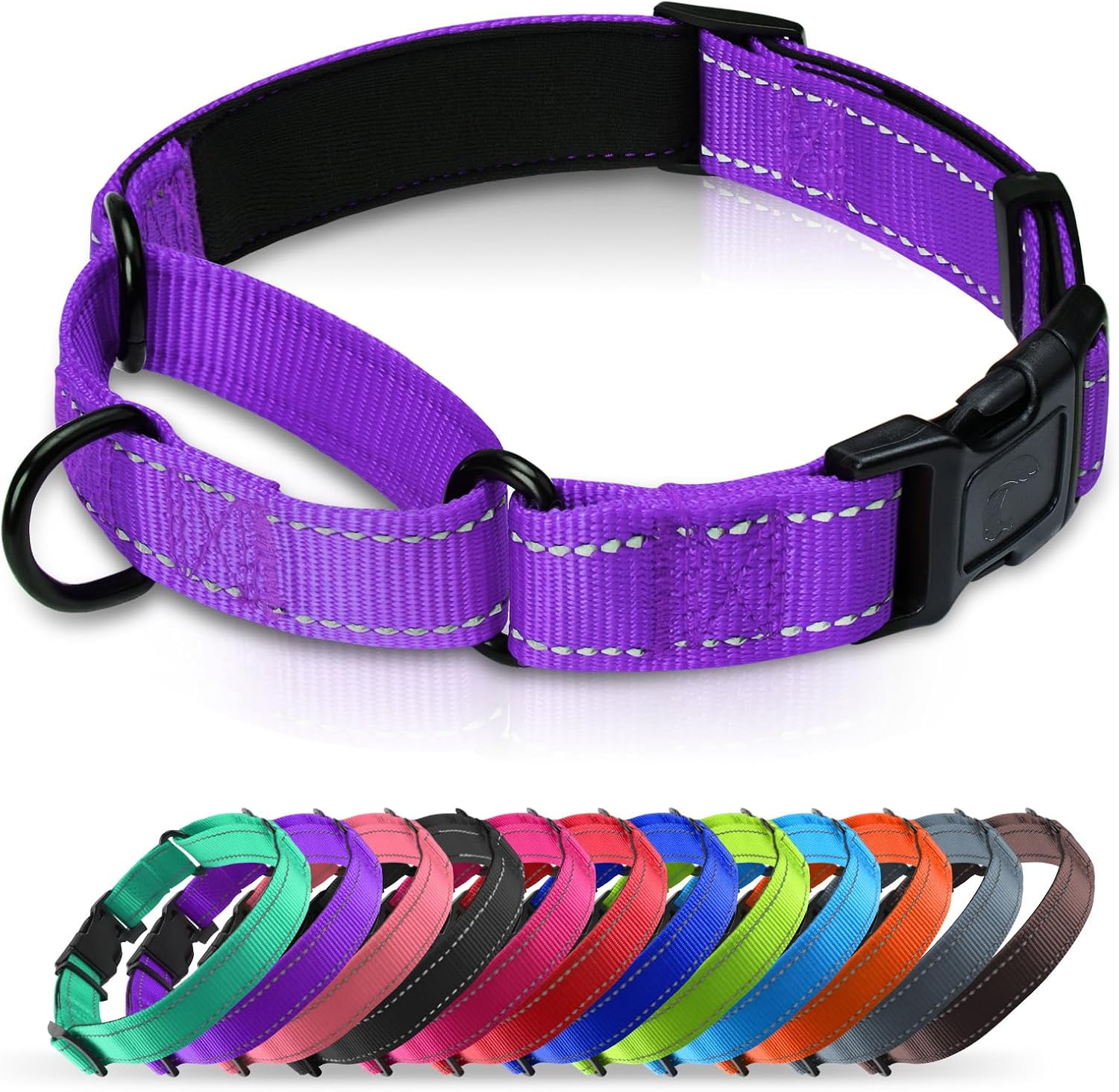
| Size | M: width 1" neck 14.5-19" |
|---|---|
| Material Type | Neoprene, Nylon |
| Closure Type | Buckle |
| Care | Hand Wash |
The Erbine Padded Martingale Collar is built for dogs that pull or try to back out of standard collars by tightening gently under tension and releasing when the dog relaxes. It pairs a martingale loop with a quick-release plastic buckle so you can slip the collar on and off quickly, and a metal D-ring provides a secure leash attachment for daily walks. The neoprene-lined, padded interior reduces direct pressure on the neck and the reflective stitch adds low-light visibility. Typical use is for leash training and controlled walks while supervised rather than as an all-day or unattended collar. Practical benefits include softer contact for sensitive-necked dogs and simpler handling thanks to the buckle, but buyers should inspect the plastic buckle and metal ring periodically if their dog pulls hard, and remove the collar when the dog is left alone since martingales are not intended for unsupervised wear. Sized options and machine-washable materials make it easy to fit and clean, though very powerful pullers may prefer a harness or heavier-duty hardware.
Best for: Buyers focused on protecting their dog’s neck while training or walking a dog that tends to pull, and who want a comfortable, easy-to-use collar for supervised outings.
Less Ideal for: Owners who need a collar for continuous all-day wear, unattended use, or very strong pullers who require heavy-duty metal hardware or a harness.
- Martingale design tightens gently to prevent slipping without harsh corrections
- Neoprene padded lining cushions the neck for greater comfort during pulls
- Quick-release buckle allows fast on/off for walks and training
- Metal D-ring provides a dedicated leash attachment point
- Reflective stitching improves visibility on low-light walks
- Plastic quick-release buckle may wear faster than metal hardware under heavy force
- Not intended for unsupervised wear or as a tie-out/crate collar
Verdict: The best padded collar for dogs that pull and owners concerned about neck comfort, with cushioning that helps distribute pressure more gently.
Hikiko Martingale Dog Collar Large
Best Reflective Collar

| Material Type | Nylon |
|---|---|
| Closure Type | Buckle |
| Size | Large |
| Pattern | Solid |
This Hikiko martingale collar combines the tightening loop of a training-style martingale with a quick-release buckle and reflective trim for nighttime visibility. You use it as a slip-style collar that tightens slightly when the dog pulls, which helps prevent slipping out while giving you gentle corrective control during walks or training sessions. The nylon webbing and metal hardware are built for routine outdoor use and the seller notes pull testing to resist fraying under normal use. The quick-release buckle makes removal fast in an emergency, though the product description cautions against leaving it on unsupervised or using it off-leash. Reflective detailing improves low-light safety but will not replace a light or reflective leash for maximum visibility. Sizing requires measuring so the collar slips over the head yet fits snugly when adjusted; like all martingales it works best as a training/walking tool rather than an everyday buckle collar for unsupervised wear.
Best for: Buyers who walk dogs that pull and need a collar that helps prevent escapes while improving visibility during low-light walks.
Less Ideal for: Owners who want a collar for unsupervised all-day wear or for dogs that require a harness for heavy pulling should choose a different solution.
- Martingale design reduces chances of slipping out and offers gentle corrective control
- Reflective trim increases visibility for dawn, dusk, and nighttime walks
- Quick-release buckle allows fast removal in emergencies
- Durable nylon webbing and sturdy hardware made for regular outdoor use
- Not intended for unsupervised or off-leash use as a primary buckle collar
- Reflective material improves visibility but is not as bright as a dedicated light
Verdict: The best reflective collar for owners who walk pull-prone dogs in dawn, dusk, or nighttime conditions and need enhanced visibility.
Starmark Pro-Training Collar Large
Best Training Collar

| Breed Recommendation | Large, Medium |
|---|---|
| Material Type | Nylon, Polymer |
| Item Length | 20 inches |
| Size | Large |
| Included Components | Safety Clip |
The Starmark Pro-Training Collar is a martingale-style training collar that uses high-strength polymer "watchband" links to deliver gentle, distributed pressure for discouraging pulling and teaching leash manners. You size it by adding or removing links so the fit can be adjusted precisely, and the rounded link tips and martingale action reduce sharp pinching compared with metal chain collars. It includes a backup nylon slip collar and is intended for supervised training sessions rather than continuous wear. In practice the collar works well for owners doing short leash training sessions, handling lunging and sudden pulls more humanely than choke chains while offering enough control for large and strong dogs. Limitations are that it requires correct fitting to function and must not be left on an unattended dog, and the polymer links can be bulkier than a flat nylon collar which some dogs may find unfamiliar at first.
Best for: Owners focused on improving leash manners who want a humane, controllable training tool for short supervised sessions with medium to large dogs.
Less Ideal for: People seeking a collar for all-day wear, passive identification, or for unsupervised use should choose a regular flat collar or harness instead.
- Adjustable watchband-style links allow precise sizing for a snug training fit
- Polymer link construction provides distributed, rounded pressure that is gentler than metal choke chains
- Martingale design helps prevent slipping over the head while giving corrective leverage
- Includes a backup nylon slip collar for safety during training sessions
- Not intended for unsupervised or continuous wear and must be removed after training
- Requires proper fit and handling to be effective and safe
Verdict: The best training collar for dogs that pull and owners working on leash manners, providing features that aid in humane cueing and control during sessions.
Choosing the Right Dog Collar Pulling: Key Factors to Consider
Control Mechanics
How a collar applies and redirects force determines how effectively you can manage pulling. Some collars change the angle of pull or distribute force across a broader area to reduce chokiness. Understanding whether a design relies on leverage, pressure distribution, or redirection helps you choose a collar that suits your dog's size and pulling behavior.
A collar that gives you predictable, graduated control will reduce sudden jerks and make it easier to teach better leash manners. For dogs that pull strongly, a design that offers incremental correction rather than an abrupt stop is generally safer and more effective during long-term training.
Fit and Adjustability
A collar must fit snugly without restricting breathing or movement. Multiple adjustment points and a clear sizing range let you dial in a secure fit for growing dogs or breeds with deep chests and narrow necks. Improper fit can cause rubbing, slipping, or excessive pressure on sensitive areas.
Look for collars with obvious size markers and easy adjustment mechanisms so you can fine-tune the fit quickly. For dogs that pull, it is especially important that the collar cannot twist or rotate into a position that concentrates force on the trachea.
Material and Padding
Material choice affects comfort, grip, and longevity. Soft, breathable padding reduces chafing and makes a collar tolerable for longer wear, while high-strength webbing provides the backbone for resisting force. Water-resistant materials help if you walk in wet conditions, and smooth edges reduce the risk of hair matting or skin irritation.
Durable stitching and reinforced attachment points prevent failure during a sudden pull. For dogs with sensitive skin, hypoallergenic or natural-fiber linings can reduce irritation during prolonged use.
Hardware Strength and Design
Buckles, D-rings, and adjustment slides must hold up when a dog pulls hard. Metal components typically offer greater strength than plastic, but quality of construction matters more than material alone. Low-profile hardware reduces snagging on brush or fencing while strong rings and buckles reduce the chance of accidental release.
Consider the method of attachment for the leash point and whether the hardware allows force to be directed in a controlled way. Corrosion-resistant finishes and secure rivets or stitching will extend service life in outdoor conditions.
Safety Features and Visibility
Reflective trim, bright colors, and quick-release mechanisms increase safety during walks, particularly at dusk or in crowded areas. Reflective accents do not affect control but help others see you and your dog, reducing collision risks. A reliable quick-release can help in emergencies but should not be so easy to open that it releases under load.
A balance between secure fastening and emergency release is important. Also evaluate whether the collar design allows room to clip an ID tag without interfering with the leash attachment.
Ease of Cleaning and Maintenance
Collars for active dogs will pick up dirt, sweat, and odors. Materials that tolerate machine washing or simple rinsing will remain sanitary and comfortable over time. Stains and salt can degrade fabrics and hardware, so look for collars with finishes that resist moisture and are easy to dry.
Replaceable or removable padding can extend a collar's usable life and make upkeep simpler. Regular inspection for fraying, loose stitching, or worn hardware will keep the collar reliable when your dog pulls unexpectedly.
How Does a Collar Reduce Pulling Without Harsh Corrections?
Different collar designs reduce pulling by changing how force is transferred when your dog moves against the leash. Some styles redirect the dog's forward motion so the leash tension prompts the dog to slow or change direction rather than creating a hard stop at the throat. Others spread pressure over a wider area to avoid concentrated force on the windpipe.
For training, collars that allow you to give small, controlled cues are easier to pair with positive reinforcement. The goal is to create consistent, predictable feedback that teaches alternative behaviors without causing pain or panic.
- Redirection designs alter leash angle to discourage forward lunging
- Pressure-distributing collars reduce localized neck compression
- Graduated feedback supports stepwise leash training
Which Collar Features Help with Strong, Persistent Pullers?
For dogs that tug repeatedly or generate high force, prioritize reinforced hardware, wider contact surfaces, and multi-point adjustments. Wider collars spread load more evenly and reduce the chance of injury from a single sharp pull. Reinforced attachment points and metal D-rings help ensure the leash connection holds under stress.
Also consider designs that allow for alternate leash attachment locations so you can change leverage without swapping equipment. Combining a well-fitted collar with a separate front-clip harness can be an effective long-term strategy, but if you want a collar solution alone, look for robust construction and secure fastening.
- Prioritize wide, reinforced collars for load distribution
- Check for metal hardware and double-stitched attachment points
- Multiple adjustment slots allow fine tuning for security
How to Size a Collar for a Dog That Pulls
Measure your dog's neck at rest and add room for two fingers to fit comfortably under the band. For dogs that pull, avoid overly loose fits; a collar that slides can concentrate force or allow the dog to back out. If the breed has a thick fur coat, measure closer to the skin to account for compression under tension.
Try the collar on and simulate leash tension to confirm it stays positioned and does not rotate toward the throat. A properly sized collar will remain stable and allow you to attach a leash without the band twisting into a dangerous angle.
- Measure neck circumference snug to skin, then add adjustment room
- Test under gentle tension to ensure the collar stays in place
- Recheck fit periodically, especially for growing dogs
Maintaining a Collar That Sees Heavy Pulling
Regular checks will catch wear before failure. Inspect stitching, webbing edges, and hardware for signs of stress such as fraying, corrosion, or loose rivets. Clean salt, mud, and sweat off materials promptly to avoid accelerated degradation.
If the collar has removable padding or covers, launder according to the manufacturer instructions to maintain hygiene and comfort. Replace a collar at the first sign of structural weakening rather than waiting for a complete failure.
- Inspect seams and hardware monthly with active dogs
- Rinse off salt and dirt after wet walks
- Replace any collar showing frayed webbing or bent hardware
When Should You Prefer a Collar Over a Harness for Pullers?
Collars are simpler and often more appropriate for dogs that respond to neck-based cues or for short controlled walks. They are also better when you need a place to carry ID tags or a license without interference from harness straps. If your dog tolerates collar handling and does not have a history of neck injury, a well-designed collar can be a practical choice.
However, for dogs with respiratory conditions or extreme, continuous pulling, a harness that distributes force across the chest is typically safer. Consider a collar when the intent is to provide control for training sessions or quick outings rather than all-day restraint.
- Use collar for short walks and training where neck cues are effective
- Choose harnesses for dogs with respiratory or neck issues
- Assess individual dog history before committing to collar-only use
How We Chose the Best Dog Collar Pulling
We prioritized collars that offer effective control without compromising safety or comfort. Our selection filters favored designs that distribute force to minimize concentrated pressure on the throat, use durable materials and hardware that withstand repeated pulling, and provide adjustable fit options to suit different neck shapes and sizes. We also looked for features that aid everyday use, such as secure fastenings, clear sizing guidance, and low-maintenance materials that resist moisture and abrasion. Excluded from consideration were novelty or fashion-only collars that lack structural strength, products intended only for decorative use, and designs that rely on painful or punitive mechanisms. Key evaluation criteria included control mechanics, fit adjustability, strength of buckles and D-rings, padding and material comfort, and evidence of durability in typical outdoor conditions. We emphasized solutions that enable safer leash handling while minimizing the risk of injury during regular walks and training exercises.
Our full evaluation process is outlined in our review methodology.
FAQ
Can collars stop a dog from pulling completely?
Collars can reduce pulling by changing feedback and improving handler control, but they rarely eliminate the behavior on their own. Combining an appropriate collar with consistent leash training and reward-based reinforcement produces the best long-term results.
Are padded collars better for dogs that pull?
Padded collars increase comfort and reduce chafing, which helps if you use the collar regularly. Padding does not change the basic mechanics of control, so for strong pullers you still need robust construction and correct fit in addition to padding.
How often should I replace a collar used by an active puller?
Inspect the collar frequently and replace it when you notice fraying, weakened stitching, or bent hardware. For very active dogs, expect to evaluate condition monthly and replace sooner if the collar shows structural signs of wear.
Is metal hardware always better than plastic?
Metal hardware typically offers greater strength and longevity, but quality matters. High-grade plastic can be durable in light-use situations, while poorly made metal components can still fail. Choose proven construction and solid attachment methods regardless of material.
Will a collar that redirects pulling harm my dog?
When used correctly, collars that redirect pulling are designed to minimize harm by spreading force or changing the angle of pull. Avoid collars that concentrate force on the throat and always ensure correct fit and supervised use to reduce the risk of injury.
Final Verdict
Prioritize safety, fit, and construction when choosing a collar for dogs that pull. Focus on designs that provide predictable control while distributing force to reduce neck strain, and make sure adjustment options allow a secure, stable fit. Weigh the tradeoff between brief, effective control cues and long-term comfort; for many dogs, the best choice is a sturdy, well-fitted collar used alongside consistent training. If your dog has breathing issues or pulls continuously despite training, consider switching to an alternative restraint system. Otherwise, selecting a collar that balances robust hardware, comfortable materials, and proper sizing will give you the most reliable, humane way to manage pulling during walks.

