

If you take your dog camping, a reliable tie out can keep them safe while giving them space to move and explore around the campsite. The right tie out reduces stress for both you and your dog by preventing escapes, limiting tangles, and fitting easily into your outdoor kit. This guide looks at seven top-rated camping tie outs that we shortlisted for sturdiness, portability, and ease of use. Below you will find practical advice on what to look for, how different features affect real-world use, and which setups suit different camping styles.
Top Picks at a Glance
| Best Overall Tie Out The all-around pick that suits most camping setups and dogs | BV Dog Tie Out Cable 25ft |  |
| Best Budget Tie Out A low-cost option that still keeps your dog secure outdoors | Amazon Basics Tie-Out Cable 25 Feet |  |
| Best Heavy-Duty Tie Out Built for strong chewers and larger dogs who pull hard | Snagle Paw Dog Tie Out Cable 30FT |  |
| Best Long-Length Tie Out Extra reach for more roaming room at campsites or yards | LZ.MZXU 100ft Dog Tie Out Cable |  |
| Best Compact Tie Out A small, lightweight option that’s easy to pack and carry | jenico Dog Tie Out Cable 10ft |  |
| Best Easy-Install Tie Out Quick setup designs for fast anchoring at campsites or parks | WePet Spiral Tie-Out Stake 16 Inch |  |
| Best Premium Tie Out A higher-end choice with superior materials and thoughtful details | Ruffwear Knot-a-Hitch 28.5 ft |  |
BV Dog Tie Out Cable 25ft
Best Overall Tie Out

| Length | 25 feet |
|---|---|
| Material Type | Alloy Steel |
| Closure Type | Snap |
| Maximum Dog Weight | Up to 250 pounds |
The BV Dog Tie Out Cable is a heavy-duty yard lead intended to give large or strong dogs room to roam while keeping them anchored. It pairs a 25-foot alloy steel cable with a reflective, rust-resistant vinyl cover and 360-degree rotating clasp to reduce tangles and improve nighttime visibility. Typical use is anchoring the clip to a stake, fixed anchor point, or harness so the dog can move around a yard or campsite without a leash getting knotted. The cable's hardware includes swivel clips and crimp covers to protect the metal from corrosion and wear, which helps it hold up outdoors. Practical benefits include generous reach for exercise, visible reflective coating for low-light safety, and construction rated to handle very large dogs. Limitations are that it is a fixed-length tie-out rather than a retractable or padded walking leash, so it is not optimized for hands-on control during walks and it requires a secure anchor point; it is also heavier than lightweight walking leads and may be overbuilt for small dogs.
Best for: Buyers who need a durable, weather-resistant tie-out for strong or very large dogs that spend time tethered outdoors and prioritize strength and nighttime visibility.
Less Ideal for: People who want a handheld walking leash, a retractable lead, or a lightweight option for small dogs should look elsewhere.
- Built from alloy steel with protective vinyl cover for rust resistance and durability
- Rated up to 250 pounds, suitable for very large or strong dogs
- 25-foot length provides plenty of roaming space in a yard
- 360-degree rotating clasp and swivel clips reduce tangles and hardware stress
- Reflective coating increases visibility in low light
- Fixed 25-foot length is not designed for close control during walks
- Heavier and bulkier than standard handheld leashes
Verdict: The best overall tie out balances strength, length options, ease of installation, and reliability so it works for most camping trips and dog sizes.
Amazon Basics Tie-Out Cable 25 Feet
Best Budget Tie Out

| Length | 25 Feet |
|---|---|
| Suitable for dogs up to | 60 lb |
| Material | Alloy Steel Metal with PVC coating |
| Closure Type | Snap |
This Amazon Basics tie-out cable is a straightforward yard leash that uses a steel core with PVC coating and metal snap clips to give a dog about 25 feet of roaming space. You clip one end to a fixed anchor or stake and the other to your dog's collar or harness to keep them contained while allowing movement. The PVC jacket protects the steel from rust and reduces abrasion on grass and pavement, while the metal clips make quick connections simple. At this price point the build is basic but practical for casual, supervised outdoor use; the cable is lightweight so it does not weigh smaller dogs down. It is not a substitute for secure fencing or constant supervision since a strong puller or chewer could damage the cable or clips. The product also lacks swivel indicators or shock-absorbing features, so it performs best for calm dogs that will not repeatedly stress the connection point.
Best for: Owners who want a low-cost, no-frills way to give a medium dog supervised outdoor freedom in a yard or similar area.
Less Ideal for: Those needing a restraint for strong, determined pullers, frequent unsupervised confinement, or dogs that chew metal hardware.
- 25-foot length gives a useful roaming radius for yard play
- PVC-coated steel resists rust and reduces wear compared with bare wire
- Durable metal snap clips for quick, secure attachment
- Lightweight design minimizes drag on smaller dogs
- Not designed to withstand heavy chewers or very strong pullers
- No shock-absorbing or swivel features to reduce tangling
Verdict: The best budget tie out gives reliable basic restraint and simple installation for campers who need a secure, affordable solution without extra features.
Snagle Paw Dog Tie Out Cable 30FT
Best Heavy-Duty Tie Out
| Length | 30 feet |
|---|---|
| Break strength | 1000 lbs |
| Material Type | Vinyl coated 6×19 wire cable |
| Includes | Shock-absorbing spring and lockable swivel hook |
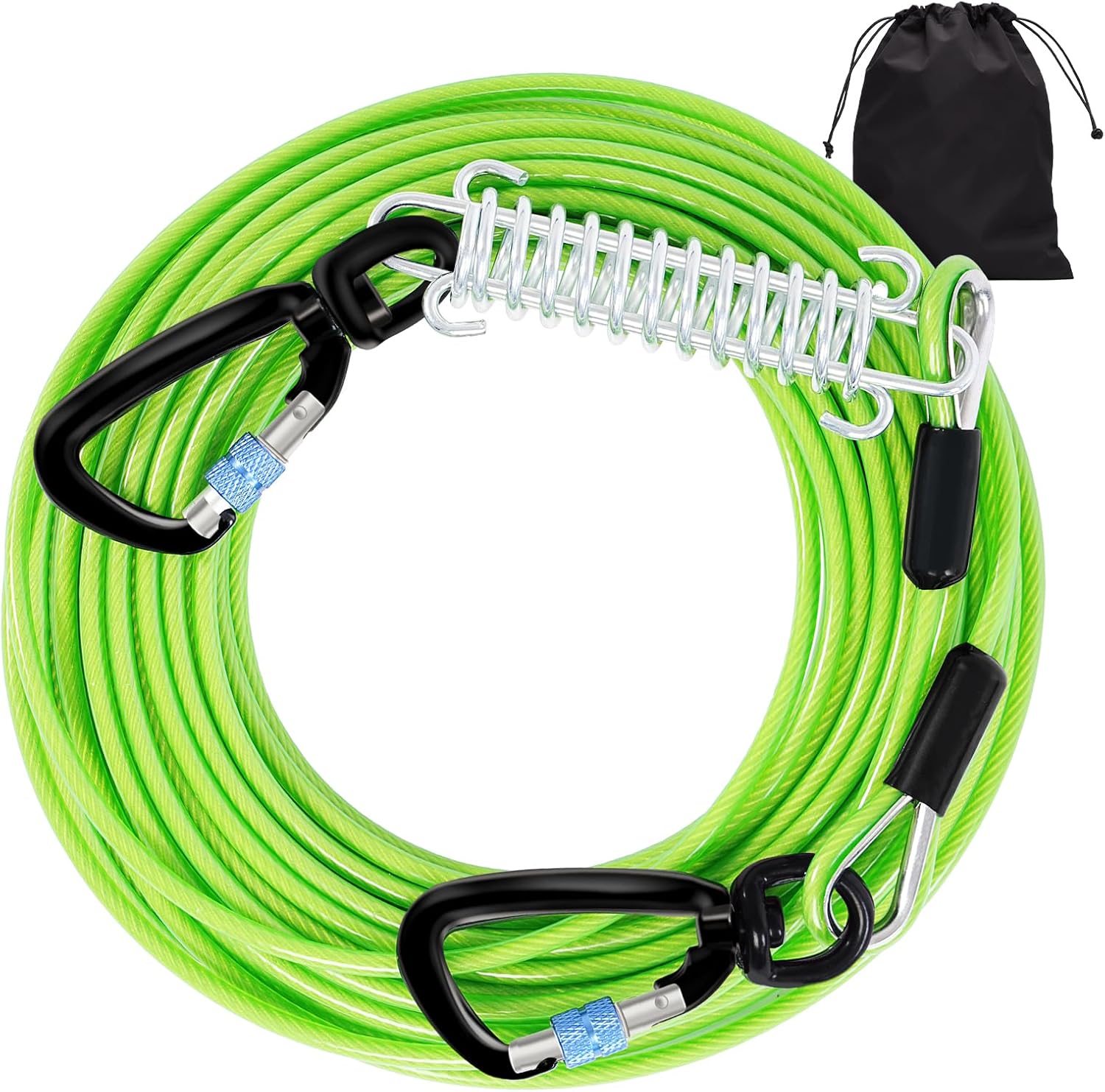
This Snagle Paw tie-out cable is built for heavy use around the campsite or yard, combining a 6×19 flexible wire core with a vinyl coating and reinforced loopguard to resist chewing and corrosion. It gives a dog roughly 30 feet of range while the 360° swivel clip and lockable hook reduce tangles and keep the attachment secure. A shock-absorbing buffer spring helps soften sudden lunges, which lowers jerking forces on both collar and anchor during active play. Practical touches include an anti-rust coating for easier cleaning and a small carry bag for packing with camping gear. The cable's claimed 1000-pound break strength and metal reinforcements make it suitable for strong, persistent pullers, but the vinyl coating and spring add stiffness that can make the line less compact than a fabric lead. It is a functional, durable option when you need a rugged tether that resists chewing and the elements, but users who want a lightweight, highly packable tie-out may prefer an alternate design.
Best for: Campers and outdoor owners who need a rugged, chew-resistant tie-out that withstands strong, persistent pulling and holds up to wet or muddy conditions.
Less Ideal for: People looking for the lightest, most compact travel tether or those who need a permanent, fixed anchoring solution for long-term restraint.
- High 1000 lb break strength suitable for powerful pullers
- 360° swivel and lockable clip reduce tangles and secure attachment
- Shock-absorbing spring softens sudden lunges to protect collar and anchor
- Vinyl coating with anti-rust finish resists chewing and eases cleaning
- Includes reinforced loopguard and carry bag for durability and portability
- Vinyl-coated cable is stiffer and less packable than fabric leads
- Not suited for permanent restraint without a proper ground anchor or stake
Verdict: The best heavy-duty tie out is made with thicker cables or reinforced hardware and higher load ratings to withstand strong, persistent pulling and rough use.
LZ.MZXU 100ft Dog Tie Out Cable
Best Long-Length Tie Out

| Size | 100FT |
|---|---|
| Unit Count | 1 Count |
| Pet Type | Dog |
This 100ft tie-out cable is built to give active dogs a lot more room to roam while keeping them safely anchored during camping, backyard play, or park outings. The kit includes the long reflective rope, heavy-duty steel buckles, a 360° anti-tangle clip and a compact carry bag, so it sets up quickly and packs down small for trips. The reflective points improve visibility after dark and the lightweight design reduces strain when carrying. Using a trolley-style attachment and aluminum carabiner lets the dog run along a secured line without twisting the leash, and the steel buckles provide a solid connection to trees or posts. Expect easy one-person setup in under five minutes. Limitations are that this is not a chew-proof steel-core cable and very strong chewers could damage the rope, and it relies on a solid anchor point rather than replacing a full-duty stake system for loose-ground installations.
Best for: Buyers who want to give energetic dogs much more outdoor freedom while keeping them secured for camping or yard use and who prioritize extended range and portability.
Less Ideal for: Owners with aggressive chewers or those who need a heavy-duty ground stake solution should consider more robust metal-core or stake-based systems instead.
- Extremely long 100 foot length gives dogs wide roaming range
- Reflective rope improves nighttime visibility
- Includes 360° anti-tangle clip for smoother movement along the line
- Heavy-duty steel buckles provide reliable anchor connections
- Lightweight and comes with a carry bag for camping and travel
- Rope construction is not steel-core and can be vulnerable to strong chewers
- Depends on a secure fixed anchor rather than functioning as a ground stake system
Verdict: The best long-length tie out provides extended cable or tether length to give energetic dogs more freedom while still maintaining a secure anchor point.
jenico Dog Tie Out Cable 10ft
Best Compact Tie Out

| Material Type | Alloy Steel |
|---|---|
| Unit Count | 10 Feet |
| Item Highlight | For dogs up to 500 lbs |
| Closure Type | Tie |
The jenico 10 ft tie-out cable is a compact, heavy-duty tether built from 5 mm stainless steel wire with a PVC coating and a swivel locking carabiner for tangle-free running. Designed for yard, camping, or short-term outdoor confinement, it attaches to a tree, stake, or other anchor and gives dogs room to move while remaining secured. The PVC coating resists rust and adds a reflective element that improves visibility in low light, and the steel core and locking hook are rated for large dogs up to 500 pounds, so it holds up well against strong pulls. At 10 feet and advertised as lightweight, it packs down small for backpacking or car camping, and the simple hook-and-cable design makes setup quick. Limitations are that it is a single fixed-length cable without built-in shock absorption, so sudden lunges transfer force to the anchor and collar, and the metal cable can be colder and less flexible than braided rope in wet or cold weather. For short trips where durability and compact stowage matter, this cable is a practical choice but consider an accessory bungee or padded attachment if you want shock reduction for very active dogs.
Best for: Campers and day-trippers who need a durable, easy-to-stow tether that gives a dog short-range freedom without taking much pack space.
Less Ideal for: Owners planning long unattended tethering sessions or those who need shock-absorbing or softer rope tethers for extremely active or chewer-prone dogs should consider other options.
- Stainless steel core with PVC coating for strong, rust-resistant construction.
- Swivel locking carabiner provides 360° rotation to reduce tangles.
- Reflective coating increases visibility in low light conditions.
- Compact 10 ft length and lightweight design that stows easily for camping.
- No built-in shock absorption so sudden pulls transfer force to anchor and collar.
- Metal cable is less flexible and can be colder to handle than rope alternatives.
Verdict: The best compact tie out prioritizes portability and low weight for campers who need a space-saving tether that stows easily in a pack.
WePet Spiral Tie-Out Stake 16 Inch
Best Easy-Install Tie Out

| Size | Medium, 16 Inch |
|---|---|
| Material | Stainless Steel |
| Style | Spiral |
| Recommended for | Dogs up to 100 lbs |
This spiral tie-out stake screws into the ground to provide a simple anchored tether point for dogs in yards, campsites, or other outdoor spots. The 16-inch stainless steel spiral shaft is built for loose or sandy soil and the spiral shape helps bite into the ground for a firmer hold than a straight stake. It pairs with a tie-out cable or leash via the top clip, making attachment and removal quick and straightforward. Practical benefits include corrosion resistance from the stainless material and compact portability for travel or storage. Because it is a basic stake there are no extra features like a swivel base, ground sleeve, or integrated shock absorber, so strong, sustained pulling on soft soil can still loosen it over time. For typical yard use and medium-strength pullers this stake offers a robust, low-cost anchoring option, but buyers who need heavy-duty or permanent installations should consider more substantial ground anchors or anchoring systems.
Best for: Owners who need a straightforward, low-cost tethering solution for everyday yard or campsite use and prioritize rust resistance and easy installation over extra features.
Less Ideal for: People who need a high-security permanent anchor or who have very large, highly reactive dogs that routinely apply extreme force to the tether.
- Spiral screw design improves grip in loose or sandy soil compared with straight stakes
- Stainless steel construction resists rust for outdoor exposure
- 16-inch length gives decent depth for medium-strength dogs
- Simple top clip allows fast connection and removal of leash or cable
- No swivel or shock-absorbing feature to reduce strain from sudden pulls
- Not intended as a permanent or heavy-duty anchor for very strong or determined dogs
Verdict: The best easy-install tie out features simple stakes, ground anchors, or quick-attach hardware so owners can secure their dog fast without tools or fuss.
Ruffwear Knot-a-Hitch 28.5 ft
Best Premium Tie Out

| Length | 28.5 ft |
|---|---|
| Material Type | Polyester |
| Closure Type | Carabiner |
| Item Highlight | Tangle-Free Swiveling Carabiner, Quick & Easy Setup, Convenient Stow Bag |
The Ruffwear Knot-a-Hitch is a camping-focused tie-out system built like climbing gear to give dogs several feet of supervised range without tangling. It sets up between two trees or around a single post using a kernmantle-style rope, sliding tensioner, and a swiveling carabiner that keeps a leash from twisting. The integrated reflectivity and durable polyester webbing help visibility and durability in low light and rough outdoor conditions, and the included stow bag with storm flap keeps everything organized when not in use. In practice it works well for day use at campsites and parks where you need a quick, removable anchor and a bit of roaming room for a dog; the swivel and webbing make leash handling smoother than a simple stake. Limitations are that it is not a permanent anchor and setup requires suitable trees or posts, and heavier chewers or dogs left unsupervised could still damage the rope or hardware over time.
Best for: Campers and outdoor owners who want a rugged, easy-to-set-up tether that behaves more like climbing gear than a garden stake and prioritizes durability and smooth leash handling.
Less Ideal for: Owners who need a permanent or ground-anchored solution, or those who cannot rely on trees or posts at their outdoor locations.
- Climbing-inspired kernmantle rope and tensioning system for reliable, adjustable anchoring
- Swiveling carabiner reduces leash twist and tangles during use
- Durable polyester webbing with integrated reflectivity for low-light visibility
- Compact stow bag with storm flap keeps components protected and organized
- Designed for quick setup around two trees or a single post for campsite convenience
- Not intended as a permanent or heavy-duty anchor for prolonged unsupervised use
- Requires suitable trees or posts so it is not usable in open, tree-free areas
- May be vulnerable to determined chewers over time
Verdict: The best premium tie out uses top-grade materials, corrosion-resistant finishes, and refined hardware for longer life, smoother operation, and greater overall reliability.
Choosing the Right Dog Tie Out Camping: Key Factors to Consider
Material and Tensile Strength
Material determines how a tie out holds up to abrasion, moisture, and force. Heavy-duty braided ropes and coated steel cables resist chewing and wear far better than lightweight webbing, which can fray quickly when dragged over rocks or lodged under roots.
Tensile ratings or working load limits give a practical guide to suitability for different dog sizes. Choose a tie out with a safety margin above your dog's typical pulling force, especially if you camp in windy areas or near wildlife that may provoke sudden lunges.
Anchor Type and Holding Power
Anchors come in stakes, augers, ground anchors, and portable anchor plates, and each works differently depending on soil type. A spiral auger provides strong holding in soft soil, while a heavy-duty stake with wide flanges can resist pull-out in packed dirt.
Consider the expected campsite surfaces you will encounter and pick an anchor that matches. Anchors that embed deeply or distribute load over a larger area reduce the chance of failure during a sudden pull, which is essential for safety in camping conditions.
Length and Tangle Management
Cord length dictates how much freedom your dog has to move. Longer lengths provide more range for sniffing and stretching but increase the risk of tangles with campsite gear and other dogs. Shorter lengths improve control but can feel restrictive.
Look for features that reduce twisting and knots, such as rotatable swivels, beaded sections, or secondary tie-off points. Balance length with your campsite layout to avoid tripping hazards and to keep the dog away from fire rings, food storage, and trailheads.
Portability and Pack Size
Camping gear needs to fit your travel style. Ultralight, compact tie outs are best for backpackers who must minimize weight and bulk, while car campers can accept heavier anchors that offer superior holding power.
Consider how the tie out packs down, whether it can be wrapped or stored in a compact pouch, and if it adds significant weight to your gear list. Fast stowage and clearly marked storage help when setting up camp after dark or in bad weather.
Attachment Hardware and Ease of Use
Clips, carabiners, and swivels affect how quickly you can secure or release your dog. Gate-style carabiners and spring-hook clips allow one-handed operation, useful when you are managing a leash, a tent, or a cooler.
Hardware should be corrosion-resistant and sized appropriately for the tie out line. Smooth operation under mud and grit is important; mechanisms that jam easily reduce safety and convenience at the campsite.
Visibility and Safety Features
High-visibility colors and reflective elements improve safety during dawn or dusk activity. Bright lines and reflective tracers reduce the chance of accidental trips and make it easier to locate your dog at night.
Other safety features to consider include breakaway sections, elastic shock absorbers that reduce strain on the dog and anchor during sudden pulls, and reinforced collars or attachment loops designed to release under extreme force to prevent injury.
How Do I Choose the Right Anchor for Rocky or Sandy Campsites?
Different campsites demand different anchor designs. In sandy conditions look for anchors that increase surface area, such as wide-flanged stakes or anchor plates that sit on top of the sand and resist pull-through. On rocky ground you may not be able to screw an auger in at all; low-profile stakes that wedge into cracks or heavy plate anchors you can bury beneath small rocks perform better.
When anchoring is uncertain, carry a secondary option like a sand anchor or a heavy-duty stake. You can also use natural anchors in a pinch by securing the tie out to a large, immovable rock or a suitably rooted stump, making sure the attachment point is strong and the rope runs clear of edges that could cut.
- Use augers for soft soil and wide flanged stakes for firm but loose ground
- Carry a flat anchor or plate for sandy beaches where screwing is ineffective
- Inspect natural anchors carefully before relying on them
Can a Tie Out Be Used Safely with a Harness Instead of a Collar?
Attaching a tie out to a harness reduces neck strain and distributes force across the dog's body, which is especially helpful for dogs that pull frequently. Use a harness rated for restraint and ensure attachment points are reinforced. Avoid harnesses with weak buckles or thin webbing when using them with an anchored tie out.
Be mindful that some harnesses allow the dog to pivot more, which can increase tangling if the tie out has no swivel. Pair a harness setup with a swivel or a tangle-reducing design to minimize twisting and the chance of the dog ending up wrapped around a tree or tent stake.
- Harness attachment reduces neck injury risk
- Choose reinforced harnesses for anchored use
- Combine with swivels to limit tangles
How Should I Position a Tie Out Around a Campsite to Reduce Hazards?
Plan placement before you set the anchor. Keep the dog away from fire rings, food storage areas, trails, and low-hanging tent guy lines. Place anchors so that the dog's roaming radius does not include trip hazards or places where wildlife might gather.
Also consider wind and sun exposure. A tie out positioned near shade helps prevent overheating on warm days, while a sheltered spot reduces exposure to wind that could cause sudden lunges. Always check the line for vertical clearance to prevent the dog from getting caught on low branches.
- Avoid placing anchors near fire rings or food storage
- Ensure the roaming radius is free of trip hazards
- Choose shaded or sheltered spots when possible
What Maintenance Does a Camping Tie Out Need?
Rinse and dry rope or cable after exposure to mud, salt, or heavy moisture to prevent abrasion and corrosion. Inspect for frays, broken strands, or rust before each trip and replace any component that shows significant wear.
Lubricate moving hardware lightly if it begins to stiffen, and store anchors and lines in a dry bag away from prolonged sunlight to preserve webbing and coatings. Regular maintenance keeps the system reliable and extends service life.
- Rinse off mud and salt after each use
- Inspect for frays, rust, or damaged hardware before trips
- Store in a dry place away from UV exposure
Are Shock-absorbing Tie Outs Worth It for Camping?
Shock-absorbing sections can reduce strain on both the dog and the anchor during sudden pulls, which is helpful if wildlife or passing hikers provoke abrupt lunges. They are most valuable for dogs that regularly pull or for campsites where surprises are likely.
However, elastic components add complexity and can wear out faster than plain rope or cable. If you choose a shock-absorbing tie out, inspect the elastic element regularly and weigh the tradeoff between comfort and long-term durability.
- Good for reducing jerk force during sudden pulls
- Requires more frequent inspection and potential replacement
- Consider for excitable dogs or busy camp areas
How to Avoid Tangles when Using Multiple Dogs at a Campsite?
If you camp with more than one dog, keep tie outs separated by sufficient distance and orient anchors so lines do not cross common walking paths. Shorter lines or dedicated zones for each dog reduce the chance of entanglement and altercations.
Use swivel attachments and clip the lines in a way that lets each dog move in a roughly circular area without overlapping another dog's space. Supervising dogs during high-activity times and training them to wait near the tent can also reduce tangles.
- Space anchors to keep roaming radii separate
- Use swivels to limit line twisting
- Supervise dogs during high-activity periods
How We Chose the Best Dog Tie Out Camping
We focused on features and performance that matter for camping use rather than casual backyard tethering. Key evaluation criteria included material strength and abrasion resistance to handle rough ground and weather; anchoring options and holding power on typical campsite surfaces; cord or cable length and tangle-resistance for safe movement; packability and weight for hikers and car campers; and quick-release or user-friendly attachment points for fast setup and emergency release. We excluded products meant only for indoor use, lightweight novelty tethers not rated for repeated outdoor stress, and chains or cables lacking corrosion resistance. We prioritized options with clear specifications for load or tensile strength and those that offered multiple anchoring methods. Durability in wet or muddy conditions and ease of cleaning were also important. Finally, we considered safety features such as breakaway mechanisms or shock-absorbing elements that reduce jerking during sudden pulls.
Our full evaluation process is outlined in our review methodology.
FAQ
Is a cable tie out better than rope for camping?
A cable resists chewing and abrasion better than many ropes, which can make it a good choice for chewer-prone dogs and rocky terrain. Rope is lighter and packs smaller, so it may be preferable for backpacking. The best choice depends on your dog's behavior and how much weight you are willing to carry.
How long should a camping tie out be?
Length depends on campsite layout and the dog's activity level. Fourteen to twenty feet is common for giving freedom without creating excessive tangling. Shorter lengths are safer in crowded sites or near hazards.
Can I leave a dog unattended on a tie out while I go away from camp?
Leaving a dog tied unattended is risky because of wildlife, theft, or entanglement. If you must leave briefly, limit the duration, choose a safe spot away from hazards, and ensure the anchor and attachment are secure. Supervised use is always safer.
How do I reduce my dog's anxiety while tied at a campsite?
Provide familiar bedding, toys, and a predictable routine to help your dog relax. Keep the tethered zone within sight and avoid tethering near busy paths or noisy areas. Short supervised sessions and positive reinforcement for calm behavior can also reduce stress.
What should I do if the anchor pulls out?
Stay calm and secure the dog immediately using a backup leash or handheld restraint. Move the dog to safety and check for injuries. For future trips choose an anchor better suited to the campsite surface and consider multiple anchor points for redundancy.
Final Verdict
Prioritize durability, appropriate anchoring, and sensible length when choosing a dog tie out for camping. Think about the typical surfaces you will encounter, how mobile you need to be, and whether your dog is likely to pull or chew. Tradeoffs between weight and holding power are common, so match the system to your travel style and the dog's behavior. Choose a solution that balances reliable holding force, easy setup, and visible safety features. With the right tie out and careful placement, you can give your dog freedom to enjoy camp while keeping them and others safe.

