

When you are working with a stubborn dog, the right training collar can make the difference between repeated frustration and steady progress. You need a tool that gives clear, adjustable signals, fits comfortably, and lets you reinforce desired behaviors without causing stress. This guide shortlists the top options for stubborn dogs and explains the practical strengths buyers should expect. The selections that follow were evaluated for how well they deliver reliable corrections, versatility in settings, and safe fit. Read on to see which features matter most and how to match a collar to your dog's temperament and training plan.
Top Picks at a Glance
| Best Overall Training Collar A reliable all-around choice that fits most stubborn dogs | Dogtra 280X E-Collar 1-Dog |  |
| Best Budget Training Collar A low-cost option that still trains reliably for basic needs | HapTop AC131 Dog Shock Collar |  |
| Best Compact Training Collar A smaller, lightweight unit ideal for travel and small breeds | koikvs Small Dog Training Collar YM2 |  |
| Best Heavy-Duty Training Collar Built with rugged materials for strong, active or large dogs | SportDOG SportHunter 825X |  |
| Best Waterproof Training Collar Water-resistant design for baths, rain, and muddy outdoor use | MrSpark HQ01 Shock Training Collar |  |
| Best Rechargeable Training Collar Rechargeable battery for frequent use without swapping disposable cells | BOUSNIC Dog Training Collar 2-Pack |  |
| Best Premium Training Collar Higher-end features and build for serious trainers and longevity | Garmin Sport PRO Training Collar |  |
Dogtra 280X E-Collar 1-Dog
Best Overall Training Collar

| Dog weight recommendation | 10 lbs and up |
|---|---|
| Correction levels | 100 levels |
| Range | 1/2 mile |
| Features | Tone, Vibration, BOOST, LED light |
The Dogtra 280X is a compact, trainer-focused e-collar designed for consistent everyday use with stubborn dogs. It pairs a handheld remote with a rechargeable receiver worn on the dog and delivers 100 levels of precise static correction plus tone and XPP vibration for non-shock attention. A prominent front button and safety level lock make it easy to deliver quick, repeatable responses and prevent accidental activations, while the BOOST feature instantly raises stimulation for urgent recall situations. The unit is fully waterproof, has a bright 1000-lux LED for visibility at night, and is expandable to control up to three dogs from one transmitter. Practical benefits include a durable Biothane collar strap, removable contact points for skin comfort, and a large, readable screen that speeds dialing in the right level. Limitations are that the system includes only a single receiver in this kit and the half-mile range, while ample for most fields and parks, may be restrictive for very long-range work. New users should spend time finding the correct level and using tone and vibration before relying on static correction.
Best for: Owners who need a dependable, easy-to-use trainer that delivers precise corrections and quick recall for hard-to-focus dogs during everyday off-leash work.
Less Ideal for: Handlers who require built-in GPS tracking, app control, or very long-range systems beyond about half a mile should consider different devices.
- Wide 100-level range for fine-tuned correction
- Front-centered main button and BOOST for fast, reliable responses
- Fully waterproof receiver and durable construction for outdoor use
- Bright 1000-lux LED increases visibility for low-light training
- Expandable system supports up to three dogs with one transmitter
- Single-receiver kit requires buying additional receivers to train multiple dogs at once
- Half-mile stated range may be limiting for very large properties or extreme long-range work
Verdict: The best overall training collar for stubborn dogs that balances effective correction modes, comfortable fit, and intuitive controls for everyday use.
HapTop AC131 Dog Shock Collar
Best Budget Training Collar

| Training modes | Beep, Vibration, Safe Shock, Shock Boost |
|---|---|
| Range | 4500 ft |
| Fit neck | 7.8"-24.4" (10-120 lb) |
| Waterproof rating | IPX8 |
| Charging | USB-C |
The HapTop AC131 is a rechargeable e-collar kit designed for everyday obedience and distance work. It uses a 2-channel remote to control up to two dogs and offers four training modes: beep, vibration, safe shock (0–99 levels) and a shock boost, with the shock function optional for no-shock training. The remote's long 4500 foot range and memory for individual dog settings make it useful for off-leash recall, boundary training, and reinforcing commands across yards or trails. The receiver is IPX8 waterproof and the kit includes multiple prong lengths, silicone covers, a test light tool, and USB-C charging for practical field use. Safety-oriented features include an adjustable low-to-high stimulation range, a security lock to prevent accidental corrections, and a manufacturer guideline limiting continuous wear to 12 hours. Trade-offs are typical for this class: it relies on batteries and correct fitment to be effective, and some owners prefer vibration or beep-only methods before adding shock. The unit's feature set and range make it a strong daily trainer for owners willing to follow safe use guidelines.
Best for: Owners who want a versatile, safety-minded e-collar for regular obedience and distance work and who plan to use multiple training modes progressively.
Less Ideal for: People who want a purely non-aversive training tool or who are uncomfortable using shock-style corrections should choose vibration- or treat-based training alternatives.
- Very long 4500 ft remote range for off-leash training
- Multiple modes (beep, vibration, adjustable shock) for progressive training
- IPX8 waterproof receiver suitable for wet outdoor use
- Includes extra prongs, silicone covers, test light tool, and USB-C charging
- 2-channel remote controls two dogs and remembers individual settings
- Shock feature requires careful adjustment and responsible use to avoid misuse
- Not intended for continuous wear longer than 12 hours per day
Verdict: The best budget training collar for owners who need an affordable, effective solution that covers essential features without extra cost.
koikvs Small Dog Training Collar YM2
Best Compact Training Collar

| Breed Recommendation | Small |
|---|---|
| Included Components | Remote Control |
| Animal Collar Type | Electronic Training Collar |
| IP Rating | IP67 (receiver) |
This compact koikvs training collar is built specifically for small breeds and travel use, combining a lightweight receiver with a simple two-button remote for everyday corrections. The receiver is very light and low-profile, with removable contact points and silicone covers to reduce irritation on sensitive necks, and the nylon strap adjusts from very short to 25 inches to fit tiny puppies through small adult dogs. Controls are straightforward: two large front buttons for beep and vibration and side controls for 1–16 shock levels so you can reserve stimulation for moments that require firm correction. The receiver is rated IP67, so it tolerates rain and submersion, while the remote is rainproof only. Battery life is strong on paper, with long standby and multi-day use between charges, and the remote claims up to a 1000 ft range in open areas which is useful for recall practice in yards. Expect a learning curve dialing in the right stimulation level for a very small dog and keep the remote dry; otherwise this is a sensible, travel-friendly option for focused training with compact breeds.
Best for: Buyers of small-breed dogs or frequent travelers who want a genuinely lightweight, low-profile training collar that is easy to carry and simple to operate for routine behavior shaping.
Less Ideal for: Owners who need multi-dog simultaneous control, advanced programmable schedules, or a fully submersible remote should consider other systems designed for those capabilities.
- Very lightweight, low-profile receiver suited to small breeds
- Removable contact points with silicone covers to protect sensitive skin
- Simple remote layout with dedicated beep and vibration buttons for everyday use
- IP67 waterproof receiver for swimming and wet-weather use
- Long battery standby and claimed range up to 1000 ft for outdoor training
- Remote is only rainproof and should not be submerged
- Shock levels require careful adjustment on tiny or very young puppies
Verdict: The best compact training collar for pet owners who prioritize portability and minimal bulk while maintaining effective training functionality.
SportDOG SportHunter 825X
Best Heavy-Duty Training Collar

| Range | 1/2 mile (880 yards) |
|---|---|
| Stimulation levels | 21 levels |
| Modes | Tone, Vibration, Static |
| Waterproof rating | Submersible to 25 ft |
| Battery | Rechargeable lithium-ion, 50–70 hours |
The SportDOG SportHunter 825X is a rugged remote training collar built for long-range off-leash work and repeated field use. It pairs a handheld transmitter with a rechargeable receiver collar that is waterproof to 25 feet, offers tone, vibration, and 21 levels of static stimulation, and can be expanded to control up to three dogs with additional collars. The remote is designed for no-look operation with a dial for consistent intensity selection and a quick two-hour charge for both transmitter and receiver; lithium-ion batteries claim 50 to 70 hours per charge. Practical benefits include a wide range for recall and field control, multiple stimulus types for progressive training, and durable DryTek waterproofing that stands up to wet, muddy conditions. Limitations to consider are the learning curve for proper fit and intensity selection, the need to trim or use longer contact points on thick-coated dogs for reliable contact, and that the system is focused on static reinforcement rather than GPS tracking or advanced telemetry features. For owners who train in rugged environments and need a dependable, long-range e-collar, the 825X delivers a heavy-duty, field-ready option.
Best for: Owners of strong, very active, or working dogs who need a durable, long-range e-collar that tolerates wet and muddy field conditions and supports progressive, repeatable corrections.
Less Ideal for: Owners seeking GPS tracking, smartphone connectivity, or a purely positive-reward training-only solution should consider other systems.
- Half-mile (880 yard) range suitable for off-leash field work
- Waterproof and submersible to 25 feet using DryTek technology
- 21 levels of static plus tone and vibration for tailored training
- Rechargeable lithium-ion batteries with 50–70 hour runtime and 2-hour quick charge
- Expandable to control up to three dogs with add-on collars
- Requires correct collar fit and skin contact; long coats may need trimming or longer contact points
- No built-in GPS or location tracking features
Verdict: The best heavy-duty training collar for owners of strong or very active dogs who need a durable, reliable device that tolerates rough use.
MrSpark HQ01 Shock Training Collar
Best Waterproof Training Collar

| Training modes | Beep, Vibration, Shock (adjustable levels) |
|---|---|
| Waterproof rating | IP68 receiver |
| Remote range | 4500ft |
| Recharge time | 2 hours |
The MrSpark HQ01 is a rechargeable e-collar designed for remote obedience and bark control using three modes: beep, vibration and adjustable shock levels. You use the handheld remote to send instant corrections up to 4,500 feet away, which makes it practical for off-leash field work, recall training, and perimeter control. Notable features include an IP68 waterproof receiver that can be rinsed after swims or muddy sessions, a built-in LED collar light and a remote flashlight for night visibility, and a safety lock plus automotive-grade safety chip to reduce accidental stimulation. Battery life is strong: the receiver claims up to about 20 days between charges and the remote up to 90 days with a two-hour full charge time. The collar ships with short and long metal prongs and silicone covers to fit different coat types and has an adjustable buckle fit. Limitations to be aware of are that the remote is not waterproof and users must follow the daily-wear and skin-inspection guidance to avoid irritation from sustained contact; effective, humane use requires gradual level setting and monitoring during training.
Best for: Pet owners who prioritize a durable, moisture-resistant training collar for frequent outdoor use, night walks, and water activities and who want a long-range remote for off-leash correction.
Less Ideal for: Owners who need a fully waterproof remote or who prefer passive bark-only collars without user-controlled correction should consider other options.
- IP68-rated receiver that can be rinsed after swimming or muddy play
- Long 4,500 ft RF range with adaptive frequency hopping for stable response
- Multiple training modes with adjustable levels for gradual, precise corrections
- Long battery runtime and 2-hour fast recharge to minimize downtime
- Included hardware (short/long prongs and silicone covers) for fit across coat types
- Remote unit is not waterproof which limits use in wet conditions
- Requires careful daily-wear management and periodic skin checks to prevent irritation
Verdict: The best waterproof training collar for pets that spend time outdoors or in wet conditions and need a reliable, easy-to-dry training device.
BOUSNIC Dog Training Collar 2-Pack
Best Rechargeable Training Collar

| Range | Up to 4000 ft |
|---|---|
| Modes | Beep, Vibration, Static (1–16 levels) |
| Charging | USB rechargeable, 2–3 hour quick charge |
| Receiver waterproof rating | IPX7 |
This BOUSNIC kit pairs a handheld remote with two lightweight, waterproof receivers so you can train two dogs at once using beep, vibration, or adjustable static stimulation. The remote shows channel info on a numeric display and has separate controls for each dog, plus a lock slider to avoid accidental corrections. In practice the long advertised range and stable signal make it useful for off-leash work in large yards or fields, and the spring-sheet contact points with silicone covers help maintain contact on dogs with thicker coats. Recharge time is short and the factory claim of 30 to 60 days per charge suggests long standby life for typical intermittent training sessions. Trade-offs to note are that the remote is not described as waterproof and the unit uses contact-point stimulation which requires proper fit and careful level selection for humane, effective results. Some users may also need to swap contact points for size and check pairing steps when setting up two dogs.
Best for: Owners who train frequently and want a rechargeable system that handles two dogs and long-range off-leash work while minimizing recurring battery costs.
Less Ideal for: People who need a fully waterproof handheld remote or who prefer non-contact training methods such as GPS geofencing or purely remote audio cues.
- Two-receiver kit lets one remote control two dogs independently
- Long reported range up to 4000 feet for large-area training
- Three modes (beep, vibration, adjustable static) for progressive correction
- Quick 2–3 hour recharge with long standby/runtime, reducing battery swap hassle
- Silicone covers and detachable contact points reduce skin irritation and improve fit over thicker coats
- Remote is not explicitly waterproof while receivers are IPX7 rated
- Effectiveness depends on correct fit and cautious level selection for humane use
Verdict: The best rechargeable training collar for owners who train often and want the convenience and lower ongoing cost of a rechargeable power source.
Garmin Sport PRO Training Collar
Best Premium Training Collar
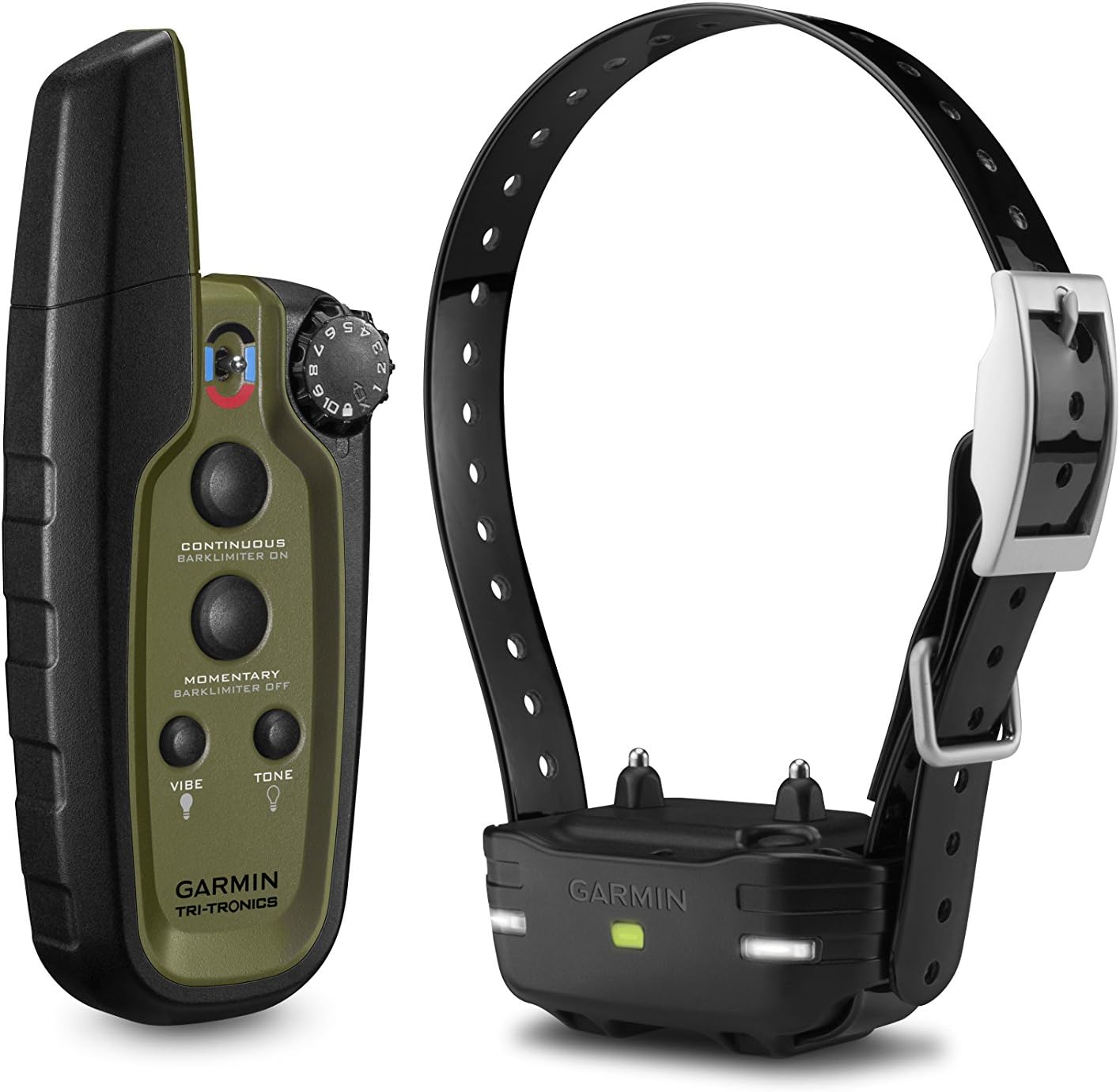
| Range | 3/4 mile |
|---|---|
| Training modes | Stimulation, vibration, tone |
| Dog devices supported | Up to 3 dogs |
| Handheld battery life | Up to 60 hours |
| Handheld water rating | IPX7 |
The Garmin Sport PRO bundle pairs a compact, one-handed handheld with a rechargeable dog device to give precise remote corrections and auxiliary cues for stubborn dogs. The handheld uses a quick-turn dial with positive clicks to switch among 10 stimulation levels and to select tone, vibration, or lights, while four buttons let you apply momentary or continuous stimulation. The dog unit includes settable BarkLimiter levels and remote-controlled LED beacon lights for locating dogs in low light. Both units use rechargeable, user-replaceable lithium-ion batteries and the handheld floats for field durability. Practical benefits include long handheld battery life, rugged water resistance, and interchangeable contact points for wet conditions. Limitations are that only one dog device is included in the bundle so training multiple dogs requires additional purchases, the 3/4-mile range can be reduced in dense terrain, and the device offers no smartphone app integration for logging sessions.
Best for: Owners who want a durable, feature-rich training system and are willing to invest in a premium remote collar to correct strong-willed or hard-to-reach dogs.
Less Ideal for: People seeking a simple, budget collar or those who need smartphone-based tracking and training logs should look elsewhere.
- Intuitive one-handed control with a click-dial for quick, eyes-free level changes
- Multiple correction modes including 10 stimulation levels plus vibration and tone
- Built-in BarkLimiter and remote beacon lights helpful for unwanted barking and low-light recovery
- Rechargeable, user-replaceable batteries with long handheld runtime and rugged, water-resistant design
- Interchangeable long and short stainless steel contact points for wet or varied coat conditions
- Bundle includes only one dog device so training multiple dogs requires buying extra collars
- Water resistance differs between handheld (IPX7) and dog device (1 ATM), limiting submersion tolerance of the collar unit
Verdict: The best premium training collar for owners willing to pay more for advanced features, superior materials, and longer-term reliability.
Choosing the Right Dog Training Collar Stubborn Dog: Key Factors to Consider
Correction Modes and Versatility
Different stubborn behaviors respond to different cues. A collar that offers multiple correction modes—high-quality vibration, tone, and graduated static or momentary stimulation—lets you start with the least invasive option and increase only if needed. Some dogs react better to vibration or sound than to static stimulation, so having alternatives improves your chances of finding an effective signal without escalating force.
Versatility also means having adjustable intensity levels. Fine-grained control lets you match the signal to your dog's size, coat thickness, and sensitivity. A collar that forces you into a single intensity risks underwhelming or overstimulating the dog, which can slow progress or create negative associations with training.
Fit, Contact Reliability, and Comfort
A properly fitted collar ensures consistent contact with the dog's neck so each correction registers as intended. Collars that allow for precise sizing and include replaceable or shaped contact points work better on different coat lengths. Poor contact causes missed cues and inconsistent responses, which is especially damaging when you are trying to change persistent behaviors.
Comfort matters for safety and long-term acceptance. Padding, smooth edges, and materials that do not irritate skin are important when a collar is used frequently during sessions. Also consider how the collar behaves during activity: straps that slip or buckle styles that loosen will undermine training consistency.
Control Range and Remote Responsiveness
When working with a stubborn dog outdoors, you may need to communicate cues at a distance. A reliable range ensures the signal reaches the collar without delay or dropout, which preserves the timing necessary for effective training. Short or inconsistent range forces you to get closer than intended and reduces the collar's usefulness for off-leash control.
Responsiveness is as important as nominal range. The remote and collar should pair quickly and deliver corrections with minimal lag. Controls that are intuitive and positioned for one-handed operation reduce user error and help you deliver timely cues that the dog can associate with specific behaviors.
Battery Life and Durability
Training sessions can be long and frequent when addressing stubborn behaviors. Batteries that die mid-session interrupt progress and can confuse your dog if a cue is missed. Look for collars with multi-day battery life under normal use and straightforward charging or replaceable batteries to avoid downtime.
Durability affects how a collar performs during regular walks, play, and outdoor training. Water resistance or waterproofing, corrosion-resistant contacts, and robust buckles matter for collars that will see heavy use. A flimsy collar or remote will likely fail when you need it most.
Safety Features and Humane Settings
Safety features reduce the risk of accidental overcorrection and help you use the collar responsibly. Automatic shutoff after a sustained signal, lockout intervals between stimulations, and visual or audible low-battery warnings let you avoid prolonged exposure to a correction. Humane design also includes low-intensity starting points and gentle modes so you can rely on positive reinforcement alongside the collar.
Good documentation and clear labeling of modes and intensity levels help you apply corrections consistently and safely. If a collar lacks these user-friendly safety cues, it can be misused even with good intentions.
Ease of Use and Learning Curve
A training device should make consistent cues easier to deliver, not add complexity. Look for remotes with simple, labeled controls and collars that pair reliably without repeated setup. Digital displays or clear LED indicators on remotes and collars help you confirm mode and intensity at a glance.
A steep learning curve increases the chance of operator error, which undermines training with stubborn dogs. Quick setup, straightforward mode changes, and clear manuals or supported training resources save time and reduce frustration for both handler and dog.
How Should I Introduce a Training Collar to a Stubborn Dog?
Introduce the collar gradually and pair it with positive experiences. Fit the collar loosely at first and let your dog wear it without corrections during short sessions so they can get used to the feel. Offer treats and praise while the dog is wearing the collar to create a neutral or positive association.
Start with the gentlest mode available, such as tone or vibration, and only move to stronger settings if the dog does not register the cue. Use the collar for clear, momentary signals rather than prolonged corrections, and always follow up a successful cue with immediate reinforcement so the dog understands what behavior earned the reward.
- Begin beside you inside the house before moving to outdoor practice.
- Test responsiveness at a very low setting to identify the minimal effective correction.
- Keep early sessions short and end on a positive note to maintain motivation.
What Training Approaches Work Best with Collars for Stubborn Dogs?
Collars are most effective as part of a broader training plan that emphasizes timing, consistency, and reinforcement. Use the collar to mark the moment a behavior occurs, then immediately reward the behavior you want. This approach helps the dog associate the collar's signal with a specific action rather than as a vague punitive device.
Pair collar cues with established obedience commands so the dog learns the command, not just the sensation. Over time you can reduce reliance on corrections and use the collar mainly for maintenance or proofing behaviors in distracting environments.
- Combine collar cues with verbal commands and hand signals for redundancy.
- Use short, frequent practice sessions rather than long, tiring ones.
- Gradually fade corrections as the dog demonstrates consistent responses.
How to Size and Position a Training Collar Correctly
Measure your dog's neck and choose a collar that allows for precise adjustment. You should be able to fit two fingers between the collar and the dog's skin when it is properly fastened for training sessions. Position the contact points so they touch skin rather than resting on thick fur, adjusting or swapping contact tips if needed.
Check fit before each session: straps can shift during play or activity. A collar that is too tight can irritate the dog, while one that is too loose will cause missed signals and inconsistent training outcomes.
- Trim long fur around contact points if recommended by the collar instructions.
- Confirm that the collar sits high enough on the neck to register cues but not on the windpipe.
- Recheck fit after vigorous activity or if you notice slipping.
Can Collars Replace Professional Training for Persistent Issues?
A collar is a tool to support training, not an automatic fix for complex behavioral problems. For stubborn dogs with deep-seated issues such as reactivity, severe fear, or aggression, professional guidance remains important. A trainer can design a behavior modification plan and show you how to integrate a collar safely into that plan.
For many common stubborn behaviors like inconsistent recall or persistent pulling, collars used correctly can speed results when paired with consistent practice and reinforcement. The key is proper timing, appropriate intensity, and a focus on teaching alternative behaviors rather than relying solely on correction.
- Seek a trainer if the dog shows aggression or fear responses.
- Use collars for cue reinforcement and proofing under distraction rather than as the sole intervention.
- Document responses and adjust your approach if the dog shows signs of stress.
How to Manage Safety and Welfare During Collar Training
Monitor your dog for signs of stress such as yawning, lip licking, avoidance, or unusually stiff posture during and after training. If those signs appear, reduce intensity, increase rewards, or stop the session. Always use the lowest setting that achieves a clear, repeatable response.
Limit collar usage to short training sessions and avoid leaving correction collars on the dog unsupervised for long periods. Ensure contact points and straps are clean and intact to prevent skin irritation, and follow manufacturer guidelines for maintenance to preserve safety features.
- Rotate short training sessions with positive play to avoid negative associations.
- Inspect contact points regularly and clean according to instructions.
- Use humane settings and automatic safety features where available.
How We Chose the Best Dog Training Collar Stubborn Dog
Our shortlist focused on collars that provide clear, adjustable feedback while minimizing unintended effects that increase resistance in stubborn dogs. We prioritized reliable signal delivery, precise intensity control, comfortable and secure fit, and a variety of correction modes so owners can use training methods that suit their dog's sensitivity and learning pace. Battery life and real-world range were included because inconsistent power or poor range breaks training sessions and frustrates both handler and dog. We also considered durability and water resistance for regular outdoor use, and simple controls so owners can change settings quickly during a session. Safety features such as automatic safety shutoff, low-voltage options, and selectable modes were weighed heavily to reduce the risk of overcorrection. We excluded items lacking adjustable intensity or with one-size-fits-all designs that do not work for a range of neck sizes and coat types. We also removed collars without clear documentation on correction modes or without reliable remote connectivity. The remaining criteria used to rank selections were practical effectiveness with stubborn behaviors, ease of use, and consistent operation across common training scenarios.
Our full evaluation process is outlined in our review methodology.
FAQ
Will a training collar make a stubborn dog stop misbehaving immediately?
Not usually. A collar can speed learning when used with consistent timing and reinforcement, but stubborn behaviors often require repeated practice and clear alternative behaviors. Expect gradual improvement rather than instant compliance.
Is static stimulation safe for stubborn dogs?
Static stimulation can be safe when used at the lowest effective level and for momentary corrections. Safety depends on correct fit, appropriate intensity, and limiting session length. Choose collars with safety features and avoid prolonged exposure.
How often should I use a training collar during the week?
Frequent short sessions are better than occasional long ones. Daily brief practice builds consistency without tiring the dog. Adjust frequency based on the dog's response and energy, and always combine corrections with positive reinforcement.
Can puppies use training collars for stubborn behavior?
Puppies are still developing and often need gentler methods. If using a collar with a young dog, select modes and intensities appropriate for small bodies and focus on positive reinforcement. Consult a trainer for age-appropriate guidance.
What should I do if my dog ignores the collar at low settings?
First verify fit and contact reliability. If the collar is making contact and the dog still does not respond, increase intensity gradually to the minimal effective level or try an alternate mode such as vibration or tone before escalating further.
Final Verdict
Prioritize collars that let you start with gentle cues and scale to stronger signals only when necessary. The most useful devices combine reliable, adjustable corrections with a secure, comfortable fit and straightforward controls so you can train consistently and safely. Balance corrective cues with reward-based practice and consider professional help for entrenched behavior problems. With the right tool and a patient, consistent approach, you can improve responsiveness in a stubborn dog without sacrificing welfare.

