

If you are trying to stop constant barking without adding stress, the right training collar can help you manage behavior consistently and humanely. A collar with automatic bark control detects vocalizations and applies a corrective cue so you do not need to intervene every time. Choosing the right unit matters because sensitivity, correction type, and fit determine whether the collar discourages nuisance barking without creating anxiety. This guide covers six shortlisted training collars that offer automatic bark control, focusing on detection accuracy, comfort, and battery life. Below you will find practical buying criteria, usage pointers, and answers to common owner questions to help you pick the best option for your dog and training goals.
Top Picks at a Glance
| Best Overall Training Collar The top all-around pick that fits most dog training needs | Colofrog RS8 2-in-1 Dog Training Collar |  |
| Best Budget Training Collar A low-cost option that still offers core bark-control features | Honeynet Q10 Dog Bark Collar |  |
| Best Premium Training Collar A higher-end model with advanced features and durable materials | Garmin BarkLimiter Deluxe |  |
| Best Rechargeable Training Collar A model with long battery life and convenient USB charging | Kollgux Bark Collar TC-013 |  |
| Best Compact Training Collar A smaller, lightweight collar built for small dogs and portability | ELECANE Tiny Bark Collar Small |  |
| Best Heavy-Duty Training Collar Built with rugged materials for strong, active, or working dogs | HapTop AC131 Dog Shock Collar |  |
Colofrog RS8 2-in-1 Dog Training Collar
Best Overall Training Collar

| Model | RS8 |
|---|---|
| Battery | Rechargeable, 2 Lithium Ion included |
| Range | Up to 3300 ft |
| Waterproof | IP67 |
| Bark sensitivity | 5 adjustable levels |
The Colofrog RS8 is a 2-in-1 bark and shock collar designed for everyday training and bark control. It can operate autonomously as a bark-detection collar or as a remote-controlled training collar, so you can use automatic correction when you are not actively training and switch to remote commands for focused sessions. The remote offers three training functions — beep, vibration and a graduated safe shock — with wide adjustment ranges (beep levels 1–8, vibration 1–16, shock 1–99) and the system supports three collar modes including combined and bark-only operation. Notable practical benefits include IP67 waterproofing for outdoor use, a long reported standby life and a 3300 ft remote range that keeps small dogs responsive at distance. The adjustable sensitivity and five bark-sensing levels help reduce false triggers, and the kit includes replacement prongs and a protective rubber cover. Important limitations are the reliance on contact prongs for corrections which may not suit very small or sensitive dogs and the need to keep the remote dry despite the receiver being waterproof. Expect a short setup period to find the right sensitivity and stimulation settings for a small dog.
Best for: Owners who want a single collar that can both automatically curb barking and be used for targeted remote training, prioritizing ease of use and adjustable intensity for small dogs.
Less Ideal for: People seeking completely non-contact training methods or owners of very tiny toy breeds that cannot tolerate contact prongs should consider alternative no-contact bark deterrents.
- Two-in-one design supports both automatic bark control and active remote training
- Wide adjustment ranges for beep, vibration, and shock let you scale corrections to a small dog
- IP67 receiver waterproofing makes the collar usable in wet weather
- Long battery standby and quick recharge reduce maintenance
- Includes spare prongs, protective rubber cover, and charging cable for everyday use
- Contact-prong correction may be too strong for the smallest or most sensitive dogs
- Remote is not waterproof and must be kept dry during outdoor use
Verdict: The best overall training collar balances effective automatic bark control, safe stimulation modes, reliable sensors, and ease of use for most pet owners.
Honeynet Q10 Dog Bark Collar
Best Budget Training Collar

| Power source | Rechargeable battery |
|---|---|
| Sensitivity levels | 8 levels |
| Modes | 4 working modes |
| Waterproof rating | IP67 |
| Strap length | 27 inches |
The Honeynet Q10 is a straightforward rechargeable bark collar that detects barking and applies one of three correction options to deter the behavior. It offers 8 sensitivity levels and four working modes so you can tune detection to a small dog's voice and reduce false triggers, and the unit includes a visible color display that shows status and battery level. The collar charges in about two hours and the company claims 15 to 20 days of run time on a full charge, which makes it convenient for busy owners. IP67 waterproofing means it can be worn for outdoor play or light swimming without worry, and the included silicone conductive contacts and adjustable 27 inch strap aim to fit a wide range of neck sizes. The device also has a built-in protect mode that pauses corrections after repeated activations to avoid overstimulation. This is a budget-focused option, so it lacks advanced remote controls or app integration and some users may need time to find the right sensitivity setting for very small or soft-voiced dogs.
Best for: Owners who want a low-cost, no-frills electronic collar that reduces barking and can be tuned to a small dog’s voice rather than a feature-packed training system.
Less Ideal for: People who need app control, multi-dog management, or a collar specifically tailored for very young puppies or dogs under six months of age.
- Adjustable 8-level sensitivity to better match small dog vocal patterns
- Rechargeable battery with roughly 15–20 days claimed runtime per charge
- IP67 waterproof rating suitable for outdoor use and light swimming
- Protect mode that temporarily stops corrections after repeated activations to prevent overstimulation
- No remote control or smartphone app for distance or multi-dog management
- May require careful sensitivity tuning for very small or soft-barked dogs
Verdict: The best budget training collar gives owners essential automatic bark control and dependable performance at a lower price without unnecessary extras.
Garmin BarkLimiter Deluxe
Best Premium Training Collar
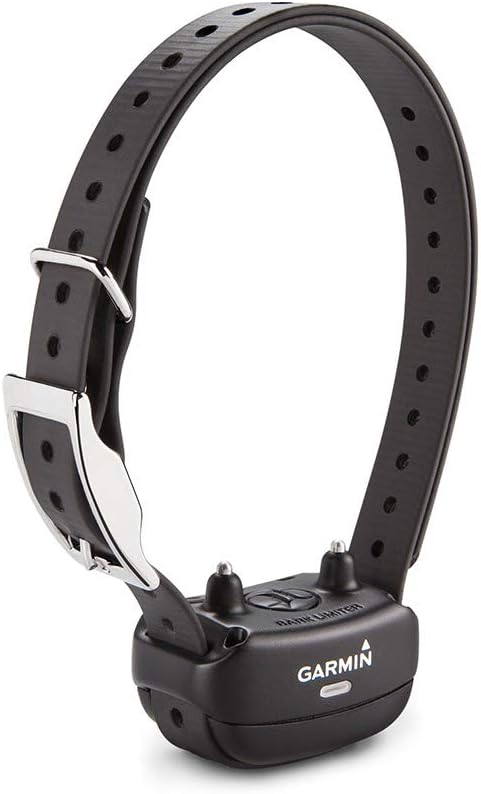
| Included Components | Bark |
|---|---|
| Breed Recommendation | All Breed Sizes |
| Material Type | Stainless Steel |
| Warranty Description | 1 year |
The Garmin BarkLimiter Deluxe is a compact, rechargeable bark-control collar that uses motion-based sensors to identify barking and deliver correction automatically or by manual selection. It is typically worn on the dog's neck and used to reduce nuisance barking at home or in the yard; the unit offers an Auto Rise setting that programs stimulation intensity based on each dog's barking, plus vibration and manual stimulation options. Notable features include advanced bark-differentiation to reduce false triggers, a bark odometer that tracks barking events, integrated stainless steel contact points sized to work across coat types, and a long-lasting rechargeable battery rated up to three months per charge. In practice the device is easy to fit with a buckle closure and stays lightweight for daily wear, and the rechargeable design avoids frequent battery swaps. Limitations are that effective and humane use requires correct fit and gradual training, and the collar focuses solely on bark correction rather than broader training functions or multi-dog remote control capabilities.
Best for: Owners who prioritize a refined, durable bark-specific solution and are willing to invest in a premium, rechargeable collar with advanced false-trigger protection.
Less Ideal for: Owners seeking a multifunction remote training system, multi-dog controller, or a collar that focuses on obedience beyond barking should consider other training tools.
- Advanced bark identification reduces false corrections from non-bark noises
- Auto Rise feature automatically adjusts stimulation level to the dog’s barking pattern
- Rechargeable lithium-ion battery with long run time up to three months per charge
- Stainless steel contact points designed to work across coat types and integrated for durability
- Bark odometer provides measurable feedback on effectiveness
- Device is single-purpose for barking correction and lacks broader remote-training features
- Needs correct fit and responsible, gradual use to avoid overcorrection
Verdict: The best premium training collar is for owners willing to pay more for superior build quality, refined bark-detection, extra safety features, and longer-lasting components.
Kollgux Bark Collar TC-013
Best Rechargeable Training Collar

| Suitable dog weight | 5–150 lbs |
|---|---|
| Feedback modes | Beep, Vibration, Beep+Vibration, Static Stimulation |
| Waterproof rating | IP67 |
| Recharge | USB-C, ~2 hours |
This Kollgux bark collar is a rechargeable training collar that detects barking automatically and delivers one of four feedback types: beep, vibration, beep plus vibration, or adjustable static stimulation. It is used as an everyday bark management tool worn like a regular collar, with soft silicone contact covers and an ergonomic shape for comfort and reflective accents for low-light visibility. The clear digital display and LED battery indicator make it easy to check and change settings, while seven sensitivity levels let you tune detection to reduce false triggers. IP67 waterproofing and a USB‑C recharge that takes about two hours add practical durability for outdoor use. The stated benefit here is the long battery life and automatic sleep mode that together minimize recharging; the collar claims up to 20 days standby depending on use, which fits the goal of low‑maintenance operation during multi-day outings. Limitations to note are that static stimulation requires careful introduction and that effectiveness depends on consistent fit and correct sensitivity setting for small dogs.
Best for: Owners who want a low‑maintenance bark training collar that stays usable across long outings and multi-day trips with minimal recharging and easy on-collar controls.
Less Ideal for: People seeking a purely remote- or vibration-only solution without any static stimulation option or those who prefer professional trainer-led behavior programs instead of collar-based feedback.
- Multiple feedback modes including beep, vibration, combined, and adjustable static allow tailoring to individual dogs
- Adjustable sensitivity with seven levels helps reduce false triggers from non-bark sounds
- Long standby battery with USB‑C recharge and about 2 hours charging time supports multi-day use
- IP67 waterproofing and reflective accents make it suitable for outdoor wear in varied conditions
- Static stimulation option requires careful, gradual introduction and monitoring
- Standby time varies with usage so active training sessions will reduce the quoted 20‑day figure
Verdict: The best rechargeable training collar suits owners who want consistent automatic bark control with easy USB charging and extended runtime between charges.
ELECANE Tiny Bark Collar Small
Best Compact Training Collar

| Dog weight | 5-15 lbs |
|---|---|
| Neck size fit | 6-20 inches |
| Training modes | 3 Modes |
| Sensitivity levels | 7 levels |
| Water resistance | IP67 |
The ELECANE Tiny Bark Collar is a rechargeable, no-shock training collar designed for small breeds and puppies, using sound and vibration to reduce unwanted barking. It attaches like a regular buckle collar and offers three training modes plus seven sensitivity levels so you can match correction intensity to a tiny dog's temperament. The unit is lightweight and compact for all-day wear and includes an IP67 water-resistant rating so it tolerates rain and outdoor play. A 2024 chip and false-alarm filtering help prevent responses to background noise, and magnetic/USB charging finishes a full charge quickly. Practical benefits include humane, adjustable corrections that avoid prong or shock stimulation, easy daily use because it is rechargeable, and a small footprint suited to tiny necks. Important limitations are that effective use still requires proper fit and gradual introduction for puppies, and this model is focused on short-term bark correction rather than advanced remote or app-based behavior training features.
Best for: Buyers looking for a minimal, low-bulk bark solution for small or sensitive dogs who prioritize comfort and humane, vibration-based correction.
Less Ideal for: Owners who need remote/App integration, multi-dog management, or who prefer collars with static stimulation for rapid suppression should consider other options.
- Very lightweight and compact for small dogs and puppies
- No-shock corrections using sound and vibration for humane training
- Seven sensitivity levels and three modes to match dog temperament
- Rechargeable with quick USB/magnetic charging and built-in battery
- IP67 water-resistant for outdoor use and easy cleaning
- No remote or app control for long-range or programmatic training
- Requires careful fit and gradual introduction to avoid irritation
Verdict: The best compact training collar fits small breeds comfortably and is ideal for owners who need a lightweight, unobtrusive automatic bark-control option.
HapTop AC131 Dog Shock Collar
Best Heavy-Duty Training Collar

| Training modes | Beep, Vibration, Safe Shock, Shock Boost |
|---|---|
| Range | 4500 ft |
| Fit neck | 7.8"-24.4" (10-120 lb) |
| Waterproof rating | IPX8 |
| Charging | USB-C |
The HapTop AC131 is a rechargeable e-collar kit designed for everyday obedience and distance work. It uses a 2-channel remote to control up to two dogs and offers four training modes: beep, vibration, safe shock (0–99 levels) and a shock boost, with the shock function optional for no-shock training. The remote's long 4500 foot range and memory for individual dog settings make it useful for off-leash recall, boundary training, and reinforcing commands across yards or trails. The receiver is IPX8 waterproof and the kit includes multiple prong lengths, silicone covers, a test light tool, and USB-C charging for practical field use. Safety-oriented features include an adjustable low-to-high stimulation range, a security lock to prevent accidental corrections, and a manufacturer guideline limiting continuous wear to 12 hours. Trade-offs are typical for this class: it relies on batteries and correct fitment to be effective, and some owners prefer vibration or beep-only methods before adding shock. The unit's feature set and range make it a strong daily trainer for owners willing to follow safe use guidelines.
Best for: Owners who want a versatile, safety-minded e-collar for regular obedience and distance work and who plan to use multiple training modes progressively.
Less Ideal for: People who want a purely non-aversive training tool or who are uncomfortable using shock-style corrections should choose vibration- or treat-based training alternatives.
- Very long 4500 ft remote range for off-leash training
- Multiple modes (beep, vibration, adjustable shock) for progressive training
- IPX8 waterproof receiver suitable for wet outdoor use
- Includes extra prongs, silicone covers, test light tool, and USB-C charging
- 2-channel remote controls two dogs and remembers individual settings
- Shock feature requires careful adjustment and responsible use to avoid misuse
- Not intended for continuous wear longer than 12 hours per day
Verdict: The best heavy-duty training collar is designed for active or strong dogs, offering robust construction and reliable automatic bark control under rough use.
Choosing the Right Dog Training Collar Automatic Bark Control: Key Factors to Consider
Bark Detection Accuracy
Accurate bark detection is the foundation of any automatic bark control collar. A unit that reliably senses vocalizations and ignores wind, doors, or other dogs prevents unnecessary corrections and reduces the chance of confusing your dog. Look for devices that use multi-sensor logic, such as vibration plus sound analysis, because combining inputs reduces false triggers.
Sensitivity settings matter because a miscalibrated detector can either miss problematic barking or trigger too often. Prefer collars with adjustable thresholds so you can fine-tune detection during real-world use. Accurate detection minimizes stress for the dog and makes training signals meaningful and predictable.
Correction Type and Adjustability
Correction methods vary from vibration and sound cues to static stimulation and citronella spray. The right method depends on your dog's size, temperament, and sensitivity. Choose collars that offer multiple correction modes and a range of intensity levels so you can begin with the least intrusive option and escalate only if needed.
Adjustability allows for gradual conditioning rather than abrupt punishment. It also makes the collar adaptable if you retrain or if the same unit will be used for dogs with different sensitivity. Look for clear markings, simple controls, and documented safe intensity ranges.
Fit and Comfort
A training collar must be comfortable enough for frequent wear while maintaining the sensor's correct position against the skin. Poor fit can lead to inaccurate readings and skin irritation. Check that the collar has multiple sizing holes or interchangeable contact points and that the contact materials are skin-friendly and corrosion-resistant.
Consider the collar width and weight relative to your dog's neck size. Lighter, low-profile units are usually better for small and medium dogs, while larger dogs can handle more robust housings. Proper fit supports reliable detection and reduces the risk of chafing during regular use.
Battery Life and Power Management
Automatic bark control systems need dependable power because inconsistent operation undermines training consistency. Battery life affects how often you must remove the collar to recharge and whether it will be active during critical periods. Evaluate typical run times and real-world charging cycles rather than just short-cycle specifications.
Some collars include low-battery indicators or hibernation modes that preserve settings. Fast charging or swappable batteries are helpful for owners who need continuous coverage. Choose a solution that matches your daily routine so the collar is active when you need it to be.
Durability and Weather Resistance
Training collars are worn outdoors and should withstand moisture, dirt, and rough play. Water-resistant or waterproof housings extend a product's useful life and reduce false faults caused by moisture. Durable buckles and corrosion-resistant contact points ensure long-term reliability.
Consider how easy the unit is to clean and whether the electronics are protected from sweat and rain. Robust construction lowers the chance of failure during training and keeps detection and correction components working as intended.
Ease of Use and Setup
A collar that is difficult to program or adjust will see less consistent use. Simple menus, intuitive controls, and clear documentation make it easier to set sensitivity and correction levels correctly. Quick-fit features and straightforward charging reduce friction in daily use.
Ease of setup is also important for owners new to automatic bark control. Look for collars with guided calibration or recommended starting settings. Practical user feedback mechanisms, such as LED indicators or audible confirmations, help you confirm the collar is operating as expected.
How Should I Start when Introducing an Automatic Bark Collar to My Dog?
Begin with the lowest correction level and the most benign mode available, such as vibration or an audible cue. Let your dog wear the collar for short supervised sessions to get used to the feel and the detection cues without associating the device with harsh corrections.
Gradually increase session length as you confirm the collar is triggering only for actual barking. Pair the collar's corrections with positive training signals and reward quiet behavior so the dog learns the desired response rather than simply avoiding the stimulus.
- Start on the lowest sensitivity and lowest correction intensity.
- Use short supervised sessions and increase exposure gradually.
- Reward quiet behavior immediately after a successful pause in barking.
Can Automatic Bark Control Replace Regular Training?
Automatic bark control can be a useful tool to reduce nuisance barking but it is not a substitute for comprehensive behavior training. These collars provide immediate feedback that discourages unwanted barking patterns, which can speed up behavior change when combined with consistent training work.
Long-term success comes from addressing the underlying causes of barking such as boredom, anxiety, or lack of exercise. Use the collar as part of a broader plan that includes reinforcement of quiet behavior and environmental management.
- Use the collar alongside reward-based training methods.
- Address environmental triggers and provide sufficient exercise and enrichment.
How to Avoid Common Problems Like False Triggers and Skin Irritation
To reduce false triggers, calibrate the sensitivity in the dog's normal environment and test while the dog is moving, barking, and at rest. Proper placement against the skin is essential because loose collars or long fur between the sensor and skin can cause missed or false detections.
Prevent skin irritation by ensuring the contact points are clean and by checking the fit regularly. Rotate where the collar sits slightly and give the skin a rest for a few hours each day if the dog wears it long-term. If irritation appears, stop use and consult a veterinarian.
- Calibrate sensitivity in real-world conditions rather than only on a bench.
- Keep contact points clean and inspect skin daily for signs of chafing.
- Allow daily breaks from continuous wear to protect skin health.
Which Correction Mode Is Best for Shy or Highly Sensitive Dogs?
Shy or highly sensitive dogs generally respond better to low-impact cues such as vibration or short auditory tones rather than static stimulation. Start with the gentlest mode and monitor the dog's behavior and body language closely to ensure the cue does not increase anxiety.
If the dog shows signs of stress when corrected, stop and switch to a gentler mode while increasing positive reinforcement. The goal is to teach an alternative behavior, not to frighten the animal.
- Prefer vibration or tone modes for sensitive dogs.
- Observe body language and reduce intensity if anxiety increases.
What Maintenance Keeps an Automatic Bark Collar Reliable?
Regular maintenance includes cleaning the contact points, charging the battery according to manufacturer guidance, and inspecting seals and buckles for wear. Keep the sensor area free of dirt and fur buildup so detection remains consistent.
Store the collar dry and at moderate temperatures when not in use. Replace worn straps and check that connectors remain tight to maintain water resistance and electrical reliability.
- Wipe contact points after outdoor use and before reattaching.
- Charge on a regular schedule and watch for low-battery indicators.
- Inspect straps and fasteners monthly and replace if damaged.
How to Interpret Behavior Changes After Activation
Expect gradual change rather than immediate perfection. Many dogs reduce nuisance barking within days, but full behavior modification can take weeks depending on reinforcement and triggers. Track when the collar triggers and what preceded the bark to identify patterns you can address through training.
If you notice increased anxiety, shutdown, or attempts to avoid the collar, discontinue use and reassess your approach with a trainer or veterinarian. The collar should reduce unwanted barking without harming the dog's overall wellbeing.
- Log trigger events and associated circumstances for targeted training.
- Seek professional guidance if the dog shows signs of stress or regression.
How We Chose the Best Dog Training Collar Automatic Bark Control
To assemble this list we used a focused editorial process that prioritized real-world training utility and pet welfare. We evaluated collars for bark detection accuracy, preferring units that distinguish barking from other noises and movement to avoid false triggers. Correction method was another essential filter: we looked for multiple cue options and graduated intensity so owners can match corrections to a dog's temperament. Fit and materials were assessed for durability and long-term comfort to ensure the collar could be worn safely during daily activity. Battery life and charging convenience were included because consistent operation is critical for automatic systems. Finally, we considered ease of use, including intuitive controls and clear instructions for setting sensitivity and correction levels. We excluded collars that rely solely on blunt, non-adjustable corrections or that lack reliable sensitivity controls. Products that do not offer clear safety features or that require continual owner intervention to function as advertised were also removed from contention. The final picks reflect devices that balance accurate bark sensing, adjustable corrections, comfortable fit, and practical battery performance.
Our full evaluation process is outlined in our review methodology.
FAQ
Will an automatic bark control collar stop all barking?
No, these collars typically reduce nuisance barking but do not eliminate every vocalization. Barking for reasons like pain, alarm, or social signaling may continue and should be addressed through training and environmental management.
How often should my dog wear the collar?
Usage depends on training goals and the dog's comfort. Many owners use the collar during peak barking periods rather than continuously. Daily breaks of several hours help prevent skin issues and reduce habituation to the stimulus.
Are automatic bark control collars safe for puppies?
Puppies have developing nervous systems and thinner skin, so it is usually better to use the gentlest modes or wait until the dog is older. Consult a veterinarian or certified trainer before using automatic correction on young dogs.
How can I reduce false triggers in busy environments?
Calibrate sensitivity lower in noisy or high-activity settings and test while the dog is engaged in normal activities. Proper placement and snug fit also help the sensor discriminate between barking and other noises or movements.
What should I do if my dog shows signs of anxiety after wearing the collar?
Stop using the collar and switch to gentler training methods. Assess the dog's environment and routines to identify stressors and consult a trainer or veterinarian for guidance tailored to your dog's behavior and health.
Final Verdict
When choosing a training collar with automatic bark control, prioritize accurate detection, adjustable corrections, and a comfortable fit. These elements determine whether the device reduces nuisance barking without adding stress. Balance battery life and durability with easy setup so the collar fits into your daily routine while remaining reliable. Use the collar as one part of a broader training plan that addresses the reasons for barking and reinforces quiet behavior. Start low, monitor your dog closely, and prioritize modes that preserve wellbeing to achieve steady, humane progress.

