

If you own a cocker spaniel, finding a whistle that matches the breed's sensitivity and drive makes training easier and safer. The right dog whistle provides clear, consistent cues you can use at a distance without startling or overwhelming your dog. This guide shortlists the top options suited to cocker spaniels and explains the practical differences between adjustable tone, compact designs, and ease of use. Below you will find our top picks for whistles targeted at cocker spaniel owners plus the evaluation criteria we used to select them and helpful buying considerations to guide your choice.
Top Picks at a Glance
| Best Overall Whistle The all-purpose pick that suits most training and recall needs | ACME Alpha 210.5 Dog Whistle |  |
| Best Budget Whistle A low-cost option that still performs reliably for regular use | Browning Dog Training Whistle Blaze |  |
| Best Premium Whistle A higher-end choice that prioritizes build quality and refined sound | Logan A1 Shepherd Whistle |  |
| Best Pealess Whistle A weather-resistant design with consistent tone and no internal pea | ACME 210.5 Dog Whistle |  |
| Best Adjustable-Pitch Whistle A whistle with tunable pitch for customized recall and signals | ESONLITOR Adjustable Dog Whistle |  |
| Best Long-Range Whistle Designed to carry farther for open fields and distance recall | SportDOG Roy Gonia Mega Whistle |  |
| Best Compact Whistle A small, lightweight design for easy carry on keys or gear | TISUR Titanium Emergency Whistle |  |
ACME Alpha 210.5 Dog Whistle
Best Overall Whistle

| Standardized frequency | 5700Hz |
|---|---|
| Range | Approximately 100 yards |
| Material | BPA-free plastic |
| Pealess | Yes |
The ACME Alpha 210.5 is a compact, pealess training whistle engineered for clear, consistent recall and everyday use with smaller breeds like Cocker Spaniels. It produces a standardized 5700Hz tone and a bright sound that the manufacturer rates to carry roughly 100 yards, which makes it useful for both close-range cues and off-leash recall at a distance. The plastic, BPA-free body and ergonomic grip make it comfortable to hold and effortless to blow, and the pealess design avoids internal balls that can rust or stick in wet weather. Practical benefits include consistent pitch for multiple handlers and a weatherproof build that is easy to clean after outdoor sessions. Limitations are the focus on a single frequency tuned for smaller dogs, so handlers who want multiple pitch options or ultra-long-range signals may prefer a different model, and its plastic construction will not have the same heft or longevity as some metal professional whistles. For routine training, recall work, and field practice with medium-small breeds this whistle offers dependable performance and simple maintenance.
Best for: Handlers training recall and everyday cues for Cocker Spaniels and similar smaller breeds who prioritize a reliable, easy-to-blow whistle with consistent pitch.
Less Ideal for: People who need multiple frequency options, extreme long-range signaling, or prefer a heavier metal construction for professional fieldwork should consider other models.
- Standardized 5700Hz frequency for consistent dog recognition
- Pealess design so no internal ball to stick or corrode in wet conditions
- Ergonomic grip and light weight for comfortable, repeatable use
- BPA-free plastic construction that is weatherproof and easy to clean
- Single fixed frequency may not suit handlers who prefer adjustable pitches
- Plastic body is less durable-feeling than metal professional whistles
Verdict: The best overall whistle balances ease of use, reliable sound projection, and durable construction to work well for everyday training and recall.
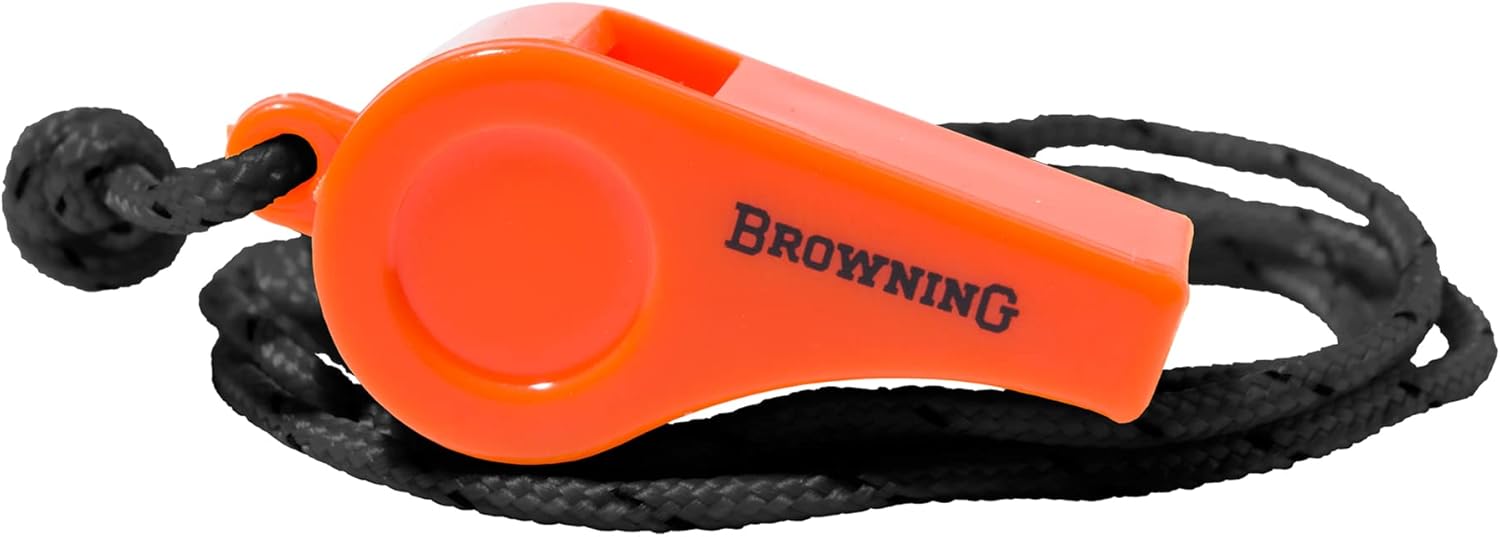
Browning Dog Training Whistle Blaze
Best Budget Whistle
| Item model number | P000037980199 |
|---|---|
| Manufacturer | Signature Products Group |
| Included Components | Dog Whistle |
| Date First Available | October 8, 2021 |
The Browning Dog Training Whistle is a straightforward pea-less whistle designed for consistent, rattle-free tones during training and fieldwork. It is intended to be blown for on- and off-leash cues and includes a built-in retractable lanyard with clip plus an adjustable nylon lanyard so you can carry it on your person or wear it around your neck. The whistle is made from durable plastic that resists freezing in cold weather and incorporates a small compass and thermometer for quick environmental checks while outdoors. As a budget-focused tool it delivers reliable tone and durability without electronic tuning or variable frequency controls, so users who want precise pitch adjustments will need a different model. Its lightweight construction keeps it unobtrusive during walks or hunt sessions, and the pea-less design prevents the rattling common with traditional pea whistles. Expect solid day-to-day performance for routine obedience and hunting recall work, but not the fine-tunable sound range prized by professional trainers.
Best for: Cocker Spaniel owners who want an affordable, reliable whistle for routine obedience and recall training or occasional field use and value simple, rugged gear over fine-tuned control.
Less Ideal for: Owners seeking a whistle with adjustable pitches or pro-level frequency tuning for advanced voiceless signaling should consider higher-end models.
- Pea-less design prevents rattling for consistent tones
- Includes retractable clip lanyard plus adjustable nylon neck lanyard for convenient carry
- Durable plastic construction resists freezing in cold weather
- Lightweight and easy to carry during walks or hunts
- No adjustable frequency or tuning for precise pitch control
- Basic feature set with no electronic or multi-frequency options
Verdict: The best budget whistle gives pet owners a dependable, affordable option with acceptable sound quality and durability for routine training without extra features.
Logan A1 Shepherd Whistle
Best Premium Whistle

| Material | anodised aluminium |
|---|---|
| Model | LWA1B |
| Country of Origin | United Kingdom |
| Intended Uses | Recall Training, Herding, Obedience Training, Livestock Handling |
The Logan A1 Shepherd Whistle is a solid, single-piece anodised aluminium whistle built for distance recall and structured training. Handcrafted in the UK with no rivets or joins, it produces a strong, consistent tone that carries well outdoors and suits work with herding and sporting dogs as well as everyday recall practice. Its classic A1 design and precision finish mean the pitch and response remain stable session after session, making it useful for trainers who rely on repeatable signals. The whistle is compact and lightweight for pocket or lanyard carry, and the etched Border Collie motif adds a traditional look without affecting function. There are few extras here: it is a straightforward, purpose-built tool without adjustable pitch or electronic features, and users who need variable frequency options may prefer other models. The emphasis is durability and tonal consistency, so frequent handlers and professional trainers will appreciate its refined, no-nonsense construction.
Best for: Buyers who prioritize build quality and consistent, repeatable tones for frequent outdoor recall and working-dog training sessions.
Less Ideal for: Casual pet owners seeking multi-tone or electronic whistle features or those who prefer an adjustable-frequency tool for tuning to a specific dog response.
- Single-piece anodised aluminium construction for durability and consistent performance
- Classic A1 design tuned for clear tones that carry over long distances
- Handcrafted manufacture promotes repeatable pitch and long service life
- Lightweight and pocket-friendly for everyday field use
- No adjustable frequency or multi-tone settings for personalized signaling
- Lacks protective case or accessories in the basic package
Verdict: The best premium whistle is for owners who want superior materials, precise tone control, and long-lasting performance and are willing to pay more for those upgrades.
ACME 210.5 Dog Whistle
Best Pealess Whistle

| Item model number | 210.5 |
|---|---|
| Manufacturer | J Hudson & Co (Whistles) Ltd |
| Material | BPA Free Plastic |
| Country of manufacture | United Kingdom |
The ACME 210.5 is a compact pealess dog whistle that produces a high-pitched single frequency for close and distance control. Built from BPA-free plastic to food-grade standards, it is weatherproof and designed not to squeal or jam when wet, so trainers can rely on a consistent tone outdoors. Its single-note output makes commands easy to associate with a single cue, and the whistle's small, lightweight design makes it simple to carry on a lanyard or in a pocket during walks or fieldwork. Practical benefits include durable construction from a long-established maker and suitability for spaniels and similar breeds that respond to higher pitches. Limitations are the fixed single frequency, which offers less versatility than multi-tone whistles for nuanced signaling, and the plastic body may not have the same heft or perceived durability as metal alternatives.
Best for: Owners who need a dependable, weatherproof whistle for consistent recall and control in outdoor conditions and who prefer a straightforward single-tone cueing approach.
Less Ideal for: Trainers who require multiple pitch options or prefer the heavier feel and longevity of metal whistles for intensive daily use.
- Pealess single-frequency output provides a stable, weatherproof tone that resists jamming.
- Made from BPA-free plastic to food-grade standards and manufactured in the UK.
- Lightweight and easy to carry on a lanyard or in a pocket for training and field use.
- Simple single-note design helps dogs learn a clear, consistent cue.
- Single fixed frequency limits flexibility for trainers who use multiple distinct tones.
- Plastic construction is lighter but may feel less robust than metal whistles.
Verdict: The best pealess whistle is ideal for owners who need a reliable, weatherproof sound that won't jam or change tone in wet conditions.
ESONLITOR Adjustable Dog Whistle
Best Adjustable-Pitch Whistle

| Material | 304 stainless steel |
|---|---|
| Adjustable frequency | 200Hz–22KHz |
| Number of items | 2 |
| Included components | Whistles with lanyards and lock nut |
| Range | Up to 1000m |
The ESONLITOR Adjustable Dog Whistle is a compact, metal ultrasonic whistle designed for recall, obedience and bark-control training. It ships as a two-pack with lanyard straps and an adjustable nut so you can fine-tune the pitch across a broad frequency range for different commands and dog sensitivities. In practice the small stainless body is durable and rust-resistant, and the included lock nut and cover reduce the chance of the setting slipping or losing the unit on a collar or keyring. The whistle projects well for long-distance work — the listing states an effective range up to 1000 meters — so it is useful for off-leash training in open areas. It is silent to most humans and marketed as safe for dogs when used properly, but it does require a short training period to associate the sound with commands, and very small or sound-sensitive dogs may need gentler introduction. The two-pack gives a backup or a spare to keep on leash gear, and the simple metal design keeps operation straightforward without batteries or electronics.
Best for: Owners who prioritize a portable, no-battery training tool they can carry on a keyring or collar and who plan to use whistle signals for recall, bark control and basic obedience.
Less Ideal for: People seeking electronic, automated bark deterrents or those who prefer visible cues over sound-based training should consider other options.
- Adjustable frequency (200Hz–22KHz) lets you tune pitch for different commands and dog sensitivity
- Durable 304 stainless steel construction resists rust and holds up to outdoor use
- Compact size with lanyard and lock nut reduces loss and fits easily on a keyring or collar
- Two-pack provides a backup or placement on multiple locations for convenience
- Long stated transmission range suitable for off-leash recall and open-area training
- Requires consistent training to condition a dog to the whistle signals
- Ultrasonic sound may need careful introduction for very noise-sensitive or elderly dogs
Verdict: The best adjustable-pitch whistle lets owners fine-tune frequency and tone to match their dog's responsiveness and preferred training signals.
SportDOG Roy Gonia Mega Whistle
Best Long-Range Whistle

| Item model number | SAC00-11748 |
|---|---|
| Manufacturer | Radio Systems Corporation |
| Included Components | 1 Whistle |
| Specific Uses for Product | Outdoor |
| Department | Training & Behavior |
The SportDOG Roy Gonia Mega Whistle is a handheld training whistle built to send a strong, focused sound forward so handlers can signal dogs at a distance without blasting their own ears. It uses an easy-to-blow design with a pea to produce a penetrating, modulated tone that cuts through wind and wet conditions, which makes it useful for hunting, blind work, and wide-open recall practice. The whistle is compact and lightweight for carrying on a vest or lanyard and is tuned to favor projection rather than subtle or high-frequency signaling. That loud, forward-directed output helps maintain clear communication across fields but also means it is not suited to situations where a very quiet or ultrasonic cue is needed. Durability and simple operation are its strengths, though the pea can freeze or become noisy in certain environments compared with pea-less designs. For handlers who need an audible, far-carrying whistle for outdoor training and hunting, this model delivers reliable volume and directional control.
Best for: Buyers who need a loud, clearly directed whistle for off-leash recall, hunting, or training across large open areas and prioritize distance and audibility over stealth.
Less Ideal for: People looking for a barely audible, ultrasonic, or pea-less whistle for very cold conditions or stealthy signaling should consider other designs.
- Designed to direct sound forward to protect the handler's ears and improve projection
- Easy-to-blow, consistent loud output for long-range signaling
- Lightweight and portable for carrying on a vest or lanyard
- Performs well in windy or wet outdoor conditions
- Contains a pea which can freeze or rattle in extreme conditions compared with pea-less whistles
- Produces a loud audible tone so it is not suitable when a quiet or ultrasonic signal is desired
Verdict: The best long-range whistle produces a clear, far-reaching tone that makes it easier to communicate with dogs at distance in open environments.
TISUR Titanium Emergency Whistle
Best Compact Whistle

| Material Type | titanium |
|---|---|
| Included Components | Paracord, Whistle |
| Unit Count | 2 Count |
| Loudness | 120 dB (advertised) |
The TISUR Titanium Emergency Whistle is a small, rugged signal whistle built for carrying on a keyring or around the neck. Made from titanium alloy, each whistle is corrosion resistant and washable, and the set includes paracord for easy attachment. It produces a very loud tone—advertised up to 120 dB—so it is suitable for emergency signaling, outdoor navigation, pet training, or coach/referee use where a sharp clear sound is needed. The compact size and light weight make it unobtrusive in everyday carry, and the integrated holes allow quick attachment to lanyards or keychains. Because it is a simple mechanical whistle there are no batteries to worry about and it will work in wet conditions. The main limitations are its tiny form factor, which can be hard to handle with gloves, and the lack of a protective cover so it can collect dirt when stored loose in a pocket or backpack.
Best for: Buyers who prioritize extreme portability and durable materials for everyday carry or outdoor safety will appreciate this lightweight titanium whistle.
Less Ideal for: Users who need a larger, glove-friendly grip, integrated dirt protection, or multi-tone training whistles should consider other styles.
- Titanium construction offers strong corrosion resistance and long-term durability.
- Very loud output (up to 120 dB) for effective long-distance signaling.
- Includes paracord and keychain-friendly holes for easy, secure carry.
- Tiny, lightweight design makes it convenient for EDC or hanging on a pet collar.
- Small size can be fiddly to grip or use with gloves.
- No protective cap so the mouthpiece can get dirty when loose in a bag.
Verdict: The best compact whistle is for owners who prioritize portability and convenience without sacrificing clear sound for basic training and safety use.
Choosing the Right Dog Whistle Cocker Spaniel: Key Factors to Consider
Tone Consistency and Frequency Control
A whistle that produces a steady, repeatable tone helps a cocker spaniel learn and generalize commands quickly. Dogs respond better when the pitch is predictable, so choose a whistle with minimal wobble or stray harmonics.
Adjustable frequency is useful because individual dogs have different sensitivity ranges. Being able to fine-tune the pitch lets you find the sweet spot that your dog hears clearly but does not find aversive. Small adjustments can change how the dog perceives the cue, so look for controls that hold their setting during normal use.
Volume and Projection
Projection matters when you need to signal at a distance, for example in parks or open fields. A whistle that projects clearly across 50 to 200 feet will give you reliable recalls without raising your voice.
At the same time, volume should be controllable: overly loud or harsh whistles can stress a sensitive breed. A design that balances projection with a smooth timbre is ideal for cocker spaniels, who can be reactive to sharp, piercing sounds.
Ergonomics and Ease of Use
You will use the whistle while walking, holding a leash, or during training drills, so it should be comfortable to grip and easy to operate one-handed. Buttons or tiny adjustment rings can be difficult to manipulate in cold weather or with gloves on.
A compact, lightweight whistle also reduces the chance of fumbling. Consider how the whistle attaches to a lanyard or clip so it stays accessible without dangling in a way that could spook the dog or tangle with gear.
Durability and Weather Resistance
Whistles used outdoors face rain, dirt, and sweat. Corrosion-resistant materials and sealed adjustment mechanisms extend service life and keep tone consistent even after heavy use.
Check that moving parts do not seize after exposure to moisture and that the whistle does not absorb odors or become brittle in cold temperatures. A durable design prevents mid-session failures and maintains consistent training signals over time.
Safety and Nonirritating Sound Profile
Some whistles produce sharp, high-frequency overtones that are unpleasant for sensitive dogs. Choose whistles that generate a clean, well-shaped tone rather than harsh, strident noise.
Also consider materials that are non-toxic and edge-free to avoid accidental injury to the handler. Safety includes predictable behavior under normal handling, so the whistle should not change tone abruptly when gripped or after a light drop.
Adjustability for Different Training Tasks
Different signals are useful for different commands: a long steady note for recall, short bursts for attention, and varied patterns for specific cues. A whistle that allows you to alter tone length and pitch quickly supports this range of uses.
Being able to produce consistent short bursts without losing tone quality matters for shaping complex behaviors. If you plan to use the whistle across obedience, tracking, or fieldwork, choose a model that handles both single-tone and patterned signaling reliably.
How Loud Should a Whistle Be for a Cocker Spaniel?
Loudness should match the training situation. For close-range obedience work, a moderate volume with a clean tone is preferable so you can cue without startling the dog. For off-leash recalls in larger spaces, choose a whistle with better projection but still a smooth timbre.
Avoid whistles that are simply louder without tone control. A whistle with adjustable frequency or a milder timbre gives you the flexibility to signal at different ranges while keeping your cocker spaniel comfortable.
- Use moderate volume for close training sessions.
- Use stronger projection for field recalls, not harsher tone.
- Adjust pitch before increasing volume to avoid startling.
What Pitch Works Best for Cocker Spaniels?
Cocker spaniels tend to respond to mid- to high-range pitches but individual sensitivity varies. Start with a mid-frequency setting and raise or lower it to find the tone that consistently gets your dog's attention without causing anxiety.
If you notice avoidance or agitation at certain pitches, shift to a gentler range. The goal is a clear, pleasant-sounding cue that the dog associates with a reliable outcome, such as reward or safe return.
- Begin with a mid-frequency setting.
- Watch your dog's body language when trying new pitches.
- Prefer steady tones over rapidly fluctuating ones.
How to Integrate Whistle Training Into Regular Sessions
Pair the whistle with positive reinforcement early on so your cocker spaniel forms a clear association between the sound and a reward. Start indoors at short range, reward reliable responses, and slowly increase distance and environmental complexity.
Keep sessions short and consistent. Use the same cue patterns for specific commands and avoid changing pitch or pattern mid-training. Transfer from whistle to voice cues only after the dog reliably responds under distractions.
- Start close and pair whistle with treats or praise.
- Increase distance gradually with consistent reinforcement.
- Use distinct patterns for different commands and maintain consistency.
Maintenance Tips to Keep Your Whistle Sounding Right
Rinse or wipe the whistle after exposure to rain, mud, or salt, and allow it to dry thoroughly. Inspect adjustment mechanisms and moving parts periodically to ensure they still hold settings and do not produce rattles or leaks.
Avoid lubricants that can attract dirt or affect sound. Store the whistle in a dry place and check for dents or deformation after accidental drops, because small shape changes can alter tone quality.
- Clean after heavy outdoor use and dry completely.
- Check adjustment settings before each session.
- Store in a protective pouch to prevent dents.
Can You Use Whistle Signals Indoors and Outdoors?
Yes, but use different volumes and patterns. Indoors, keep signals soft and brief to avoid echo and startling the dog. Outdoors, increase projection as needed but keep the tone smooth to maintain compliance.
Be mindful of neighbors and other animals when using whistles outside. If you train in multi-user spaces, prefer a pitch and pattern that are effective for your dog while minimizing disturbance to others.
- Use softer, shorter signals indoors.
- Adjust projection for outdoor distances.
- Be considerate of surrounding people and pets.
How We Chose the Best Dog Whistle Cocker Spaniel
We shortlisted whistles based on criteria that matter for training cocker spaniels and typical owner needs. We prioritized tone consistency, because predictable pitch helps the dog learn cues faster; adjustability of frequency so you can fine-tune signals to your dog's hearing and sensitivity; ease of use during walks and fieldwork; durability and weather resistance for outdoor use; and safety, meaning nonirritating sounds and materials that won't harm the dog or handler. For each candidate we checked construction quality, user controls for tone and volume, clarity of the emitted sound at common recall distances, and whether the design is easy to hold and use while moving. We excluded novelty whistles and items lacking basic user controls or waterproof features. We also filtered out models with unverified claims about ultrasonic ranges that are inaudible to handlers. The final list focuses on practical, well-made whistles that balance training effectiveness with comfort for both handler and cocker spaniel.
Our full evaluation process is outlined in our review methodology.
FAQ
Will a dog whistle hurt my cocker spaniel's ears?
A properly used whistle should not hurt your dog's ears. Pain occurs with very harsh or excessively loud sounds. Test new pitches at low volume and watch your dog for signs of discomfort, then adjust the pitch or reduce volume as needed.
How soon can I expect my cocker spaniel to respond reliably?
Response time varies by dog and training consistency. Many dogs begin to respond to whistle cues within a few weeks of daily short sessions, but some require longer reinforcement and gradual distance increases.
Is an adjustable-frequency whistle necessary?
Adjustability is helpful but not always required. It is valuable if your dog is unusually sensitive or if you use the whistle across different environments. Fixed-pitch whistles can work well when the pitch suits your dog's hearing range.
Can I train recall with only a whistle?
You can, but pairing the whistle with positive reinforcement speeds learning. Using treats, praise, or a favorite toy when the dog returns makes the whistle a reliable cue for recall over time.
How do I prevent other dogs from reacting to my whistle?
Choose a pitch that your dog responds to strongly and practice in controlled environments before using it where other dogs are present. Consistent, calm recall training reduces the chance of competitive or reactive behaviors when other dogs hear the sound.
Final Verdict
Focus on a whistle that balances tone consistency, comfortable volume, and durable construction. For cocker spaniels, prioritize models that allow pitch adjustment and offer a smooth sound profile rather than sheer loudness. Consider how you will use the whistle most often—close-range obedience, field recalls, or mixed use—and choose the features that support those scenarios. Ultimately, pick a whistle that you can operate reliably in real conditions and that your dog finds pleasant. Training consistency and proper reinforcement will determine success more than any single hardware feature, so favor predictable performance and easy handling when making your selection.

