

If you own a Labrador, choosing the right whistle can make daily training and recall much easier. Labradors respond well to consistent, high-pitched cues, but the ideal whistle balances audible range, adjustable frequency, and a comfortable feel for repeated use. This guide highlights seven shortlisted whistles chosen for clarity, durability, and ease of tuning so you can find an effective tool for backyard sessions, field training, or busy parks. Below you will find compact product summaries and a clear explanation of the evaluation criteria used to select them, followed by practical advice on fit, training, and maintenance.
Top Picks at a Glance
| Best Overall Whistle A reliable all-purpose whistle that suits most Labrador owners | ACME Alpha 211.5 Dog Training Whistle |  |
| Best Budget Whistle An affordable, no-frills whistle that still performs reliably | XXINMOH Adjustable Dog Whistle 2-Pack |  |
| Best Premium Whistle Higher-end build and features for owners who want the best | Logan A1 Shepherd Whistle |  |
| Best Adjustable-Frequency Whistle Allows tuning pitch to suit your dog’s hearing and recall | KIVORA Dog Whistle 4-Pack |  |
| Best Long-Distance Whistle Designed for clear audibility at greater ranges outdoors | ACME Whistle 212 |  |
| Best Stainless-Steel Whistle Durable metal construction that resists wear and weather | TISUR Titanium Emergency Whistle |  |
| Best Compact Whistle Small, lightweight whistle easy to carry on collars or keyrings | SportDOG Roy Gonia Special Whistle |  |
ACME Alpha 211.5 Dog Training Whistle
Best Overall Whistle

| Item model number | 211.5_ALPHA_BLK |
|---|---|
| Standardized Frequency | 5400 Hz |
| Material | BPA-free plastic |
| Pealess | Yes |
| Made in | United Kingdom |
The ACME Alpha 211.5 is a pealess, single-note dog training whistle designed for reliable recall and long-range signaling. It produces a standardized 5400 Hz tone intended to be consistent between users and offers an advertised effective range of roughly 450 to 500 yards, making it suitable for field training and off-leash recall. The molded BPA-free plastic body and ergonomic grip make it comfortable in the mouth and easy to hold in wet or cold conditions, and the pealess design reduces maintenance and avoids small internal parts that can fail. Practical benefits include a bright, consistent sound favored by professional trainers, weather resistance for outdoor use, and the option to use different colored whistles while keeping the same frequency. Limitations are that it is a single fixed-frequency whistle, so users cannot vary pitch for different cues, and learning a clear whistle pattern and consistent reinforcement is still required for effective training. The whistle is also very small, which some users may find easy to misplace.
Best for: Buyers who want a reliable, professional-style whistle for everyday training and long-range recall where consistent tone and durability matter.
Less Ideal for: People who need variable pitches for complex multi-cue training or who prefer larger, harder-to-lose training tools should consider alternatives.
- Standardized 5400 Hz tone for consistent recognition
- Long effective range around 450–500 yards for field recall
- Pealess design with no internal ball reduces maintenance and failure
- Ergonomic BPA-free plastic body that is weather resistant and comfortable to hold
- Fixed single-frequency limits the ability to use multiple pitches for separate cues
- Very small form factor can be easy to lose
Verdict: The best overall whistle for Labrador owners balances ease of use, audibility at typical recall distances, and durable construction for everyday training and outdoor use.
XXINMOH Adjustable Dog Whistle 2-Pack
Best Budget Whistle

| Material | 304 stainless steel |
|---|---|
| Pack | 2 pieces |
| Model number | GKS-1 |
| Item weight | 1.44 ounces |
These stainless steel adjustable whistles come as a two-pack with lanyards and are designed for basic whistle training, bark interruption, and recall at distance. You adjust pitch with a small screw to find the frequency that gets your dog's attention, then pair specific whistle signals with treats or commands to teach responses like sit or come. The 304 stainless construction resists rust and feels durable for outdoor use, and the compact metal body is easy to carry on a lanyard or keyring. The seller claims long-range effectiveness and silent ultrasonic tones that do not bother humans, which makes them convenient for long-distance recall and quiet bark control. Practical limits are that very small adjustments can be fiddly and some dogs may not react to the same frequencies, so training and patience are required to find the right setting; also results will vary by dog and environment rather than being an instant fix for behavior problems.
Best for: Buyers who want an inexpensive, no-frills training tool for basic recall and bark control and are willing to invest short training sessions to find the right frequency.
Less Ideal for: Owners seeking a guaranteed solution for severe behavior issues or those who need programmable electronic training with multiple modes should consider other options.
- Two whistles per purchase for backup or multiple handlers
- Adjustable pitch via screw lets you match a frequency your dog responds to
- 304 stainless steel construction resists rust for outdoor durability
- Compact, lanyard-ready design makes it easy to carry during walks and training
- Fine tuning can be fiddly and may require patience to find an effective frequency
- Effectiveness depends on the individual dog and environment, not guaranteed for all behaviors
Verdict: The best budget whistle for owners who need a dependable, low-cost recall tool that remains loud and durable enough for regular practice.
Logan A1 Shepherd Whistle
Best Premium Whistle

| Material | anodised aluminium |
|---|---|
| Model | LWA1B |
| Country of Origin | United Kingdom |
| Intended Uses | Recall Training, Herding, Obedience Training, Livestock Handling |
The Logan A1 Shepherd Whistle is a solid, single-piece anodised aluminium whistle built for distance recall and structured training. Handcrafted in the UK with no rivets or joins, it produces a strong, consistent tone that carries well outdoors and suits work with herding and sporting dogs as well as everyday recall practice. Its classic A1 design and precision finish mean the pitch and response remain stable session after session, making it useful for trainers who rely on repeatable signals. The whistle is compact and lightweight for pocket or lanyard carry, and the etched Border Collie motif adds a traditional look without affecting function. There are few extras here: it is a straightforward, purpose-built tool without adjustable pitch or electronic features, and users who need variable frequency options may prefer other models. The emphasis is durability and tonal consistency, so frequent handlers and professional trainers will appreciate its refined, no-nonsense construction.
Best for: Buyers who prioritize build quality and consistent, repeatable tones for frequent outdoor recall and working-dog training sessions.
Less Ideal for: Casual pet owners seeking multi-tone or electronic whistle features or those who prefer an adjustable-frequency tool for tuning to a specific dog response.
- Single-piece anodised aluminium construction for durability and consistent performance
- Classic A1 design tuned for clear tones that carry over long distances
- Handcrafted manufacture promotes repeatable pitch and long service life
- Lightweight and pocket-friendly for everyday field use
- No adjustable frequency or multi-tone settings for personalized signaling
- Lacks protective case or accessories in the basic package
Verdict: The best premium whistle for buyers willing to pay more for exceptional materials, refined acoustics, and longer-lasting performance in demanding conditions.
KIVORA Dog Whistle 4-Pack
Best Adjustable-Frequency Whistle

| Material | 304 stainless steel |
|---|---|
| Frequency range | Adjustable up to 22 kHz |
| Number of items | 4 |
| Waterproof rating | IPX4 |
These KIVORA whistles are a four-pack of adjustable stainless steel training whistles designed to interrupt barking and reinforce recall at distance. Each whistle has a tuning screw so you can vary the pitch from low audible tones up into ultrasonic ranges above 20 kHz, and the listing emphasizes long-range recall and bark interruption without human-audible noise. Built from 304 stainless steel, the whistles should resist rust and tolerate everyday handling, and the set includes a reflective lanyard and an anti-swallow safety lock for convenience. In practice the adjustable pitch makes it useful across breeds from small to large since you can fine-tune what your dog responds to, and having multiple whistles is handy for keeping spares in a car, bag, or with neighbors. Limitations to expect are variable effectiveness between individual dogs and settings because response depends on the animal and environmental noise, and some users report mixed results with consistency. For buyers wanting a rugged, multi-piece starter pack for outdoor training, these offer practical value, but they are not a guaranteed solution for every dog or situation.
Best for: Owners who need a rugged, ready-to-use whistle set for regular outdoor training and want multiple durable spares to keep around gear, vehicles, or with helpers.
Less Ideal for: Dog owners seeking a guaranteed behavior fix without training work or those who prefer a single precision tool with electronic frequency control should look elsewhere.
- Four whistles included so you have spares for travel, neighbors, or backups
- Adjustable pitch up to ultrasonic range to tailor signals for different dogs
- 304 stainless steel construction resists rust and stands up to frequent handling
- Includes reflective lanyard and safety lock for carrying and accidental ingestion prevention
- Effectiveness varies by dog and environment, so some trial-and-error tuning is required
- Ultrasonic settings may be truly inaudible to humans which makes on-the-spot checking difficult
Verdict: The best adjustable-frequency whistle for owners who want to fine-tune pitch to match a Labrador’s responsiveness and reduce background interference.
ACME Whistle 212
Best Long-Distance Whistle

| Item model number | 212 |
|---|---|
| Material | BPA Free Plastic |
| Number of Items | 1 |
| Sound level | 110dBA |
The ACME Whistle 212 is a compact, pealess training whistle built to produce a stable, single-note tone that stays the same whether you blow softly or hard. Handlers use it for long-range recall and directional signaling in open fields, beaches, and heavy cover where consistency matters; its 110 dBA output and medium pitch make it audible over wind and distance without being sharply shrill. The plastic construction is BPA free and food-grade, so it is lightweight and weather-resistant for outdoor work, and the absence of a pea or cork reduces the chance of clogging or mechanical failure. Practical benefits include a reliable signal across users and environments and a sound that Labradors and other retrievers respond to well for hunting and off-leash training. Limitations are that it produces a single fixed pitch so you cannot vary tone for different cues, and some handlers may prefer metal whistles for a different timbre or greater durability under heavy abuse.
Best for: Handlers who need a reliably consistent, long-range signal for field work and want a lightweight, weather-resistant whistle that Labradors readily respond to.
Less Ideal for: People who want multi-tone signaling or need an extremely rugged metal whistle for heavy daily abuse should consider other options.
- Holds a constant frequency regardless of blow strength for clear, repeatable signaling
- High loudness (110 dBA) projects well across fields and heavy cover
- Pealess design reduces mechanical failure and clogging
- Lightweight BPA free plastic construction is weather-resistant and easy to carry
- Single fixed pitch limits the ability to encode multiple distinct cues
- Plastic body is less impact-resistant than metal alternatives
Verdict: The best long-distance whistle for handlers who need a signal that remains sharp and identifiable across wide fields, beaches, or rural areas.
TISUR Titanium Emergency Whistle
Best Stainless-Steel Whistle

| Material Type | titanium |
|---|---|
| Included Components | Paracord, Whistle |
| Unit Count | 2 Count |
| Loudness | 120 dB (advertised) |
The TISUR Titanium Emergency Whistle is a small, rugged signal whistle built for carrying on a keyring or around the neck. Made from titanium alloy, each whistle is corrosion resistant and washable, and the set includes paracord for easy attachment. It produces a very loud tone—advertised up to 120 dB—so it is suitable for emergency signaling, outdoor navigation, pet training, or coach/referee use where a sharp clear sound is needed. The compact size and light weight make it unobtrusive in everyday carry, and the integrated holes allow quick attachment to lanyards or keychains. Because it is a simple mechanical whistle there are no batteries to worry about and it will work in wet conditions. The main limitations are its tiny form factor, which can be hard to handle with gloves, and the lack of a protective cover so it can collect dirt when stored loose in a pocket or backpack.
Best for: Buyers who prioritize extreme portability and durable materials for everyday carry or outdoor safety will appreciate this lightweight titanium whistle.
Less Ideal for: Users who need a larger, glove-friendly grip, integrated dirt protection, or multi-tone training whistles should consider other styles.
- Titanium construction offers strong corrosion resistance and long-term durability.
- Very loud output (up to 120 dB) for effective long-distance signaling.
- Includes paracord and keychain-friendly holes for easy, secure carry.
- Tiny, lightweight design makes it convenient for EDC or hanging on a pet collar.
- Small size can be fiddly to grip or use with gloves.
- No protective cap so the mouthpiece can get dirty when loose in a bag.
Verdict: The best stainless-steel whistle for owners prioritizing ruggedness and longevity, offering corrosion resistance and consistent sound after heavy use.
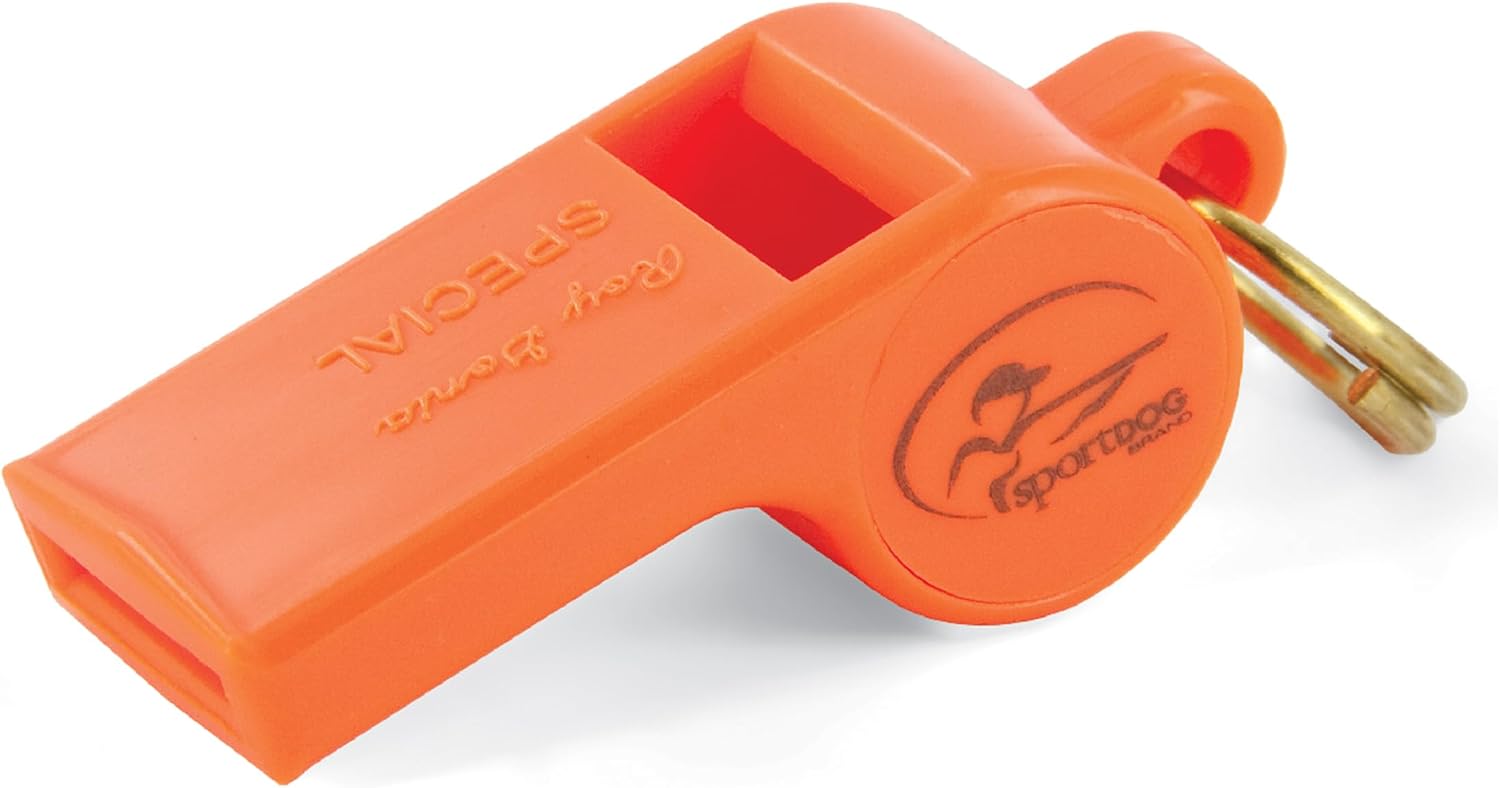
SportDOG Roy Gonia Special Whistle
Best Compact Whistle
| Item model number | SAC00-11749 |
|---|---|
| Manufacturer | Radio Systems Corporation |
| Size | With Pea |
| Department | Pet Supplies |
The SportDOG Roy Gonia Special is a simple, hand-crafted training whistle designed to produce a lower-pitched sound that carries farther than many small whistles. It is used by trainers and hunters to give clear long-distance signals during fieldwork or everyday recall practice; the easy-to-blow profile makes it comfortable to use for extended sessions. The version listed includes a pea, which adds an audible burst that helps dogs locate the source of the sound in varied conditions. Practical benefits include a durable plastic body and a tone tuned for range rather than a very high, shrill pitch, making it useful in wind or over background noise. Limitations are its single fixed tone and the pea mechanism, which can be affected by moisture or debris and slightly changes consistency compared with pea-less designs. For routine training and field use it is a no-frills, effective whistle that emphasizes range and simplicity over adjustable frequencies.
Best for: Buyers who want an affordable, dependable whistle for everyday training and field recall work and who prioritize range and ease of use over adjustable tones.
Less Ideal for: People seeking an electronically tuned or multi-frequency whistle for precise signal variation or users who want a completely waterproof, pea-less option.
- Lower-pitched tone designed for longer range signals
- Easy-to-blow design reduces user fatigue during extended use
- Hand-crafted reputation with a long history in field training
- Includes a pea for an attention-grabbing burst to help locate the sound
- Single fixed tone with no pitch adjustment
- Pea can be affected by moisture or dirt, altering consistency
Verdict: The best compact whistle for owners who want a minimal, easy-to-carry signal device that’s convenient for everyday walks and quick training sessions.
Choosing the Right Dog Whistle Labrador: Key Factors to Consider
Frequency Adjustability
Being able to change the pitch lets you match the whistle to your Labrador's hearing and temperament. Some dogs react best to higher pitches while others prefer lower ones; a tunable whistle lets you experiment until you find the most reliable frequency.
Adjustability also affects versatility. Trainers often use different pitches for separate cues such as recall, stop, or directional commands. A whistle that holds its setting under use and after exposure to moisture is more practical than one that slips or drifts.
Audible Range and Tone Clarity
Range determines how far away your Labrador can reliably hear the whistle. Look for a clear, penetrating tone that carries across wind and background noise rather than a thin or breathy sound that fades quickly.
Tone clarity affects recognition. A consistent, distinct pitch is easier for dogs to distinguish from environmental sounds and for handlers to reproduce reliably during training sessions.
Durability and Weather Resistance
Whistles used for Labrador training will often be exposed to wet conditions, dirt, and repeated handling. Materials that resist corrosion and physical wear help the whistle retain its tone and adjustment over time.
Weather-resistant construction also reduces the need for frequent replacement. Consider materials that are easy to dry and clean so moisture and grime do not degrade internal components or change the whistle's sound.
Ergonomics and Ease of Use
A whistle should sit comfortably in your hand and be simple to operate with one finger or the mouth while you manage a leash or other gear. Controls for tuning or volume should be reachable and intuitive so you can adjust quickly during a session.
Small details such as a nonslip surface or a smooth mouthpiece improve comfort during repeated use. If you use a lanyard or clip, consider how the whistle attaches and whether it stays accessible without snagging on clothing or equipment.
Consistency and Repeatability
Training depends on delivering the same cue each time. A whistle that produces a consistent tone under different blowing pressures and environmental conditions makes it easier for your Labrador to learn and respond reliably.
Look for designs that are tolerant of varied breath strength or that include instructions on how to produce consistent tones. Mechanical inconsistency creates confusion and slows training progress.
Maintenance and Hygiene
Regular cleaning prevents buildup that can alter sound or harbor bacteria. Choose whistles with simple interiors or ones that disassemble for washing to keep them sanitary and sounding as intended.
Maintenance requirements also influence long-term value; a whistle that needs frequent special care is less practical than one that you can rinse and dry quickly between outings.
How Loud Should a Whistle Be for Reliable Outdoor Recall?
Audible power matters more than raw volume. A whistle that produces a focused, penetrating tone will carry farther than one that is simply loud but diffuse. For outdoor recall, prioritize clarity and directionality so the sound cuts through wind and background noise.
Test a whistle in the conditions where you will use it most. Walk to different distances and positions while a helper sounds the whistle so you can judge how well the tone carries. Keep in mind that loudness alone can startle some dogs, so balance intensity with a pitch your Labrador reliably recognizes.
- Try the whistle from various distances and angles before committing to a training tool
- Prefer clear, narrow-frequency tones over broad, noisy sounds
- Remember that obstacles and wind can change perceived loudness
What Pitch Works Best with Labradors?
Labradors tend to respond well to mid-to-high pitches, but individual sensitivity varies. Start with a moderate setting and adjust gradually while watching for consistent alertness and approach behavior.
Use separate pitches for different cues. For example, a distinct higher pitch for recall and a lower pitch for stop or directional cues helps the dog learn to associate each sound with a specific action.
- Begin training at a comfortable mid-range pitch
- Adjust in small steps and note which pitch yields the fastest, calmest response
- Keep different cues sufficiently distinct in pitch and pattern
How to Introduce a Whistle to Your Labrador
Introduce the whistle slowly and pair it with positive reinforcement. Start in a quiet, familiar area. Blow a short, consistent cue and immediately reward the dog for any attentive behavior with a treat or praise.
Repeat brief sessions focusing on association rather than distance. Once the dog links the whistle to a reward, gradually increase the distance and add mild distractions, maintaining high rewards for correct responses to build reliability.
- Keep initial sessions short and rewarding
- Use a single simple cue for the first stage of training
- Progress to distance and distraction only after the dog shows consistent responses
Cleaning and Storing Your Whistle
Rinse and dry the whistle after exposure to moisture or dirt. If the design allows disassembly, clean internal components occasionally to prevent debris from changing tone or airflow.
Store the whistle in a dry place and avoid leaving it in direct sun or freezing conditions for long periods. Regular inspection for cracks or wear prevents unexpected failures during use.
- Rinse with fresh water after wet outings and let air dry thoroughly
- Disassemble and clean if the model supports it to remove internal buildup
- Keep a spare whistle accessible in case of loss or damage
Using Whistle Cues Alongside Verbal Commands
Whistle cues are most effective when they complement, not replace, consistent verbal training. Pair a short whistle pattern with a verbal cue during early training so the dog learns both signals mean the same thing.
Over time you can rely on the whistle for long-distance communication while keeping verbal cues for close-quarters work. Consistency in timing and reward is the key to transferring control between signals.
- Start by pairing whistle with a verbal command and reward
- Use distinct whistle patterns for different commands to avoid confusion
- Maintain consistent timing between whistle and reward during training
How We Chose the Best Dog Whistle Labrador
We focused on features that matter for Labrador training and real-world handling. Our selection criteria prioritized frequency adjustability, audible range, construction materials, ease of use, and consistency of tone across environments. Frequency adjustability matters because Labradors vary in sensitivity; a whistle that can be tuned lets you find a pitch that your dog reliably notices without startling them. Audible range and tone stability were included because recall at distance and in noisy conditions depends on a whistle that remains clear and consistent. Durability and weather resistance were considered to ensure the whistle performs after repeated outdoor use and exposure to moisture. Ergonomics and ease of cleaning were evaluated so the tool stays comfortable in long training sessions and remains hygienic. We also considered mounting and carrying options since trainers often clip whistles to collars or lanyards for quick access. We excluded tools that were primarily decorative or lacked any frequency control and omitted whistles with clearly poor construction or materials that would fail with normal outdoor use. The final list reflects a balance of practical training performance and build quality rather than novelty features.
Our full evaluation process is outlined in our review methodology.
FAQ
Can Labradors hear dog whistles that humans cannot?
Often yes. Many whistles produce high-frequency tones above the human hearing range that dogs can detect. However, effectiveness depends on the specific frequency and how easily your Labrador responds to that pitch.
How soon will my Labrador learn to respond to a whistle?
It depends on the dog and training consistency. With short, frequent sessions that pair the whistle with rewards, many dogs start showing recognition within a few days to weeks. Consistent cues and gradual increases in distance speed learning.
Will using a whistle make my Labrador anxious or fearful?
It depends on how you introduce the whistle. A sudden, loud blast can startle some dogs. Introducing the whistle gently, using brief cues and immediate rewards, reduces the chance of fear and builds a positive association.
Do all Labradors respond the same way to the same pitch?
No. Individual sensitivity varies, so a pitch that works for one Labrador may be less effective for another. That is why adjustable-frequency whistles are useful; they let you find the pitch that elicits the most consistent response.
How often should I clean the whistle?
Clean the whistle after exposure to moisture, dirt, or heavy use. A quick rinse and air dry after wet outings and periodic deeper cleaning if it disassembles will keep the sound consistent and the tool hygienic.
Final Verdict
Focus on findability and consistency when choosing a whistle for your Labrador. Prioritize a tunable instrument with a clear, penetrating tone that holds up in wet and windy conditions, and practice short, reward-based introduction sessions. Tradeoffs typically involve choosing between compact convenience and the level of adjustability you need. Choose a whistle that matches your training style and the environments you use most. With consistent cues, clear tones, and routine maintenance, you can build reliable long-distance communication with your Labrador.

