

Getting a whistle meant for recall training can make outdoor time safer and your sessions more efficient. A good whistle gives you a single, repeatable cue your dog learns to respond to even at distance or with distractions. This guide shortlists the top options for recall training and explains the evaluation criteria you should expect from any effective whistle. Below you'll find concise picks that balance tone control, range, and durability, plus practical advice on using and maintaining a whistle for consistent recall results.
Top Picks at a Glance
| Best Overall Whistle The top all-purpose whistle for most recall-training needs | ACME Alpha 211.5 Dog Training Whistle |  |
| Best Budget Whistle A low-cost option that still performs for basic training | Browning Dog Training Whistle Blaze |  |
| Best Premium Whistle A higher-end choice with refined sound and build quality | Logan Whistles 304 Stainless Steel Whistle |  |
| Best Compact Whistle A small, lightweight whistle that’s easy to carry daily | SportDOG Roy Gonia Special Whistle |  |
| Best Long-Range Whistle Designed for maximum audible distance in open areas | ACME 575 Shepherd Whistle |  |
| Best Adjustable-Pitch Whistle A whistle that lets you change tone to suit training | KIVORA Dog Whistle 4-Pack |  |
| Best Weatherproof Whistle Built to resist moisture and harsh outdoor conditions reliably | TISUR Titanium Emergency Whistle |  |
ACME Alpha 211.5 Dog Training Whistle
Best Overall Whistle

| Item model number | 211.5_ALPHA_BLK |
|---|---|
| Standardized Frequency | 5400 Hz |
| Material | BPA-free plastic |
| Pealess | Yes |
| Made in | United Kingdom |
The ACME Alpha 211.5 is a pealess, single-note dog training whistle designed for reliable recall and long-range signaling. It produces a standardized 5400 Hz tone intended to be consistent between users and offers an advertised effective range of roughly 450 to 500 yards, making it suitable for field training and off-leash recall. The molded BPA-free plastic body and ergonomic grip make it comfortable in the mouth and easy to hold in wet or cold conditions, and the pealess design reduces maintenance and avoids small internal parts that can fail. Practical benefits include a bright, consistent sound favored by professional trainers, weather resistance for outdoor use, and the option to use different colored whistles while keeping the same frequency. Limitations are that it is a single fixed-frequency whistle, so users cannot vary pitch for different cues, and learning a clear whistle pattern and consistent reinforcement is still required for effective training. The whistle is also very small, which some users may find easy to misplace.
Best for: Buyers who want a reliable, professional-style whistle for everyday training and long-range recall where consistent tone and durability matter.
Less Ideal for: People who need variable pitches for complex multi-cue training or who prefer larger, harder-to-lose training tools should consider alternatives.
- Standardized 5400 Hz tone for consistent recognition
- Long effective range around 450–500 yards for field recall
- Pealess design with no internal ball reduces maintenance and failure
- Ergonomic BPA-free plastic body that is weather resistant and comfortable to hold
- Fixed single-frequency limits the ability to use multiple pitches for separate cues
- Very small form factor can be easy to lose
Verdict: The best overall whistle balances audible range, consistent tone, durable construction, and ease of use for most owners teaching reliable recall.
Browning Dog Training Whistle Blaze
Best Budget Whistle
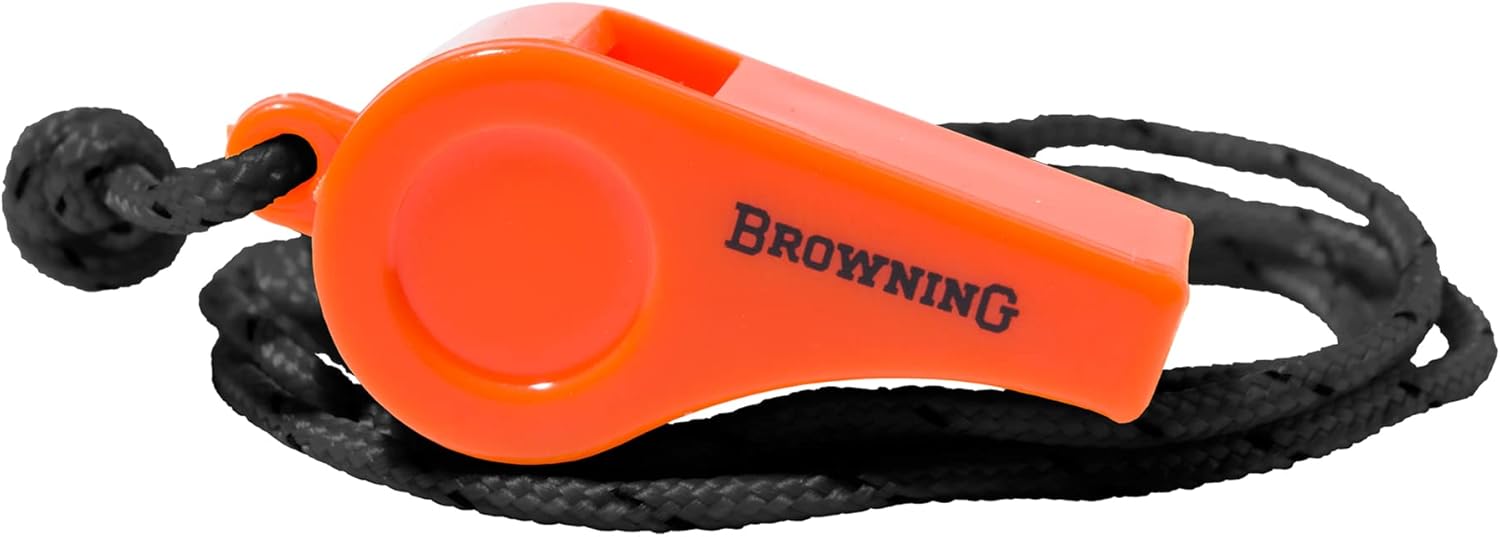
| Item model number | P000037980199 |
|---|---|
| Manufacturer | Signature Products Group |
| Included Components | Dog Whistle |
| Date First Available | October 8, 2021 |
The Browning Dog Training Whistle is a straightforward pea-less whistle designed for consistent, rattle-free tones during training and fieldwork. It is intended to be blown for on- and off-leash cues and includes a built-in retractable lanyard with clip plus an adjustable nylon lanyard so you can carry it on your person or wear it around your neck. The whistle is made from durable plastic that resists freezing in cold weather and incorporates a small compass and thermometer for quick environmental checks while outdoors. As a budget-focused tool it delivers reliable tone and durability without electronic tuning or variable frequency controls, so users who want precise pitch adjustments will need a different model. Its lightweight construction keeps it unobtrusive during walks or hunt sessions, and the pea-less design prevents the rattling common with traditional pea whistles. Expect solid day-to-day performance for routine obedience and hunting recall work, but not the fine-tunable sound range prized by professional trainers.
Best for: Cocker Spaniel owners who want an affordable, reliable whistle for routine obedience and recall training or occasional field use and value simple, rugged gear over fine-tuned control.
Less Ideal for: Owners seeking a whistle with adjustable pitches or pro-level frequency tuning for advanced voiceless signaling should consider higher-end models.
- Pea-less design prevents rattling for consistent tones
- Includes retractable clip lanyard plus adjustable nylon neck lanyard for convenient carry
- Durable plastic construction resists freezing in cold weather
- Lightweight and easy to carry during walks or hunts
- No adjustable frequency or tuning for precise pitch control
- Basic feature set with no electronic or multi-frequency options
Verdict: The best budget whistle gives owners a dependable, simple signal device at a low price without sacrificing basic tone consistency or durability.
Logan Whistles 304 Stainless Steel Whistle
Best Premium Whistle

| Material Type | Stainless Steel |
|---|---|
| Instrument Key | D |
| Included Components | 1 Sheepdog Whistle, leather lanyard, swivel clip, velvet pouch |
| Model Name | 304 Stainless Steel |
The Logan 304 is a single-piece, precision-machined stainless steel whistle built for serious training and field use. It produces a wide range of clear, responsive tones with a turbo-style shape that improves projection so signals carry over wind, rain, and background noise. Supplied with a leather lanyard, swivel clip, and velvet pouch, it is ready to wear and access during outdoor sessions or herding work. The stainless construction and hand finishing promise long-term durability and a consistent tone profile that helps maintain reliable responses from trained dogs. Because it is a premium, metal whistle it can feel colder and heavier than plastic models and requires basic care of the leather accessories to stay looking their best. It also lacks adjustable frequency dials found on some tunable models, so tone variation comes from technique rather than a built-in tuner.
Best for: Owners who prioritize durable, factory-quality materials and tonal consistency for advanced recall and field training and are willing to invest in a premium tool.
Less Ideal for: Casual pet owners seeking a lightweight, inexpensive whistle or those who need an adjustable-frequency plastic model for rapid pitch changes.
- Precision-machined single-piece 304 stainless steel for durability and consistent tone
- Turbo design improves sound projection over long distances and in poor weather
- Comes with leather lanyard, swivel clip, and velvet pouch for convenient carry
- Produces a wide range of clear, responsive tones suitable for recall and herding commands
- No built-in frequency tuner so pitch control depends on user technique
- Leather accessories require occasional care to maintain condition
Verdict: The best premium whistle is for owners willing to invest in superior materials, precision-tone consistency, and long-term reliability for advanced training.
SportDOG Roy Gonia Special Whistle
Best Compact Whistle
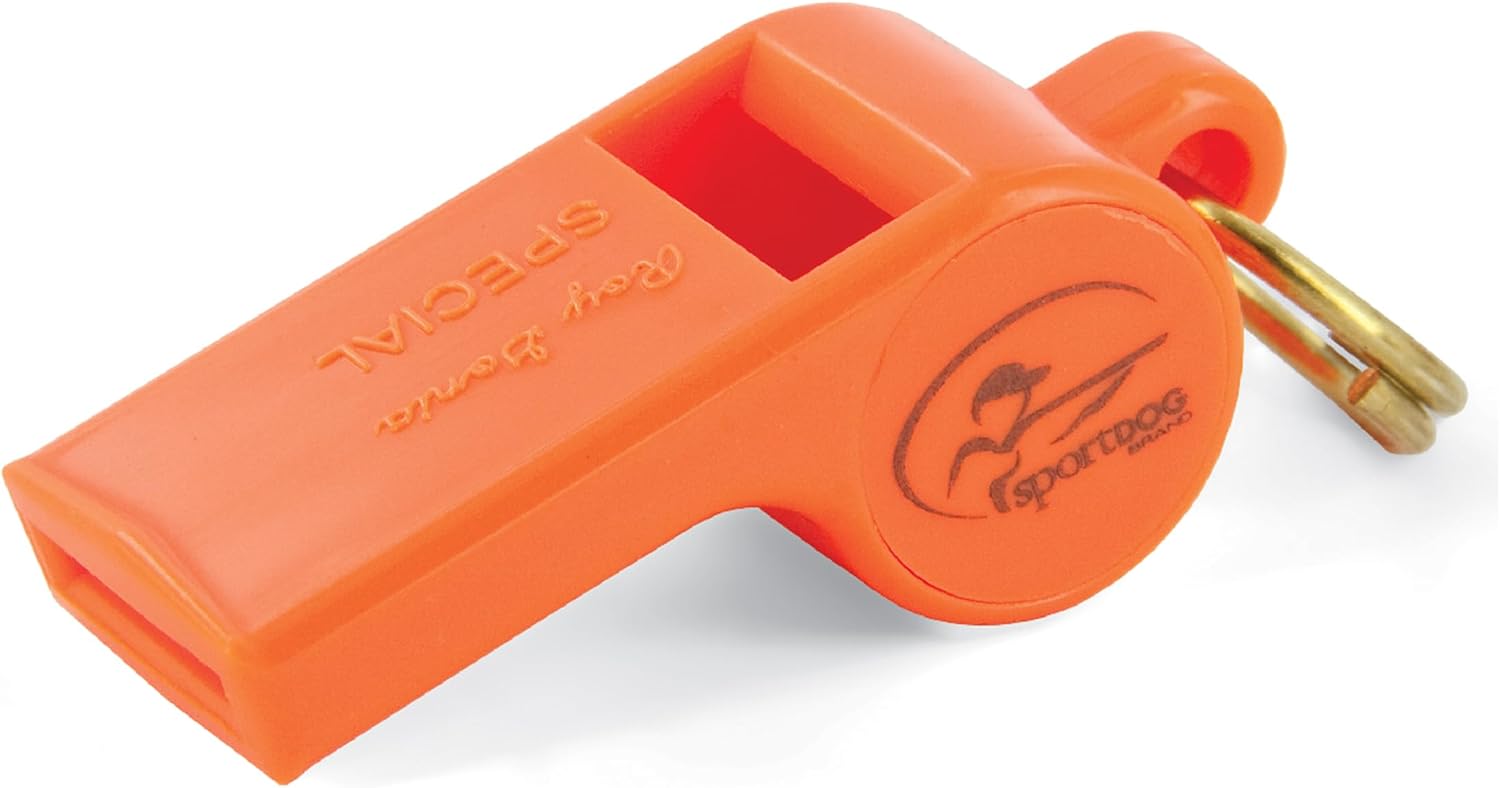
| Item model number | SAC00-11749 |
|---|---|
| Manufacturer | Radio Systems Corporation |
| Size | With Pea |
| Department | Pet Supplies |
The SportDOG Roy Gonia Special is a simple, hand-crafted training whistle designed to produce a lower-pitched sound that carries farther than many small whistles. It is used by trainers and hunters to give clear long-distance signals during fieldwork or everyday recall practice; the easy-to-blow profile makes it comfortable to use for extended sessions. The version listed includes a pea, which adds an audible burst that helps dogs locate the source of the sound in varied conditions. Practical benefits include a durable plastic body and a tone tuned for range rather than a very high, shrill pitch, making it useful in wind or over background noise. Limitations are its single fixed tone and the pea mechanism, which can be affected by moisture or debris and slightly changes consistency compared with pea-less designs. For routine training and field use it is a no-frills, effective whistle that emphasizes range and simplicity over adjustable frequencies.
Best for: Buyers who want an affordable, dependable whistle for everyday training and field recall work and who prioritize range and ease of use over adjustable tones.
Less Ideal for: People seeking an electronically tuned or multi-frequency whistle for precise signal variation or users who want a completely waterproof, pea-less option.
- Lower-pitched tone designed for longer range signals
- Easy-to-blow design reduces user fatigue during extended use
- Hand-crafted reputation with a long history in field training
- Includes a pea for an attention-grabbing burst to help locate the sound
- Single fixed tone with no pitch adjustment
- Pea can be affected by moisture or dirt, altering consistency
Verdict: The best compact whistle is ideal for owners who want a lightweight, pocketable signal that sacrifices little in tone or range for convenience.
ACME 575 Shepherd Whistle
Best Long-Range Whistle

| Item model number | 575 |
|---|---|
| Material | Silver |
| Number of Items | 1 |
| Specific Uses for Product | Behavior, Outdoor, Training, Weight |
The ACME 575 is a classic in‑mouth shepherd whistle built for long‑distance communication with working dogs. It is designed to be held in the mouth and produces variable frequency tones by changing air pressure and tongue position, allowing a skilled user to generate a wide range of clear, penetrating notes up to loud levels suitable for open fields and herding. Made in the UK from nickel silver, the whistle is pealess and compact, so it sits comfortably on the tongue and is weather resistant when cared for properly. Practical benefits include precise tone control for distinct recall and directional signals and a durable metal construction that will last with simple cleaning. Limitations are that it requires practice to produce consistent sounds and that tone output depends on the user's technique rather than fixed pitched settings, so beginners may need time to get reliable long‑range signals.
Best for: Owners who train or call dogs across wide fields and need a whistle that can produce clear, far‑carrying signals and precise tonal control for recall or herding.
Less Ideal for: Casual pet owners who want an immediately usable, single‑pitch click whistle or those unwilling to practice producing tones in the mouth.
- Variable frequency design allows finely tuned tones for distinct commands
- Pealess metal construction is durable and weather resistant
- Compact in‑mouth format produces a clear, far‑carrying sound suitable for open areas
- Requires practice to produce consistent tones and volume
- Tone depends on user technique rather than fixed pitch settings
Verdict: The best long-range whistle produces a clear, far-carrying tone suited for owners who train or call dogs across wide fields or large outdoor spaces.
KIVORA Dog Whistle 4-Pack
Best Adjustable-Pitch Whistle

| Material | 304 stainless steel |
|---|---|
| Frequency range | Adjustable up to 22 kHz |
| Number of items | 4 |
| Waterproof rating | IPX4 |
These KIVORA whistles are a four-pack of adjustable stainless steel training whistles designed to interrupt barking and reinforce recall at distance. Each whistle has a tuning screw so you can vary the pitch from low audible tones up into ultrasonic ranges above 20 kHz, and the listing emphasizes long-range recall and bark interruption without human-audible noise. Built from 304 stainless steel, the whistles should resist rust and tolerate everyday handling, and the set includes a reflective lanyard and an anti-swallow safety lock for convenience. In practice the adjustable pitch makes it useful across breeds from small to large since you can fine-tune what your dog responds to, and having multiple whistles is handy for keeping spares in a car, bag, or with neighbors. Limitations to expect are variable effectiveness between individual dogs and settings because response depends on the animal and environmental noise, and some users report mixed results with consistency. For buyers wanting a rugged, multi-piece starter pack for outdoor training, these offer practical value, but they are not a guaranteed solution for every dog or situation.
Best for: Owners who need a rugged, ready-to-use whistle set for regular outdoor training and want multiple durable spares to keep around gear, vehicles, or with helpers.
Less Ideal for: Dog owners seeking a guaranteed behavior fix without training work or those who prefer a single precision tool with electronic frequency control should look elsewhere.
- Four whistles included so you have spares for travel, neighbors, or backups
- Adjustable pitch up to ultrasonic range to tailor signals for different dogs
- 304 stainless steel construction resists rust and stands up to frequent handling
- Includes reflective lanyard and safety lock for carrying and accidental ingestion prevention
- Effectiveness varies by dog and environment, so some trial-and-error tuning is required
- Ultrasonic settings may be truly inaudible to humans which makes on-the-spot checking difficult
Verdict: The best adjustable-pitch whistle lets owners modify frequency for clearer, personalized signaling to match their dog’s responsiveness and training style.
TISUR Titanium Emergency Whistle
Best Weatherproof Whistle

| Material Type | titanium |
|---|---|
| Included Components | Paracord, Whistle |
| Unit Count | 2 Count |
| Loudness | 120 dB (advertised) |
The TISUR Titanium Emergency Whistle is a small, rugged signal whistle built for carrying on a keyring or around the neck. Made from titanium alloy, each whistle is corrosion resistant and washable, and the set includes paracord for easy attachment. It produces a very loud tone—advertised up to 120 dB—so it is suitable for emergency signaling, outdoor navigation, pet training, or coach/referee use where a sharp clear sound is needed. The compact size and light weight make it unobtrusive in everyday carry, and the integrated holes allow quick attachment to lanyards or keychains. Because it is a simple mechanical whistle there are no batteries to worry about and it will work in wet conditions. The main limitations are its tiny form factor, which can be hard to handle with gloves, and the lack of a protective cover so it can collect dirt when stored loose in a pocket or backpack.
Best for: Buyers who prioritize extreme portability and durable materials for everyday carry or outdoor safety will appreciate this lightweight titanium whistle.
Less Ideal for: Users who need a larger, glove-friendly grip, integrated dirt protection, or multi-tone training whistles should consider other styles.
- Titanium construction offers strong corrosion resistance and long-term durability.
- Very loud output (up to 120 dB) for effective long-distance signaling.
- Includes paracord and keychain-friendly holes for easy, secure carry.
- Tiny, lightweight design makes it convenient for EDC or hanging on a pet collar.
- Small size can be fiddly to grip or use with gloves.
- No protective cap so the mouthpiece can get dirty when loose in a bag.
Verdict: The best weatherproof whistle is for owners who need a rugged, moisture-resistant signal that maintains tone and function in wet or rough environments.
Choosing the Right Dog Whistle Recall Training: Key Factors to Consider
Tone Clarity and Frequency Control
A whistle used for recall training must produce a clear, consistent tone that your dog can learn to recognize. Dogs respond to specific frequencies, so a whistle that wavers or produces multiple pitches can slow learning and create confusion. Reliable frequency control—either via a tuned design or adjustable head—lets you establish the same cue every time.
Consistency matters more than sheer loudness. A sharp, distinct tone that remains stable across repeated blows helps your dog generalize the command, which is essential when you move from short-range to long-distance recall.
Audible Range and Tone Projection
Range determines how far your recall cue will reach and whether it can cut through ambient noise like wind, traffic, or other animals. Consider the environments where you train: open fields require long projection, while wooded areas need a tone that carries without echoing unpredictably.
A whistle that projects a focused frequency will remain recognizable at distance. Range also interacts with tone frequency since higher frequencies sometimes attenuate faster in air; choose a whistle whose audible performance matches your typical training terrain.
Build Quality and Weather Resistance
Durability is important because a recall whistle is handled frequently and exposed to the elements. Materials that resist corrosion and mechanical wear keep pitch stable and prevent cracks or deformation that change the tone. Metal, high-grade plastic, and sealed components are common durable choices.
Weather resistance matters if you train in rain, snow, or coastal areas. A whistle that retains consistent sound after exposure to moisture and temperature swings will save time and prevent retraining due to pitch drift.
Ergonomics and Ease of Use
You want a whistle that is comfortable to hold and easy to use repeatedly without fumbling. Size, mouthpiece shape, and whether the whistle requires a lot of breath all affect usability during training sessions. Lightweight options that attach securely to a lanyard or collar are convenient for quick access.
Consider how you signal during movement. A whistle that allows precise short bursts and graduated signals supports more nuanced recall training. Ease of cleaning and simple disassembly also contribute to long-term usability.
Signal Consistency Across Users
If multiple people will be using the same recall cue, the whistle should produce the same tone regardless of who blows it. Some designs are more user-dependent, varying with breath strength or embouchure, which can be problematic when family members or handlers rotate.
Choose models that minimize user variability so the dog learns one reliable cue that sounds the same whether you or another handler uses it.
Maintenance and Hygiene
Because whistles are handled and placed near the mouth, easy cleaning is important to prevent buildup and maintain tone. Designs that allow rinsing or straightforward wiping without damaging internal components make routine maintenance painless.
Parts that trap moisture or debris can change the sound over time, so favor simple constructions that are quick to clean and inspect. Long-term hygiene also reduces wear and prolongs consistent performance.
How Do I Introduce a Whistle for Recall Training?
Start by choosing a quiet, low-distraction area and associate a single, short whistle blast with a positive reward. Use one consistent tone pattern—such as two short bursts—so the dog can form a clear link between the sound and the desired behavior.
Begin at close range. Blow the whistle, immediately offer the reward, then repeat several times. Gradually increase distance only after the dog reliably responds. Keep sessions short and frequent to reinforce the association without overwhelming the dog.
- Use one clear tone pattern from the outset.
- Reward immediately after the dog responds to the whistle.
- Increase distance gradually as reliability improves.
What Frequency Should I Use for Different Environments?
Lower frequencies tend to travel farther in open areas and are less affected by wind, while higher frequencies can be more attention-grabbing at close range. If you mostly train in wide open fields, prioritize a whistle with strong low-to-mid frequency projection. For close-range or mixed-terrain training, a mid-frequency, clear tone often provides the best balance.
Rather than switching frequencies frequently, pick a tone that performs well in your most common setting and keep it consistent so your dog learns to respond regardless of minor environmental changes.
- Open fields: prioritize lower-frequency projection.
- Wooded or mixed terrain: choose a clear mid-frequency tone.
- Urban or noisy areas: test tone audibility at typical training distances.
Can Anyone Use the Whistle the Same Way, or Does Technique Matter?
Technique affects some whistle designs more than others. Choose a model that produces a consistent sound without requiring precise lip shape or breath control if multiple handlers will use it. When technique does matter, spend a few practice minutes teaching each user how to hold and blow the whistle for reliable results.
Standardize the signaling pattern in your household or training group so the dog hears the same sequence of blasts regardless of who is handling the cue. Consistency across handlers reduces confusion and speeds learning.
- Test any whistle with different users before committing to it.
- Teach a single, repeatable blowing technique to everyone who will signal.
- Prefer designs that minimize user-dependent variability.
How Should I Maintain and Store a Recall Whistle?
Rinse or wipe the whistle after use, especially when exposed to dirt, sweat, or moisture. Regularly inspect the mouthpiece and internal openings for debris that can muffle the tone. Store the whistle in a dry place and avoid leaving it in prolonged direct sunlight or freezing conditions that might warp components.
If the whistle has removable parts, disassemble periodically for a deeper clean following manufacturer guidance. Proper maintenance preserves pitch and extends functional life.
- Rinse after exposure to moisture or dirt.
- Inspect openings and mouthpiece regularly.
- Store in a dry, moderate-temperature location.
When Should I Use a Whistle Versus Voice Commands?
A whistle is a single, consistent cue that works well at longer distances and in noisy environments where voice projection may fail. Use a whistle to supplement voice work, especially for off-leash recall or when you need a repeatable signal that travels farther than your voice.
Continue rewarding and reinforcing with voice and treats during close-range training so the dog maintains responsiveness to both types of cues. Overreliance on either method can create gaps, so combine them thoughtfully based on distance and context.
- Use whistle for long-distance or noisy situations.
- Maintain voice cues at close range to preserve versatility.
- Reinforce both whistle and voice during training sessions.
How to Test a Whistle Before Using It with Your Dog
Test the whistle yourself at the distances and typical locations where you plan to train. Walk or stand at increasing distances and listen for tone consistency and projection. Try the whistle in different weather conditions if possible, because wind and humidity can change how the sound carries.
Have another person act as a handler to blow the whistle so you can confirm how user-dependent the tone is. If the sound changes dramatically between users or with short bursts versus sustained blows, consider a different design or spend time standardizing technique among handlers.
- Test range and tone at actual training locations.
- Check performance with different users and blowing styles.
- Repeat tests in varied weather when practical.
How We Chose the Best Dog Whistle Recall Training
We focused on attributes that matter specifically for recall training rather than general-purpose signaling. Each candidate had to offer consistent tone production, adjustable or well-defined frequency, and predictable sound across typical outdoor conditions. Range and audibility were examined in terms of both peak distance and how the tone carries over wind or background noise. Build quality and materials were considered to ensure a whistle maintains pitch and function over repeated use and exposure to weather. We prioritized ergonomics that make rapid, repeatable signaling easy during walks or training sessions, and included options with simple maintenance and cleaning. Safety and non-toxicity of materials were also part of the evaluation because these items are handled frequently. Exclusions included whistles designed strictly for marine or industrial use that sacrifice tone consistency for loudness, and novelty whistles without reliable frequency control. The final list reflects products that balance tone clarity, range, durability, and user practicality for recall training.
Our full evaluation process is outlined in our review methodology.
FAQ
How long does it usually take a dog to learn a whistle recall?
It often depends on the individual dog and training consistency. Many dogs begin responding reliably within a few weeks of short, consistent sessions, while others may take longer if distractions or inconsistent cues interfere.
Can a whistle damage a dog's hearing?
When used responsibly and at common training volumes, a recall whistle is unlikely to harm a dog's hearing. Avoid very loud sustained blasts at close range and focus on short, controlled signals to minimize any risk.
Is a metal whistle better than a plastic one for recall?
Metal and high-grade plastic both have advantages. Metal often offers durability and stable pitch, while quality plastics can resist corrosion and be lighter. The best choice depends on your environment and preference for weight versus long-term pitch stability.
Should I use whistles with different tones for different cues?
Using distinct tone patterns is effective if you keep them consistent and well-reinforced. Many handlers prefer a single, unmistakable pattern for recall and reserve other signals for different commands to avoid confusing the dog.
Will weather affect how the whistle sounds?
Yes. Wind, rain, and humidity change how sound travels and can reduce range or alter how a tone carries. Test your whistle in the conditions where you typically train and adjust placement or signal strength accordingly.
Final Verdict
Choose a recall whistle that balances tone clarity, reliable range, and durable construction for the places where you actually train. Prioritize consistent sound production over maximum loudness and pick a design that minimizes differences between users. Maintain simple cleaning and storage habits to preserve pitch and responsiveness. With steady, short training sessions that pair the same whistle pattern with positive reinforcement, you can build a dependable recall cue that works across distances and distractions. Focus on consistency, usability, and environment-specific range when selecting the right whistle for recall training.

