

If a neighboring dog's persistent barking is disrupting your home life, the right whistle can give you a nonconfrontational way to interrupt and redirect that behavior. A well-chosen dog whistle provides a clear, consistent cue that can be used from a distance without shouting or direct contact. This guide covers the top shortlisted whistles for stopping neighbours dog barking, focusing on range, adjustable tone, and ease of use so you can pick an option that fits your situation. Below you will find practical buying guidance and evaluation criteria we used to narrow the field to the most useful, humane whistles for neighborhood barking control.
Top Picks at a Glance
| Best Overall Whistle A reliable, effective whistle that works well for most owners | ACME Alpha 211.5 Dog Training Whistle |  |
| Best Budget Whistle An affordable whistle that still gets the job done reliably | XXINMOH Adjustable Dog Whistle 2-Pack |  |
| Best Premium Whistle A higher-end pick with superior materials and refined performance | ACME 535 Silent Dog Whistle |  |
| Best Adjustable-Pitch Whistle A whistle with tunable pitch to match training needs and dogs | NIKIMORE Adjustable Dog Whistle 2-Pack |  |
| Best Weatherproof Whistle Built to resist moisture, rust, and outdoor wear for longevity | FutureSteps Premium Brass Whistles 2-Pack |  |
| Best Compact Whistle A small, portable whistle that's easy to carry and store | FXHDC-M Mini Stainless Steel Whistle 2-Pack |  |
ACME Alpha 211.5 Dog Training Whistle
Best Overall Whistle

| Item model number | 211.5_ALPHA_BLK |
|---|---|
| Standardized Frequency | 5400 Hz |
| Material | BPA-free plastic |
| Pealess | Yes |
| Made in | United Kingdom |
The ACME Alpha 211.5 is a pealess, single-note dog training whistle designed for reliable recall and long-range signaling. It produces a standardized 5400 Hz tone intended to be consistent between users and offers an advertised effective range of roughly 450 to 500 yards, making it suitable for field training and off-leash recall. The molded BPA-free plastic body and ergonomic grip make it comfortable in the mouth and easy to hold in wet or cold conditions, and the pealess design reduces maintenance and avoids small internal parts that can fail. Practical benefits include a bright, consistent sound favored by professional trainers, weather resistance for outdoor use, and the option to use different colored whistles while keeping the same frequency. Limitations are that it is a single fixed-frequency whistle, so users cannot vary pitch for different cues, and learning a clear whistle pattern and consistent reinforcement is still required for effective training. The whistle is also very small, which some users may find easy to misplace.
Best for: Buyers who want a reliable, professional-style whistle for everyday training and long-range recall where consistent tone and durability matter.
Less Ideal for: People who need variable pitches for complex multi-cue training or who prefer larger, harder-to-lose training tools should consider alternatives.
- Standardized 5400 Hz tone for consistent recognition
- Long effective range around 450–500 yards for field recall
- Pealess design with no internal ball reduces maintenance and failure
- Ergonomic BPA-free plastic body that is weather resistant and comfortable to hold
- Fixed single-frequency limits the ability to use multiple pitches for separate cues
- Very small form factor can be easy to lose
Verdict: The best overall whistle balances clear audible tone, useful range, comfortable handling, and dependable performance for everyday bark control and training.
XXINMOH Adjustable Dog Whistle 2-Pack
Best Budget Whistle

| Material | 304 stainless steel |
|---|---|
| Pack | 2 pieces |
| Model number | GKS-1 |
| Item weight | 1.44 ounces |
These stainless steel adjustable whistles come as a two-pack with lanyards and are designed for basic whistle training, bark interruption, and recall at distance. You adjust pitch with a small screw to find the frequency that gets your dog's attention, then pair specific whistle signals with treats or commands to teach responses like sit or come. The 304 stainless construction resists rust and feels durable for outdoor use, and the compact metal body is easy to carry on a lanyard or keyring. The seller claims long-range effectiveness and silent ultrasonic tones that do not bother humans, which makes them convenient for long-distance recall and quiet bark control. Practical limits are that very small adjustments can be fiddly and some dogs may not react to the same frequencies, so training and patience are required to find the right setting; also results will vary by dog and environment rather than being an instant fix for behavior problems.
Best for: Buyers who want an inexpensive, no-frills training tool for basic recall and bark control and are willing to invest short training sessions to find the right frequency.
Less Ideal for: Owners seeking a guaranteed solution for severe behavior issues or those who need programmable electronic training with multiple modes should consider other options.
- Two whistles per purchase for backup or multiple handlers
- Adjustable pitch via screw lets you match a frequency your dog responds to
- 304 stainless steel construction resists rust for outdoor durability
- Compact, lanyard-ready design makes it easy to carry during walks and training
- Fine tuning can be fiddly and may require patience to find an effective frequency
- Effectiveness depends on the individual dog and environment, not guaranteed for all behaviors
Verdict: The best budget whistle gives pet owners a low-cost option with acceptable tone clarity and durability for routine use without extra features.
ACME 535 Silent Dog Whistle
Best Premium Whistle
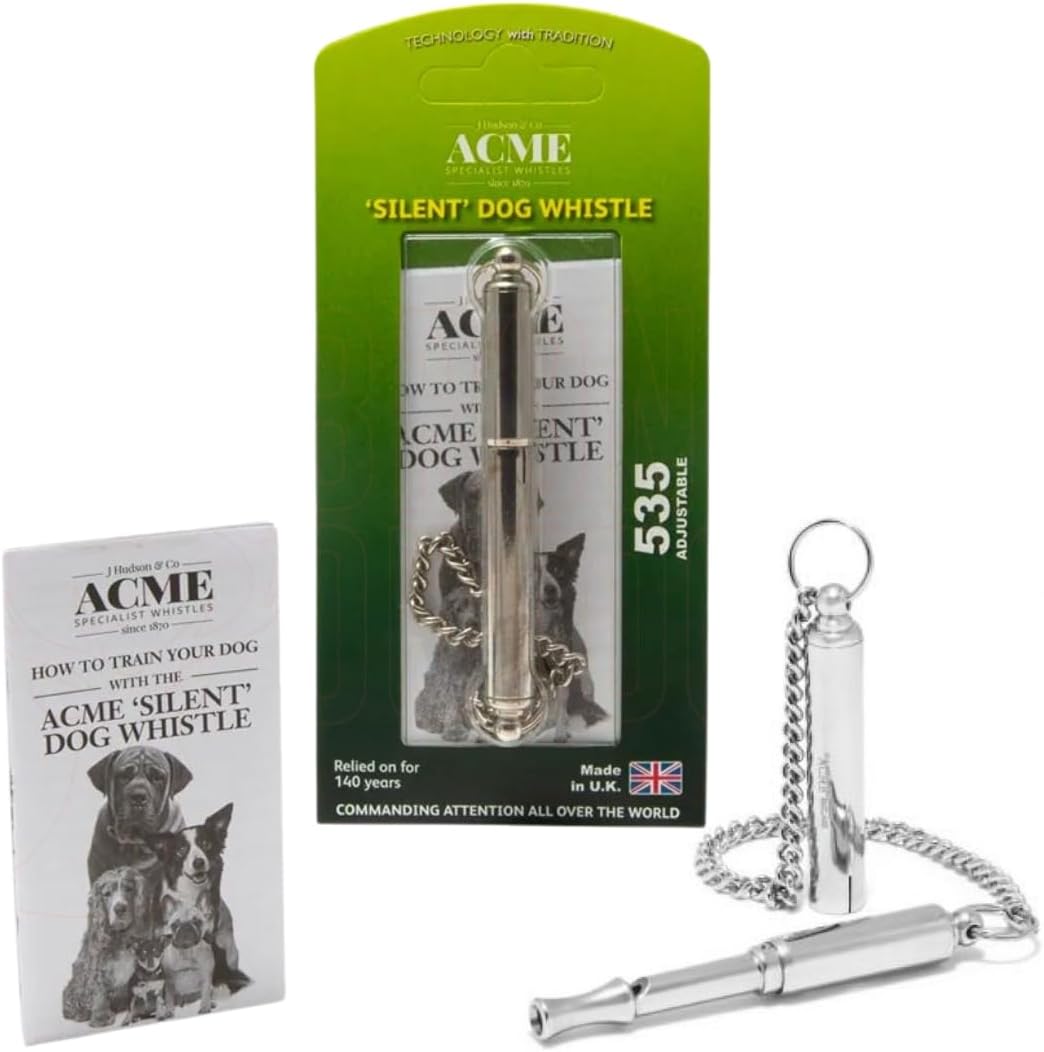
| Adjustable frequency | 5400-12800Hz |
|---|---|
| Material | Brass, nickel-plated |
| Included components | Whistle, information leaflet |
| Intended use | Dog training/behavior |
The ACME 535 Silent Dog Whistle is a precision, adjustable-frequency training whistle built from solid brass with a nickel plate and a protective end cap. Tunable between roughly 5400 and 12,800 Hz, it lets you dial in a pitch that suits your dog while keeping most of the sound out of the human hearing range so you can confirm operation without loud noise. The whistle's internal air directors aim to produce a focused, consistent tone that carries at distance, and the included leaflet explains simple training cues and cleaning. In practice this means you can create a repeatable whistle cue for recall or to interrupt barking without relying on harsh audible commands, and the metal construction offers durable, weather-resistant performance. Limitations are its learning curve and dependence on training: dogs must be taught to respond to a whistle cue, and some dogs less sensitive to high frequencies may need different pitches or more reinforcement. The 535 is a solid choice if you want a long-lasting, finely adjustable whistle and are prepared to invest the time to train the response.
Best for: Buyers who prioritize build quality and precise tuning and who are willing to train their dog to respond to a whistle cue to manage barking or recall.
Less Ideal for: Owners looking for an instant, untrained fix for nuisance barking or those who prefer electronic/automatic bark deterrents should consider other solutions.
- Adjustable frequency range for precise tuning to your dog
- Solid brass, nickel-plated construction for durability and weather resistance
- Designed air directors for a focused, carryable tone at distance
- Produces low human-audible confirmation sound so user knows it is working
- Comes with training guidance to help establish consistent whistle cues
- Requires consistent training for dogs to associate the whistle with a command
- May not be effective for dogs insensitive to high-frequency tones
Verdict: The best premium whistle is for owners willing to pay more for precise tuning, premium build quality, and consistently clear tone at range.
NIKIMORE Adjustable Dog Whistle 2-Pack
Best Adjustable-Pitch Whistle

| Frequency range | 20 kHz-28 kHz |
|---|---|
| Material | 304 stainless steel |
| Package contents | 2 x dog whistle, 2 x lanyard |
| Operating temperature | -20℃ to 60℃ |
This adjustable dog whistle lets you precisely tune pitch across an ultrasonic range so you can match the tone that each dog responds to best. It is a manual, air-blown whistle made from 304 stainless steel with a screw adjustment to lock frequency, and it ships as a two-pack with lanyards for easy carrying. In practice you use it during short training sessions to pair a specific pitch with rewards for recall, obedience, or to discourage excessive barking; the ultrasonic range can be set to audible or effectively silent to humans. The metal construction and weatherproof design mean it holds up to outdoor use without batteries or charging, and the compact ergonomic shape is pocket-friendly. Important limits are that effective results require consistent positive-reward training and some dogs are less responsive to sound-based cues, and the ultrasonic setting may not be perceived the same at extreme distances or in noisy environments. For owners willing to tune pitches and train deliberately, this gives a durable, low-maintenance way to shape responses without electronic components.
Best for: Owners who want to fine-tune a whistle tone to match different dogs or specific training cues and who plan to use consistent, reward-based training sessions.
Less Ideal for: People looking for a quick fix without training effort or those who prefer audible-only cues for neighbors or group settings.
- Adjustable frequency (20 kHz–28 kHz) lets you fine-tune pitch for different dogs or cues
- Made from 304 stainless steel for corrosion resistance and weatherproof outdoor use
- Comes as a two-pack with detachable lanyards for convenient access and backups
- Battery-free, manual air-blown design requires no charging and works instantly
- Requires repeated training and positive reinforcement to be effective
- Ultrasonic tones may be less effective at very long range or in high ambient noise
Verdict: The best adjustable-pitch whistle is ideal for owners who need to fine-tune tone to different dogs or training cues for better responsiveness.
FutureSteps Premium Brass Whistles 2-Pack
Best Weatherproof Whistle

| Material | Brass |
|---|---|
| Pack quantity | 2 |
| Included lanyard length | 30 inches |
| Sound level | 125 dB |
These FutureSteps brass whistles are a compact, weather-resistant pair intended for emergency signaling, trail safety, and outdoor use. Made from solid brass, each whistle is small enough to hang on a neck cord or keyring but is engineered to put out an extremely loud tone that the brand states reaches around 125 dB. They come as a two-pack with 30-inch lanyards so you can keep one on your person and one on gear as a backup. In practice the metal construction makes them durable and naturally corrosion resistant, so they handle rain, splashes, and rough handling without sounding muted. Because they are uncorded pea-less whistles they produce a sharp, piercing tone that carries well across distance, which is useful for alerting people or for basic dog recall training at short ranges. The trade-offs are that the sound is very loud and single-tone, so it is less useful for subtle training indoors or for graduated high-frequency dog-only cues, and brass will patina over time if not cleaned. For anyone wanting a rugged, always-accessible safety whistle that keeps working in wet conditions, this set delivers dependable performance.
Best for: Buyers who need a compact, waterproof signaling tool that keeps working in rain, splashes, and rugged outdoor conditions and who prioritize reliability over subtlety.
Less Ideal for: People seeking a quiet, frequency-tunable dog training whistle or a gentle indoor recall cue should consider alternate whistle styles or electronic trainers.
- Solid brass construction resists corrosion and survives rough outdoor use
- Very loud single-tone output designed to carry long distances
- Two-whistle pack provides a ready backup or gear-spare
- Includes 30-inch lanyards for hands-free carry and quick access
- Single, piercing tone is not adjustable or suited for subtle indoor training
- Very high volume can be uncomfortable at close range and may startle pets or people
Verdict: The best weatherproof whistle is for owners who need reliable performance in wet or rugged outdoor conditions without tonal degradation.
FXHDC-M Mini Stainless Steel Whistle 2-Pack
Best Compact Whistle

| Material | Stainless steel |
|---|---|
| Number of items | 2 |
| Decibel (listed) | Up to 120 dB |
| Manufacturer recommended age | 3 years and up |
These two mini stainless steel survival whistles are small, rugged signal tools intended for outdoor safety and simple communication. Each whistle produces a high-frequency, high-decibel tone—the listing claims up to 120 dB—which makes them suitable for attracting attention across distance or interrupting unwanted dog behavior in neighborhood settings. Made from stainless steel, the whistles resist rust and are described as durable for harsh environments, while a smooth, burr-free mouthpiece improves comfort when blown. Their tiny size and included keychain make them easy to carry on a belt loop, pack, or leash for quick access. Practical benefits include a consistent, sharp sound that does not rely on batteries and a construction that tolerates wet conditions. Limitations are that pitch and effectiveness for training dogs vary by animal, and the whistles are basic metal tubes without adjustable frequency or tone control used in dedicated dog training devices. They are best treated as compact emergency signals or convenience tools for occasional bark interruption rather than precision training instruments.
Best for: Buyers who need a tiny, always-available signaling tool they can clip to keys, a leash, or pack and expect a clear, attention-grabbing sound for occasional bark interruption and outdoor safety.
Less Ideal for: People seeking a precision dog-training whistle with adjustable pitch or a dedicated trainer who needs repeatable, fine-tuned frequencies for behavior shaping should look at specialized training whistles instead.
- Very loud, high-frequency tone suitable for attracting attention at distance
- Stainless steel construction resists rust and holds up in wet outdoor use
- Compact, lightweight design with keychain makes it easy to carry on gear or a leash
- Smooth, polished mouthpiece for comfortable blowing and consistent sound
- No adjustable frequency or tone control so effectiveness for stopping barking can vary by dog
- Basic design offers no volume modulation or trainer features found in dedicated dog whistles
Verdict: The best compact whistle suits owners who prioritize portability and convenience while still needing a clear, usable signal for bark control.
Choosing the Right Dog Whistle Neighbours Barking: Key Factors to Consider
Range and Audibility
How far a whistle carries determines whether it will reach the neighbour's yard. Wind, foliage, and ambient noise reduce effective range, so look for a whistle that produces a strong, focused tone rather than a diffuse sound.
Longer range increases your ability to interrupt barking without entering the other property. However, a louder or farther-reaching whistle is not always better if it is painful for nearby people or pets, so balance distance with controllability.
Tone and Frequency Control
Different dogs respond to different frequencies. Adjustable tone or pitch control lets you experiment from a safe distance and identify which frequency reliably gets the dog's attention without causing distress.
A fixed-frequency whistle may work in many cases, but tunable whistles reduce trial-and-error and help you find the least intrusive setting that still stops barking.
Build Quality and Weather Resistance
Outdoor use exposes whistles to rain, cold, and UV. Corrosion-resistant materials and simple construction help keep the tool reliable over time. Metal or hard plastic housings with sealed components resist moisture and remain consistent in output.
Solid build quality also affects tone consistency. A poorly made whistle can change pitch after a few uses, making training cues inconsistent.
Ease of Use and Ergonomics
You may need to use the whistle quickly and from various positions. A shape that sits comfortably in your hand, an easy-to-operate adjustment ring, and a secure lanyard or clip all help you deploy the whistle reliably.
Simple operation reduces the chance of fumbling during a barking episode and encourages consistent use, which improves the likelihood of long-term behavior change.
Humane Effectiveness and Safety
The goal is to interrupt barking without causing fear or pain. Choose tools designed to send a clear, repeatable cue rather than startle-based methods. Avoid devices that produce unpredictable or extreme ultrasonic output.
Consider how often you will use the whistle and aim for the lowest effective intensity. Humane use also includes following local noise rules and respecting neighbours when applying any behavioral tool.
Visibility and Portability
If you need to signal from a distance, having the whistle attached to a lanyard or clipped to clothing makes it accessible. Bright or contrasting colors make it easier to find quickly when needed.
Portability matters if you will carry the whistle during walks or outdoor chores. A compact, lightweight design encourages routine use and proper storage between incidents.
How Do I Find the Right Tone to Get a Neighbour's Dog to Stop Barking?
Start by standing at a similar distance as you would when signaling and try several pitches, beginning with milder tones and increasing only as needed. Observe the dog's response rather than assuming louder is better; a subtle lift in attention is the ideal immediate result.
Record which tones prompt head-turning or pausing and use those as your primary cues. Consistency matters: use the same tone each time you follow up with a calm, short verbal cue if allowed by your relationship with the neighbour.
- Begin with lower-intensity pitches and work upward until the dog responds.
- Use short bursts rather than continuous blowing to avoid stress.
- Note effective tones and repeat them consistently in future interactions.
Is Using a Whistle Humane and Legal for Neighborhood Barking?
Using a whistle is generally considered a humane, noncontact way to interrupt barking when used responsibly. It provides a neutral auditory cue rather than a punitive action. However, the welfare of the animal is important, so avoid prolonged, high-intensity blasting and monitor the dog's reaction.
Legal considerations are typically about noise and nuisance rules rather than the whistle itself. Check local regulations about sound levels and be mindful of neighbours when testing out a whistle so you do not create new disturbances.
- Use brief, purposeful signals, not continuous noise.
- Coordinate with neighbours if possible to ensure they know your intent and to avoid misunderstandings.
When Should I Avoid Using a Whistle and Choose Another Approach?
If the neighbour's dog shows signs of fear, aggression, or health problems when exposed to sound cues, stop using the whistle and discuss alternatives with the dog's owner or an animal behavior professional. Whistles are not a fix for underlying issues like separation anxiety or medical pain.
Also avoid relying solely on a whistle for long-term barking problems. It works best as a short-term interruption tool while owners address root causes through training, enrichment, and management changes.
- Stop if the dog freezes, retreats repeatedly, or shows aggressive escalation.
- Use the whistle as an adjunct while encouraging the neighbour to pursue training and management.
How Far Away Can Whistles Typically Be Effective in a Suburban Setting?
In typical yards, effective distances vary with wind, terrain, and background noise. Many handheld whistles produce an audible cue across one to several hundred meters under favorable conditions, but real-world effectiveness is usually less.
Plan for reduced range near busy roads or when foliage is dense. A whistle with adjustable tone helps compensate for distance by letting you use frequencies that carry better in your specific environment.
- Test your whistle at typical signaling distances before relying on it.
- Use higher ground or unobstructed lines of sight to maximize reach.
Simple Etiquette for Using a Whistle on Neighbour Dogs
Respectful communication with neighbours prevents escalation. If you plan to use a whistle regularly, let the dog owner know your intent and invite cooperation. Offer to show how you use the tool and emphasize your goal is to reduce nuisance barking, not to punish the animal.
When possible, coordinate times for troubleshooting and avoid using the whistle very early or late when ambient noise is minimal and a sound may carry further than intended.
- Inform the dog owner before testing a whistle.
- Avoid signaling during quiet hours or when the dog is clearly distressed.
How We Chose the Best Dog Whistle Neighbours Barking
We narrowed the list by applying filters that matter specifically when the goal is stopping a neighbour's dog from barking without confrontation. Our evaluation prioritized effective range so the whistle can be heard across yards, adjustable tone or frequency control to find what the distant dog responds to, and consistent output so cues are repeatable. Durability and weather resistance were considered because outdoor use exposes the tool to rain and sun, and ergonomic design mattered for quick, one-handed signaling. Safety and humane use were nonnegotiable: we excluded devices that rely on startling ultrasonic levels or unpredictable electrical feedback. We also screened for practical features such as an easy-to-see lanyard attachment and simple maintenance. Items that required complex setup, ongoing power sources, or unproven behavior-modifying claims were excluded. In short, we selected whistles that deliver a clear, adjustable auditory cue at useful distances, are built for outdoor use, and are intended for responsible, humane interruption of barking rather than punishment.
Our full evaluation process is outlined in our review methodology.
FAQ
Will a whistle work if the dog is inside the neighbour's house?
It often depends on window coverings, insulation, and distance. Whistles are more effective when the dog has a clear line of sight or is outdoors. If the dog is deep inside a building, the signal may be muffled and less likely to prompt a response.
How often can I use the whistle without harming the dog?
Short, intermittent signals are generally safe. Frequent, prolonged blasting can cause stress. Aim for brief cues and stop if the dog shows signs of distress, then pursue cooperative solutions with the owner if barking continues.
Should I adjust pitch differently during windy or noisy conditions?
Yes. Wind and background noise reduce certain frequencies more than others. Try higher or lower pitches to find one that carries through the specific environmental noise, and always test adjustments at the distances you expect to use.
Can I train a neighbour's dog remotely using only a whistle?
A whistle can interrupt or redirect behavior, but reliable long-term change usually requires the owner's involvement. Remote signaling helps in short-term situations, but coordinated training and reinforcement by the dog's owner are needed for lasting results.
What should I do if the whistle worsens the barking?
If barking increases or the dog appears agitated, stop using the whistle and communicate with the owner. The reaction may indicate the tone is aversive or that the dog is excited by the sound. Work with the neighbour to find alternative cues or professional help.
Final Verdict
When your goal is to reduce neighbour dog barking without confrontation, prioritize a whistle that balances useful range with adjustable tone and durable construction. The best choice is the one that lets you send a clear, repeatable cue from a distance while minimizing stress for the dog and avoiding unwanted disturbance to nearby people. Start with conservative, short signals and coordinate with the dog's owner whenever possible. Use the evaluation factors in this guide to weigh tradeoffs and pick an option that supports humane, effective interruption and helps restore quiet to your neighborhood.

