

Picking the right dry food for a chow chow puppy matters for growth, coat health, and long-term wellbeing. chow chow puppies have specific needs: steady calorie delivery, controlled growth rate to protect joints, and nutrients that support their distinctive double coat. This guide shortlists seven top dry puppy foods chosen for those priorities and explains the practical differences buyers should weigh. You will find evaluation criteria like protein quality, DHA and calcium balance, digestibility, and kibble size so you can match food to your puppy's life stage and feeding routine.
Top Picks at a Glance
| Best Overall Dry Food for Chow Chow Puppy The top all-around puppy formula balancing nutrition and growth needs | Purina ONE Plus Healthy Puppy Dry Food 8 lb |  |
| Best Budget Dry Food for Chow Chow Puppy A low-cost puppy formula that still meets basic growth requirements | Pedigree Puppy Dry Dog Food 3.5 lb |  |
| Best Premium Dry Food Higher-end formulas with superior ingredients and targeted nutrition | Pedigree Puppy Growth and Protection 28 lb |  |
| Best High-Protein Dry Food Formulas with higher protein to support muscle and growth | Purina Pro Plan Puppy Chicken & Rice 34 lb |  |
| Best Grain-Free Dry Food Recipes without grains for owners avoiding grain-based ingredients | The Honest Kitchen Clusters Puppy 4 lb |  |
| Best Limited-Ingredient Dry Food Simpler recipes for pets with ingredient sensitivities or allergies | Blue Buffalo Life Protection Puppy Lamb 5 lb |  |
| Best Large-Kibble Dry Food Bigger kibble shapes sized for large-breed puppy mouths and chewing | Purina Pro Plan Large Breed Puppy Chicken & Rice 34 lb |  |
Purina ONE Plus Healthy Puppy Dry Food 8 lb
Best Overall Dry Food for Chow Chow Puppy

| Flavor | Chicken |
|---|---|
| Age Range Description | Puppy |
| Item Form | Blended, Kibble, Crunchy, Morsels |
| Animal Food Ingredient Claim | No Artificial Colors, No Artificial Flavors |
| Unit Count | 128 Ounce |
Purina ONE +Plus Healthy Puppy is a high-protein dry kibble formulated for puppies and reproducing females, with real chicken listed first and added DHA to support vision and brain development. It is fed as a complete diet for growth, typically offered in multiple small meals for young puppies and transitioned gradually over 7 to 10 days from a previous food. Notable features include crunchy kibble with meaty morsels, a blend of four antioxidant sources for immune support, natural sources of glucosamine for joint support, and added vitamins and minerals for bone and heart development. The formula emphasizes digestibility and targeted nutrients such as omega-6 fatty acids for skin and coat and calcium for teeth. Practical benefits are straightforward: familiar ingredient sourcing, broad breed suitability, and clear feeding guidance from Purina that makes portioning and transition easier. Limitations to consider are the inclusion of some common cereal and by-product ingredients rather than an all-meat formula and that kibble texture and shape may not suit extremely small toy-breed puppies without monitoring portion size and chewing ability.
Best for: Buyers seeking a balanced, growth-focused puppy formula that covers core developmental needs without specialty ingredient claims and who want a broadly suitable, easy-to-feed dry food.
Less Ideal for: Owners specifically looking for grain-free, single-protein, or limited-ingredient formulas for food-sensitive puppies should consider alternatives tailored to those needs.
- Real chicken is the first ingredient to provide high-quality protein for growth
- Contains DHA and antioxidants to support brain, vision, and immune development
- Includes natural glucosamine and calcium to support joints and bone/teeth development
- Formulated for digestive tolerability and made without artificial flavors or preservatives
- Clear feeding instructions and broad suitability for all breed sizes
- Contains grain ingredients and chicken by-product meal rather than an all-first-meat-only ingredient list
- Kibble size and texture may require adjustment for very small toy-breed puppies
Verdict: The best overall dry food for a Chow Chow puppy that provides balanced growth nutrition, appropriate calorie density, and ingredients tailored to large-breed puppy development.
Pedigree Puppy Dry Dog Food 3.5 lb
Best Budget Dry Food for Chow Chow Puppy

| Flavor | Chicken & Vegetable |
|---|---|
| Age Range Description | Puppy |
| Item Form | Dry Kibble |
| Unit Count | 56 Ounce |
| Animal Food Nutrient Content Claim | High Protein, No Added Sugar |
Pedigree Puppy Dry Dog Food is a straightforward, budget-friendly puppy kibble made from chicken-based protein, grains, and added vitamins and minerals to support growth. You would typically use it as a daily staple while transitioning a young dog from weaning to adult food, following the feeding guide on the package to match your puppy's weight and age. The formula emphasizes high-quality protein sources for muscle development and includes 36 vitamins, minerals, and amino acids intended to support immune health, brain development, and bone strength. In practice this means an owner gets a complete and balanced commercial diet that is easy to portion and serve dry or softened with water for very young pups. Ingredient-wise it contains common commodity grains and by-product meals rather than premium single-source meats, so it delivers required calories and nutrients at a lower cost but not the cleanest ingredient panel. Expect good availability and consistent kibble size, but owners seeking grain-free, novel proteins, or limited-ingredient formulas will need to look elsewhere.
Best for: Value-conscious puppy owners who need an affordable, complete puppy kibble that supports growth and daily feeding routines.
Less Ideal for: Owners who require grain-free, novel-protein, or limited-ingredient veterinary diets for food sensitivities should consider specialty formulas instead.
- Formulated specifically for puppies with nutrients to support growth and immune health
- Contains high-protein sources to support muscle development
- Includes 36 vitamins, minerals, and amino acids for complete and balanced nutrition
- Easy-to-follow feeding guide for age and weight makes portioning simple
- Uses ingredient list with grains and by-product meals rather than single-source premium proteins
- Not suitable for owners seeking grain-free or limited-ingredient diets
Verdict: The best budget dry food for a Chow Chow puppy offering essential nutrients and adequate calories for healthy growth while keeping costs low for everyday feeding.
Pedigree Puppy Growth and Protection 28 lb
Best Premium Dry Food

| Flavor | Chicken |
|---|---|
| Age Range Description | Puppy |
| Item Form | Dry |
| Unit Count | 448 Ounce |
| Target Species | Puppy |
Pedigree Puppy Growth and Protection is a conventional puppy kibble designed to support early development with nutrients like DHA for brain development and added calcium and phosphorus for bone and tooth health. You would use this as a daily complete diet for growing puppies, following the package feeding guide split across two or more meals. The formula lists poultry ingredients and grain-based carbohydrates and includes added vitamins, minerals, taurine, and preservatives for shelf stability. Practically, it delivers broad-spectrum nutrition targeted at typical growth needs and is widely available in a large 28 lb bag that suits multi-puppy households or breeders. Limitations for buyers seeking a premium option include its ingredient mix, which contains by-product meals, multiple grains, and preservatives rather than premium whole-protein sources or grain-free formulations, so it is not positioned as an elevated ingredient recipe. For a Chow Chow puppy, the product offers the core nutrients needed for growth but lacks specialized high-end proteins or novel ingredient focus that some owners prioritize for breed-specific sensitivities or premium feeding plans.
Best for: Buyers who want an affordable, nutritionally complete puppy kibble that covers core developmental needs and is practical for regular feeding schedules.
Less Ideal for: Owners specifically seeking a premium ingredient list, novel single-protein formulas, or grain-free recipes for sensitive or pedigree-sensitive Chow Chow puppies should consider alternative premium options.
- Includes DHA for brain development and added calcium and phosphorus for bone and tooth support
- Formulated as a complete daily diet with added vitamins, minerals, and taurine
- Large 28 lb bag is convenient for households with growing puppies or multiple dogs
- Feeding guide provides clear portioning by weight for staged growth
- Uses poultry by-product meals and grain-based ingredients rather than single whole-protein sources
- Contains preservatives such as BHA and citric acid
- Not formulated as a premium or novel-ingredient recipe for sensitive puppies
Verdict: The best premium dry food for owners willing to invest in elevated ingredient quality, more precise nutrient profiles, and additional functional benefits for optimal puppy development.
Purina Pro Plan Puppy Chicken & Rice 34 lb
Best High-Protein Dry Food

| Flavor | Chicken & Rice |
|---|---|
| Age Range Description | Puppy |
| Item Form | Dry |
| Animal Food Nutrient Content Claim | High Protein |
| Unit Count | 544 Ounce |
Purina Pro Plan High Protein Dry Puppy Food Chicken & Rice is a large-bag dry kibble designed to support healthy growth in puppies with a high-protein formula and chicken listed as the first ingredient. It is typically fed as a sole diet for puppies from weaning through their juvenile stage and is used in multiple small meals per day when young, transitioning to fewer feedings as they mature. Notable features include added DHA from fish oil for brain and vision development, targeted minerals like calcium and phosphorus for bone and teeth formation, and antioxidants and vitamins for immune support. The formula emphasizes digestibility and lean muscle development through concentrated protein sources, and the bagged packaging makes it convenient for multi-puppy households or long-term feeding. Limitations are that the ingredient list includes poultry by-product meal and several grains, so buyers seeking grain-free or limited-ingredient diets should look elsewhere, and very sensitive puppies may still need a veterinary-prescribed sensitive-stomach formula if they have food intolerances.
Best for: Buyers raising large-breed puppies who prioritize higher protein and nutrient-dense formulations to support rapid muscle and skeletal development while keeping a generally digestible dry diet.
Less Ideal for: Owners seeking a grain-free, single-protein, or veterinary-prescribed hypoallergenic diet for puppies with confirmed food allergies should consider specialized alternatives.
- High-protein recipe with chicken as the first ingredient to support muscle development
- Includes DHA from fish oil to support brain and vision development
- Contains added calcium, phosphorus, vitamins and antioxidants for growth and immune support
- Large 34 lb bag is practical for households with large-breed puppies or long-term feeding
- Contains poultry by-product meal and multiple grains, so not a limited-ingredient or grain-free formula
- May not be suitable as a first choice for puppies with diagnosed food allergies or severe sensitivities
Verdict: The best high-protein dry food for puppies that need extra amino acids to support muscle development and active growth phases without excess fillers.
The Honest Kitchen Clusters Puppy 4 lb
Best Grain-Free Dry Food
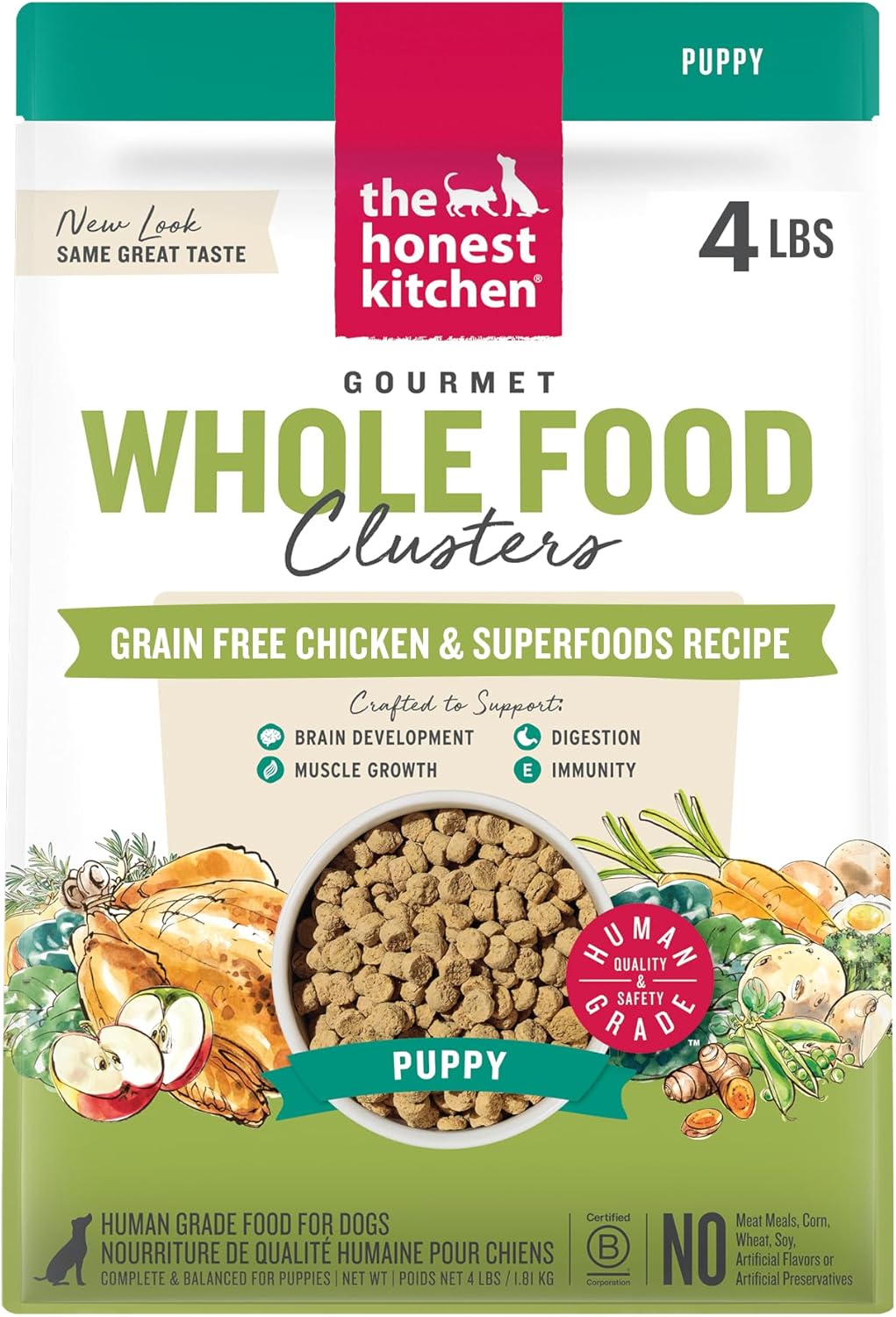
| Flavor | Chicken & Superfoods |
|---|---|
| Age Range Description | Puppy |
| Item Form | Dry |
| Unit Count | 64 Ounce |
The Honest Kitchen Clusters Puppy is a human-grade, grain-free dry puppy food made from cage-free chicken and whole-food ingredients that are cold-pressed, roasted and gently dehydrated into small clusters. It is typically used as a complete daily meal for puppies, a topper to add fresh-food texture to wet food, or as high-value training rewards thanks to the bite-sized pieces. Notable features include a first-ingredient real protein (cage-free chicken), added probiotics and salmon oil for digestive and brain support, and a production process aimed at preserving nutrients without high-heat extrusion. In practice this delivers a recognizable-ingredient recipe that most puppies find palatable and that supports digestion, skin and coat when fed according to the provided guidelines. Limitations to consider are that the formula is grain-free with many whole-food inclusions rather than a strictly short, minimal-ingredient list, and the product comes in 4 lb packaging which may be more than needed for very small dogs or single-puppy households expecting longer storage; storage and gradual transitions are advised to avoid stomach upset.
Best for: Buyers who prioritize human-grade, recognizable ingredients and want a puppy formula that doubles as tasty training treats and a digestive-supporting main meal for sensitive puppies.
Less Ideal for: Owners who need a very short, single-protein elimination diet or who require tiny trial-size packaging for repeated rotation between formulas.
- Human-grade ingredients with cage-free chicken as the first ingredient
- Cold-pressed and gently dehydrated clusters that preserve flavor and nutrients
- Includes probiotics and salmon oil to support digestion and brain development
- Bite-sized clusters suitable as a complete meal, topper, or training treat
- Not a single-source or extremely short ingredient list despite being clean-label
- 4 lb bag may be large for very small breeds or single-puppy households
Verdict: The best grain-free dry food for puppies whose owners prefer formulas that exclude grains while still delivering complete nutrition and balanced macro ratios.
Blue Buffalo Life Protection Puppy Lamb 5 lb
Best Limited-Ingredient Dry Food

| Flavor | Lamb & Oatmeal |
|---|---|
| Age Range | Puppy |
| Crude Protein | 26% min |
| Crude Fat | 16% min |
| Unit Count | 80 Ounce |
This Blue Buffalo Life Protection Lamb & Oatmeal puppy formula is a grain-containing dry kibble that starts with real lamb and is designed to support healthy growth from about 2–12 months. Typical use is daily feeding as a complete puppy diet; the bag includes feeding guidelines by weight and age so you can adjust portions as your pup grows. Key features include lamb as the first ingredient, added DHA and ARA for brain and eye development, LifeSource Bits that deliver a blend of antioxidants and vitamins, and natural prebiotic fiber to support digestion. The formula also lists glucosamine and chondroitin for joint support and provides calcium and phosphorus for bone and tooth development. Practically, this means you get a nutrition-focused puppy food without chicken ingredients, with recognizable whole grains like oatmeal and brown rice rather than corn, wheat, or soy. Limitations are that it is a grain-inclusive recipe and comes in a 5 lb bag size here, so very active or large-breed puppies may need larger quantities or a breed-specific formula; consult your veterinarian for puppies with specific allergies despite the chicken-free formulation.
Best for: Buyers who want a chicken-free, veterinarian-formulated puppy kibble that balances growth-focused nutrients and digestibility for most breeds.
Less Ideal for: Owners seeking a grain-free puppy diet or those whose puppy requires a veterinary-prescribed specialty formula should look elsewhere.
- Real lamb is listed first for high-quality protein source
- Includes DHA and ARA to support brain and eye development
- LifeSource Bits provide a targeted blend of antioxidants, vitamins, and minerals
- Natural prebiotic fiber supports digestion and stool quality
- Formulated without corn, wheat, soy, artificial flavors, or preservatives
- Contains grains (oatmeal, brown rice, barley) so not suitable for grain-free seekers
- 5 lb packaging may require more frequent repurchasing for larger or multiple puppies
Verdict: The best limited-ingredient dry food for puppies with food sensitivities, offering a short, transparent ingredient list to reduce exposure to common triggers.
Purina Pro Plan Large Breed Puppy Chicken & Rice 34 lb
Best Large-Kibble Dry Food

| Weight | 34 lb |
|---|---|
| Flavor | Chicken & Rice |
| Breed recommendation | Large Breeds |
| Item form | Dry |
| Animal food nutrient content claim | High Protein |
Purina Pro Plan Large Breed Puppy Chicken & Rice is a high-protein dry formula designed to support growth and development in puppies expected to exceed 50 pounds as adults. It is typically fed as a staple kibble for large-breed puppies and can be served moistened for weaning puppies or dry for older pups. The formula lists real chicken first, includes DHA from fish oil to support brain and vision development, and delivers added vitamins and omega-6s for skin and coat health. Glucosamine-containing ingredients and targeted nutrients aim to support bone and joint development in fast-growing large-breed dogs. In practical use the 34 lb bag reduces the need for frequent repurchasing and simplifies feeding schedules for multi-puppy or high-consumption households. Potential limitations are that it is a calorie-dense, large-breed puppy formula so portion control is important to avoid overfeeding, and some ingredient choices include grain and by-product meals which some buyers avoid. Feed according to the bag chart and consult your veterinarian when transitioning or adjusting amounts for ideal growth.
Best for: Buyers with large-breed puppies who need a vet-backed, growth-focused formula supplied in large bags to cut repurchase frequency and lower cost per serving.
Less Ideal for: Owners who prefer grain-free or limited-ingredient diets, or those who want boutique single-protein formulations should consider alternatives.
- Large 34 lb bag reduces frequency of reorders for busy households
- Real chicken listed as the first ingredient for protein-focused growth
- Contains DHA from fish oil to support brain and vision development
- Includes glucosamine sources and nutrients targeted for bone and joint development
- Contains grain and poultry by-product meal which some owners prefer to avoid
- Calorie-dense formulation requires careful portion control to prevent excess growth
Verdict: The best large-kibble dry food designed for large-breed puppies to encourage proper chewing, reduce gulping, and better match jaw size during early development.
Choosing the Right Dry Food Chow Puppy: Key Factors to Consider
Protein Quality and Source
High-quality protein supplies essential amino acids that support lean tissue growth and immune development. Look for named meat sources listed early in the ingredient panel and avoid vague terms that hide protein origin. For chow chow puppies, who need substantial protein during growth, the digestibility of that protein matters because poorly digested protein can lead to loose stool and waste of calories.
Protein percentage is important, but the source and amino acid profile are what determine usefulness. Animal proteins generally provide the full complement of essential amino acids puppies need. Also consider whether the formula uses multiple complementary proteins to round out the amino acid profile without relying on excessive carbohydrate to meet calorie targets.
Controlled Energy and Growth Rate
Puppies require enough calories for healthy growth, but oversized calorie density can encourage too-rapid weight gain. Chow chows are a medium-to-large breed with a predisposition to joint issues, so a formula that supports steady growth helps protect developing bones and joints.
Check feeding guidelines and calorie-per-cup estimates to understand how much a puppy will eat at different growth stages. Formulas targeted for large-breed puppies often have moderated calorie and calcium levels; even when not labeled large-breed, look for balanced energy-to-protein ratios and clear feeding guidance to manage pace of growth.
Digestibility and Stool Quality
Digestible diets allow puppies to extract needed nutrients with smaller portions, which helps regulate body condition. Ingredients such as cooked animal proteins, prebiotics, and moderate soluble fiber often improve stool consistency and gut comfort.
Poor digestibility leads to variable stool, flatulence, or nutrient loss. For chow chow puppies, whose dense coat and skin health depend on consistent nutrient uptake, reliable digestion supports both overall health and easier house training through predictable elimination.
Fatty Acids for Skin and Cognitive Development
Essential fatty acids, especially omega-3s like DHA, support brain and eye development in puppies and contribute to a healthy coat. Chow chows have a thick double coat that benefits from balanced omega-6 to omega-3 ratios; too much omega-6 without omega-3 can increase skin inflammation.
Look for named sources of omega-3s such as fish oil or algal DHA and a stated level of EPA/DHA when available. Adequate fat also provides energy, but it should not be excessive; quality of fats matters more than sheer percentage for developmental and skin benefits.
Calcium and Phosphorus Balance
Correct calcium-to-phosphorus ratios are vital for bone mineralization and skeletal development. Too much calcium or an imbalanced ratio during rapid growth can contribute to orthopedic problems in medium and large-breed puppies.
Ensure the formula meets established nutrient profiles for growth and lists guaranteed calcium and phosphorus levels or uses a formulation designed for growing puppies. If your veterinarian has specific skeletal growth concerns, discuss formulas with attention to mineral balance and feeding amounts rather than switching without guidance.
Kibble Size and Texture
Kibble shape and size affect how comfortably a puppy eats and whether they can adequately chew before swallowing. Chow chow puppies have a broad skull and a short muzzle; overly small or oddly shaped kibble can be swallowed whole while oversized kibble may be difficult to pick up.
Choose a kibble texture that encourages chewing and slows intake when necessary. Some formulas offer puppy-specific shapes that promote mechanical breakdown and dental abrasion while also fitting the puppy's mouth. Consider whether you will moisten the kibble for very young puppies and how that affects feeding routine and storage.
How Much Should a Chow Chow Puppy Eat Each Day?
Daily intake depends on the puppy's age, current weight, activity level, and the calorie density of the chosen dry food. Young puppies need frequent meals, often three to four times daily, with portions adjusted at each growth milestone.
Use the feeding table on the food label as a starting point, then adjust based on body condition. A growing chow chow should have a visible waist and ribs that can be felt without excess fat cover. Consult your veterinarian if you are unsure about portion adjustments or if growth seems too rapid or too slow.
- Divide daily calories into multiple meals for younger puppies to maintain consistent energy.
- Weigh your puppy regularly to track steady gains rather than spikes.
- Adjust portions when activity level changes, such as after spay/neuter or reduced outdoor time.
When Should I Transition From Puppy to Adult Dry Food?
Transition timing depends on the puppy's physical maturity rather than a fixed age for every dog. Many chow chows reach skeletal maturity between 12 and 18 months. Transitioning too early can deprive a dog of growth nutrients; too late may supply excess calories for a maturing dog.
Look for signs of maturity such as slowed growth plateaus and stable body condition. Move gradually over 7 to 10 days by mixing increasing amounts of adult formula to avoid digestive upset.
- Check with your veterinarian about the right time for your puppy.
- Monitor weight and energy rather than relying solely on a calendar age.
How to Spot Common Food-related Skin or Coat Issues
Changes in coat quality, persistent itching, flaky skin, or patchy hair loss can signal a dietary shortfall or sensitivity. Essential fatty acid deficiency often shows as a dull coat and dry skin, while other ingredients can trigger allergic or intolerant responses.
When you notice skin or coat problems, review the food's fat profile and ingredient list. A trial of a different protein source or a formula with higher omega-3 content under veterinary guidance can help determine whether diet is the underlying cause.
- Watch for improvements in coat sheen within 6 to 8 weeks after a formula change focused on fatty acids.
- Skin issues that persist despite dietary adjustments should be evaluated by a veterinarian.
Is Grain-free Dry Food Necessary for Chow Chow Puppies?
Grain-free is not inherently necessary for chow chow puppies unless a veterinarian has diagnosed a specific intolerance or allergy. Whole grains can provide digestible carbohydrates, fiber, and micronutrients that support steady energy and gut health.
Choosing a balanced formula that lists quality carbohydrate and fiber sources is more important than excluding grains by default. If you suspect a sensitivity, discuss an elimination trial with your veterinarian rather than switching without a diagnostic plan.
- Avoid assuming grain-free equals better; focus on ingredient quality and digestibility.
- Document symptoms before changing diets and allow sufficient time to assess results.
Feeding Schedules and Training Treats
Use part of the daily ration as training treats to avoid overfeeding. Small, kibble-sized rewards taken from the main meal help maintain calorie control while reinforcing training sessions.
Keep treats low-calorie and count them within the daily allowance. For intensive training days, reduce meal portions to compensate for extra rewards and prevent unintended weight gain.
- Measure all food and treats to track daily calorie intake precisely.
- Consider using the kibble itself for short training sessions to avoid extra calories.
How We Chose the Best Dry Food Chow Puppy
We screened candidate dry puppy foods through criteria that reflect chow chow puppies' physiological and developmental needs. First, we prioritized protein quality and source because amino acid profile affects lean mass development and immune function. Second, we checked energy density and controlled-calorie formulations to reduce the risk of too-rapid growth that can stress developing joints. Third, digestibility and fiber profile were considered to support consistent stool quality and nutrient absorption. Fourth, we evaluated essential fatty acid levels and micronutrients that influence skin and coat condition, with attention to DHA for brain and eye development. Fifth, we looked at kibble size and texture for easy mastication by broad-muzzled puppies. Exclusions included adult-only formulas, foods without complete nutrient guarantees for growth, and products lacking clear ingredient transparency. The final selections balanced nutrient adequacy, real food sources, and practical feeding considerations for chow chow puppies.
Our full evaluation process is outlined in our review methodology.
FAQ
How often should I feed a young chow chow puppy?
Feed younger puppies three to four times per day to maintain stable blood sugar and energy. As they approach six months, you can often reduce feedings to two or three times daily depending on their tolerance and schedule.
What signs indicate my puppy needs a different dry food?
Look for persistent loose stools, sudden weight changes, poor coat condition, or recurring digestive upset. These symptoms often indicate a mismatch between the formula and your puppy's digestive tolerance or nutrient needs.
Can I mix wet food with dry kibble for a chow chow puppy?
You can mix wet and dry food to increase palatability or moisture intake, but do so deliberately and count both toward daily calories. Gradually introduce any wet food to avoid intestinal upset and monitor stool consistency.
Should I add supplements like fish oil or glucosamine?
Supplements may help in specific situations, such as adding omega-3s for coat health or glucosamine for joint support under veterinary advice. Avoid routine supplementation without consulting a veterinarian, because excess nutrients can disrupt balance.
How do I switch my puppy from one dry food to another safely?
Transition slowly over 7 to 10 days by mixing increasing proportions of the new food into the old. Watch for signs of digestive upset and pause or slow the change if you notice vomiting or diarrhea.
Final Verdict
Choose a puppy dry food that balances high-quality protein, moderated calories, and essential fatty acids to support steady growth and a healthy coat. Prioritize digestibility and correct calcium-to-phosphorus ratios to protect developing joints while ensuring nutrient density for brain and immune development. Weigh tradeoffs between calorie density and growth pacing, and use feeding adjustments and veterinarian advice to fine-tune the choice for your individual pup.

