

Choosing the right e-collar for dog training matters because it affects how quickly your dog responds, how safe training sessions are, and how confident you feel using remote correction tools. You want a device that balances effective signal delivery with clear controls and built-in safety features so training stays consistent and stress-free for both you and your dog. This guide shortlists seven top e-collars for dog training, each selected for reliable stimulation options, user-friendly remotes, and sensible safety measures. Below you will find an overview of what to look for and focused guidance to help you pick an e-collar that fits your training style and your dog's temperament.
Top Picks at a Glance
| Best Overall E-Collar A well-rounded training collar that fits most dog owners' needs | Educator ET-300 Mini E Collar |  |
| Best Budget E-Collar A low-cost option that still handles basic training tasks reliably | Asrcs X13 Dog Training Collar |  |
| Best Long-Range E-Collar Extended-distance remote control for off-leash work and wide-open areas | Dogtra 1900X E-Collar |  |
| Best Waterproof E-Collar Water-resistant design for wet weather, swimming, and messy play | Dogtra 280X E-Collar 1-Dog |  |
| Best Rechargeable E-Collar Built-in battery and USB charging for easy daily use | HapTop AC131 Dog Shock Collar |  |
| Best Compact E-Collar Small, lightweight unit for smaller dogs or minimal bulk | Educator ME-300 Micro E-Collar |  |
| Best Heavy-Duty E-Collar Rugged construction and stronger components for active dogs | Garmin Sport PRO Training Collar |  |
Educator ET-300 Mini E Collar
Best Overall E-Collar

| Dog weight recommendation | 15+ lbs |
|---|---|
| Stimulation levels | 100 adjustable levels |
| Modes | Stimulation, Tone, Vibration |
| Water resistance | Waterproof |
| Included components | Receiver, Remote, Two contact point sets, Dual charger |
The Educator ET-300 Mini is a compact e-collar system designed for focused obedience and behavior work with dogs 15 pounds and up. The kit pairs a lightweight waterproof receiver with a floating remote and delivers 100 adjustable blunt stimulation levels along with tone and vibration modes, letting trainers dial responses to an individual dog rather than relying on a single intensity. The receiver and remote are built to withstand wet conditions and include an integrated LED for night visibility, and the package ships with two sets of contact points and a dual charger to keep both units ready. In practice the unit is suited to frequent outdoor training and real-world distraction management because of the long range and durable construction, and the multiple stimulation settings make it usable across a wide temperament range. Expect a premium feel and dependable electronics, but be prepared for a learning curve when setting the correct stimulation level and for paying more than budget alternatives for the refined controls and build quality.
Best for: Owners who prioritize dependable, durable training equipment and want precise, adjustable controls for intensive or long-term behavior work.
Less Ideal for: Casual owners seeking a low-cost, no-frills training aid or those uncomfortable using stimulation-based collars should consider alternative training tools.
- Very wide adjustment range with 100 stimulation levels for fine tuning
- Waterproof receiver and remote suitable for outdoor training in wet conditions
- Includes tone and vibration modes as non-shock communication options
- Built-in LED improves visibility during low-light sessions and tracking
- Kit includes extra contact points and a dual charger for continuous use
- Higher priced than basic training collars
- Requires time and care to find the correct stimulation level for each dog
Verdict: The best overall e-collar balances effective stimulation options, reliable range, comfortable fit, and ease of use for most everyday training situations.
Asrcs X13 Dog Training Collar
Best Budget E-Collar

| Range | 2000FT |
|---|---|
| Waterproof Rating | IPX7 |
| Dog Size | 8-150 lbs |
| Power | Rechargeable (included cable) |
The Asrcs X13 is an entry-level electronic training collar that offers the core features most owners need at a budget price. It supports beep, vibration, and adjustable shock modes plus a flashlight, and the handheld remote controls one or two receivers so you can train more than one dog. With a quoted 2000 foot range and IPX7 waterproofing, the collar works for backyard, park, and wet-weather use, and the included charging cable and claimed long standby make it easy to keep powered between sessions. The receiver ships with multiple contact point lengths and silicone caps to suit different coat types, and the adjustable strap fits dogs from about 8 to 150 pounds. Expect straightforward operation and adequate performance for everyday obedience work, though advanced trainers may find the feature set and precision limited compared with higher-end units. Build and ergonomics are typical for budget collars, so treating it as a practical tool rather than a precision instrument is the best approach.
Best for: Owners who want a no-frills, affordable e-collar that covers everyday obedience and boundary training without paying for advanced features.
Less Ideal for: Professional trainers or handlers who need precise stimulation control, advanced programming, or premium build quality should consider higher-end models.
- Multiple stimulation modes including beep, vibration, and adjustable shock for flexible training cues
- Long claimed remote range of up to 2000 feet suitable for parks and open areas
- IPX7 waterproof receiver for use in wet conditions and around water
- Rechargeable batteries with long standby time and included charging cable
- Includes multiple contact points and silicone caps to fit different coat types
- Basic feature set and control precision compared with higher-end training collars
- Ergonomics and build quality reflect budget construction
Verdict: The best budget e-collar provides essential stimulation and remote control features at a low price while remaining safe and functional for routine training.
Dogtra 1900X E-Collar
Best Long-Range E-Collar

| Model Number | 1900X |
|---|---|
| Range | 3/4 mile |
| Stimulation Levels | 100 |
| Waterproof Rating | IPX9K |
| Included Components | Charger, Collar (Receiver), Remote Control |
The Dogtra 1900X is a long-range e-collar built for off-leash training and field work where reliable signal and durable construction matter. The system pairs a one-hand remote with a rugged metal receiver and a 3/4-mile nominal range, and it offers 100 levels of stimulation plus tone and vibration so handlers can scale corrections precisely. The unit includes safety features such as a 12-second automatic shutoff and a safety level lock to prevent accidental changes, and the receiver is IPX9K rated for high-pressure water resistance. Practical benefits include the built-in 1000 lux LED for visibility in low light and a sturdy biothane strap with buckle closure for a secure fit during active work. Limitations are that the device is aimed at medium to large dogs and may be heavier than ultra-compact models, and full-range performance depends on open terrain and line of sight like other radio systems. The remote's dial and quick-access buttons make real-world timing easier during recalls, but adding receivers for multi-dog setups is an extra purchase.
Best for: Handlers who need dependable control at longer distances for recall and off-leash work in large open spaces, and who prioritize precise, trainer-style corrections and durable gear.
Less Ideal for: Owners who train only small indoor dogs or who need a minimal, ultra-lightweight collar for very small breeds should consider more compact alternatives.
- Long nominal range (3/4 mile) suitable for large open areas
- 100 stimulation levels plus tone and vibration for fine-grained control
- Rugged metal receiver and IPX9K waterproofing for harsh outdoor use
- Safety features including 12-second automatic shutoff and safety level lock
- Built-in 1000 lux LED increases dog visibility in low light
- Designed primarily for medium to large dogs so not ideal for very small breeds
- Receiver weight and robust construction make it bulkier than compact e-collars
- Extra receivers for training multiple dogs are sold separately
Verdict: The best long-range e-collar offers dependable signal strength and consistent correction at greater distances, ideal for recall and off-leash training in large spaces.
Dogtra 280X E-Collar 1-Dog
Best Waterproof E-Collar

| Range | 1/2 Mile |
|---|---|
| Output Levels | 100 Levels |
| Functions | Tone, Vibration, Nick/Continuous, BOOST |
| Expandable | Up to 3 Dogs |
| Included Components | Receiver, Transmitter, Contact Points, USB-C Charging Splitter |
The Dogtra 280X is a compact, rugged remote e-collar designed for everyday outdoor training where weather and rough use are expected. It pairs a handheld transmitter with a rechargeable receiver collar and offers tone, XPP vibration, nick/continuous static outputs and a BOOST function for instant higher stimulation for quick recall. The front-facing main button and 100 precise output levels make it straightforward to dial in responses during on-leash or off-leash work, and the safety level lock reduces accidental activations. Built to be fully waterproof and virtually drop-proof, the unit includes a bright 1000-lux LED for visibility in low light and removable contact points for easier maintenance. Expandability to up to three dogs and a USB-C charging splitter add practical convenience. Buyers should note it uses correction-based cues rather than positive-only methods and requires appropriate fit and conditioning for sensitive dogs. The compact form and durable Biothane strap suit active handlers who train in rain, mud, or around water and need a reliable, weatherproof system.
Best for: Active owners and trainers who need a durable, weatherproof remote collar for outdoor training sessions and want precise, adjustable correction options that hold up in wet conditions.
Less Ideal for: People seeking a positive-only or vibration/tone-only training tool without static correction or owners who want GPS tracking and smartphone integration.
- Fully waterproof and rugged design for use in rain, puddles, and swims
- 100 adjustable output levels plus tone and XPP vibration for nuanced corrections
- Front-facing main button and BOOST for fast, one-handed response
- Bright 1000-lux LED increases visibility during low-light training
- Expandable system supports adding receivers for up to three dogs
- Correction-based system requires careful introduction and monitoring for sensitive dogs
- No built-in GPS or app connectivity for location tracking
Verdict: The best waterproof e-collar keeps working through rain, puddles, and swims so owners can train outdoors without worrying about moisture damage.
HapTop AC131 Dog Shock Collar
Best Rechargeable E-Collar

| Training modes | Beep, Vibration, Safe Shock, Shock Boost |
|---|---|
| Range | 4500 ft |
| Fit neck | 7.8"-24.4" (10-120 lb) |
| Waterproof rating | IPX8 |
| Charging | USB-C |
The HapTop AC131 is a rechargeable e-collar kit designed for everyday obedience and distance work. It uses a 2-channel remote to control up to two dogs and offers four training modes: beep, vibration, safe shock (0–99 levels) and a shock boost, with the shock function optional for no-shock training. The remote's long 4500 foot range and memory for individual dog settings make it useful for off-leash recall, boundary training, and reinforcing commands across yards or trails. The receiver is IPX8 waterproof and the kit includes multiple prong lengths, silicone covers, a test light tool, and USB-C charging for practical field use. Safety-oriented features include an adjustable low-to-high stimulation range, a security lock to prevent accidental corrections, and a manufacturer guideline limiting continuous wear to 12 hours. Trade-offs are typical for this class: it relies on batteries and correct fitment to be effective, and some owners prefer vibration or beep-only methods before adding shock. The unit's feature set and range make it a strong daily trainer for owners willing to follow safe use guidelines.
Best for: Owners who want a versatile, safety-minded e-collar for regular obedience and distance work and who plan to use multiple training modes progressively.
Less Ideal for: People who want a purely non-aversive training tool or who are uncomfortable using shock-style corrections should choose vibration- or treat-based training alternatives.
- Very long 4500 ft remote range for off-leash training
- Multiple modes (beep, vibration, adjustable shock) for progressive training
- IPX8 waterproof receiver suitable for wet outdoor use
- Includes extra prongs, silicone covers, test light tool, and USB-C charging
- 2-channel remote controls two dogs and remembers individual settings
- Shock feature requires careful adjustment and responsible use to avoid misuse
- Not intended for continuous wear longer than 12 hours per day
Verdict: The best rechargeable e-collar has reliable battery life and convenient charging, reducing downtime and ongoing cost compared with disposable batteries.
Educator ME-300 Micro E-Collar
Best Compact E-Collar

| Range | 1/3 mile |
|---|---|
| Stimulation levels | 100 levels |
| Modes | Stimulation, Tone, Vibration |
| Recharge time | About 2 hours |
| Recommended neck size | 10–26 inches |
The Educator ME-300 Micro is a small, rechargeable e-collar system designed for routine training with small to medium dogs. The kit includes a compact transmitter and a low-profile receiver that fits dogs with 10–26" necks and is intended for dogs 5 pounds and up. It offers 100 incremental stimulation levels plus tone and vibration, which makes it easy to dial in a level that prompts attention without overcorrecting, and the waterproof construction means you can train in rain or near water. The roughly two-hour recharge time and included batteries keep the system ready for frequent sessions, and the one-third mile range covers most park and suburban off-leash work. Because the receiver is designed to be minimal and the strap uses biothane, it stays low-profile on smaller necks but still secures comfortably. Limitations include that the system is aimed at individual-dog use rather than multi-dog setups and that the high number of levels can require patience to find the right setting for a particular dog.
Best for: Buyers who want a lightweight, unobtrusive e-collar for regular obedience and recall work on small dogs or for owners who prioritize a low-profile fit.
Less Ideal for: Owners who need a multi-dog system or who prefer collars with integrated app connectivity and advanced tracking features should look elsewhere.
- Compact, low-profile receiver suited to small necks
- 100 adjustable stimulation levels for fine-tuned responses
- Tone and vibration modes provide non-stimulation correction options
- Waterproof transmitter and receiver for training in wet conditions
- Rechargeable system with about 2-hour charge time so sessions can resume quickly
- Designed primarily for single-dog use rather than multi-dog capability
- May require time to identify the appropriate stimulation level for each dog
Verdict: The best compact e-collar is lightweight and low-profile so it’s comfortable on small dogs or for owners who prefer a less obtrusive training device.
Garmin Sport PRO Training Collar
Best Heavy-Duty E-Collar
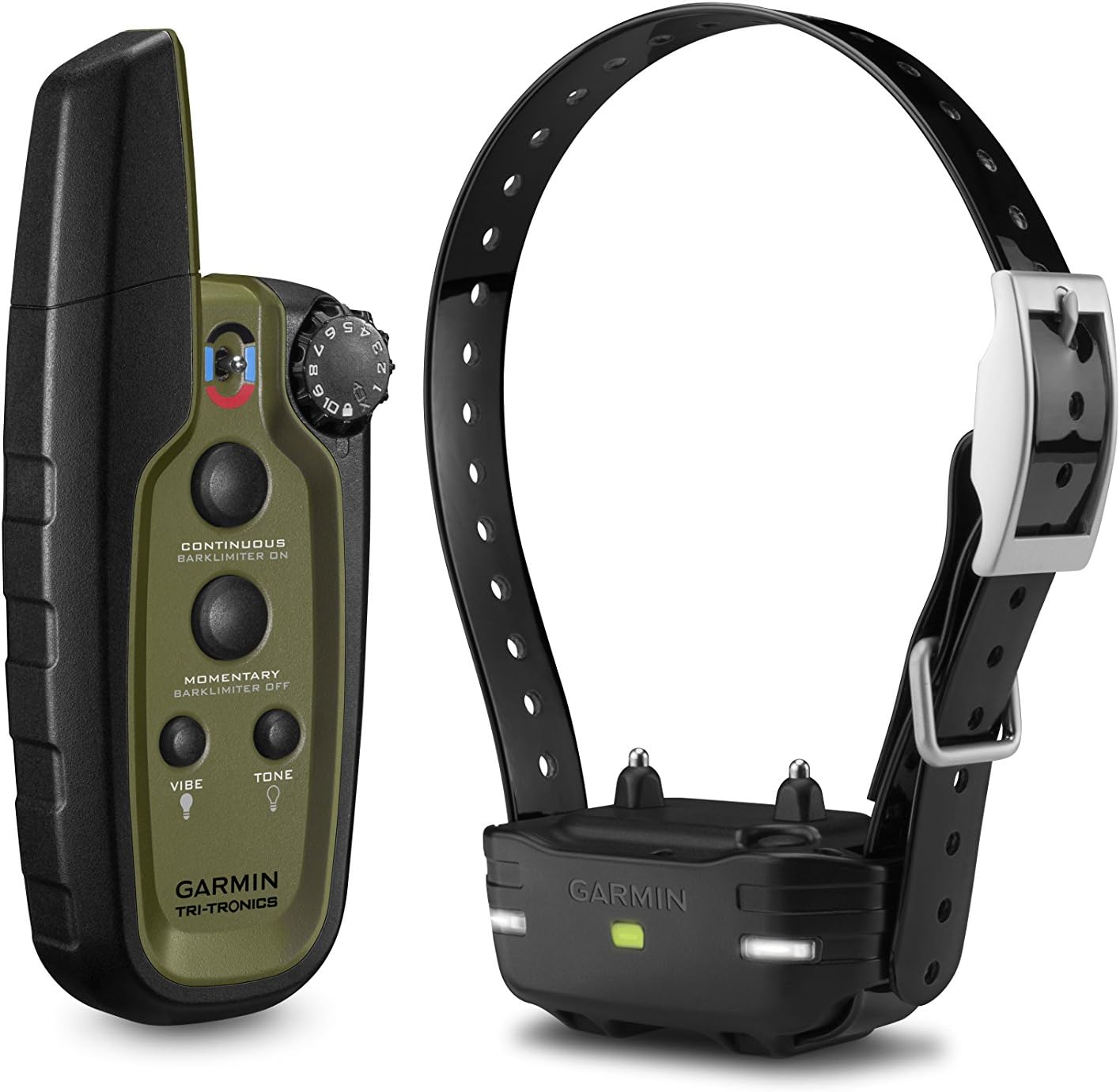
| Range | 3/4 mile |
|---|---|
| Training modes | Tone, Vibration, 10 stimulation levels |
| Dog capacity | Up to 3 dogs |
| Handheld battery life | Up to 60 hours |
| Handheld water rating | IPX7 |
The Garmin Sport PRO bundle pairs a one-handed handheld transmitter with a rechargeable dog device to deliver tone, vibration and 10 levels of static stimulation for training at distances up to three quarters of a mile. The handheld is ergonomically shaped for one-handed, no-look operation and uses a quick-turn dial with positive clicks to step through stimulation levels and auxiliary functions, while four buttons provide momentary and continuous corrections plus vibration and tone. Built-in LED beacon lights help locate a dog in low light and a settable BarkLimiter offers automatic barking control. Both units use rechargeable lithium-ion batteries and the handheld floats, adding practical durability for field use. The dog device accepts long and short stainless steel contact points for wet conditions and the system is rated water-resistant for rugged outdoor use. Limitations include no GPS tracking or advanced smartphone integration and the dog device water rating is lower than the handheld, so fully submerged use is limited.
Best for: Buyers who need a rugged, easy-to-operate remote trainer for active outdoor work and want reliable controls and durable contact hardware for strong, energetic dogs.
Less Ideal for: If you require GPS tracking, smartphone integration, or full waterproofing for underwater use, consider alternatives with those specific features.
- One-handed ergonomic handheld with quick-turn dial for easy level changes
- Up to 3/4 mile range suitable for open-field training
- Rechargeable, user-replaceable lithium-ion batteries for long runtimes
- Interchangeable long and short stainless steel contact points for wet use and durability
- Built-in LED beacon lights and settable BarkLimiter for locating and barking control
- Dog device has lower water rating than the handheld, limiting submerged use
- No GPS location tracking or smartphone app integration
Verdict: The best heavy-duty e-collar combines durable materials, reinforced contacts, and solid electronics to withstand strong, active dogs and rough outdoor use.
Choosing the Right E Collar Dog Training: Key Factors to Consider
Stimulation Control and Modes
How stimulation is delivered and controlled directly shapes training effectiveness. Multiple modes such as momentary (nick) stimulation, continuous stimulation, vibration, and tone let you choose the least intrusive option that still gets your dog's attention. Fine-grained intensity settings matter because dogs vary in sensitivity; having more incremental levels helps you find the minimum effective correction. Consistent output at a chosen level is important so that the feedback your dog receives is predictable.
In practice, look for clearly labeled buttons or a dial that let you change intensity without fumbling. Mode indicators and a memory function that recalls the last setting speed up sessions and reduce accidental overcorrection.
Safety Features and Limits
Safety features reduce the chance of accidental or excessive stimulation during training. Useful protections include automatic shut-off after a set continuous stimulation duration, timeout lockouts that prevent repeated long activations, and low-voltage cutoffs that keep output within a safe band. Visual and audible indicators for active stimulation and battery status also help you avoid unintended corrections.
Consider collars that offer alternative feedback modes such as vibration or tone for initial shaping, allowing you to rely less on electrical stimulation. Safety is about both hardware safeguards and sensible training protocols, so choose a collar that supports conservative use and makes it easy to avoid mistakes.
Range and Signal Reliability
Range determines how far you can be from your dog while still delivering commands. For everyday city and backyard work, short to moderate range is usually adequate, while field or off-leash recall practice benefits from longer reach. Beyond advertised distance, what matters is reliable signal transmission through obstacles, brush, and variable terrain.
Look for collars that report realistic range performance and include features such as re-syncing or re-pairing methods that are straightforward. A remote with a stable connection and fast response avoids lag that could confuse the dog during corrections.
Fit, Contact Points, and Coat Compatibility
A collar must sit securely against the dog's skin for consistent stimulation. Different contact point lengths and styles accommodate short, medium, and long coats; soft silicone tips or rounded edges reduce irritation. Adjustable strap lengths and quick-release buckles make fitting easier and safer.
Poor contact causes inconsistent signaling and can lead to unreliable training results. Check that the collar head is sized for your dog's neck and that replacement contact points are available when you need longer or shorter probes for the coat type.
Battery Life and Charging Convenience
Battery performance affects how often you recharge and whether you can complete long training sessions away from home. Look for collars and remotes that provide realistic runtime estimates and fast internal charging or convenient swappable batteries. Low-battery warnings and holdover reserves are useful so you do not lose function mid-session.
Battery longevity also ties to ruggedness and daily use. Consider how charging ports are protected against moisture and debris to maintain a reliable connection over time.
Control Ergonomics and Ease of Use
How the remote feels in your hand and how easily you can reach buttons during live training impacts safety and consistency. Intuitive button placement, tactile feedback, and a layout that supports one-handed operation let you deliver timely cues. Clear labels or iconography reduce mistakes when switching modes or levels under stress.
Menus and pairing procedures should be simple. A remote that requires elaborate sequences to change intensity or modes is cumbersome during a live exercise; choose controls that align with how you train so adjustments are quick and predictable.
When Should I Use Vibration or Tone Instead of Stimulation?
Vibration and tone are effective early-stage cues or for dogs sensitive to electrical stimulation. Use these modes to get attention and to build a conditioned response before introducing any electrical stimulation.
Reserve momentary or low-level stimulation for situations where audible cues are ignored or when you need a clearer attention-getter. By progressing from tone to vibration to lower levels of stimulation, you can teach reliable responses with minimal aversive input.
- Start with tone or vibration during foundation training.
- Reserve stimulation for higher-distraction scenarios or safety-critical recalls.
- Use the lowest effective level and test responsiveness at home first.
How to Size and Fit an E-collar Safely
Measure your dog's neck and ensure the collar sits high on the neck, with contact points touching clean, dry skin. Straps should be snug but not tight; you should be able to fit one or two fingers between the strap and the neck.
Trim long hair under the contact points or use longer probes if your dog has a thick coat. Check the skin under the contact points after sessions for any redness and rotate contact point placement if irritation appears.
- Check fit before every session.
- Use correct probe length for coat type.
- Inspect skin after moderate to long training sessions.
How to Introduce an E-collar to Your Dog
Introduce the collar gradually: let your dog wear it without activating the remote to get used to the feel. Pair the collar with treats and short, positive sessions so the dog learns the collar predicts training rather than punishment.
When you begin using signals, keep initial corrections minimal and reward correct responses immediately. Consistent timing and clear commands help the dog link the cue to behavior, which speeds learning and reduces stress.
- Wear-only acclimation for several days.
- Use low-level vibration or tone before stimulation.
- Reward correct responses immediately.
Troubleshooting Common Connection and Range Issues
If the remote seems unresponsive, first check battery levels on both units and re-pair according to the manufacturer instructions. Ensure contacts are clean and free of corrosion, and that the collar sits snugly against the skin.
For inconsistent range, test in an open field to establish a baseline and then note how obstacles affect performance in your usual training locations. Antenna orientation and how you hold the remote can influence reach, so try different hand positions or body angles if signal drops.
- Verify batteries and pairing before troubleshooting further.
- Clean contact points and check strap tension.
- Test range in open areas then in typical training locations.
Do Water Resistance Ratings Matter for Outdoor Training?
Yes. Water resistance protects internal electronics from rain, puddles, and sweat during active play or fieldwork. For regular outdoor training choose a collar rated for at least splash and rain exposure; fully submersible units are useful if your training includes swimming or heavy wet conditions.
Even with a rated collar, rinse and dry the unit after exposure to salt water or muddy conditions and check seals and charging ports regularly to maintain long-term reliability.
- Match resistance rating to typical training conditions.
- Rinse and dry after exposure to salt or mud.
- Check seals and ports periodically.
How We Chose the Best E Collar Dog Training
We screened e-collars using a practical set of criteria focused on real-world training needs. Primary evaluation points included stimulation control, defined as the range of correction modes and the granularity of intensity levels; safety systems, including automatic shut-off timers, short-circuit protections, and low-voltage limits to reduce risk of overcorrection; and remote ergonomics, covering button layout, tactile feedback, and ease of single-handed operation. We also assessed range and signal reliability under typical conditions, battery life and charging convenience for both collar and remote, and fitment options such as adjustable strap lengths and contact point choices for different coat types. Durability and water resistance were checked to ensure units hold up to normal outdoor use. Usability for beginners and trainers alike was considered, including how easy it is to pair, switch modes, and interpret indicator lights. Products were excluded if they lacked clear safety features, offered limited stimulation control, or had poor remote ergonomics that would impede consistent handling. We focused on features and specifications that matter for responsible, progressive dog training rather than promotional claims or marketing language.
Our full evaluation process is outlined in our review methodology.
FAQ
Will an e-collar hurt my dog?
An e-collar is not inherently harmful when used responsibly. Modern units offer adjustable intensity and alternative modes like vibration and tone so you can start with the least aversive cues. Use the lowest effective level, limit stimulation duration, and monitor your dog's behavior for signs of distress.
How long should stimulation pulses last?
Keep pulses short and purposeful. Momentary or nick-style pulses are usually sufficient for corrections; continuous stimulation should be avoided except in emergencies. Many collars include automatic timeouts to prevent prolonged activation.
Can puppies use e-collars?
Puppies can be introduced cautiously using tone and vibration well before electrical stimulation. Wait until basic obedience and impulse control are established and consult a qualified trainer for age-appropriate protocols. Many trainers recommend delaying stimulation until the dog has matured enough to understand cues.
How do I know if the collar is making good contact?
Good contact means the probes touch clean, dry skin without excessive force. You should see consistent responses at a given level during a controlled test and avoid loose straps or hair obstructing the contact. If results are inconsistent, adjust probe length or strap tension and retest.
How often should I check the collar for wear?
Inspect the collar before each session for frayed straps, damaged contact points, and secure housing around the electronics. Do a more thorough check monthly to verify seals, charging ports, and overall integrity, especially if you train outdoors frequently.
Final Verdict
Choosing an e-collar comes down to matching control, safety, and ease of use to your training goals and your dog's temperament. Prioritize units that offer precise stimulation control, built-in safety limits, and reliable signal performance so you can teach clear cues without overreliance on high output. Balance range and durability with a comfortable fit and straightforward remote ergonomics. When you pick a collar that supports conservative progression from tone and vibration to stimulation, you can achieve dependable recall and obedience while minimizing stress for your dog.

