

If you want a tool to reinforce recall, boundary training, or off-leash control, an e collar dog option can be effective when used appropriately. Choosing the right unit matters because collar fit, stimulation adjustability, and range affect both safety and training speed. This guide covers seven shortlisted e-collar options that represent common feature sets and use cases, and it explains the evaluation criteria we used. Read on to understand which features make the most difference for everyday dog training and how to match a collar to your dog and training goals.
Top Picks at a Glance
| Best Overall E-Collar The top all-around choice balancing features, reliability, and ease | Educator ET-300 Mini E Collar |  |
| Best Budget E-Collar A low-cost option that still covers core training needs | Asrcs X13 Dog Shock Collar |  |
| Best Premium E-Collar Higher-end models with advanced features and stronger build quality | Dogtra ARC-X E-Collar |  |
| Best Long-Range E-Collar Designed for extended-distance control during off-leash or field training | Jugbows T100 Training Collar |  |
| Best Rechargeable E-Collar Good battery life and convenient USB or dock recharging setup | HapTop AC131 Dog Shock Collar |  |
| Best Waterproof E-Collar Sealed design for use in wet conditions and rough weather | MrSpark HQ01 Shock Training Collar |  |
| Best Heavy-Duty E-Collar Built for larger dogs and frequent, demanding training sessions | BLACKDOG Military Shock Collar OT9 |  |
Educator ET-300 Mini E Collar
Best Overall E-Collar

| Dog weight recommendation | 15+ lbs |
|---|---|
| Stimulation levels | 100 adjustable levels |
| Modes | Stimulation, Tone, Vibration |
| Water resistance | Waterproof |
| Included components | Receiver, Remote, Two contact point sets, Dual charger |
The Educator ET-300 Mini is a compact e-collar system designed for focused obedience and behavior work with dogs 15 pounds and up. The kit pairs a lightweight waterproof receiver with a floating remote and delivers 100 adjustable blunt stimulation levels along with tone and vibration modes, letting trainers dial responses to an individual dog rather than relying on a single intensity. The receiver and remote are built to withstand wet conditions and include an integrated LED for night visibility, and the package ships with two sets of contact points and a dual charger to keep both units ready. In practice the unit is suited to frequent outdoor training and real-world distraction management because of the long range and durable construction, and the multiple stimulation settings make it usable across a wide temperament range. Expect a premium feel and dependable electronics, but be prepared for a learning curve when setting the correct stimulation level and for paying more than budget alternatives for the refined controls and build quality.
Best for: Owners who prioritize dependable, durable training equipment and want precise, adjustable controls for intensive or long-term behavior work.
Less Ideal for: Casual owners seeking a low-cost, no-frills training aid or those uncomfortable using stimulation-based collars should consider alternative training tools.
- Very wide adjustment range with 100 stimulation levels for fine tuning
- Waterproof receiver and remote suitable for outdoor training in wet conditions
- Includes tone and vibration modes as non-shock communication options
- Built-in LED improves visibility during low-light sessions and tracking
- Kit includes extra contact points and a dual charger for continuous use
- Higher priced than basic training collars
- Requires time and care to find the correct stimulation level for each dog
Verdict: The best all-around e-collar for most dog owners, offering a balanced mix of effective training modes, reliable range, comfort, and straightforward controls.
Asrcs X13 Dog Shock Collar
Best Budget E-Collar

| Range | 2000FT |
|---|---|
| Waterproof rating | IPX7 |
| Dog size range | 8-150 lbs |
| Power | Rechargeable batteries (included) |
The Asrcs X13 is a no-frills remote training collar that combines adjustable shock with vibration, beep, and a built-in flashlight so you can use progressively stronger cues without swapping devices. It is sold as a single-dog system with dual-channel support for additional receivers, and typical use cases are basic obedience, boundary reinforcement, and off-leash recall at distance. Practical benefits include an IPX7 waterproof receiver for wet conditions, a compact rechargeable design that claims long standby on a short charge, and multiple contact point options for different coat lengths. The 2000 ft range and lightweight handset make it suitable for park or trail training, while included accessories like extra contacts, a test light, and charging cables simplify setup. Important limitations are that intensity control granularity and actual maximum range can vary with terrain and interference, and the product focuses on corrective signals rather than positive-only methods. For buyers wanting a budget-minded but capable electronic trainer, the X13 delivers core functionality without advanced telemetry or smartphone integration.
Best for: Owners who need an affordable, functional training collar that provides dependable corrective signals for basic obedience and off-leash recall without extra smart features.
Less Ideal for: People who want app control, advanced logging, or a strictly reward-based training approach should consider other options.
- Multiple stimulus modes (shock, vibration, beep) for stepwise training
- IPX7 waterproof receiver suitable for wet use
- Includes spare contact points and test light for easier fit and setup
- Rechargeable batteries with claimed long standby and quick charge
- Actual range and shock strength can be affected by terrain and may not meet the maximum in all environments
- No smartphone app or advanced telemetry; basic handset-only controls
Verdict: The best budget e-collar for owners who need effective basic training features and reliable performance without extra frills or high cost.
Dogtra ARC-X E-Collar
Best Premium E-Collar

| Range | 3/4 mile |
|---|---|
| Stimulation levels | 100 levels |
| Waterproof rating | IPX9K |
| Expandable | Up to 3 dogs |
| Collar strap material | Biothane |
The Dogtra ARC-X is a premium remote training system designed for owners and trainers who need precise control at a distance. The unit pairs a slim, curved receiver that sits close to the dog with a rugged handheld remote that reaches up to 3/4 mile, making it useful for fieldwork, recall training, and off-leash control in open areas. It offers 100 stimulation levels along with nick, continuous, and XPP vibration modes, plus tone and an LED beacon for visibility. The receiver is IPX9K waterproof and uses a Biothane collar strap for durability and ease of cleaning, while Boost and Level Lock features help prevent accidental intensity changes. The collar is rechargeable and expandable to train up to three dogs from one transmitter. Trade-offs are its premium price and the learning curve to dial in the right stimulation level for different dogs, and owners wanting minimalistic or budget options may prefer simpler models.
Best for: Buyers who prioritize refined controls, durable materials, and advanced training features and are willing to invest in a long-range collar for serious off-leash work or professional training.
Less Ideal for: Casual dog owners on a tight budget or those who only need a simple short-range or single-mode bark controller should consider simpler, lower-cost options.
- Long 3/4 mile remote range suitable for open-area training
- 100 stimulation levels with multiple modes for precise, graduated corrections
- Slim, curved IPX9K waterproof receiver designed for comfortable wear and durability
- Expandable system supports training up to three dogs with one remote
- LED beacon and tone add visibility and non-static cues for training sessions
- Premium price point compared with entry-level e-collars
- Requires time and care to properly find effective stimulation settings for each dog
Verdict: The best premium e-collar for owners willing to pay more for refined controls, superior materials, longer durability, and advanced training options.
Jugbows T100 Training Collar
Best Long-Range E-Collar
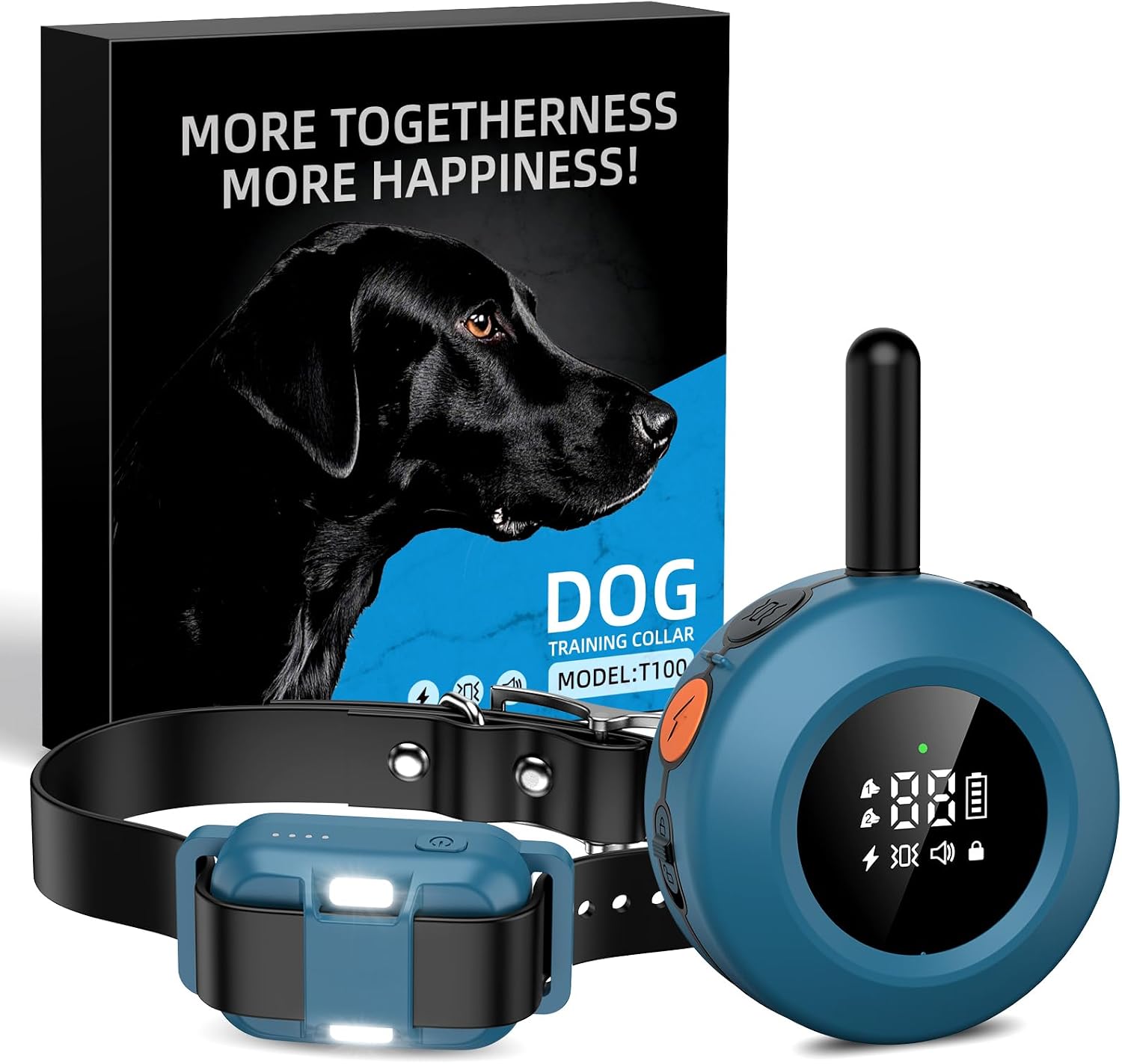
| Target Species | Dog |
|---|---|
| Battery | Type‑C rechargeable (remote and receiver) |
| Waterproof Rating | IPX8 |
| Range | 3/4 mile |
| Modes | Daily and Professional |
The Jugbows T100 is a long-range e-collar built for off‑leash recall and distance work. It pairs a handheld remote with a waterproof receiver and supports dual channels so one remote can control two collars, making it useful for multi‑dog sessions. The system offers two operation modes: a Daily Mode with limited beep, vibration, and low-level safe shock settings for gradual introduction, and a Professional Mode with many more intensity steps for stronger, more precise corrections. Key practical benefits include an advertised 3/4‑mile range, bright LED indicators for locating dogs in low light, a safety lock to prevent accidental stimulation, and detachable contact points to switch to non‑shock options. The receiver's IPX8 rating and reinforced casing make it suitable for wet or rough conditions, and Type‑C charging with long standby times reduces downtime between outings. Important limitations are the reliance on battery charging rather than user-replaceable cells and the higher shock-level range in Professional Mode which requires responsible use and careful adjustment for each dog. For distance work it delivers the connectivity and durability most handlers need, provided you use the stronger settings judiciously.
Best for: Owners who regularly train dogs at distance and need a dependable signal, durable hardware, and configurable stimulation that can scale from introduction to advanced reinforcement.
Less Ideal for: Owners seeking a very simple vibration-only trainer or those uncomfortable managing higher-intensity stimulation levels should consider less powerful, non-shock alternatives.
- Long advertised 3/4‑mile remote range for off‑leash training and recall
- Dual‑channel support lets one remote control two receivers
- IPX8 waterproof receiver and reinforced casing for wet and rough conditions
- Two operation modes (Daily and Professional) with adjustable levels for progressive training
- Fast Type‑C charging and multi‑week standby times reduce charging frequency
- Uses internal rechargeable batteries rather than user‑replaceable cells
- Professional Mode offers very high intensity steps that require careful, experienced handling
Verdict: The best long-range e-collar for owners who train at a distance and need consistent signal strength and responsiveness across larger areas.
HapTop AC131 Dog Shock Collar
Best Rechargeable E-Collar

| Training modes | Beep, Vibration, Safe Shock, Shock Boost |
|---|---|
| Range | 4500 ft |
| Fit neck | 7.8"-24.4" (10-120 lb) |
| Waterproof rating | IPX8 |
| Charging | USB-C |
The HapTop AC131 is a rechargeable e-collar kit designed for everyday obedience and distance work. It uses a 2-channel remote to control up to two dogs and offers four training modes: beep, vibration, safe shock (0–99 levels) and a shock boost, with the shock function optional for no-shock training. The remote's long 4500 foot range and memory for individual dog settings make it useful for off-leash recall, boundary training, and reinforcing commands across yards or trails. The receiver is IPX8 waterproof and the kit includes multiple prong lengths, silicone covers, a test light tool, and USB-C charging for practical field use. Safety-oriented features include an adjustable low-to-high stimulation range, a security lock to prevent accidental corrections, and a manufacturer guideline limiting continuous wear to 12 hours. Trade-offs are typical for this class: it relies on batteries and correct fitment to be effective, and some owners prefer vibration or beep-only methods before adding shock. The unit's feature set and range make it a strong daily trainer for owners willing to follow safe use guidelines.
Best for: Owners who want a versatile, safety-minded e-collar for regular obedience and distance work and who plan to use multiple training modes progressively.
Less Ideal for: People who want a purely non-aversive training tool or who are uncomfortable using shock-style corrections should choose vibration- or treat-based training alternatives.
- Very long 4500 ft remote range for off-leash training
- Multiple modes (beep, vibration, adjustable shock) for progressive training
- IPX8 waterproof receiver suitable for wet outdoor use
- Includes extra prongs, silicone covers, test light tool, and USB-C charging
- 2-channel remote controls two dogs and remembers individual settings
- Shock feature requires careful adjustment and responsible use to avoid misuse
- Not intended for continuous wear longer than 12 hours per day
Verdict: The best rechargeable e-collar for owners who prefer the convenience and lower running cost of built-in batteries with reliable runtime and quick recharging.
MrSpark HQ01 Shock Training Collar
Best Waterproof E-Collar

| Training modes | Beep, Vibration, Shock (adjustable levels) |
|---|---|
| Waterproof rating | IP68 receiver |
| Remote range | 4500ft |
| Recharge time | 2 hours |
The MrSpark HQ01 is a rechargeable e-collar designed for remote obedience and bark control using three modes: beep, vibration and adjustable shock levels. You use the handheld remote to send instant corrections up to 4,500 feet away, which makes it practical for off-leash field work, recall training, and perimeter control. Notable features include an IP68 waterproof receiver that can be rinsed after swims or muddy sessions, a built-in LED collar light and a remote flashlight for night visibility, and a safety lock plus automotive-grade safety chip to reduce accidental stimulation. Battery life is strong: the receiver claims up to about 20 days between charges and the remote up to 90 days with a two-hour full charge time. The collar ships with short and long metal prongs and silicone covers to fit different coat types and has an adjustable buckle fit. Limitations to be aware of are that the remote is not waterproof and users must follow the daily-wear and skin-inspection guidance to avoid irritation from sustained contact; effective, humane use requires gradual level setting and monitoring during training.
Best for: Pet owners who prioritize a durable, moisture-resistant training collar for frequent outdoor use, night walks, and water activities and who want a long-range remote for off-leash correction.
Less Ideal for: Owners who need a fully waterproof remote or who prefer passive bark-only collars without user-controlled correction should consider other options.
- IP68-rated receiver that can be rinsed after swimming or muddy play
- Long 4,500 ft RF range with adaptive frequency hopping for stable response
- Multiple training modes with adjustable levels for gradual, precise corrections
- Long battery runtime and 2-hour fast recharge to minimize downtime
- Included hardware (short/long prongs and silicone covers) for fit across coat types
- Remote unit is not waterproof which limits use in wet conditions
- Requires careful daily-wear management and periodic skin checks to prevent irritation
Verdict: The best waterproof e-collar for dogs that encounter rain, swimming, or muddy conditions and need a collar that keeps working despite moisture exposure.
BLACKDOG Military Shock Collar OT9
Best Heavy-Duty E-Collar

| Training modes | Beep, Vibration, Safe Shock, Strobe Light |
|---|---|
| Range | 4200ft |
| Waterproof rating | IP67 |
| Power | USB-C fast charge; 90-day claimed runtime (1 hr/day) |
The BLACKDOG OT9 is a rechargeable training collar system aimed at regular use in outdoor conditions. The remote and collar provide four user-selectable modes—beep, vibration, safe shock, and a strobe light—with multiple intensity levels, an LCD on the transmitter for clear mode and battery readouts, and tool-free removable prongs so you can switch to no-shock operation. Its rechargeable design (USB-C fast charge) and claimed 90-day battery life based on one hour of daily use make it convenient for owners who train often and want low running costs compared with disposable batteries. The unit is built to a rugged spec with an IP67 rating and reinforced casing for heavy-duty outdoor use, while the remote flashlight and collar strobe improve night safety. Practical limits: the shock mode is present so careful, informed use is required, and real-world range and battery life will vary with terrain and usage intensity. The system suits hands-on, consistent trainers who need a weatherproof rechargeable collar with visible lighting features.
Best for: Owners who train regularly and prioritize a rechargeable collar that is rugged enough for outdoor use and includes visibility features for night or low-light sessions.
Less Ideal for: People who want a purely positive-reinforcement tool without any static stimulation or those who need a collar-free solution for noise-only behavior control.
- Rechargeable USB-C system with fast charging and long claimed runtime
- Multiple training modes including beep, vibration, and adjustable safe shock levels
- IP67 waterproof build and reinforced casing for rugged outdoor use
- Integrated remote flashlight and collar-mounted strobe for night visibility
- Tool-free removable prongs allow switching to no-shock configuration
- Shock feature requires responsible use and may not suit sensitive or inexperienced handlers
- Real-world range and battery life depend on terrain and usage and may be lower than claims
Verdict: The best heavy-duty e-collar for owners of strong or larger dogs who need reinforced construction, stronger contact points, and resilient electronics for rigorous use.
Choosing the Right E Collar Dog: Key Factors to Consider
Stimulation Settings and Control
How stimulation is delivered and adjusted is the most important safety and effectiveness factor. Look for collars that offer multiple modes such as tone, vibration, and graduated static levels so you can begin with non-aversive cues and only increase intensity when needed. Fine-grain level adjustments let you match the stimulus to your dog's size, temperament, and sensitivity.
Clear, labeled controls and a numeric scale on the remote reduce guesswork during training. Some systems include a safety cutoff or lowest non-shock option that helps avoid accidental high levels. Avoid units that provide only one fixed intensity; those limit your ability to tailor training and increase the risk of inappropriate correction.
Fit, Contact Points, and Coat Compatibility
A collar must maintain reliable contact with the skin for cues to register. Check receiver shape, strap width, and the length of contact probes when evaluating compatibility with short, medium, and thick coats. Adjustable probe length or alternative contact attachments can improve contact on heavily coated dogs.
Comfort matters for long-term wear. Soft, flexible straps and rounded receiver edges reduce chafing. For dogs that will wear the collar frequently, choose materials that breathe and do not trap moisture. Poor fit leads to inconsistent signaling and can confuse training progress.
Range and Signal Reliability
Range requirements depend on how you train: neighborhood recall and field work have different needs. Consider practical line-of-sight range rather than just the maximum advertised distance, and prioritize systems known for stable connections without frequent dropouts.
Signal interference resistance and quick response time are important during real-world use. If you plan to train at long distances, confirm both transmitter power and receiver sensitivity, and remember that dense terrain, buildings, and vegetation reduce effective range.
Battery Life and Charging Convenience
A dependable battery ensures the collar is ready when you need it and prevents lost training opportunities. Look for units that provide several days of regular use on a single charge and that include convenient charging options such as USB chargers or simple dock systems.
Battery-level indicators on both the transmitter and receiver help avoid unexpected shutdowns. Replaceable batteries can be useful for extended outings but require carrying spares. Consider how long a full charge takes and whether the system supports quick top-ups between sessions.
Water Resistance and Durability
Training happens outdoors in variable conditions, so water resistance matters. A collar with a water-resistant receiver and sealed controls will tolerate rain, puddles, and wet fur without failing. Durable housing and corrosion-resistant contacts help the unit last through active use.
Also evaluate the robustness of the transmitter—buttons and switches should remain reliable after frequent handling. Durable straps and secure buckles prevent accidental loss during rough play or exploration.
Usability and Ergonomic Design
A handheld transmitter that fits your hand and presents clear controls reduces errors during training. Look for logically arranged buttons, an easy-to-read display, and tactile controls you can operate without looking. Quick access to commonly used functions like boost or vibration makes sessions smoother.
Consider how the collar straps fasten and whether replacement straps are available. Simple setup steps and clear user instructions reduce initial frustration and help you begin training more quickly.
How Should I Introduce an E Collar to My Dog?
Start with short, positive sessions to let the dog wear the collar without stimulus while you reward calm behavior. Allow the dog to get used to the feel and weight for a few days before adding any cues.
When you begin using the remote, start with non-aversive signals such as tone or vibration to build an association with desirable responses. Use clear, consistent timing and immediate rewards to reinforce the behavior you want.
- Fit the collar snugly so contacts touch the skin but do not pinch
- Begin with the lowest stimulation level and increase only if necessary
- Keep initial sessions brief and end on a positive note
Can E Collars Be Used for Behavior Problems Like Barking and Digging?
E collars can be an effective part of a behavior modification plan when used with consistent training and management. For nuisance behaviors such as excessive barking, many units offer a tone or vibration mode that provides a warning before stronger levels are used.
Addressing underlying causes is essential: exercise, enrichment, and environmental management often reduce problem behaviors and reduce reliance on corrective cues.
- Pair corrective signals with clear cueing and redirection
- Use behavior-specific strategies rather than relying solely on the collar
What Maintenance Does an E Collar Need?
Regularly inspect contact probes, straps, and the receiver housing for wear or corrosion. Clean probe contacts with a mild cleaner and dry them thoroughly to maintain consistent operation.
Monitor battery health and replace or recharge as recommended by the manufacturer. Store units in a dry, cool place when not in use and avoid exposing the receiver to saltwater or prolonged moisture.
- Check strap tension and condition before each outing
- Test transmitter and receiver connection briefly before training
How to Choose the Right Stimulation Mode for Training Goals
Select the least aversive mode that achieves reliable responses. Tone and vibration are useful for communication and as pre-corrections, while graduated static may be necessary for reliable off-leash recall in distraction-heavy environments.
Combine mode selection with timing, markers, and rewards. The goal is to use the collar to communicate clearly, not to punish. Gradual progression and observation of the dog's reactions guide safe level selection.
- Use tone for attention-getting cues
- Use vibration for clearer communication without static
- Reserve static levels for when other cues fail and use the lowest effective level
Do Multi-dog Setups Require Special Considerations?
If you plan to control more than one dog from the same transmitter, ensure the system supports multiple receivers and that channels are clearly labeled. Check that adding receivers does not compromise range or battery life.
Separate quick-access controls for each dog help avoid accidental cues to the wrong dog. Also verify that straps and receivers are sized appropriately for each dog to maintain contact and safety.
- Label transmitter buttons for each dog
- Test each receiver independently before combined use
How We Chose the Best E Collar Dog
We focused on features that influence safety, usability, and training effectiveness for dogs. Core evaluation criteria included stimulation control and levels to ensure a range from gentle cues to stronger corrections; receiver fit and contact reliability to guarantee consistent skin contact across coat types; remote range and signal stability for typical training distances; and battery life plus charging convenience for reliable field use. Additional criteria included adjustable modes (tone, vibration, static) to support positive cueing, water resistance to withstand outdoor sessions, and ergonomics of the handheld controller for comfortable repeated use. We examined build quality and materials likely to hold up under active use and assessed whether the system supports multi-dog setups where relevant. Units were excluded if they lacked basic safety features, had no adjustable intensity, or used unregulated stimulation levels. The result is a curated list that emphasizes practical, safe operation and features that matter to everyday dog owners and trainers.
Our full evaluation process is outlined in our review methodology.
FAQ
Are e collars safe for puppies?
Puppies are still developing and often respond differently to stimulation. Many trainers recommend waiting until basic obedience and impulse control are established before introducing an e collar, and if used, apply the lowest settings and prioritize tone or vibration cues.
How often should my dog wear the e collar?
Limit wearing time to training sessions and necessary management periods. Continuous 24/7 wear is not recommended; allowing skin and coat to breathe prevents irritation. Follow fit and inspection guidelines if the collar is worn daily.
What if my dog does not respond to the lowest stimulation level?
First confirm reliable skin contact and correct probe length. If contact is good, increase intensity gradually and consider using a clearer cue or pairing with reward. If the dog still does not respond, consult a qualified trainer to review technique and suitability.
Can rain ruin an e collar?
Many modern e collars feature water-resistant receivers suitable for rain and puddles, but prolonged submersion or exposure to saltwater can cause damage. Always check the unit's water-resistance rating and dry components thoroughly after wet use.
Will an e collar cause fear or aggression?
When used improperly, any corrective tool can increase anxiety or elicit unwanted reactions. Proper timing, least-aversion principles, and positive reinforcement minimize risk. If you observe stress signals, stop and reassess your approach or consult a professional.
Final Verdict
Choose an e collar based on control options that match your training goals, a secure fit that maintains contact through the dog's coat, and a transmitter with reliable range and ergonomics. Prioritize units that offer non-aversive modes and fine-grain intensity adjustments so you can use the least forceful cue that gets consistent results. Balance practicality and safety by considering battery life, water resistance, and ease of use. When introduced thoughtfully and paired with sound training methods, an e collar can be a practical tool for improving recall and off-leash reliability.

