

If you train a German shepherd, the right e-collar can make short, controlled corrections that speed learning and improve safety. You want consistent range, adjustable stimulation levels, and a device that fits the size and temperament of a GSD without causing unnecessary stress. This guide shortlists the top options for GSDs and explains how we evaluated them for effectiveness, fit, and user control. Below you will find the best choices for common training needs plus practical buying guidance to match a collar to your dog and training goals.
Top Picks at a Glance
| Best Overall E-Collar for GSD Balanced performance, reliability, range, and comfort for German Shepherds | Dogtra 280X E-Collar 1-Dog |  |
| Best Budget E-Collar for GSD Cost-conscious pick that covers core training needs affordably | HapTop AC131 Dog Shock Collar |  |
| Best Premium E-Collar Higher-end features, build quality, and advanced training modes | Garmin Pro 70 Dog Training System |  |
| Best Long-Range E-Collar Extended communication distance for off-leash recall and open spaces | Dogtra 1900X E-Collar |  |
| Best Waterproof E-Collar Resistant to rain, splashes, and wet-weather training sessions | BLACKDOG Military Dog Shock Collar OT9 |  |
| Best Compact E-Collar Smaller, lighter units that fit comfortably on medium to large dogs | Educator ME-300 Micro E-Collar |  |
| Best Heavy-Duty E-Collar Rugged construction and tough components for active working dogs | ABBIDOT AB-T60 Shock Collar |  |
Dogtra 280X E-Collar 1-Dog
Best Overall E-Collar for GSD

| Range | 1/2 mile |
|---|---|
| Stimulation levels | 100 levels |
| Functions | Tone, Vibration, Static (Nick/Continuous), BOOST |
| Waterproof | Yes |
| Expandable to | Up to 3 dogs |
The Dogtra 280X is a premium, purpose-built e-collar aimed at serious trainers and owners of larger, energetic dogs. It pairs a compact, rugged receiver with a handheld remote that offers 100 discrete stimulation levels plus tone and an XPP vibration pager, so you can tailor corrections precisely as your dog progresses. The front-mounted main button and programmable BOOST instantly raise intensity for urgent recalls without fumbling through controls, and the safety level lock reduces accidental activations. Built waterproof and designed for daily outdoor use, the unit includes a bright 1000-lux LED for visibility and removable contact points for comfort and fit. The system supports expansion to additional dogs and charges via USB-C. Trade-offs are the higher-end positioning and feature set that may be more than a casual owner needs, and learning to find the correct stimulation level takes time and careful introduction. For handlers who want refined ergonomics, reliable range, and durable construction, the 280X is a strong premium choice for large-dog training tasks.
Best for: Owners who prioritize top-tier durability, precise control, and advanced ergonomics for training large or strong dogs and are willing to invest in a premium tool.
Less Ideal for: Casual owners looking for a simple, low-cost humane correction or those uncomfortable with adjustable electronic stimulation should consider gentler or lower-feature alternatives.
- 100 levels of precise stimulation for fine-tuned training
- Front-facing main button and BOOST for instant, one-handed recall control
- Fully waterproof receiver and rugged construction for outdoor use
- Bright 1000-lux LED improves visibility for evening or low-light training
- Expandable system supports additional receivers for multi-dog households
- Premium features and durability come at a higher cost which may exceed casual needs
- Requires time and careful introduction to identify appropriate stimulation levels
Verdict: The best overall E-Collar for GSD balances effective training modes, reliable range, durable build, and fit so most German Shepherd owners get consistent results.
HapTop AC131 Dog Shock Collar
Best Budget E-Collar for GSD

| Training modes | Beep, Vibration, Safe Shock, Shock Boost |
|---|---|
| Range | 4500 ft |
| Fit neck | 7.8"-24.4" (10-120 lb) |
| Waterproof rating | IPX8 |
| Charging | USB-C |
The HapTop AC131 is a rechargeable e-collar kit designed for everyday obedience and distance work. It uses a 2-channel remote to control up to two dogs and offers four training modes: beep, vibration, safe shock (0–99 levels) and a shock boost, with the shock function optional for no-shock training. The remote's long 4500 foot range and memory for individual dog settings make it useful for off-leash recall, boundary training, and reinforcing commands across yards or trails. The receiver is IPX8 waterproof and the kit includes multiple prong lengths, silicone covers, a test light tool, and USB-C charging for practical field use. Safety-oriented features include an adjustable low-to-high stimulation range, a security lock to prevent accidental corrections, and a manufacturer guideline limiting continuous wear to 12 hours. Trade-offs are typical for this class: it relies on batteries and correct fitment to be effective, and some owners prefer vibration or beep-only methods before adding shock. The unit's feature set and range make it a strong daily trainer for owners willing to follow safe use guidelines.
Best for: Owners who want a versatile, safety-minded e-collar for regular obedience and distance work and who plan to use multiple training modes progressively.
Less Ideal for: People who want a purely non-aversive training tool or who are uncomfortable using shock-style corrections should choose vibration- or treat-based training alternatives.
- Very long 4500 ft remote range for off-leash training
- Multiple modes (beep, vibration, adjustable shock) for progressive training
- IPX8 waterproof receiver suitable for wet outdoor use
- Includes extra prongs, silicone covers, test light tool, and USB-C charging
- 2-channel remote controls two dogs and remembers individual settings
- Shock feature requires careful adjustment and responsible use to avoid misuse
- Not intended for continuous wear longer than 12 hours per day
Verdict: The best budget E-Collar for GSD provides essential stimulation modes, dependable basic range, and a secure fit for owners prioritizing value over advanced features.
Garmin Pro 70 Dog Training System
Best Premium E-Collar

| Battery Average Life | 80 hours |
|---|---|
| Control Method | Remote |
| Compatible Devices | PT 10 Dog Device |
| Human-Interface Input | Dial |
| Display Type | LCD |
The Garmin Pro 70 is a handheld E-collar system designed for one-handed control of up to six dogs when additional collars are added. It uses a top-mounted selection dial for six stimulation levels plus tone, and color-coded front buttons to switch between paired dog devices quickly, which makes it practical during field training with a working breed like a German Shepherd. The remote also controls LED beacon lights on the dog device to aid locating dogs in low light and includes a BarkLimiter feature to reduce nuisance barking at the kennel. The unit is handheld, has an LCD with anti-glare, and offers Bluetooth connectivity and GPS support listed in the specs, while the dog device is rechargeable with an advertised 80-hour battery life. Trade-offs are that it does not have a touchscreen and advanced app/GPS features are not described as integrated, so buyers wanting smartphone-driven tracking or mapping should verify those capabilities before relying on them for remote tracking of long-range work.
Best for: Experienced owners or handlers of working breeds who want a rugged, one-handed remote with precise level control and multi-dog capability for structured field training.
Less Ideal for: Owners who need built-in smartphone app tracking, integrated GPS mapping, or touchscreen controls for navigation and location features.
- One-handed control with a top-mounted dial for quick adjustment between six stimulation levels
- Expandable to train up to six dogs with color-coded buttons for easy selection
- LED beacon lights on the dog device improve visibility in low light
- Long battery life advertised at around 80 hours
- Includes BarkLimiter to help reduce kennel barking
- No touchscreen or clearly described smartphone app/GPS integration in product details
- Range and frequency specifics may be limited compared with some modern long-range systems
Verdict: The best premium E-Collar delivers superior build quality, more precise stimulation and mode options, and extras like app control or GPS for owners seeking top-tier performance.
Dogtra 1900X E-Collar
Best Long-Range E-Collar

| Range | 3/4 mile |
|---|---|
| Stimulation levels | 100 levels |
| Waterproof rating | IPX9K |
| Included components | Charger, Collar (Receiver), Remote Control |
| Power | Rechargeable Lithium Polymer batteries (included) |
The Dogtra 1900X is a purpose-built remote e-collar for medium and large dogs that combines long-range control with a durable, weatherproof build. It is used for off-leash training, hunting, and recall work where precise timing matters, offering tone, vibration, and adjustable stimulation including a BOOST mode and 100 intensity levels for fine control. The handset is laid out for one-handed operation with a central dial and quick-access buttons, and the receiver includes an integrated 1000-lux LED for visibility in low light and a 12-second automatic safety shut-off to prevent over-correction. Practical benefits include an IPX9K waterproof metal case and a sturdy Biothane collar strap and buckle that stand up to outdoor conditions, plus rechargeable Lithium Polymer batteries. Trade-offs are that the unit is physically aimed at stronger, heavier dogs and may be heavier than compact no-bark or small-dog systems, and trainers should ensure proper fit and gradual conditioning when using static stimulation levels. It also requires learning the controls to use the fine-grain intensity settings effectively.
Best for: Owners who need a robust, long-range training tool for strong, active dogs and prioritize precise, adjustable correction and durable construction during off-leash work.
Less Ideal for: People looking for a lightweight no-bark-only collar or a gentle cue system for very small or sensitive dogs should consider smaller, lower-intensity alternatives.
- Long 3/4 mile range suitable for off-leash training and hunting
- 100 levels of adjustable stimulation plus tone and vibration for precise cues
- IPX9K waterproof metal receiver and durable Biothane strap for rugged outdoor use
- Intuitive one-hand remote layout with a safety 12-second shut-off and built-in LED for visibility
- Rechargeable Lithium Polymer batteries and included charger for ready use
- Designed for medium to large dogs and may be overbuilt or heavy for small breeds
- Requires responsible training and familiarity with stimulation settings to avoid misuse
Verdict: The best long-range E-Collar offers reliable signal and consistent stimulation at greater distances to support off-leash training and recall work in wide or rural areas.
BLACKDOG Military Dog Shock Collar OT9
Best Waterproof E-Collar
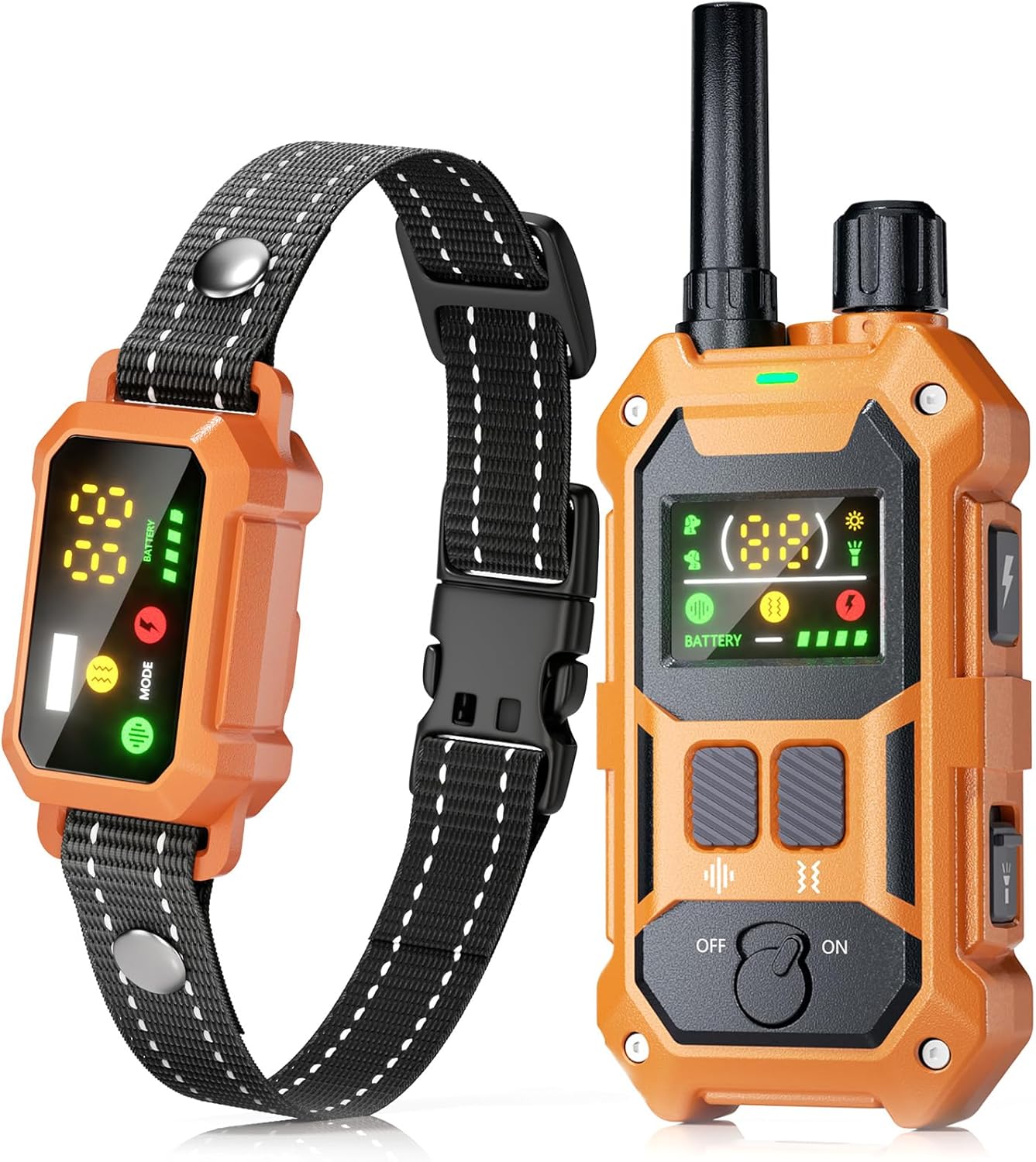
| Range | 4200 ft |
|---|---|
| Waterproof rating | IP67 |
| Training modes | Beep, Vibration, Safe Shock, Strobe Light |
| Strap fit | 8–25 inches |
The BLACKDOG OT9 is a heavy-duty e-collar built for outdoor training where weather and rough conditions matter. It pairs a handheld remote with a collar receiver that offers four modes—beep, vibration, adjustable safe shock levels, and a strobe light—so you can use non-aversive cues or graduated stimulation depending on the dog and situation. The unit emphasizes durability and water resistance with an IP67 rating and reinforced casing intended to withstand crush and bite forces, while the collar and remote both include lights for night visibility and locating a dog in low light. Practical benefits include a quoted 4200 ft range for long-distance recall work, an LCD on the remote for clear mode and battery info, removable prongs to switch to no-shock use, and USB-C fast charging with long battery life claims. Trade-offs to note are the reliance on included 9V batteries for power in some components and that the shock option may be more forceful than vibration for sensitive dogs, so careful level selection and supervised introduction are important.
Best for: Buyers who need an e-collar that continues to work reliably in wet, muddy, or stormy conditions and want long-range control for outdoor training sessions.
Less Ideal for: Owners seeking a minimal, gentle-only training tool or those who prefer a fully integrated rechargeable system without any disposable battery components should consider alternatives.
- IP67 water resistance and reinforced casing for reliable operation in rain, lakes, and muddy conditions
- Long 4200 ft signal range suitable for open areas and long-distance recall training
- Multiple modes (beep, vibration, adjustable shock) plus removable prongs for no-shock use
- Integrated flashlight on the remote and collar strobe improve night visibility and locating a dog
- LCD remote shows mode and battery level and unit supports USB-C fast charging with extended battery life
- Shock mode has many intensity levels and can be uncomfortable if set too high, requiring careful adjustment
- Some components use 9V batteries which may be less convenient than fully rechargeable systems
Verdict: The best waterproof E-Collar protects electronics and maintains reliable function in wet conditions, making it ideal for dogs that train near water or in bad weather.
Educator ME-300 Micro E-Collar
Best Compact E-Collar

| Range | 1/3 mile |
|---|---|
| Stimulation levels | 100 levels |
| Modes | Stimulation, Tone, Vibration |
| Recharge time | About 2 hours |
| Recommended neck size | 10–26 inches |
The Educator ME-300 Micro is a small, rechargeable e-collar system designed for routine training with small to medium dogs. The kit includes a compact transmitter and a low-profile receiver that fits dogs with 10–26" necks and is intended for dogs 5 pounds and up. It offers 100 incremental stimulation levels plus tone and vibration, which makes it easy to dial in a level that prompts attention without overcorrecting, and the waterproof construction means you can train in rain or near water. The roughly two-hour recharge time and included batteries keep the system ready for frequent sessions, and the one-third mile range covers most park and suburban off-leash work. Because the receiver is designed to be minimal and the strap uses biothane, it stays low-profile on smaller necks but still secures comfortably. Limitations include that the system is aimed at individual-dog use rather than multi-dog setups and that the high number of levels can require patience to find the right setting for a particular dog.
Best for: Buyers who want a lightweight, unobtrusive e-collar for regular obedience and recall work on small dogs or for owners who prioritize a low-profile fit.
Less Ideal for: Owners who need a multi-dog system or who prefer collars with integrated app connectivity and advanced tracking features should look elsewhere.
- Compact, low-profile receiver suited to small necks
- 100 adjustable stimulation levels for fine-tuned responses
- Tone and vibration modes provide non-stimulation correction options
- Waterproof transmitter and receiver for training in wet conditions
- Rechargeable system with about 2-hour charge time so sessions can resume quickly
- Designed primarily for single-dog use rather than multi-dog capability
- May require time to identify the appropriate stimulation level for each dog
Verdict: The best compact E-Collar is lightweight and low-profile while still delivering effective stimulation and a comfortable fit for active dogs that need a less bulky option.
ABBIDOT AB-T60 Shock Collar
Best Heavy-Duty E-Collar

| Range | Up to 4500 ft |
|---|---|
| Training modes | Beep, Vibration, Shock |
| Multi-dog support | Up to 6 collars |
| Receiver waterproof rating | IP67 |
| Charging | USB-C |
The ABBIDOT AB-T60 is a remote training collar that combines long-range control with a wide array of intensity options for recall and obedience work. It is typically used off-leash in yards, parks, or open fields and supports one receiver in this package with the remote able to pair up to six collars on selectable channels. The unit offers an integrated e-clicker on the remote, nine beep modes, 36 vibration levels and 118 shock levels, plus a setting lock and LCD for visible confirmation of channel and battery status. The receiver is rated IP67 for outdoor use, has a 3-mode LED for low-light visibility and an adjustable strap sized to fit most necks. USB-C charging and extended standby times reduce downtime between sessions. Trade-offs are the included batteries detail and that the remote is not waterproof, so heavy wet-field use requires caution for the handheld unit and attention to proper fit and gradual intensity adjustments for working German Shepherds.
Best for: Handlers needing a robust, long-range training tool for frequent off-leash work with active, working-line German Shepherds who want fine-grained control and multi-dog capability.
Less Ideal for: Owners who expect a fully waterproof remote for constant wet-field or swimming work or those looking for a simpler, single-mode training device.
- Long nominal remote range up to 4500 ft for off-leash recall practice
- Extensive intensity options with 9 beep, 36 vibration and 118 shock levels for fine tuning
- IP67-rated receiver and 3-mode LED aid outdoor durability and visibility
- Remote supports up to 6 collars with channel selection for multi-dog control
- USB-C charging and long standby times reduce frequent recharging interruptions
- Remote is not waterproof which limits use in heavy rain or wet environments
- Uses included 9V batteries per product details which may be less convenient than internal rechargeable cells for some users
Verdict: The best heavy-duty E-Collar is built for durability and frequent use, with robust materials and secure connections for working or highly active German Shepherds.
Choosing the Right E Collar GSD: Key Factors to Consider
Stimulation Control and Adjustability
How finely you can adjust stimulation levels directly affects both safety and training effectiveness. German shepherds have a range of sensitivity across individual dogs, so a collar that offers multiple levels and a gradual ramp helps you start low and increase only as needed.
Look for collars that include momentary (nick) and continuous modes, plus a clearly labeled dial or digital steps. Predictable, consistent output matters more than maximum power; avoid devices that jump too many levels between settings because they make fine-tuning difficult.
Range and Signal Reliability
Effective off-leash training for a GSD often requires reliable communication at distance. Range specifications are useful, but real-world reliability is influenced by terrain, vegetation, and interference. Choose an e-collar with a tested practical range that matches your training locations.
Also consider signal type and how the transmitter reports connection status. A system that maintains consistent pulses without lag or dropouts reduces the chance of missed corrections and helps you maintain clear timing during recall training.
Receiver Fit and Contact Design
A secure, comfortable fit ensures the contact points stay in place for reliable stimulation and reduces skin irritation. German shepherds have dense coats and strong necks, so adjustable strap length and multiple contact point options help achieve consistent skin contact.
Consider collars with replaceable or variable-length contacts and padding where the unit presses against the neck. Proper fit also limits movement of the receiver during activity, which improves signal consistency and reduces unnecessary stimulation from poor contact.
Battery Life and Charging Convenience
Battery performance affects how often you need to recharge between training sessions, which matters if you train frequently or take long outings. Look for receivers and transmitters with multi-day battery life under typical use and a clear indicator for remaining charge.
Fast charging and removable batteries are useful features, but durability and consistent output at lower charge levels are equally important. A collar whose output weakens significantly as the battery drains can lead to inconsistent corrections and frustrate training progress.
Durability and Water Resistance
German shepherds train in all kinds of conditions, so a rugged, water-resistant receiver and transmitter help them tolerate rain, mud, and the occasional swim. Check for solid construction, abrasion-resistant straps, and secure seals around charging ports.
Longevity of the electronics and the straps matters because replacing worn components can be disruptive. Corrosion-resistant contacts and well-sealed housings reduce the risk of failure after exposure to moisture or dirt.
User Controls and Safety Features
Clear, easy-to-use controls on the transmitter let you time corrections precisely, which is critical for effective training. Look for tactile buttons or ergonomic triggers and a display or indicator lights that confirm the selected level and mode.
Safety features such as automatic shutoff on continuous stimulation, lock modes to prevent accidental activation, and graduated stimulation options reduce the risk of overcorrection. These design elements help you manage corrections responsibly and maintain a positive training relationship.
How Strong Should Stimulation Be for a German Shepherd?
Start with the lowest effective level and observe the dog's response. Many GSDs respond to low to moderate stimulation when timing and consistency are correct, so the goal is not maximum power but precise application.
If the dog freezes, shows stress signals, or avoids you after a correction, the level is too high. Use momentary, short pulses for most training and reserve longer modes for controlled boundary or safety scenarios. Always combine corrections with clear verbal cues and reward-based reinforcement to shape the desired behavior.
- Begin at the lowest setting that elicits acknowledgment, not panic
- Prefer short, timed pulses over prolonged stimulation
- Monitor body language and adjust downward if the dog appears stressed
Will Coat Thickness Affect Collar Performance?
Yes. A dense double coat can insulate the skin from contact points, reducing stimulation effectiveness. Using longer contacts or trimming a small patch of hair where the contact points sit can improve reliability, but keep any trimming minimal and done carefully.
Select collars that offer replaceable contacts or multiple contact lengths to adapt to coat thickness. Good fit and consistent skin contact are more important than higher stimulation levels when dealing with a thick coat.
- Consider longer contacts for thick coats
- Trim hair cautiously if necessary to achieve contact
- Ensure consistent placement behind the jawline where skin contact is reliable
How to Size and Fit an E-collar for a GSD
Measure the neck circumference and choose a strap that allows for secure adjustment with room for two fingers under the strap when fitted. The receiver should sit centered under the jawline and not shift during normal movement.
Replace or trim contact points as needed and check fit before each session. Loose collars can cause inconsistent stimulation while overly tight collars may irritate the skin. Regularly inspect the strap and attachment points for wear.
- Measure neck at the point where the collar will sit
- Adjust for a snug but not tight fit; two-finger rule
- Check and replace worn straps or contacts promptly
Training Techniques That Work with E-collars
Use the e-collar as a timing tool rather than a deterrent. Pair a brief, consistent correction with a verbal cue and immediately reward the desired response. Over time the verbal cue should become sufficient with the collar used only as a backup.
Start with on-leash work to establish the association between cue and correction in a controlled setting before moving to long-range or off-leash work. Keep sessions short and focused, and avoid using the collar for emotional or repetitive corrections that do not teach a specific behavior.
- Start on-leash, progress to distance gradually
- Use short, consistent pulses timed to the cue
- Follow corrections with positive reinforcement
Maintenance and Safety Checks to Perform Regularly
Inspect the contact points and strap before each session for corrosion, fraying, or loosening. Clean contact points regularly according to manufacturer guidance to prevent buildup that reduces conductivity.
Test transmitter and receiver functions, check battery levels, and verify range in the training environment. Replace worn parts promptly and store units in a dry location to protect seals and electronics.
- Clean contacts and check for corrosion
- Verify battery charge and test range before outings
- Inspect straps and hardware for signs of wear
How We Chose the Best E Collar GSD
We selected e-collars based on criteria that matter for training medium-to-large, high-drive breeds like German shepherds. Primary evaluation factors included stimulation control and adjustability, receiver fit and contact reliability, operating range under real-world conditions, and battery life during routine training sessions. We also weighed construction quality and water resistance because GSDs are active dogs that often train in varied environments. Other important considerations were transmitter ergonomics and control precision, safety features such as lockout or graduated stimulation modes, and the ease of swapping or trimming contact points for a snug fit. We excluded products with inadequate range specs, poor waterproofing claims that lacked reliable user feedback, or transmitters that limited multi-mode control. In practice we filtered for collars designed to provide consistent, repeatable corrections at low to moderate stimulation levels, durable build suitable for frequent use, and clear user controls. Products that delivered on those dimensions and offered sensible safety features and fit options were advanced to the shortlist.
Our full evaluation process is outlined in our review methodology.
FAQ
Is an e-collar safe for German shepherds?
When used properly, an e-collar can be a safe training tool. Safety depends on correct fit, starting at low stimulation, using short pulses, and combining corrections with positive reinforcement to avoid stress or overcorrection.
How long should a training session with an e-collar last?
Keep sessions short and focused, typically 10 to 20 minutes for most dogs. Frequent, brief sessions with clear goals are more effective than long sessions that risk fatigue or confusion.
Can I use an e-collar on a long line or leash?
Yes. Starting on-leash or with a long line gives you more control over timing and position, which is important when teaching cues. It also helps ensure safety while you assess appropriate stimulation levels.
Should I trim my GSD's coat for better contact?
Trimming a small patch where the contact points sit can improve reliability for some dogs, but do it minimally and carefully. Alternatively, use longer contact probes designed to reach through thicker coats.
How often should I charge the receiver and transmitter?
Charge based on usage and the manufacturer's stated battery life, but as a rule check levels before each session and recharge if charge is below a reliable threshold. Frequent short outings benefit from checking battery indicators rather than assuming full charge.
Final Verdict
Pick an e-collar that prioritizes adjustable, predictable stimulation and a secure fit for a German shepherd. Balance range against the environments where you train and favor systems with clear controls and safety features that prevent accidental or prolonged activation. Remember that timing, consistency, and positive reinforcement remain the most important elements of training. Use the collar as a precise communication tool rather than a shortcut; when you match device features to your dog and training goals, you can correct reliably while minimizing stress and maximizing learning.

