

You want a collar that helps keep your dog safe and responsive during walks, hikes, and off-leash time. The right GPS training collar combines precise location tracking with training tools so you can locate your dog quickly and reinforce commands from a distance. This guide shortlists the top options for various uses and explains the practical tradeoffs that matter most to everyday owners. We evaluated range, battery life, training features, durability, and ease of use to assemble the best picks. Read on to find a GPS training collar dog that fits how you and your dog get out and enjoy time together.
Top Picks at a Glance
| Best Overall GPS Training Collar The best all-around GPS training collar for most dog owners | Garmin Alpha TT 25 Collar |  |
| Best Budget GPS Training Collar A low-cost GPS training collar that covers core tracking and training | NASlus GPS Dog Collar F830 |  |
| Best Premium GPS Training Collar A higher-end pick with advanced features and superior build quality | Garmin Pro 550 Plus GPS Bundle |  |
| Best Compact GPS Training Collar A smaller, lightweight collar designed for small dogs or minimal bulk | Fi Series 3+ Smart GPS Dog Collar Large |  |
| Best Heavy-Duty GPS Training Collar Built tougher for active dogs and rough outdoor conditions | SpotOn Nova GPS Dog Collar |  |
| Best Waterproof GPS Training Collar A water-resistant model that survives swims, rain, and messy play | Dogtra Pathfinder 2 GPS Tracker |  |
Garmin Alpha TT 25 Collar
Best Overall GPS Training Collar

| Included Components | Collar, rechargeable Li-ion battery pack, 1" strap, charging clip, USB-C cable, contact points |
|---|---|
| Range | Up to 9 miles (with compatible handheld) |
| Training Modes | 18 stimulation levels, tone, vibration |
| Battery Life | Up to 68 hours (standard) or 136 hours (expanded) with dynamic tracking |
| LED | Multicolor identification light |
The Alpha TT 25 combines precise GPS tracking with a full-featured training collar in a rugged, slim package. Paired with a compatible Garmin handheld (sold separately), it provides tracking and training commands up to 9 miles with update rates as frequent as 2.5 seconds, which makes it useful for packs working over varied terrain. The collar includes 18 stimulation levels in both momentary and continuous modes plus tone and vibration, so handlers can tailor corrections during fieldwork. A bright multicolor LED helps identify dogs at night and the user-replaceable flex band and battery pack simplify maintenance in the field. Dynamic tracking extends runtime by adjusting update rates to a dog's movement, and Wi‑Fi charging enables automatic software updates. Trade-offs are that the collar requires a compatible Garmin handheld to use tracking and command features, and the advanced capabilities add complexity that may be unnecessary for casual pet owners.
Best for: Owners who need reliable, long-range GPS tracking and a full-featured training collar for working, hunting, or active dogs and who are comfortable pairing the collar with a compatible handheld.
Less Ideal for: Casual pet owners who want a simple, plug-and-play GPS tag without a separate handheld or those unwilling to learn multi-feature systems.
- Accurate long-range tracking up to 9 miles when paired with a compatible handheld
- 18 levels of momentary and continuous stimulation plus tone and vibration for flexible training
- User-replaceable battery and optional expanded pack for up to 136 hours with dynamic tracking
- Built-in multicolor LED for easy dog identification in low light
- Rugged yet slim housing with user-replaceable flex band for field durability and fit
- Requires a compatible Garmin handheld to access tracking and training commands
- Advanced features add complexity for owners who only need basic tracking
Verdict: The best all-around GPS training collar that balances tracking accuracy, training features, comfort, and dependable battery life for everyday use with most dogs.
NASlus GPS Dog Collar F830
Best Budget GPS Training Collar
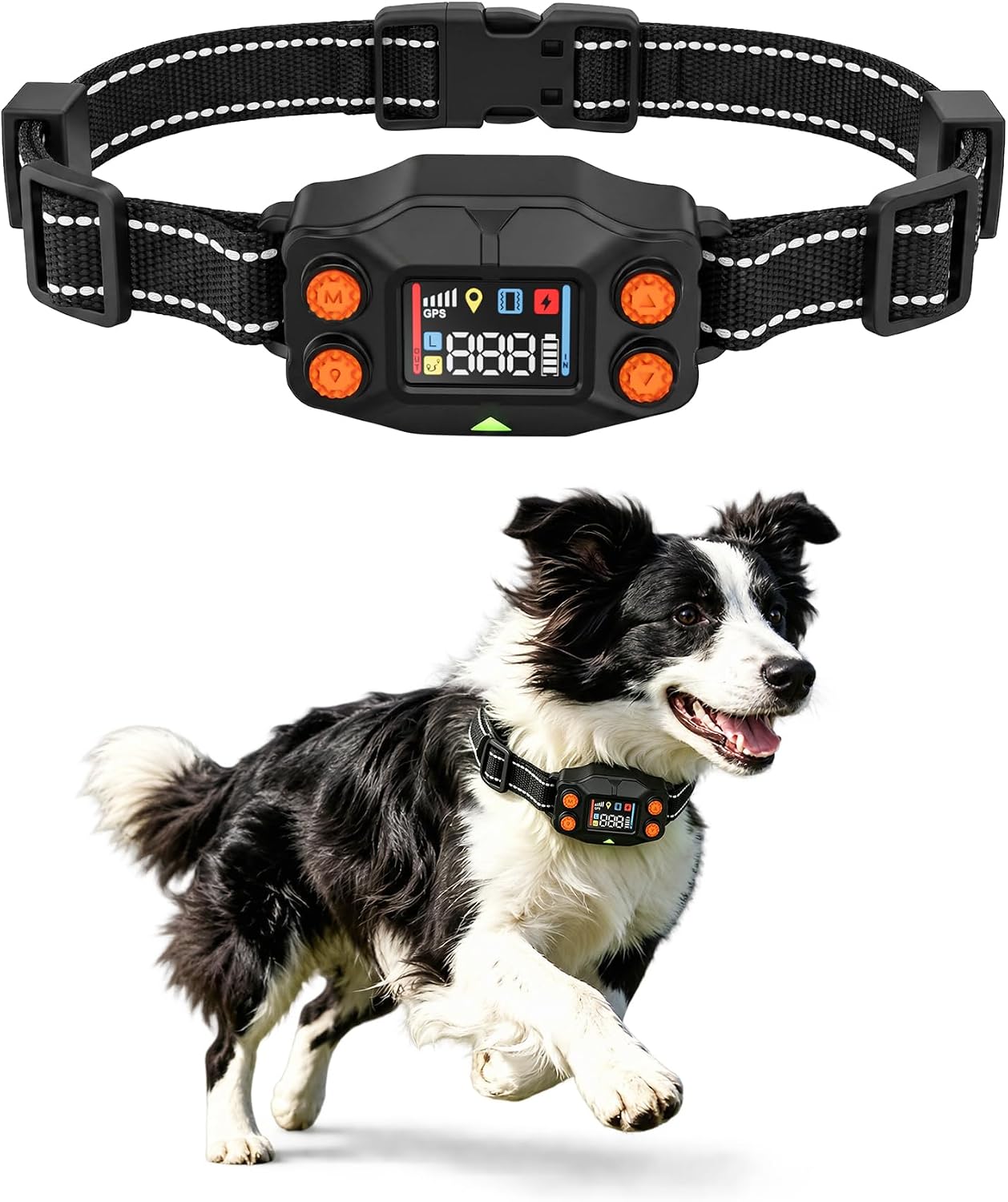
| Model | F830 |
|---|---|
| Boundary radius | 25-999 yards |
| Waterproof rating | IPX7 |
| Power | Rechargeable battery (included) |
| Suitable dog size | Over 15 lb |
The NASlus F830 GPS dog collar is a portable, no-base-station containment solution that uses multi-constellation satellite positioning to create an adjustable circular geofence from 25 to 999 yards. You set the radius with onboard controls, fit the adjustable strap to a dog over 15 pounds, and the collar monitors position and delivers progressive beep, vibration, then static correction as the dog nears or crosses the boundary. It is rechargeable and IPX7 rated, so it holds up to wet conditions and saves your boundary setting after power-off, which is handy for travel or temporary setups. Because it relies on GNSS signals, it works best in open outdoor spaces and can be less reliable in dense trees, near tall buildings, or indoors. The lack of an app or base unit keeps setup simple and truly portable, but it also means you do not get map-based controls or multi-collar coordination features. For owners wanting a lightweight, cable-free way to contain a single dog in open areas, this collar is a practical, easy-to-use option.
Best for: Owners who need a lightweight, truly portable containment option for travel, camping, temporary boundaries, or small open yards and prefer a simple, standalone device over app-based systems.
Less Ideal for: People who need indoor containment, precise map-based boundary control, coordinated multi-dog setups, or who have heavy tree cover or urban signal interference at their property.
- True GPS/GNSS geofence with adjustable radius from 25 to 999 yards for flexible outdoor boundaries
- Progressive feedback sequence (beep, vibration, static) supports stepwise boundary training
- Rechargeable battery and memory function that retains boundary settings after power-off
- IPX7 waterproofing suitable for wet outdoor conditions and active play
- No base station, app, Wi-Fi, or subscription required, making it highly portable
- Satellite signal dependence reduces accuracy in dense vegetation, near tall structures, and indoors
- Single-collar setup lacks centralized map controls or multi-collar coordination features
- Not intended for dogs under 15 pounds
Verdict: The best budget GPS training collar for owners who need reliable location tracking and basic training functions at a lower price without premium extras.
Garmin Pro 550 Plus GPS Bundle
Best Premium GPS Training Collar

| Screen Size | 2.5 inches |
|---|---|
| Supported Satellite Navigation System | GLONASS, GPS |
| Multi-Dog Training | Up to 3 dogs |
| Training Levels | 18 levels continuous & momentary |
| Battery Life | Up to 24 hours |
The Garmin Pro 550 Plus bundle pairs a rugged handheld GPS navigator with an Alpha TT25 dog collar to deliver both tracking and training in one package. The handheld is built for one-handed operation and shows directional tracking on a 2.5-inch LCD with GPS and GLONASS reception and a 2.5-second update rate, giving reliable position updates across varied terrain. It supports training up to three dogs with 18 levels of continuous and momentary stimulation plus tone and vibration, and an intuitive dial and switch let you change settings quickly while working in the field. The unit is made for long days outdoors with a rechargeable battery rated up to 24 hours and USB charging options including a car adapter. It also integrates with Garmin wearables, navigators, and the Alpha app for expanded situational awareness and post-session review. The main compromises are the premium price and the focused feature set geared to hunting and professional training rather than casual pet play or basic pet-finder use.
Best for: Experienced handlers and serious hunters who prioritize precise, durable GPS tracking and advanced multi-dog training features and are willing to invest in a premium system.
Less Ideal for: Casual pet owners seeking a simple pet-finder or budget-friendly shock collar should consider simpler, lower-cost alternatives.
- Combined handheld GPS and training collar in one bundle for immediate use
- Dual-satellite reception (GPS + GLONASS) with 2.5-second updates for accurate tracking
- Supports training up to three dogs with 18 stimulation levels plus tone and vibration
- Rugged, one-handed design with up to 24 hours of battery life and USB/car charging options
- Integrates with Garmin wearables, navigators, and the Alpha app for expanded tracking and review
- Premium cost reflects professional-grade features and materials
- Designed for hunting/training use so some consumer-focused conveniences may be absent
Verdict: The best premium GPS training collar for owners willing to pay more for extra accuracy, advanced training modes, rugged materials, and longer-term reliability.
Fi Series 3+ Smart GPS Dog Collar Large
Best Compact GPS Training Collar

| Connectivity Technology | Cellular |
|---|---|
| Battery Capacity | 285 milliamp_hours |
| Supported Application | Fi app |
| Additional Features | Geo-Fence, Real Time Tracking, Rechargeable, Water Resistant |
The Fi Series 3+ is a GPS dog collar designed for everyday off-leash monitoring and activity tracking. It uses cellular connectivity and GPS to show live location in the Fi app, supports virtual fences with instant escape alerts, and includes a Lost Mode for rapid, high-frequency updates when a dog is missing. Beyond location it records activity and health signals like steps, sleeping, scratching, licking, eating and drinking so you can share data with your vet. The collar is built for durability with a stainless steel frame, IP68/66K water resistance, a built-in LED for night visibility, and a wireless charging base that claims up to three months of battery life on typical use. A Fi membership is required for GPS/LTE service, which provides nationwide coverage and shared access for family or caregivers. The main compromises are the subscription requirement for live tracking and that advanced features depend on the companion app and cellular coverage, so performance varies with your local network and membership plan.
Best for: Buyers who prioritize reliable, always-on location tracking, extended battery life, and built-in health monitoring for an off-leash dog that spends time outdoors.
Less Ideal for: Owners who want a completely subscription-free tracker or who live in areas with poor cellular coverage should consider alternatives.
- Real-time GPS plus LTE cellular connectivity for live location beyond Bluetooth range
- Long battery life up to three months per charge with included wireless charging base
- Comprehensive activity and health monitoring that logs steps, sleep, scratching and more
- Durable, water-resistant stainless steel construction with built-in LED for night visibility
- Virtual fence and Lost Mode provide prompt escape alerts and rapid tracking during a loss
- Requires a Fi membership subscription for GPS/LTE tracking and unlimited data
- Location accuracy and update frequency depend on cellular coverage and regional network performance
Verdict: The best compact GPS training collar for owners of smaller dogs or anyone who prefers a lightweight, low-profile unit that doesn't impede movement.
SpotOn Nova GPS Dog Collar
Best Heavy-Duty GPS Training Collar

| Fits neck size | 10"–26" |
|---|---|
| Battery | 1 Nonstandard Battery (included) |
| Intended use | Outdoor |
| Model name | Nova Edition |
The SpotOn Nova GPS Dog Collar is a premium app-connected containment and tracking collar designed for owners who want high-precision geofencing and real-time visibility. You set unlimited virtual fences and keep-out zones in the app, then monitor containment activity and your dog's position from your phone while the collar enforces boundary cues. The device uses dual-band, dual-feed GPS to maintain stable location fixes in wooded or uneven terrain, and SpotOn highlights strong signal performance for consistent cue timing. The package includes a charging puck, spare contact points, and tools to get started, and certified trainer support is available through the service for behavior setup and troubleshooting. Trade-offs are that this is a higher-end solution intended for dedicated containment and tracking needs rather than a basic locator, and effective use assumes owners will follow the safety and training guidance provided in the manual.
Best for: Owners who prioritize top-tier GPS accuracy and advanced geofencing controls and are willing to invest in a durable, trainer-supported containment system.
Less Ideal for: Casual users who only need a simple location tracker or buyers who prefer a lower-cost, no-app collar solution.
- High GPS accuracy using dual-band, dual-feed technology for precise boundary location
- App-controlled unlimited fences and configurable keep-out zones for flexible containment
- Designed to perform in dense trees and challenging terrain for consistent cue timing
- Includes charger, contact points, tester, and quick start accessories out of the box
- Access to certified one-on-one trainer support and real-time app monitoring
- Premium feature set and training support make it more expensive than basic GPS trackers
- Requires owner commitment to training and following safety directions for best results
Verdict: The best heavy-duty GPS training collar for active dogs and outdoor owners who need extra durability, impact resistance, and rugged construction.
Dogtra Pathfinder 2 GPS Tracker
Best Waterproof GPS Training Collar

| Range | Up to 9-Miles |
|---|---|
| Waterproof | IPX9K |
| Dog Weight | For Dogs 35-100 lbs+ |
| App Compatibility | Smartphone, Smartwatch |
| Map Features | Offline, Satellite, Terrain |
The Dogtra Pathfinder 2 combines real-time GPS tracking with e-collar training functions aimed at handlers who work in large, rural, or off-grid areas. It pairs a GPS receiver collar with the Pathfinder2 app (and an optional GPS Connector accessory) to deliver 2-second refresh rates, offline maps, compass guidance, and smartwatch compatibility so you can monitor dogs across long distances. The system includes tone, vibration, nick and constant stimulation modes plus an LED locate light and pager vibration for locating dogs at night or in thick cover. It is waterproof to IPX9K and supports tracking up to 9 miles, with no monthly subscription required. Practical limitations include the need for the GPS Connector and a compatible smartphone or smartwatch to access certain functions, and the e-collar corrections require careful setup and training to use humanely and effectively. Battery life varies with update rate and features like the LED light and frequent polling will drain power faster than conservative settings.
Best for: Owners who need dependable, long-range location updates and integrated training controls for dogs that work or roam far from home, especially in rural or off-grid environments.
Less Ideal for: People who want a simple passive tracker without app dependence or those who are uncomfortable using remote correction features should consider simpler GPS-only collars.
- Real-time tracking with fast 2-second refresh for accurate location updates.
- Long range capability up to 9 miles for large properties and rural use.
- No subscription or monthly fees and free offline maps via the app.
- Integrated e-collar functions (tone, vibration, nick, constant) and LED locate light for training and locating.
- Smartwatch compatibility and compass view add convenient remote monitoring on the trail.
- Requires Pathfinder2 GPS Connector and a compatible smartphone or smartwatch for full functionality.
- E-collar corrections need proper training and may be inappropriate for inexperienced users.
Verdict: The best waterproof GPS training collar for owners who want dependable tracking and training performance in wet conditions, from rainy walks to water play.
Choosing the Right GPS Training Collar Dog: Key Factors to Consider
Gps Accuracy and Update Rate
Gps precision determines how reliably you can locate a dog at distance. A system that offers frequent position updates and uses robust satellite fixes will give more useful location data during active tracking.
Faster update rates help when a dog is moving quickly because they reduce the lag between the collar's real-world position and what you see on the map. In close quarters, minor errors matter less, but in wide-open areas or near hazards, tighter accuracy can be the difference between a quick recovery and a stressful search.
Training Features and Control Options
Different collars use tone, vibration, or static stimulation to communicate with a dog. Look for units that provide multiple stimulus types and fine-grain intensity settings so you can match the correction to your dog's temperament.
Control method matters too: physical remotes offer tactile feedback and immediate response without relying on a phone, while app-based controls can integrate maps and telemetry. Consider which interface you prefer and whether the collar supports both for redundancy.
Battery Life and Charging Convenience
Battery runtime dictates how long you can track and train away from a charger. Longer life reduces the chance of being caught with a dead collar during extended outings. Also evaluate real-world battery figures that account for both tracking frequency and training usage, not just idle claims.
Fast charging or swappable batteries add flexibility for multi-day trips. Pay attention to how the manufacturer reports runtimes—continuous gps tracking and repeated training signals drain batteries faster than standby ratings suggest.
Range and Connectivity Reliability
Range affects how far you can reliably command or track your dog. For many owners, a few hundred meters is sufficient; for hunting or wide-open properties, longer ranges are preferable. Note that line-of-sight range is often higher than what you will get in forested or urban areas.
Connectivity technology and antenna placement influence real-world performance. Some systems maintain better signal through obstacles, while others require clearer paths. Consistent connection is essential for safety and predictable training outcomes.
Durability and Weather Resistance
Collars used outdoors must resist water, mud, and knocks. Look for solid housings, sealed buttons or ports, and materials that tolerate rubbing against brush or rough terrain.
Waterproof ratings and impact resistance can indicate longevity. A more durable collar reduces the likelihood of failures in critical moments and avoids frustrating field repairs or replacements.
Fit, Comfort, and Size Options
A collar needs to sit comfortably and securely on your dog without chafing or slipping. Adjustable sizing, low-profile modules, and soft contact surfaces improve wearability for everyday use.
Poor fit can reduce gps accuracy if the antenna is obstructed and can make training signals less effective if contacts do not maintain consistent skin contact. Choose a design that suits your dog's neck shape and activity level.
How Do Gps Tracking and Training Features Work Together in Practice?
Gps tracking gives you a location fix while training features let you reinforce commands at distance. When paired well, they let you keep visual contact, intervene remotely, and confirm a dog's location on a map while delivering an appropriate cue to prompt return.
In use, coordinate tracking updates with deliberate training signals. For example, use a tone or vibration when you see the dog on the map moving away unexpectedly, then follow up with a corrective cue if the dog does not respond. Reliable updates and immediate control reduce time spent searching and help teach consistent boundaries.
- Use low-intensity cues first to avoid overcorrection.
- Check gps position before escalating a response.
- Combine voice commands with device cues for clearer messaging.
What Range Should I Expect for Different Environments?
Manufacturers often quote best-case ranges achieved in open line-of-sight. In forests, hills, or built-up areas, expect shorter practical ranges. If you frequently use a collar in dense terrain, prioritize models known for robust connectivity or longer nominal range.
For everyday urban walks, moderate range is usually sufficient. For rural properties, search areas, or hunting situations, look for longer-range solutions and pay attention to real-world range reports and antenna design.
- Open fields: near-maximum quoted range likely.
- Wooded or hilly areas: range reduced, plan for closer control.
- Urban environments: signal blocked by buildings, test before reliance.
How to Balance Battery Life and Tracking Frequency
Longer tracking intervals conserve battery but provide less timely location updates. Higher-frequency tracking gives better situational awareness but shortens runtime. Decide which is more important for your routine: constant monitoring on hikes or multi-day battery life for long trips.
If you need frequent position updates, look for collars with larger batteries or power-saving modes that throttle the gps when stationary. Also consider charging options, such as fast-charge capability or replaceable batteries, to match your outing patterns.
- Increase update interval to extend runtime.
- Reserve high-frequency tracking for active search windows.
- Carry a portable charger when planning long outings.
Setting Up and Training with a Gps Training Collar
Initial setup typically includes fitting the collar, pairing it with a remote or app, and introducing your dog to the stimulation types at low intensity. Take time to condition the dog to the cues with positive reinforcement so the collar becomes a communication tool rather than a surprise.
Start with the gentlest effective cue and practice recall and boundary exercises in a controlled area. Gradually increase range and distractions as the dog demonstrates consistent responses. Frequent short sessions produce better learning than occasional, long corrections.
- Fit the collar snugly but not tight; check contact points regularly.
- Begin training in a fenced or contained area before open use.
- Combine device signals with voice and treat rewards for clarity.
Maintenance and Troubleshooting Tips
Regularly inspect the collar for worn straps, loose contacts, and damaged housings. Keep charging ports and contacts clean and dry to avoid intermittent connections. Replace worn parts like straps to maintain fit and function.
If you experience inconsistent tracking or intermittent controls, verify the collar is fully charged, confirm firmware or app updates, and re-pair devices if necessary. Test the system in a known area before using it on critical outings to ensure the connection and updates behave as expected.
- Wipe contacts and charging ports after wet use.
- Check for firmware updates and follow manufacturer instructions.
- Test range and response in a safe area after any major changes.
How We Chose the Best GPS Training Collar Dog
We narrowed the field with filters specific to gps training collars and the needs of active dog owners. First, we prioritized precise location tracking and the reliability of the positioning method, since accurate GPS fixes determine whether a collar is useful off leash. Second, we evaluated training feature sets that matter in real situations: types of stimuli, adjustable intensity or tone, and how intuitively the remote or app delivers corrections. Third, battery life under realistic use and estimated charge times were included because short runtimes reduce the collar's usefulness on long outings. Fourth, we considered durability and weather resistance, focusing on collars that withstand wet, muddy, and rough-terrain use. Fifth, we looked at range and connectivity performance in open and obstructed environments. Finally, we assessed ergonomics and ease of setup, including mounting, size adjustments, and app or remote usability. We excluded products that focus solely on tracking without integrated training controls or collars that require proprietary subscription services without transparent terms. Entries that lacked basic safety features, such as adjustable stimulation or fail-safe modes, were not considered. Our selection emphasizes practical performance dimensions: gps accuracy, training versatility, battery endurance, durability, and user experience.
Our full evaluation process is outlined in our review methodology.
FAQ
Can a gps training collar work without cell service?
Many gps training collars rely on direct radio links between the remote and the collar, which do not need cell service. Some models use smartphone apps with cloud features that require a data connection for map overlays or remote access, so capability without cell service depends on the system architecture.
How do I choose the right stimulation level for my dog?
Start at the lowest setting and observe your dog's response. Increase gradually only if the dog does not acknowledge the cue. The goal is communication, not punishment, so use the minimal effective intensity combined with voice and rewards to reinforce desired behavior.
Are these collars safe for everyday use?
When fitted correctly and used as a training aid, gps training collars can be safe for routine use. Follow manufacturer guidance on session length and intensity, check fit to avoid chafing, and use positive training methods alongside device cues to support the dog's wellbeing.
How often should I charge the collar?
Charging frequency depends on tracking settings and training use. With moderate daily use, many collars need charging every few days, while heavy use or continuous tracking may require daily charging. Monitor battery indicators and charge before long outings.
Will the collar stay on during rough activity?
A secure fit and appropriate strap material are the main factors keeping a collar on during vigorous activity. Choose a collar with adjustable, durable straps and check fit routinely. For extra security, some owners use secondary fastening methods designed for safety during high-activity sessions.
Final Verdict
Prioritize the features that match how you use your dog in the real world. If you need long-range reliability, focus on systems with strong connectivity and proven range. If daily training and multiple short sessions matter most, choose a collar with versatile stimulus options and comfortable fit. Tradeoffs are inevitable: longer battery life may mean less frequent position updates, and compact units may offer fewer training intensity steps. Decide which compromises you can accept and pick the option that balances gps accuracy, battery endurance, training controls, and durability to suit your routines and your dog's temperament.

