

Getting the right lead for puppy training changes everyday walks from a tugging struggle into a manageable learning session. A lead designed for puppies helps you teach loose-leash walking, reliable recalls, and polite greeting behavior while protecting a developing neck and throat. This guide shortlists the top leads suited to puppy training, focusing on fit, handling, durability, and materials. Use the picks below alongside consistent training and positive reinforcement to make early outings safer and more productive.
Top Picks at a Glance
| Best Overall Lead for Puppy Training A versatile, reliable lead ideal for beginner puppy training sessions | Hi Kiss Long Training Leash 30ft |  |
| Best Budget Lead for Puppy Training An affordable lead that still works well for basic training needs | PetSafe Nylon Dog Leash 3/8 x 6 ft |  |
| Best Premium Lead Higher-end materials and features for owners seeking long-term performance | Mendota Pet Slip Leash 3/8 x 6 ft |  |
| Best Hands-Free Lead Wearable or waist-attach designs that free your hands while walking | iYoShop Hands Free Dog Leash Large |  |
| Best Short Lead A compact-length lead for tight control in crowded spaces | SEPXUFORE 3 FT Slip Lead |  |
| Best Reflective Lead Built-in reflective elements for improved visibility in low light | KEITTPEET Slip Lead SL01 5FT |  |
Hi Kiss Long Training Leash 30ft
Best Overall Lead for Puppy Training

| Length | 30 Feet |
|---|---|
| Material Type | Nylon |
| Closure Type | Snap |
| Dog Breed Size | Medium |
This 30-foot Hi Kiss training leash is a simple, no-frills tool for recall practice, field work, and letting a dog roam while retaining control. Made from nylon with reinforced stitching and a nickel-plated swivel bolt snap, it resists twisting and stands up to regular outdoor use like hiking, beach play, and backyard training. The thin 3/4-inch webbing keeps the leash lightweight and easy to coil, and the 30-foot length gives plenty of room for graduated distance training without fully abandoning control. Because it is an inexpensive leash, construction is basic: the clip and stitching are serviceable but not heavyweight hardware, so very large, powerful dogs that pull hard may wear it faster than premium options. The leash is best used for supervised training sessions where you can monitor wear and avoid rough surfaces that abrade webbing. For owners who want a long, affordable training line for recalls and off-leash practice, this delivers the essentials without extras like handles, line locks, or padded grips.
Best for: Practical owners on a tight budget who need a long, reliable line for recall and distance training sessions and prefer a simple, lightweight tool over premium extras.
Less Ideal for: Owners seeking heavy-duty, long-term gear for very large strong dogs or those who want extra comfort and control features like padded handles or locking mechanisms.
- Generous 30-foot length suitable for recall and distance training
- Lightweight 3/4-inch nylon webbing that is easy to handle and coil
- Reinforced stitching for improved durability over basic ties
- Nickel-plated swivel bolt snap helps prevent twisting during use
- Basic hardware and thin webbing may wear faster with very strong, heavy pullers
- No padded handle, line lock, or additional features for advanced training
Verdict: The best overall lead for puppy training balances control, gentle handling, appropriate length, and durable construction to support learning and safe walks.
PetSafe Nylon Dog Leash 3/8 x 6 ft
Best Budget Lead for Puppy Training

| Material Type | Nylon |
|---|---|
| Closure Type | Snap |
| Dog Breed Size | Small |
| Unit Count | 1 Count |
The PetSafe Nylon Dog Leash is a straightforward, no-frills leash designed for daily walking and basic training work. Made from soft, flexible nylon with a nickel-plated zinc alloy bolt snap, it connects easily to collars or harnesses and holds up to routine use without adding weight or bulk. Its availability in several lengths and widths makes it easy to pick a size suited to small dogs or for closer control during training sessions. The leash's thin profile and lightweight feel help reduce hand fatigue during short walks, though heavier pullers will find it lacks the padding and reinforced hardware of premium options. Stitching and the clasp are adequate for regular use but should be inspected frequently if your dog pulls or chews. For owners focused on basic leash manners and on-leash obedience drills, this leash is a dependable, inexpensive tool that does the job without extra features.
Best for: Budget-conscious owners who need a reliable, no-frills leash for everyday walks and basic on-leash training, especially for small to medium dogs.
Less Ideal for: Owners training very strong pullers, working dogs, or anyone who wants a padded, shock-absorbing, or heavy-duty leash.
- Lightweight, low-bulk nylon construction comfortable to carry and use
- Available in multiple lengths and widths to match dog size and training needs
- Simple bolt snap hook for easy on/off attachment
- Durable nickel-plated zinc alloy clasp resists corrosion for everyday use
- Thin width offers limited shock absorption for strong pullers
- Minimal padding or ergonomic handle for extended walks
- Not designed for heavy-duty or working-dog use where reinforced hardware is needed
Verdict: The best budget lead for puppy training gives owners a low-cost, dependable option with adequate control and reasonable durability for everyday practice.
Mendota Pet Slip Leash 3/8 x 6 ft
Best Premium Lead
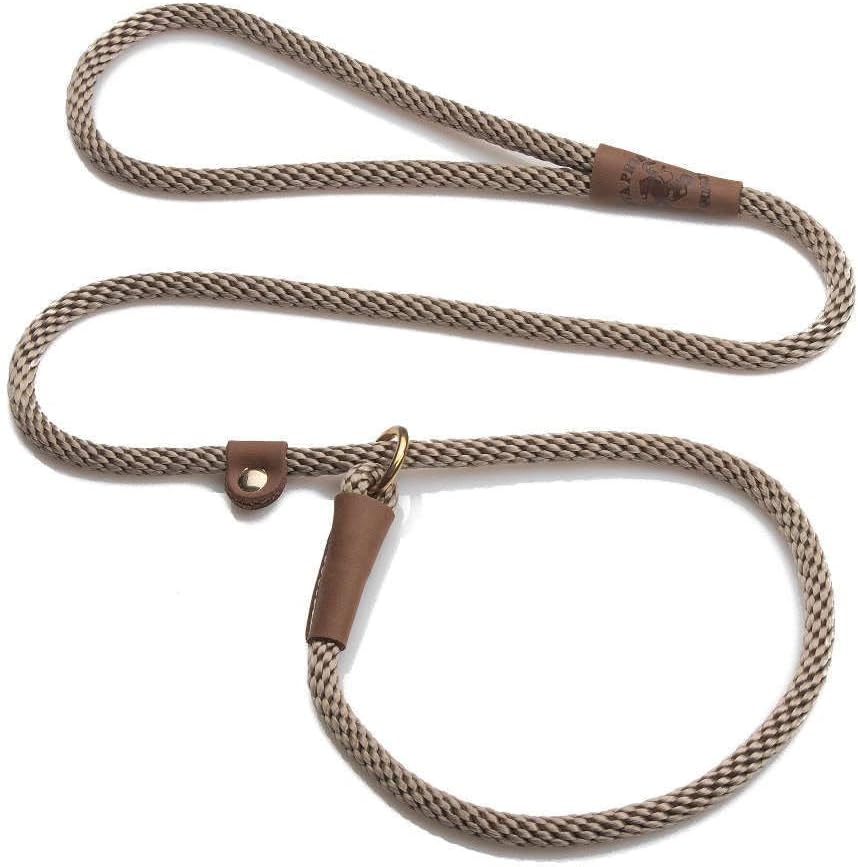
| Size | 3/8 in x 6 ft |
|---|---|
| Material Type | Polypropylene |
| Included Components | Slip Lead |
| Closure Type | Buckle |
The Mendota Pet Slip Leash is a classic combination leash and collar designed for training and everyday walks. You place the adjustable loop over the dog's head and use the handle end as the leash, which provides quick corrective control without separate collar hardware. Its multi-filament polypropylene rope is waterproof and colorfast, and the oil-tanned leather slide helps keep the loop from slipping off during use. Handcrafted brass hardware and leather splices give it a durable, traditional feel and the rope is soft on hands straight out of the package. Practical benefits include compactness for trainers who need a simple, one-piece tool and easy adjustments for different neck sizes. Limitations are that it is a slip-style tool, so it requires proper fitting and handling technique to be safe and effective, and it is sized for smaller breeds up to around 50 lb so it will not suit large, strong dogs that need heavier-duty stopping power.
Best for: Buyers who want a simple, trainer-favored slip leash that offers quick corrections, compact carry, and a durable handmade build for routine walks and training with small to medium dogs.
Less Ideal for: Those who need a non-slip buckle collar solution or a heavy-duty leash for large, powerful dogs should choose a different style built for higher stopping force.
- Leash and collar in one simplifies handling and speeds up training corrections.
- Waterproof, colorfast polypropylene rope resists weather and stays pliable.
- Brass hardware and oil-tanned leather splices increase durability and give a traditional look.
- Soft, broken-in feel is comfortable in the hands from first use.
- Slip design requires correct fitting and handler skill to avoid causing discomfort.
- Sized and rated for small to medium dogs, not intended for large, strong breeds.
Verdict: The best premium lead offers superior materials, smoother hardware, and refined construction for owners who want long-lasting comfort and control on walks and training.
iYoShop Hands Free Dog Leash Large
Best Hands-Free Lead

| Length of Waist Belt | 27" (Min) – 48" (Max) |
|---|---|
| Length of Leash | 51" (Min) – 68" (Max) |
| Size | Large |
| Material Type | Nylon |
This hands-free leash turns your standard walk or run into a truly hands-off experience by fastening to an adjustable waist belt and using bungee shock-absorbers to smooth out pulls. It is typically used for jogging, hiking, or errands when you want your hands free but still need quick access to control via the dual padded handles and traffic handle near the clip. The leash includes a removable zipper pouch that holds a phone, keys, or poop bags, and a heavy-duty 2 inch clip plus double D-rings that help distribute force for more durable attachment. Practical benefits include reduced tugging thanks to the dual shock absorbers, instant close control from the secondary handles, and a waist belt that slides so the dog can run on either side. Limitations are that the Large model is aimed at medium to large dogs and uses a single-width nylon strap that may feel less cushioned than padded specialty belts on long runs, and some users may prefer a quick-locking reel-style leash for very reactive dogs.
Best for: Active owners who want to run, hike, or do errands hands-free while keeping reliable, quick control of a medium to large dog without juggling pockets or bags.
Less Ideal for: People who need a heavily padded running belt for long-distance runs or owners of very small dogs who require a lighter, narrower leash solution.
- Hands-free waist belt frees your hands for jogging or carrying items
- Dual bungee shock-absorbers reduce jarring tugs during runs
- Two padded handles plus a traffic handle give immediate control when needed
- Removable zipper pouch stores phone, keys, treats, or poop bags
- Heavy-duty 2 inch clip and double D-rings for secure attachment
- Waist belt is not heavily padded, which may be less comfortable on long runs
- Large size is targeted for medium to large dogs and may be bulky for small breeds
Verdict: The best hands-free lead secures to your body to let you move hands-free while retaining good control and keeping the puppy close during training.
SEPXUFORE 3 FT Slip Lead
Best Short Lead

| Material Type | Nylon |
|---|---|
| Item Length | 36 inches |
| Closure Type | Pull-On |
| Size | 1/2" x 3ft |
This 3 ft slip lead pairs a short fixed-length leash with an adjustable slip loop so you get leash and collar in one tool for training and tight-control walking. Made from dense nylon rope, it feels soft in the hand while remaining sturdy for medium and large breeds, and the half-inch width provides a secure grip without being bulky. The short 3-foot length keeps dogs close for heel work, traffic control, and crowded areas where you need quick corrections or rapid recall. Setup is simple: slip the loop over the neck and use the handle end as the leash, making it fast to put on and remove between training reps. Its main limitations are that slip leads require responsible handling to avoid over-tightening and they are less comfortable for free-roaming walks where more length is preferred. There is no padding on the loop and the product is not chew-proof, so supervision and proper technique are necessary. For handlers who want a compact, effective training lead, this is a practical and durable option.
Best for: Handlers and trainers who need tighter, immediate control during obedience sessions, street walks, or crowded situations and who use correction-based cues responsibly.
Less Ideal for: Owners who prefer long recreational walks, hands-off roaming, or who have dogs that chew gear or react poorly to slip pressure should consider other leash types.
- Short 3 ft length gives close control for heel work and crowded environments
- Integrated slip loop combines collar and leash for fast on/off during training
- Dense nylon rope construction feels comfortable in hand while being durable
- Half-inch width offers a secure grip without excess bulk
- Slip lead design can cause neck tightening if not used with proper technique
- No padding on the loop for added collar comfort during prolonged wear
- Not chew-resistant, so unsuitable for dogs that mouth or bite leashes
Verdict: The best short lead is for owners needing maximum control and proximity during training, vet visits, or busy sidewalks where close handling matters most.
KEITTPEET Slip Lead SL01 5FT
Best Reflective Lead

| Length | 5 feet |
|---|---|
| Material Type | Leather, Metal, Nylon |
| Closure Type | Pull-On |
| Style | Solid |
This slip lead combines a slip-collar and leash in one simple tool for walking and training dogs that pull. It tightens when the dog pulls and releases when the behavior is corrected, giving clear, immediate feedback during heel work, recall practice, and everyday walks. The rope is heavy duty nylon with reinforced leather-wrapped connection points and a sliding metal ring plus a safety limit buckle so you can set how far the loop closes to avoid over-tightening. A soft padded foam handle reduces rope friction on your hand for longer walks, and the stopper keeps the loop from sliding too far. The construction is built for strong pullers, but because it is a slip lead you must use it with correct fitting and handling to avoid throat discomfort; leave room for two fingers and position the loop high behind the jaw as directed. The design is compact and easy to slip over the head, making it convenient for training sessions and quick outings, though some owners may prefer a harness for sustained heavy pulling. For low-light walks the reflective rope improves visibility while maintaining a rugged, trainer-friendly feel.
Best for: Owners who walk dogs that pull in low light and want a single-piece training lead that improves visibility and gives quick, clear corrections while remaining easy to put on and use.
Less Ideal for: Owners who need hands-free control or have dogs that pull continuously and require redirecting pressure via a harness or no-pull system.
- Integrated slip-collar and leash provides immediate correction and simple on/off use
- Heavy duty nylon rope with reinforced leather stitching at connection points for durability
- Padded foam handle reduces rope friction and improves comfort on long walks
- Safety limit buckle and sliding metal ring let you control how tightly the loop closes
- Reflective construction improves visibility for low-light walking
- Slip lead design can stress the throat if fitted or used incorrectly
- Not a long-term solution for dogs that require constant heavy pulling management like a front-clip harness
Verdict: The best reflective lead increases nighttime visibility with reflective stitching or materials so walks and training sessions are safer in dim conditions.
Choosing the Right Lead Puppy Training: Key Factors to Consider
Size and Adjustability
A proper fit is essential for a puppy lead because pups grow quickly and have different proportions than adult dogs. Adjustable leads let you shorten or lengthen the effective leash for different training drills, from close-heel practice to longer recall work. Multiple attachment points or sliding features increase versatility, allowing the same lead to be used as a short training tether or a longer walking lead. If a lead is too loose it can allow the puppy to slip free or develop bad habits; if it is too tight it can cause rubbing and discomfort. Adjustable hardware should be easy to operate with one hand and secure when clipped, so you can make quick changes during a session without interrupting training flow. Consider leads with clear length markings or multiple attachment rings to simplify repeated adjustments as your puppy grows.
Control and Handling
How a lead transmits force to the handler influences training outcomes. A lead that gives predictable, proportionate feedback helps puppies learn which behaviors stop undesirable pulling and which are rewarded. For gentle correction techniques, look for leads that allow quick, subtle cues rather than abrupt jerks. Handle placement and grip design matter because you will be holding the lead frequently during early leash training; padded or ergonomic handles reduce hand fatigue and improve control. A lead that resists twisting and tangling keeps control consistent during distractions or excited movements. Finally, consider whether the lead facilitates common training drills such as loose-leash walking, front-clip cueing, or short recalls.
Material and Comfort
Material choice affects durability, grip, and puppy comfort. Soft webbing or braided materials reduce chafing across a puppy's neck and chest during corrections or pulls. Lightweight materials are important so the lead does not weigh down the puppy or create imbalance, especially for very small breeds. Breathable, quick-drying fabrics handle wet-weather outings and are easier to clean after messy play. Stitching quality and edge finishing determine whether a lead will fray or rub sensitive skin. Non-abrasive materials also make it safer to use harness conversions or front-clip attachments without causing hair loss or irritation.
Hardware and Fastenings
The clips and rings on a puppy lead must be secure yet easy to operate, even when you are handling a squirming puppy. Corrosion-resistant metals and strong stitching keep attachment points reliable over time. Snap hooks that open widely reduce the chance of fumbling when hooking to a collar or harness, and locking mechanisms add reassurance during high-energy moments. Rings should be positioned so they do not press into the puppy's body or interfere with training cues. Pay attention to the transition points where hardware meets fabric; these are common failure areas if not reinforced properly.
Visibility and Safety Features
Higher visibility is important for early walks, especially when training near roads or in low light. Reflective strips, bright colors, or contrast stitching improve the chance drivers and cyclists will see you. Some leads include additional safety features like breakaway elements or traffic-handling loops that give you a quick, secure grip when you need to get a puppy under control. Visibility features also help maintain a consistent training environment by making it easier to spot the puppy at a glance during recalls or off-leash transitions. Ensure any reflective materials are securely bonded and do not delaminate with washing.
Ease of Cleaning and Maintenance
Puppies get messy, so a lead that is simple to clean keeps training consistent and hygienic. Machine-washable materials or wipeable coatings save time and preserve appearance. Consider whether hardware tolerates repeated exposure to water and dirt without rusting or sticking. Quick-dry materials reduce downtime between sessions and prevent mildew. Easy maintenance also supports long-term safety because dirt and grit can abrade fabrics and weaken stitched areas if not removed regularly.
What Length Lead Should I Use for Puppy Training?
Length depends on the training goal. Shorter leads, around 3 to 4 feet, are best for close-heel drills, loose-leash walking in busy areas, and when you need rapid corrective feedback. Longer leads, 8 to 15 feet, are useful for recalls, loose recall practice, and teaching distance commands.
Choose a lead that allows you to swap between lengths or has multiple attachment points so you do not have to carry several leashes. For very small puppies, avoid overly long leads that create excessive drag or entanglement risk.
- 3–4 ft: daily walks and close control
- 6–10 ft: balanced control with some distance
- 10–15 ft: recall practice and off-leash transition
Can a Lead Replace a Harness for Puppy Training?
A lead can serve many training roles, but it does not universally replace a harness. Harnesses distribute pressure across the chest and shoulders and are often preferable for puppies that pull or have respiratory sensitivity. However, leads with front-clip attachment options or short training configurations can mimic harness-style control for certain exercises.
Consider using a lead in combination with a properly fitted harness for early walks, switching to collar-only work only after reliable loose-leash behavior and recall are established.
- Use harnesses for heavy pullers or brachycephalic breeds
- Leads are best for direct cueing and short-session drills
How Do I Prevent Tangles and Leash Chewing?
Prevent tangles by keeping the lead shortened when walking in high-traffic or confined spaces. Teach a leave-it cue for the lead and reward calm behavior when the puppy does not mouth the leash. Swap in chew-resistant materials if your puppy is persistently chewing, and provide appropriate chew toys during idle periods so the lead is not treated as a play object.
If chewing persists, interrupt the behavior with a firm, consistent cue and resume training only when the puppy is calm. Supervised, short practice sessions reduce boredom-driven chewing during longer outings.
- Shorten the lead in crowded areas to reduce wrap risk
- Use chew-resistant fabrics or coatings for chronic chewers
- Teach leave-it and reward non-mouth behaviors
When Should I Transition to a Longer or Different Lead?
Transition when your puppy consistently responds to cues at the current working distance without pulling or ignoring commands. Gradually increase length in controlled environments, adding distractions incrementally so the puppy learns to generalize the behavior.
Monitor for signs of stress or overstimulation when increasing freedom; revert to a shorter lead if the puppy regresses and rebuild training from that distance.
- Increase length after consistent cue response
- Progress slowly and add distractions in stages
- Drop back if behavior deteriorates
Which Handle and Grip Styles Help During Early Training?
A padded handle provides comfort during brisk practice and repeated short corrections. Narrower handles give closer control for small hands, while wider, ergonomic grips suit longer sessions and larger handlers. Dual-handle leads combine a primary handle for regular walking with a second traffic handle near the clip for instant close control at busy intersections.
Choose a grip that feels secure when you hold it with either one or two hands and that does not slip when wet. Textured or friction-enhancing surfaces improve control without adding bulk.
- Padded handles reduce hand fatigue
- Dual handles give immediate close-control options
- Textured grips resist slipping in wet conditions
How We Chose the Best Lead Puppy Training
We evaluated leads for puppy training using criteria that matter to new puppy owners and trainers. Primary filters were fit and adjustability to ensure a secure, comfortable attachment that protects a puppy's delicate neck. Handling and leash dynamics were assessed to favor leads that offer clear feedback without harsh jerks. Build quality and hardware durability were considered so a lead can withstand frequent use and active puppies. Material and comfort factors were included to reduce chafing and avoid heavy or abrasive fabrics against young fur. Safety features such as reflective panels or secure fastenings were weighed for visibility and reliability during early walks. We excluded leads intended only for older, heavy-pulling dogs or specialized sports training that do not prioritize gentle control. We also filtered out designs that require advanced handler skill to be effective, focusing on practical, beginner-friendly options. The final list reflects a balance of safety, user control, easy adjustment, and durable construction specific to puppy training needs.
Our full evaluation process is outlined in our review methodology.
FAQ
Is a lightweight lead better for small puppies?
Often yes. Lightweight leads reduce the physical load on small puppies and help prevent balance issues. However, ensure the hardware is still durable enough to handle sudden lunges or playful jerks.
How often should I shorten or adjust the lead during a walk?
Usually adjust the lead based on context: keep it short in busy or confined spaces and allow more length during recall practice. Quick one-handed adjustments during training transitions are normal and help reinforce different drills.
Can reflective features on a lead make a real difference?
Reflective features often improve visibility in low light and can increase safety during dusk or dawn walks. They are an added precaution and should complement, not replace, careful route planning and awareness.
What should I do if my puppy chews the lead persistently?
Address chewing by redirecting to appropriate toys, teaching leave-it, and supervising walks more closely. Consider a chew-resistant lead material and end sessions when chewing begins to remove the reward from the behavior.
Are front-clip attachments helpful for loose-leash training?
Front-clip attachments can help redirect a puppy's momentum and make loose-leash cues clearer. They are a useful tool but work best when combined with consistent reward-based training rather than as a standalone solution.
Final Verdict
Choose a lead that matches your puppy's size, your training goals, and the handling style you prefer. Prioritize adjustable fit, predictable handling, and comfortable materials so that early training sessions are safe and productive. Expect tradeoffs: lighter leads are easier for small pups but may sacrifice some durability, while heavier-duty leads last longer but can feel bulky. Start with manageable lengths and build distance gradually, use harnesses when needed for added safety, and favor straightforward hardware and maintenance. With the right lead and consistent practice, you can make walks a reliable and positive training environment.

