

Finding the right no-pull harness for a Boston terrier matters because their compact, muscular build and short neck create unique fit challenges. A poor-fitting harness can rub, restrict movement, or fail to discourage lunging, while a well-chosen harness improves control and comfort for both dog and handler. This guide shortlists the top options for Boston terrier owners and shows how we evaluated each choice for fit, durability, and ease of use. Read on for straightforward guidance on sizing, adjustment points, and the harness features that make everyday walks safer and more enjoyable.
Top Picks at a Glance
| Best Overall No-Pull Harness The best all-around harness balancing control, comfort, and fit | rabbitgoo No Pull Dog Harness Small |  |
| Best Budget No-Pull Harness An affordable no-pull option that still performs reliably | BINGPET Small Dog Harness M |  |
| Best Premium No-Pull Harness A higher-end harness with superior materials and features | Ruffwear Front Range Dog Harness Small |  |
| Best Adjustable No-Pull Harness Multiple adjustment points for a precise, customizable fit | PoyPet No Pull Dog Harness Small |  |
| Best Heavy-Duty No-Pull Harness Reinforced build and stronger hardware for powerful dogs | OneTigris Tactical Dog Harness Small |  |
| Best Reflective No-Pull Harness High-visibility trim and reflective panels for low-light walks | PHOEPET No Pull Dog Harness Small |  |
| Best Training No-Pull Harness Designed for obedience work with control-focused features | Halti Front Control Harness Small |  |
rabbitgoo No Pull Dog Harness Small
Best Overall No-Pull Harness

| Closure Type | Buckle |
|---|---|
| Dog Breed Size | Small |
| Material Type | Polyester |
| Product Care Instructions | Hand Wash Only |
The rabbitgoo No Pull Dog Harness is a vest-style harness designed to reduce pulling while keeping small dogs comfortable for daily walks and short outings. It uses a front leash clip to redirect forward motion and a rear clip for relaxed walking or jogging, and the padded chest and breathable mesh help distribute pressure without rubbing. The harness slips over the head and secures with two quick-release buckles and four adjustment points so you can fine-tune the fit as your Boston Terrier moves or grows. Built-in reflective strips increase visibility on early-morning or evening walks and a reinforced top handle gives quick control in crowded or roadside situations. On the downside the product is not chew-proof and the brand recommends removing the harness when not actively walking, so it is not intended for all-day wear. For owners who want an easy-on, adjustable harness that balances control and comfort, this model performs well for small, energetic breeds.
Best for: Owners of Boston Terriers and other small, energetic breeds who prioritize effective no-pull control combined with everyday comfort and simple on/off use.
Less Ideal for: People needing a harness for constant wear, heavy chewers, or owners of much larger, strong-pulling dogs who require heavier-duty control systems.
- Front and back metal leash clips provide both no-pull redirection and conventional walking options
- Padded chest and breathable mesh reduce rubbing and improve comfort on active walks
- Top reinforced handle allows quick physical control in traffic or crowded areas
- Reflective strips improve visibility for early-morning or evening outings
- Multiple adjustment points and quick-release buckles make fitting and on/off fast for small dogs
- Not chew-proof and manufacturer advises removing between activities
- Not intended for continuous all-day wear
Verdict: The best overall no-pull harness for owners who want a reliable blend of effective pull control, comfortable wear, durable construction, and easy everyday use.
BINGPET Small Dog Harness M
Best Budget No-Pull Harness

| Dog Breed Size | Medium |
|---|---|
| Weight Range | 12-20lbs |
| Material Type | Nylon, Polyester |
| Closure Type | no pull |
The BINGPET Small Dog Harness is a soft, breathable step-in vest aimed at small and some medium breeds, built to reduce pulling while protecting the neck. You put it on overhead, guide the front legs through, then clip the quick-release buckle and adjust the chest strap for a snug fit; the neck opening is not adjustable so checking the size chart first is important. The mesh construction and soft padding make it comfortable for everyday walks and active play, and a reinforced triangular structure with a heavy-duty back D-ring helps disperse force to limit choke and strain on the throat. Practical benefits include very low weight for small dogs, easy on/off for owners who prefer step-in styles, and machine-washable materials for simple care. Limitations are that the neck is fixed so sizing must be accurate, and the harness is targeted at lighter dogs so it will not control very strong pullers or larger breeds. For Dachshunds you may need to size carefully because of their unique body shape.
Best for: Owners of small to short-backed dogs who prioritize a low-cost, comfortable no-pull option that is easy to put on and easy to clean.
Less Ideal for: Families with large dogs or very strong pullers who need a heavy-duty control harness or a front-clip training system should look elsewhere.
- Lightweight breathable air mesh keeps small dogs cool and comfortable
- Step-in overhead design with quick-release buckle makes it fast to put on and take off
- Reinforced triangular stitching and heavy-duty back D-ring disperse pulling force to reduce neck strain
- Machine-washable nylon and polyester construction for easy cleaning
- Neck opening is non-adjustable so accurate sizing is required
- Not designed for strong pullers or large-breed control
Verdict: The best budget no-pull harness for owners who need effective pull reduction at a lower price while still getting acceptable comfort and durability for daily walks.
Ruffwear Front Range Dog Harness Small
Best Premium No-Pull Harness

| Leash attachment points | Back V-ring + Chest webbing |
|---|---|
| Adjustment points | 4 Points |
| Material Type | Polyester |
| Closure Type | Pull On |
The Ruffwear Front Range harness is a well-built, comfortable everyday harness that combines a back V-ring and a reinforced chest webbing attachment for redirecting pullers. It is foam padded across the chest and belly to reduce chafing during longer outings and includes four adjustment points plus side-release buckles for a secure, tunable fit. The harness also has reflective trim and a dedicated loop for an accessory light to improve visibility on early morning or evening walks, and an ID pocket for small tags. In practice it performs as a reliable daily-walk harness that eases leash control without harsh pressure on the throat, and the padding and adjustment options make it pleasant for hikes or extended wear. Trade-offs are that it is a basic halter-style configuration rather than a specialized front-clip no-pull system with mechanical leverage, and the polyester construction requires hand washing to stay clean. For owners who value build quality, fit, and comfort in a premium package, this harness delivers a durable, user-friendly option.
Best for: Owners who prioritize premium construction, refined fit, and extra comfort for daily walks, hikes, and longer wear and are willing to pay more for those qualities.
Less Ideal for: People who need a mechanical front-clip leverage system specifically for strong, persistent pullers or who prefer a harness that is machine washable.
- Two leash attachment points (aluminum back V-ring plus reinforced chest webbing) for versatile control and training
- Closed-cell foam padding on chest and belly to reduce chafing during long wear
- Four adjustment points and side-release buckles enable a customized, secure fit
- Reflective trim and light loop increase low-light visibility
- Not a specialized leverage front-clip no-pull design so very strong pullers may need an alternative
- Requires hand wash care rather than being machine washable
Verdict: The best premium no-pull harness for owners willing to spend more for top-tier materials, refined fit, extra padding, and long-term durability.
PoyPet No Pull Dog Harness Small
Best Adjustable No-Pull Harness

| Size | S |
|---|---|
| Closure Type | Buckle |
| Dog Breed Size | Small |
| Material Type | Oxford cloth Nylon fabric; POM buckle |
| Product Care Instructions | Machine Wash |
The PoyPet No Pull Dog Harness is a soft-padded vest-style harness designed to give owners more control on walks while keeping small dogs comfortable. It uses a front D-ring to discourage pulling and a back D-ring for relaxed walking, with reinforced webbing and a padded handle for quick control in traffic or training situations. The harness fastens with three quick-release buckles including a lockable neck buckle so you can put it on without pulling it over the head, and the four-way adjustable straps let you fine-tune the fit as your dog grows. Breathable mesh lining and Oxford fabric padding reduce chafing and the dual elastic belly straps absorb jerks for gentler pressure distribution. Reflective stitching improves nighttime visibility. Trade-offs are typical for lightweight fabric harnesses: the buckles and attachment points are plastic and POM which may not match hardware strength of heavy-duty metal harnesses, and sizing needs careful checking to avoid looseness. For everyday walks, hikes, and beginner training this harness balances comfort and leash control for small dogs.
Best for: Owners of small, active dogs who want a comfortable, breathable harness that discourages pulling but still offers everyday walking and light-hiking control and safety.
Less Ideal for: Do not choose this harness if you need industrial-strength metal hardware for very strong pullers or if you require a specialized sport or working-dog rig.
- Front clip plus back clip offers both no-pull training and relaxed walking options
- Padded breathable mesh and Oxford fabric provide comfort for extended wear
- Lockable neck buckle and three quick-release buckles make on/off quick without forcing over the head
- Reinforced webbing and a padded top handle give instant control in crowds or emergencies
- Reflective stitching increases visibility for night walks
- Plastic buckles and non-metal hardware are less rugged than some heavy-duty harnesses
- Requires careful sizing adjustment to prevent slipping or chafing
Verdict: The best adjustable no-pull harness for owners who need a customizable fit across chest and torso to accommodate growing, broad, or unusually shaped dogs.
OneTigris Tactical Dog Harness Small
Best Heavy-Duty No-Pull Harness

| Material Type | Nylon |
|---|---|
| Closure Type | Buckle |
| Dog Breed Size | Small |
| Included Components | Harness |
The OneTigris Tactical Dog Harness is a no-pull vest-style harness built from heavy-duty 1000D nylon with padded mesh lining and multiple adjustment points for a close fit. It is used as an everyday walking, training, and outdoor activity harness where control and durability matter. Notable features include a top handle for short-range guidance, a front V-ring for leash attachment to discourage pulling, four quick-release buckles for secure fitting, and MOLLE and hook-and-loop panels for attaching ID patches or small pouches. In practice the harness balances strength and comfort: the nylon and reinforced stitching stand up well to frequent use while the padding helps prevent chafing on short-coated breeds like Boston Terriers. Limitations include that the handle is intended for control rather than lifting and the harness is not designed to bear heavy loads, so it should not be used for towing or lifting the dog. Sizing requires careful measurement to avoid chafing or restricted movement on stout-chested dogs.
Best for: Owners of energetic, strong small-breed dogs who prioritize a rugged, controllable harness for walks, training, and outdoor trips and who will measure carefully for a snug fit.
Less Ideal for: Owners who need a harness rated for lifting or carrying their dog, or who want a lightweight fashion harness for occasional indoor use.
- Durable 1000D nylon construction and reinforced stitching for frequent outdoor use
- Padded mesh lining improves breathability and reduces skin irritation
- MOLLE and hook-and-loop panels allow attachment of patches or lightweight gear
- Multiple adjustment points and four quick-release buckles enable a secure, customizable fit
- Front V-ring plus top handle offer no-pull control and easy short-range guidance
- Handle and construction are not rated for lifting or carrying the dog
- Not chew- or scratch-proof and requires care around sharp objects
Verdict: The best heavy-duty no-pull harness for owners of strong or energetic dogs who need extra-strength webbing, stitching, and hardware to withstand regular pulling and rough use.
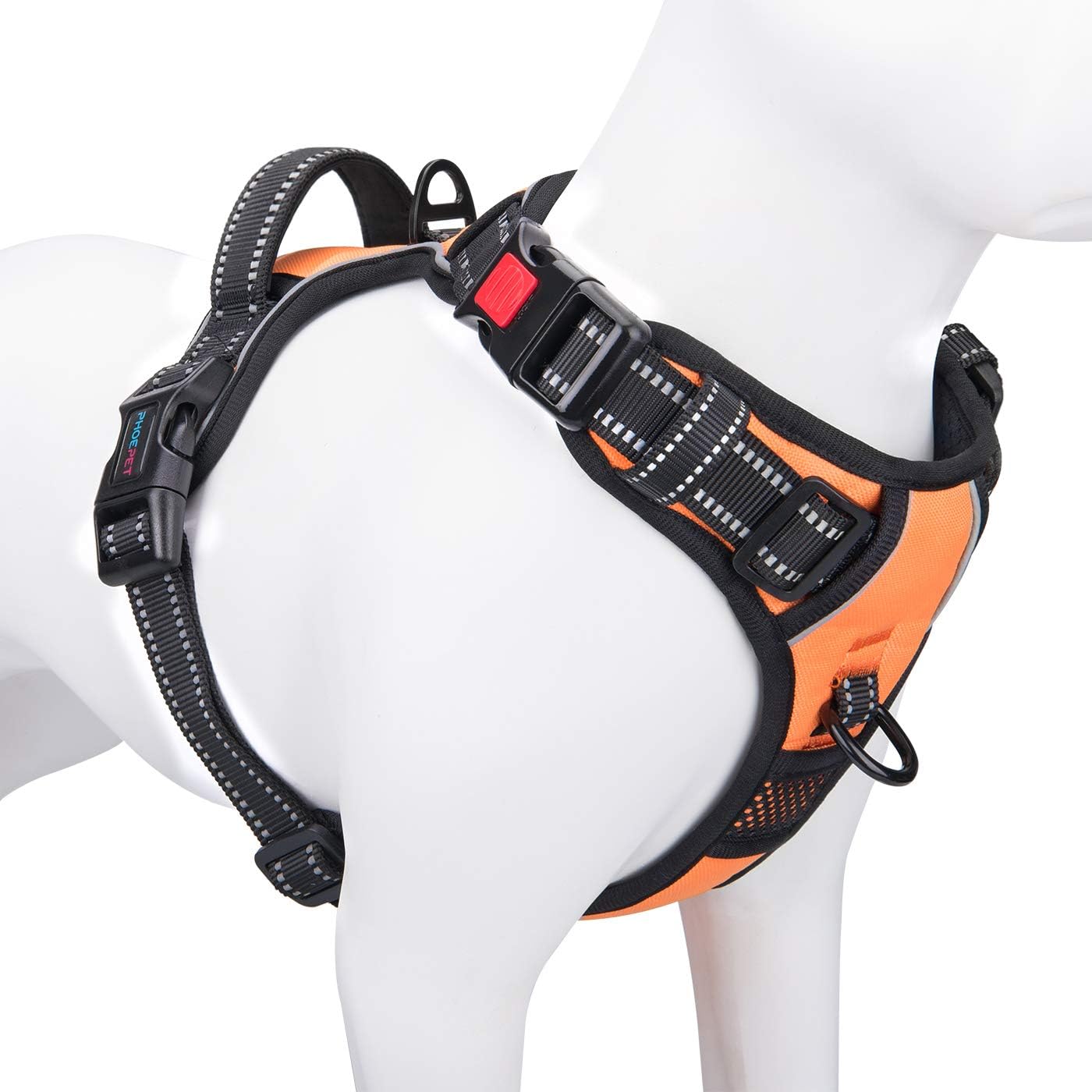
PHOEPET No Pull Dog Harness Small
Best Reflective No-Pull Harness
| Size | Small |
|---|---|
| Material Type | Breathable Air Mesh with Padded Cushion, Durable Oxford Surface |
| Closure Type | Buckle |
| Leash Attachment | Front and back metal rings |
| Product Care Instructions | Hand Wash Only |
The PHOEPET No Pull Dog Harness is a lightweight vest-style harness designed to reduce pulling and make daily walks easier. It has both front and back metal leash attachment rings so you can switch between a corrective front-clip setup and a standard back-clip, plus a soft padded handle for close control or lifting into a car. The harness uses breathable air mesh with a padded cushion and an Oxford outer surface, and adjustable straps with three quick-release buckles let you tailor the fit and take it on and off quickly without forcing it over the head. Reflective material improves visibility on low-light walks and the two metal leash hooks provide secure attachment points. For small dogs the harness is easy to adjust and very light, but the fabric requires hand washing and the step-in style and multiple buckles can take a few adjustments to fit perfectly on wiggly pets. The design is practical for everyday walks and short training sessions aimed at reducing pulling, though owners seeking a heavy-duty working harness or machine-wash convenience may want a different model.
Best for: Owners of small dogs who want a humane, reliable way to reduce pulling and gain better control on daily walks while keeping their pet comfortable.
Less Ideal for: People who need a machine-washable harness or a heavy-duty tactical/work harness for very strong pullers or professional use.
- Both front and back metal leash attachment rings let you use a front-clip no-pull setup or a conventional back-clip.
- Padded breathable air mesh and durable Oxford outer provide comfort during walks.
- Soft training handle gives immediate close control and helps with lifting or guiding the dog.
- Three quick-release buckles enable faster on/off without pulling the harness over the head.
- Reflective trim improves visibility for early morning or evening walks.
- Requires hand washing rather than machine laundering.
- May need patience to size and adjust for dogs that squirm during fitting.
Verdict: The best reflective no-pull harness for owners who walk in dawn, dusk, or nighttime conditions and want added visibility and safety without sacrificing control.
Halti Front Control Harness Small
Best Training No-Pull Harness

| Size | Small |
|---|---|
| Closure Type | Clip |
| Material Type | Neoprene, Nylon |
| Dog Breed Size | Small |
| Included Components | 1 Front Control Harness |
The Halti Front Control Harness is a lightweight, neoprene-padded front-clip harness built to redirect a dog's forward motion by steering from the chest and shoulders. You put it on like a standard harness and attach the lead to the front clip to guide turns and discourage lunging during walks; an added safety clip secures the harness to the dog's collar. The padded shoulder straps and multiple adjustment points make it comfortable for small dogs while keeping the harness snug without rubbing. It is hand-wash only and sized for small breeds, so it works best for persistent pullers or dogs that dislike headcollars and need a kinder steering-style option. Limitations include a focus on small dogs only and no crash-tested car-safety features, so it is not intended as a travel restraint. For everyday training walks it offers clear steering feedback and is simple to use once fitted correctly.
Best for: Buyers who want a steering-style front-clip solution to teach small dogs better leash manners without using a headcollar, and who prioritize comfort and easy adjustment during training walks.
Less Ideal for: Owners looking for a harness to restrain dogs in vehicles, or people with medium and large breeds who need stronger, crash-tested travel harnesses.
- Front-clip design redirects chest-forward pulling into gentle steering
- Neoprene-padded shoulder straps for added comfort during walks
- Multiple adjustment points for a secure, customizable fit
- Includes safety clip to attach to collar for backup security
- Lightweight construction suited to small breeds and regular use
- Sized specifically for small breeds so not suitable for medium or large dogs
- Requires hand washing for cleaning rather than machine washable
- Not designed or marketed as a car travel or crash-tested restraint
Verdict: The best training no-pull harness for owners focused on behavior change and leash training, offering clip placement and control features that support consistent training sessions.
Choosing the Right No Pull Harness Boston Terrier: Key Factors to Consider
Proper Fit for Short Necks and Deep Chests
Boston terriers typically have shorter necks and broader chests than many other small breeds. A harness that fits the neck snugly without riding up behind the ears reduces chafing and prevents escape.
Look for designs with separate neck and chest adjustment points so you can fine-tune both dimensions independently. If a harness relies only on a single loop, it often either zips up the neck or leaves the chest loose. Accurate measurement and a model that accommodates a shorter neck circumference are essential to prevent pressure on the throat and to keep the harness stable during turns or sudden pulls.
Adjustment Range and Easy On/off
Multiple adjustment points let you adapt the harness as a Boston terrier grows or if their coat changes seasonally. Ratcheting or sliding buckles that stay put during movement maintain a consistent fit.
Quick-release buckles or step-in designs make daily use less stressful for both dog and owner. However, ease of use should not sacrifice security: buckles should be sturdy and designed so a wriggly dog cannot accidentally free itself. Consider how many straps you can reasonably tighten while the dog is standing calmly and whether you can reach the buckles without wrestling the dog.
Front-clip Effectiveness and Leash Control
A front-clip attachment redirects forward momentum and helps discourage lunging when used correctly. For Boston terriers, the position and height of a front clip matter because a clip set too low or too far forward can shift pressure onto the throat or chest in uncomfortable ways.
Choose harnesses with a front-clip engineered to sit near the dog's sternum area so a forward pull turns the dog rather than compressing the neck. Also consider how the clip pairs with a rear attachment for moments when you want more straightforward guidance or to attach a second lead for training.
Material Comfort and Breathability
Boston terriers can be prone to overheating in heavy or non-breathable materials because of their brachycephalic face and tendency to pant. Lightweight, breathable fabrics reduce trapped heat and wick moisture, which lowers skin irritation risk.
Padding in high-contact areas helps distribute pressure, but it should be low-profile so it does not bulk up around the chest and interfere with a snug fit. Smooth seams and soft edge binding minimize chafing, particularly under the armpits where rubbing commonly occurs.
Hardware and Attachment Durability
Strong, reliable D-rings and buckles matter because a choking or lunging dog can put sudden high loads on connection points. Corrosion-resistant metal or high-grade polymer hardware that resists bending and failure increases long-term safety.
Check how attachment points are reinforced in the design. Sewn reinforcements, bar-tacks, or welded rings provide more security than single-line stitching. For owners who use harnesses daily, durable hardware reduces the chance of mid-walk failures and extends service life.
Freedom of Movement and Training Compatibility
A good no-pull harness should discourage forward lunges while preserving the dog's natural gait. Restrictive shapes that alter shoulder movement can cause discomfort and long-term joint stress if used constantly.
Look for designs that sit clear of the shoulder blades and allow full stride length. Also consider whether the harness works with common training approaches: ability to attach at front and rear, compatibility with martingale-style control, and whether it integrates with short training leads or hands-free walking systems without restricting mobility.
How Do I Measure My Boston Terrier for a No-pull Harness?
Take three measurements: neck circumference at the base where a collar would normally sit, chest girth at the widest part directly behind the front legs, and the distance from the neck base to the chest measurement to help judge torso depth. Use a flexible cloth tape measure and keep it snug but not tight.
Compare those numbers to the manufacturer's size chart and prioritize chest girth and neck fit over nominal 'small' or 'medium' labels. If the dog falls between sizes, choose the larger size if the harness offers more adjustment in the neck and belly straps.
- Measure while the dog is standing square for accurate girth.
- If you cannot fit a cloth tape, use a piece of string and measure the string afterward.
- Allow two fingers' width between tape and dog for comfortable breathing and movement.
Which Front-clip Features Actually Reduce Pulling?
Front-clip designs work by applying a turning force when the dog lunges, which breaks the forward trajectory. The most effective front clips sit centered on the chest so the lead redirects the dog's shoulders rather than torquing the throat. A swivel-style clip helps prevent leash twisting and maintains consistent redirection.
Additional stabilization, such as a secondary belly strap or a contoured chest plate, prevents the clip from sliding out of position when the dog turns. Remember that a front clip is a training aid, not a permanent behavioral fix; pairing the harness with consistent reward-based training yields the best long-term results.
- Prefer clips placed near the sternum, not at the low belly.
- Swivel attachments reduce leash twist during active walks.
- Use short, consistent corrections and rewards while training with a front-clip harness.
Can a No-pull Harness Cause Chafing or Skin Issues?
Yes, poor fit or abrasive materials can cause rubbing, especially under the armpits and along the chest. Look for soft edge binding, smooth seams, and breathable padding in contact zones. Regularly check the skin for redness or hair loss, especially after the first few weeks of use.
Rotate harnesses with different padding levels if you notice sore spots and keep the harness clean, since dirt and sweat trapped against the skin increase irritation risk. Adjust straps to eliminate unnecessary movement that creates friction without tightening so much that it restricts breathing.
- Inspect skin after walks during the first two weeks of regular use.
- Wash harnesses per the care instructions to remove oils and debris.
- Trim long hair around contact points to reduce matting and rub.
Which Harness Styles Are Easiest to Put on a Boston Terrier?
Step-in harnesses can be quick for calm dogs because you lift a front paw into each opening and fasten buckles behind. Over-the-head harnesses with large neck openings and a single belly buckle work well if the neck opening is wide enough to clear the head comfortably. Avoid designs that require forcing the dog's legs through tight loops if your pet is anxious or wriggly.
Evaluate how many buckles you must reach and whether you can do so without lifting the dog. Quick-release buckles and properly oriented straps reduce fumbling and make daily use faster and less stressful for both of you.
- Practice fitting the harness indoors with treats to reduce stress.
- Test how many adjustments you need to make each time the dog is fitted.
- Choose a style that balances security with manageable on/off steps.
How Should I Introduce a New No-pull Harness to My Dog?
Start by letting the dog sniff the harness and reward calm interest. Gradually increase wearing time: first just a minute or two with treats, then short indoor sessions before moving to outdoor walks. Use positive reinforcement and short, engaging training drills while the harness is on so the dog forms a pleasant association.
Avoid long, unsupervised sessions the first few days. If the dog shows signs of stress or severe resistance, take smaller steps and consider a different fit or style. Consistency, patience, and pairing the harness with reward-based walking practice produce the best behavior changes.
- Pair initial fittings with high-value treats or play.
- Keep early sessions short and positive.
- Reassess fit after active play and adjust straps as needed.
Should I Use a Front-clip Harness for Formal Training or Casual Walks?
Front-clip harnesses are versatile for everyday walking and as a training aid to reduce pulling. For formal obedience training that requires precise positional control, you may switch between front-clip and rear-clip attachments depending on the drill. For casual neighborhood walks, a front-clip harness paired with consistent reward cues helps maintain calm behavior.
Consider having a harness that offers both clip positions so you can adapt quickly. Rely on short training sessions to reinforce loose-leash behavior rather than expecting the harness alone to correct ingrained pulling.
- Use front-clip mode for immediate redirection and loose-leash practice.
- Switch to rear-clip for steady walking or when attaching cargo such as a light pouch.
- Incorporate reward-based training for lasting behavioral change.
How We Chose the Best No Pull Harness Boston Terrier
We evaluated harnesses using criteria that matter specifically for Boston terriers: accurate sizing for short necks and deep chests, ease of adjustment for compact frames, leash-attachment options that reduce forward momentum, breathable and low-bulk materials to prevent overheating and chafing, and build quality at key stress points to endure active play. Each product had to offer multiple adjustment points or a reliably structured fit to suit the breed's proportions. We prioritized designs that allow quick on/off without forcing limbs through tight openings, since many owners need fast changes for walks or training sessions. Products were excluded if they lacked clear sizing guidance for short-necked breeds, relied solely on a single strap that concentrates pressure, or used materials likely to irritate sensitive skin. We also filtered out harnesses with flimsy hardware or those that offer only a single front-clip configuration that cannot be paired with a rear-clip option for training transitions. The final list reflects a balance of practical control, comfort, and durability for Boston terrier owners seeking a no-pull solution.
Our full evaluation process is outlined in our review methodology.
FAQ
How tight should a harness be on my Boston terrier?
A harness should be snug but not restrictive. You should be able to fit two fingers between the strap and the dog's body at the neck and chest. If you can slide an entire hand under the strap, it is too loose and may allow slipping.
Can a no-pull harness harm my dog's shoulders or joints?
Used correctly, a well-fitted harness that sits clear of the shoulder blades should not harm shoulders or joints. Avoid designs that force the shoulder into an unnatural position or that the dog must pull against constantly; balance use with exercises that do not rely solely on the harness for control.
Is a front-clip harness enough to stop a persistent puller?
A front-clip harness helps reduce pulling by redirecting momentum, but it is not a stand-alone behavioral cure. Consistent training, rewards for loose-leash walking, and possibly professional guidance are often needed for persistent pullers.
How often should I check and adjust the harness fit?
Check fit before every walk until you are confident it stays in place, then at least weekly. Recheck after seasonal weight changes, grooming, or if the dog goes through a growth spurt. Tighten or loosen straps as needed to maintain two-finger clearance.
Can I use a no-pull harness with a training leash or head halter?
Yes, many owners pair a no-pull harness with short training leads for added control during sessions. Combining devices should be done carefully to avoid conflicting pressure points; if using multiple tools, ensure each is fitted correctly and only use them under supervision.
Final Verdict
For Boston terriers, prioritize harnesses that offer precise adjustability for short necks and deep chests, breathable materials to reduce chafing, and secure attachment hardware. Expect tradeoffs between low-bulk comfort and padded support, and choose a model that balances redirection capability with natural freedom of movement. Ultimately, pair a front-clip no-pull harness with consistent, reward-based training to achieve calmer, safer walks and to support long-term behavior change.

