

Finding the right pinch collar for a small dog matters because a poor fit or heavy-handed use can cause stress or injury while undermining training. You want a tool that gives effective, precise correction without bulk or excessive pressure, and that fits the proportions and coat of a smaller breed. This guide shortlists the top pinch collars for small dogs and explains the features that affect fit, safety, and handling. We evaluated construction, link size and spacing, adjustability, and user control so you can choose a collar that supports calm, consistent training. Read on for quick decision criteria and what to expect from each recommended option.
Top Picks at a Glance
| Best Overall Pinch Collar The best all-around option for most small-dog owners | Supet Prong Pinch Collar Small |  |
| Best Budget Pinch Collar A low-cost choice that still delivers basic training function | Yvnicll Prong Collar S |  |
| Best Premium Pinch Collar A higher-end pick with superior materials and refined features | Herm Sprenger ClicLock Prong Collar 18in |  |
| Best Adjustable Pinch Collar Designed for precise sizing and easy fit adjustments | MR.BEEFOO Prong Training Collar Small |  |
| Best Lightweight Pinch Collar A low-mass option that minimizes bulk for small breeds | JIPIMON Prong Collar Small |  |
| Best Heavy-Duty Pinch Collar Built for extra strength and durability under frequent use | Azinoo Adjustable Pinch Dog Training Collar 20 in |  |
| Best Corrosion-Resistant Pinch Collar Materials and finishes that resist rust and moisture damage | Herm Sprenger Ultra-Plus Prong Collar 16in Small |  |
Supet Prong Pinch Collar Small
Best Overall Pinch Collar

| Material Type | Stainless Steel |
|---|---|
| Closure Type | Buckle |
| Included Components | Chain |
| Size | S (Neck: 14"–16'') |
This Supet prong pinch collar is built for short, supervised leash-training sessions on small dogs and provides clear, immediate feedback when your dog pulls. It uses linked stainless steel prongs with rounded contact points and removable rubber caps so the collar tightens evenly around the neck during a correction while the caps reduce sharp contact for gentler use. The kit includes extra links to customize fit and a quick-release plastic buckle that makes it faster to put on and take off than traditional split-ring designs. Chrome plating and stainless steel construction give it a durable, rust-resistant feel, and the nylon strap and D-ring let you clip a leash securely when needed. Limitations are that pinch collars are intended for short-term, supervised training rather than continuous wear, the plastic buckle can feel less robust than all-metal alternatives, and effective, humane use requires proper sizing and handling skills.
Best for: Someone who wants a compact, effective training collar for everyday short walks and leash-training sessions on small dogs and values easy fit adjustment and durable metal links.
Less Ideal for: Owners who prefer positive-only, non-aversive tools or who need a collar for constant wear and identification should consider alternative harnesses or flat collars.
- Rounded stainless steel links spread pressure for clearer leash feedback
- Includes extra links for customized fit
- Quick-release buckle speeds on/off for short training sessions
- Chrome plating and stainless steel resist rust and wear
- Not intended for continuous or unsupervised wear
- Plastic quick-release buckle is less heavy-duty than metal closures
Verdict: The best overall pinch collar balances effective training control, safe fit, durable construction, and ease of adjustment to suit most small dogs and everyday use.
Yvnicll Prong Collar S
Best Budget Pinch Collar

| Included Components | Leash |
|---|---|
| Breed Recommendation | Small, Medium, Large |
| Size | S |
| Closure Type | Button |
This Yvnicll prong collar is a budget-focused pinch collar kit that pairs an adjustable metal prong chain with a basic leash and quick-release snap. It works by applying even pressure around the neck when the leash is pulled, which many trainers use as a corrective reminder during walks or training sessions. The collar includes silicone-covered prongs and polished surfaces intended to reduce pinching discomfort, plus an aluminum alloy snap for faster fastening and removal. The supplied leash has a foam-filled handle and an O-ring for accessories, and the set notes a reflective element for better visibility at night. Expect straightforward, functional performance for short-term training and pull correction, but this model is a no-frills option: materials and fitment are simple rather than high-end, and careful sizing and handling are required to use prong collars safely and effectively on small dogs.
Best for: Buyers who need a low-cost, functional pinch collar setup for short-term training and basic leash control on small dogs and prioritize value over premium materials.
Less Ideal for: Owners looking for a long-term, high-end factory-quality prong collar or those uncomfortable using corrective neck devices should consider alternative training tools.
- Silicone-covered prongs to reduce direct metal contact with the neck
- Adjustable link design lets you size the collar by adding or removing links
- Includes a leash with foam handle and O-ring for accessories
- Quick-release aluminum alloy snap speeds on/off use
- Polished finish and treated surfaces to minimize sharp edges
- Basic construction and materials compared with premium factory-quality collars
- Requires correct fit and experienced handling to be safe on small dogs
Verdict: The best budget pinch collar gives owners reliable control and acceptable materials at a lower price, ideal for those who need functionality without premium features.
Herm Sprenger ClicLock Prong Collar 18in
Best Premium Pinch Collar

| Size | 18in (up to 15" neck) x 2.25mm Links |
|---|---|
| Material Type | Metal |
| Closure Type | Buckle |
This Herm Sprenger ClicLock prong collar is a premium training collar built from stainless steel with a center quick-release buckle and 360-degree swivel ring. It is used as a corrective training aid: you size it by removing or adding links so it fits snugly behind the ears, attach a leash to the swivel ring, and deliver subtle corrective feedback when the dog pulls. The ClicLock buckle makes putting the collar on and taking it off quick and safer than sliding a choke over the head, while the swivel ring and flexible connection reduce twisting and tangling during walks. The stainless construction resists rust and should hold up to long-term use, and the 2.25mm links are machined for smoother engagement compared with cheaper pinch collars. Important limitations are that effective and humane use requires correct fit and handling, and the collar is intended for training under guidance rather than casual everyday wear for every dog.
Best for: Owners who prioritize build quality and long-term durability and plan to use a prong collar as a serious training tool for small dogs that need stronger, controlled corrections.
Less Ideal for: Owners seeking a gentle everyday collar, first-time trainers who are uncomfortable with corrective tools, or households that prefer harness-only management.
- Premium stainless steel construction resists rust and improves longevity
- Quick-release ClicLock buckle for faster, secure on/off without pulling over the head
- 360-degree swivel ring reduces leash twist and improves handling
- Removable links let you fine-tune length for a snug fit behind the ears
- Requires correct sizing and experienced handling to be effective and humane
- Not intended as a daily decorative collar or for unsupervised use
Verdict: The best premium pinch collar is for owners willing to pay more for top-tier build quality, smoother links, refined finishes, and long-term durability.
MR.BEEFOO Prong Training Collar Small
Best Adjustable Pinch Collar

| Size | Small / 12.5-18" Neck Size |
|---|---|
| Material Type | Black-painted Steel |
| Included Components | 2 Spare Links, 28pcs Rubber Covers |
| Closure Type | Release Buckle |
This MR.BEEFOO prong training collar is built for small dogs and combines the classic interlocking-link design with a quick-release buckle for easier on/off during training sessions. It is used as a behavior-correction tool worn loosely and tightened briefly when the dog pulls, with round-head prongs and 28 rubber tips included to soften contact. The collar ships with spare links so you can fine-tune length by adding or removing links; links require pliers to adjust, which keeps the connection secure during walks. The quick-release clasp is tested for repeated use and makes attaching and detaching faster than traditional all-link collars. Practical benefits include repeatable fit adjustments, a secure swivel connection for leash attachment, and protective rubber caps for dogs that need gentler pressure. Important limitations are that proper fit and technique are required to be humane and effective, the metal construction can be heavier than fabric options, and link adjustments need tools rather than being tool-free for fast sizing changes.
Best for: Owners of small, growing, or active dogs who need a collar that can be precisely adjusted for repeatable training fit and who are comfortable using a prong-style tool responsibly.
Less Ideal for: People seeking a purely positive reinforcement or non-aversive training approach, or those who prefer a lightweight fabric martingale or harness for everyday control.
- Adjustable interlocking links let you dial in a repeatable fit for changing neck sizes.
- Quick-release buckle speeds putting the collar on and taking it off between training sessions.
- Includes spare links and 28 rubber tips so you can customize length and soften prong contact.
- Chrome-plated steel construction and secure swivel ring provide durable, stable leash attachment.
- Link sizing requires pliers to add or remove, so on-the-go adjustments are not tool-free.
- Metal prong collar is heavier and less subtle than fabric training collars.
Verdict: The best adjustable pinch collar is ideal for owners who need accurate, repeatable fit for a small dog's changing neck size or for achieving the correct training fit.
JIPIMON Prong Collar Small
Best Lightweight Pinch Collar

| Size | Small |
|---|---|
| Material Type | Nylon, Stainless Steel |
| Closure Type | Buckle |
| Unit Count | 1 Count |
This JIPIMON prong collar is a basic training tool that uses linked stainless steel prongs to deliver short corrective pressure when a dog pulls, and it ships with extra links and rubber caps for fit and comfort. It is intended for short, supervised training sessions worn high on the neck behind the ears; you add or remove links to dial in the circumference. The collar pairs stainless steel prongs with a nylon strap and a quick-release alloy buckle so it is straightforward to put on and remove in everyday use. Practical advantages include the included covers to soften each contact point and the extra link so you can adjust sizing without buying separate parts. Limitations are that it is a training-only device rather than a daily wear collar and must be removed when unattended or after brief sessions, and users should be familiar with proper positioning and timing to avoid causing discomfort. For a low-cost option that covers the essentials, this collar gives usable control for small dogs when used responsibly.
Best for: Owners of small dogs who need an inexpensive, no-frills training tool to gain quick control during short obedience sessions and who are comfortable using corrective collars responsibly.
Less Ideal for: Those looking for an everyday or hands-off solution, inexperienced owners uncomfortable with corrective collars, or dogs with neck or respiratory issues.
- Includes extra link and rubber caps for fit and added comfort
- Stainless steel prongs with nylon components for basic durability
- Quick-release alloy buckle makes on/off fast and secure
- Adjustable by adding or removing links to fit neck circumference
- Designed for short, supervised training only and not for continuous wear
- Requires correct placement and handling knowledge to avoid misuse
Verdict: The best lightweight pinch collar suits tiny or delicate dogs by delivering training control with minimal weight and reduced discomfort from a heavy chain.
Azinoo Adjustable Pinch Dog Training Collar 20 in
Best Heavy-Duty Pinch Collar

| Adjustable perimeter | up to 23.8 inches |
|---|---|
| Material | Chrome-plated stainless steel prongs |
| Tip protection | Rubber-tipped prongs |
This adjustable pinch (prong) collar is built for routine training and frequent handling, with removable links that let you size the perimeter to your dog's neck. Chrome-plated stainless steel prongs and silver-coated links give it a heavier-duty feel compared with thin costume-style collars, and rubber tips on the prongs reduce direct metal contact against skin. The collar secures with a D-ring that locks the leash quickly, and the link system makes taking the collar on and off straightforward during sessions. For small dogs the 20 inch variant with a maximum neck fit listed is convenient when trimmed to the correct number of links, and the manufacturer's sizing guidance helps avoid over-tightening. Keep in mind this is a training tool meant for short, supervised use rather than continuous wear, and proper fit and handling are essential to avoid discomfort. The collar delivers a durable, no-frills option for owners who train frequently and need something that holds up to regular use.
Best for: Buyers who train frequently and want a sturdier, longer-lasting pinch collar that tolerates regular use and handling while allowing precise sizing for small dogs.
Less Ideal for: Owners seeking a collar for everyday unrestricted wear, or those uncomfortable using corrective training tools should consider alternative positive-reinforcement options.
- Removable link system allows precise sizing for a better fit.
- Chrome-plated stainless steel prongs and silver-coated links improve durability and corrosion resistance.
- Rubber-tipped prongs reduce risk of scratching and increase comfort during corrections.
- D-ring quick-lock makes attaching and removing a leash fast during training.
- Intended for supervised training use only and not for continuous wear.
- Requires knowledge of proper fit and handling to be effective and safe.
Verdict: The best heavy-duty pinch collar is for owners who need a sturdier, longer-lasting option that stands up to frequent handling and active dogs.
Herm Sprenger Ultra-Plus Prong Collar 16in Small
Best Corrosion-Resistant Pinch Collar
| Material Type | Alloy Steel |
|---|---|
| Item Length | 16 inches |
| Prong Gauge | 2.25mm |
| Fits Neck | 13 to 19 inches |
| Closure Type | Double Ring |
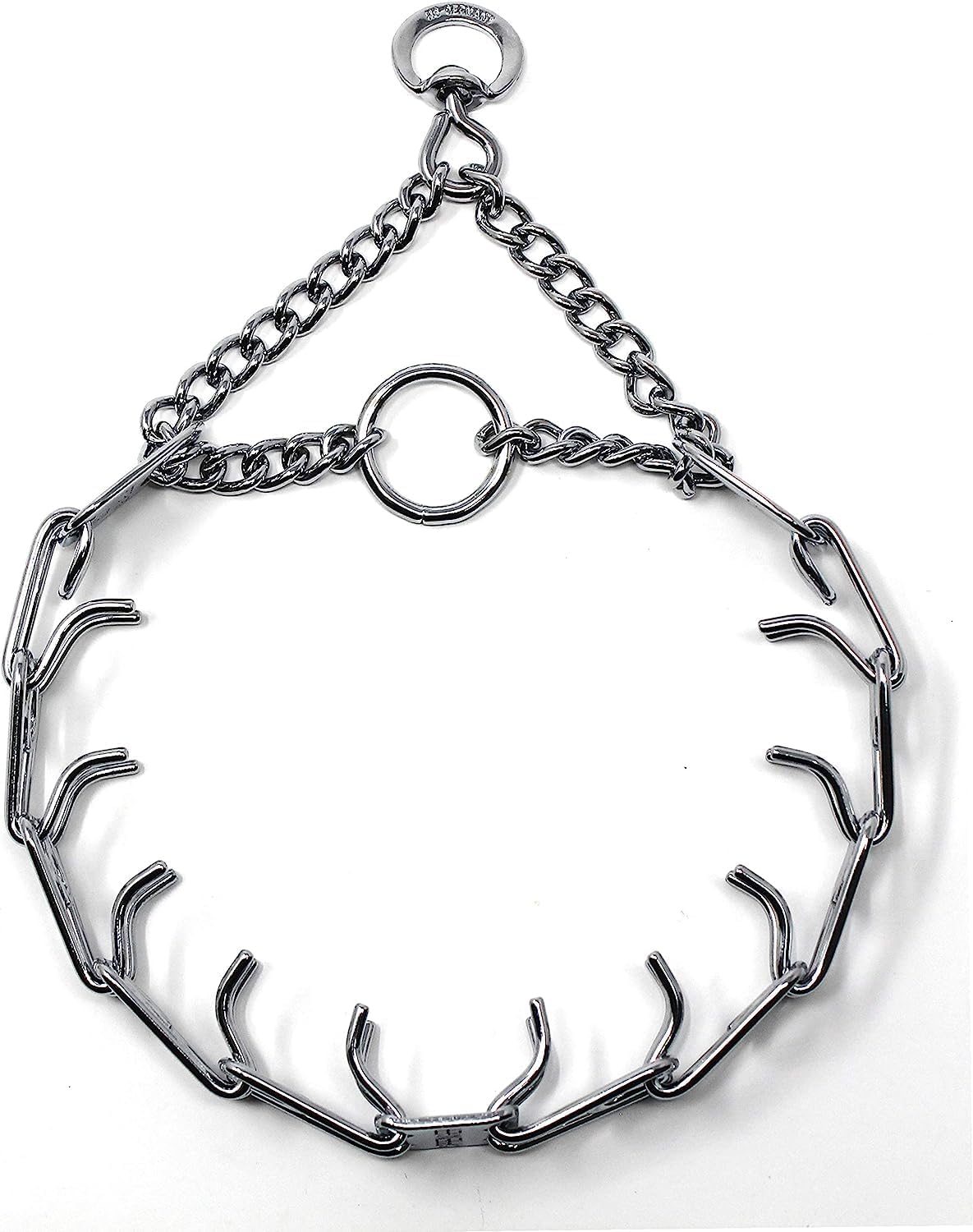
This Herm Sprenger Ultra-Plus prong collar is a factory-quality training chain made from chrome-plated alloy steel with the brand's specialty prong shape intended to distribute pressure evenly. It is sized as the 16-inch small variant and ships in a base configuration that fits roughly 13-inch necks out of the box and can be extended to about 19 inches by adding prong links. Typical use is as a high, snug training collar placed behind the ears for leash corrections during obedience work; the double-ring closure and included swivel make leash attachment straightforward. The Ultra-Plus center plate and precision links give a secure, consistent feel and the metal construction should resist bending or rusting under normal use. Limitations are that proper sizing and placement are essential for safe use, additional links are required for some neck sizes and those links are sold separately, and prong collars are a specialized tool that need knowledgeable handling to avoid misuse. For everyday obedience training where firm, repeatable control and durable materials matter, this collar performs well.
Best for: Buyers who want a dependable, well-made prong collar for regular obedience work and prioritize consistent control and build quality.
Less Ideal for: Owners who prefer gentler training tools, are inexperienced with corrective collars, or need a non-metal or decorative everyday collar.
- Chrome-plated alloy steel construction is durable and corrosion-resistant
- Ultra-Plus prong shape designed to distribute pressure more evenly
- Double-ring closure with swivel for reliable leash attachment and control
- Ships in a base size that fits many small dogs and can be extended with extra links
- Additional prong links required separately for larger neck sizes
- Requires correct placement and experienced handling to be used safely
Verdict: The best corrosion-resistant pinch collar is for owners who want a collar that tolerates wet conditions and stays reliable longer without rusting or degrading.
Choosing the Right Pinch Collar Small Dog: Key Factors to Consider
Link Size and Spacing
Link size and spacing determine how pressure is distributed around a small dog's neck. Smaller, closely spaced links create a smoother contact surface and reduce the chance of individual links pinching skin or fur. For small dogs with thin skin or a fine coat, choose collars with smaller-diameter links and tighter spacing so corrections are more controlled and less jarring.
Improper spacing can lead to localized pressure points that increase discomfort and the risk of injury. When assessing link geometry, imagine how the chain will sit when the dog pulls: links should conform to the curve of a small neck rather than creating gaps that fold or rotate under load.
Weight and Overall Profile
Weight matters for small dogs because excess mass increases strain on the neck and can change the animal's posture. A lightweight collar with a low profile reduces leverage and keeps corrections proportional to the dog's size. Consider the total mass of the chain and hardware, not just link thickness.
A slim profile also reduces interference with the dog's natural movement and makes the collar less likely to rub the trachea or base of the neck. Avoid heavy, bulky designs intended for larger breeds; even small differences in weight are noticeable on lighter dogs.
Adjustability and Fit Range
A pinch collar must be adjustable to sit in the correct position behind the dog's ears and under the jaw. Small dogs require finer adjustment increments so the collar does not slide or choke when tension is applied. Look for collars that allow removal of individual links or that offer small-size options tailored to toy and small breeds.
Proper fit also affects control. If the collar is too loose it will move and create inconsistent corrections; if it is too tight it can cause constant pressure and irritation. Measure the dog's neck while relaxed and choose a collar that can be set to a snug but non-restrictive fit.
Finish and Skin Safety
The metal finish and the quality of link edges affect comfort and long-term wearability. Smooth, polished finishes reduce abrasion to fur and skin, and plated or stainless metals resist corrosion that could roughen surfaces over time. Sharp edges or burrs can catch hair and cause skin damage, especially on dogs with thin or sensitive coats.
For small dogs that frequently wear a collar during training, a rust-resistant finish and well-finished welds lower the chance of irritation or staining. Avoid materials that show signs of flaking or uneven finishing on close inspection.
Hardware Reliability and Safety Features
Secure hardware prevents accidental release, which is crucial for small dogs that can bolt or slip loose quickly. Check the quality of clasps, welds, and any quick-release links. A reliable connection point should hold under normal leash forces while still allowing purposeful removal when handling the dog.
Some collars include features such as reinforced end links or link retainers that reduce rotation and improve stability. For small dogs, these design elements help keep the collar oriented correctly so corrections are predictable and the collar does not shift into an unsafe position.
User Control and Training Compatibility
How easily the handler can apply short, consistent corrections matters more than any single hardware detail. A collar that responds predictably to brief leash tugs supports clearer communication with a small dog. Consider how the collar feels in hand, how much leverage is required, and whether the collar allows for gradual, incremental responses during training.
Also think about how the collar will integrate with your leash, training style, and the dog's temperament. Tools that amplify overcorrections or that require excessive force are less suitable for sensitive or easily stressed small dogs.
How Do I Measure My Small Dog for a Pinch Collar?
Measure your dog's neck while the dog is standing and relaxed. Use a soft tape measure and place it where the collar will sit, typically just behind the ears and under the jaw. Add a comfortable allowance so you can fit a finger between the tape and the neck for a snug but not restrictive setting.
If the collar allows removing individual links, record the total length you need and choose the nearest smaller size so the collar sits stable under tension. If in doubt, err on the side of a slightly tighter fit that can be loosened by removing a link rather than a collar that slips.
- Measure twice, once while relaxed and once after gentle stretching.
- Mark the measurement and compare it to the collar's smallest and largest fit points.
- Remember that coats compress under force, so account for fur thickness in long-haired breeds.
Can Pinch Collars Be Used on Puppies and Toy Breeds?
Pinch collars can be used on puppies and toy breeds only with great care and under the guidance of a qualified trainer. Young dogs have developing neck structures and may be more susceptible to injury from incorrect fit or excessive force. For very young puppies, gentler training methods and flat collars or harnesses are often better initial choices.
If you choose a pinch collar for a small or young dog, select the smallest available links, ensure the lightest possible weight, and limit use to short, supervised training sessions focused on leash response. Monitor the dog's neck for redness or discomfort and stop use if you see signs of distress.
- Prefer short, supervised sessions.
- Use the lightest corrections possible.
- Consult a positive-focused trainer if unsure.
What Maintenance Keeps a Pinch Collar Safe and Long-lasting?
Regular maintenance prevents rust, rough edges, and hardware failure. Wipe the collar after outdoor use, dry thoroughly, and inspect links and welds for sharpness or wear. If the finish becomes pitted or flaking, retire the collar to avoid skin irritation.
Occasionally open and close clasps or quick links to ensure smooth operation. Replace any link that shows cracking or deformation. Proper storage in a dry place will extend a collar's life and maintain predictable behavior during training.
- Clean and dry after exposure to moisture.
- Check welds and link edges monthly with a visual and tactile inspection.
- Replace collars that show corrosion or permanent deformation.
How Should Corrections Be Applied when Training with a Pinch Collar?
Corrections should be brief, consistent, and timed to the unwanted behavior. A quick, controlled tug that is immediately released gives the dog a clear signal without prolonged pressure. Avoid repetitive or sustained pulling, which can cause fear, stress, or physical injury.
Pair corrections with positive reinforcement so the dog learns the desired behavior rather than only fearing the correction. If you struggle to deliver concise corrections or the dog reacts with extreme distress, stop and consult a trainer experienced with small-dog handling.
- Use brief, single-tug corrections.
- Follow corrections with a positive marker and reward for correct behavior.
- Avoid using the collar as a constant restraint or for long periods.
When Is a Pinch Collar Not the Right Tool?
A pinch collar is not appropriate for dogs with neck injuries, thyroid issues, or known tracheal collapse. It is also a poor choice for dogs that consistently respond with extreme fear, panic, or aggression to correction-based tools. For those cases, non-aversive methods or specialized veterinary-approved approaches are safer.
If you cannot deliver short, consistent corrections or if training has relied on heavy-handed handling, consider alternative tools and seek professional guidance. The goal is effective communication with minimal risk, and sometimes a different approach achieves that more reliably.
- Avoid use on dogs with existing neck or respiratory conditions.
- Do not use on dogs that panic under correction.
- Seek alternatives and professional help when behavior is severe or health-compromised.
How We Chose the Best Pinch Collar Small Dog
We prioritized criteria that determine whether a pinch collar is appropriate and safe for a small dog and that influence everyday handling. First, we looked at link size and spacing to ensure each chain can deliver precise, distributed pressure without large gaps that pinch skin or pull unevenly. Second, we evaluated construction quality and metal finish to minimize rust, rough edges, and skin irritation on delicate necks. Third, adjustability and range of sizes were considered so the collar can be trimmed or fitted to a small neck while remaining stable during use. Fourth, hardware and connection points were checked for secure snaps and welds to avoid accidental openings. Finally, ease of use and control was judged from how straightforward the collar is to put on and remove and how predictably it responds during normal leash corrections. We excluded collars intended for larger breeds, heavy-duty training tools, or designs with excessive weight for small-dog neck anatomy. Products that lacked clear sizing information or had obvious sharp edges in photos were not considered. The final list emphasizes fit, safety, and consistent mechanical action rather than marketing claims or unverified features.
Our full evaluation process is outlined in our review methodology.
FAQ
How often should a pinch collar be worn during training?
Often short, supervised sessions are best. Limit wear to focused training times rather than leaving the collar on continuously. Regularly check the neck for signs of rubbing or irritation after each session.
Can a pinch collar damage a small dog's trachea?
It can if fitted or used improperly. Proper sizing, light corrections, and correct placement behind the jaw reduce the risk. Avoid sustained pressure and stop use if the dog coughs, gags, or shows respiratory distress.
Are there materials that are safer for sensitive skin?
Yes. Stainless finishes and smoothly polished links are less likely to irritate sensitive skin. Avoid rough or plated metals that flake; regular inspection helps catch early wear before it causes problems.
How do I know the collar is fitted correctly?
The collar should sit high on the neck behind the jaw and allow a snug fit without constricting breathing. When tension is applied, the correction should be brief and distributed rather than localized to a single spot. If the collar slides toward the throat, it is likely too loose or incorrectly sized.
Can I use a pinch collar with any leash?
Usually yes, but choose a leash and attachment method that allow controlled, short corrections. Avoid heavy or rigid leads that amplify force beyond what is appropriate for a small dog. A standard training leash that provides good feel and moderate control is typically best.
Final Verdict
When choosing a pinch collar for a small dog, prioritize fit, finish, and weight over decorative features. The right collar should allow precise, predictable corrections while minimizing pressure points and potential skin irritation. Balance adjustability and secure hardware so the collar remains stable during short training sessions. Recognize tradeoffs: lighter collars reduce strain but may require finer handling, while heavier collars deliver stronger feedback that is usually unnecessary for small breeds. Choose a collar that matches your handling style and commit to short, supervised training with positive reinforcement to get consistent results.

