

Training and handling a Great Dane demands tools that match the breed's size and strength. The right prong collar can give you more predictable control while distributing pressure in a way that reduces sudden strain on the neck. For owners who need reliable handling during walks or controlled training moments, choosing a properly sized and well-made prong collar matters for both safety and effectiveness. This guide gathers seven top picks and explains the criteria we used to narrow the list so you can evaluate fit, construction, and use-case suitability.
Top Picks at a Glance
| Best Overall Prong Collar for Great Dane The best all-around choice sized and suited for large breeds | Herm Sprenger Prong Collar 3.2mm 23in |  |
| Best Budget Prong Collar for Great Dane A low-cost option that still delivers safe basic control | Aheasoun Prong Dog Collar Large |  |
| Best Premium Prong Collar Higher-end materials and finish with superior fit and longevity | Herm Sprenger Ultra-Plus Prong Collar 25in |  |
| Best Heavy-Duty Prong Collar Extra-strong build and hardware for very powerful dogs | Downtown Pet Supply Prong Collar Large |  |
| Best Adjustable Prong Collar Easy-to-fit designs that simplify sizing and incremental adjustments | Maiiu Adjustable Prong Collar X Large |  |
| Best Training Prong Collar Designed for controlled, short-term training sessions with clear feedback | Supet Prong Training Collar Medium |  |
| Best Lightweight Prong Collar Lower-profile, lighter links for comfort while maintaining control | NozlaID Lightweight Prong Collar M |  |
Herm Sprenger Prong Collar 3.2mm 23in
Best Overall Prong Collar for Great Dane

| Material Type | Alloy Steel |
|---|---|
| Size | 23in (58cm) x 3.2mm |
| Closure Type | Slip On |
| Included Components | Removable links, center plate, assembly chain |
This Herm Sprenger prong collar is a professional-style training tool made from chrome-plated alloy steel and intended to give controlled, even pressure around a dog's neck during leash training. It slips over the head and tightens via interlocking links; you adjust fit by adding or removing links and the included center plate helps orient the links so they tighten symmetrically. In practice the slightly beveled, blunt prong tips distribute pressure across a band of skin rather than on the trachea, which many trainers prefer for short, precise corrections. The collar is built to a high standard in Germany and is durable for regular use, though sizing requires care — it is sized to sit just below the ears and you must measure the neck and add about 2 inches for correct fit. This model is not recommended for light-colored coats and is a training tool rather than a daily decorative collar, so owners should pair it with humane, conditioned training and supervise use.
Best for: Owners who need a robust, adjustable training tool that delivers consistent, controllable corrections during leash work and are committed to learning proper fitting and handling.
Less Ideal for: Owners looking for a purely decorative or hands-off solution, or those who are uncomfortable using corrective training equipment without professional guidance.
- Sturdy chrome-plated alloy steel construction made in Germany for long service life
- Center plate design promotes symmetrical tightening for more consistent corrections
- Removable interlocking links allow incremental size adjustments
- Blunt, slightly beveled prong tips spread pressure around the neck instead of on the trachea
- Requires careful measurement and proper placement to be safe and effective
- Not recommended for use on light-colored dogs and not intended as an everyday decorative collar
Verdict: The best overall prong collar for a Great Dane, balancing correct fit, durable construction, and reliable control for everyday training and walks.
Aheasoun Prong Dog Collar Large
Best Budget Prong Collar for Great Dane

| Size | Large, 4.0mm, 23.6-Inch |
|---|---|
| Material Type | Rubber, Stainless Steel |
| Included Components | dog prong collar |
This Aheasoun prong collar is a straightforward, budget-minded training collar that uses interlocking stainless steel links with rubber tips to apply even pressure to the sides of the neck. It is sized for larger dogs and can be shortened or lengthened by removing or adding links, and it includes spare rubber tips for the prongs. In use it functions like most pinch collars: clipped on with the D-ring for leash attachment and tightened to provide quick corrective signals during leash training or to stop hard pulls. The chrome plating and rubber tips help reduce sharp contact and the manufacturer notes trainers recommend stainless steel construction for durability. Limitations are typical for this category: it is meant for short training sessions rather than constant wear and requires correct sizing and fitting to avoid misuse, and the simple pull-on closure offers no micro-adjustments compared with specialized mechanisms. For someone wanting an economical, serviceable prong collar for periodic correction, this model delivers the basics without extras.
Best for: Buyers who need a low-cost, no-frills training collar to deliver effective leash corrections during short training sessions and are comfortable fitting and using a prong-style tool safely.
Less Ideal for: Owners looking for a collar for continuous everyday wear, or those who prefer softer, non-aversive training tools and precise adjustment mechanisms.
- Adjustable link design lets you customize fit by adding or removing chain links.
- Made from chrome-plated stainless steel for acceptable corrosion resistance and strength.
- Rubber-tipped prongs reduce sharp contact and include extras in the package.
- Simple D-ring closure is quick to attach and works with standard leashes.
- Not intended for continuous wear; designed for short training sessions only.
- Pull-on closure offers limited fine-tuning compared with some locking or quick-release systems.
Verdict: The best budget prong collar for a Great Dane that provides effective correction, acceptable materials, and secure hardware for owners on a tight budget.
Herm Sprenger Ultra-Plus Prong Collar 25in
Best Premium Prong Collar

| Material Type | Stainless Steel |
|---|---|
| Size | 25in (63cm) x 4mm |
| Breed Recommendation | Large Breeds |
| Included Components | Dog Collar |
The Herm Sprenger Ultra-Plus prong collar is a professional-grade stainless steel training tool intended to give firm, even pressure around a large dog's neck during obedience work. It slips over the head and tightens through interlocking links that each carry two blunt, slightly beveled prongs; links can be removed or added to fine-tune fit. The center plate connector helps the collar tighten symmetrically instead of twisting, and the stainless construction is corrosion-resistant for long life. In practice this collar is used for on-leash training to reduce pulling and reinforce corrections when combined with consistent handler timing. Its metal build and O-ring attachment make it durable and simple to attach to a leash, but the prong action is noticeable on the skin and requires an owner who understands proper sizing and handling. The collar is adjustable by link so you can get a snug placement just below the ears, though adding links is a manual process and replacement links are sold separately. This is a no-frills, heavy-duty option for owners seeking predictable, factory-quality correction in training sessions.
Best for: Owners of large dogs who want a durable, reliable training tool that delivers consistent corrective pressure and who are comfortable using prong collars as part of a structured training plan.
Less Ideal for: Pet owners who prefer gentle, force-free training methods or who are inexperienced with corrective collars should consider alternative training tools and consult a professional trainer.
- High-quality German stainless steel construction for durability and corrosion resistance
- Interlocking links with blunt, slightly beveled prongs allow incremental size adjustment
- Center plate connector provides symmetrical tightening to prevent twisting
- Slips on over the head for quick on/off and uses standard O-ring leash attachment
- Requires knowledge of proper fit and handling to avoid misuse
- Replacement links must be purchased separately to significantly change size
Verdict: The best premium prong collar for owners who want top-tier materials, refined construction, and superior durability for long-term use.
Downtown Pet Supply Prong Collar Large
Best Heavy-Duty Prong Collar

| Breed Recommendation | All Breed Sizes |
|---|---|
| Dog Breed Size | Large |
| Material Type | Alloy Steel |
| Item Length | 22 inches |
This chrome-plated prong collar is a metal training collar with removable links so you can size it to your dog and use it to correct strong pulling and lunging during walks. It is designed for large dogs over 50 pounds and up to a 22 inch neck, and the flat-tipped, rounded prongs aim to apply even pressure without cutting or causing injury. The collar is chrome-plated alloy steel, which resists rust and provides a heavier, more robust feel suitable for repeated use and outdoor training. Links are removable and reattach by pinching the prongs, allowing incremental adjustments for a closer or looser fit. The collar uses a pull-on closure rather than a buckle, so it functions more like a traditional correction collar and requires correct placement and handler skill to be effective and safe. Limitations include the need for careful fitting and supervised use since this style is only appropriate for training corrections and not for everyday, unattended wear. Novice handlers should learn proper technique before using this on a strong or reactive dog.
Best for: Buyers seeking a rugged, metal training collar for powerful or hard-pulling large dogs who plan to use it as an occasional training aid with proper technique and supervision.
Less Ideal for: Owners who want an everyday, hands-off collar or who are uncomfortable with correction-style training should consider harnesses or positive-reward tools instead.
- Chrome-plated alloy steel construction resists rust and feels durable for heavy use
- Removable links let you fine-tune the fit for incremental sizing
- Flat-tipped, rounded prongs designed to distribute pressure without cutting
- Designed for large, powerful dogs with a 22 inch neck width and pull-on correction closure
- Requires correct fit and experienced handling to avoid misuse
- Not intended for continuous or unsupervised wear
Verdict: The best heavy-duty prong collar for very strong dogs that need reinforced links and hardware to withstand heavy pulling and frequent use.
Maiiu Adjustable Prong Collar X Large
Best Adjustable Prong Collar

| Size | X Large (4.0 mm, 23.6 inch) |
|---|---|
| Material Type | Metal |
| Closure Type | Pull On |
| Breed Recommendation | All Breed Sizes |
This Maiiu adjustable prong collar is a metal training collar that uses interlocking prongs to apply even pressure around the neck and is intended to help control strong dogs during training. It is made from stainless steel with polished prong tips and rubber safety covers to reduce sharp contact, and the chain style lets you size the collar by adding or removing links so you can fine tune the fit as your dog grows. You put it on like a slip collar and pull to produce the corrective pressure, so it is typically used during on-leash training sessions rather than everyday loose-collar wear. Practical benefits include durable stainless construction, individual rubber tip protection for comfort, and a straightforward pull-on closure that is quick to use. Important limitations are that prong collars require correct fitting and handler knowledge to avoid misuse, adjustments are manual (pliers recommended for link removal), and this design is not a substitute for positive reinforcement training techniques.
Best for: Owners of very large, strong-breed dogs who need a collar that can be sized precisely as the dog grows or for a tuned fit during training sessions.
Less Ideal for: Owners unfamiliar with prong-collar fitting, people seeking everyday non-corrective collars, or those who prefer only positive-reinforcement training tools.
- Adjustable link design allows precise sizing by adding or removing links
- Stainless steel construction offers durability and resistance to wear
- Polished prong tips with rubber covers reduce risk of skin puncture and improve comfort
- Simple pull-on closure makes it quick to put on and take off
- Requires correct fit and handling knowledge to be safe and effective
- Link removal for resizing is manual and may need pliers or tools
Verdict: The best adjustable prong collar for owners who need a collar that’s simple to size precisely as their dog grows or for fine-tuned fit.
Supet Prong Training Collar Medium
Best Training Prong Collar
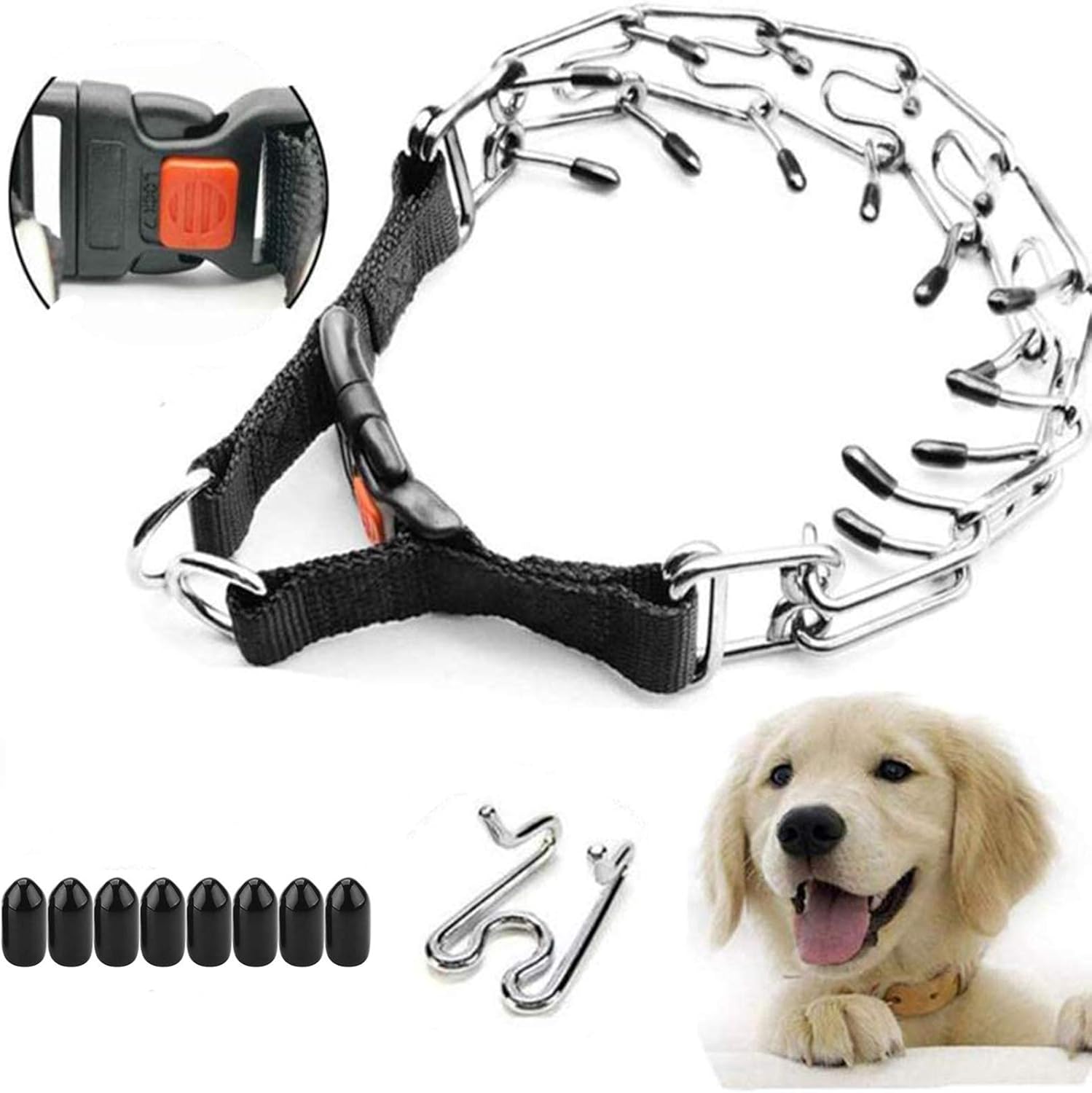
| Material Type | Stainless Steel |
|---|---|
| Included Components | Links, Rubber Caps |
| Closure Type | Buckle |
| Size | M (Neck: 16"–18'') |
The Supet prong training collar is a metal-link pinch collar meant for short, supervised training sessions and daily walks to reduce pulling and improve leash communication. It fastens with a quick-release plastic buckle and uses interlocking chrome-plated links that can be removed or added to fine-tune fit; rubber caps cover the contact points for a gentler feel and can be removed if a firmer correction is needed. Use it high on the neck, just below the ears and under the jaw, for brief cueing rather than continuous wear. Practical benefits include clear, consistent feedback to the dog, durable stainless steel construction, and included extra links so the collar can be adjusted across several neck sizes. Limitations are that pinch-style collars require careful, experienced handling and supervision, and the plastic quick-release buckle, while convenient, is less robust than an all-metal closure. This collar is best treated as a training tool used intermittently rather than an everyday fastening collar.
Best for: Buyers who want an adjustable prong-style training tool that can be finely sized for different necks and used for short, supervised leash training sessions.
Less Ideal for: Owners looking for a daily, hands-off collar solution or users unfamiliar with safe prong collar handling should consider alternative no-pull harnesses or consult a trainer first.
- Adjustable metal links allow precise sizing by adding or removing links
- Rubber caps on contact points reduce sharpness for gentler guidance
- Includes extra links to fit a range of neck sizes
- Chrome-plated stainless steel construction offers strength and corrosion resistance
- Quick-release buckle makes putting on and removing the collar fast and convenient
- Plastic quick-release buckle is less durable than an all-metal closure
- Not intended for unsupervised or continuous wear and demands correct handling
Verdict: The best training prong collar for focused behavior work, providing consistent, safe correction during supervised training sessions.
NozlaID Lightweight Prong Collar M
Best Lightweight Prong Collar
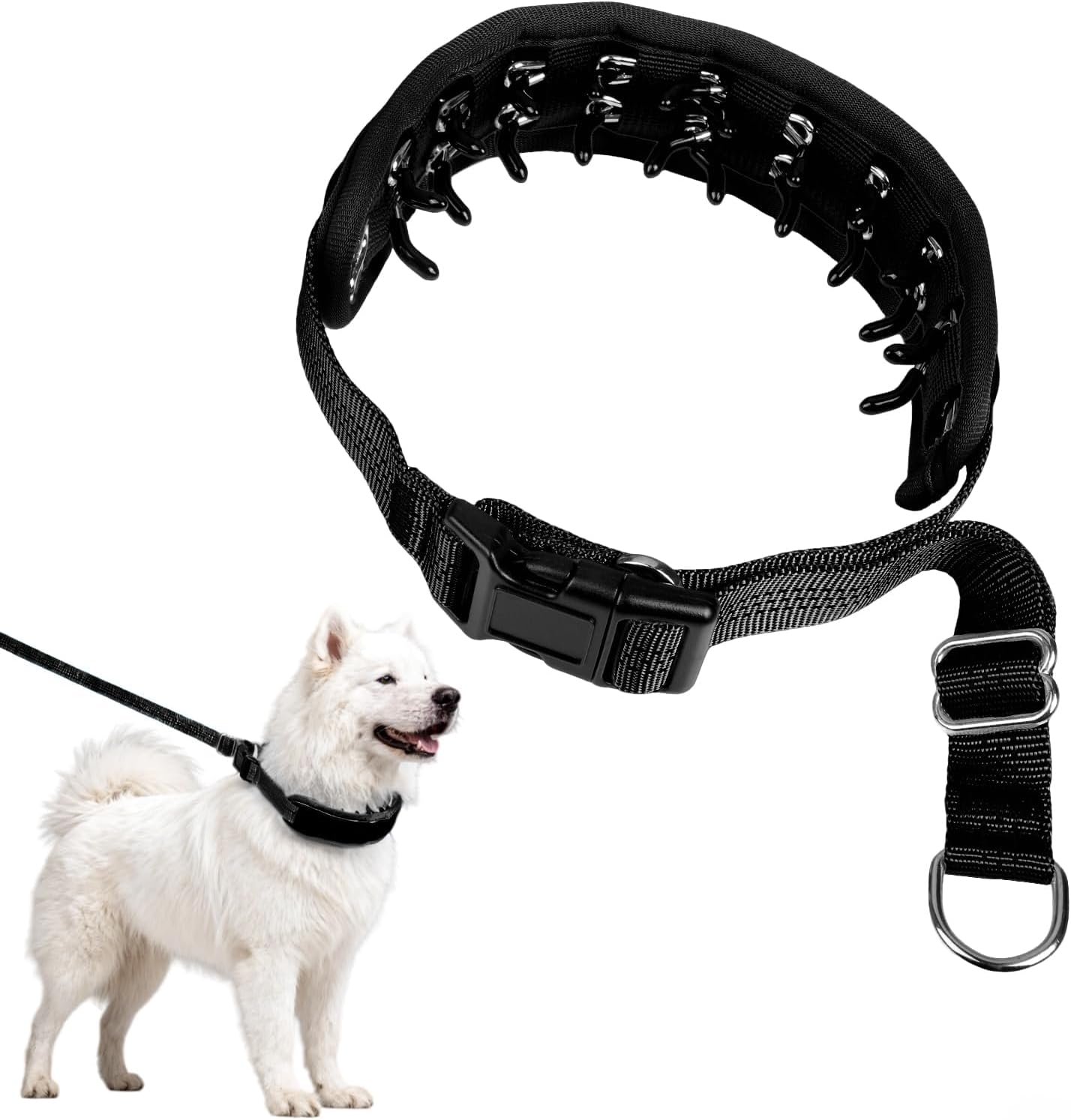
| Size | M (15"-19.5") |
|---|---|
| Included Components | Dog Collar |
| Closure Type | Buckle |
This NozlaID prong-style martingale collar is built to give control without the bulk of traditional metal pinch collars. It uses a high-density woven core and an airflow grid to keep the neck cooler and reduce rubbing during longer sessions, and the reflective stitching improves nighttime visibility. The collar is intended for training and walking scenarios where you need to discourage pulling while keeping corrections more distributed across the neck rather than concentrated. Zinc alloy hardware is rust-resistant and the wipe-clean exterior stands up to mud and rain, though the collar still relies on proper fit and handler technique for safe use. Size M fits a 15" to 19.5" range and adjusts quickly via five holes and a buckle closure, so you can fine-tune fit for larger breeds. Buyers should note it is a training tool that requires supervision and cannot replace professional behavior work for severe reactivity or aggression, and some dogs may still resist the sensation during initial use.
Best for: Owners who prioritize reduced bulk and greater comfort while keeping a prong-style correction available for large, strong dogs and frequent outdoor training.
Less Ideal for: People looking for a gentle everyday flat collar only, or owners of dogs with serious aggression issues who need specialized behavior modification plans.
- Lightweight construction reduces neck strain compared with heavy metal prong collars
- Breathable airflow grid reduces hot spots and skin irritation during long wear
- Full-length reflective stitching improves visibility at night
- Rust-resistant zinc alloy hardware and wipe-clean finish for all-weather durability
- Quick five-hole adjustment and buckle closure for fast, repeatable fit
- Not a substitute for professional training for severe behavior issues
- Requires correct sizing and supervised use to be safe and effective
Verdict: The best lightweight prong collar for owners seeking reduced bulk and greater comfort while retaining effective control and safety.
Choosing the Right Prong Collar Great Dane: Key Factors to Consider
Proper Sizing and Fit
Getting the right size is critical for a Great Dane. A prong collar that is too small can concentrate pressure dangerously, while one that is too large will not provide reliable control or consistent contact. Measure the dog's neck accurately at the widest point and choose a collar where the link count and minimum circumference provide a snug, even fit when closed.
Fit affects how the collar sits on the neck—ideally low on the neck behind the ears but not so low that it presses on the throat. Many prong collars allow you to add or remove links to fine-tune circumference; make small adjustments and observe the dog's response during short training sessions to confirm the setting is both secure and comfortable.
Prong Design and Shape
The prong profile determines how pressure is distributed. Rounded or blunted prongs spread force over a slightly larger surface area compared with sharp points, reducing the risk of skin pinching or localized discomfort. Uniform spacing between prongs helps create even contact around the neck rather than concentrating force in a single spot.
Also consider whether the prongs hinge smoothly at the link connection. Stiff or poorly finished prongs can snag fur and cause uneven pressure, while well-formed prongs move with the dog's neck and deliver more predictable feedback during corrections.
Material Strength and Finish
A Great Dane can generate considerable pulling force, so choose a collar made from robust metal alloys rated for high tensile loads. Links should be stamped or forged rather than thinly bent wire to reduce the chance of deformation under load. A durable finish such as electroplating or stainless steel resists rust and keeps edges smooth over time.
Corrosion resistance matters because rust can create rough surfaces that irritate skin and weaken links. Inspect construction points like welds or rivets conceptually: strong, clean joins will hold up under repeated use and reduce the need for frequent replacement.
Adjustment Range and Modularity
Because adult Great Danes vary in neck size and condition, you want a collar that offers several removable links or a wide size range so you can adjust as needed. Modularity allows you to start with a snug setting and remove links for a closer fit as the dog gains muscle or as you refine training. It also makes storage and transport easier because a multi-link collar can be partially disassembled.
Check how links attach and detach. Tools that require complex procedures to alter link count are inconvenient; simple snap or hook mechanisms let you adapt fit quickly without compromising structural integrity.
Attachment Points and Leash Compatibility
Secure, well-placed attachment rings reduce the risk of accidental release during walks or training. Look for collars with a dedicated center ring for leash clipping that keeps force distributed across the collar rather than pulling a side link out of alignment. A secondary control ring that allows the collar to act as a quick-release catch can be useful for moments when you need a fast disengage.
Compatibility with common leash hardware matters because you may prefer to use specific clips or training tools. Ensure the attachment rings are large and robust enough to accept your leash clip without bending or jamming.
Comfort and Skin Safety
Even when used for corrections, a collar should minimize skin trauma and hair damage. Features that improve comfort include smoothly finished link edges, rounded prong tips, and consistent spacing that avoids pinching. Some collars have protective sleeves or optional pads for brief use; while these change the correction profile, they can reduce irritation during acclimation.
Monitor the dog's skin under the collar after use for redness or hair breakage, and avoid prolonged continuous wear. Comfort-related design choices directly affect how quickly a dog accepts the collar and how effective short, clear training signals will be.
How Tight Should a Prong Collar Sit on a Great Dane's Neck?
A prong collar should fit snugly but not constrict breathing. When closed, it should sit high on the neck just behind the ears with enough contact to deliver even pressure across the links without sliding. You should be able to fit a finger between the collar and neck for a quick check; if the collar moves excessively, remove a link or reduce circumference.
Test tightness during short controlled sessions rather than leaving the collar on for extended periods. Proper tension gives you predictable feedback for training cues and reduces the risk of slippage or shifting that could lead to uneven pressure.
- Place the collar high behind the ears for best leverage.
- Aim for even contact around the neck; avoid gaps.
- Adjust link count gradually and re-check during use.
Can Prong Collars Be Used for Everyday Walks?
Prong collars can be appropriate for regular walks if they are sized and fitted correctly and used by someone who understands how to give brief, consistent cues. They are not intended to be worn continuously and should be put on only for training or supervised walks where control is required. Continuous wear increases risk of skin irritation and reduces the clarity of training signals.
If everyday use is necessary because of safety concerns, follow short-session practices: fit the collar for each walk, monitor the dog's comfort, and remove the collar immediately after the activity. Combine collar use with positive reinforcement techniques to encourage good leash manners without relying solely on correction.
- Use only during supervised sessions, not as a permanent collar.
- Pair with consistent training cues and reward-based reinforcement.
What Maintenance Keeps a Prong Collar Safe and Reliable?
Regular inspection is essential. Check each link for deformation, cracks, or wear and verify that attachment rings and any fasteners are secure. Clean the collar after exposure to sweat, dirt, or moisture to prevent corrosion and keep link joints moving freely. A simple wipe-down and occasional mild scrub will extend service life.
Replace any collar that shows signs of metal fatigue or corrosion. Small issues can escalate quickly under the loads a Great Dane can apply, so err on the side of caution. Store the collar dry and avoid leaving it in damp environments.
- Inspect links and rings before each use.
- Clean and dry after exposure to moisture.
- Disassemble modular collars occasionally to check internal surfaces.
How to Introduce a Prong Collar to a Great Dane
Introduce a prong collar slowly and positively. Let the dog sniff and inspect the collar off the body, then briefly fit it for short sessions while offering treats and calm praise. Keep initial sessions low intensity so the dog learns to associate the collar with predictable cues rather than stress.
Begin with simple leash-walking drills and reward compliance. Watch for signs of discomfort or anxiety and stop if the dog shows persistent avoidance. Gradual introduction helps the dog accept the tool and lets you refine fit and link count without rushing adaptation.
- Start with short, positive sessions.
- Use treats and calm reinforcement when first fitting the collar.
- Gradually increase duration as the dog tolerates it.
Are There Alternative Handling Tools Worth Considering?
Yes. Depending on the training goal, alternatives like front-clip harnesses, head halters, or body harnesses can provide control without using prongs. Each alternative has a different effect on steering and pressure distribution, and some owners prefer them for routine walks or for dogs that do not respond well to neck-based cues.
When considering alternatives, match the tool to the specific behavior you want to change. For example, front-clip harnesses reduce pulling by redirecting the dog's shoulder line, while head halters change the line of force near the head. Evaluate whether an alternative supports your long-term training objectives and the physical comfort of a large-breed dog.
- Assess whether the training objective requires neck pressure.
- Trial different tools under supervision to see which yields the best, most humane results.
How We Chose the Best Prong Collar Great Dane
To assemble this list we applied a strict set of criteria tailored to large-breed use and safety. We prioritized fit range and sizing options that reliably cover adult Great Dane neck measurements, because correct sizing is the single biggest factor in safe, effective prong collar use. Material quality and metal alloy strength were required filters; we favored collars with corrosion-resistant finishes and solid link construction to withstand the forces a large dog can exert. We also assessed ring configuration and attachment options to ensure secure leash connection and predictable pressure distribution. Ease of adjustment and the availability of multiple link sizes mattered because owners may need to fine-tune tension and remove links as the dog's conditioning changes. Comfort-focused details such as rounded prongs and smooth link edges were included as explicit selection criteria. Finally, we excluded any collars with thin wire construction, brittle finishes, or limited sizing that would not meet the durability and safety demands of a Great Dane.
Our full evaluation process is outlined in our review methodology.
FAQ
Will a prong collar hurt my Great Dane?
When sized and used correctly, a prong collar provides brief, evenly distributed pressure rather than prolonged pain. Improper fit or misuse can cause discomfort or skin issues, so education on correct placement and short supervised sessions is important.
How often should I use a prong collar with a Great Dane?
Frequency depends on training goals. Many owners use prong collars for focused training sessions or for walks where extra control is needed, not for continuous daily wear. Use short, consistent sessions paired with positive reinforcement to maintain progress.
Can I leave a prong collar on between walks?
No. It is safer to put the collar on only for supervised walks or training sessions. Leaving it on for long periods increases the chance of chafing, hair breakage, and unclear signals that reduce training effectiveness.
How do I know when to remove or add links?
Adjust links when you notice excessive sliding or gap formation, or after the dog's neck changes due to weight or conditioning. Make small adjustments and observe response during short sessions until the collar maintains even contact without pinching.
Are rust or finish chips a safety concern?
Yes. Corrosion and chipped finishes can create rough edges that irritate skin and weaken the metal. Inspect collars regularly and replace any component that shows rust, pitting, or structural damage.
Final Verdict
Choosing a prong collar for a Great Dane means balancing secure handling with careful attention to fit, materials, and responsible use. Prioritize collars that offer an accurate sizing range, solid link construction, and smooth prong finishes so corrections remain consistent and safe. Remember that this tool works best as part of a structured training plan with short, supervised sessions and positive reinforcement. If you focus on proper sizing, routine inspection, and gradual introduction, you can select a prong collar that gives reliable control while minimizing risk. Favor durable construction and adjustable designs so you can refine fit as the dog's condition changes and feel confident using the collar when safety or training demand it.

