

If you handle a powerful or strong-pulling dog, choosing the right prong collar matters for control, handler safety, and the dog's comfort. A properly selected prong collar can help you manage leash pressure more predictably while reducing the risk of sudden neck torque when used correctly. This guide shortlists the top options for large dogs and explains how we evaluated fit, construction, and adjustability. Read on to find a collar that matches your dog's size, temperament, and training needs before you move to product specifics.
Top Picks at a Glance
| Best Overall Prong Collar for Large Dogs A balanced choice combining effectiveness, fit, and durable construction | Herm Sprenger Ultra-Plus Prong Collar 25in |  |
| Best Budget Prong Collar for Large Dogs A low-cost option that still delivers reliable basic performance | Aheasoun Prong Dog Collar Large |  |
| Best Premium Prong Collar Higher-end build and finish for owners seeking superior materials | Herm Sprenger Prong Collar 23in |  |
| Best Stainless-Steel Prong Collar Corrosion-resistant metal for long-lasting strength and low maintenance | Downtown Pet Supply Prong Collar Large |  |
| Best Adjustable Prong Collar Easy sizing adjustments for a more precise, comfortable fit | Supet Prong Training Collar Medium |  |
| Best Safety-Release Prong Collar Includes quick-release or fail-safe features for added safety | MR.BEEFOO Prong Training Collar M/L |  |
Herm Sprenger Ultra-Plus Prong Collar 25in
Best Overall Prong Collar for Large Dogs

| Material Type | Stainless Steel |
|---|---|
| Size | 25in (63cm) x 4mm |
| Breed Recommendation | Large Breeds |
| Included Components | Dog Collar |
The Herm Sprenger Ultra-Plus prong collar is a professional-grade stainless steel training tool intended to give firm, even pressure around a large dog's neck during obedience work. It slips over the head and tightens through interlocking links that each carry two blunt, slightly beveled prongs; links can be removed or added to fine-tune fit. The center plate connector helps the collar tighten symmetrically instead of twisting, and the stainless construction is corrosion-resistant for long life. In practice this collar is used for on-leash training to reduce pulling and reinforce corrections when combined with consistent handler timing. Its metal build and O-ring attachment make it durable and simple to attach to a leash, but the prong action is noticeable on the skin and requires an owner who understands proper sizing and handling. The collar is adjustable by link so you can get a snug placement just below the ears, though adding links is a manual process and replacement links are sold separately. This is a no-frills, heavy-duty option for owners seeking predictable, factory-quality correction in training sessions.
Best for: Owners of large dogs who want a durable, reliable training tool that delivers consistent corrective pressure and who are comfortable using prong collars as part of a structured training plan.
Less Ideal for: Pet owners who prefer gentle, force-free training methods or who are inexperienced with corrective collars should consider alternative training tools and consult a professional trainer.
- High-quality German stainless steel construction for durability and corrosion resistance
- Interlocking links with blunt, slightly beveled prongs allow incremental size adjustment
- Center plate connector provides symmetrical tightening to prevent twisting
- Slips on over the head for quick on/off and uses standard O-ring leash attachment
- Requires knowledge of proper fit and handling to avoid misuse
- Replacement links must be purchased separately to significantly change size
Verdict: The best overall prong collar for large dogs balances secure correction, adjustable fit, durable materials, and comfort so most owners get reliable training results without unnecessary complexity.
Aheasoun Prong Dog Collar Large
Best Budget Prong Collar for Large Dogs

| Size | Large, 4.0mm, 23.6-Inch |
|---|---|
| Material Type | Rubber, Stainless Steel |
| Included Components | dog prong collar |
This Aheasoun prong collar is a straightforward, budget-minded training collar that uses interlocking stainless steel links with rubber tips to apply even pressure to the sides of the neck. It is sized for larger dogs and can be shortened or lengthened by removing or adding links, and it includes spare rubber tips for the prongs. In use it functions like most pinch collars: clipped on with the D-ring for leash attachment and tightened to provide quick corrective signals during leash training or to stop hard pulls. The chrome plating and rubber tips help reduce sharp contact and the manufacturer notes trainers recommend stainless steel construction for durability. Limitations are typical for this category: it is meant for short training sessions rather than constant wear and requires correct sizing and fitting to avoid misuse, and the simple pull-on closure offers no micro-adjustments compared with specialized mechanisms. For someone wanting an economical, serviceable prong collar for periodic correction, this model delivers the basics without extras.
Best for: Buyers who need a low-cost, no-frills training collar to deliver effective leash corrections during short training sessions and are comfortable fitting and using a prong-style tool safely.
Less Ideal for: Owners looking for a collar for continuous everyday wear, or those who prefer softer, non-aversive training tools and precise adjustment mechanisms.
- Adjustable link design lets you customize fit by adding or removing chain links.
- Made from chrome-plated stainless steel for acceptable corrosion resistance and strength.
- Rubber-tipped prongs reduce sharp contact and include extras in the package.
- Simple D-ring closure is quick to attach and works with standard leashes.
- Not intended for continuous wear; designed for short training sessions only.
- Pull-on closure offers limited fine-tuning compared with some locking or quick-release systems.
Verdict: The best budget prong collar for large dogs gives owners an affordable, safe, and functional training tool that covers essential fit and durability needs without premium features.
Herm Sprenger Prong Collar 23in
Best Premium Prong Collar
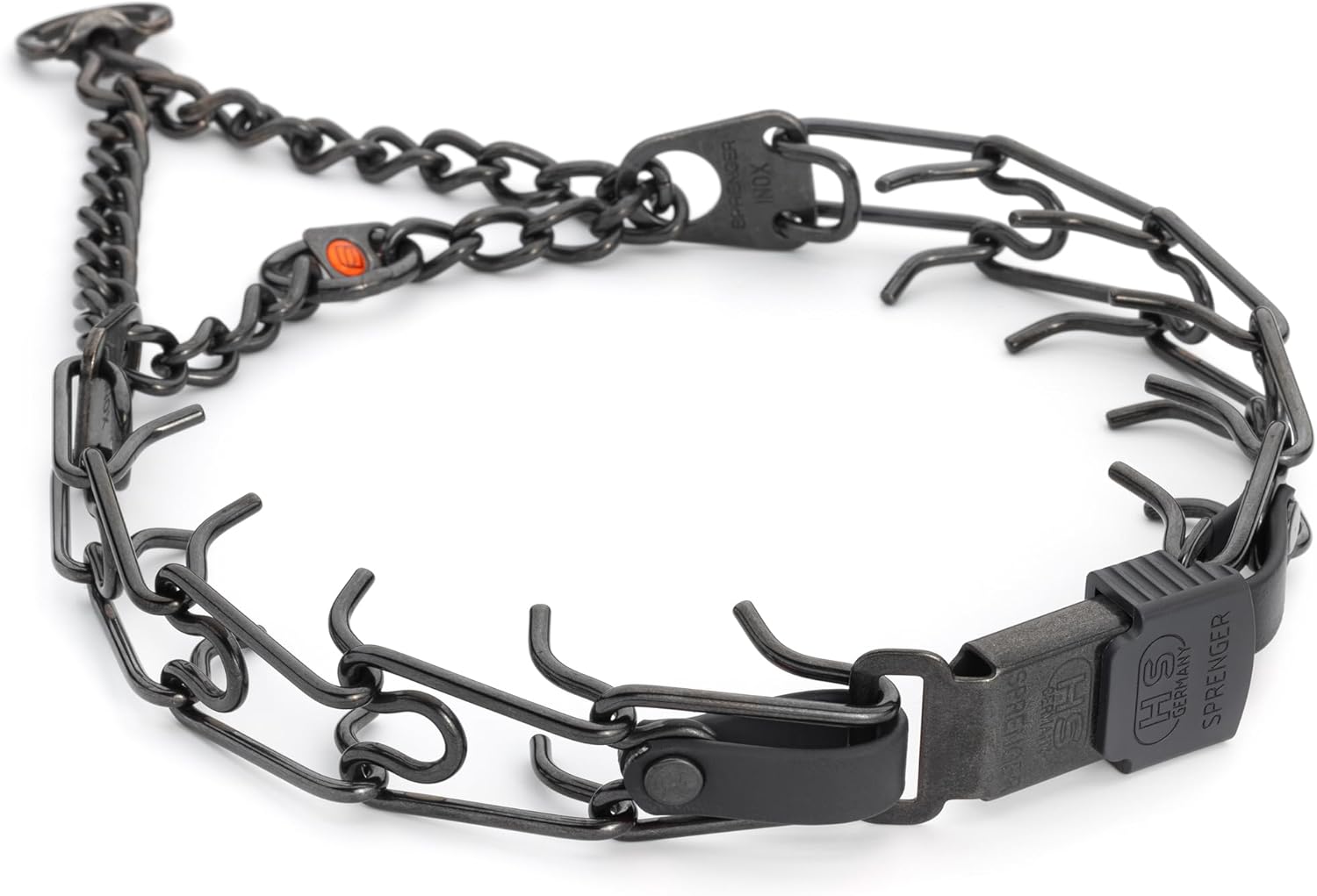
| Size | 23in x 3.2mm (neck size up to 19-20in) |
|---|---|
| Material Type | Black Stainless Steel |
| Closure Type | Buckle |
| Included Components | Dog Collar |
This Herm Sprenger prong collar is a premium training collar built from black stainless steel with a ClickLock quick-release buckle, a U.S.-made Biothane insert, and a 360-degree swivel D-ring. It is used as a training aid that tightens through the chain loop when a dog pulls, helping owners communicate corrections during walks or sessions; the ClickLock buckle lets you open and close the collar without pulling it over the head, and the Biothane insert improves buckle stability and adds a finished look. Practical benefits include durable German-made steel for longevity, a secure but removable plastic jacket that slides on the unfastened buckle, and the swivel ring that prevents leash tangles. Important limitations are that this is a corrective training tool that must be fitted and used carefully—it needs to sit snugly under the ears and jawline and is not a walk-only buckle like a standard collar. Buyers should be comfortable with prong-style training methods and know how to size and adjust pronged links for a safe fit.
Best for: Owners seeking a long-lasting, well-finished prong collar for serious training of large dogs who prioritize build quality and reliable hardware.
Less Ideal for: Casual owners wanting a simple everyday collar, or anyone unfamiliar with safe prong collar fitting and handling should consider alternative training tools.
- Premium black stainless steel construction for durability and longevity
- ClickLock quick-release buckle for easy on/off without removing over the head
- Biothane insert adds buckle stability and a finished, low-maintenance surface
- Swivel D-ring provides 360-degree rotation to reduce leash tangles
- Requires correct fit and knowledgeable use since it is a corrective training tool
- Not suitable as a day-to-day identification collar or for owners who do not use prong training methods
Verdict: The best premium prong collar offers superior materials, refined construction, and extra comfort or finish details for owners willing to pay more for longevity and ride quality.
Downtown Pet Supply Prong Collar Large
Best Stainless-Steel Prong Collar

| Breed Recommendation | All Breed Sizes |
|---|---|
| Dog Breed Size | Large |
| Material Type | Alloy Steel |
| Item Length | 22 inches |
This chrome-plated prong collar is a metal training collar with removable links so you can size it to your dog and use it to correct strong pulling and lunging during walks. It is designed for large dogs over 50 pounds and up to a 22 inch neck, and the flat-tipped, rounded prongs aim to apply even pressure without cutting or causing injury. The collar is chrome-plated alloy steel, which resists rust and provides a heavier, more robust feel suitable for repeated use and outdoor training. Links are removable and reattach by pinching the prongs, allowing incremental adjustments for a closer or looser fit. The collar uses a pull-on closure rather than a buckle, so it functions more like a traditional correction collar and requires correct placement and handler skill to be effective and safe. Limitations include the need for careful fitting and supervised use since this style is only appropriate for training corrections and not for everyday, unattended wear. Novice handlers should learn proper technique before using this on a strong or reactive dog.
Best for: Buyers seeking a rugged, metal training collar for powerful or hard-pulling large dogs who plan to use it as an occasional training aid with proper technique and supervision.
Less Ideal for: Owners who want an everyday, hands-off collar or who are uncomfortable with correction-style training should consider harnesses or positive-reward tools instead.
- Chrome-plated alloy steel construction resists rust and feels durable for heavy use
- Removable links let you fine-tune the fit for incremental sizing
- Flat-tipped, rounded prongs designed to distribute pressure without cutting
- Designed for large, powerful dogs with a 22 inch neck width and pull-on correction closure
- Requires correct fit and experienced handling to avoid misuse
- Not intended for continuous or unsupervised wear
Verdict: The best stainless-steel prong collar uses corrosion-resistant metal and robust finishes to stay durable in wet or outdoor conditions while maintaining reliable performance.
Supet Prong Training Collar Medium
Best Adjustable Prong Collar
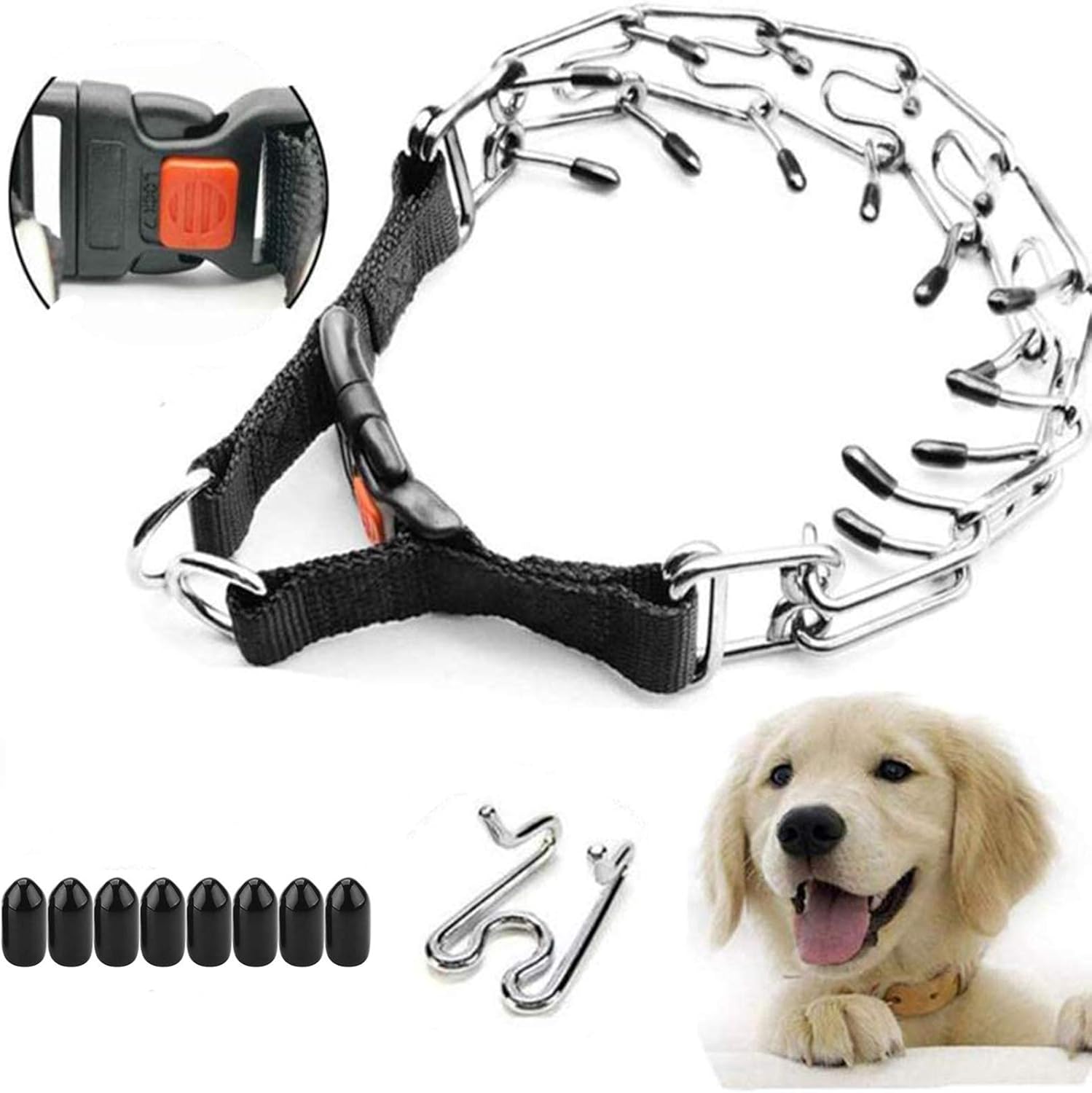
| Material Type | Stainless Steel |
|---|---|
| Included Components | Links, Rubber Caps |
| Closure Type | Buckle |
| Size | M (Neck: 16"–18'') |
The Supet prong training collar is a metal-link pinch collar meant for short, supervised training sessions and daily walks to reduce pulling and improve leash communication. It fastens with a quick-release plastic buckle and uses interlocking chrome-plated links that can be removed or added to fine-tune fit; rubber caps cover the contact points for a gentler feel and can be removed if a firmer correction is needed. Use it high on the neck, just below the ears and under the jaw, for brief cueing rather than continuous wear. Practical benefits include clear, consistent feedback to the dog, durable stainless steel construction, and included extra links so the collar can be adjusted across several neck sizes. Limitations are that pinch-style collars require careful, experienced handling and supervision, and the plastic quick-release buckle, while convenient, is less robust than an all-metal closure. This collar is best treated as a training tool used intermittently rather than an everyday fastening collar.
Best for: Buyers who want an adjustable prong-style training tool that can be finely sized for different necks and used for short, supervised leash training sessions.
Less Ideal for: Owners looking for a daily, hands-off collar solution or users unfamiliar with safe prong collar handling should consider alternative no-pull harnesses or consult a trainer first.
- Adjustable metal links allow precise sizing by adding or removing links
- Rubber caps on contact points reduce sharpness for gentler guidance
- Includes extra links to fit a range of neck sizes
- Chrome-plated stainless steel construction offers strength and corrosion resistance
- Quick-release buckle makes putting on and removing the collar fast and convenient
- Plastic quick-release buckle is less durable than an all-metal closure
- Not intended for unsupervised or continuous wear and demands correct handling
Verdict: The best adjustable prong collar offers simple, secure sizing options so owners can fine-tune fit for both safety and effective, consistent corrections during training.
MR.BEEFOO Prong Training Collar M/L
Best Safety-Release Prong Collar
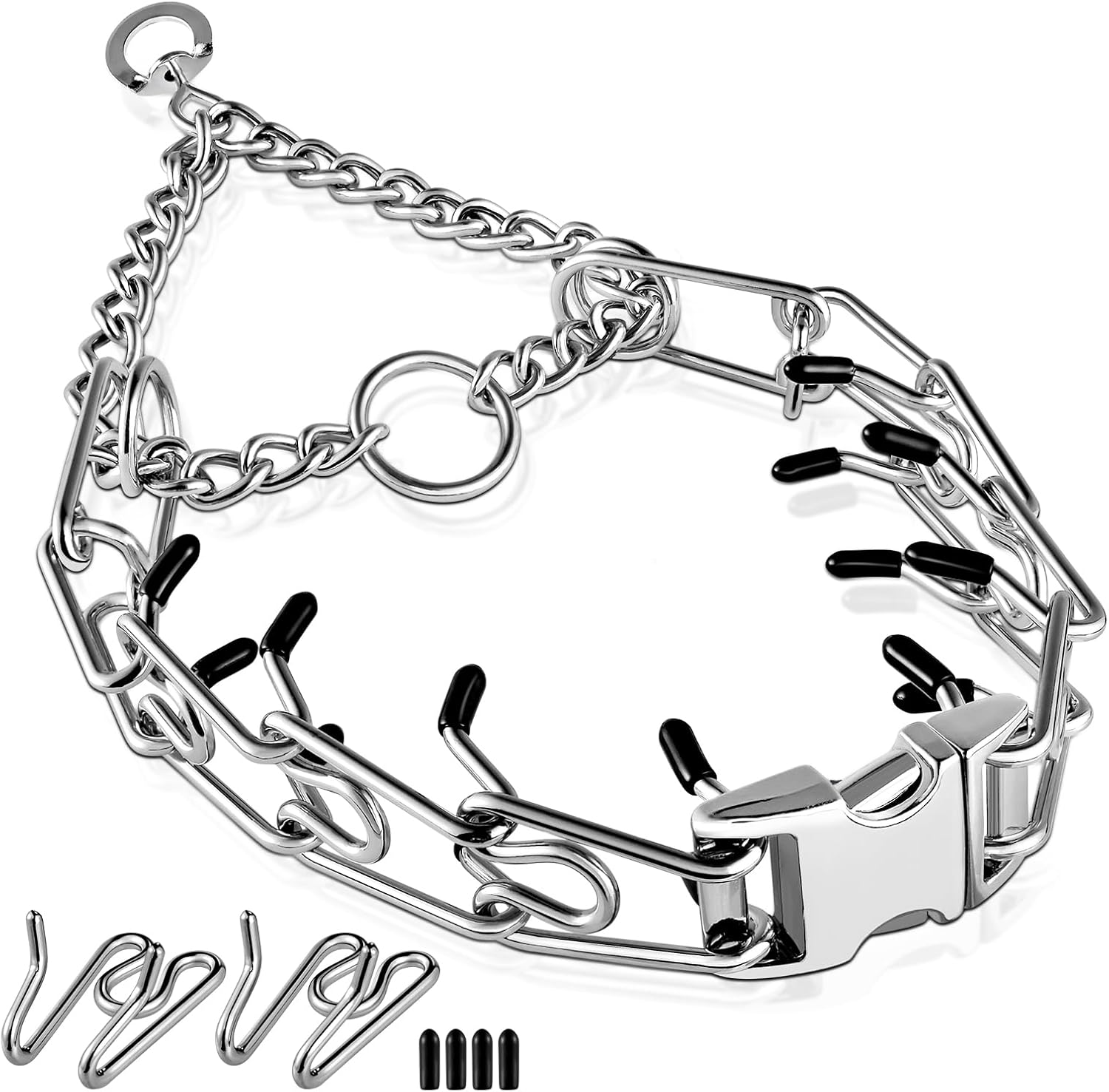
| Size | M/L / 18-23" Neck Size |
|---|---|
| Material Type | Nickel-plated Steel |
| Included Components | 2 Spare Links, 28pcs Rubber Covers |
| Closure Type | Release Buckle |
This MR.BEEFOO prong training collar is built as a metal pinch collar that combines the traditional interlocking prong links with a quick-release clasp for faster on/off. It is typically used for leash-based training and pull correction on large, strong dogs and comes with spare links and rubber tips so you can size it and soften prong contact. The collar's chrome-plated nickel-steel construction and secure swivel ring mean the links lock together tightly and require pliers to adjust, which reduces the chance of accidental separation during strong tugs. The quick-release buckle makes putting the collar on or removing it much faster than a full chain-only design, and the included rubber caps let you reduce sharpness for dogs that need gentler pressure. Important limitations: proper fit and responsible handling are essential because prong collars apply pressure to the neck, and the metal links can still pinch if not fitted or used correctly; adjusting length requires tools and the removable links add setup time.
Best for: Buyers who need a durable prong-style collar with a safety-release mechanism for training powerful or large-breed dogs and who plan to use it as part of supervised leash correction.
Less Ideal for: Owners looking for a completely pressure-free or non-corrective training tool, or those uncomfortable with metal prong-style collars and without experience in corrective leash training.
- Quick-release buckle for faster, easier on and off during training sessions
- Secure interlocking metal links and swivel ring reduce risk of accidental separation
- Includes spare links for size customization and rubber tips to soften contact
- Chrome-plated nickel-steel construction is durable for strong, large dogs
- Sizing requires pliers to add or remove links which is less convenient in the field
- Still applies neck pressure and requires correct fitting and experienced handling
Verdict: The best safety-release prong collar includes quick-release or fail-safe mechanisms that reduce risk during unexpected tugs while still providing controlled correction when used properly.
Choosing the Right Prong Collar Large Dog: Key Factors to Consider
Proper Fit and Sizing
A prong collar must sit high on the dog's neck and fit snugly without restricting breathing. Measure the neck where a standard training collar would sit, and choose a size that allows the collar to sit comfortably behind the ears with enough room to handle two fingers. Incorrect sizing concentrates force in the wrong place and increases the chance of slipping or excessive pressure.
For large dogs, small deviations in sizing make a bigger difference because of stronger force vectors. Look for collars that list clear size ranges, provide multiple link counts, or allow link removal so you can fine-tune the circumference. Proper fit also reduces chafing and helps ensure the correction is delivered as intended rather than at a weird angle.
Material Quality and Finish
The metal used for links and hardware affects longevity, weight, and corrosion resistance. Heavy-gauge steel or plated alloys are common; higher-quality finishes reduce rusting and rough edges. For large dogs, links and rings must withstand greater loads without bending or separating.
Pay attention to edge finishing and link machining. Smooth, well-formed prongs move predictably and are less likely to cause hot spots. Weld quality on closures and the robustness of attachment points are also important because failure can lead to loss of control under load.
Link and Prong Design
Not all prong collars use the same link geometry. Some feature rounded, spoon-like prongs while others are flatter with different contact areas. The design determines how pressure is distributed around the neck and how likely the collar is to pinch or shift.
For large dogs, choose a design that spreads pressure evenly and resists twisting when the dog lunges. Links that articulate smoothly and sit flush against each other prevent snagging and ensure the collar tightens uniformly. Consider how easy it is to add or remove links to adjust fit.
Closure, Safety Catch, and Hardware
Secure fastening is essential for peaceful handling. Collars for large dogs should have a reliable connection that does not open under tension, a clear point for leash attachment, and ideally a safety mechanism or backup to prevent accidental release. Hardware such as D-rings and swivels should be robust and proportioned for heavier leashes and stronger pulls.
Small or flimsy snaps can fail when a large dog surges. Evaluate the geometry of the leash attachment to avoid angles that encourage torque on the neck. Where present, quick-release sections should be tested for durability and should not be the sole retention method under load.
Weight and Balance
Heavier metal collars may be more durable but can feel cumbersome on a large dog, especially for long walks. Balance the need for strength with a weight that the dog can carry without discomfort. A collar that is too light may flex or deform; one that is too heavy can alter natural head carriage and cause fatigue.
Consider link thickness, overall circumference, and the distribution of mass. Design choices such as hollow links or lighter alloys can reduce weight without sacrificing structural integrity when properly engineered.
Ease of Adjustment and Maintenance
Owners need to be able to add or remove links to achieve the proper fit and to clean or service the collar. For large dogs you will likely adjust fit as the dog changes condition or coat thickness, so accessible link removal matters. Look for collars with straightforward link designs that do not require special tools.
Maintenance also includes corrosion prevention. Choose finishes that resist rust and are easy to wipe clean. Regular inspection for bent links, worn welds, or sharp edges is part of safe long-term use.
How Should a Prong Collar Sit on a Large Dog's Neck?
A prong collar should sit high on the neck, just behind the jawline and below the ears. This position provides the most direct leverage with the least chance of slippage and ensures corrections affect the area trainers expect.
When fitted correctly, the collar should be snug but not tight: you should be able to feel the collar against the neck but not compress the windpipe. Check positioning at the start of each walk, especially on thick-coated dogs where the collar can drift.
- Place the collar high, directly behind the ears and jaw.
- Aim for a snug fit that does not compress the trachea.
- Re-check fit after a few minutes of activity to ensure the collar has not shifted.
What Safety Practices Reduce Risk when Using a Prong Collar?
Use a prong collar as a training tool under informed supervision rather than as a permanent restraint. Employ short, guided sessions and combine the collar with positive training methods so corrections are clear and infrequent.
Always use a separate leash attachment rather than looping a leash through the collar in ways that create unsafe angles. Inspect the collar regularly for bent links or sharp edges and remove it for unsupervised tethering or long periods when the dog is unattended.
- Limit full-strength corrections to short, focused training sessions.
- Do not leave a prong collar on an unattended dog.
- Inspect hardware and link alignment before each use.
How to Measure Your Large Dog for the Right Prong Collar Size
Measure the circumference of the neck where the collar should sit, using a flexible tape measure. Record that measurement and compare it to the collar's specified fit range. If the collar uses removable links, determine how many links are needed to reach the correct circumference.
If you are between sizes, opt for the size that allows link removal or use the smaller size with added links rather than a collar that will slide too freely. Accurate measurement reduces the chance of adjustments during training and improves the consistency of corrections.
- Measure high on the neck behind the jawline.
- Account for coat thickness when measuring.
- Prefer adjustable-link designs if your dog's size is borderline.
When Should You Consider Alternatives to a Prong Collar?
Alternatives may be appropriate if the dog has neck injuries, a medical condition affecting the spine or throat, or extreme sensitivity to neck pressure. In such cases, front-clip harnesses or head halters can offer control with different pressure distribution.
Also consider alternatives if you or your handler feel uncomfortable using corrective tools. Training tools are most effective when the handler is confident and trained in their use. Professional advice from a trainer can help identify whether a prong collar is the right tool for a specific behavioral goal.
- Avoid prong collars for dogs with neck or throat injuries.
- Seek professional guidance when uncertain about tool selection.
- Evaluate alternatives for handlers who cannot apply consistent, brief corrections.
How to Care for and Inspect a Metal Prong Collar
Regular maintenance prolongs service life and keeps safety risks low. Wipe the collar after wet walks and inspect links for rust, cracks, or deformation. Pay special attention to welds, link joints, and the leash attachment point.
If you find bent links, sharp edges, or compromised hardware, retire the collar immediately. Store metal collars in a dry area and periodically lubricate moving parts if recommended by the manufacturer to keep articulation smooth.
- Wipe dry after exposure to moisture.
- Inspect links and welds before use.
- Replace the collar if any structural damage is found.
How We Chose the Best Prong Collar Large Dog
We screened collars against practical, training-focused standards that matter for large dogs. Primary evaluation criteria included fit and sizing options to ensure a secure, anatomy-appropriate fit; construction and materials such as metal quality and finishing that affect durability and corrosion resistance; link design and smoothness to reduce pinch points and ensure even pressure distribution; and safety features including reliable closures, swivels, and edge finishing to minimize rubbing. We also weighed adjustability and ease of use during on-leash corrections, plus compatibility with standard leashes and training setups. To keep recommendations useful and widely applicable, we excluded collars with limited sizing for very small dogs, novelty-only designs, and products lacking clear construction details. We prioritized designs with repeatable, predictable mechanics rather than ones that rely on unusual hardware. Final selections are those that met multiple criteria for large-dog handling, offering robust materials, sensible link geometry, and practical adjustment range.
Our full evaluation process is outlined in our review methodology.
FAQ
Can a prong collar hurt my large dog?
Used properly, prong collars distribute pressure across several points and are not meant to injure. However, improper fit or harsh, repeated corrections can cause pain. Follow fit guidelines, use brief corrections only, and monitor your dog's response.
How often should I use a prong collar in training?
Use it for focused, short training sessions rather than all-day wear. Many handlers use prong collars during leash training or behavior correction sessions and switch to a regular collar or harness for general outings.
Will a heavy large-dog prong collar be uncomfortable on long walks?
A very heavy collar can alter head carriage and cause fatigue over long periods. For extended walks, consider a lighter model or alternate to a harness once the dog responds reliably to commands.
How do I know when to remove or add links?
Start with a snug fit and remove or add links if the collar shifts or pinches. The correct number of links allows the collar to tighten uniformly without sliding to the throat or hanging loosely when relaxed.
Can I attach tags to a prong collar?
It is not recommended to attach identification tags to a prong collar because they can interfere with link articulation and may create noise or pressure points. Keep ID on a separate flat collar worn when the prong collar is not in use.
Final Verdict
When selecting a prong collar for a large dog, prioritize correct fit, robust construction, and a design that distributes pressure evenly. Decide on the collar weight and hardware strength based on the dog's size and typical activity, and ensure you can adjust and maintain the collar easily. Balance the need for control with safety practices: use the collar for targeted training sessions, inspect it regularly, and consider alternatives if there are medical or comfort concerns. With proper selection and responsible use, a prong collar can be an effective tool for handling strong, large dogs.

