

If you own a Rottweiler and need stronger, more precise leash control, choosing the right prong collar matters for everyday walks and training sessions. The wrong collar can be uncomfortable or unsafe, while a correctly sized and well-made prong collar can improve communication and reduce pulling when used properly by a competent handler. This guide shortlists the top prong collars suitable for Rottweilers and explains the features that matter most, including fit, material quality, and ease of adjustment. Read on to see the options we considered and the evaluation criteria that guided our selections.
Top Picks at a Glance
| Best Overall Prong Collar for Rottweiler The best all‑around prong collar for most Rottweiler owners | Supet Prong Training Collar Medium |  |
| Best Budget Prong Collar for Rottweiler A reliable low-cost prong collar that still performs well | Aheasoun Prong Dog Collar Large |  |
| Best Heavy-Duty Prong Collar Built for powerful dogs and frequent, rigorous use | Mayerzon Heavy Duty No Pull Collar Large |  |
| Best Adjustable Prong Collar Easy to size and customize for a precise fit | AKDNZ No Pull Prong Collar 3mm M/L |  |
| Best Stainless-Steel Prong Collar Corrosion-resistant metal for longevity and outdoor use | Titan Easy-On Prong Dog Collar 20" |  |
| Best Comfort-Lined Prong Collar Extra padding or rounded links to reduce pinching | Supet Dog Prong Collar Large |  |
| Best Premium Prong Collar Higher-end materials and finish for discerning owners | Herm Sprenger Prong Training Collar 23 in |  |
Supet Prong Training Collar Medium
Best Overall Prong Collar for Rottweiler
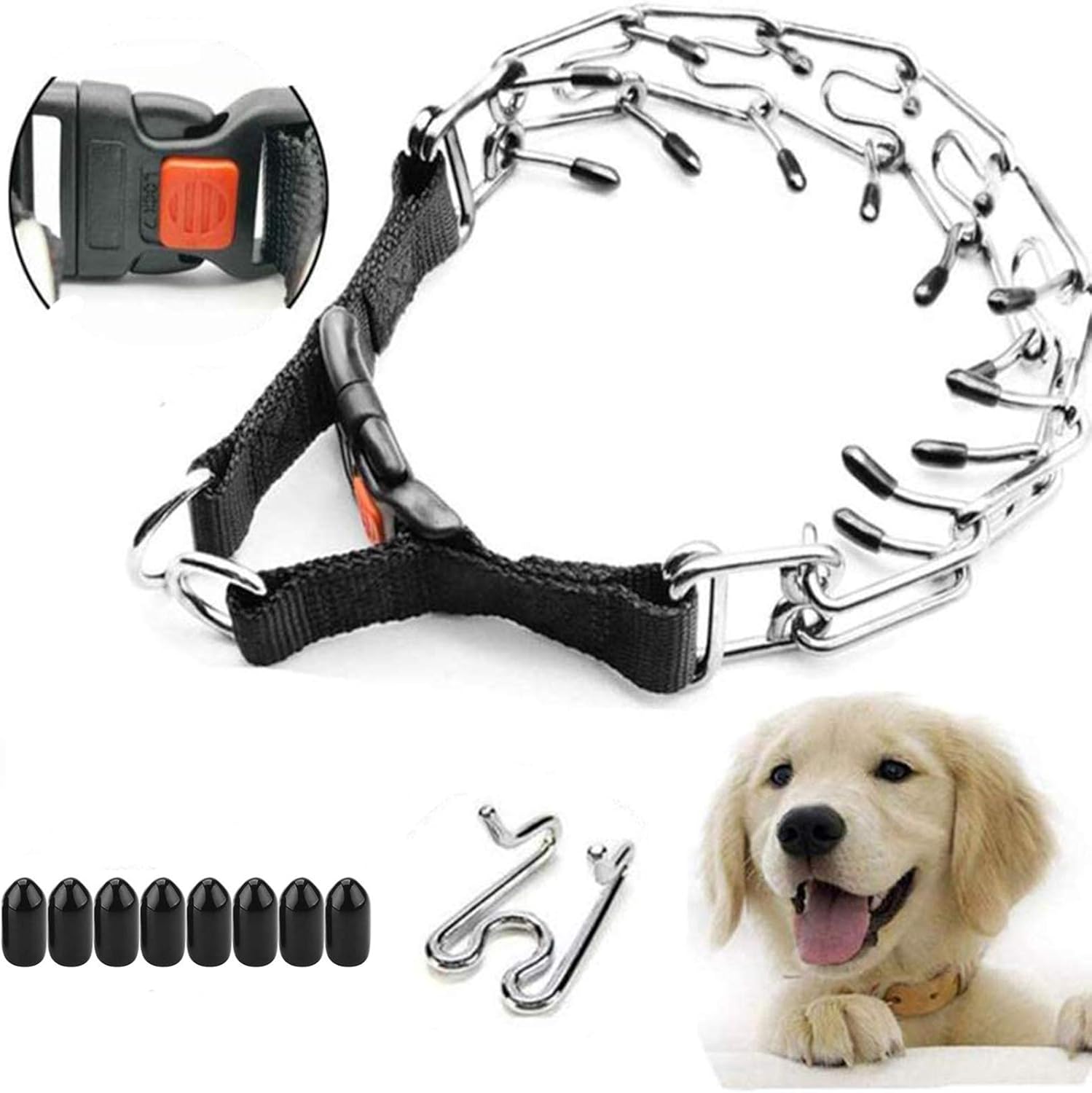
| Material Type | Stainless Steel |
|---|---|
| Included Components | Links, Rubber Caps |
| Closure Type | Buckle |
| Size | M (Neck: 16"–18'') |
The Supet prong training collar is a metal-link pinch collar meant for short, supervised training sessions and daily walks to reduce pulling and improve leash communication. It fastens with a quick-release plastic buckle and uses interlocking chrome-plated links that can be removed or added to fine-tune fit; rubber caps cover the contact points for a gentler feel and can be removed if a firmer correction is needed. Use it high on the neck, just below the ears and under the jaw, for brief cueing rather than continuous wear. Practical benefits include clear, consistent feedback to the dog, durable stainless steel construction, and included extra links so the collar can be adjusted across several neck sizes. Limitations are that pinch-style collars require careful, experienced handling and supervision, and the plastic quick-release buckle, while convenient, is less robust than an all-metal closure. This collar is best treated as a training tool used intermittently rather than an everyday fastening collar.
Best for: Buyers who want an adjustable prong-style training tool that can be finely sized for different necks and used for short, supervised leash training sessions.
Less Ideal for: Owners looking for a daily, hands-off collar solution or users unfamiliar with safe prong collar handling should consider alternative no-pull harnesses or consult a trainer first.
- Adjustable metal links allow precise sizing by adding or removing links
- Rubber caps on contact points reduce sharpness for gentler guidance
- Includes extra links to fit a range of neck sizes
- Chrome-plated stainless steel construction offers strength and corrosion resistance
- Quick-release buckle makes putting on and removing the collar fast and convenient
- Plastic quick-release buckle is less durable than an all-metal closure
- Not intended for unsupervised or continuous wear and demands correct handling
Verdict: The best overall prong collar for Rottweilers that balances fit, durable construction, effective control, and safe use for everyday training and walks.
Aheasoun Prong Dog Collar Large
Best Budget Prong Collar for Rottweiler

| Size | Large, 4.0mm, 23.6-Inch |
|---|---|
| Material Type | Rubber, Stainless Steel |
| Included Components | dog prong collar |
This Aheasoun prong collar is a straightforward, budget-minded training collar that uses interlocking stainless steel links with rubber tips to apply even pressure to the sides of the neck. It is sized for larger dogs and can be shortened or lengthened by removing or adding links, and it includes spare rubber tips for the prongs. In use it functions like most pinch collars: clipped on with the D-ring for leash attachment and tightened to provide quick corrective signals during leash training or to stop hard pulls. The chrome plating and rubber tips help reduce sharp contact and the manufacturer notes trainers recommend stainless steel construction for durability. Limitations are typical for this category: it is meant for short training sessions rather than constant wear and requires correct sizing and fitting to avoid misuse, and the simple pull-on closure offers no micro-adjustments compared with specialized mechanisms. For someone wanting an economical, serviceable prong collar for periodic correction, this model delivers the basics without extras.
Best for: Buyers who need a low-cost, no-frills training collar to deliver effective leash corrections during short training sessions and are comfortable fitting and using a prong-style tool safely.
Less Ideal for: Owners looking for a collar for continuous everyday wear, or those who prefer softer, non-aversive training tools and precise adjustment mechanisms.
- Adjustable link design lets you customize fit by adding or removing chain links.
- Made from chrome-plated stainless steel for acceptable corrosion resistance and strength.
- Rubber-tipped prongs reduce sharp contact and include extras in the package.
- Simple D-ring closure is quick to attach and works with standard leashes.
- Not intended for continuous wear; designed for short training sessions only.
- Pull-on closure offers limited fine-tuning compared with some locking or quick-release systems.
Verdict: The best budget prong collar for Rottweilers that provides secure control and acceptable durability for owners who need an affordable training option.
Mayerzon Heavy Duty No Pull Collar Large
Best Heavy-Duty Prong Collar

| Size | Large, 2.5mm, 18.5"-21.25" Neck |
|---|---|
| Closure Type | Buckle |
| Material Type | Alloy Steel, Polyester, Rubber, Stainless Steel |
| Included Components | Rubber Caps |
This Mayerzon heavy-duty no-pull collar is built for large dogs that pull hard and need a sturdier training tool. It combines reinforced webbing, thick foam-padded edges, and a 25 mm alloy quick-release buckle so the collar stays secure during strong pulls and repeated use. The martingale-style links are 2.5 mm and symmetrical, which applies balanced pressure for training corrections, and removable rubber tips on the links soften the sensation for dogs new to this style. A reflective strip improves visibility for early morning or evening walks and the smooth slider makes size adjustments straightforward. Practical touches include a D-ring for leash attachment and an instruction manual with fit guidance; the brand also warns to remove the collar when unattended and to use it as a training aid rather than a permanent collar. The collar is clearly aimed at handling heavy pulling, but it requires correct fitting and learning to use safely, and some owners may prefer a harness-based solution for long-term daily walks.
Best for: Owners of large, strong dogs who want a rugged martingale-style collar with heavy-duty hardware for short training sessions and controlled walks where reducing pulling is a priority.
Less Ideal for: People who need a collar for unsupervised all-day wear or who prefer a no-pull solution that avoids neck pressure entirely should consider harness-based alternatives.
- Reinforced webbing and foam-padded edges for added durability and comfort
- Sturdy 25 mm alloy quick-release buckle designed for large, powerful dogs
- 2.5 mm symmetrical links with removable rubber tips provide balanced, adjustable corrections
- Built-in reflective strip increases visibility in low light
- Easy size adjustment with a smooth slider and a D-ring for leash attachment
- Intended as a training tool and not for unsupervised or continuous wear
- Requires correct placement and sizing to work effectively
Verdict: The best heavy-duty prong collar for owners of strong or energetic dogs who need extra-strength links and hardware that withstand sustained pulling and use.
AKDNZ No Pull Prong Collar 3mm M/L
Best Adjustable Prong Collar
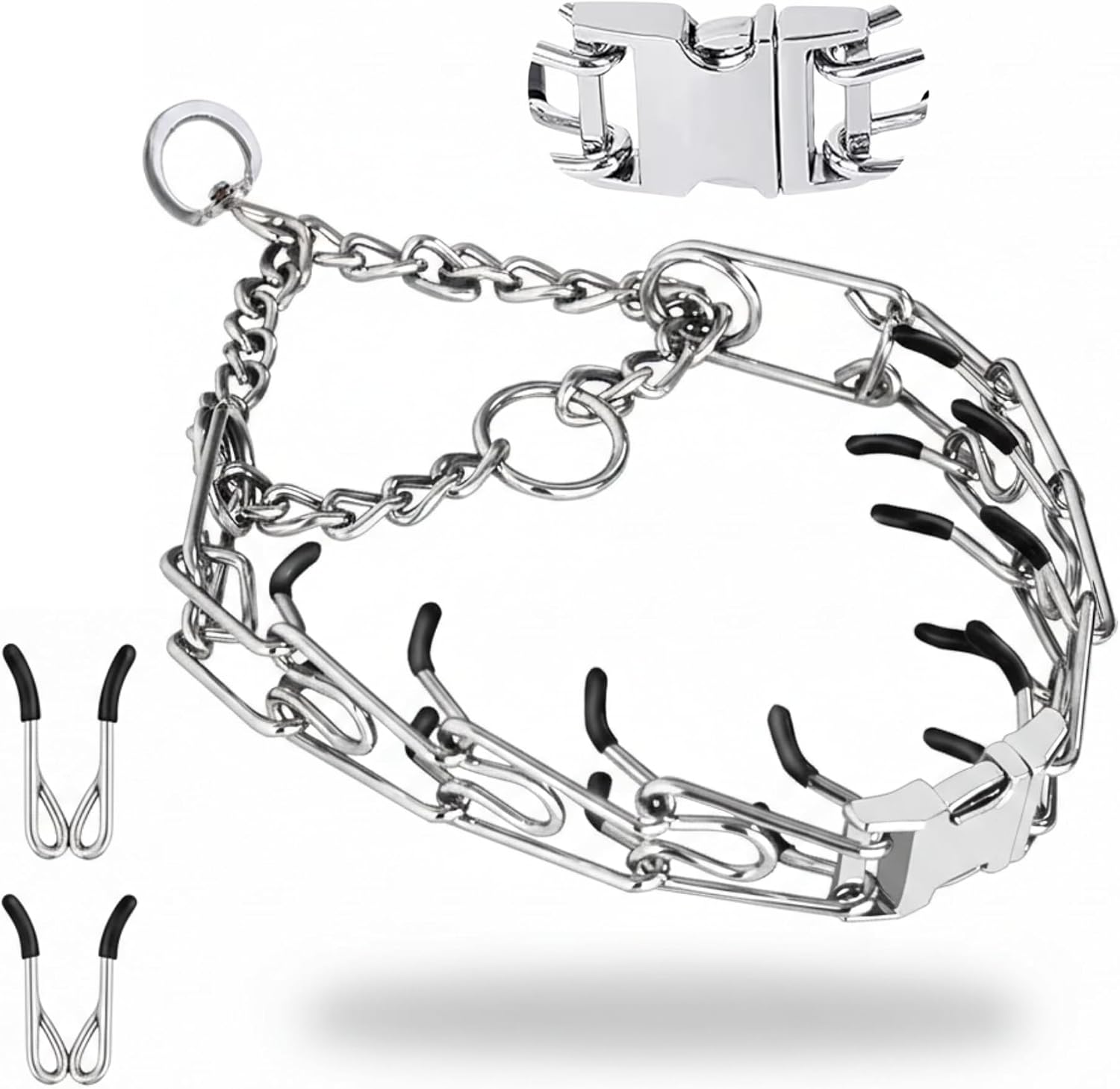
| Size | 3mm (18-23 Inches) M/L |
|---|---|
| Included Components | 2 Extra Links |
| Closure Type | Buckle |
| Animal Collar Type | Animal Pinch Collar |
This AKDNZ prong collar is a stainless steel, adjustable training collar built to discourage pulling during walks. It is sized for 18–23 inch necks and ships with two extra links so you can fine-tune the fit or extend it for larger necks without tools. The collar uses blunt, rounded prongs with rubber end caps to distribute pressure more evenly and reduce sharp contact, and a quick-release buckle lets you remove it quickly between sessions. In practice it functions as a corrective tool for short, supervised training sessions rather than a daily wear collar; fit high on the neck behind the ears and use brief, positive introductions as the listing advises. Strength guidance in the product notes suggests it is suitable for dogs roughly 45–85 pounds, so it offers a balance of firm control and humane design for many medium to large dogs. Limitations are that the 3mm gauge and components are not rated for the heaviest or most powerful breeds, and any prong collar requires informed, careful use to avoid misuse during unsupervised wear.
Best for: Buyers who need a sturdy corrective tool for medium to large dogs that pull and who plan to use it for controlled training sessions.
Less Ideal for: Owners of very large or extremely powerful breeds that require heavier-gauge hardware or handlers who want an everyday, hands-off solution for loose-leash walking.
- Professional-grade stainless steel construction for corrosion resistance and durability
- Adjustable length with two extra removable links for a closer or larger fit without tools
- Blunt prongs with rubber caps spread pressure to reduce sharp contact
- Quick-release buckle for fast on/off during training sessions
- Sized specifically for 18–23 inch necks, matching many medium and large dogs
- 3mm gauge and hardware are not intended for the largest, strongest pullers
- Designed for supervised training rather than continuous daily wear
Verdict: The best adjustable prong collar for owners who want fine-tuned fit and link flexibility to ensure consistent, comfortable contact and safe function.
Titan Easy-On Prong Dog Collar 20"
Best Stainless-Steel Prong Collar

| Material Type | Nylon, chrome plated |
|---|---|
| Closure Type | Buckle |
| Size | 20" |
| Item Type Name | Titan Easy-On Prong Dog Training Collar W/Buckle-Neck Size |
The Titan Easy-On prong collar is a chrome-plated steel training collar that uses interlocking prongs to deliver a distributed correction across the neck while limiting over-tightening. It fastens with a side-release parachute-style buckle and includes a nylon loop for attaching a leash or quick removal, so it is straightforward to put on and take off for session-based training. The chrome plating improves corrosion resistance and the electrically welded links give the collar a sturdy feel suited to powerful breeds such as Rottweilers. In practice it works best for short, supervised training bursts where immediate response is needed rather than constant wear. Buyers should note this is a mechanical correction tool that requires proper fit and handling to avoid discomfort, and the collar is not a replacement for positive-reinforcement techniques. Constructed for durability and easy cleaning, this collar is a practical metal option for owners who need a weather-resistant training tool for large, strong dogs.
Best for: Owners of large, strong dogs who need a durable, low-maintenance metal training collar for weather-exposed use and controlled training sessions.
Less Ideal for: Pet owners seeking an everyday, non-correction collar or those unfamiliar with prong collar fitting and handling should consider gentler training tools instead.
- Chrome-plated steel resists rust and simplifies cleaning
- Electrically welded links provide strong, durable construction
- Side-release parachute buckle allows quick on/off
- Design limits closure to prevent the collar from tightening excessively
- Requires correct sizing and experienced handling to avoid misuse
- Intended for supervised training sessions only, not continuous wear
Verdict: The best stainless-steel prong collar for owners who prioritize rust resistance, easy maintenance, and long-lasting metal performance in all weather conditions.
Supet Dog Prong Collar Large
Best Comfort-Lined Prong Collar

| Material | Nylon, Rubber, Stainless Steel |
|---|---|
| Closure Type | Buckle |
| Size | L (Neck:18''-20'') |
| Included Components | Spare link, Additional rubber tips, Protector cover |
This Supet prong collar pairs solid stainless steel links with rubber caps and an optional nylon protector to soften contact while still providing corrective control during walks or training sessions. Use it as an on-leash training aid: size the collar to the dog by adding or removing links and clip the quick-release buckle for daily use or the full chain for session-based corrections. The rubber tips smooth the link edges and the nylon cover gives a gentler option for emergency restraint, so it can reduce chafing compared with bare-prong designs. It ships with an extra link and spare rubber tips so you can fine-tune fit, and the chrome plating helps resist rust from outdoor use. Important limitations are that correct, brief application and proper fit are essential to avoid misuse, and some handlers will still prefer force-free alternatives; adjustments require simple tools like pliers and the collar is intended for training rather than continuous wear.
Best for: Owners who need a high-control training tool for a powerful breed but want softer contact points to minimize neck irritation during short, supervised training sessions.
Less Ideal for: People seeking completely force-free training methods or those who want a collar intended for constant everyday wear without removal for sessions.
- Rubber caps on each link and nylon protector reduce direct metal contact and potential neck irritation
- Stainless steel construction with chrome plating offers strength and corrosion resistance
- Includes extra link and spare rubber tips for adjustable fit
- Quick-release buckle lets you switch between training setup and a safer covered option quickly
- Requires correct sizing and occasional use of pliers to add or remove links
- Not suitable as a continuous collar or for owners inexperienced with prong training methods
Verdict: The best comfort-lined prong collar for pet owners who want the control benefits of a prong design but with softer contact points to reduce irritation.
Herm Sprenger Prong Training Collar 23 in
Best Premium Prong Collar

| Material Type | Stainless Steel |
|---|---|
| Overall Length | 23 inches |
| Wire Gauge | 3.2 mm |
| Made In | Germany |
This Herm Sprenger prong training collar is a factory-quality stainless steel pinch collar built for hands-on obedience work. It uses interlocking links with two blunt prongs per link so you can add or remove links to size the collar precisely, and the included swivel makes leash attachment smoother during sessions. The black German stainless steel resists rust and the slightly beveled prong tips are less sharp than some competitors while still delivering clear feedback for corrective training. In practice it is used snugly low on the neck just below the ears and sized by measuring neck circumference plus four inches, which gives consistent fit for focused training with strong, independent breeds. The collar is durable and easy to wipe clean, though using a prong collar requires confident handling and knowledge of timing to avoid accidental overcorrection. It also lacks padding or a quick-release buckle, so it is best for short, supervised training sessions rather than everyday wear.
Best for: Buyers wanting a durable, adjustable correction tool for focused obedience and training sessions with a strong, independent breed who will use it only under supervision.
Less Ideal for: Owners looking for an everyday, hands-off restraint or a gentle corrective option for nervous or inexperienced dogs should choose a different collar style.
- Adjustable length via removable interlocking links for a precise fit
- Black German stainless steel construction resists rust for long service life
- Swivel for leash attachment reduces twisting during training
- Beveled, blunt prong tips provide clear feedback without excessively sharp points
- No quick-release or padded option so it is not comfortable for continuous wear
- Requires experienced handler and careful timing to use safely
Verdict: The best premium prong collar for owners willing to invest more for superior materials, refined construction, and enhanced durability and fit.
Choosing the Right Prong Collar Rottweiler: Key Factors to Consider
Correct Sizing and Fit
A proper fit is the single most important factor when selecting a prong collar for a Rottweiler. Measure neck circumference accurately and account for coat thickness so the collar sits at the correct level behind the ears. A collar that is too loose can move around and apply pressure unpredictably; one that is too tight can cause discomfort and skin irritation.
Look for collars with incremental sizing options and clear measurement guidance. If the collar relies on removable links, ensure spare links are available so you can fine-tune the fit. Proper fit affects both safety and training effectiveness because predictable pressure distribution depends on consistent contact points.
Link Construction and Finish
The shape, finish, and assembly quality of each prong link determine how smoothly the collar engages and releases. Links with rounded edges and a polished finish reduce the chance of pinching or catching fur. Welded or solid links are generally more durable than thin stamped pieces that can bend under stress.
Inspect how links articulate. Even movement across the whole circumference helps distribute pressure evenly. Materials that resist corrosion and maintain a smooth finish matter for longevity and comfort, especially for dogs that swim or live in humid environments.
Material Strength and Hardware Quality
Rottweilers are powerful dogs, so the collar must have hardware and metal grades capable of handling high loads without deforming. Look for collars made from thicker-gauge metal or with reinforced connection points. The ring and clip design should stay secure under tension and should not open or slip when the dog pulls.
High-quality plating or stainless options resist rust and wear. Durable materials also reduce long-term maintenance, keep the collar functioning predictably, and lower the chance of sudden failures during walks or training.
Adjustment Method and Ease of Use
How you adjust and put the collar on affects safety and daily usability. Some collars rely on adding or removing links to set size; others use a sliding mechanism or fixed loops. For handlers who need frequent adjustments, a system that is quick and intuitive will save time and reduce handling errors.
Consider whether you can comfortably remove or add links without tools and how the collar behaves when connected to a leash. Ease of adjustment also matters in situations where you need to change fit between handlers or for seasonal coat changes.
Comfort Features and Padding Options
While prong collars are not padded training collars, small comfort-oriented design choices can reduce irritation. Options such as a removable neck sleeve or softer link shaping can prevent direct metal-to-skin contact and protect the fur. These features matter when working a Rottweiler for longer sessions or when the dog has a sensitive neck.
Evaluate whether accessories like neoprene sleeves are compatible with the collar and how they affect the fit. A sleeve should not interfere with how the collar functions but should provide a barrier when needed for comfort during low-intensity walks.
Intended Use and Handler Experience
Prong collars require knowledgeable handling to be effective and safe. Consider how you plan to use the collar: for occasional leash control, consistent training sessions, or professional handling. A collar that performs well for a professional trainer may be overkill for a casual walker, while a simpler design may be easier for a less experienced handler to use responsibly.
Assess whether you or others who will handle the dog understand proper fitting and use. Training with a qualified trainer or under guidance is recommended for first-time prong collar users to minimize risk and achieve consistent results.
How Tight Should a Prong Collar Sit on a Rottweiler?
A prong collar should sit high on the neck, just behind the ears, and be snug enough that it cannot slide down over the jawline. It should never be pinching the skin; instead, it should make even contact around the neck so pressure is distributed uniformly.
Start with a fit that allows you to add or remove a single link for adjustment. When fitted correctly, the handler should feel direct, predictable feedback through the leash without abrupt jerks. If the dog shows discomfort unrelated to training cues, reassess fit and placement before continuing.
- Place collar high on the neck behind the ears.
- Snug enough to prevent significant movement but not tight enough to pinch skin.
- Fine-tune with one link at a time for precise adjustment.
Can I Use a Neck Sleeve with a Prong Collar?
Yes, a removable neck sleeve can reduce direct metal contact and protect the coat on low-intensity walks or when the dog is resting. Make sure any sleeve you use is made for prong collars and does not impede the collar's ability to sit correctly or move as intended.
Do not rely on a sleeve to mask an ill-fitting collar. The sleeve should be an accessory for comfort, not a substitute for proper sizing and safe handling techniques.
- Choose sleeves designed for prong collars to avoid affecting fit.
- Remove sleeve during focused training where direct feedback is needed.
What Maintenance Does a Prong Collar Need?
Regular maintenance extends the life of the collar and preserves safe function. Rinse and dry the collar after exposure to water, check links for corrosion or sharp edges, and inspect the ring and clip for wear before each use. Replace any link or hardware that shows signs of deformation.
Occasional lubrication of pivot points with a dry, pet-safe product can keep articulation smooth. Store the collar dry and away from chemicals that might degrade metal plating.
- Rinse and dry after wet use.
- Inspect links and hardware for wear before each use.
- Keep spare links and maintenance tools on hand if you adjust sizes frequently.
How to Transition a Rottweiler to a Prong Collar Safely
Introduce the collar gradually and pair its use with clear, consistent commands. Start with short, low-distraction walks so the dog can adapt to the feeling without high-intensity corrections. Never leave a prong collar on an unattended dog.
Combine the collar with positive reinforcement and calm handling. If the dog reacts negatively or shows signs of stress, pause training and reassess the fit or your approach. Professional guidance can help ensure the transition is safe and effective.
- Use short sessions to begin, focusing on calm leash manners.
- Never leave collar on an unattended dog.
- Pair use with clear commands and positive reinforcement.
Signs a Prong Collar Is Not Working Well
Watch for persistent resistance, flinching, or unusual vocalization that does not diminish with proper fit and consistent cues. These behaviors may indicate discomfort, poor fit, or that the method is not appropriate for your dog's temperament.
If the dog pawing at the neck or excessively trying to rub the collar off, stop and evaluate both the hardware and the training approach. A short rest and alternative training methods are better options than continuing with a collar that causes distress.
- Look for flinching, persistent resistance, or vocalization.
- Check for physical signs like hair loss, redness, or irritation.
- Switch methods and seek professional help if concerning signs continue.
How We Chose the Best Prong Collar Rottweiler
We evaluated prong collars for Rottweilers using practical, safety-first criteria relevant to strong, powerful dogs. Our process prioritized fit accuracy, build quality, and the collar's ability to distribute pressure evenly across the neck. We tested product specifications for materials and finish to identify collars with corrosion resistance and smooth links that minimize skin pinching. Adjustability and range of sizing were assessed to ensure a secure, customized fit for mature Rottweiler necks, and we checked hardware design for secure connections and predictable behavior under load. We excluded collars marketed for very small breeds or those with vague sizing guidance. We also excluded models with unverified construction claims or insufficient information about link finish and metal grade. Final selections favored collars with clear sizing charts, robust materials, and design details that improve safe, consistent handling. The list reflects items that meet those dimensions rather than popularity alone.
Our full evaluation process is outlined in our review methodology.
FAQ
Are prong collars safe for Rottweilers?
Prong collars can be safe when fitted correctly and used by an informed handler. Safety depends more on fit, material quality, and proper handling than on the collar alone. Supervision, conservative use, and training guidance reduce risks.
How do I size a prong collar for my Rottweiler?
Measure the widest part of the neck and follow the collar manufacturer's link-based sizing guidance to allow for a snug, high placement behind the ears. Start with a size that allows removing or adding a single link to fine-tune the fit.
Can a prong collar damage my Rottweiler's neck?
If used improperly or left on unsupervised, any collar can cause skin irritation or injury. Proper fit, good materials with smooth finishes, and correct handling reduce the chance of damage. Monitor the neck for any signs of irritation and stop use if they appear.
How often should I inspect a prong collar?
Inspect the collar before each use for signs of corrosion, sharp edges, or weakened links. Perform a more thorough check monthly to confirm hardware integrity and replace parts as soon as wear is detected.
Is training with a prong collar better than other tools?
It depends on the dog and the handler. Prong collars provide direct feedback that some handlers find effective for strong dogs, but they require proper technique. Other tools may be preferable for different training goals or for handlers who prefer less aversive methods.
Final Verdict
Choose a prong collar for a Rottweiler by prioritizing accurate sizing, sturdy link construction, and corrosion-resistant materials. Fit and how the handler uses the collar matter more than small design differences. Balance control needs with comfort by checking finish quality and using sleeves only where appropriate. When in doubt, favor collars with clear sizing guidance and robust hardware, and combine the collar with responsible, consistent handling or professional instruction. That approach will help you get effective control while minimizing risk.

