

If you live with shedding pets, a quieter robot vacuum can keep floors tidy without stressing anxious animals. You want a machine that balances low noise with the suction and brush action needed to capture fur from carpets, rugs, and hard floors. This guide lists seven shortlisted quiet robot vacuums that are well suited to pet hair, evaluated for noise output, cleaning performance, and usability. We'll explain the criteria used to choose these picks and what matters when matching a quiet robot vacuum to your home and pet habits.
Top Picks at a Glance
| Best Overall Quietest Robot Vacuum The best all-around calm performer for pet hair pickup and quiet operation | roborock Qrevo Curv 2 Flow |  |
| Best Budget Quietest Robot Vacuum Low-cost quiet option that still handles basic pet hair cleanup | ILIFE A30s Robot Vacuum |  |
| Best Compact Quietest Robot Vacuum Smaller footprint model for tight spaces and low-height furniture | eufy C10 Robot Vacuum |  |
| Best Large-Capacity Quietest Robot Vacuum Bigger dustbin and longer runtime for homes with lots of shedding | Kilgone SDL40 Robot Vacuum |  |
| Best Long-Battery Quietest Robot Vacuum Extended runtime models for whole-home cleaning on a single charge | roborock Q7 M5+ Robot Vacuum |  |
| Best HEPA Quietest Robot Vacuum Models with allergy-grade filtration to trap pet dander and allergens | Bissell FlexClean FurForce 4072L |  |
| Best Premium Quietest Robot Vacuum Top-tier quiet models with advanced navigation and extra features | ECOVACS DEEBOT X12 OMNICYCLONE |  |
roborock Qrevo Curv 2 Flow
Best Overall Quietest Robot Vacuum

| Maximum Suction | 20,000 Pa |
|---|---|
| Battery Life | 242 minutes |
| Filter Type | Washable Filter |
| Power Source | Battery Powered |
| Controller Type | App Control, Button Control, Voice Control |
The Roborock Qrevo Curv 2 Flow is a robot vacuum and mop designed for heavy‑hair homes and multi‑level layouts. It combines 20,000 Pa HyperForce suction with a Dual Zero‑Tangle roller system and an upgraded side brush to reduce hair wrap and lift embedded pet hair from carpets and hard floors. Navigation uses PreciSense LiDAR plus structured light AI obstacle recognition to map rooms, avoid cables and toys, and store up to four floor plans for repeatable cleaning. The multifunctional dock handles auto dust emptying, auto refilling of the water tank, high‑temperature mop washing and hot‑air drying, which lowers manual maintenance and keeps the mop hygienic. Practical features include washable filters, app and voice control, smart carpet strategies that lift the mop on rugs, and intelligent dirt detection that triggers additional passes. Tradeoffs are the relatively large unit footprint and weight compared with slimmer models, and the product requires 2.4 GHz Wi‑Fi for smart features. For homes with a lot of long pet hair the combination of powerful suction and tangle‑resistant rollers makes this a strong everyday performer.
Best for: Buyers who need a dependable, low‑maintenance robot that picks up large amounts of long pet hair daily and maps multiple floors for scheduled cleaning.
Less Ideal for: People who prioritize an ultra‑compact, lightweight robot for very tight spaces or who cannot use 2.4 GHz Wi‑Fi for smart features.
- Very strong 20,000 Pa suction for deep pickup of hair and debris
- Dual Zero‑Tangle roller and upgraded side brush to minimize hair wrap
- PreciSense LiDAR and AI obstacle recognition for reliable multi‑room navigation
- Multifunctional dock with auto dust emptying, mop high‑temperature wash and hot‑air drying reduces maintenance
- Washable filter and app/voice control for convenient ongoing use
- Unit is relatively heavy and bulky compared with ultra‑slim robot vacuums
- Smart features require 2.4 GHz Wi‑Fi and may be limited without it
Verdict: The best all-around quietest robot vacuum for pet owners seeking top cleaning performance, low noise, and reliable pet-hair pickup in daily home use.
ILIFE A30s Robot Vacuum
Best Budget Quietest Robot Vacuum

| Max Suction | 10000 Pa |
|---|---|
| Dustbin Capacity | 500 ml |
| Battery Life | 150 minutes |
| Navigation | LiDAR with SLAM |
The ILIFE A30s is a straight‑forward robotic vacuum focused on suction and mapping rather than extra frills like mopping or self‑emptying. It uses LiDAR navigation and SLAM mapping to create efficient cleaning paths and supports no‑go zones, scheduled runs, and remote, app or voice control. Practical for pet households, the A30s offers up to 10,000Pa spot suction and dual anti‑tangle brushes to reduce hair wrap while its 500 ml dustbin cuts down how often you empty it. Battery runtime reaches up to 150 minutes on gentle mode and the unit will auto‑recharge and resume to finish larger jobs. Noise is listed at 72 dB, so it is not whisper quiet but is reasonable for a budget machine with strong suction. It is vacuum‑only, so buyers who want mopping or a self‑emptying base will need to look elsewhere. The A30s is best used on hard floors and low‑pile carpet where its suction and brushes pick up pet fur and everyday debris efficiently.
Best for: Pet owners who prioritize strong suction and reliable mapping on a budget and want a simple, app/voice controllable vacuum that handles fur without extra features.
Less Ideal for: Buyers who need an ultra‑quiet machine, an integrated mop, or a self‑emptying base should consider higher‑tier models with those features.
- Strong peak suction up to 10,000Pa for lifting pet hair and crumbs
- LiDAR navigation with home mapping and no‑go zone support for efficient, repeatable cleaning
- Dual anti‑tangle brushes help reduce hair wrap during runs
- 500 ml dustbin reduces emptying frequency compared with smaller bins
- Long runtime with 150 minutes and auto‑recharge and resume for larger homes
- Reported noise level around 72 dB, louder than premium quiet models
- Vacuum‑only design means no mopping capability
- Two power levels limit finer control of suction vs noise
Verdict: The best budget quietest robot vacuum for pet owners who need an affordable, low-noise cleaner that removes fur without extra frills.
eufy C10 Robot Vacuum
Best Compact Quietest Robot Vacuum

| Battery Life | 120 minutes |
|---|---|
| Suction Power | 4000 Pa |
| Dust Bag Capacity | 3 liters |
| Filter Type | Washable |
| Control Method | App (2.4 GHz Wi‑Fi) |
The eufy C10 is a low-profile robot vacuum built to reach under low-clearance furniture while handling regular pet hair and debris. It pairs a 2.85-inch slim body with LiDAR navigation to map rooms and follow efficient paths, and it uses a 4,000 Pa suction system plus a rolling brush and extendable corner arm to lift trapped pet hair from edges and tight spots. The included self-empty station holds up to a 3 liter dust bag so you can run multiple cleaning cycles without emptying the robot frequently, and washable filters reduce replacement costs. App control enables scheduled runs, no-go zones, and remote starts, though the app requires 2.4 GHz Wi-Fi. Noise during normal cleaning is relatively low, but the station can be louder while emptying. Expect the C10 to be most effective on hard floors and short-pile carpets; deep-pile rugs may limit hair pickup and could increase brush tangles despite the Pro-Detangle comb. The slim profile and CornerRover arm make it especially useful for extracting hair from under beds and along baseboards, while the 120-minute runtime covers many medium-sized homes between charges.
Best for: Homeowners who need a slim robot that actually fits under low-profile beds and sofas and who want a mostly hands-off way to capture pet hair trapped in corners and under furniture.
Less Ideal for: People with mostly deep-pile or high-pile carpets where a low-profile unit may struggle to pull embedded hair and where a taller, more powerful vacuum would perform better.
- 2.85-inch ultra-slim body reaches under low-clearance furniture
- Self-emptying station with 3 liter dust bag reduces manual emptying frequency
- 4,000 Pa suction plus extendable corner brush improves edge and corner hair pickup
- LiDAR navigation with mapping for efficient, repeatable cleaning paths
- Washable filter lowers maintenance cost and app scheduling enables hands-off cleaning
- Best performance on hard floors and short carpets rather than deep-pile rugs
- App requires 2.4 GHz Wi-Fi and no remote control is included
Verdict: The best compact quietest robot vacuum for homes and apartments needing a low-profile, quiet unit that reaches under furniture and stores easily.
Kilgone SDL40 Robot Vacuum
Best Large-Capacity Quietest Robot Vacuum
| Battery Life | 150 minutes |
|---|---|
| Dust Bag Capacity (base) | 2.5 L |
| Dustbin Capacity (robot) | 300 ml |
| Navigation | 360° LiDAR |
| Filter Type | Hepa Filter |
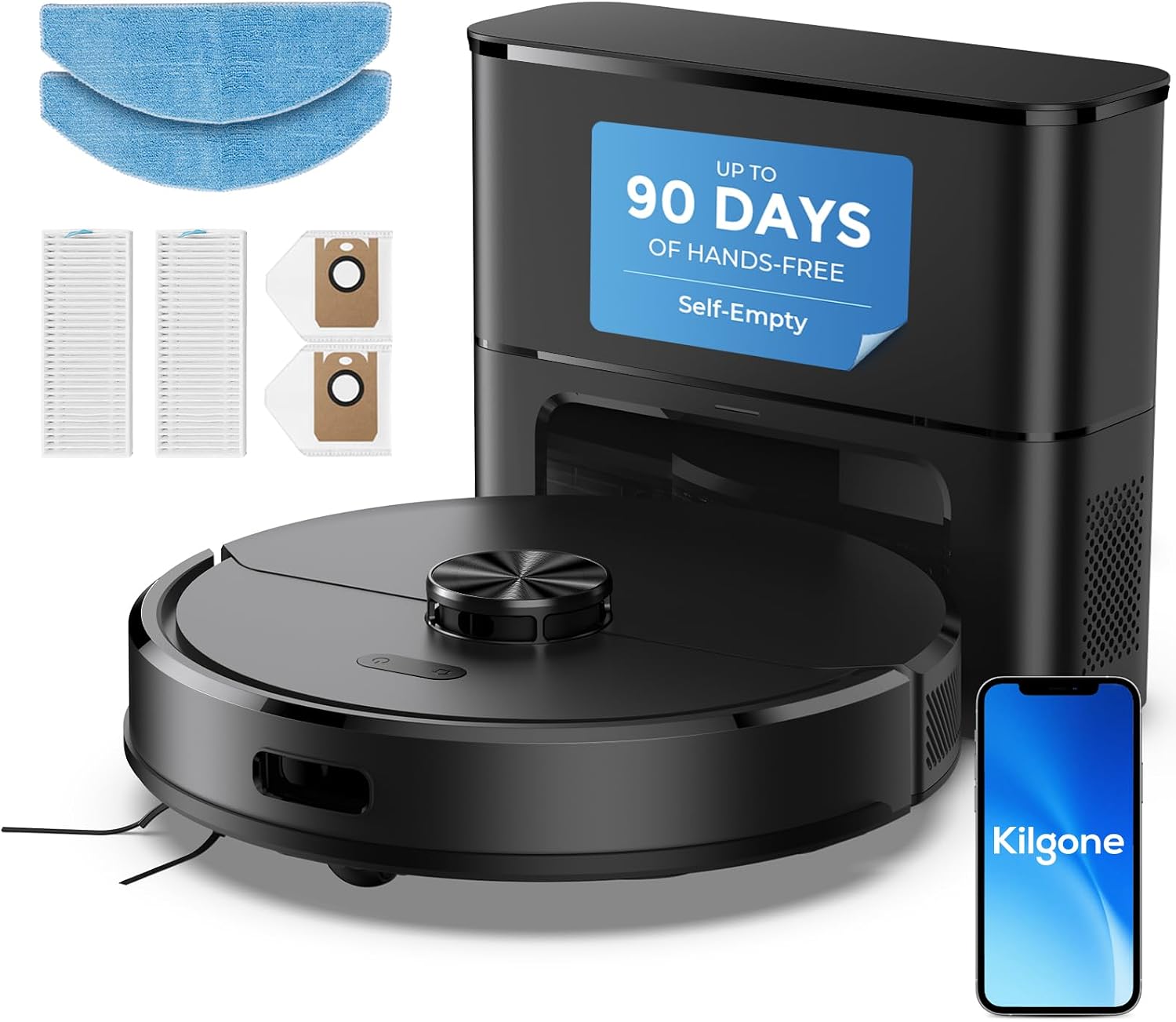
The Kilgone SDL40 is a 2-in-1 robot vacuum and mop designed for homes with mixed floors and shedding pets. It uses 360° LiDAR mapping to build up to five maps and follows a turning path to reduce missed corners, while app control and Amazon Echo compatibility let you schedule and customize runs. The SDL40 pairs strong suction and an anti-tangle main brush with a HEPA filter to capture pet hair and fine dust, and the sonic mopping feature handles light damp cleaning on hard floors. A major convenience is the 2.5L self-emptying base that holds about 90 days of debris for typical use, cutting down manual emptying. Battery life is up to 150 minutes with auto-recharge and resume for larger homes. Be aware that sonic mopping requires setting carpets as no-mop zones to avoid wetting rugs, and deep soiled carpets may still need occasional spot cleaning or a dedicated carpet cleaner. For heavy-duty wet scrubbing or very high-pile carpets the mop function and low profile design have practical limits.
Best for: Homes with multiple shedding dogs or large carpeted areas whose priority is long runs and infrequent dust-bin maintenance, and whose owners want smart mapping and hands-off operation.
Less Ideal for: Households that need aggressive wet scrubbing or professional-level carpet deep cleaning should look at dedicated carpet cleaners instead.
- Large 2.5L auto-empty dust bag reduces manual emptying for months
- 360° LiDAR mapping with multi-map support for accurate navigation across multiple floors
- Anti-tangle main brush and HEPA filtration tailored for pet hair and fine dust capture
- Up to 150 minutes runtime with auto-recharge and resume for extended cleaning coverage
- App control and Amazon Echo compatibility for scheduling and custom cleaning zones
- Mop function is sonic/light-duty and requires careful no-mop zone setup to protect carpets
- Not intended as a replacement for deep carpet shampooing on heavily soiled or high-pile rugs
Verdict: The best large-capacity quietest robot vacuum for multi-pet households that need larger debris capacity and fewer empty cycles while staying quiet.
roborock Q7 M5+ Robot Vacuum
Best Long-Battery Quietest Robot Vacuum
| Maximum Suction | 10000Pa |
|---|---|
| Capacity | 2.7 liters |
| Battery Life | 150 minutes |
| Filter Type | Cartridge |
| Noise Level | 65 db |
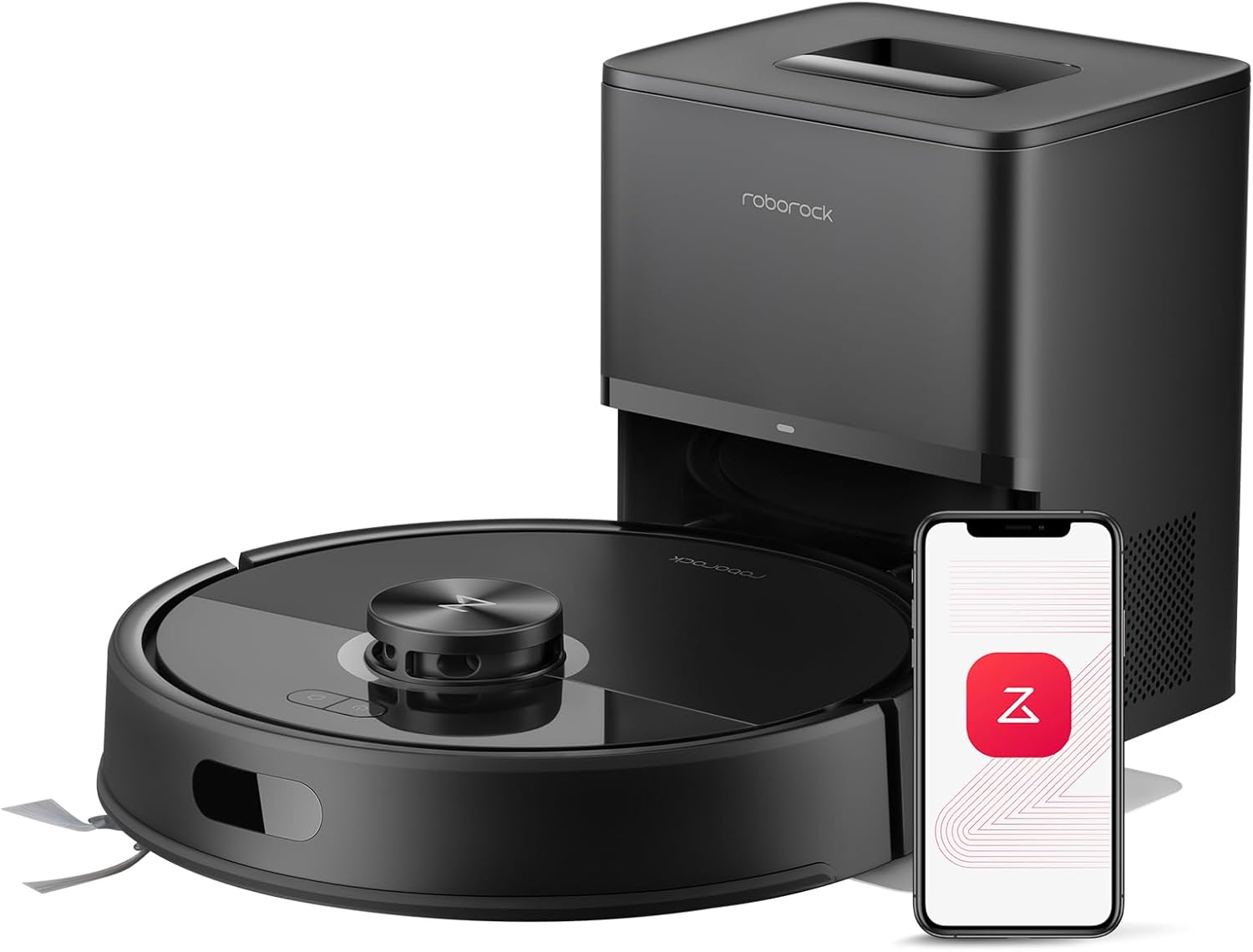
The roborock Q7 M5+ is a robot vacuum-and-mop combination built to handle pet hair and deep dirt on mixed floors. It uses PreciSense LiDAR for reliable mapping and multi-level maps, and the app plus voice control let you schedule cleanings and set no-go zones. The key hardware strengths are a 10000 Pa HyperForce motor for strong extraction and a Dual Anti-Tangle system that reduces brush hair wrap for long-haired pets. Paired with the RockDock Plus self-emptying base and a 2.7 L sealed dust bag, it can go many weeks between manual emptying, which is helpful in heavy-shedding homes. The VibraRise 2.0 electronic mop and adjustable water flow provide basic mopping between vacuum passes but will not replace manual deep scrubbing on textured grout or stubborn stains. Expect typical robot limitations such as navigation around very cluttered rooms, occasional edge residue on high-pile rugs, and app dependency for advanced settings. For households prioritizing suction and low-maintenance pet hair pickup, the Q7 M5+ is a strong choice.
Best for: Buyers with heavy-shedding dogs or homes with textured floors who want the strongest possible suction in a low-maintenance robot and value scheduled, automated cleaning.
Less Ideal for: People who need a robot that replaces deep manual mopping or who prefer a fully manual upright for spot deep-cleaning and stairs.
- Very high suction power rated at 10000 Pa for deep carpet and rug extraction
- Dual Anti-Tangle brush system reduces hair wrap and maintenance
- 2.7 L sealed dust bag in the RockDock Plus supports weeks of hands-free emptying
- PreciSense LiDAR navigation with multi-level mapping for efficient room coverage
- App and voice control with scheduling and no-go zones for convenient automation
- Mopping function is basic and not a substitute for aggressive manual scrubbing on textured floors
- May struggle with very cluttered spaces or extremely high-pile carpets
Verdict: The best long-battery quietest robot vacuum for owners who want extended, uninterrupted low-noise cleaning across larger floor plans.
Bissell FlexClean FurForce 4072L
Best HEPA Quietest Robot Vacuum

| HEPA filtration | 99.97% at 0.3 microns |
|---|---|
| Battery life | 180 minutes |
| Special features | Self-Emptying, LiDAR Navigation, Anti-Hair Wrap, Vacuum & Mop |
| Included components | Docking Station |
The Bissell FlexClean FurForce is a 2-in-1 robot vacuum and mop built with pets in mind. It runs up to 180 minutes and uses what Bissell calls 2X stronger suction plus a NeverTangle brush roll to pick up fur and reduce hair wrap, while LiDAR navigation maps and avoids obstacles for whole-home coverage. A built-in HEPA filtration system captures 99.97% of particles down to 0.3 microns, which helps reduce airborne pet dander stirred up during cleaning. The unit also pairs with a self-emptying base that holds debris for up to about eight weeks and supports a multi-surface cleaning formula for mopping. Practical trade-offs: full mopping capability requires app setup, the robot is relatively large and comes with a bulky dock, and mixed vacuum-and-mop operation can require occasional spot checks on rugs. For allergy-minded pet owners who want automated, hands-off maintenance across hard floors and low-pile carpets, the FurForce balances strong suction, anti-tangle hardware, and HEPA filtration into a mostly hassle-reducing package.
Best for: Pet owners who prioritize reducing airborne dander and minimizing hands-on maintenance will appreciate a HEPA-equipped, self-emptying robot that handles fur and routine mopping across whole-home routes.
Less Ideal for: People who need a compact, minimalist dock setup or those who rely primarily on deep carpet cleaning for very high-pile rugs should consider other specialized machines.
- HEPA filtration rated to capture 99.97% of 0.3 micron particles for better indoor air quality
- Self-emptying base stores debris for up to eight weeks for low-maintenance operation
- NeverTangle brush roll and increased suction improve pet hair pickup and reduce clogging
- LiDAR navigation delivers reliable whole-home mapping and obstacle avoidance
- Long 180-minute runtime covers larger homes on a single charge
- App required to enable full mopping functionality
- Large footprint and dock can take up notable floor space
- Mopping while vacuuming may need attention around area rugs and thresholds
Verdict: The best HEPA quietest robot vacuum for pet owners prioritizing allergen capture and cleaner air while keeping operation whispers-quiet.
ECOVACS DEEBOT X12 OMNICYCLONE
Best Premium Quietest Robot Vacuum

| Surface Recommendation | Hardwood, laminate, vinyl, tile, marble, ceramic, linoleum, sealed concrete & low-pile short carpet |
|---|---|
| Battery Life | 200 minutes |
| Control Method | App, Voice |
| Filter Type | WASHABLE |
| Capacity | 22 liters_per_second |
The DEEBOT X12 OmniCyclone is a premium robot vacuum and mop engineered for heavy-duty homes with pets and mixed flooring. It combines a self-washing OZMO Roller 3.0 and FocusJet pre-spray to break up sticky messes on hard floors while a 22,000Pa BLAST suction and ZeroTangle 4.0 system pull pet hair and debris from carpets and floors. The bagless Omnicyclone station automatically collects debris without disposable bags and supports PowerBoost fast charging and Adaptive Charging to shorten interruptions in long cleaning runs. Smart features include app and voice control, AIVI 3D obstacle sensing, TruEdge edge scrubbing, and a Carpets First mode that lifts and shields the roller when carpets are detected to avoid wetting rugs. In practice the X12 is well suited to large homes and multi-pet households because it balances strong suction, mop cleaning that avoids smear, and robust navigation. The trade-offs are its substantial size and weight compared with entry-level units and the higher purchase cost that comes with these premium features.
Best for: Dog owners who prioritize top-tier suction, reliable pet-hair management, and hands-off cleaning across large or multi-room homes and who are willing to invest in a premium, feature-rich robot.
Less Ideal for: People on a tight budget or those who need a very small, lightweight unit for compact apartments should consider simpler models instead.
- Very strong 22,000Pa BLAST suction for deep pet-hair pickup
- Self-washing OZMO Roller 3.0 plus FocusJet pre-spray for effective hard-floor stain removal
- Bagless Omnicyclone station removes need for disposable dust bags
- ZeroTangle 4.0 reduces hair wrap around the brush path
- Adaptive Charging and PowerBoost shorten charging interruptions during long cleaning jobs
- Heavier and larger than compact robot vacuums which may limit handling and storage
- Higher price point associated with premium features
Verdict: The best premium quietest robot vacuum for buyers willing to pay more for superior noise control, navigation, build quality, and convenience features.
Choosing the Right Quietest Robot Vacuum Pet Hair: Key Factors to Consider
Noise Level and How It Is Measured
Noise specifications matter because pets are sensitive to sudden or sustained loud sounds. Look for published decibel ratings measured during normal cleaning cycles rather than turbo or max modes. Lower numbers reduce stress for skittish animals, but you should also consider the sound profile; some vacuums emit a steady hum that pets adapt to more easily than intermittent high-frequency noises.
Noise level affects where and when you can run a vacuum. A very quiet unit can clean during daytime without disturbing naps, while louder vacuums may require scheduling for when pets are out or in a different room. For multi-level homes, quieter operation also makes it easier to run the robot on a schedule without waking household members.
Suction Power Versus Quiet Design
Quiet robots balance motor output and sound damping to reduce noise, but that tradeoff can reduce raw suction. Focus on models that maintain consistent suction in standard and edge cleaning modes. Specifications like airwatts or airflow numbers are helpful, but real-world performance on pet hair is more revealing: look for evidence the vacuum handles hair pickup on both hard floors and carpets without frequent re-runs.
Consider whether the manufacturer offers multiple power modes so you can switch to higher suction for heavy shedding days. A unit that ramps up briefly for stubborn areas and then returns to a quiet setting gives flexible performance without constant loud operation.
Brush System and Hair Management
Brushes and the way they interact with hair determine how often you need to intervene. Look for brush designs that minimize tangling, such as rubberized rollers or wide brush paths that channel hair into the intake. Many quiet models rely on refined brush geometry rather than brute force suction to pick up hair efficiently.
Also evaluate access for cleaning the brushes and the dustbin. Pet owners should prefer designs where hair can be removed without tools and where the dustbin seals well to limit exposure to dander. Frequent maintenance cycles are typical in pet homes, so easier servicing reduces overall time spent.
Filtration and Dander Containment
Good filtration helps limit allergens recirculated into the air while the robot is running. HEPA or high-efficiency filters are preferable for homes with allergy concerns. Check whether the filter is washable or replaceable and how often it needs attention under heavy use.
Sealed dustbins and tight intake pathways reduce escape of fine hair and dust. For pet households, it's useful when the unit minimizes the number of times you must empty the bin during a week of regular cleaning, and when emptying it does not disperse trapped dander back into the room.
Navigation, Mapping, and Obstacle Handling
A quiet robot that frequently becomes stuck or repeats areas generates more noise and offers poorer cleaning efficiency. Reliable navigation reduces unnecessary returns to charging docks and repeated passes that can wake pets. Look for models with effective mapping, obstacle detection, and low bump force to avoid startling animals.
Consider how the robot handles thresholds, pet bowls, and bedding. Smooth, deliberate navigation is preferable to machines that drive aggressively into furniture, since calm movement reduces noise spikes and the chance of disturbing pets.
Battery Life and Scheduled Cleaning
Longer battery life lets the robot finish larger rooms in a single quiet session, reducing the need for multiple runs. For pet owners, being able to schedule cleanings at consistent low-noise times is convenient; a robot that pauses or docks mid-clean can create extra noise on return or require a second run.
Also consider recharge-to-run behavior: how much cleaning area a full charge covers, and whether the robot resumes automatically after recharging. These features affect how frequently you hear it operating and how much active maintenance is required.
When Should I Run a Quiet Robot Vacuum Around Pets?
Run quiet cleaning cycles when pets are most relaxed, such as during regular nap times or when they are occupied in another room. This reduces the chance of stress or startle responses and helps the robot complete its run uninterrupted.
If your pet is reactive to new sounds, start with short sessions near their usual resting spots so they can acclimate. Gradually increase the vacuum's schedule length as the animal becomes comfortable with the machine's presence.
- Use quieter modes during the day and reserve higher suction modes for weekly deep cleans.
- Schedule runs when pets are fed or engaged with toys to minimize interaction.
How to Reduce Hair Tangles and Maintenance Time
Preventive steps cut down on how often you need to detangle brushes. Regularly trim long fur around a pet's underside and bathing on schedule reduces shedding load. Placing entry mats and restricting access to high-shed areas before runs reduces the volume of loose hair the robot encounters.
When emptying the dustbin, do it near a ventilation source or outdoors to avoid redistributing dander indoors. Keep a small brush or tool handy for quick hair removal from rollers so the vacuum maintains peak cleaning efficiency between major cleanings.
- Limit runs in areas where fur accumulates fastest until after a quick manual sweep.
- Keep replacement filters and brush-cleaning tools accessible for faster maintenance.
Will a Quiet Robot Vacuum Handle Thick Pet Hair on Carpets?
Many quiet robots perform well on low- to medium-pile carpets but can struggle on deep-pile rugs if suction is modest. For heavy-haired pets, pick models with adaptive suction or a boost mode for carpets so the unit temporarily increases power where needed.
If you have high-pile rugs or dense matting, plan a supplemental manual vacuum or occasional brush roll cleaning to reach deeply embedded hair that a quieter robot may not remove on a single pass.
- Run the robot perpendicular to carpet fibers for better pickup.
- Use higher-power modes selectively on area rugs with heavy shedding.
Tips to Help Pets Acclimate to a Robot Vacuum
Introduce the device gradually in short, supervised sessions. Let pets approach and sniff the stationary unit before switching it on so they do not associate the machine with sudden intrusion. Reward calm behavior with treats and praise to build positive associations.
Avoid running the vacuum when pets are already stressed or during mealtime. Over time, many animals learn to ignore the robot as part of the household routine, especially when its operation is predictably quiet.
- Keep initial runs brief and within sight.
- Use consistent scheduling so the noise becomes part of the normal environment.
How to Evaluate Real-world Quiet Performance
Look beyond peak decibel figures and consider noise during normal use on your floor types. A vacuum may advertise low noise, but interaction with furniture, thresholds, and airflow changes can produce audible spikes. Pay attention to review notes about steady-state noise during typical cycles.
If possible, test a unit in a living area similar to where it will run. Notice not only volume but how the sound character affects pets: a steady low-frequency hum is less likely to provoke anxious behavior than sharp, intermittent clicks or whines.
- Compare noise at the most-used power setting rather than max mode.
- Consider user reports on noise when the robot docks, since return behavior can add unexpected sounds.
How We Chose the Best Quietest Robot Vacuum Pet Hair
We focused on attributes that matter most when selecting a quiet robot vacuum for households with pets. Primary evaluation criteria included measured noise level during typical cleaning cycles, suction performance on both low- and medium-pile carpets, and brush design effectiveness for lifting and containing pet hair. We also weighed battery life and coverage per charge to understand how often a unit finishes a routine in medium and larger homes. Filtration quality and how easily hair and dander are removed from brushes and dustbins were considered for ongoing maintenance and allergy sensitivity. Navigation and obstacle-handling were assessed to ensure the vacuum could reliably cover rooms with furniture and pet bedding without repeated re-runs. Excluded from the shortlist were units with poor reliability reports, limited serviceability, or designs that made hair removal difficult. We did not include models that traded quiet operation for very low suction, since cleaning effectiveness is essential for pet owners. The result is a set of options that strike a practical balance between low noise and real-world hair removal performance.
Our full evaluation process is outlined in our review methodology.
FAQ
Can a quiet robot vacuum still remove embedded pet hair?
Often yes, but it depends on the carpet pile and the unit's suction and brush design. Quiet models with well-designed rollers and a boost mode perform better on embedded hair than those relying solely on low motor output.
How often will I need to empty the dustbin when using it for pet hair?
It usually depends on the size of your home and shedding level. For moderate shedding in a medium home, expect to empty the bin after one or two full runs; heavier shedding may require more frequent emptying, especially if the robot has a smaller dustbin.
Do quiet robot vacuums help with pet allergies?
They can reduce visible hair and some dander, especially if equipped with high-efficiency filtration. However, they are one part of an allergy management plan and work best alongside regular grooming and room ventilation.
Will the robot bother my skittish cat or dog?
Some pets adapt quickly, while others are more reactive. Choosing a quieter model and introducing it gradually reduces the likelihood of stress. Scheduling runs when pets are occupied elsewhere also limits negative encounters.
Is it better to run quiet modes daily or use powerful modes less often?
Daily quiet runs remove surface hair and prevent large accumulations, while occasional higher-power sessions help lift embedded hair. A mixed approach often delivers the best balance between noise and cleaning effectiveness.
Final Verdict
When choosing a quiet robot vacuum for pet hair, prioritize a balance between measured low noise and sufficient cleaning performance. Focus on suction consistency, brush design that resists tangles, and filtration that helps contain dander. Navigation reliability and battery life influence how often the unit runs and whether it completes cleaning in one session. Tradeoffs are common: the quietest models may need supplemental boost cycles for deep cleaning. Pick a unit that fits your home layout and shedding pattern, and use scheduled quiet runs with occasional higher-power cleans to keep floors hair-free without stressing your pets.

