

If you want clearer communication with your dog at a distance, choosing the right remote control dog training collar matters. The right collar helps reinforce recall, manage problem behaviors, and extend training from the yard to real-world situations. This guide shortlists six top options built for effective remote signaling and safe, adjustable stimulation levels. We evaluated each pick on the practical factors that matter for everyday training, including signal range, stimulation options, durability, and ease of use. Read on to find the setups that fit your training goals and the situations where they work best.
Top Picks at a Glance
| Best Overall Remote Control Dog Training Collar The best all-around trainer that balances range, features, and ease | HapTop AC131 Dog Shock Collar |  |
| Best Budget Remote Control Dog Training Collar A low-cost trainer that covers essential features without extras | DDZ Shock Collar P21 |  |
| Best Premium Remote Control Dog Training Collar A higher-end unit with advanced features and refined build | Garmin Sport PRO Training Collar |  |
| Best Long-Range Remote Control Dog Training Collar Designed for extended-distance control during off-leash exercise and recall | PAWPRO Dog Shock Collar Ultimate |  |
| Best Compact Remote Control Dog Training Collar A smaller, lighter trainer for small dogs and travel use | Jugbow Mini Dog Training Collar |  |
| Best Heavy-Duty Remote Control Dog Training Collar Built tougher for large, strong dogs and demanding conditions | BLACKDOG Military Shock Collar OT9 |  |
HapTop AC131 Dog Shock Collar
Best Overall Remote Control Dog Training Collar

| Training modes | Beep, Vibration, Safe Shock, Shock Boost |
|---|---|
| Range | 4500 ft |
| Fit neck | 7.8"-24.4" (10-120 lb) |
| Waterproof rating | IPX8 |
| Charging | USB-C |
The HapTop AC131 is a rechargeable e-collar kit designed for everyday obedience and distance work. It uses a 2-channel remote to control up to two dogs and offers four training modes: beep, vibration, safe shock (0–99 levels) and a shock boost, with the shock function optional for no-shock training. The remote's long 4500 foot range and memory for individual dog settings make it useful for off-leash recall, boundary training, and reinforcing commands across yards or trails. The receiver is IPX8 waterproof and the kit includes multiple prong lengths, silicone covers, a test light tool, and USB-C charging for practical field use. Safety-oriented features include an adjustable low-to-high stimulation range, a security lock to prevent accidental corrections, and a manufacturer guideline limiting continuous wear to 12 hours. Trade-offs are typical for this class: it relies on batteries and correct fitment to be effective, and some owners prefer vibration or beep-only methods before adding shock. The unit's feature set and range make it a strong daily trainer for owners willing to follow safe use guidelines.
Best for: Owners who want a versatile, safety-minded e-collar for regular obedience and distance work and who plan to use multiple training modes progressively.
Less Ideal for: People who want a purely non-aversive training tool or who are uncomfortable using shock-style corrections should choose vibration- or treat-based training alternatives.
- Very long 4500 ft remote range for off-leash training
- Multiple modes (beep, vibration, adjustable shock) for progressive training
- IPX8 waterproof receiver suitable for wet outdoor use
- Includes extra prongs, silicone covers, test light tool, and USB-C charging
- 2-channel remote controls two dogs and remembers individual settings
- Shock feature requires careful adjustment and responsible use to avoid misuse
- Not intended for continuous wear longer than 12 hours per day
Verdict: The best overall remote control dog training collar for owners who want a dependable, easy-to-use system that balances effective stimulation options, reliable range, and durability for everyday training.
DDZ Shock Collar P21
Best Budget Remote Control Dog Training Collar

| Range | 2000 ft |
|---|---|
| Waterproof rating | IPX7 |
| Fit range | 15–120 lb |
| Power | Rechargeable batteries |
This DDZ P21 shock collar is a budget-focused remote training system that provides beep, vibration, and adjustable static stimulation across multiple intensity levels plus a built-in flashlight and security lock. In everyday use the handheld remote and receiver pair quickly and the wide claimed 2000 ft range is useful for yard or park training; the collar is rechargeable and the vendor states long standby life so it needs less frequent charging than disposable-battery units. The IPX7 waterproof receiver makes it usable in wet weather and outdoor play, and multiple contact point lengths and silicone caps help fit a range of coat types. Practical limitations to expect are a basic feature set compared with higher-end systems and a learning curve dialing in safe stimulation levels for each dog. For owners focused on straightforward correction and recall work without premium extras, this collar covers the essentials at a low price point.
Best for: Owners seeking an inexpensive, no-frills remote collar that reliably provides basic safety controls and adjustable stimulation for routine outdoor training.
Less Ideal for: People who need advanced tracking, multi-dog telemetry beyond four channels, or professional-level customization and logs should consider higher-end systems instead.
- IPX7 waterproof receiver suitable for rain and wet conditions
- Rechargeable batteries with long standby time to reduce frequent charging
- Includes beep, vibration, and adjustable static modes for graduated training
- 2000 ft claimed remote range useful for open-area training
- Comes with multiple contact point lengths and silicone caps for better fit
- Basic feature set without advanced safety/telemtry found on premium models
- Intensity control requires careful adjustment and user judgment for safety
Verdict: The best budget remote control dog training collar for owners who need basic training functions and dependable performance without extra bells and higher prices.
Garmin Sport PRO Training Collar
Best Premium Remote Control Dog Training Collar
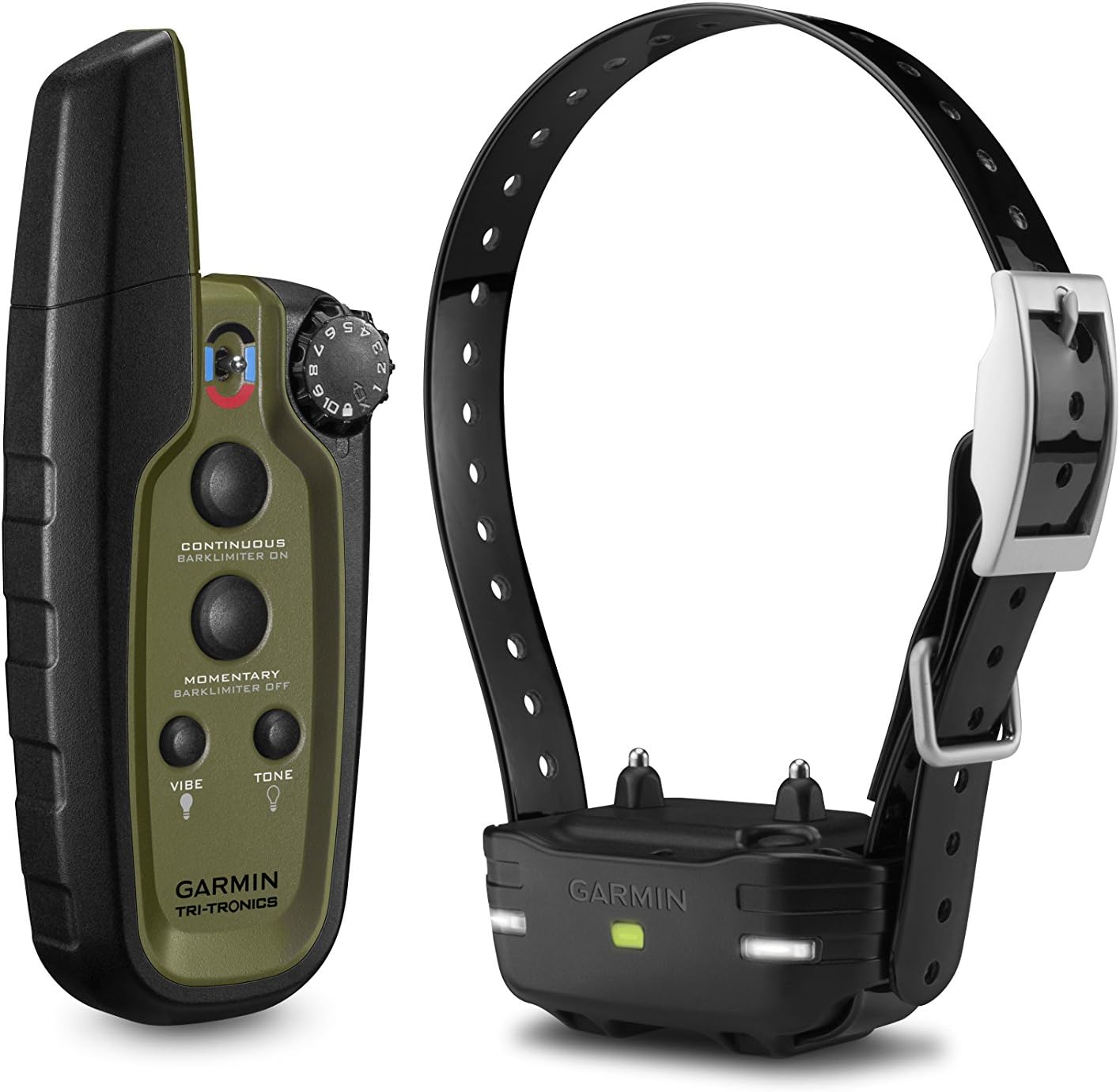
| Range | 3/4 mile |
|---|---|
| Training modes | Tone, Vibration, 10 stimulation levels |
| Dog capacity | Up to 3 dogs |
| Handheld battery life | Up to 60 hours |
| Handheld water rating | IPX7 |
The Garmin Sport PRO bundle pairs a one-handed handheld transmitter with a rechargeable dog device to deliver tone, vibration and 10 levels of static stimulation for training at distances up to three quarters of a mile. The handheld is ergonomically shaped for one-handed, no-look operation and uses a quick-turn dial with positive clicks to step through stimulation levels and auxiliary functions, while four buttons provide momentary and continuous corrections plus vibration and tone. Built-in LED beacon lights help locate a dog in low light and a settable BarkLimiter offers automatic barking control. Both units use rechargeable lithium-ion batteries and the handheld floats, adding practical durability for field use. The dog device accepts long and short stainless steel contact points for wet conditions and the system is rated water-resistant for rugged outdoor use. Limitations include no GPS tracking or advanced smartphone integration and the dog device water rating is lower than the handheld, so fully submerged use is limited.
Best for: Buyers who need a rugged, easy-to-operate remote trainer for active outdoor work and want reliable controls and durable contact hardware for strong, energetic dogs.
Less Ideal for: If you require GPS tracking, smartphone integration, or full waterproofing for underwater use, consider alternatives with those specific features.
- One-handed ergonomic handheld with quick-turn dial for easy level changes
- Up to 3/4 mile range suitable for open-field training
- Rechargeable, user-replaceable lithium-ion batteries for long runtimes
- Interchangeable long and short stainless steel contact points for wet use and durability
- Built-in LED beacon lights and settable BarkLimiter for locating and barking control
- Dog device has lower water rating than the handheld, limiting submerged use
- No GPS location tracking or smartphone app integration
Verdict: The best premium remote control dog training collar for owners willing to pay more for advanced features, finer adjustment options, superior materials, and longer-term reliability.
PAWPRO Dog Shock Collar Ultimate
Best Long-Range Remote Control Dog Training Collar

| Range | Up to 4 miles (open terrain) |
|---|---|
| Stimulation levels | Beep 1–8, Vibration 1–16, Static 1–99 |
| Waterproof rating | IPX7 |
| Battery life | Up to 15 days (per listing) |
The PAWPRO Dog Shock Collar is built for long-distance off-leash training, pairing a dual-channel remote with an advertised 4-mile open-terrain range. You use the remote to deliver beep, vibration, or adjustable static stimulation and to activate a built-in LED for low-light visibility; the unit supports two dogs with the dual-channel function. Practical features include an IPX7 waterproof receiver, hypoallergenic adjustable strap, multiple contact points for size tuning, and a 30-day step-by-step training guide to help beginners start gently. The controls offer fine-grained adjustment across beep, vibration and 99 static levels so you can find an appropriate response for different dogs and distractions. Battery life and fast charging are convenient for multi-day outings, and the collar is made to handle rain and trails. The main compromises are that real-world effective range depends on terrain and obstacles, and static stimulation requires careful, informed use so you can train safely and humanely. For owners who need extended remote control, this package gives versatile modes and practical outdoor readiness.
Best for: Owners who need dependable remote control across large open areas and want a feature-rich collar that balances long range with adjustable stimulation and outdoor durability.
Less Ideal for: People who only train indoors or in small fenced yards where extreme range is unnecessary, or those unwilling to learn responsible use of static stimulation methods.
- Very long advertised open-terrain range up to 4 miles for wide-area recall and off-leash training
- Multiple stimulation modes with wide adjustment (beep, vibration, 1–99 static) for precise responses
- IPX7 waterproof receiver and reflective adjustable strap for outdoor use in wet conditions
- Dual-channel remote supports training two dogs with a single transmitter
- Includes step-by-step 30-day training guide and multiple contact points for fit and beginner support
- Effective range will be reduced by trees, buildings, and terrain so 4-mile performance is situational
- Static stimulation requires careful, informed use and gradual introduction to avoid misuse
Verdict: The best long-range remote control dog training collar for owners who need reliable communication and effective correction at greater distances during off-leash activities.
Jugbow Mini Dog Training Collar
Best Compact Remote Control Dog Training Collar
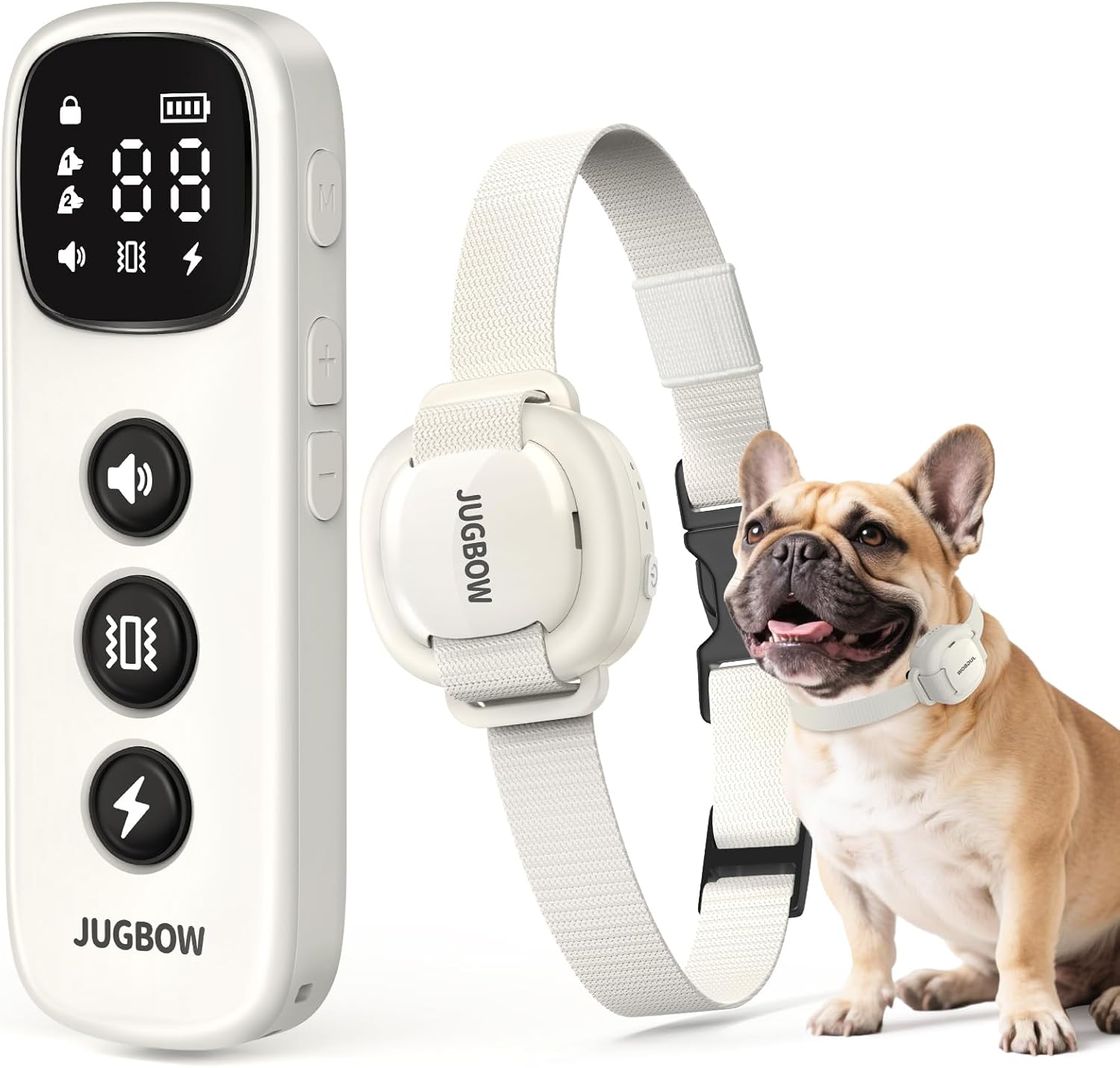
| Breed recommendation | Small Sizes |
|---|---|
| Dog weight range | 5 to 30 pounds |
| Neck circumference fit | 6 to 19 inches |
| Modes | Beep, Vibration, Static (adjustable) |
| Waterproof rating | IPX8 |
The Jugbow Mini is a lightweight e-collar built specifically for small breeds and owners who need a portable remote system. It pairs a tiny receiver and soft nylon collar with a compact remote that claims up to 4200 feet range and two-channel control for training two dogs. Users can choose between beep, vibration, or stepped static stimulation and save settings with the memory function, which makes repeat sessions quicker. The receiver is IPX8 waterproof and the kit uses a fast 2-in-1 charging system that reaches a full charge in about two hours with very long standby times. In practice the collar is easy to fit to necks between 6 and 19 inches and is unobtrusive on dogs from roughly 5 to 30 pounds, and the safety lock helps avoid accidental activation. Important limits are that the system is optimized for small dogs so larger or very thick-coated dogs may not get the intended effect, and static stimulation requires careful level selection and supervision for sensitive breeds.
Best for: Owners of small or toy-breed dogs who want a truly compact, lightweight remote training system that is comfortable for daily wear and easy to carry when traveling.
Less Ideal for: People training larger dogs, working with very thick-coated breeds, or those who prefer purely non-static correction methods should consider a different system.
- Very lightweight receiver and soft nylon collar designed for small-breed comfort
- Three training modes (beep, vibration, adjustable static) with memory function for repeatable settings
- Long reported remote range (4200 ft) and two-channel support to control two dogs
- IPX8 waterproof receiver suitable for all-weather use
- Fast charging with long standby times for remote and receiver
- Optimized for small dogs and not ideal for larger or heavy-coated breeds
- Static stimulation requires careful adjustment and monitoring for sensitive dogs
Verdict: The best compact remote control dog training collar for owners of smaller breeds or those who prioritize portability and a lightweight receiver for daily wear and travel.
BLACKDOG Military Shock Collar OT9
Best Heavy-Duty Remote Control Dog Training Collar

| Training modes | Beep, Vibration, Safe Shock, Strobe Light |
|---|---|
| Range | 4200ft |
| Waterproof rating | IP67 |
| Power | USB-C fast charge; 90-day claimed runtime (1 hr/day) |
The BLACKDOG OT9 is a rechargeable training collar system aimed at regular use in outdoor conditions. The remote and collar provide four user-selectable modes—beep, vibration, safe shock, and a strobe light—with multiple intensity levels, an LCD on the transmitter for clear mode and battery readouts, and tool-free removable prongs so you can switch to no-shock operation. Its rechargeable design (USB-C fast charge) and claimed 90-day battery life based on one hour of daily use make it convenient for owners who train often and want low running costs compared with disposable batteries. The unit is built to a rugged spec with an IP67 rating and reinforced casing for heavy-duty outdoor use, while the remote flashlight and collar strobe improve night safety. Practical limits: the shock mode is present so careful, informed use is required, and real-world range and battery life will vary with terrain and usage intensity. The system suits hands-on, consistent trainers who need a weatherproof rechargeable collar with visible lighting features.
Best for: Owners who train regularly and prioritize a rechargeable collar that is rugged enough for outdoor use and includes visibility features for night or low-light sessions.
Less Ideal for: People who want a purely positive-reinforcement tool without any static stimulation or those who need a collar-free solution for noise-only behavior control.
- Rechargeable USB-C system with fast charging and long claimed runtime
- Multiple training modes including beep, vibration, and adjustable safe shock levels
- IP67 waterproof build and reinforced casing for rugged outdoor use
- Integrated remote flashlight and collar-mounted strobe for night visibility
- Tool-free removable prongs allow switching to no-shock configuration
- Shock feature requires responsible use and may not suit sensitive or inexperienced handlers
- Real-world range and battery life depend on terrain and usage and may be lower than claims
Verdict: The best heavy-duty remote control dog training collar for owners of large, powerful dogs or those who need extra durability for rugged outdoor training environments.
Choosing the Right Remote Control Dog Training Collar: Key Factors to Consider
Range and Signal Reliability
Range determines how far you can effectively train and how confident you can be that a command reaches the receiver. Look for tested line-of-sight range and consistent performance in typical environments like parks and suburban areas. Signal reliability also covers how the system behaves near obstacles or around other electronics; intermittent signal or delayed response undermines timing-critical cues.
Consider the controller-to-receiver pairing method and whether the system uses frequency-hopping or other techniques to reduce interference. For many users, a practical working range rather than a maximum headline number gives a more useful expectation for real-world training.
Stimulation Modes and Adjustability
Different dogs respond to different cue types and intensities, so a collar that offers multiple stimulation modes—such as beep, vibration, and multiple stimulation levels—gives you flexibility. Proportional output or stepped levels let you start low and increase gradually, which reduces stress and allows clearer communication.
Adjustability matters for safety and effectiveness. Fine-grained control helps trainers avoid overcorrection and tailor signals for small breeds, seniors, or highly sensitive dogs while still providing enough intensity for larger, more stubborn animals.
Fit, Comfort, and Ergonomics
A receiver that fits comfortably against the dog's neck and uses appropriate contact points reduces skin irritation and ensures consistent signal delivery. Consider strap width, padding, and whether the contact probes are replaceable. A poor fit may cause uneven contact and unpredictable responses.
Controller ergonomics influence how quickly and accurately you can deliver cues. Button layout, tactile feedback, and one-handed operation are important when you need to give immediate corrections during recall or off-leash distractions.
Battery Life and Charging Convenience
Reliable battery life prevents training interruptions and reduces the chance you'll be left without a functioning cue at a critical moment. Assess stated runtimes for both the controller and the receiver under typical use conditions. Rechargeable systems are common, so check charge times and whether spare batteries or quick-charge options are available.
Also consider battery indicators and low-battery warnings. A clear status indicator helps avoid unexpected shutdowns during sessions and supports responsible training by ensuring full function for every outing.
Durability and Weather Resistance
Training gear sees rough use: rain, mud, and accidental drops. Water resistance and a robust housing extend usable life and keep electronics functioning under real-world conditions. Look for units with sealed contact points and corrosion-resistant materials.
Durability also includes the quality of straps, buckles, and connectors. Well-made attachments and replaceable parts reduce long-term ownership costs and make maintenance easier when a strap or contact probe wears out.
Safety Features and User Controls
Safety features help prevent accidental over-stimulation and reduce stress on the dog. Automatic shutoff, lockable controls to prevent unintended button presses, and clear level indicators are valuable. A progressive or stepped stimulation system that resets after a set time can prevent prolonged output.
User controls should be intuitive so handlers can respond quickly during training. Clear labeling and a predictable response curve for stimulation levels help you apply consistent, humane corrections aligned with positive training principles.
How Much Range Do You Really Need for Reliable Recall?
Think about the environments where you will train most often. For suburban parks and open fields, a working range of several hundred meters provides useful buffer for long recalls; for backyard or short off-leash sessions, a shorter range may be adequate. Remember that advertised maximums are often line-of-sight figures and performance drops near trees, buildings, or heavy foot traffic.
If you plan to use the collar on trails or in areas with potential interference, prioritize models with proven signal stability and clear documentation of a practical working range rather than only the top-end number.
- Test a new collar in the typical locations you will use it before relying on it for critical recall.
- Consider range fade when the receiver is low to the ground or the dog is behind obstacles.
When Should You Use Vibration or Beep Instead of Stimulation?
Vibration and beep modes are useful as stepping-stone cues or for dogs that are sensitive to stimulation. Start with the least intrusive cue that reliably gets the dog's attention and escalate only if necessary. These modes are also helpful for recall practice where you want to build a positive association before introducing stimulation.
Use non-stimulation cues during early training sessions and in situations where distraction levels are low. Reserve higher stimulation levels for situations where safety is a concern or when lower-level cues fail to gain attention.
- Use beep/vibration for attention-getting and proofing behaviors.
- Introduce stimulation gradually and monitor the dog's body language for stress.
How to Fit the Receiver for Consistent Contact and Comfort
Place the receiver high on the neck, just behind the jawline, and adjust the strap so it sits snugly without pinching. The contact points need steady skin contact to deliver consistent signals, so check fit before each session and after vigorous activity. Rotate placement slightly if skin irritation appears, and clean contact points regularly to maintain conductivity.
If a dog has a thick coat, trim a small patch where the contacts sit to improve reliability and reduce the temptation to crank up the output. Replace worn probes and straps promptly to keep the system functioning predictably.
- Check contact after swimming or heavy panting; moisture can affect conductivity.
- Inspect the skin under the collar regularly for redness or chafing.
Signs the Collar Settings Are Too Strong or Too Weak
If a dog freezes, yelps, or shows intense avoidance when cued, the setting is probably too strong. Conversely, if the dog ignores cues or only occasionally responds, the setting may be too weak or the timing may be off. Proper intensity produces immediate attention without fear-based reactions.
Adjust incrementally and pair cues with clear verbal or hand signals so the dog learns what the stimulus means. Monitor long-term behavior changes to ensure the training approach is not causing anxiety or avoidance.
- Look for consistent orientation toward the handler after a cue as a sign of correct intensity.
- If you are unsure, err on the side of lower intensity and refine timing and reinforcement.
Maintaining and Troubleshooting Your System in the Field
Carry a small maintenance kit with spare contact probes, a strap, and a lightweight USB charger if the system uses rechargeables. Routine checks before each session—battery level, strap integrity, and contact cleanliness—prevent avoidable failures. Many problems stem from dirty contacts, loose straps, or low charge rather than core electronics.
If you experience intermittent signals, change locations to rule out local interference and test range in open sightlines. Re-pairing the controller and receiver or performing a factory reset can clear glitches, but document your settings before resetting to restore your preferred configuration.
- Wipe probes with alcohol swabs to remove buildup.
- Keep firmware updated if the manufacturer provides updates to improve reliability.
How We Chose the Best Remote Control Dog Training Collar
We selected products that meet the core needs of remote training: consistent wireless range, a variety of stimulation modes, reliable battery life, and comfortable receiver design. Our editorial filters prioritized units with proportional or multi-level stimulation so handlers can match output to a dog's size and sensitivity. Signal reliability and latency were considered to ensure commands register promptly at typical training distances. We also evaluated build quality and water resistance to account for outdoor use and active dogs, plus controller ergonomics and interface clarity for quick, confident operation. We excluded products that rely solely on single fixed-intensity stimulation, units with unclear or unreliable range specifications, and anything that lacked basic safety features such as automatic shutoff or clearly labeled controls. Final choices balanced practical performance with predictable control so trainers can focus on technique rather than troubleshooting electronics.
Our full evaluation process is outlined in our review methodology.
FAQ
Are remote control training collars safe for regular use?
They can be safe when used responsibly with proper fit, conservative settings, and as part of a balanced training plan. Use the lowest effective intensity, monitor the dog's response, and avoid prolonged continuous stimulation. Combine collar use with positive reinforcement to teach desired behaviors.
How do I choose the right stimulation level for my dog?
Start at the lowest level and increase gradually until the dog reliably responds. Look for attention and orientation rather than fear reactions. Adjustments should be small and paired with clear cues so the dog learns the intended behavior.
Can these collars be used on small or toy breeds?
Many systems offer lower-intensity ranges suitable for smaller dogs, but suitability depends on collar fit and the dog's sensitivity. Ensure the receiver is an appropriate size and that contact probes do not injure the skin. When in doubt, prioritize vibration or beep modes and consult a trainer.
How often should I check the fit and skin under the collar?
Check fit before every session and inspect the skin under the collar several times per week, especially during heavy training periods. Look for redness, hair loss, or chafing and adjust placement or give breaks if issues appear.
What is the best way to prevent signal interference?
Test the system in the locations where you plan to use it and avoid areas with dense radio traffic if possible. Keep the controller and receiver charged and maintain a direct line of sight when practical. Re-pairing devices and using systems that advertise interference-mitigation features can also help.
Final Verdict
Choose a remote control dog training collar that matches the environments where you train and the temperament of your dog. Prioritize reliable signal range, adjustable stimulation modes, and a comfortable, secure fit. Balance durability and battery life with safety features like automatic shutoff and lockable controls. The right choice supports consistent timing and clear cues, which are the foundation of effective recall and behavior work. Focus on gradual, measured adjustments and combine remote cues with positive reinforcement so you can train confidently and humanely.

