

When you take your dog on the road, the right crate does more than keep them contained. It reduces injury risk during sudden stops, minimizes driver distraction, and creates a familiar den that helps anxious dogs relax. This guide shortlists the top safe crates built specifically for car travel and explains the practical tradeoffs that matter when you measure safety, fit, and comfort. Below are the best car-ready safe crates selected for secure transport, easy installation, and everyday usability. Read the evaluation criteria to see how we judged crash protection, vehicle fit, ventilation, and occupant comfort before the product list.
Top Picks at a Glance
| Best Overall Safe Crate The top all-around choice balancing safety, size, and durability | Petmate Ultra Vari Kennel 40in |  |
| Best Budget Safe Crate A low-cost crate that still meets basic safety and travel needs | Feandrea Collapsible Dog Crate 30" |  |
| Best Crash-Tested Safe Crate Designed and rated for stronger impact protection during vehicle travel | Lucky Dog Kennel Intermediate |  |
| Best Compact Safe Crate A smaller-footprint crate suited for limited cabin or trunk space | Amazon Basics 23-Inch Two-Door Pet Kennel |  |
| Best Large-Capacity Safe Crate A bigger crate for large breeds or dogs that need extra room | SportPet XX-Large Travel Dog Kennel |  |
| Best Portable Safe Crate Lightweight and easy to move or stow between trips | ZOMISIA Collapsible Dog Crate Large |  |
| Best Premium Safe Crate A higher-end option with advanced materials, fit, and features | Thule Allax Dog Crate L |  |
Petmate Ultra Vari Kennel 40in
Best Overall Safe Crate

| Model Name | Ultra Vari Kennel (70 to 90 lbs) |
|---|---|
| Maximum Weight Recommendation | 90 pounds |
| Material Type | Plastic |
| Item Weight | 15.5 pounds |
The Petmate Ultra Vari Kennel is a robust travel crate built for large dogs roughly 70 to 90 pounds and intended for car or airline cargo use. It is a two-piece heavy-duty plastic kennel with metal screws and covered door posts that assemble without tools, and a one-hand friendly latch that locks securely for transport. The shell includes 360-degree ventilation openings and wire vents for airflow and visibility, a raised interior floor and tie-down holes that help stabilize the crate in vehicles, and plastic that wipes clean easily. In practice this means straightforward setup, reliable containment on the road, and easy cleaning after trips. Its construction is focused on durability and secure travel rather than home aesthetics, and the kennel's weight and rigid shell make it less convenient to store or move frequently compared with soft-sided carriers. Also check airline rules for exact sizing, since requirements vary. For most traveling dog owners who prioritize crash-resistant construction, secure latching, and reliable ventilation, this kennel is a practical, travel-ready choice.
Best for: Dog owners who travel by car or need an airline-adaptable kennel and who prioritize sturdy, secure construction and reliable ventilation for large dogs.
Less Ideal for: Owners who need a lightweight, easily collapsible carrier for frequent short trips or for storage in small spaces should consider soft-sided or folding alternatives.
- Heavy-duty two-piece plastic shell with metal screws and covered door posts for durable crash-resistant construction
- Secure, easy-open front latch that can be operated one-handed for quick access during travel
- 360-degree ventilation and wire vents provide good airflow and visibility for the dog
- Tie-down holes and raised interior floor help stabilize the kennel in vehicles and protect pets from road contact
- Tool-free assembly makes setup and breakdown straightforward
- Rigid plastic and relatively heavy construction make it bulkier to store and move than soft-sided carriers
- Size must be checked against specific airline requirements because regulations vary
Verdict: The best overall safe crate delivers the strongest mix of crash protection, secure latching, sizing options, and everyday durability for most traveling dog owners.
Feandrea Collapsible Dog Crate 30"
Best Budget Safe Crate

| Size | 30"L x 21"W x 21"H |
|---|---|
| Material | Steel Frame, 600D Oxford Fabric |
| Pad Material | Sherpa Fleece (removable cover) |
| Doors | 4 Mesh Doors |
| Suitable For | Medium Dogs (up to 56 lb) |
This Feandrea collapsible dog crate is built for travel and frequent moves thanks to a lightweight, fold-flat design and convenient carrying handles. It assembles in about 30 seconds without tools and folds down to a low profile that fits easily in a car or closet, making it practical for owners who transport a crate often. The steel frame gives the fabric structure while 600D Oxford material and self-locking zippers help keep dogs secure, and four mesh doors provide ventilation and multiple access points. A thick removable sherpa fleece pad adds comfort and the outer fabric is water resistant for easy wiping; a pocket stores treats or small supplies. Notable limitations are that the soft-sided construction offers less rigid protection than metal wire crates and the inner padding is not machine washable, so heavy chewers or escape-prone dogs may need a sturdier option. For travel and short-term containment the crate balances comfort, portability, and quick setup.
Best for: Owners who frequently move a crate or travel with their dog and prioritize low weight, fast setup, and easy storage over a rigid, heavy-duty kennel.
Less Ideal for: People who need a highly chew-proof or crash-rated crate for strong, escape-prone dogs should choose a sturdier metal option instead.
- Very portable with quick 30-second assembly and fold-flat storage
- Lightweight construction supported by a reinforced steel frame
- Four mesh doors for ventilation and easy access from multiple sides
- Removable sherpa fleece pad and water-resistant fabric simplify cleaning
- Self-locking zippers and reflective strips add safety during travel
- Soft-sided design is less impact-resistant than a metal wire crate
- Inner padding is not machine washable, limiting deep cleaning options
Verdict: The best budget safe crate provides straightforward, reliable protection and secure travel performance at a wallet-friendly price for owners prioritizing value.
Lucky Dog Kennel Intermediate
Best Crash-Tested Safe Crate

| Dog Breed Size | Medium |
|---|---|
| Compatible with Vehicle Type | Car |
| Material Type | Plastic |
| Warranty Description | Lifetime |
The Lucky Dog Kennel is a purpose-built, crash-tested hard plastic crate intended primarily for vehicle travel and outdoor use. It features an injection-molded flip door with a one-handed locking paddle latch, integrated powder-coated tie downs for securing the kennel in a car, and strategically placed ventilation holes plus a pitched floor that channels water to drain holes for easier cleanup. The kennel's lightweight yet durable construction and five-star crash test rating make it suitable for transporting dogs up to 50 pounds, and non-slip rubber feet and heavy-duty lift handles help when loading or moving the crate. Practical benefits include quick door reversal, stackable storage, and a lifetime warranty backing the build. Limits to consider are that interior dimensions are tailored toward travel safety rather than roomy home confinement so buyers who prefer extra interior space at home may want a larger size, and the hard plastic shell offers less soft-sided comfort compared with padded or fabric options.
Best for: Buyers who put verified crash performance and secure, travel-focused features first and need a durable kennel for car trips, camping, and active outdoor use.
Less Ideal for: Owners seeking a roomy, comfortable home crate or a soft-sided carrier for frequent indoor lounging should consider alternative styles.
- Five star crash-tested rating for validated impact performance
- Injection-molded flip door with one-handed locking paddle latch for secure, easy operation
- Integrated tie downs and non-slip feet for safe vehicle installation and stable placement
- Pitched floor with drain channels and ventilation holes for cleaner, cooler travel conditions
- Lightweight yet durable plastic construction with heavy-duty lift handles and stackable design
- Interior space is sized for travel safety so it may feel snug for some dogs when used as a home crate
- Hard plastic interior lacks the cushioning of soft-sided or padded travel carriers
Verdict: The best crash-tested safe crate is built and validated to higher-impact standards so owners who prioritize documented crash performance can travel with extra confidence.
Amazon Basics 23-Inch Two-Door Pet Kennel
Best Compact Safe Crate

| Material Type | PP, Iron |
|---|---|
| Closure Type | Two-Door Top-Load |
| Dog Breed Size | Medium |
| Maximum Weight Recommendation | 9.07 kg |
This 23-inch Amazon Basics hard-sided kennel is a compact travel crate built for short trips and car travel with small to medium pets. It has two access points—a front wire door and a top-loading door—so getting a nervous cat or small dog in and out is easier and less stressful, and the top door can swing left or right for flexible loading. The shell is molded plastic with ventilation on the sides, top, and back, and the front wire door uses a spring-loaded latch for straightforward single-handed opening. The top and bottom snap together with four latches and include screws for extra reinforcement, which helps keep the kennel secure during transport. Practical benefits include a molded handle for carrying and multiple ventilation points for airflow on longer rides. Limitations are its compact interior, which suits smaller pets only, and the plastic construction can feel less sturdy than heavy-duty airline crates for very active chewers or larger breeds.
Best for: Pet owners who need a compact, easy-to-store travel kennel that makes loading and short car trips less stressful for small dogs or cats.
Less Ideal for: Owners of large breeds, very strong chewers, or those seeking an airline-certified heavy-duty crate for long-haul travel should look elsewhere.
- Two-door design (front and top) speeds loading and reduces stress when placing pets inside
- Durable molded plastic shell with steel-wire front door for visibility and basic security
- Spring-loaded front latch and reversible top door for easy one-handed operation
- Multiple vents on sides, top, and back improve airflow during car travel
- Top carry handle and snap-plus-screw assembly add convenience and reinforcement
- Interior is compact and intended for small to medium pets only
- Plastic construction is not as robust as heavy-duty airline-rated crates for large, powerful chewers
Verdict: The best compact safe crate is scaled down for tighter car cabins and smaller dogs while still offering secure restraints and adequate crash performance.
SportPet XX-Large Travel Dog Kennel
Best Large-Capacity Safe Crate
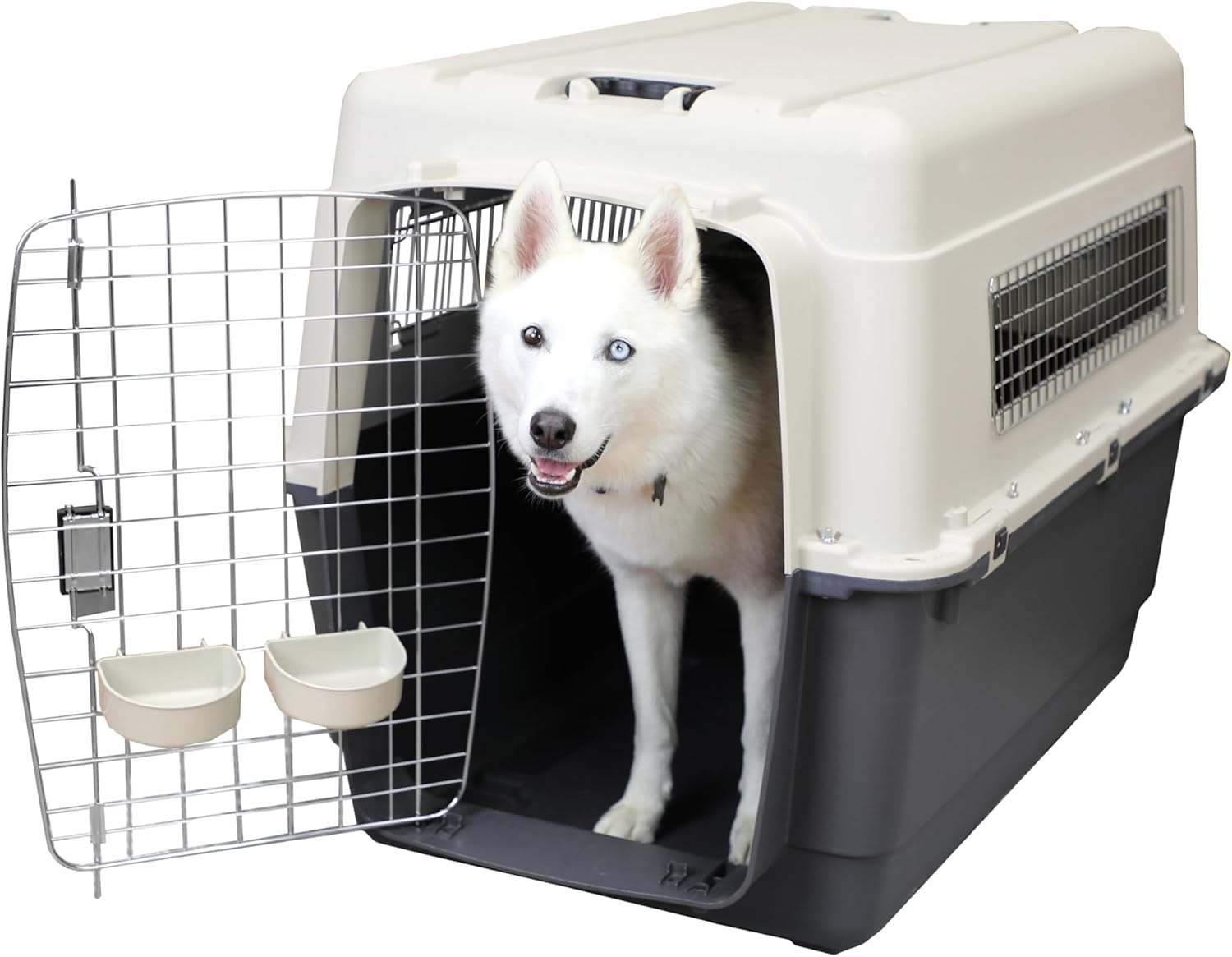
| IATA compliance | 51st Edition IATA Live Animals Regulation (2025) compatible |
|---|---|
| Maximum weight recommendation | 90 pounds |
| Included accessories | 2 food/water dishes, 4 live animal labels |
| Material | Plastic |
| Assembly hardware | Metal bolts and nuts |
This SportPet XX-Large travel kennel is a heavy-duty, hard-sided crate built for both car trips and airline travel. It separates into two halves for storage, uses metal bolts and reinforced hardware for secure assembly, and includes a strong metal door with a locking latch and tie-down holes to anchor the kennel in a vehicle. Ventilation on all sides and an accident moat on the floor help keep a pet comfortable and dry, and the plastic construction wipes clean easily after outdoor use. Removable snap-on wheels and top carry handles make it simple to move through airports or between car and home, while the two included food/water dishes and live-animal labels cover common travel requirements. The kennel is large enough for very big dogs and is marketed as IATA compliant, but buyers should still confirm specific airline or vehicle rules before travel and plan for temperature control since plastic crates can retain heat in direct sun.
Best for: Buyers who prioritize a sturdy, travel-ready kennel that can be anchored in a car and moved through airports with minimal fuss, and who need a roomy enclosure for very large dogs.
Less Ideal for: Owners who need a lightweight, easily carried daily carrier for short trips or those who frequently lift the crate by hand over long distances.
- Durable hard-sided plastic with reinforced metal hardware for secure containment
- IATA airline-compliant design with tie-down holes and included live-animal labels and dishes
- Removable snap-on wheels and top handles for easy movement through airports and car-to-car transfers
- Good ventilation on all sides and an accident moat to help keep pets dry
- Separates into two pieces for more compact storage and straightforward cleaning
- Large and relatively heavy compared with soft carriers, making it less convenient for quick pickups or frequent lifting
- Plastic shell can become warm in direct sunlight so temperature-managed transport is required
Verdict: The best large-capacity safe crate provides generous interior space and robust construction to safely accommodate bigger dogs during car travel.
ZOMISIA Collapsible Dog Crate Large
Best Portable Safe Crate

| Material Type | Polyester |
|---|---|
| Item model number | ZOMISIA Collapsible Dog Crate Grey L US |
| Specific Uses For Product | Outdoor |
| Dog Breed Size | Large |
This ZOMISIA collapsible dog crate is built for owners who need a portable but sturdy kennel for frequent travel or short-term housing. The frame uses high-strength iron tubing and 600D Oxford fabric to keep the structure stable while remaining lightweight enough to carry by the top handle and fold flat for storage. Three breathable mesh windows and a roll-up door give good airflow and visibility, and the included plush pad and internal safety leash improve comfort and containment during trips. Setup requires no tools and the external storage pocket is handy for treats or paperwork when moving between locations. Expect typical soft-sided limitations: it is not escape-proof against determined chewers and will not offer the rigid security of a metal crate for extremely strong or anxious dogs. For road trips, plane-side waiting, or temporary lodging where a balance of durability and packability matters, this crate performs well.
Best for: Owners who travel frequently with a large dog and prioritize a crate that folds compactly for car or short-term stays while still offering stable structure and ventilation.
Less Ideal for: Those needing a permanent, escape-proof kennel for strong chewers or for long-term heavy-duty confinement should choose a metal or fully rigid crate instead.
- Foldable design with handle packs flat for easy transport and storage
- High-strength iron frame combined with 600D Oxford fabric for a durable, lightweight structure
- Three mesh windows and roll-up door provide good ventilation and visibility
- Includes plush pad and built-in safety leash for pet comfort and secure containment
- External storage pocket for treats, paperwork, or small accessories
- Soft-sided construction is not ideal against heavy chewers or dogs that need rigid containment
- Not as secure as metal crates for very strong or anxious dogs
Verdict: The best portable safe crate balances lower weight, foldability, and quick setup for owners who frequently transfer the crate between vehicles or locations.
Thule Allax Dog Crate L
Best Premium Safe Crate

| Material Type | Aluminum |
|---|---|
| Number of Doors | 1 |
| Breed Recommendation | Large Breeds |
| Included Components | Dog Crate |
The Thule Allax is a trunk-only dog travel crate engineered around safety and everyday usability. It is crash tested front and rear and uses a 10–13 cm crumple zone to absorb impact, plus an escape hatch for rear access and a built-in front door lock for security. The aluminum construction and precision fit aim to minimize rattles while the gas-damped door holds open and closes gently, which helps with loading nervous dogs. Adjustable depth across sizes lets you get a closer fit for both car and dog, and accessory options such as a bumper mat and leash hook make it more practical for repeated travel. On the downside this is a high-end, heavy crate intended for trunk installations only and it requires adults to follow assembly and installation instructions carefully. The focus on crash protection and durable materials makes it best suited for owners who prioritize long-term safety and quiet operation over budget or lightweight portability.
Best for: Owners who are prepared to invest in a durable, safety-first travel crate and want long-term protection and quiet, reliable use during car trips.
Less Ideal for: People needing a lightweight, portable crate for frequent moves or those who require back-seat or truck-bed installations.
- Crash-tested front and rear with a 10–13 cm crumple zone for impact absorption
- Aluminum construction and precision design that reduces rattling and feels durable
- Gas-damped door mechanism that holds open and closes gently for safer loading
- Built-in front door lock plus rear emergency escape hatch for access and security
- Adjustable depth and available accessories for a tailored, long-term installation
- Designed strictly for trunk use, not for truck beds or back seat applications
- Heavy and premium construction makes it less practical for frequent carrying or quick moves
Verdict: The best premium safe crate is for owners willing to pay more for superior materials, refined fit, enhanced crash features, and durable long-term performance.
Choosing the Right Safe Dog Crate Car Travel: Key Factors to Consider
Crash Safety and Structural Strength
A crate's ability to stay intact and protect the dog during a collision is the most important factor for car travel. Look for reinforced frames, sturdy panels, and secure door latches that resist deformation under force. The design should prevent the crate from collapsing and reduce objects entering the interior during an impact.
Anchoring points and compatibility with vehicle tie-downs matter because a well-secured crate is far less likely to shift or tip. Consider how the crate interfaces with seatbelt hardware, cargo anchors, or dedicated restraint straps, and whether attachment points are rated for load. Even without formal crash testing data, prioritize crates with obvious structural reinforcement and robust fasteners.
Vehicle Fit and Footprint
A crate that is safe but does not fit your vehicle creates new hazards, so measuring both the cargo area and interior seat configuration is essential. A too-large crate can prevent proper anchoring and block driver sightlines; a too-small crate forces an awkward, constrained posture for the dog.
Think about where the crate will sit during travel: rear cargo area, back seat, or behind the front seats. Account for door swing, sloped cargo floors, and any wheel-well intrusions. Some crates have modular sizing or tapered shapes to better fit common vehicle interiors, which increases the chance of secure installation and reduces rocking while driving.
Ventilation and Climate Control
Good airflow prevents overheating and keeps your dog comfortable during longer drives. Crates for car travel should have multiple ventilation openings that do not compromise structural strength. Placement of vents matters too; vents near the top encourage heat to escape while lower vents promote crossflow.
Consider the materials used: solid panels offer privacy and noise dampening but block airflow, while mesh or slotted panels increase ventilation. Also check whether the crate silhouette blocks air vents in the vehicle or sits in sunlight; these factors affect interior temperature and may require additional shade or cooling measures on hot days.
Comfort and Interior Layout
A secure crate should also be comfortable enough for a dog to ride calmly. Interior dimensions must allow the dog to stand, turn, and lie down comfortably. Padding and floor support matter for both comfort and safety because thin or uneven flooring can shift a dog during sudden stops.
Look for non-slip floors, washable liners, and low-profile thresholds that make entry and exit easier. If the crate will be used for frequent short trips, consider features that reduce motion stress such as a familiar blanket pocket or the option to partially block view to reduce external stimulation.
Ease of Installation and Everyday Use
A travel crate must be easy to secure and remove, because complicated installation reduces the likelihood that owners will anchor it properly every time. Quick-release straps, integrated seatbelt channels, and clear anchor instructions are practical advantages. Portability features like side handles, carry options, and fold-flat designs can matter if you need to move the crate between vehicles or carry it long distances.
Maintenance also plays into daily usability: spare parts availability, replaceable liners, and removable doors simplify cleaning and upkeep. Consider how the crate opens for loading a dog—top access or front access can make a significant difference for nervous or older animals.
Visibility and Calming Features
How much the dog can see affects anxiety and behavior in the car. Crates that offer a balance between visibility and privacy help many dogs remain calmer. Full-visibility panels can be reassuring for dogs that want to watch you, while partially covered panels can reduce motion-related stress.
Other calming features, such as rounded interior corners, muted interior colors, or attachment points for familiar bedding, can help a dog settle. Think about whether you want a crate that keeps the dog engaged with the cabin or one that provides a den-like retreat for relaxed travel.
How Do You Measure Your Dog and Vehicle for the Right Crate?
Measure your dog from the tip of the nose to the base of the tail for length and from the paws to the top of the head for height when standing naturally. Add at least four inches in each direction for comfortable movement and enough space for bedding. For tall breeds that sit up, verify head clearance so the dog never has to crouch.
Next, measure the intended vehicle location: cargo floor width, available height under the hatch, and depth from the back of the seat to the tailgate. Compare those interior measurements with the external crate footprint, remembering that latches, handles, or mounting hardware can add a few inches. If you plan to anchor the crate to seatbelt points, check that the anchor locations are accessible with the crate in place.
- Measure your dog standing, not curled up.
- Add clearance for bedding and a natural turn radius.
- Confirm anchor access after the crate is in position.
Can a Crate Be Anchored to a Seat Belt or Does It Need Dedicated Tie-downs?
Many car travel crates can be anchored using the vehicle's seat belt routed through dedicated channels or by attaching to cargo-area tie-downs. Seat belt anchoring works for some designs, particularly smaller crates, but it depends on whether the crate includes reinforced belt pass-throughs and rated attachment points.
Larger or heavier crates often benefit from dedicated tie-down straps that connect to cargo anchors or to the vehicle frame. When using seat belts, follow the crate manufacturer's routing instructions and ensure the belt is tensioned. For maximum stability on long trips and when transporting large dogs, dedicated tie-downs that minimize movement are preferable.
- Check for reinforced belt channels or anchor points on the crate.
- Use dedicated tie-downs for larger or heavier crates when possible.
- Ensure any belt used is routed and tensioned according to instructions.
How to Keep a Travel Crate Cool and Ventilated on Long Drives
Position the crate away from direct sunlight and avoid placing it where cabin vents are blocked. If your vehicle has rear climate controls or vented cargo areas, orient the crate to take advantage of airflow. Portable fans designed for pet use or battery-powered venting units can help in vehicles without strong rear ventilation.
Always monitor the temperature inside the crate on warm days and stop regularly to check the dog. Lightweight, breathable bedding helps airflow while still providing comfort. Never leave a dog unattended in a closed vehicle; even crates that promote ventilation cannot compensate for rising ambient temperatures during a stop.
- Use breathable bedding and avoid overly insulated liners in hot weather.
- Position crate to benefit from cabin airflow and avoid direct sun.
- Carry a thermometer to check crate interior temperature on long trips.
What Features Make Loading and Unloading Easier for Older or Anxious Dogs?
Low thresholds and wide front openings reduce the effort required for older dogs to step into a crate. A top-loading option or removable roof panel can help when lifting a dog into position, especially for larger breeds. Non-slip ramps or portable steps are useful accessories when the crate sits higher in a cargo area or on an elevated platform.
Familiar bedding and gradual acclimation to the crate in the home can make the loading process less stressful. During travel, open the vehicle and crate doors in a calm environment so the dog can enter at its own pace, and use treats or a favorite toy to reward cooperative behavior.
- Choose low thresholds or pair the crate with a ramp for easier access.
- Consider top access or removable panels for assisted loading.
- Use familiar bedding and positive reinforcement to reduce anxiety.
How to Maintain and Clean a Travel Crate While on the Road
Select crates with removable, washable liners or trays that lift out for cleaning. For trips, carry extra absorbent pads and a small cleaning kit with enzymatic cleaner to handle accidents quickly. Hard-surface floors that wipe clean are often faster to service between stops than carpeted interiors.
Inspect latches and fasteners regularly for signs of wear, and tighten or replace any straps or buckles that show damage. Keep spare mounting straps and a basic tool kit in the vehicle so you can make minor repairs or adjustments during long journeys.
- Pack spare absorbent pads and a travel cleaning kit.
- Prefer removable liners or trays for fast cleanup.
- Carry spare straps and basic tools for on-the-road repairs.
How We Chose the Best Safe Dog Crate Car Travel
We focused on attributes that directly affect safety and usability for transporting dogs in a vehicle. Our selection process prioritized crash performance features such as reinforced construction, secure attachment points, and stable base designs that reduce forward movement during sudden stops. We also evaluated ventilation and visibility to ensure proper airflow and to reduce heat buildup on longer trips. Size and interior layout were assessed for realistic fit and comfort so dogs can stand, turn, and lie down naturally. Installation practicality was another key criterion, covering how a crate anchors to typical car seatbelt systems or cargo-area tie-downs and how easy it is to load and unload a dog. Durability and materials were considered to ensure a crate can withstand repeated use, while user-focused details such as easy-clean liners, doors that lock securely, and handles for carrying influenced our choices. We excluded products that lack clear attachment methods for vehicles or that are intended solely for home use. Overall, we favored crates that combine demonstrable safety features with everyday convenience for vehicle travel.
Our full evaluation process is outlined in our review methodology.
FAQ
Is a hard-sided crate safer than a soft-sided one for car travel?
Hard-sided crates generally offer better structural protection during impacts because they resist collapse and provide more predictable force distribution. Soft-sided crates can be comfortable and lightweight but often lack the rigidity needed to protect a dog in a severe collision. Choice depends on dog size, vehicle space, and how the crate will be anchored.
Can I use a crate in the back seat, or should it go in the cargo area?
Both locations can work depending on vehicle layout and crate size. The cargo area typically allows better anchoring and reduces intrusion into passenger space, while a back seat placement may offer easier access. Ensure the crate is securely anchored and does not block airbags or driver sightlines wherever it is placed.
How long can a dog safely stay in a crate during a road trip?
Duration depends on the dog's age, health, and comfort. Plan for regular stops every two to three hours for exercise, water, and bathroom breaks. Puppies and older dogs may need more frequent breaks. Never leave a dog unattended for extended periods, especially in varying temperatures.
Are there official crash-test ratings I should look for?
Formal crash-test ratings are not available for every crate, but look for products with documented testing or clear engineering features such as reinforced frames and rated anchor points. When ratings are absent, evaluate build quality, materials, and how the crate attaches to the vehicle to judge relative safety.
How do I know if a crate's ventilation is adequate for hot weather?
Adequate ventilation means multiple open panels that allow crossflow and do not trap heat. Check that the crate does not block vehicle vents and that bedding is breathable. Monitor interior temperature on warm drives and avoid prolonged exposure to direct sun if ventilation seems marginal.
Final Verdict
For car travel, prioritize a crate that balances structural strength, secure anchoring, and a proper fit for both your dog and vehicle. Tradeoffs are inevitable: the sturdiest designs may be heavier or bulkier, while lighter options are easier to move but may offer less protection. Focus first on crash-resilient features and reliable attachment methods, then consider comfort, ventilation, and ease of use. Choose the crate that best matches your vehicle footprint and the dog's size, and plan to test installation and acclimation before long trips. With the right balance of safety and comfort, you can reduce stress and make car travel safer for your dog.

