

Finding the right shock collar for a bulldog matters because this breed has a compact neck, sensitive skin, and a strong-headed temperament that responds differently to corrections than many other dogs. You want an option that delivers consistent, adjustable feedback without causing unnecessary discomfort, and that fits securely on a shorter, wider neck. This guide covers the top six shock collars shortlisted for bulldogs, explaining the safety, fit, and usability factors that shaped our picks. We evaluate features like intensity control, contact design, and power delivery so you can pick a collar that works for basic obedience, boundary training, or reinforcement of cues. Read on for concise buying guidance and practical use tips before you inspect individual models.
Top Picks at a Glance
| Best Overall Shock Collar A well-rounded collar balancing effectiveness, safety, and user control | BLACKDOG Military Shock Collar OT9 |  |
| Best Budget Shock Collar A low-cost option that still delivers core training features | Asrcs X13 Dog Shock Collar |  |
| Best Premium Shock Collar A higher-end unit with extra features and superior construction | SportDOG FieldTrainer 425X |  |
| Best Compact Shock Collar A smaller, lightweight collar designed for portability and small dogs | koikvs Small Dog Training Collar YM2 |  |
| Best Rechargeable Shock Collar A rechargeable model with longer run time and lower upkeep costs | MrSpark HQ01 Shock Training Collar |  |
| Best Waterproof Shock Collar Fully water-resistant design for wet-weather and active dogs | RYCOOLAR S101S Dog Shock Collar |  |
BLACKDOG Military Shock Collar OT9
Best Overall Shock Collar

| Training modes | Beep, Vibration, Safe Shock, Strobe Light |
|---|---|
| Range | 4200ft |
| Waterproof rating | IP67 |
| Power | USB-C fast charge; 90-day claimed runtime (1 hr/day) |
The BLACKDOG OT9 is a rechargeable training collar system aimed at regular use in outdoor conditions. The remote and collar provide four user-selectable modes—beep, vibration, safe shock, and a strobe light—with multiple intensity levels, an LCD on the transmitter for clear mode and battery readouts, and tool-free removable prongs so you can switch to no-shock operation. Its rechargeable design (USB-C fast charge) and claimed 90-day battery life based on one hour of daily use make it convenient for owners who train often and want low running costs compared with disposable batteries. The unit is built to a rugged spec with an IP67 rating and reinforced casing for heavy-duty outdoor use, while the remote flashlight and collar strobe improve night safety. Practical limits: the shock mode is present so careful, informed use is required, and real-world range and battery life will vary with terrain and usage intensity. The system suits hands-on, consistent trainers who need a weatherproof rechargeable collar with visible lighting features.
Best for: Owners who train regularly and prioritize a rechargeable collar that is rugged enough for outdoor use and includes visibility features for night or low-light sessions.
Less Ideal for: People who want a purely positive-reinforcement tool without any static stimulation or those who need a collar-free solution for noise-only behavior control.
- Rechargeable USB-C system with fast charging and long claimed runtime
- Multiple training modes including beep, vibration, and adjustable safe shock levels
- IP67 waterproof build and reinforced casing for rugged outdoor use
- Integrated remote flashlight and collar-mounted strobe for night visibility
- Tool-free removable prongs allow switching to no-shock configuration
- Shock feature requires responsible use and may not suit sensitive or inexperienced handlers
- Real-world range and battery life depend on terrain and usage and may be lower than claims
Verdict: The best overall shock collar for owners who want a reliable, responsibly designed training tool that balances adjustable stimulation, comfort, and easy controls for everyday training.
Asrcs X13 Dog Shock Collar
Best Budget Shock Collar

| Range | 2000FT |
|---|---|
| Waterproof rating | IPX7 |
| Dog size range | 8-150 lbs |
| Power | Rechargeable batteries (included) |
The Asrcs X13 is a no-frills remote training collar that combines adjustable shock with vibration, beep, and a built-in flashlight so you can use progressively stronger cues without swapping devices. It is sold as a single-dog system with dual-channel support for additional receivers, and typical use cases are basic obedience, boundary reinforcement, and off-leash recall at distance. Practical benefits include an IPX7 waterproof receiver for wet conditions, a compact rechargeable design that claims long standby on a short charge, and multiple contact point options for different coat lengths. The 2000 ft range and lightweight handset make it suitable for park or trail training, while included accessories like extra contacts, a test light, and charging cables simplify setup. Important limitations are that intensity control granularity and actual maximum range can vary with terrain and interference, and the product focuses on corrective signals rather than positive-only methods. For buyers wanting a budget-minded but capable electronic trainer, the X13 delivers core functionality without advanced telemetry or smartphone integration.
Best for: Owners who need an affordable, functional training collar that provides dependable corrective signals for basic obedience and off-leash recall without extra smart features.
Less Ideal for: People who want app control, advanced logging, or a strictly reward-based training approach should consider other options.
- Multiple stimulus modes (shock, vibration, beep) for stepwise training
- IPX7 waterproof receiver suitable for wet use
- Includes spare contact points and test light for easier fit and setup
- Rechargeable batteries with claimed long standby and quick charge
- Actual range and shock strength can be affected by terrain and may not meet the maximum in all environments
- No smartphone app or advanced telemetry; basic handset-only controls
Verdict: The best budget shock collar for buyers who need a functional, affordable training device that provides basic adjustable stimulation and acceptable durability without premium extras.
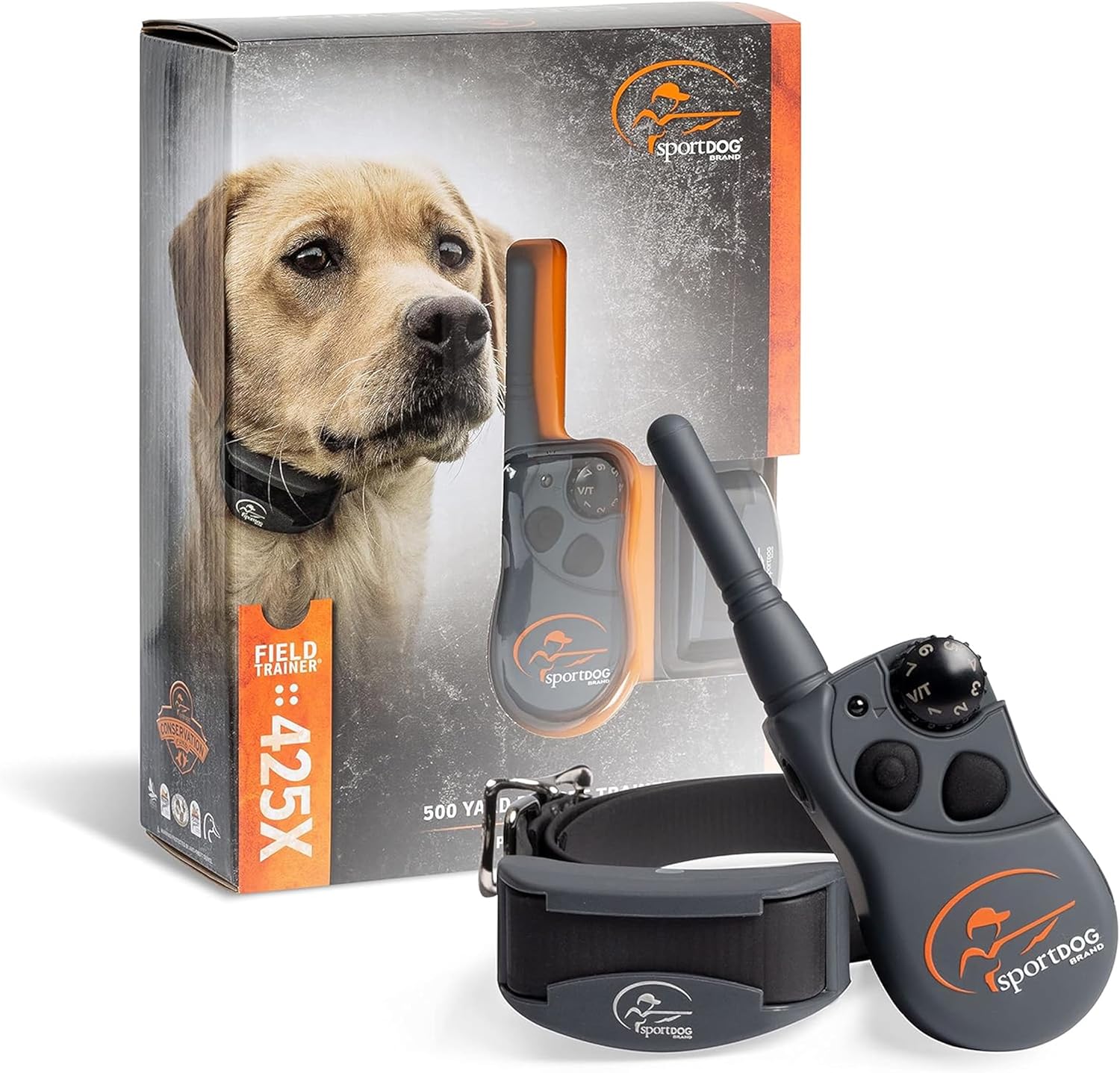
SportDOG FieldTrainer 425X
Best Premium Shock Collar
| Range | 500 yards |
|---|---|
| Stimulation levels | 21 levels |
| Modes | Tone, vibration, static |
| Waterproof rating | Submersible to 25 ft |
| Battery | Rechargeable lithium‑ion, 50–70 hours |
The SportDOG FieldTrainer 425X is a compact remote trainer built for off-leash control and field work where reliable, no-look operation matters. The handheld transmitter dials through 21 static-stimulation levels and can also deliver tone or vibration, letting you tailor corrections while you recall or reinforce obedience. Its 500-yard range and expandability to control up to three dogs make it suitable for working dogs in open spaces, and DryTek waterproofing makes both remote and receiver submersible to 25 feet for water training. Rechargeable lithium-ion batteries promise long runtime and a two-hour quick charge, and the included longer contact points help ensure skin contact on thick-coated dogs. On the flip side, the unit is SportDOG's smallest receiver so very large mastiff-type necks may find the housing compact, and advanced users who need half-mile-plus range or OLED-screen feedback might prefer larger models. For Cane Corso owners focused on rugged, repeatable off-leash recall and obedience work, the 425X provides a tough, field-ready baseline with proven durability and customizable stimulation.
Best for: Buyers who need a durable, field-ready e‑collar to reinforce off-leash control and recall for strong, active working dogs and who prioritize waterproofing and consistent, no-look operation.
Less Ideal for: Owners seeking the longest possible range, a larger receiver housing for very wide necks, or a display-equipped transmitter for fine-grained telemetry should consider larger SportDOG models.
- Multiple stimulus modes (tone, vibration, 21 levels of static) for flexible training.
- 500-yard range suitable for most yard and field training scenarios.
- Waterproof DryTek design submersible to 25 feet for wet conditions and water work.
- Rechargeable Li‑ion batteries with long 50–70 hour runtime and quick 2-hour charge.
- Expandable to control up to three dogs with add-on collars.
- Receiver is the brand’s smallest and may sit small on very large or thick-necked mastiff breeds.
- Range and feature set are less advanced than SportDOG’s higher-end half-mile models.
Verdict: The best premium shock collar for owners willing to invest in top build quality, refined controls, extended range or battery life, and advanced safety features for long-term use.
koikvs Small Dog Training Collar YM2
Best Compact Shock Collar

| Breed Recommendation | Small |
|---|---|
| Included Components | Remote Control |
| Animal Collar Type | Electronic Training Collar |
| IP Rating | IP67 (receiver) |
This compact koikvs training collar is built specifically for small breeds and travel use, combining a lightweight receiver with a simple two-button remote for everyday corrections. The receiver is very light and low-profile, with removable contact points and silicone covers to reduce irritation on sensitive necks, and the nylon strap adjusts from very short to 25 inches to fit tiny puppies through small adult dogs. Controls are straightforward: two large front buttons for beep and vibration and side controls for 1–16 shock levels so you can reserve stimulation for moments that require firm correction. The receiver is rated IP67, so it tolerates rain and submersion, while the remote is rainproof only. Battery life is strong on paper, with long standby and multi-day use between charges, and the remote claims up to a 1000 ft range in open areas which is useful for recall practice in yards. Expect a learning curve dialing in the right stimulation level for a very small dog and keep the remote dry; otherwise this is a sensible, travel-friendly option for focused training with compact breeds.
Best for: Buyers of small-breed dogs or frequent travelers who want a genuinely lightweight, low-profile training collar that is easy to carry and simple to operate for routine behavior shaping.
Less Ideal for: Owners who need multi-dog simultaneous control, advanced programmable schedules, or a fully submersible remote should consider other systems designed for those capabilities.
- Very lightweight, low-profile receiver suited to small breeds
- Removable contact points with silicone covers to protect sensitive skin
- Simple remote layout with dedicated beep and vibration buttons for everyday use
- IP67 waterproof receiver for swimming and wet-weather use
- Long battery standby and claimed range up to 1000 ft for outdoor training
- Remote is only rainproof and should not be submerged
- Shock levels require careful adjustment on tiny or very young puppies
Verdict: The best compact shock collar for owners who prioritize a lightweight, unobtrusive device that stays comfortable on smaller necks while still offering effective training levels.
MrSpark HQ01 Shock Training Collar
Best Rechargeable Shock Collar

| Training modes | Beep, Vibration, Shock (adjustable levels) |
|---|---|
| Waterproof rating | IP68 receiver |
| Remote range | 4500ft |
| Recharge time | 2 hours |
The MrSpark HQ01 is a rechargeable e-collar designed for remote obedience and bark control using three modes: beep, vibration and adjustable shock levels. You use the handheld remote to send instant corrections up to 4,500 feet away, which makes it practical for off-leash field work, recall training, and perimeter control. Notable features include an IP68 waterproof receiver that can be rinsed after swims or muddy sessions, a built-in LED collar light and a remote flashlight for night visibility, and a safety lock plus automotive-grade safety chip to reduce accidental stimulation. Battery life is strong: the receiver claims up to about 20 days between charges and the remote up to 90 days with a two-hour full charge time. The collar ships with short and long metal prongs and silicone covers to fit different coat types and has an adjustable buckle fit. Limitations to be aware of are that the remote is not waterproof and users must follow the daily-wear and skin-inspection guidance to avoid irritation from sustained contact; effective, humane use requires gradual level setting and monitoring during training.
Best for: Pet owners who prioritize a durable, moisture-resistant training collar for frequent outdoor use, night walks, and water activities and who want a long-range remote for off-leash correction.
Less Ideal for: Owners who need a fully waterproof remote or who prefer passive bark-only collars without user-controlled correction should consider other options.
- IP68-rated receiver that can be rinsed after swimming or muddy play
- Long 4,500 ft RF range with adaptive frequency hopping for stable response
- Multiple training modes with adjustable levels for gradual, precise corrections
- Long battery runtime and 2-hour fast recharge to minimize downtime
- Included hardware (short/long prongs and silicone covers) for fit across coat types
- Remote unit is not waterproof which limits use in wet conditions
- Requires careful daily-wear management and periodic skin checks to prevent irritation
Verdict: The best rechargeable shock collar for pet owners who prefer the convenience and lower long-term cost of USB-rechargeable batteries and consistent power for regular training sessions.
RYCOOLAR S101S Dog Shock Collar
Best Waterproof Shock Collar

| Range | 4200 FT |
|---|---|
| Training modes | Beep, Vibration, Shock, Shock Boost |
| Waterproof rating | IPX8 |
| Neck fit | 7.8 – 24.4 inches |
The RYCOOLAR S101S is a rechargeable electronic training collar designed for off-leash control and everyday obedience work. It pairs a palm-sized remote with a compact receiver that clips to an adjustable collar and offers four modes: beep, multi-level vibration, a range of safe shock settings, and a higher-intensity shock boost, letting you match stimulus to the situation. The unit advertises a 4200 foot control range and the remote can operate two receivers independently with memory for each dog's settings, which is useful for multi-dog households. The receiver is IPX8 waterproof and uses Type-C charging, and the listed battery life supports long standby times so you will not need to recharge frequently during typical use. Practical benefits include a smaller, lower-profile receiver that reduces neck bulk for large active breeds, clear remote controls for quick adjustments, and weather resistance for outdoor training. Important limitations are the reliance on static stimulation methods that require careful, informed use and the need to follow recommended wear limits and fit checks to keep the collar comfortable and safe for the dog.
Best for: Owners who want a rechargeable collar that lets them train at distance and manage two dogs with a single remote, especially those who prioritize convenience and lower long-term charging hassle.
Less Ideal for: People who prefer fully positive-only training tools or who are uncomfortable using static stimulation should consider vibration-only or no-shock alternatives.
- Rechargeable Type-C battery with long standby times reduces frequent recharging
- 4200 ft remote range supports off-leash recall and distance training
- Compact, 30% smaller receiver that reduces neck bulk for more comfortable wear
- IPX8 waterproof receiver suitable for rain, mud, and swimming
- Remote controls two dogs independently with memory for each dog
- Uses static stimulation which requires careful, responsible training and monitoring
- Intensity levels and effects can vary by dog and may need trial-and-error to set correctly
Verdict: The best waterproof shock collar for households with active or water-loving dogs that need a durable, weatherproof unit that withstands splashes, rain, and easy rinsing.
Choosing the Right Shock Collar Bulldog: Key Factors to Consider
Neck Fit and Sizing
Bulldogs have short, wide necks with loose skin folds that can prevent consistent contact with standard collar shapes. Proper sizing matters because a collar that rides too loose will fail to deliver reliable signals and one that is too tight can cause chafing or breathing discomfort.
Look for collars with multiple length adjustments, short strap tails, and contact points positioned on a narrow mounting plate to stay aligned with the throat area. Some collars include spacer pads or adjustable electrode heights to keep contacts against the skin without excessive pressure. If a collar allows quick position checks and re-centering, that reduces the likelihood of missed signals during training sessions.
Contact Point Design and Materials
The shape, spacing, and finish of the electrodes change how stimulation feels and how often skin irritation occurs. Rounded or covered contact tips and plated finishes disperse pressure more evenly, which is important on the softer skin of a bulldog's neck.
Insulated or partly coated electrodes reduce hotspots and lower the chance of abrasion when the dog is active. Removable or replaceable contacts let you swap to longer or shorter probes for a better fit. Pick collars that list hypoallergenic or stainless materials and avoid permanently protruding sharp pins that press into folds of skin.
Adjustable Stimulation Levels and Modes
A wide, clearly labeled range of intensity settings helps you start as low as possible and increase only when necessary. Bulldogs can be stubborn but also sensitive; being able to step through small increments reduces the risk of overcorrection.
Multi-mode options such as vibration or tone provide alternatives to static stimulation and let you pair less aversive cues with commands. Tone and vibration can be effective for many training scenarios and useful when you want to avoid strong stimulations. Ensure the collar has easy-to-read level indicators so you always know the current setting during use.
Safety Features and Automatic Cutoffs
Built-in safety mechanisms prevent prolonged exposure to stimulation and protect against accidental continuous output from a stuck button or transmitter. Features to look for include an automatic shutoff after a short maximum duration, lockout or require-press sequences to change high levels, and clear warnings when the battery is low.
Fail-safe behavior on signal loss is also important: the collar should default to an inactive state if it loses communication with the remote. These protections reduce the risk of accidental harm and give owners confidence when using corrective feedback for training.
Remote Ergonomics and Control Clarity
Ease of use in the hand matters because training requires timely, consistent responses. A remote with distinct, tactile buttons for stimulation, vibration, and tone, plus a clear display of intensity levels, reduces operator error. Lightweight, well-balanced remotes mean you can hold them comfortably during longer sessions.
Responsive feedback from the transmitter and an unambiguous indicator when a signal is sent help you synchronize corrections with the exact behavior you are addressing. If the remote can be reused with different collars or has channel switching, confirm that channel selection is obvious to avoid sending a correction to the wrong unit.
Battery Life and Charging Convenience
Reliable battery life ensures the collar and remote are ready for daily training without frequent interruptions. Rechargeable systems are often more convenient, but confirm charge time and how many full sessions you can expect per charge.
Consider whether the collar works while charging or has replaceable batteries for quick swaps. Battery indicators on both collar and remote help avoid surprises during training. For owners who travel to training classes or parks, longer range between charges is a practical advantage.
How Do I Ensure a Shock Collar Fits My Bulldog Comfortably?
To achieve a comfortable, secure fit, measure the thickest part of your bulldog's neck and choose a collar that allows for snug adjustment without compressing skin folds. Place the contact points against bare skin; if coat or folds prevent contact consider trimming a small area of hair or using short replaceable contacts designed for short-neck breeds.
After fitting, perform a gentle movement test: the collar should stay in place while the dog walks and panting should not be restricted. Recheck the fit after a few minutes of activity and adjust as needed so the electrodes maintain consistent contact without digging into the skin.
- Measure neck circumference at the widest point, not where the collar normally sits.
- Start at the lowest stimulation level when testing fit and response.
- Use padded straps or spacer pads if recommended by the manufacturer to protect skin folds.
When Should I Use Vibration or Tone Instead of Static Stimulation?
Vibration and tone are good first-line options for bulldogs because they are less aversive and often effective for attention-getting and cue reinforcement. Begin training with tone or vibration paired with a verbal command so your dog learns the association before escalating to static stimulation.
Reserve static stimulation for situations where vibration or tone does not elicit the desired response, and always step up intensity gradually. For sensitive or anxious dogs, alternate positive reinforcement with lower-level cues rather than moving directly to higher static levels.
- Use tone or vibration for recall and simple obedience.
- Progress to low static only when lower modes fail to change undesired behavior.
- Combine cues with consistent timing to avoid confusing the dog.
How to Reduce Skin Irritation From Contact Points
Preventing irritation starts with correct fit and clean contact surfaces. Wipe the contact points and the dog's neck regularly to remove dirt and oils that increase friction. If your dog has particularly sensitive skin, select collars with plated or coated electrodes and consider using replaceable soft tips.
Give the skin rest periods by removing the collar during long indoor downtime and avoid leaving a corrective collar on continuously for more than a few hours unless specifically designed for long-term wear. Monitor the skin for redness or sore spots and discontinue use if irritation persists.
- Clean electrodes weekly and after outdoor use.
- Rotate collar placement slightly each day to avoid pressure in the same spot.
- Inspect skin daily for signs of chafing or inflammation.
Are There Training Practices That Make Shock Collars More Effective?
Consistency and timing are essential. Deliver the stimulus at the exact moment of the unwanted behavior and follow up immediately with a clear command or redirection. Use short, focused sessions rather than long corrections. Start sessions in a low-distraction environment and increase difficulty as the dog reliably responds.
Pairing corrections with positive reinforcement for the desired behavior improves learning speed and reduces stress. Avoid punishing reactions like barking or pawing; instead, target the underlying behavior and reward an alternative action you want the dog to perform.
- Keep sessions brief: multiple 5- to 10-minute sessions work better than one long session.
- Record or have a partner watch training to confirm timing accuracy.
- Use reinforcement immediately after the dog responds correctly.
What Safety Checks Should I Perform Before Each Session?
Before starting, test the remote-collar link and confirm battery indicators are adequate. Inspect the collar strap and contacts for damage or corrosion. Verify the intensity is set to the lowest necessary level and that the automatic shutoff feature is active.
Observe the dog calmly for a short period after the first application to ensure there is no unexpected distress. Stop using the collar immediately if the dog shows signs of extreme discomfort, persistent agitation, or skin injury.
- Check remote response and signal strength at the working distance.
- Confirm automatic cutoff and lock features are enabled.
- Have a plan to pause and soothe the dog between corrections.
How We Chose the Best Shock Collar Bulldog
We prioritized criteria that matter specifically for bulldogs: neck profile and fitment, graduated intensity and stimulation types, contact point design and materials, safety cutoffs and fail-safes, and usability for everyday handling. Neck profile and fitment was a primary filter because bulldogs have short, broad necks and loose skin; collars had to offer secure, adjustable sizing with contact points that maintain consistent skin contact. We also required multiple low-intensity settings and graduated stimulation modes so owners can start with minimal feedback and increase only when needed. Contact materials and electrode shape were examined for comfort and reduced skin irritation. Safety features such as automatic shutoff, lockout thresholds, and clear intensity labeling were mandatory. Usability criteria included remote ergonomics, range appropriate to typical yard sizes, and battery life sufficient for routine use. We excluded any collar lacking clear safety cutoffs, collars with one-size-fits-all metal contacts that do not accommodate short-neck breeds, and units with complex, nonintuitive controls. The final list focuses on products that balance humane, measurable correction with a fit and contact design suited to bulldogs.
Our full evaluation process is outlined in our review methodology.
FAQ
Will a shock collar hurt my bulldog?
Shock collars are designed to deliver brief, controlled corrections rather than cause harm. When used with low starting intensities, proper fit, and gradual escalation, many dogs only experience a momentary startle or awareness. Monitor your dog for distress and prioritize vibration or tone modes first.
How long can my bulldog wear a shock collar each day?
Limit continuous wear to a few hours and remove the collar during extended rest periods to prevent skin irritation. For ongoing behavior modification, use the collar during active training sessions and check the skin daily for any signs of chafing.
Can I use a shock collar for basic obedience and recall?
Yes, shock collars can be effective tools for reinforcing recall and obedience when paired with consistent commands and rewards. Start with tone or vibration and only use static stimulation if those modes do not work, always keeping intensity low and timing precise.
How should I introduce a shock collar to my bulldog?
Introduce the collar gradually by letting your dog wear it unpowered to get used to the feel. Then pair low-level cues like tone or vibration with treats and positive reinforcement before applying any static stimulation. Short, positive sessions help the dog associate the collar with predictable outcomes.
Are rechargeable collars practical for regular use?
Rechargeable collars are convenient for daily trainers because they avoid frequent battery swaps. Check the expected session count per charge and the indicated recharge time; many systems provide clear battery indicators so you can plan sessions without interruption.
Final Verdict
Choose a collar that prioritizes fit, clear control, and safety features for the bulldog body type. Fit and contact design determine whether corrections are consistent and comfortable, while adjustable modes and automatic cutoffs reduce the risk of overcorrection. Prioritize collars that offer low starting intensities, vibration or tone modes, and clear user controls. Pair any corrective device with short, properly timed training sessions and positive reinforcement to get reliable results while minimizing stress.

