

Keeping a dog safely inside your yard matters for their welfare and your peace of mind. The right shock collar for yard containment gives you a predictable way to mark a boundary and discourage escapes without constant supervision. In this guide we shortlisted five top options that focus on dependable range, adjustable correction levels, and safety features built for outdoor use. Below you'll find concise evaluations and practical buying advice so you can match a collar to your yard size, your dog's temperament, and local rules. The selections were chosen for consistent containment performance, usable controls, and durable construction.
Top Picks at a Glance
| Best Overall Shock Collar The best all-around choice that balances features and reliability | HapTop AC131 Dog Shock Collar |  |
| Best Budget Shock Collar A low-cost option that still handles basic containment needs | CIUZL C94 Dog Shock Collar |  |
| Best Waterproof Shock Collar Built to withstand rain, puddles, and active outdoor play | BLACKDOG Military Dog Shock Collar OT9 |  |
| Best Compact Shock Collar A smaller, lightweight design for small dogs and discreet use | Heaflex Shock Collar D10-1P |  |
| Best Premium Shock Collar Higher-end build quality and extra features for demanding owners | Halo Collar 5 |  |
HapTop AC131 Dog Shock Collar
Best Overall Shock Collar

| Training modes | Beep, Vibration, Safe Shock, Shock Boost |
|---|---|
| Range | 4500 ft |
| Fit neck | 7.8"-24.4" (10-120 lb) |
| Waterproof rating | IPX8 |
| Charging | USB-C |
The HapTop AC131 is a rechargeable e-collar kit designed for everyday obedience and distance work. It uses a 2-channel remote to control up to two dogs and offers four training modes: beep, vibration, safe shock (0–99 levels) and a shock boost, with the shock function optional for no-shock training. The remote's long 4500 foot range and memory for individual dog settings make it useful for off-leash recall, boundary training, and reinforcing commands across yards or trails. The receiver is IPX8 waterproof and the kit includes multiple prong lengths, silicone covers, a test light tool, and USB-C charging for practical field use. Safety-oriented features include an adjustable low-to-high stimulation range, a security lock to prevent accidental corrections, and a manufacturer guideline limiting continuous wear to 12 hours. Trade-offs are typical for this class: it relies on batteries and correct fitment to be effective, and some owners prefer vibration or beep-only methods before adding shock. The unit's feature set and range make it a strong daily trainer for owners willing to follow safe use guidelines.
Best for: Owners who want a versatile, safety-minded e-collar for regular obedience and distance work and who plan to use multiple training modes progressively.
Less Ideal for: People who want a purely non-aversive training tool or who are uncomfortable using shock-style corrections should choose vibration- or treat-based training alternatives.
- Very long 4500 ft remote range for off-leash training
- Multiple modes (beep, vibration, adjustable shock) for progressive training
- IPX8 waterproof receiver suitable for wet outdoor use
- Includes extra prongs, silicone covers, test light tool, and USB-C charging
- 2-channel remote controls two dogs and remembers individual settings
- Shock feature requires careful adjustment and responsible use to avoid misuse
- Not intended for continuous wear longer than 12 hours per day
Verdict: The best overall shock collar offers the right mix of safe stimulation settings, range, battery life, and comfort for most owners who need reliable containment and training.
CIUZL C94 Dog Shock Collar
Best Budget Shock Collar

| Range | 3300 ft |
|---|---|
| Waterproof rating | IP67 (receiver) |
| Neck fit | 6 – 26 inches |
| Suitable weight | 8 – 120 pounds |
| Charge time | 2 hours |
The CIUZL C94 is a straightforward training collar that gives basic, adjustable correction options across beep, vibration, and safety shock modes and is built for outdoor use thanks to an IP67 receiver. You use the handheld remote to cue or correct at distances up to 3300 feet, which makes it useful for backyard, park, or beach sessions where you need reliable range. The collar includes two probe lengths and a silicone sleeve to fit both short- and long-haired dogs and the nylon strap adjusts from 6 to 26 inches so it fits large necks. Rechargeable batteries with quick two-hour charge and long standby times mean less frequent charging for the collar and remote, and the built-in light modes help locate a dog at night. Practical limitations are its simple feature set and basic remote ergonomics — there are no advanced training programs or multi-dog channel details in the listing — but for buyers seeking a no-frills, budget-friendly system that covers the essential training functions it performs as expected.
Best for: Buyers wanting an affordable, no-frills training collar for large dogs who prioritize reliable range and basic adjustable stimulation for outdoor recall and behavior work.
Less Ideal for: Owners who need feature-rich professional training tools, programmable multi-dog setups, or premium ergonomics should consider higher-end systems.
- Long remote range up to 3300 ft for open-area training
- Adjustable beep, vibration, and safety shock levels for graduated corrections
- IP67 waterproof receiver suitable for outdoor use
- Rechargeable batteries with short charge time and extended standby
- Includes two probe lengths and silicone sleeves to adapt to different coat types
- Remote is only splash-proof and not fully waterproof
- No advanced training modes or detailed multi-dog channel information provided
Verdict: The best budget shock collar gives owners an affordable way to keep dogs in the yard or reinforce basic training while sacrificing few nonessential features.
BLACKDOG Military Dog Shock Collar OT9
Best Waterproof Shock Collar

| Waterproof rating | IP67 |
|---|---|
| Training modes | Beep, Vibration, Safe Shock, Strobe |
| Range | 4200 ft |
| Fits neck | 8–25 inches |
| Battery life | 90-day (1 hr/day) |
The BLACKDOG OT9 is a rugged training collar built for heavy outdoor use and long-distance recall work. It combines four training modes—beep, vibration, safe shock, and strobe—with an LCD remote that shows level and battery status, so you can adjust intensity from a distance. The unit emphasizes durability: a reinforced casing rated to survive high crush and bite forces and an IP67 waterproof rating mean the electronics are protected during swims, heavy rain, or muddy hikes. Night visibility is strong thanks to a remote flashlight and collar-mounted strobe, useful when keeping a dog in yard or off-leash after dusk. The system claims up to 4200 ft range and includes removable metal prongs plus a tool-free option to switch off shock for sensitive dogs or puppies. Practical trade-offs are its reliance on 9V batteries for operation and a relatively complex level range that requires careful, gradual adjustment for humane training; owners should test settings before full use. For yard containment and outdoor training this unit delivers reliable range and weatherproofing with factory-style durability.
Best for: Buyers who need a weatherproof, durable training collar for off-leash yard containment and outdoor adventures and who prioritize reliable range and visibility in wet or rough conditions.
Less Ideal for: Owners who prefer built-in rechargeable power only or those seeking the simplest beginner collar with minimal adjustment steps should consider other options.
- IP67 waterproof rating protects electronics in rain, lakes, and muddy conditions
- Long 4200 ft remote range suitable for large yards, parks, and hikes
- Dual lighting system: remote flashlight plus collar strobe for night visibility
- Removable prongs and tool-free option to disable shock for puppies or sensitive dogs
- Reinforced military-style casing designed to resist crush and bite damage
- Operates on two 9V batteries rather than built-in rechargeable cells in some competitors
- Wide numeric level ranges require careful testing to find an appropriate intensity
Verdict: The best waterproof shock collar protects electronics and maintains performance during wet-weather walks, swimming sessions, or muddy outdoor activity without risking damage.
Heaflex Shock Collar D10-1P
Best Compact Shock Collar
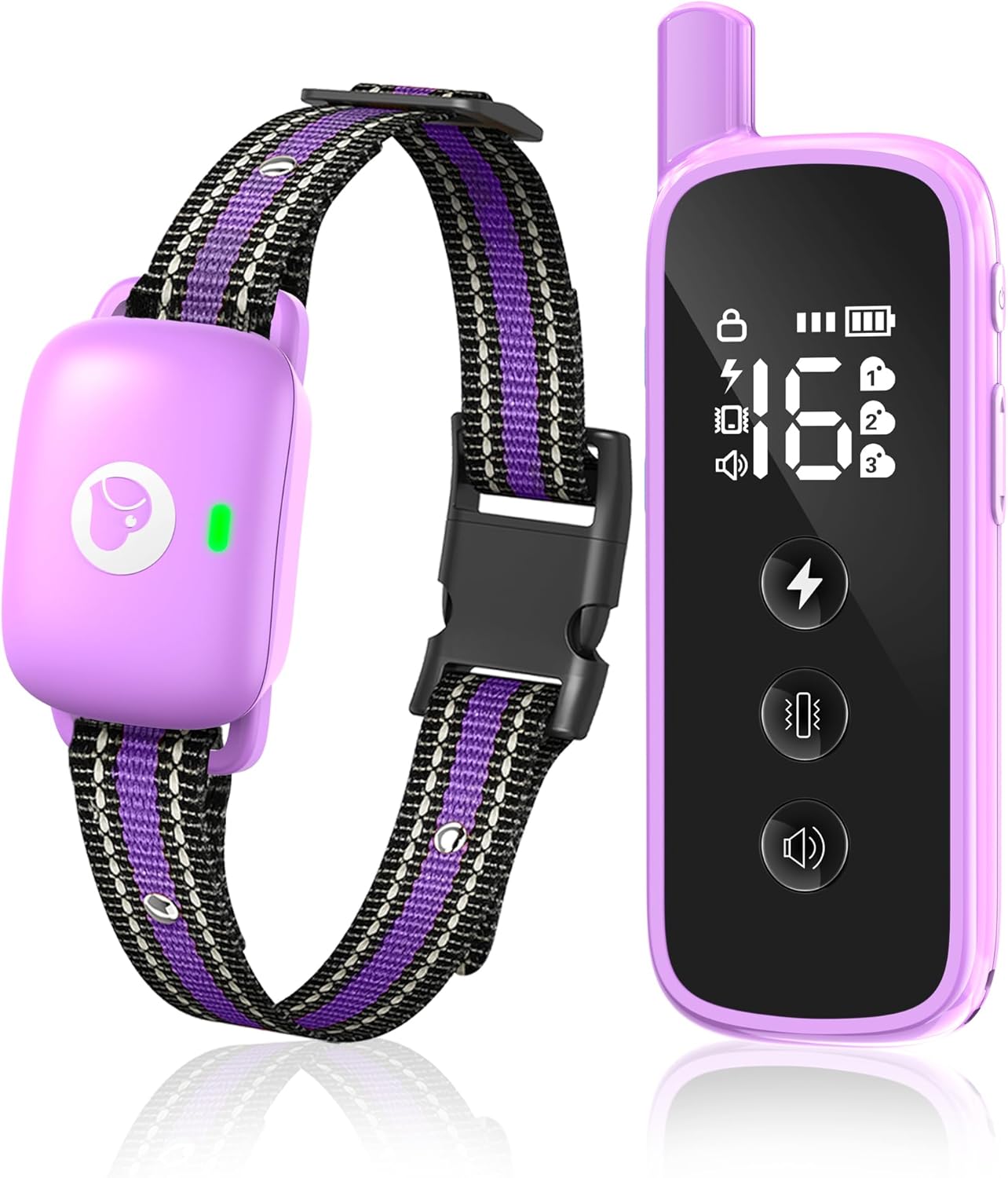
| Training modes | Beep, Vibration, Shock (1-16) |
|---|---|
| Range | 2600 ft |
| Water resistance (receiver) | IP68 |
| Fit | Neck 6-27 in |
| Charging | 2.5 hours dual 2-in-1 charger |
The Heaflex Shock Collar D10-1P is a compact remote training system that offers three stimulus modes — beep, vibration and adjustable safe shock — and can control up to three receivers with one remote. It is typically used for recall, boundary and bark/chase correction during outdoor training sessions thanks to its 2600 ft maximum range and an IP68 waterproof receiver for wet conditions; the remote itself is not waterproof. Practical features include two silicone probe covers for different coat types, a lightweight nylon strap that fits necks 6–27 inches, a security lock to prevent accidental activation and a memory function that resists interference from neighboring e-collars. The system charges quickly via a 2-in-1 charger and reports long standby times for both remote and receiver, which makes it convenient for regular use and trips. Limitations to consider are that the remote is not waterproof and the shock mode, while adjustable, requires careful introduction and supervision to avoid overuse, and some users may prefer models with more granular level feedback or different ergonomics for very small or very large dogs.
Best for: Buyers who want a lightweight, easy-to-carry training collar for medium dogs that still provides effective range and adjustable correction options for outdoor recall and behavior work.
Less Ideal for: Owners who need a fully waterproof remote for frequent water work or those who prefer strictly non-aversive training tools should consider alternatives.
- Three training modes (beep, vibration, adjustable shock) for flexible correction.
- 2600 ft remote range suitable for yard and park recall work.
- IP68 waterproof receiver withstands rain and puddles.
- Lightweight receiver with two silicone probe covers for different coat types.
- Long battery standby and fast dual charging for remote and receiver.
- Remote is not waterproof which limits use in wet conditions.
- Shock mode needs careful, responsible use and gradual calibration for each dog.
Verdict: The best compact shock collar fits smaller necks comfortably and stays unobtrusive while still providing effective corrections and essential features for lighter breeds.
Halo Collar 5
Best Premium Shock Collar

| Batteries | 1 Lithium Ion (included) |
|---|---|
| Material Type | Waterproof Housing (IP67) |
| Included Components | Contact Tips, Magnetic Charger, Perfect Fit Kit, Pro Case + Strap |
| Breed Recommendation | Dogs over 10 lbs (various groups) |
The Halo Collar 5 is a premium GPS wireless containment and tracking collar that creates virtual fences without wires or installation. You set one or more fence perimeters in the Halo app and the collar delivers sound, vibration, or optional static feedback as your dog approaches the boundary while sending instant alerts to your phone. It uses dual-frequency Precision+ GPS, AI drift prevention, and real-time ground-station corrections to improve location accuracy and updates location frequently for near real-time tracking. The package includes contact tips, a magnetic charger, a fit kit, and a pro case and the device is rated IP67 for waterproofing. Expect daily charging for best performance and a required Halo subscription to enable GPS, unlimited cellular data, fence creation, training guidance, and live support. The system is strong where accurate, installation-free containment and built-in training matter, but buyers should plan for the ongoing subscription cost and nightly charging as part of ownership.
Best for: Owners who prioritize top-tier tracking accuracy, built-in training support, and a polished, durable collar experience and are willing to invest in ongoing subscription service and premium hardware.
Less Ideal for: Buyers who want a one-time purchase without recurring fees or who cannot commit to daily charging and app-based setup and training.
- Precision+ dual-frequency GPS with ground-station corrections for improved location accuracy
- Instant fence creation and wireless containment with no digging or hardware installation
- Multiple feedback modes (sound, vibration, optional static) plus built-in training guidance
- IP67 waterproof housing and included accessories for fit and charging
- Requires a subscription to activate GPS, fence, and tracking features
- Needs nightly charging for best performance
Verdict: The best premium shock collar delivers superior materials, more precise control options, and advanced safety features for owners willing to invest in top-tier performance and durability.
Choosing the Right Shock Collar Yard Containment: Key Factors to Consider
Boundary Range and Accuracy
Range determines how large a yard the collar can reliably cover. A collar with a nominal long range can still perform poorly if signal strength drops near obstacles, fences, or heavy vegetation.
Look for systems that specify reliable operating distances in real-world conditions and offer adjustable boundary settings rather than a single fixed radius. Accurate boundary performance reduces false activations and prevents needless corrections, making containment both safer and more predictable.
Adjustable Correction Levels
Dogs vary widely in sensitivity and temperament, so the collar should offer multiple, incremental correction intensities. Having both non-stimulus cues like sound or vibration and several graduated stimulation levels lets you start with the least invasive option and increase only if needed.
Gradual adjustments make training gentler and reduce the risk of overcorrection. Also check for memory settings or user profiles if you intend to use the collar on more than one dog; consistent, repeatable settings improve training outcomes.
Receiver Fit and Electrode Design
Proper contact between electrodes and skin is essential for predictable corrections. Poorly fitting receivers or short electrodes can slip on long-haired dogs or cause inconsistent activation on skinny necks.
Choose collars with size-adjustable straps and replaceable electrodes. Rounded or contoured electrode shapes and options for longer probes help maintain reliable contact without excessive pressure. A secure, comfortable fit also prevents chafing during prolonged wear.
Safety Features and Fail-safes
Safety features lower the risk of accidental harm and support humane training. Useful safeguards include automatic shutoff after repeated corrections, warning tones or vibration steps before stimulation, and a clear low-battery alert so the device does not suddenly stop containing your dog.
Fail-safes that prevent prolonged stimuli and limit maximum intensity help manage human error. Also consider systems with temporary disable or sleep modes for veterinarians, groomers, or when the dog is inside the house.
Battery Life and Maintenance
Long battery life reduces the chance of containment lapses and means less frequent removal and charging. For yard collars that are worn continuously, choose receivers with multi-day runtime under typical use or easy-to-replace batteries.
Weatherproof charging ports and removable battery modules simplify upkeep. Also factor in how easy it is to check battery status—visible indicators or remote alerts are preferable to guessing when recharge is needed.
Weather Resistance and Durability
Yard collars are exposed to rain, mud, and sun, so water resistance and rugged construction are important. A collar that is not well sealed can corrode contacts, fail to hold settings, or stop working when you need containment most.
Look for units with verified water-resistance ratings, durable housings, and corrosion-resistant metal contacts. Replaceable straps and modular parts extend service life and are practical for dogs that spend a lot of time outdoors.
How Do Warning Tones and Vibration Help Before Stimulation?
Warning tones and vibration act as an intermediate communication step before a stimulus, letting dogs correct course without receiving a correction. Many dogs learn to associate a tone or brief vibration with approaching the boundary, which reduces the need for higher-intensity stimulation and speeds learning.
- Use the lowest effective cue first to avoid escalation.
- For timid dogs, start with vibration alone and only add stimulation if the dog repeatedly ignores the cue.
- Warning signals give a human handler a chance to intervene before a correction occurs.
Can You Use a Yard Containment Collar with Multiple Dogs?
It is possible but requires attention to fit, settings, and receiver pairing. Each dog needs a properly fitted receiver sized for its neck and sensitivity. Systems that support multiple receivers on one transmitter simplify management, but ensure each receiver has individualized correction levels so a small, sensitive dog is not overcorrected because another dog needs stronger settings.
- Confirm the system supports multiple receivers and independent settings.
- Label receivers and keep a record of each dog's ideal correction level.
- Test each receiver for consistent performance before relying on the system for unsupervised containment.
What Maintenance Keeps a Yard Collar Reliable?
Regular inspection and cleaning of electrode contacts prevents poor connectivity and false activations. Wiping contacts with a damp cloth, checking for corrosion, and replacing worn electrodes will preserve consistent performance. Also test boundary accuracy periodically, especially after changing transmitter location, adding landscaping, or installing new structures. Keep spare batteries or a charging routine and verify alerts for low battery so containment does not fail unexpectedly.
- Check strap tension and fit weekly during heavy use periods.
- Run a boundary walk test to confirm detection at the intended limit.
- Replace electrodes and straps at the first sign of wear.
How to Match Collar Settings to Your Dog's Temperament
Begin with the lowest non-stimulus cues such as tone or vibration. Observe the dog's response over several boundary approaches and increase intensity gradually only if needed. Dogs that are highly motivated by escape or prey drive may require more persistent reinforcement combined with training exercises to reinforce the boundary. Monitor behavioral signs of stress or avoidance. If a dog shows excessive fear or repeated frantic attempts to escape, stop using stimulation and seek a professional trainer for alternative containment strategies.
- Keep a training log of boundary interactions to track progress.
- Use short supervised sessions to pair cues with return rewards.
- Avoid raising intensity quickly; slow, consistent increments yield better behavior change.
What Are Common Legal or Community Considerations?
Some jurisdictions and community associations restrict the use of electronic stimulation devices or require disclosure. Before relying on a shock collar for yard containment, check local rules and any homeowners association policies that might apply. Also be mindful of public perception: neighbors who see a collar may have concerns. Using visible warning signs at yard edges and ensuring humane settings and clear safety features can reduce misunderstandings.
- Verify local regulations regarding electronic containment devices.
- Consider visible perimeter signs to notify visitors.
- Keep documentation of safety features and training steps in case of inquiries.
How We Chose the Best Shock Collar Yard Containment
Our selections started with devices designed specifically for yard containment rather than general remote training. We prioritized consistent boundary performance, testing reported operating range in typical suburban conditions, and verified the availability of adjustable correction levels to suit different dog sizes and temperaments. Receiver fit and contact reliability were weighed heavily because poor electrode contact increases false corrections and containment failures. Safety features were another major filter: we looked for collars offering graduated stimuli, warning tones or vibration steps, and automatic timeout functions that reduce the chance of prolonged correction. Build quality and weather resistance mattered for all picks because yard collars often remain on dogs outdoors for extended periods. Finally, we excluded units intended solely for short-range obedience training or invisible fence systems that require buried wiring. The final list focuses on battery life, boundary accuracy, user control, safety safeguards, and durable outdoor design.
Our full evaluation process is outlined in our review methodology.
FAQ
Will the collar work at the edge of a fenced yard?
Often it will, but performance depends on fence material and nearby electrical or metallic interference. Test the boundary at the actual fence line and adjust transmitter placement or settings until the detection matches your desired containment limit.
How long can a receiver stay on my dog each day?
It depends on the collar's battery life and comfort features. Many collars are designed for continuous daily wear, but you should inspect the skin beneath the electrodes regularly and remove the collar for cleaning or long periods of inactivity.
Are vibration-only modes effective for containment?
Vibration modes can be effective for many dogs, especially when paired with consistent training. Highly motivated escape artists may ignore vibration alone, so vibration is best used as a first-step cue before any stimulation.
What if my dog is hard of hearing or deaf?
For deaf dogs, vibration and visual training cues are more useful than auditory tones. Ensure the receiver provides strong, clear vibration and combine collar use with visual boundary markers and consistent training routines.
How often should I test the boundary accuracy?
Test boundary accuracy whenever you change transmitter location, alter landscaping, or notice different behavior near the perimeter. As a routine, check the boundary monthly in seasonal climates and after any major yard changes.
Can weather affect containment performance?
Yes. Heavy rain, dense vegetation, and metal structures can reduce effective range or create inconsistent detection. Choose weather-resistant equipment and verify containment after severe weather or yard modifications.
Final Verdict
Choose a yard containment shock collar by prioritizing accurate boundary performance, adjustable and humane correction steps, and a secure, comfortable receiver fit. Tradeoffs often involve range versus precision and stronger corrections versus more training time; opt for the gentlest settings that reliably keep your dog inside the designated area. Focus on safety features, reliable battery life, and materials that withstand outdoor conditions. With careful fitting, gradual training, and regular maintenance, a yard containment collar can be an effective part of a broader containment plan that includes supervision and positive reinforcement.

