

When persistent barking becomes a daily problem, a quiet, consistent cue can make training easier and less stressful for both you and your dog. Silent dog whistles use ultrasonic tones dogs can hear but most people cannot, letting you give a repeatable signal without adding noise to your neighborhood. This guide shortlists five top-rated silent whistles to stop barking and focuses on practical features like range, adjustability, and ease of use. Below you'll find what matters for training, how each shortlisted option performs against those criteria, and tips to get started with a whistle-based anti-bark program.
Top Picks at a Glance
| Best Overall Silent Whistle A balanced pick that works reliably for most dog owners | ESONLITOR Adjustable Dog Whistle |  |
| Best Budget Silent Whistle A low-cost option that still performs basic barking control | XXINMOH Adjustable Dog Whistle 2-Pack |  |
| Best Premium Silent Whistle A higher-end model with superior build and advanced features | Herm Sprenger Soundless Training Whistle |  |
| Best Adjustable-Frequency Silent Whistle A whistle with selectable tones to suit different dogs' sensitivities | IESWKP Adjustable Dog Whistle |  |
| Best Heavy-Duty Silent Whistle Durable construction designed for rough use and outdoor conditions | ACME 535 Silent Dog Whistle |  |
ESONLITOR Adjustable Dog Whistle
Best Overall Silent Whistle

| Material | 304 stainless steel |
|---|---|
| Adjustable frequency | 200Hz–22KHz |
| Number of items | 2 |
| Included components | Whistles with lanyards and lock nut |
| Range | Up to 1000m |
The ESONLITOR Adjustable Dog Whistle is a compact, metal ultrasonic whistle designed for recall, obedience and bark-control training. It ships as a two-pack with lanyard straps and an adjustable nut so you can fine-tune the pitch across a broad frequency range for different commands and dog sensitivities. In practice the small stainless body is durable and rust-resistant, and the included lock nut and cover reduce the chance of the setting slipping or losing the unit on a collar or keyring. The whistle projects well for long-distance work — the listing states an effective range up to 1000 meters — so it is useful for off-leash training in open areas. It is silent to most humans and marketed as safe for dogs when used properly, but it does require a short training period to associate the sound with commands, and very small or sound-sensitive dogs may need gentler introduction. The two-pack gives a backup or a spare to keep on leash gear, and the simple metal design keeps operation straightforward without batteries or electronics.
Best for: Owners who prioritize a portable, no-battery training tool they can carry on a keyring or collar and who plan to use whistle signals for recall, bark control and basic obedience.
Less Ideal for: People seeking electronic, automated bark deterrents or those who prefer visible cues over sound-based training should consider other options.
- Adjustable frequency (200Hz–22KHz) lets you tune pitch for different commands and dog sensitivity
- Durable 304 stainless steel construction resists rust and holds up to outdoor use
- Compact size with lanyard and lock nut reduces loss and fits easily on a keyring or collar
- Two-pack provides a backup or placement on multiple locations for convenience
- Long stated transmission range suitable for off-leash recall and open-area training
- Requires consistent training to condition a dog to the whistle signals
- Ultrasonic sound may need careful introduction for very noise-sensitive or elderly dogs
Verdict: The best all-around silent whistle that balances effective ultrasonic range, ease of use, durability, and consistent results for everyday barking control.
XXINMOH Adjustable Dog Whistle 2-Pack
Best Budget Silent Whistle

| Material | 304 stainless steel |
|---|---|
| Pack | 2 pieces |
| Model number | GKS-1 |
| Item weight | 1.44 ounces |
These stainless steel adjustable whistles come as a two-pack with lanyards and are designed for basic whistle training, bark interruption, and recall at distance. You adjust pitch with a small screw to find the frequency that gets your dog's attention, then pair specific whistle signals with treats or commands to teach responses like sit or come. The 304 stainless construction resists rust and feels durable for outdoor use, and the compact metal body is easy to carry on a lanyard or keyring. The seller claims long-range effectiveness and silent ultrasonic tones that do not bother humans, which makes them convenient for long-distance recall and quiet bark control. Practical limits are that very small adjustments can be fiddly and some dogs may not react to the same frequencies, so training and patience are required to find the right setting; also results will vary by dog and environment rather than being an instant fix for behavior problems.
Best for: Buyers who want an inexpensive, no-frills training tool for basic recall and bark control and are willing to invest short training sessions to find the right frequency.
Less Ideal for: Owners seeking a guaranteed solution for severe behavior issues or those who need programmable electronic training with multiple modes should consider other options.
- Two whistles per purchase for backup or multiple handlers
- Adjustable pitch via screw lets you match a frequency your dog responds to
- 304 stainless steel construction resists rust for outdoor durability
- Compact, lanyard-ready design makes it easy to carry during walks and training
- Fine tuning can be fiddly and may require patience to find an effective frequency
- Effectiveness depends on the individual dog and environment, not guaranteed for all behaviors
Verdict: The best budget silent whistle for owners who want an affordable ultrasonic tool that offers decent range and reliability for casual training and bark reduction.
Herm Sprenger Soundless Training Whistle
Best Premium Silent Whistle

| Material | brass polished, nickel-plated |
|---|---|
| Item model number | 5748100031 |
| Made in | Germany |
| Effective range | up to 400 meters |
The Herm Sprenger Soundless Training Whistle is a premium, metal dog whistle built for training and long-term use. It uses an adjustable screw to set a constant pitch and includes a protective cap and securing nut so the frequency stays locked during use, which helps maintain consistent signals across sessions. Made in Germany from polished brass with a nickel finish, the whistle feels solid and resists wear better than plastic alternatives. Trainers can use it for distance recall and bark-control cues because the tone carries far and is designed to be in a range dogs can hear up to about 400 meters. The compact, lightweight form makes it easy to carry on a lanyard or in a pocket, and the protected adjustment reduces accidental retuning. Downsides are the single-tone design which limits multi-signal training without manual adjustment, and the higher price compared with basic plastic whistles; some users may also find fine tuning requires patience to match a specific dog's sensitivity.
Best for: Buyers who prioritize durable, factory-quality training tools and want a reliable, long-lasting whistle for serious training or regular outdoor use.
Less Ideal for: Casual owners looking for a cheap, multi-tone starter whistle or those who prefer electronic/noise-based bark control solutions.
- Durable metal construction and factory-quality finish for long service life
- Adjustable screw with securing nut provides a stable, constant pitch
- Protective cover prevents accidental retuning and protects the adjustment
- Tone projects a long distance, suitable for outdoor recall and bark control
- Single adjustable tone rather than multiple preset frequencies
- Higher-cost premium construction may be overkill for casual users
Verdict: The best premium silent whistle for owners willing to pay more for refined construction, stronger performance, and extra features that improve long-term usability.
IESWKP Adjustable Dog Whistle
Best Adjustable-Frequency Silent Whistle

| Material | 304 stainless steel |
|---|---|
| Included components | whistle, lanyard, ABS protective cap |
| Range | Up to 1000 meters (claimed) |
| Power | Mechanical, no batteries |
The IESWKP adjustable dog whistle is a mechanical ultrasonic training tool that lets you tune pitch with a small screw and lock it in place for consistent cues. You use short, repeatable blows as distinct command signals for sit, stay, come, fetch, and quiet; the product is intended for indoor practice and long-range recall work outdoors where the tone carries farther than your voice. Built from rust-resistant 304 stainless steel with an ABS protective cap and included lanyard, it requires no batteries and is durable enough to survive drops, moisture, and everyday handling. The adjustable frequency and lock nut let you find a tone that reliably gets your dog's attention and then hold that setting across sessions, which helps create a clear, repeatable cue during training. Claims of long-range performance mean it is useful off-leash in open areas, but effectiveness still depends on consistent training and proper reward pairing before expecting reliable off-leash returns.
Best for: Owners who want a tunable, durable mechanical whistle to establish clear, repeatable training cues for recall, obedience, and bark control and who are willing to put in short daily training sessions.
Less Ideal for: People who prefer electronic or remote-based trainers, those who need instant results without training, or handlers working primarily in very noisy urban environments.
- Adjustable frequency with lock nut lets you find and hold a pitch your dog responds to
- Made from 304 stainless steel for rust resistance and bite durability
- No batteries or charging required so it is always ready to use
- Includes lanyard and protective ABS cap for convenient carry and storage
- Requires consistent training and reward pairing before the whistle produces reliable off-leash responses
- Ultrasonic tones may be less useful in noisy, crowded, or heavily wooded environments where range is reduced
Verdict: The best adjustable-frequency silent whistle for owners who need to tweak pitch to match a specific dog's hearing sensitivity or training responsiveness.
ACME 535 Silent Dog Whistle
Best Heavy-Duty Silent Whistle
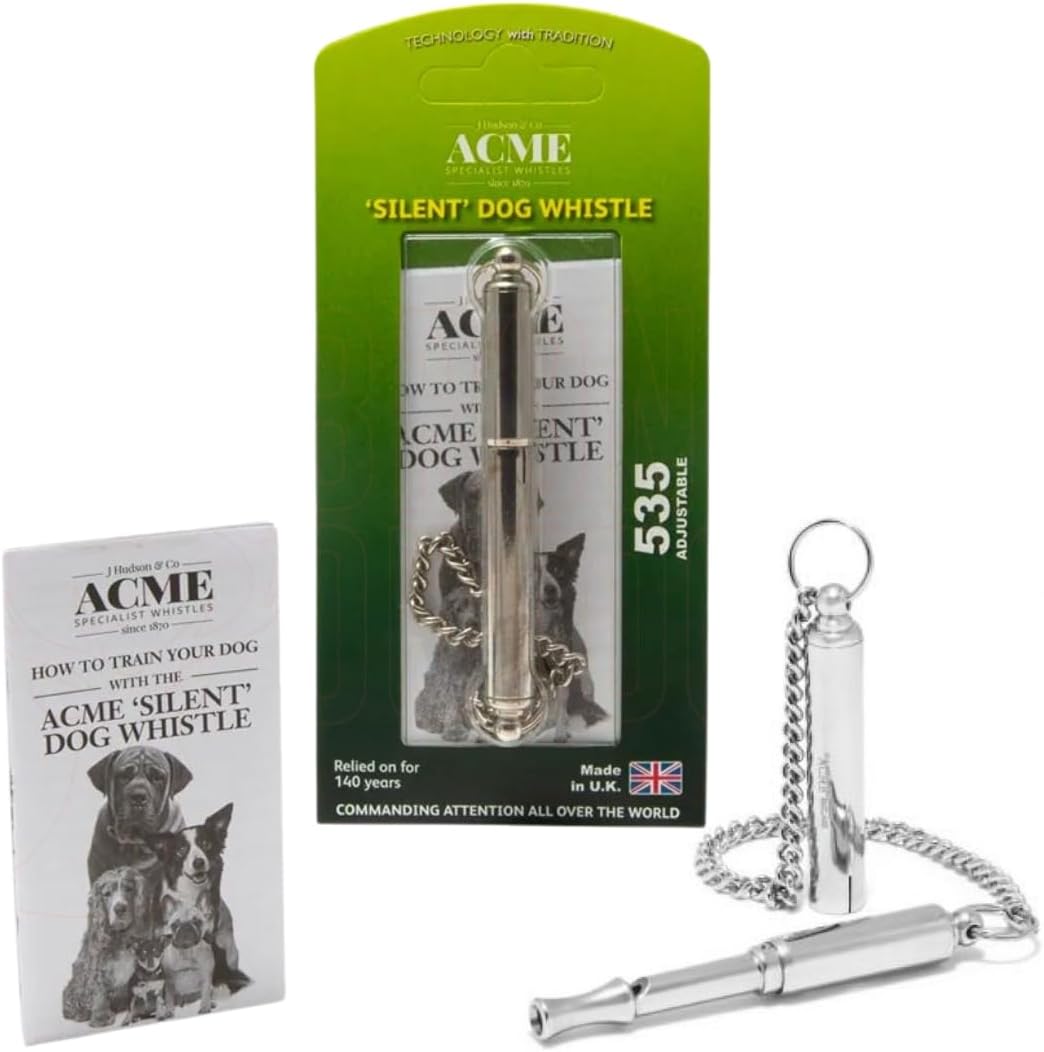
| Adjustable frequency | 5400-12800Hz |
|---|---|
| Material | Brass, nickel-plated |
| Included components | Whistle, information leaflet |
| Intended use | Dog training/behavior |
The ACME 535 Silent Dog Whistle is a precision, adjustable-frequency training whistle built from solid brass with a nickel plate and a protective end cap. Tunable between roughly 5400 and 12,800 Hz, it lets you dial in a pitch that suits your dog while keeping most of the sound out of the human hearing range so you can confirm operation without loud noise. The whistle's internal air directors aim to produce a focused, consistent tone that carries at distance, and the included leaflet explains simple training cues and cleaning. In practice this means you can create a repeatable whistle cue for recall or to interrupt barking without relying on harsh audible commands, and the metal construction offers durable, weather-resistant performance. Limitations are its learning curve and dependence on training: dogs must be taught to respond to a whistle cue, and some dogs less sensitive to high frequencies may need different pitches or more reinforcement. The 535 is a solid choice if you want a long-lasting, finely adjustable whistle and are prepared to invest the time to train the response.
Best for: Buyers who prioritize build quality and precise tuning and who are willing to train their dog to respond to a whistle cue to manage barking or recall.
Less Ideal for: Owners looking for an instant, untrained fix for nuisance barking or those who prefer electronic/automatic bark deterrents should consider other solutions.
- Adjustable frequency range for precise tuning to your dog
- Solid brass, nickel-plated construction for durability and weather resistance
- Designed air directors for a focused, carryable tone at distance
- Produces low human-audible confirmation sound so user knows it is working
- Comes with training guidance to help establish consistent whistle cues
- Requires consistent training for dogs to associate the whistle with a command
- May not be effective for dogs insensitive to high-frequency tones
Verdict: The best heavy-duty silent whistle for owners who need a rugged, weather-resistant device that stands up to frequent outdoor use and rough handling.
Choosing the Right Silent Dog Whistle Anti Bark: Key Factors to Consider
Frequency Adjustability
Dogs vary in hearing sensitivity and vocal response, so being able to change the whistle frequency matters. A whistle with an adjustable pitch lets you find a tone the individual dog notices and responds to without causing discomfort.
Begin training at a lower intensity and adjust upward only if the dog does not respond. Frequency control also helps when multiple dogs in a household react differently; you can choose a compromise frequency or switch tones during separate sessions.
Audible Range
Range determines how far away you can cue your dog effectively. For anti-bark use, you need a whistle that carries at least across typical yard distances and nearby streets without losing clarity.
Consider where you will commonly use the whistle. If you train at a dog park or on long walks, prioritize whistles with longer effective range. For indoor or small-yard use, a shorter-range whistle is often sufficient and reduces the chance of startling distant animals.
Tone Consistency
Consistent, repeatable tones are essential for forming a reliable cue-response association. If the whistle tone changes unpredictably with each blow, the dog may not learn to link the sound with the desired behavior.
Look for whistles with stable construction and simple mechanisms, because physical defects or loose parts can cause tone fluctuation. Practice a few short sessions to confirm you can produce the same sound reliably before using the whistle as a formal training cue.
Build Quality and Ergonomics
A well-built whistle makes training more reliable and comfortable. Materials that resist corrosion and a shape that fits easily in the hand or on a key ring keep the tool accessible when you need it.
Ergonomic design matters during repeated use. A whistle that is awkward to grip or hard to aim may discourage consistent training sessions. Also consider whether the whistle is easy to clean and dries quickly after outdoor use.
Humane Training Compatibility
Whistle-based cues should be used as part of positive, reward-based training. The goal is to give a clear signal the dog learns to associate with a desired behavior, not to startle or punish.
Choose whistles intended as humane training aids and pair them with consistent rewards and clear timing. Avoid using a whistle as the sole corrective; integrate it into a broader training plan that emphasizes reinforcement and gradual desensitization to triggers.
How Soon Can I Expect the Whistle to Reduce Barking?
Response time varies with the dog's age, temperament, and previous training history. Some dogs learn a new cue in a few sessions when the whistle is paired consistently with a reward, while others need repeated short sessions over several weeks.
Start with multiple short training sessions each day rather than long, infrequent ones. Use the whistle as a cue immediately followed by a reward when the dog stops barking or performs the desired behavior. Gradual, consistent conditioning produces the fastest, most reliable results.
- Younger dogs and those already familiar with cue-based training usually adapt faster.
- If barking is driven by anxiety or medical issues, training progress may be slower and require complementary behavior work.
What Training Steps Produce the Best Results with a Silent Whistle?
Begin in a low-distraction environment where the dog can focus on you. Introduce the whistle as a neutral signal: blow it briefly, then immediately give a treat and praise if the dog looks toward you or pauses barking. Repeat until the dog starts to orient to the tone.
Next, practice asking for a simple alternative behavior such as sitting or moving to a mat. Use the whistle to capture attention, then reward the alternative behavior. Gradually add mild distractions and extend the distance to generalize the response.
- Keep sessions short: five minutes several times a day is more effective than one long session.
- Always reward the desired response immediately to strengthen the association.
How to Avoid Overusing the Whistle
Over-reliance reduces the whistle's effectiveness because the dog may start expecting the cue constantly or become desensitized. Use the whistle sparingly, only when you need a clear, repeatable signal, and rely on regular verbal cues and rewards for routine shaping.
Rotate training cues and intermittently reward without the whistle to maintain responsiveness. If progress stalls, revisit basic steps and decrease session frequency rather than increasing the number of blows.
- Limit whistle use to purposeful training moments, not casual attention-seeking.
- Monitor the dog's reaction; if the dog appears stressed, pause and switch to positive reinforcement without the whistle.
Can a Whistle Work for Multi-dog Households?
A whistle can work in multi-dog homes but may require individualized tuning and separate training plans. Dogs differ in hearing and temperament, so a frequency that prompts one dog might be ignored by another or affect them differently.
Train each dog individually on the cue before using it around all animals. If needed, use different frequencies or pair the whistle with specific hand signals for each dog to reduce confusion during group situations.
- Test reactions individually to find effective frequency and reward timing for each dog.
- Use the whistle as part of a structured routine to prevent it from becoming a generalized alert signal that triggers all dogs indiscriminately.
Maintaining the Whistle for Reliable Performance
Keep the whistle dry and clean to preserve tone quality. Wipe away moisture after outdoor use and store it in a dry place. Inspect moving parts periodically for looseness or damage that could alter the tone.
If the whistle has adjustable components, check and retune them before training sessions. Replace or retire whistles that show persistent inconsistency in tone to avoid confusing the dog during conditioning.
- Avoid leaving the whistle in direct sunlight or extreme heat which can warp materials.
- Carry a backup on walks in case the primary whistle becomes clogged or damaged.
How We Chose the Best Silent Dog Whistle Anti Bark
We selected these silent whistles by applying practical, dog-training-focused filters to ensure the list favors usable tools rather than novelty gadgets. First, we prioritized consistent tone generation and adjustable frequency so a handler can find an audible range that the dog reliably responds to. Second, we looked for solid build quality and simple controls to ensure the whistle stays tuned and is comfortable to use during repeated sessions. Third, we considered effective audible range so the device works both in close quarters and at moderate distances without forcing the handler to shout. Fourth, safety and humane design were required: only whistles designed as training cues with no aversive stimulation were considered. Fifth, ease of cleaning and durability for outdoor use were part of the criteria. We excluded items that rely on shock, constant high-volume noise, or unclear frequency control, and we did not consider multipurpose devices that do not emphasize simple, repeatable whistle tones. The final picks reflect a balance of reliability, adaptability for different dogs and environments, and straightforward use by the average owner.
Our full evaluation process is outlined in our review methodology.
FAQ
Will a silent whistle hurt my dog's ears?
No, when used correctly a silent whistle produces a tone at levels that do not injure hearing. Dogs hear higher frequencies than people, so start at a low intensity and watch for signs of discomfort. If the dog shows stress, lower the frequency or reduce volume.
Can I use the whistle on all breeds and ages?
Most breeds and ages can be trained with a whistle, but responsiveness varies. Very young puppies or dogs with hearing impairment may not respond reliably. Adjust expectations and training pace based on the individual dog's abilities.
How do I know which frequency is right for my dog?
Test a range of frequencies in a calm setting and look for attentive behaviors such as head-turning or pausing. Choose a tone the dog notices without showing anxiety. If one frequency does not elicit a response after several consistent sessions, try a different setting.
Is the whistle effective for all causes of barking?
Whistles are best for teaching a clear cue and interrupting learned or attention-seeking barking. They are less effective for barking driven by medical issues, severe anxiety, or compulsive behavior, which often require behavior modification or veterinary consultation.
How often should I train with the whistle?
Short, frequent sessions work best. Aim for multiple five-minute sessions per day rather than long single sessions. Consistency and immediate rewards after the desired behavior accelerate learning without overwhelming the dog.
Final Verdict
A silent dog whistle can be a practical, low-disruption tool for reducing nuisance barking when used as a clear, consistent training cue. Prioritize a whistle with adjustable frequency, reliable tone, and comfortable handling, and pair it with short, reward-focused sessions to build the desired response. Expect gradual progress and be prepared to adapt frequency and training pace to your dog's temperament and the barking triggers. With consistent application and humane methods, a whistle can become a dependable part of your training toolkit.

