

When you train a high-energy or working dog, the right sport dog shock collar can give you precise, repeatable feedback at a distance. You want a unit that responds instantly, offers safe and adjustable stimulation, and stays comfortable during long training sessions or field work. This guide shortlists seven top options chosen for dependable range, control granularity, and durable design so you can focus on building reliable behaviors. Below we explain the criteria used to pick these collars, highlight the features that matter most in sport and working contexts, and help you match a collar to your training goals.
Top Picks at a Glance
| Best Overall Sport Dog Shock Collar A top all-around collar balancing performance, safety, and features | Dogtra 280X E-Collar 1-Dog |  |
| Best Budget Sport Dog Shock Collar A low-cost option that covers core training needs reliably | HapTop AC131 Dog Shock Collar |  |
| Best Premium Sport Dog Shock Collar Higher-end model with advanced features and superior materials | Dogtra 282C 2-Dog Training Collar |  |
| Best Compact Sport Dog Shock Collar Smaller form factor for petite dogs and minimal bulk | Chupolik DB900 Small Dog Training Collar |  |
| Best Waterproof Sport Dog Shock Collar Water-resistant design for wet conditions and easy cleaning | SportDOG WetlandHunter 425X |  |
| Best Long‑Range Sport Dog Shock Collar Extended remote range for fieldwork and off-leash training | SportDOG SportHunter 1825X |  |
| Best Heavy‑Duty Sport Dog Shock Collar Built for rugged use with tougher materials and durability | BLACKDOG Military Shock Collar OT9 |  |
Dogtra 280X E-Collar 1-Dog
Best Overall Sport Dog Shock Collar

| Range | 1/2 mile |
|---|---|
| Stimulation levels | 100 levels |
| Functions | Tone, Vibration, Static (Nick/Continuous), BOOST |
| Waterproof | Yes |
| Expandable to | Up to 3 dogs |
The Dogtra 280X is a premium, purpose-built e-collar aimed at serious trainers and owners of larger, energetic dogs. It pairs a compact, rugged receiver with a handheld remote that offers 100 discrete stimulation levels plus tone and an XPP vibration pager, so you can tailor corrections precisely as your dog progresses. The front-mounted main button and programmable BOOST instantly raise intensity for urgent recalls without fumbling through controls, and the safety level lock reduces accidental activations. Built waterproof and designed for daily outdoor use, the unit includes a bright 1000-lux LED for visibility and removable contact points for comfort and fit. The system supports expansion to additional dogs and charges via USB-C. Trade-offs are the higher-end positioning and feature set that may be more than a casual owner needs, and learning to find the correct stimulation level takes time and careful introduction. For handlers who want refined ergonomics, reliable range, and durable construction, the 280X is a strong premium choice for large-dog training tasks.
Best for: Owners who prioritize top-tier durability, precise control, and advanced ergonomics for training large or strong dogs and are willing to invest in a premium tool.
Less Ideal for: Casual owners looking for a simple, low-cost humane correction or those uncomfortable with adjustable electronic stimulation should consider gentler or lower-feature alternatives.
- 100 levels of precise stimulation for fine-tuned training
- Front-facing main button and BOOST for instant, one-handed recall control
- Fully waterproof receiver and rugged construction for outdoor use
- Bright 1000-lux LED improves visibility for evening or low-light training
- Expandable system supports additional receivers for multi-dog households
- Premium features and durability come at a higher cost which may exceed casual needs
- Requires time and careful introduction to identify appropriate stimulation levels
Verdict: The best overall Sport Dog Shock Collar for most owners, offering dependable training functions, comfortable fit, clear controls, and a strong safety feature set for everyday use.
HapTop AC131 Dog Shock Collar
Best Budget Sport Dog Shock Collar

| Training modes | Beep, Vibration, Safe Shock, Shock Boost |
|---|---|
| Range | 4500 ft |
| Fit neck | 7.8"-24.4" (10-120 lb) |
| Waterproof rating | IPX8 |
| Charging | USB-C |
The HapTop AC131 is a rechargeable e-collar kit designed for everyday obedience and distance work. It uses a 2-channel remote to control up to two dogs and offers four training modes: beep, vibration, safe shock (0–99 levels) and a shock boost, with the shock function optional for no-shock training. The remote's long 4500 foot range and memory for individual dog settings make it useful for off-leash recall, boundary training, and reinforcing commands across yards or trails. The receiver is IPX8 waterproof and the kit includes multiple prong lengths, silicone covers, a test light tool, and USB-C charging for practical field use. Safety-oriented features include an adjustable low-to-high stimulation range, a security lock to prevent accidental corrections, and a manufacturer guideline limiting continuous wear to 12 hours. Trade-offs are typical for this class: it relies on batteries and correct fitment to be effective, and some owners prefer vibration or beep-only methods before adding shock. The unit's feature set and range make it a strong daily trainer for owners willing to follow safe use guidelines.
Best for: Owners who want a versatile, safety-minded e-collar for regular obedience and distance work and who plan to use multiple training modes progressively.
Less Ideal for: People who want a purely non-aversive training tool or who are uncomfortable using shock-style corrections should choose vibration- or treat-based training alternatives.
- Very long 4500 ft remote range for off-leash training
- Multiple modes (beep, vibration, adjustable shock) for progressive training
- IPX8 waterproof receiver suitable for wet outdoor use
- Includes extra prongs, silicone covers, test light tool, and USB-C charging
- 2-channel remote controls two dogs and remembers individual settings
- Shock feature requires careful adjustment and responsible use to avoid misuse
- Not intended for continuous wear longer than 12 hours per day
Verdict: The best budget Sport Dog Shock Collar for cost-conscious buyers who need effective basic training stimulation, reasonable build quality, and simple controls without premium extras.
Dogtra 282C 2-Dog Training Collar
Best Premium Sport Dog Shock Collar
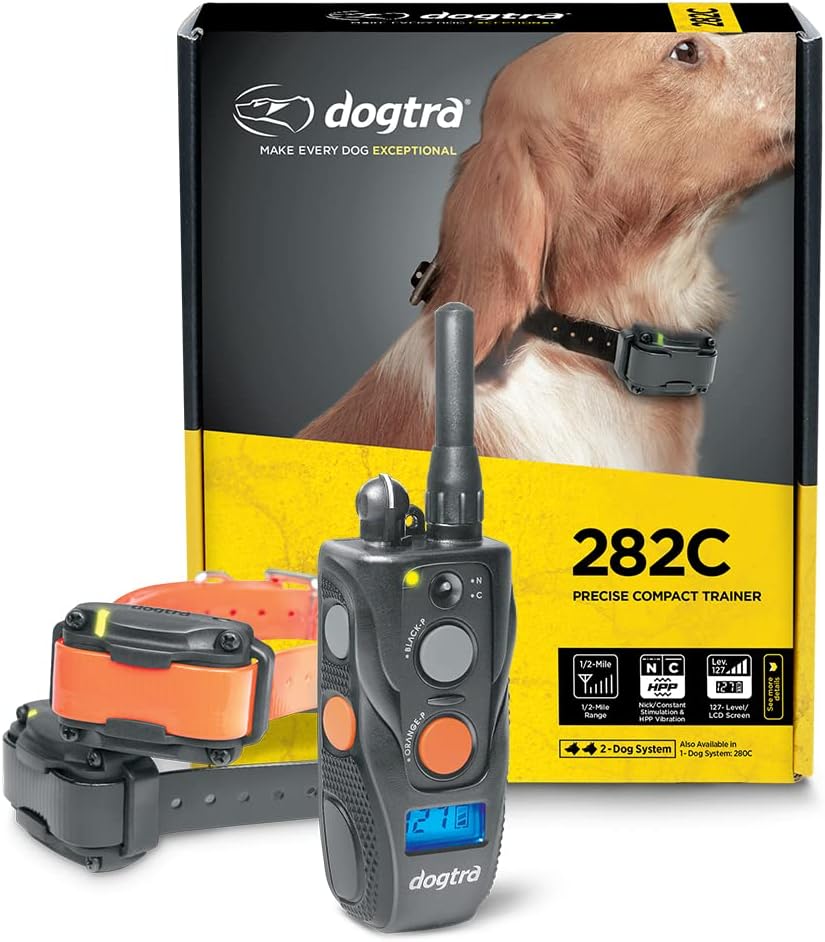
| Range | 1/2-Mile |
|---|---|
| Correction levels | 127 |
| Modes | Nick, Constant, HPP Vibration |
| Power | Rechargeable batteries |
| Dogs supported | 2-Dog System |
The Dogtra 282C is a two-dog remote e-collar built for precise, reliable field and obedience work. It pairs a handheld transmitter with two compact waterproof receivers and uses a rheostat dial and LCD to select from 0–127 stimulation levels, letting you dial in gradual corrections or use a quick nick, constant output up to 12 seconds, or a high-performance pager vibration. The system is designed for smaller dogs and keeps the receiver unobtrusive while delivering medium-range coverage of roughly a half mile, which is sufficient for most training sessions in open fields. Both units are fully rechargeable and waterproof so sessions near water or in rain are practical. Trade-offs are that the half-mile range and medium output are focused on basic-to-intermediate training rather than long-range hunting or very large, high-drive dogs, and the compact receiver targets smaller breeds, not heavy-duty use on very large dogs. For owners who need refined level control, dependable waterproofing, and two-dog capability in a compact package, the 282C is a strong premium choice.
Best for: Owners who prioritize precise, refined stimulation control, durable waterproof construction, and the ability to train two smaller dogs in field or obedience settings.
Less Ideal for: Handlers who need mile-plus range, maximum high-output corrections for very large working dogs, or those looking for heavy-duty receivers for extreme environments.
- Very fine-grained control with 127 levels and an LCD plus rheostat dial for precise adjustments
- Fully waterproof transmitter and receivers for reliable use in wet conditions
- Includes nick, constant, and HPP vibration modes for flexible training signals
- Compact, lightweight receivers suited to smaller dogs and easy handling
- Supports two dogs from a single transmitter for simultaneous training
- Half-mile range is adequate for most work but not for extended long-range applications
- Designed for smaller dogs so output may be insufficient for very large or high-drive breeds
Verdict: The best premium Sport Dog Shock Collar for owners willing to pay more for refined ergonomics, stronger build quality, advanced adjustable settings, and longer-term reliability.
Chupolik DB900 Small Dog Training Collar
Best Compact Sport Dog Shock Collar

| Breed recommendation | Small |
|---|---|
| Modes | Sound, Vibration, Shock |
| Stimulation levels | 198 levels |
| Signal range | 1300 feet |
| Batteries (remote) | 2 AAA (included) |
The Chupolik DB900 is a purpose-built compact training collar aimed at small dogs and portable use. It pairs a slim, lightweight collar module and adjustable woven strap with a handheld remote to deliver sound, vibration, or shock across 198 adjustable levels for precise correction. In practice the collar is easy to fit to small necks, the contact prongs are removable for extra comfort, and the one-key lock helps prevent accidental stimulation during handling. Battery life is strong for the size — a two-hour quick charge (magnetic connector) is claimed to last up to 15 days — and the sealed design gives IPX7-style waterproofing suitable for rainy training sessions. The 1300 foot signal range and one-to-three control let one trainer operate multiple dogs if needed. Trade-offs include reliance on AAA batteries for the remote and a very small module that may require careful placement on thicker-coated dogs to ensure consistent skin contact; buyers should measure neck size before buying. For owners seeking a highly portable, small-breed-focused remote collar, the DB900 packs strong features into a tiny package.
Best for: Buyers who need a genuinely compact, low-profile training collar for small breeds or frequent travel and who prioritize precise, adjustable stimulation over bulky hardware.
Less Ideal for: Owners of large-breed dogs or dogs with very thick coats who need higher-power receivers or collars designed for heavy-duty use should look elsewhere.
- Very compact and lightweight housing suited to small dogs
- Wide range of 198 stimulation levels for fine-tuned control
- Magnetic quick-charge collar with long claimed battery life
- Waterproof sealed collar design for outdoor training
- Remote supports up to three collars and offers a long 1300 ft range
- Remote uses AAA batteries rather than an internal rechargeable cell
- Very small contact module may struggle to make contact on thick or long coats
Verdict: The best compact Sport Dog Shock Collar for owners of small or lightweight dogs who need a lower-profile unit that still delivers consistent training stimulation and a secure fit.
SportDOG WetlandHunter 425X
Best Waterproof Sport Dog Shock Collar

| Range | 500 yards |
|---|---|
| Stimulation levels | 21 levels |
| Waterproof rating | Submersible to 25 ft |
| Battery | Rechargeable lithium-ion, 50–70 hours runtime |
| Expandable dogs | Up to 3 dogs |
The SportDOG WetlandHunter 425X is a compact, camo-finished e‑collar system intended for field use with sporting dogs. It pairs a simple no-look remote with a submersible receiver so you can deliver tone, vibration, or any of 21 static levels out to about 500 yards, and it supports up to three dogs with add-on collars. The unit is built for wet environments with DryTek waterproofing to 25 feet and rechargeable lithium-ion batteries that claim 50 to 70 hours per charge and a two-hour quick charge. Practical benefits include an easy dial for consistent timing, multiple stimulation modes for tailoring to a dog's temperament, and included long contact points for thick coats. Limits to consider are the 500-yard range, which is fine for most hunts but not for extreme long-range work, and that the system is focused on straightforward control rather than advanced telemetry or large-dog expandability beyond three collars. The WetlandHunter is best when you want a durable, field-oriented collar that balances usable stimulation settings, long runtime, and waterproofing for long days in marsh and water.
Best for: Hunters and field trainers who need a rugged, waterproof e‑collar that provides reliable, adjustable stimulation and long battery life for full days working in marsh and water.
Less Ideal for: Handlers who require extreme long-range communication or systems designed to manage large packs of more than three dogs should consider higher-range or multi-dog solutions.
- DryTek waterproofing submersible to 25 feet for true wetland use
- 21 levels of static plus tone and vibration for precise, customizable stimulation
- Rechargeable Li‑ion batteries with long 50–70 hour runtime and 2‑hour quick charge
- No-look dial and dedicated buttons make one-handed, consistent operation in the field easy
- Includes long and standard contact points and a camo receiver for hunting concealment
- 500‑yard range may be insufficient for very long-range upland or extreme field work
- Expandable to only three dogs with add‑on collars, limiting large multi-dog setups
Verdict: The best waterproof Sport Dog Shock Collar for active dogs and outdoor training in wet or muddy conditions, providing reliable electronics protection and easy maintenance.
SportDOG SportHunter 1825X
Best Long‑Range Sport Dog Shock Collar

| Range | 1 Mile (1760 yards) |
|---|---|
| Stimulation Levels | 21 levels |
| Waterproof | Submersible to 25 ft |
| Battery | Rechargeable Li-ion, 2-hour charge |
| Dog Fit | Fits dogs 8 lb and up, neck 5"–22" |
The SportDOG SportHunter 1825X is a long-range remote trainer built for field work and off-leash control up to one mile. The handheld transmitter provides no-look operation and a dial with 21 stimulation levels plus vibration and tone so you can tailor corrections to your dog during recall, obedience, or distraction training. It is rechargeable with quick two-hour charges and long runtime for both transmitter and receiver, and the DryTek waterproofing makes the receiver submersible to 25 feet for hunting or wet conditions. The system is expandable to train up to six dogs with additional collars and comes with multiple contact point sizes and practical accessories like a charging cradle and belt clip. Expect reliable signal and robust battery life in real-world outings, though serious sensitivity tuning is required to find each dog's correct recognition level and some users may prefer a different form of correction than static stimulation. The collar is designed for dogs 8 pounds and up with necks 5 to 22 inches and targets owners who need dependable long-distance control in rugged environments.
Best for: Owners who train dogs at a distance and prioritize a rugged, long-range transmitter with reliable signal performance for hunting, recall, and off-leash control.
Less Ideal for: People seeking a purely positive-reward training tool or those uncomfortable using static stimulation should consider alternative training methods or devices.
- True one-mile range suitable for long-distance training and field work
- 21 stimulation levels plus vibration and tone for fine-grained customization
- Rechargeable Li-ion batteries with quick 2-hour charge and long runtimes
- Waterproof receiver submersible to 25 feet for use in wet or hunting conditions
- Requires time and care to find the correct stimulation recognition level for each dog
- Relies on static stimulation which some owners may prefer to avoid
Verdict: The best long-range Sport Dog Shock Collar for owners who train dogs at distance and need a transmitter with extended reliable range and clear signal performance.
BLACKDOG Military Shock Collar OT9
Best Heavy‑Duty Sport Dog Shock Collar

| Training modes | Beep, Vibration, Safe Shock, Strobe Light |
|---|---|
| Range | 4200ft |
| Waterproof rating | IP67 |
| Power | USB-C fast charge; 90-day claimed runtime (1 hr/day) |
The BLACKDOG OT9 is a rechargeable training collar system aimed at regular use in outdoor conditions. The remote and collar provide four user-selectable modes—beep, vibration, safe shock, and a strobe light—with multiple intensity levels, an LCD on the transmitter for clear mode and battery readouts, and tool-free removable prongs so you can switch to no-shock operation. Its rechargeable design (USB-C fast charge) and claimed 90-day battery life based on one hour of daily use make it convenient for owners who train often and want low running costs compared with disposable batteries. The unit is built to a rugged spec with an IP67 rating and reinforced casing for heavy-duty outdoor use, while the remote flashlight and collar strobe improve night safety. Practical limits: the shock mode is present so careful, informed use is required, and real-world range and battery life will vary with terrain and usage intensity. The system suits hands-on, consistent trainers who need a weatherproof rechargeable collar with visible lighting features.
Best for: Owners who train regularly and prioritize a rechargeable collar that is rugged enough for outdoor use and includes visibility features for night or low-light sessions.
Less Ideal for: People who want a purely positive-reinforcement tool without any static stimulation or those who need a collar-free solution for noise-only behavior control.
- Rechargeable USB-C system with fast charging and long claimed runtime
- Multiple training modes including beep, vibration, and adjustable safe shock levels
- IP67 waterproof build and reinforced casing for rugged outdoor use
- Integrated remote flashlight and collar-mounted strobe for night visibility
- Tool-free removable prongs allow switching to no-shock configuration
- Shock feature requires responsible use and may not suit sensitive or inexperienced handlers
- Real-world range and battery life depend on terrain and usage and may be lower than claims
Verdict: The best heavy-duty Sport Dog Shock Collar for owners of strong, active dogs or those who need a more rugged unit that withstands rough use and extended outdoor wear.
Choosing the Right Sport Dog Shock Collar: Key Factors to Consider
Signal Range and Latency
Signal range determines how far you can reliably work your dog without losing control. In sport settings you often need several hundred yards of clean range to reward real freedom while maintaining safety. Latency matters as much as raw range; a responsive collar sends the command to the receiver immediately so corrections feel timely and relevant to the dog.
Interference from terrain, vegetation, and other radio sources reduces effective range, so look for collars with a proven performance envelope rather than headline numbers alone. Consider whether the transmitter includes range indicators or training modes that adjust output when the receiver is near the limit.
Stimulation Modes and Adjustability
Different dogs respond to different stimulus types and intensities, so collars that offer multiple modes—tone, vibration, and adjustable static levels—give you flexible tools for shaping behavior. Fine-step adjustment lets you use the minimum effective level, which improves welfare and reduces the risk of overcorrection.
Progressive or stepped stimulation modes help with incremental training, and safety features such as automatic shutoff after a set duration prevent prolonged exposure. For sport use, choose a collar that lets you switch modes quickly and set intensity in small increments.
Receiver Fit and Comfort
A receiver that rides correctly on the neck is less likely to cause skin irritation and will maintain consistent contact with the dog. For active dogs, a low-profile, rounded housing and smooth contact points reduce chafing during long runs.
Check strap options and adjustability so the collar can fit snugly without pinching. Replaceable or padded contact points are useful for dogs with sensitive skin. Good fit also improves signal reliability because consistent electrode contact reduces false triggers or missed stimulation.
Water Resistance and Durability
Sport and field work often expose gear to rain, mud, and rough handling. A water-resistant or waterproof receiver and transmitter allow training to continue in wet conditions without damage. Robust housings and reinforced straps reduce the chance of breakage during vigorous activity.
Look for corrosion-resistant contacts and sealed charging ports to extend service life. Durable materials and straightforward repairability matter because wear-and-tear from frequent use is the primary cause of failure in training gear.
Battery Life and Charging Convenience
Long battery life prevents interrupted sessions, which is especially important during multi-hour training days or trials. A receiver that lasts several days between charges and a transmitter with many hours of active use reduce logistical friction.
Fast charging or replaceable batteries can be significant advantages when you need continuous operation. Consider how the unit indicates low battery and whether charging is simple in the field; charger types that require a proprietary cradle are less convenient than USB-based charging.
Control Ergonomics and User Interface
The transmitter should let you make adjustments quickly without taking your eyes off the dog. Intuitive button layouts, tactile controls, and clear feedback (LEDs, beeps, or haptic cues) speed up decision-making during training.
Ergonomic design is especially important when you wear gloves or operate the transmitter while moving. A well-designed interface reduces inadvertent corrections and helps you maintain consistent timing when reinforcing commands.
How Do I Set Stimulation Levels Safely for Sport Training?
Begin with the lowest stimulation level and watch the dog's immediate reaction. Increase in small steps until you see a clear, attentive response such as head turn or brief pause, then stop. The goal is to find the minimal effective level that gains attention without causing fear or a prolonged stress response.
Use tone or vibration modes first where available to prime responses before applying static stimulation. During training sessions, periodically retest the baseline level because collar fit, environmental conditions, and the dog's arousal state can change how the dog responds.
- Start low and increase only as needed
- Prefer short, single pulses over prolonged stimulation
- Reassess levels after a change in fit, weather, or activity
What Maintenance Keeps a Shock Collar Reliable in the Field?
Regularly clean the contact points and check for corrosion or buildup that can block reliable stimulation. Wipe down the receiver housing after muddy sessions and inspect strap hardware for fraying or broken buckles. Keep charging contacts and ports free of debris and dry before charging.
Store units in a cool, dry place when not in use and avoid leaving batteries fully discharged for long periods. Replace worn straps or damaged electrodes promptly to preserve performance and comfort.
- Clean contacts after each wet or muddy use
- Inspect straps and housings monthly during heavy-season use
- Charge on a regular schedule and avoid long-term deep discharge
Can I Use Stimulation Collars with Young or Sensitive Dogs?
Many handlers introduce stimulation tools only after basic obedience and positive conditioning are well established. For young or sensitive dogs, rely on low-intensity modes and prioritize vibration or sound before applying static stimulation. Always pair any correction with immediate, clear expectations so the dog understands why the cue was given.
If a dog shows anxious or avoidance behaviors, stop and revisit training fundamentals with positive reinforcement. In some cases, alternative tools or professional guidance can help establish a foundation before reintroducing a stimulation collar.
- Use the lowest effective level and prefer non-static modes initially
- Monitor body language for signs of stress or avoidance
- Pause and rework foundation behaviors if anxiety appears
How to Combine a Sport Shock Collar with Reward-based Training
Use the collar as a timing tool rather than the sole training method. Give a prompt with the collar and immediately reward the correct response with a toy, food, or continued freedom. This pairing teaches the dog what the stimulus predicts and reinforces the desired behavior.
Limit use to clear, simple cues such as recall or boundary control and avoid relying on stimulation for complex chain behaviors. Alternating reinforced repetitions with free-play sessions preserves motivation and prevents the collar from becoming the dominant focus.
- Follow each corrective cue with immediate positive reinforcement on success
- Reserve stimulation for clear, short cues like recall
- Maintain frequent reward sessions to keep work engaging
Troubleshooting Unreliable Performance in the Field
If the transmitter loses contact or the receiver behaves inconsistently, first check battery levels and antenna orientation. Poor contact due to a loose collar can mimic signal issues, so confirm fit. Environmental interference, extreme terrain, or heavy vegetation can reduce effective range and require closer working distances.
Resetting the pairing or power-cycling both units often clears transient faults. If problems persist after basic checks, consult the user documentation for firmware update guidance or recommended service steps.
- Check batteries and fit before assuming radio failure
- Power-cycle and re-pair units to resolve transient issues
- Adjust working distance in dense or obstructed terrain
How We Chose the Best Sport Dog Shock Collar
We evaluated candidates using criteria that matter for sport dog training and active fieldwork. Key evaluation points included signal range and latency to ensure timely corrections across open terrain; stimulation control and step granularity so handlers can start low and increase only as needed; receiver fit and comfort for long wear during runs or trials; water and dust resistance for wet or muddy conditions; battery life and charging convenience to avoid interruptions during sessions; and durable construction that tolerates rough handling. Products that lacked clear, adjustable stimulation levels, had poor or inconsistent range performance, or used fragile materials were excluded. We prioritized collars with documented safety features such as automatic shutoff or progressive stimulation, and models offering precise remote control over multiple stimulation modes. The final list reflects units that combine reliable radio performance, thoughtful ergonomics, and control features suited to sport training rather than casual pet containment.
Our full evaluation process is outlined in our review methodology.
FAQ
Are sport dog shock collars safe for regular training?
When used properly with the lowest effective level and short pulses, these collars can be a safe timing tool for certain training tasks. Safety depends on responsible setup, correct fit, and using the device as one part of a broader training plan.
How often should I charge the receiver and transmitter?
Charging frequency depends on usage, but many handlers charge the transmitter daily during intensive sessions and the receiver every few days. Monitor battery indicators and keep a charging routine to avoid mid-session power loss.
Will a wet or muddy dog affect the collar's function?
Moisture can change electrode conductivity, which may alter stimulation sensation. Waterproof or water-resistant units maintain functionality in wet conditions, but you should still dry and inspect contacts after heavy exposure to prevent corrosion.
Can two dogs be controlled with one transmitter?
Some systems support multiple receivers per transmitter, but whether that is useful depends on your training needs and the system's user interface. Managing multiple dogs requires clear, separate cues and reliable channel switching to avoid accidental corrections.
How do I know if the collar fit is correct?
A correct fit is snug enough to keep contact points against the skin without pinching. You should be able to slide one finger under the strap. Check fit at rest and after the dog returns from running because fur compression can change contact pressure.
Final Verdict
Prioritize range, adjustable stimulation, and a comfortable receiver when choosing a sport dog shock collar for active training. Those three dimensions most directly affect safety, timing, and handler control during high-energy work. Tradeoffs are common: longer range units may be larger, and very small receivers may limit battery life. Choose the features that match how and where you train, keep stimulation at the minimal effective level, and combine the collar with consistent positive reinforcement to achieve reliable, humane results.

