

When you bring home a Pomeranian puppy, choosing the right toys matters for safety, development, and long-term enjoyment. Small-breed puppies have tiny mouths, fast-moving teeth, and high energy bursts, so toys that fit their size and chewing habits reduce choking risk and encourage healthy play. This guide shortlists the top toy options suited to Pomeranian puppies across common needs: teething relief, supervised chewing, interactive enrichment, and starter training. Each pick was chosen for how well it balances safety, durability, and engagement so you can find toys that keep your puppy active and learning. Read on for details and practical buying factors that help you pick the best toys for your Pomeranian puppy.
Top Picks at a Glance
| Best Overall Toy for Pomeranian Puppies A versatile pick that suits most Pomeranian puppy play styles | Zeaxuie Puppy Toy 9-Pack |  |
| Best Budget Toy for Pomeranian Puppies An affordable pick that still holds up to puppy play | Volacopets Puppy Teething House Small |  |
| Best Chew-Resistant Toy Built to withstand energetic chewing from teething puppies | KONG Puppy Goodie Bone XS |  |
| Best Teething Toy Soft-but-durable textures to soothe sore, developing puppy teeth | CGBD Puppy Teething Chew Toys 6-Pack |  |
| Best Small Toy Sized for tiny mouths and light enough for small-breed play | Hyper Pet MINI Tennis Ball 1.75" |  |
Zeaxuie Puppy Toy 9-Pack
Best Overall Toy for Pomeranian Puppies

| Unit Count | 9 Count |
|---|---|
| Breed Recommendation | Small |
| Pet Toy Type | Chew Toy |
| Material Type | Plush, Rubber |
| Indoor Outdoor Usage | Indoor, Outdoor |
This 9-pack mixes plush squeaky toys, tougher rope chews, a treat-dispensing ball, and a small waste bag roll to give toy-breed puppies varied stimulation. The plush items include one no-stuffing fox with crinkle paper and built-in squeaker to draw interest without creating stuffing mess, while the rope toys are tightly woven for tugging and chewing. The treat ball adds slow-feeding and problem-solving play for short training sessions or fetch. Made from plush and rubber with a note that it is intended for light chewers, the set helps occupy teething puppies, soothes gums, and can reduce destructive chewing around the house. Practical limits: pieces are sized for extra small and small breeds and are not built for aggressive or large chewers, so supervision is important and damaged toys should be discarded. For everyday play this pack provides variety and replacement options, but buyers wanting heavy-duty, long-lasting chews will need a different product.
Best for: Buyers with a toy-breed puppy who want a single, varied toy pack to provide daily chewing, interactive play, and teething relief while minimizing mess.
Less Ideal for: Owners seeking heavy-duty chews for strong adult chewers or large-breed dogs should choose sturdier, purpose-built chew products instead.
- Assortment of nine toys covers squeak, tug, chew, and treat-dispensing play
- No-stuffing fox with crinkle and squeaker reduces mess while staying engaging
- Tightly woven rope toys offer better bite resistance than loose ropes
- Treat ball encourages slow feeding and cognitive play
- Sized and marketed specifically for extra small and small breeds
- Not intended for aggressive or large chewers
Verdict: The best overall toy for Pomeranian puppies balances size, safety, stimulation, and durability to keep young pups engaged during everyday play.
Volacopets Puppy Teething House Small
Best Budget Toy for Pomeranian Puppies
| Pet Toy Type | Chew Toy |
|---|---|
| Breed Recommendation | Small |
| Recommended Uses For Product | Indoor |
| Material Type | rubber |
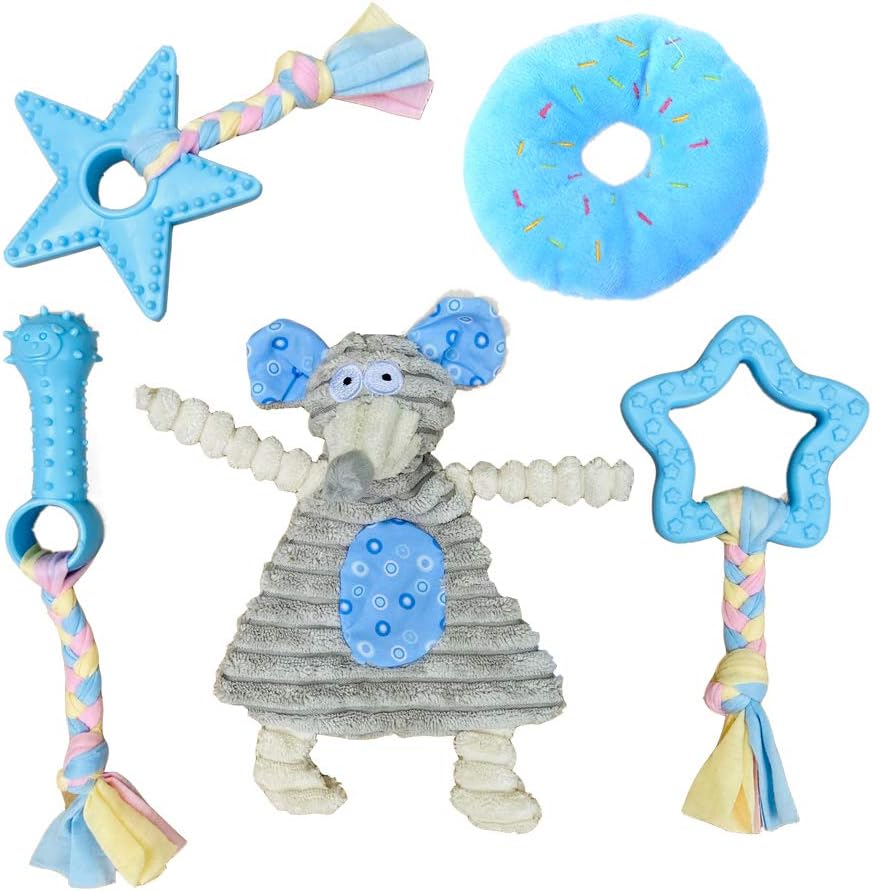
This Volacopets set bundles five small toys — chew pieces, a rope detail, a crackling plush bunny and a squeaky donut — aimed at entertaining and soothing teething puppies. In use the mix of textures and sounds encourages chewing, fetch and independent play, with nubs and woven cloth intended to massage gums and help keep teeth cleaner. The toys are lightweight and sized for small mouths, and the plush pieces include crinkle and squeakers that repeatedly draw a puppy's attention. Materials are described as rubber, stuffed and water resistant, and the pieces are washable for easy cleanup after drool and dirt. The primary limitations are that these are not built for aggressive chewers or large breeds and some components are delicate if a puppy chews destructively. For owners on a tight budget the set delivers varied textures and noise-making toys that keep small Pomeranian puppies engaged without costing much, but supervise play and replace any toy that shows tearing or exposed stuffing.
Best for: Cost-conscious owners of Pomeranian puppies who want an inexpensive, varied toy set to soothe teething and provide short bursts of supervised play.
Less Ideal for: Owners of puppies that are strong, persistent chewers or households seeking heavy-duty, long-lasting chew toys should choose a more durable option.
- Five-piece assortment offers varied textures and sounds to hold a puppy's interest
- Sized and shaped for small-breed mouths, making fetch and carry easier for Pomeranian puppies
- Includes both squeaky and crinkle elements to encourage independent play
- Washable and water resistant materials simplify cleaning after use
- Not designed for aggressive chewers and can tear if used roughly
- Some stuffed or crinkle components may be fragile and require supervision
Verdict: The best budget toy for Pomeranian puppies gives good play value and safe materials at a low price for owners watching costs.
KONG Puppy Goodie Bone XS
Best Chew-Resistant Toy

| Pet Toy Type | Chew Toy |
|---|---|
| Breed Recommendation | Small Breeds |
| Indoor Outdoor Usage | Indoor |
| Material Type | Rubber |
| Additional Features | Lightweight, Portable |
The KONG Puppy Goodie Bone pairs the brand's softer puppy-formula natural rubber bone with a cotton rope to give young dogs two textures for chewing and tug play. It is intended for supervised indoor use and targets extra small or teething puppies, helping redirect gnawing away from shoes and furniture while the rubber surface massages gums. The rope section adds a lightweight tug and fetch option and makes it easier to grip for small mouths. Because the rubber is the puppy-specific softer compound, it is gentler on emerging teeth but is not built for power chewers, so expect faster wear with strong gnawing. Practical benefits include a compact, portable design and simple cleaning, and the safety guidance to supervise and discard if damaged is appropriate for energetic pups. For owners focused on longevity under heavy chewing, this model is better suited as a teether and play accessory rather than a long-term indestructible toy.
Best for: Owners of extra small or teething puppies who want a gentle, multi-texture toy to redirect gnawing and encourage supervised tug and fetch play.
Less Ideal for: People with very aggressive chewers or older puppies that need extremely durable, chew-proof toys should choose a heavier-duty option.
- Dual-texture design: soft rubber bone plus cotton rope offers chewing and tug options
- Puppy-specific softer rubber eases teething discomfort
- Compact and lightweight for small breeds and indoor play
- Easy to clean and portable for supervised play
- Softer puppy rubber is not durable against strong or persistent chewers
- Not water resistant and not intended for heavy outdoor use
Verdict: The best chew-resistant toy is made from tough, safe materials that tolerate sharp puppy teeth and strong chewing without breaking apart.
CGBD Puppy Teething Chew Toys 6-Pack
Best Teething Toy

| Material Type | Natural Rubber, Silicone |
|---|---|
| Unit Count | 6 Count |
| Breed Recommendation | Small Dogs |
| Recommended Uses For Product | Chewing |
| Water Resistance Level | Not Water Resistant |
These six small chew toys are made from soft natural rubber and are designed specifically for puppies and small dogs going through teething. Each pack includes six distinct shapes with raised molar bumps and ridged surfaces that help clean teeth and massage gums while the puppy chews, and the natural rubber is flexible enough to be gentle on sore gums yet durable for normal play. The set is useful for supervised indoor or outdoor play, for redirecting destructive chewing, and for short training or fetch sessions because the variety of shapes helps keep interest high. Important limitations are that the toys are sized for small breeds and puppies only and are not intended for very aggressive chewers without supervision, and they are not water resistant so expect some wear if left wet. For everyday teething relief and light play this offers good tactile variety and dental-focused texture in a puppy-safe material.
Best for: Puppy owners looking for a gentle, flexible teething toy that soothes gums and provides dental-textured chewing for small breeds.
Less Ideal for: Owners of large dogs or those whose pets are heavy, destructive chewers seeking an indestructible or waterproof option.
- Soft natural rubber construction that is gentle on sore gums
- Six distinct shapes to keep puppies engaged and reduce boredom
- Raised molar bumps and ridged textures that help clean teeth and massage gums during chewing
- Sized for puppies and small dogs for a secure, chewable fit
- Not recommended for large breeds or very aggressive chewers without supervision
- Not water resistant which may reduce longevity if used in wet conditions
Verdict: The best teething toy is specifically designed to soothe sore gums with gentle textures and safe materials suitable for frequent mouthing.
Hyper Pet MINI Tennis Ball 1.75"
Best Small Toy

| Size | 1.75 inch |
|---|---|
| Unit Count | 4 Count |
| Pet Toy Type | Ball |
| Breed Recommendation | Small |
| Additional Features | Float |
These Hyper Pet MINI tennis balls are small, lightweight fetch toys made for small dogs and puppies. At about 1.75 inches in diameter they fit comfortably in a toy poodle puppy's mouth and are easy to pick up, carry, and bat around during play sessions. The balls have a rubber core with a non-abrasive felt coating intended to be gentle on young teeth, and bright colors help you spot them in grass or indoors. They float and are water resistant, so they work for splash play as well as dry fetch, and the pack of four gives you spares when one goes missing. They are not meant to be chew toys, so persistent chewers will wear through them faster than supervised fetchers; also the felt surface will eventually show wear and can pick up dirt. For supervised training, retrieving, and puppy exercise these balls are simple, portable, and puppy-friendly, but they are not a durable solution for intense chewing or heavy-duty outdoor digging sessions.
Best for: Puppy owners who want a lightweight, easy-to-carry fetch toy sized for a toy poodle puppy and intended for supervised play and training.
Less Ideal for: Owners looking for an indestructible chew toy or something for unsupervised heavy chewers should choose a sturdier, chew-specific toy instead.
- Sized for small mouths at 1.75 inch diameter making them easy for toy poodle puppies to carry
- Non-abrasive felt coating formulated to be gentle on puppy teeth
- Bright colors improve visibility outdoors and indoors
- Float and water resistant so usable for pool or lake fetch
- Sold in a four-pack so you have replacements when one is lost
- Not designed as a chew toy and will wear down with heavy chewing
- Felt surface can pick up dirt and wear visibly over time
Verdict: The best small toy fits easily in a Pomeranian puppy’s mouth and is appropriately lightweight and safe for small-breed play sessions.
Choosing the Right Toy Pomeranian Puppy: Key Factors to Consider
Size and Mouth Fit
Toys must suit a Pomeranian puppy's small mouth and short bite. A toy that is too large can be awkward to carry and play with, while a toy that is too small can pose a choking hazard. Look for products designed for toy or small breeds and check dimensions rather than relying on generic age labels.
Shape matters as much as overall size. Rounded shapes without detachable small parts reduce the chance of pieces being bitten off and swallowed. For chew toys, ensure there is enough surface area for your puppy to grip comfortably without forcing them to swallow around the toy.
Material Safety and Non-toxic Construction
Choose toys made from non-toxic, pet-safe materials that will not flake, splinter, or degrade into sharp fragments. Puppies explore with their mouths and may chew vigorously during teething, so materials should be free from harmful chemicals and have a dense but forgiving texture.
Avoid toys with thin plastic, brittle rubber, or poorly secured embellishments. Look for toys that specify phthalate-free, BPA-free, or food-grade materials where possible. Even safe materials can wear down, so inspect toys regularly and retire anything that shows tearing or exposed stuffing.
Durability Vs. Intended Use
Match the toy's durability to how your puppy plays. Soft plush toys excel for gentle tugging and comfort but are not built for heavy chewers; harder rubber or braided fabrics work better for persistent chewers. For teething puppies, choose toys that strike a balance—firm enough to withstand gnawing but soft enough to soothe sore gums.
Durability should be considered relative to supervised or unsupervised play. If you plan to leave a toy with your puppy unattended, prefer sturdier construction and minimal small parts. For interactive sessions, you can use softer toys that encourage cuddling and fetch.
Teething Relief and Texture
Pomeranian puppies go through intense teething phases, and toys that provide the right textures can ease discomfort and reduce destructive chewing. Nubby surfaces, ridged rubber, or braided fabric provide counterpressure that soothes gums and distracts from household items.
Vary textures across a small rotation of toys so your puppy has options when one texture becomes less appealing. Consider toys that combine textures—for example, a soft body with a firmer chew surface—so the puppy can switch between comfort and gnawing as needed.
Interactive Features and Mental Stimulation
Pomeranians are intelligent and benefit from toys that engage their problem-solving instincts. Puzzle-style toys, treat dispensers scaled for a small breed, and toys with hidden compartments encourage longer, more focused play sessions. This helps expend energy and supports early training cues such as patience and nose work.
Keep complexity appropriate for a young puppy. Overly difficult puzzles can frustrate rather than reward. Start with simple challenges and increase complexity as your puppy's skills improve. Interactive play with you also strengthens bonding and can reinforce desired behaviors.
Cleanability and Hygiene
Puppy toys get saliva, dirt, and food residue on them quickly, so ease of cleaning should influence your choices. Machine-washable plush or dishwasher-safe rubber toys reduce bacterial buildup and make it simpler to keep playthings sanitary. Removable covers or parts that trap moisture should be avoided unless they are easy to clean and dry thoroughly.
Frequent cleaning extends the usable life of a toy and reduces the risk of bacterial infections or odors that discourage play. Inspect seams and seams' stitching quality; toys that hold water or padding that cannot dry fully are more likely to harbor mold or mildew.
Which Toys Are Safest for a Teething Pomeranian Puppy?
For teething puppies choose toys that provide gentle counterpressure without risking dental damage. Soft rubber toys with textured surfaces and braided cotton options are good starting points because they compress under pressure and massage sore gums without sharp edges.
Avoid hard, rigid toys that require heavy force to bite through. Monitor new textures carefully and swap toys when you see early wear. Supervised chew sessions let you evaluate whether a toy is too aggressive for a puppy's developing teeth.
- Prefer resilient yet flexible materials that do not splinter
- Inspect chew toys frequently and remove at first sign of cracking
- Rotate textures to keep teething interest while limiting wear
How to Introduce New Toys so Your Pomeranian Puppy Accepts Them
Introduce toys during calm, positive moments to build a favorable association. Offer a new toy when your puppy is slightly hungry or after a short play session to make engagement more likely. Use brief praise, treats, or short play interactions to reinforce interest without creating dependence on food rewards.
If a puppy ignores a toy, try pairing it with a known favorite for short sessions or use it during a supervised training game. Avoid forcing interaction; gentle encouragement and repetition usually do more than insisting.
- Present new toys one at a time to avoid overwhelming the puppy
- Use short, frequent play sessions rather than long single sessions
- Replace but do not smother introductions with too many treats
What Makes a Good Small-breed Fetch Toy?
A good fetch toy for a Pomeranian puppy is lightweight, easy to grip, and soft enough not to injure teeth during retrieval. Foam balls, small plush fetch toys, or tiny rubber balls designed for small mouths work well. Size should allow the puppy to carry the toy comfortably while running and returning it to you.
Consider visibility and texture. A toy that makes a soft sound or has a contrasting color helps the puppy track it outdoors and learn the fetch routine more quickly. Keep sessions short while the puppy learns to release and return the toy reliably.
- Choose toys under a size that fits comfortably in a puppy's mouth
- Prefer light materials to reduce impact on emerging teeth
- Teach release commands early so the fetch game is rewarding
Are Puzzle Toys Worth It for Small Puppies?
Puzzle toys can be valuable even for young Pomeranians if they are scaled to the puppy's cognitive level. Simple hide-and-seek puzzles or small treat-dispensing toys provide mental stimulation and teach problem-solving without overwhelming the dog.
Start with low-difficulty puzzles and supervise until you understand how your puppy interacts with moving parts. Avoid puzzles with tiny removable pieces that could be swallowed, and choose designs that dispense modest rewards to prevent rapid overconsumption.
- Use puzzles to encourage focused, longer play sessions
- Supervise to ensure pieces are not chewed loose
- Increase difficulty gradually as skills improve
How Often Should You Rotate Toys and Why?
Rotate toys every few days to keep novelty high and maintain interest. Pomeranians can become easily bored when presented with the same toys repeatedly, so a small rotation keeps play fresh without needing a large collection.
Rotation also extends the lifespan of each toy by limiting continuous wear. Keep a small set of favorites for comfort and a few stimuli-rich toys for training and enrichment, swapping them regularly to sustain engagement.
- Use three to six toys in active rotation
- Keep one comfort toy available consistently for reassurance
- Store unused toys out of sight to preserve novelty
Safe Solo Play: What to Leave when You Are Not Watching
For unsupervised periods, leave only toys that pose minimal choking risk and have no detachable parts. Sturdy rubber chews or single-piece, well-constructed items designed for small breeds are safer choices than plush toys with eyes, tags, or stuffing.
Avoid toys that can trap a paw or a snout or that have strings or cords. Even with safe toys, check them regularly and clear any damaged items promptly to keep solo play safe.
- Favor single-piece, heavy-duty designs for unsupervised use
- Remove plush toys with loose stitching or exposed stuffing
- Inspect and replace toys showing wear before leaving them alone
How We Chose the Best Toy Pomeranian Puppy
We evaluated toys for Pomeranian puppies using criteria that reflect the sizes, behaviors, and developmental needs specific to small-breed puppies. Our primary filters included material safety, size and shape appropriate for a small mouth, and durability against typical puppy chewing. We also prioritized toys that offer sensory stimulation—texture, sound, or scent—for teething and cognitive development. Ease of cleaning was another core criterion because small dogs spend a lot of time with mouth-contact toys and hygiene matters for puppy health. Additional selection factors included multiuse design (play plus training), clear age recommendations from manufacturers, and accessibility for supervised solo play. Toys that required constant adult intervention to be safe or that presented obvious small-part hazards were excluded. We excluded products intended only for adult dogs or heavy chewers that vastly exceed the size and force a Pomeranian puppy can safely handle. The result is a focused set of options that balance safety, engagement, and practical durability for small-breed puppies.
Our full evaluation process is outlined in our review methodology.
FAQ
What size toy should I buy for a Pomeranian puppy?
Choose toys small enough for your puppy to grip and carry comfortably but not so small that they can be swallowed. Check product dimensions and look for toys labeled for toy or small breeds.
How can I tell if a toy is too hard for my puppy's teeth?
If your puppy avoids the toy, shows signs of discomfort, or you see teeth marks that are not shallow, the toy may be too hard. Prefer slightly flexible materials for teething and consult your vet if you notice tooth chipping.
Are squeaky toys safe for small puppies?
Squeaky toys can be engaging but pose a risk if the squeaker becomes exposed. Use squeaky toys only under supervision and remove them if stitching or material around the squeaker shows wear.
How often should I clean my puppy's toys?
Clean toys at least once a week and more often for items used daily or outdoors. Machine-wash plush toys and sanitize rubber or plastic toys per manufacturer guidance to reduce germ buildup.
When should I replace a puppy toy?
Replace a toy when it shows tearing, cracking, missing pieces, or persistent odors that do not come out with cleaning. Damaged toys can create choking hazards or harbor bacteria.
Final Verdict
When choosing toys for a Pomeranian puppy prioritize size fit, material safety, and appropriate texture for teething. Balance soft comfort toys with durable chews and a few interactive options to meet both physical and mental needs. Accept tradeoffs: softer toys are better for cuddling and light play but wear faster, while more durable chews last longer but may be less comforting. Focus on supervised introduction, regular inspection, and a small rotation to keep play safe and engaging so you can pick toys that match your puppy's habits and developmental stage with confidence.

