

Training a Labrador retriever puppy sets the foundation for a lifetime of safe, enjoyable outings and reliable obedience. The right training collar helps you deliver consistent cues while minimizing discomfort and distraction for a sensitive young dog. This guide covers seven carefully shortlisted options for lab puppies, focusing on fit, ease of use, and humane cue delivery. You'll get straightforward guidance on the features that matter most and how each pick meets common puppy training needs. Read on to find collars suited to recall practice, leash manners, and basic obedience.
Top Picks at a Glance
| Best Overall Training Collar A balanced pick that fits most puppy training needs | koikvs Small Dog Training Collar YM2 |  |
| Best Budget Training Collar A low-cost collar that covers essential training features | Starmark Pro-Training Collar Small |  |
| Best Premium Training Collar A higher-end option with top materials and extra features | Educator ET-300 Mini E Collar |  |
| Best Waterproof Training Collar Built to handle wet weather, baths, and outdoor play | MrSpark Shock Collar HQ01 |  |
| Best Compact Training Collar A smaller, lightweight design for tiny necks and travel | UbaNinva Ultra Compact Shock Collar Small |  |
| Best Long-Range Training Collar Extended remote range for off-leash recall and field work | PAWPRO Dog Shock Collar Ultimate |  |
| Best Heavy-Duty Training Collar Durable construction made for strong puppies and rugged use | SportDOG FieldTrainer 425X |  |
koikvs Small Dog Training Collar YM2
Best Overall Training Collar

| Breed Recommendation | Small |
|---|---|
| Included Components | Remote Control |
| Animal Collar Type | Electronic Training Collar |
| IP Rating | IP67 (receiver) |
This compact koikvs training collar is built specifically for small breeds and travel use, combining a lightweight receiver with a simple two-button remote for everyday corrections. The receiver is very light and low-profile, with removable contact points and silicone covers to reduce irritation on sensitive necks, and the nylon strap adjusts from very short to 25 inches to fit tiny puppies through small adult dogs. Controls are straightforward: two large front buttons for beep and vibration and side controls for 1–16 shock levels so you can reserve stimulation for moments that require firm correction. The receiver is rated IP67, so it tolerates rain and submersion, while the remote is rainproof only. Battery life is strong on paper, with long standby and multi-day use between charges, and the remote claims up to a 1000 ft range in open areas which is useful for recall practice in yards. Expect a learning curve dialing in the right stimulation level for a very small dog and keep the remote dry; otherwise this is a sensible, travel-friendly option for focused training with compact breeds.
Best for: Buyers of small-breed dogs or frequent travelers who want a genuinely lightweight, low-profile training collar that is easy to carry and simple to operate for routine behavior shaping.
Less Ideal for: Owners who need multi-dog simultaneous control, advanced programmable schedules, or a fully submersible remote should consider other systems designed for those capabilities.
- Very lightweight, low-profile receiver suited to small breeds
- Removable contact points with silicone covers to protect sensitive skin
- Simple remote layout with dedicated beep and vibration buttons for everyday use
- IP67 waterproof receiver for swimming and wet-weather use
- Long battery standby and claimed range up to 1000 ft for outdoor training
- Remote is only rainproof and should not be submerged
- Shock levels require careful adjustment on tiny or very young puppies
Verdict: The best overall training collar that balances reliable correction options, comfortable fit, safety features, and easy controls for everyday puppy training.
Starmark Pro-Training Collar Small
Best Budget Training Collar

| Breed Recommendation | Small-medium Breeds |
|---|---|
| Item Type Name | dog training collar |
| Material Type | Polymer |
| Closure Type | Snap |
| Included Components | Safety Clip |
The Starmark Pro-Training Collar is a compact martingale-style training collar made for small dogs that uses high-strength links you add or remove to size the loop precisely. It is intended for supervised training and walking to discourage pulling and lunging by applying gentle, distributed pressure around the neck rather than a hard pinch. Rounded link tips and a humane patented design make corrections less abrupt, and the included safety clip and backup nylon slip collar increase security during sessions. In practice the collar is lightweight and unobtrusive for everyday walks and travel, and the link system makes fitting straightforward without bulky hardware. Limitations include that it is a training tool meant to be used under supervision and should not be left on an unattended dog, and it does not replace a secure everyday buckle collar or harness for dogs that pull strongly or for long off-leash use.
Best for: Owners of small or lightweight dogs who want a low-profile training collar for walks and short supervised training sessions and prioritize a compact, travel-friendly option.
Less Ideal for: People needing a primary everyday restraint for strong pullers, large breeds, or off-leash control should choose a sturdier buckle collar or harness instead.
- Adjustable link system for a precise, low-profile fit
- Patented humane martingale design provides gentler corrections than metal prongs
- Lightweight and compact for travel and everyday wear on small dogs
- Includes safety clip and backup nylon slip collar for added security
- Not intended to be left on an unattended dog and requires supervised use
- Not suitable as the sole restraint for dogs that pull heavily or escape-minded
Verdict: The best budget training collar for owners who want basic, dependable training functions and a safe fit without spending much.
Educator ET-300 Mini E Collar
Best Premium Training Collar

| Dog weight recommendation | 15+ lbs |
|---|---|
| Stimulation levels | 100 adjustable levels |
| Modes | Stimulation, Tone, Vibration |
| Water resistance | Waterproof |
| Included components | Receiver, Remote, Two contact point sets, Dual charger |
The Educator ET-300 Mini is a compact e-collar system designed for focused obedience and behavior work with dogs 15 pounds and up. The kit pairs a lightweight waterproof receiver with a floating remote and delivers 100 adjustable blunt stimulation levels along with tone and vibration modes, letting trainers dial responses to an individual dog rather than relying on a single intensity. The receiver and remote are built to withstand wet conditions and include an integrated LED for night visibility, and the package ships with two sets of contact points and a dual charger to keep both units ready. In practice the unit is suited to frequent outdoor training and real-world distraction management because of the long range and durable construction, and the multiple stimulation settings make it usable across a wide temperament range. Expect a premium feel and dependable electronics, but be prepared for a learning curve when setting the correct stimulation level and for paying more than budget alternatives for the refined controls and build quality.
Best for: Owners who prioritize dependable, durable training equipment and want precise, adjustable controls for intensive or long-term behavior work.
Less Ideal for: Casual owners seeking a low-cost, no-frills training aid or those uncomfortable using stimulation-based collars should consider alternative training tools.
- Very wide adjustment range with 100 stimulation levels for fine tuning
- Waterproof receiver and remote suitable for outdoor training in wet conditions
- Includes tone and vibration modes as non-shock communication options
- Built-in LED improves visibility during low-light sessions and tracking
- Kit includes extra contact points and a dual charger for continuous use
- Higher priced than basic training collars
- Requires time and care to find the correct stimulation level for each dog
Verdict: The best premium training collar for owners willing to pay more for superior build quality, advanced settings, and longer-lasting components.
MrSpark Shock Collar HQ01
Best Waterproof Training Collar

| Range | 4500ft |
|---|---|
| Waterproof Rating | IP68 |
| Modes | Beep, Vibration, Shock |
| Receiver Runtime | Up to 20 days |
| Remote Runtime | Up to 90 days |
The MrSpark HQ01 is a full-featured training collar designed for outdoor use where water and mud are a concern. It pairs a waterproof receiver (IP68) with a military-spec RF remote rated to about 4,500 feet and offers three correction modes—beep, vibration and adjustable shock—so you can scale intensity through 16 vibration/shock levels and multiple beep settings. The receiver includes replaceable metal prongs with silicone covers, a three-stage buckle for a snug fit, and a built-in safety light for visibility at night. Battery life is strong: the receiver is claimed to last up to 20 days per charge and the remote up to 90 days, with a two-hour fast charge. Practical benefits include reliable signal in complex environments thanks to frequency hopping, easy rinsing after muddy sessions, and accessory parts for different coat depths. Limits to expect are typical for this class: metal-contact prongs require good skin contact on thick or very long fur so you may need longer probes, and owners sensitive to using stimulation should plan to start at low levels and use the beep/vibration options first.
Best for: Owners who train outdoors in wet or muddy conditions and need a rugged, water-resistant collar that maintains consistent remote response during long-range work.
Less Ideal for: People who want a no-stimulation-only solution or those unwilling to monitor and adjust probe length and contact for dogs with very dense or matted coats.
- IP68 waterproof receiver for submersion and easy rinsing after muddy use
- Long transmission range with adaptive frequency hopping for fewer dropouts outdoors
- Multiple modes and wide level range for graduated, controllable corrections
- Long battery life and fast two-hour recharge reduce downtime
- Replaceable prongs and silicone covers plus adjustable buckle help fit different coat types
- Effectiveness depends on good skin contact so very thick or matted coats may require longer probes
- Uses stimulation so requires careful, experienced application and gradual level setting
Verdict: The best waterproof training collar for active puppies and outdoor households that need reliable performance even when exposed to water or moisture.
UbaNinva Ultra Compact Shock Collar Small
Best Compact Training Collar

| Signal range | 1300 ft |
|---|---|
| Training levels | 99 levels |
| Modes | Sound, Vibration, Shock |
| Waterproof rating | IPX7 |
| Power | Rechargeable, 15-day battery life |
This ultra compact training collar pairs a pocketable remote with a tiny receiver designed for minimal bulk on the dog. It provides sound, vibration, and adjustable shock across 99 levels so you can tune intensity for sensitive or stubborn dogs, and the unit supports one-to-three dog receivers. The receiver is waterproof to IPX7 and the manufacturer claims up to a 1300 ft signal range, which makes yard and park training practical, while the rechargeable battery is rated for about 15 days between charges after a 2-hour charge. Practical benefits include a low-profile fit and soft contact points that reduce chafing, a safety lock for the shock function, and a strobe light for visibility. Limitations to note are the very small receiver size that may be less durable on large, powerful breeds and the reliance on contact-point stimulation which requires proper fit and fur management for consistent response. The collar is best used for controlled obedience, recall drills, and boundary work where minimal weight and discreet appearance matter.
Best for: Handlers who prioritize the lightest possible collar and a low-profile setup for everyday obedience, recall, and boundary training where minimizing bulk is important.
Less Ideal for: Owners seeking heavy-duty hardware for very strong, high-energy hunting breeds or users who need a collar that performs reliably through dense undercoat without regular adjustment should consider sturdier alternatives.
- Extremely compact and lightweight receiver reduces bulk on the dog
- Wide range of 99 intensity levels plus sound and vibration modes for precise training
- IPX7 waterproof rating allows use in rain, puddles, and wet conditions
- Long battery life with roughly 15 days between charges after a short 2-hour recharge
- Supports pairing up to three receivers for multi-dog training
- Receiver size may be less robust for large, high-energy breeds
- Effectiveness depends on correct contact-point placement and may be reduced on thick fur
Verdict: The best compact training collar for small or growing puppies and owners who prioritize a lightweight, low-profile fit for daily wear and travel.
PAWPRO Dog Shock Collar Ultimate
Best Long-Range Training Collar

| Range | Up to 4 miles (open terrain) |
|---|---|
| Stimulation levels | Beep 1–8, Vibration 1–16, Static 1–99 |
| Waterproof rating | IPX7 |
| Battery life | Up to 15 days (per listing) |
The PAWPRO Dog Shock Collar is built for long-distance off-leash training, pairing a dual-channel remote with an advertised 4-mile open-terrain range. You use the remote to deliver beep, vibration, or adjustable static stimulation and to activate a built-in LED for low-light visibility; the unit supports two dogs with the dual-channel function. Practical features include an IPX7 waterproof receiver, hypoallergenic adjustable strap, multiple contact points for size tuning, and a 30-day step-by-step training guide to help beginners start gently. The controls offer fine-grained adjustment across beep, vibration and 99 static levels so you can find an appropriate response for different dogs and distractions. Battery life and fast charging are convenient for multi-day outings, and the collar is made to handle rain and trails. The main compromises are that real-world effective range depends on terrain and obstacles, and static stimulation requires careful, informed use so you can train safely and humanely. For owners who need extended remote control, this package gives versatile modes and practical outdoor readiness.
Best for: Owners who need dependable remote control across large open areas and want a feature-rich collar that balances long range with adjustable stimulation and outdoor durability.
Less Ideal for: People who only train indoors or in small fenced yards where extreme range is unnecessary, or those unwilling to learn responsible use of static stimulation methods.
- Very long advertised open-terrain range up to 4 miles for wide-area recall and off-leash training
- Multiple stimulation modes with wide adjustment (beep, vibration, 1–99 static) for precise responses
- IPX7 waterproof receiver and reflective adjustable strap for outdoor use in wet conditions
- Dual-channel remote supports training two dogs with a single transmitter
- Includes step-by-step 30-day training guide and multiple contact points for fit and beginner support
- Effective range will be reduced by trees, buildings, and terrain so 4-mile performance is situational
- Static stimulation requires careful, informed use and gradual introduction to avoid misuse
Verdict: The best long-range training collar for owners who train at a distance and need reliable remote control and consistent signal across larger outdoor spaces.
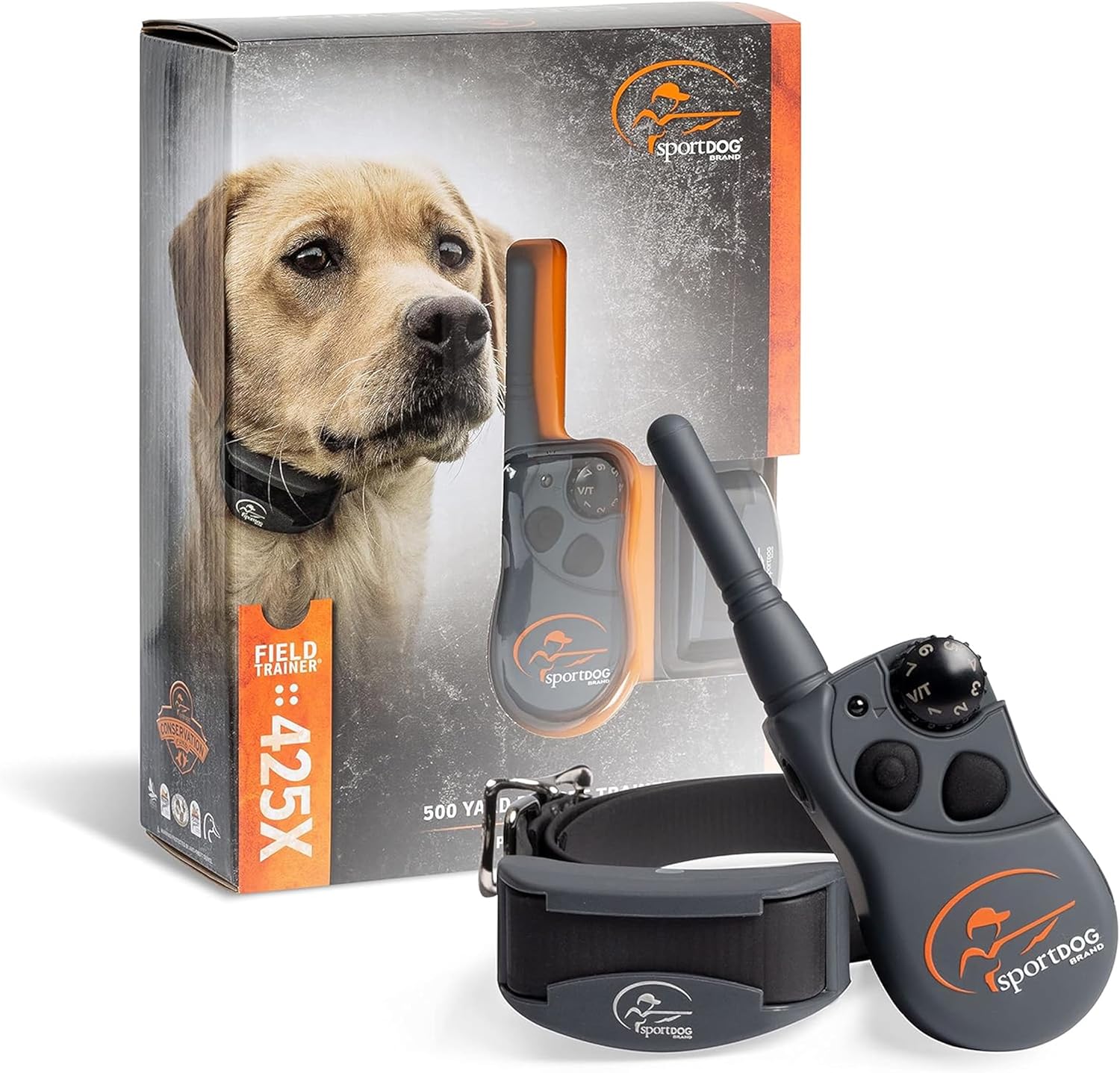
SportDOG FieldTrainer 425X
Best Heavy-Duty Training Collar
| Range | 500 yards |
|---|---|
| Stimulation levels | 21 levels |
| Modes | Tone, vibration, static |
| Waterproof rating | Submersible to 25 ft |
| Battery | Rechargeable lithium‑ion, 50–70 hours |
The SportDOG FieldTrainer 425X is a compact remote trainer built for off-leash control and field work where reliable, no-look operation matters. The handheld transmitter dials through 21 static-stimulation levels and can also deliver tone or vibration, letting you tailor corrections while you recall or reinforce obedience. Its 500-yard range and expandability to control up to three dogs make it suitable for working dogs in open spaces, and DryTek waterproofing makes both remote and receiver submersible to 25 feet for water training. Rechargeable lithium-ion batteries promise long runtime and a two-hour quick charge, and the included longer contact points help ensure skin contact on thick-coated dogs. On the flip side, the unit is SportDOG's smallest receiver so very large mastiff-type necks may find the housing compact, and advanced users who need half-mile-plus range or OLED-screen feedback might prefer larger models. For Cane Corso owners focused on rugged, repeatable off-leash recall and obedience work, the 425X provides a tough, field-ready baseline with proven durability and customizable stimulation.
Best for: Buyers who need a durable, field-ready e‑collar to reinforce off-leash control and recall for strong, active working dogs and who prioritize waterproofing and consistent, no-look operation.
Less Ideal for: Owners seeking the longest possible range, a larger receiver housing for very wide necks, or a display-equipped transmitter for fine-grained telemetry should consider larger SportDOG models.
- Multiple stimulus modes (tone, vibration, 21 levels of static) for flexible training.
- 500-yard range suitable for most yard and field training scenarios.
- Waterproof DryTek design submersible to 25 feet for wet conditions and water work.
- Rechargeable Li‑ion batteries with long 50–70 hour runtime and quick 2-hour charge.
- Expandable to control up to three dogs with add-on collars.
- Receiver is the brand’s smallest and may sit small on very large or thick-necked mastiff breeds.
- Range and feature set are less advanced than SportDOG’s higher-end half-mile models.
Verdict: The best heavy-duty training collar for energetic or strong puppies and owners who need reinforced hardware and rugged materials for long-term durability.
Choosing the Right Training Collar Lab Puppy: Key Factors to Consider
Fit and Adjustability
A proper fit is the single most important factor for a puppy training collar. Puppies grow rapidly, so choose a collar with a wide adjustment range and clear sizing guidance. An overly loose collar can slip or create inconsistent contact, while one that is too tight can chafe or hurt, disrupting training progress.
Look for soft, flexible materials and multiple sizing holes or sliding adjustments that allow the collar to be tightened as the puppy grows. Features like elasticized sections or a quick-release buckle make day-to-day handling safer and faster. Proper fit also affects how signals are delivered: when contact points sit correctly on the neck, cues are more consistent and easier for the puppy to interpret.
Cue Type and Intensity Control
Different collars offer vibration, tone, or static cues, and the best choice for a puppy emphasizes low-intensity, graduated signals. Puppies are still learning to read human communication, so start with gentle cues and increase intensity only when necessary. Collars that let you fine-tune intensity in small steps help you find the minimum effective cue for each behavior.
Consider models that provide multiple cue modes so you can use sound or vibration as a first option before introducing more intrusive signals. The ability to switch modes easily and adjust level increments makes training more humane and reduces the risk of startle responses that can slow learning.
Comfort and Material
Comfort affects how willing a puppy is to wear a collar consistently, which in turn influences training continuity. Soft webbing, neoprene padding, or silicone lining can reduce rubbing and pressure points during active play or long sessions. Breathable materials also help prevent moisture buildup under the collar during outdoor activity.
Materials should be durable enough to resist chewing and abrasion but not so stiff that they dig into the neck. Smooth, rounded edges on contact points and buckles help reduce skin irritation. Removable, washable padding is a practical plus for puppies that get dirty quickly.
Safety Features
Safety matters more with puppies because they are curious and may encounter unfamiliar objects or rough play. Look for collars with quick-release buckles or breakaway components that allow the collar to come off in an emergency. Nonconductive housings and sealed electronics reduce the risk of skin irritation and water damage.
Avoid collars that force high-intensity signals as a first resort. Redundant safety checks, clear battery indicators, and secure attachment points for ID tags and leashes are additional safety considerations. A collar that balances security with a fail-safe release gives owners peace of mind without undermining training effectiveness.
Ease of Use and Learning Curve
You will use a training collar frequently during the puppy months, so simplicity matters. Controls should be intuitive, with clearly labeled buttons and a remote that fits comfortably in the hand. Visual indicators for mode and intensity reduce mistakes and speed up consistent cueing.
A short learning curve helps both owner and puppy. Look for collars with straightforward setup instructions, quick pairing procedures, and responsive feedback. If the system requires frequent calibration or complex sequences to change modes, it will be harder to use reliably during real-world training.
Durability and Water Resistance
Labrador puppies are active and often damp, so a collar that tolerates rough play and exposure to water will last longer and provide more consistent performance. Sealed electronics, corrosion-resistant hardware, and robust buckles reduce the chance of failure during a wet hike or puddle session.
Consider recharging convenience and battery longevity as part of durability. A collar with predictable battery life and a straightforward charging routine keeps training on schedule. Replaceable components or washable straps extend usable life and keep the collar hygienic as the puppy grows.
When Should I Start Using a Training Collar with My Lab Puppy?
Many owners begin introducing gentle training collars once the puppy has basic handling tolerance, usually around 10 to 12 weeks, but timing depends on the individual pup. Start with short, positive sessions and monitor the puppy's reaction. If the puppy tolerates the collar well and responds to low-level cues, you can gradually incorporate it into recall and leash training.
Before full-time use, let the puppy wear the collar for short supervised periods so it becomes a neutral part of daily life. Always prioritize reward-based methods and use the collar as a communication tool rather than a punishment device.
- Start gradually with short sessions
- Use low-intensity cues first
- Pair collar use with treats and praise
How to Size a Collar Correctly for a Growing Lab Puppy
Measure the puppy's neck with a flexible tape measure and add two fingers' worth of slack to find a comfortable starting size. Choose a collar with a broad adjustment range so you can tighten it as the puppy grows without needing a new collar every few weeks.
Check fit weekly during rapid growth phases. Look for even contact around the neck and no pinching at the buckles. If a collar has removable pads or liners, adjust or remove them to maintain a snug but comfortable fit.
- Measure neck circumference and allow two fingers of slack
- Pick adjustable designs to accommodate growth
- Recheck fit regularly during growth spurts
Using the Collar for Recall and Leash Manners
Use the collar to reinforce clear, consistent cues during recall practice. Begin with a verbal cue and a light, brief signal only if the puppy does not respond. Reward compliance immediately with high-value reinforcement to strengthen the association.
For leash manners, prioritize loose-leash conditioning and use the collar sparingly for attention-getting cues rather than continuous corrections. Short, predictable training sessions work better than long repetitive sessions with sustained signals.
- Combine verbal cue, light collar signal, then treat
- Favor brief, infrequent cues over sustained corrections
- Keep sessions short and highly rewarding
Cleaning, Maintenance, and Charging Best Practices
Keep the collar and any removable pads clean to prevent skin irritation and odors. Follow manufacturer guidance for washing straps or pads, and wipe electronic housings with a damp cloth. Avoid submerging components unless rated for it.
Maintain consistent charging routines so the collar is ready for training sessions. Store the remote and collar in a dry place and check connectors for corrosion. Replace worn straps or hardware promptly to maintain a secure fit.
- Wash removable pads and straps as directed
- Wipe housings and avoid unnecessary submersion
- Charge regularly and inspect hardware for wear
Alternatives to Collar-based Cues for Sensitive Puppies
If a puppy shows strong negative reactions to collar cues, consider other training tools like head halters, long lines for recall, or targeting and clicker training to build impulse control. These methods allow you to shape behavior with clearer rewards and less aversive input.
Many trainers combine gentle collar cues with reward-based methods to maintain progress while reducing stress. The priority is consistent, predictable communication that the puppy can understand without fear.
- Try long lines and clicker-based recall practice
- Use head halters for leash control when appropriate
- Combine methods to minimize stress while training
How We Chose the Best Training Collar Lab Puppy
To assemble this list we applied criteria tailored to young Labrador retrievers and the realities of early training. We prioritized collars with adjustable, secure fit ranges appropriate for growing necks and soft contact points to reduce irritation during repeated sessions. Cue options and control resolution were evaluated, favoring devices that allow low-intensity signals and graduated settings so owners can use the lightest effective cue. Ease of use was another focus: collars with intuitive controls, clear feedback, and quick-release or breakaway features for safety scored higher. Durability and water resistance were considered because labs often play in water and muddy conditions. Battery life and charging convenience were also weighed since frequent recharging interrupts training consistency. We excluded any products that rely on punitive-only cues without graduated or alternative feedback and those with fixed-size designs unsuitable for puppies. The resulting shortlist balances comfort, adjustable cueing, reliable fit, and practical day-to-day durability.
Our full evaluation process is outlined in our review methodology.
FAQ
Are training collars safe for Labrador puppies?
Training collars can be safe when used responsibly: choose low-intensity, adjustable devices and introduce them gradually. Monitor the puppy for stress signs and prioritize vibration or tone before stronger cues.
How long should my puppy wear a training collar each day?
Start with short supervised periods of 10 to 30 minutes and increase gradually as the puppy tolerates it. Avoid continuous all-day wear, and remove the collar during unsupervised rest and sleep.
Can I use vibration or tone instead of static cues with a puppy?
Yes. Vibration and tone are often effective first options because they are less intrusive. Many puppies respond well to these modes, and they allow you to reinforce desired behaviors without escalating intensity.
What signs show the collar is the wrong fit or intensity?
Watch for repeated pawing at the neck, flinching, avoidance of collar-related activities, or changes in appetite or play. Those signs suggest fit adjustments or lower cue intensity is needed, or that an alternative method should be used.
When should I stop using a training collar?
Many owners phase collars out once the puppy reliably responds to verbal cues and leash manners are established. The timeline varies, but plan to transition to reward-based reinforcement and occasional reminder cues as training solidifies.
Final Verdict
Focus on fit, low-intensity cueing, and comfort when choosing a training collar for a lab puppy. Prioritize devices that let you start gently and scale signals in small steps as the puppy learns. Balance safety features and ease of use so training remains consistent without causing stress. The right collar is a communication aid rather than a shortcut. Emphasize short, positive sessions and monitor the puppy closely. With the criteria discussed here, you can choose an option that helps the puppy build reliable recall and good leash manners while keeping training humane and effective.

