

If you manage a large, stubborn dog you already know how quickly normal collars and cues can fail under pressure. The right training collar helps you deliver consistent, repeatable signals and retain control during walks, recall work, or distracting environments without escalating the situation. This guide shortlists the most practical training collars for large stubborn dogs, focusing on secure fit, effective but safe correction methods, and durability for heavy-use scenarios. Below you will find our top picks and the evaluation criteria that matter for strong, determined dogs.
Top Picks at a Glance
| Best Overall Training Collar for Large Stubborn Dogs The best all-around pick for most large, stubborn dogs | Dogtra 280X E-Collar 1-Dog |  |
| Best Budget Training Collar for Large Stubborn Dogs A low-cost option that still handles basic training needs | HapTop AC131 Dog Shock Collar |  |
| Best Premium Training Collar A higher-end option with advanced features and superior materials | Garmin Sport PRO Handheld Trainer |  |
| Best Heavy-Duty Training Collar Built for stronger dogs and tougher everyday wear | Herm Sprenger Prong Collar 3.0mm 20-25" |  |
| Best Lightweight Training Collar A minimal, low-profile collar for comfort and easy wear | Starmark Pro-Training Collar Large |  |
| Best Remote Training Collar Includes a handheld transmitter for long-distance control | SportDOG FieldTrainer 425X |  |
| Best Waterproof Training Collar Resistant to rain, puddles, and easy to clean after use | BLACKDOG Military Shock Collar OT9 |  |
Dogtra 280X E-Collar 1-Dog
Best Overall Training Collar for Large Stubborn Dogs

| Range | 1/2 mile |
|---|---|
| Stimulation levels | 100 levels |
| Functions | Tone, Vibration, Static (Nick/Continuous), BOOST |
| Waterproof | Yes |
| Expandable to | Up to 3 dogs |
The Dogtra 280X is a premium, purpose-built e-collar aimed at serious trainers and owners of larger, energetic dogs. It pairs a compact, rugged receiver with a handheld remote that offers 100 discrete stimulation levels plus tone and an XPP vibration pager, so you can tailor corrections precisely as your dog progresses. The front-mounted main button and programmable BOOST instantly raise intensity for urgent recalls without fumbling through controls, and the safety level lock reduces accidental activations. Built waterproof and designed for daily outdoor use, the unit includes a bright 1000-lux LED for visibility and removable contact points for comfort and fit. The system supports expansion to additional dogs and charges via USB-C. Trade-offs are the higher-end positioning and feature set that may be more than a casual owner needs, and learning to find the correct stimulation level takes time and careful introduction. For handlers who want refined ergonomics, reliable range, and durable construction, the 280X is a strong premium choice for large-dog training tasks.
Best for: Owners who prioritize top-tier durability, precise control, and advanced ergonomics for training large or strong dogs and are willing to invest in a premium tool.
Less Ideal for: Casual owners looking for a simple, low-cost humane correction or those uncomfortable with adjustable electronic stimulation should consider gentler or lower-feature alternatives.
- 100 levels of precise stimulation for fine-tuned training
- Front-facing main button and BOOST for instant, one-handed recall control
- Fully waterproof receiver and rugged construction for outdoor use
- Bright 1000-lux LED improves visibility for evening or low-light training
- Expandable system supports additional receivers for multi-dog households
- Premium features and durability come at a higher cost which may exceed casual needs
- Requires time and careful introduction to identify appropriate stimulation levels
Verdict: The best all-around training collar for large stubborn dogs, balancing reliable correction, comfortable fit, battery life, and intuitive controls for everyday training.
HapTop AC131 Dog Shock Collar
Best Budget Training Collar for Large Stubborn Dogs

| Training modes | Beep, Vibration, Safe Shock, Shock Boost |
|---|---|
| Range | 4500 ft |
| Fit neck | 7.8"-24.4" (10-120 lb) |
| Waterproof rating | IPX8 |
| Charging | USB-C |
The HapTop AC131 is a rechargeable e-collar kit designed for everyday obedience and distance work. It uses a 2-channel remote to control up to two dogs and offers four training modes: beep, vibration, safe shock (0–99 levels) and a shock boost, with the shock function optional for no-shock training. The remote's long 4500 foot range and memory for individual dog settings make it useful for off-leash recall, boundary training, and reinforcing commands across yards or trails. The receiver is IPX8 waterproof and the kit includes multiple prong lengths, silicone covers, a test light tool, and USB-C charging for practical field use. Safety-oriented features include an adjustable low-to-high stimulation range, a security lock to prevent accidental corrections, and a manufacturer guideline limiting continuous wear to 12 hours. Trade-offs are typical for this class: it relies on batteries and correct fitment to be effective, and some owners prefer vibration or beep-only methods before adding shock. The unit's feature set and range make it a strong daily trainer for owners willing to follow safe use guidelines.
Best for: Owners who want a versatile, safety-minded e-collar for regular obedience and distance work and who plan to use multiple training modes progressively.
Less Ideal for: People who want a purely non-aversive training tool or who are uncomfortable using shock-style corrections should choose vibration- or treat-based training alternatives.
- Very long 4500 ft remote range for off-leash training
- Multiple modes (beep, vibration, adjustable shock) for progressive training
- IPX8 waterproof receiver suitable for wet outdoor use
- Includes extra prongs, silicone covers, test light tool, and USB-C charging
- 2-channel remote controls two dogs and remembers individual settings
- Shock feature requires careful adjustment and responsible use to avoid misuse
- Not intended for continuous wear longer than 12 hours per day
Verdict: The best budget training collar for large stubborn dogs that provides effective basic correction and durability at a significantly lower price point.
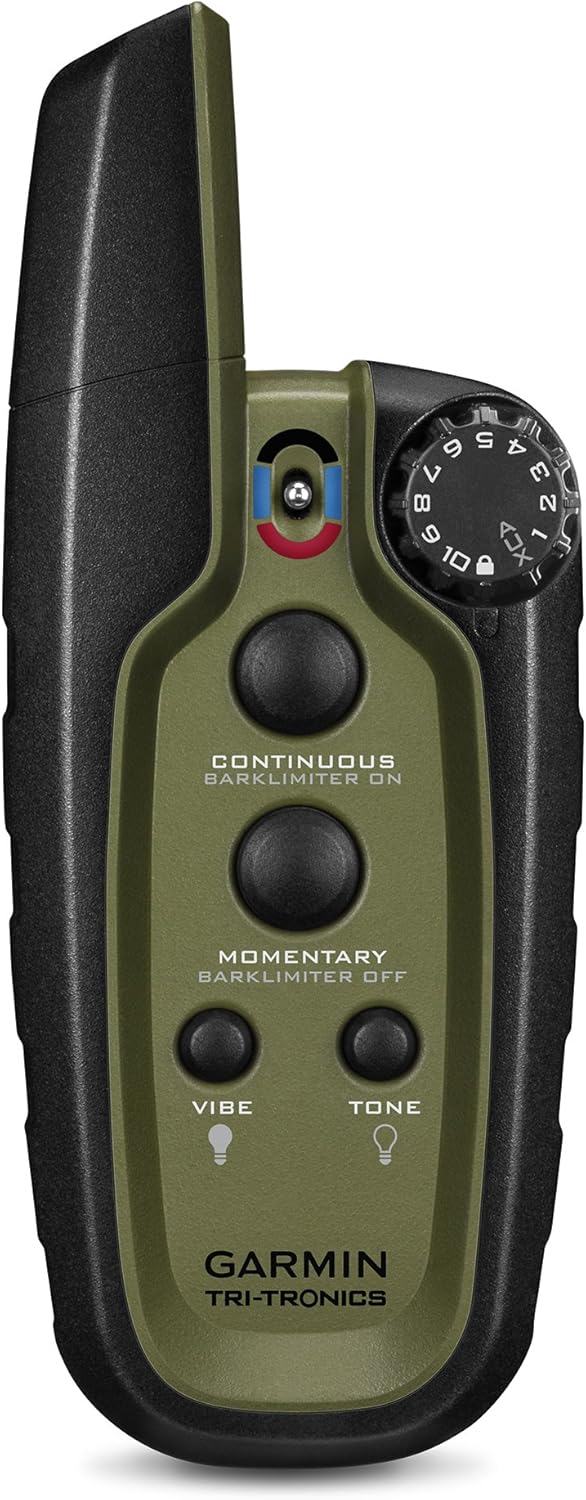
Garmin Sport PRO Handheld Trainer
Best Premium Training Collar
| Range | 3/4 mile |
|---|---|
| Stimulation levels | 10 levels |
| Included components | Remote Control |
| Battery | Rechargeable, user-replaceable |
The Garmin Sport PRO is a compact, one-handed training remote designed for intensive, long-term field work. It controls a rechargeable dog device that offers continuous and momentary stimulation across 10 levels via a quick-turn dial, plus vibration, tone and remote LED beacon lights for low-light visibility. The unit includes a settable bark limiter and interchangeable long and short contact points so you can match contact depth to coat type. Practical benefits include a usable 3/4-mile range for off-leash work, a floating handheld for wet conditions, and a rechargeable user-replaceable battery that keeps downtime low. The controls are arranged for “no-look” operation, which speeds corrections during fast training sessions, and the handheld can manage up to three dogs with additional collars. Trade-offs to consider are that the system requires buying extra dog devices to train multiple dogs and that the 10-level stimulation system is best suited to handlers experienced in graded corrections rather than first-time users.
Best for: Handlers who prioritize durable, precise controls and feature-rich hardware for intensive training sessions or working-dog programs.
Less Ideal for: Owners seeking a beginner-friendly, non-stimulation-only training tool or those who want an out-of-the-box multi-dog system without extra purchases.
- One-handed, intuitive controls with a quick-turn dial for rapid level changes
- Multiple output modes: continuous and momentary stimulation, vibration, tone, and LED beacon lights
- Rechargeable, user-replaceable battery and floating handheld for durable field use
- Interchangeable long and short contact points to fit different coat types
- Additional dog devices must be purchased separately to train more than one dog
- Stimulation-based system assumes handler familiarity with graduated corrections
Verdict: The best premium training collar for owners who want top-tier build quality, advanced feature sets, and refined comfort for intensive or long-term training.
Herm Sprenger Prong Collar 3.0mm 20-25"
Best Heavy-Duty Training Collar

| Material Type | Stainless Steel |
|---|---|
| Size | 3.0mm (20"-25" Neck) |
| Closure Type | Buckle |
This Herm Sprenger prong collar is a heavy-duty training tool built from chrome-plated stainless steel links and a quick-release buckle that speeds on/off use compared with traditional fastener plates. It is intended for short, supervised training sessions where a handler needs a strong, consistent attention-getting correction; the linked prongs distribute pressure around the neck so correction is applied evenly from any angle. The collar ships set for a 20 to 25 inch neck and links can be removed or added to fine-tune fit, and the stainless construction resists corrosion for long service life. The quick-snap buckle is the most practical change from classic designs because it makes fitting and removal faster during repeated handling. Important limitations: this is a training aid not a continuous-wear collar or a tie-out device, and effective, humane use requires proper fit and handler technique to avoid misuse. Inspect regularly and clean with a damp cloth to maintain performance.
Best for: Owners of strong, active German Shepherds who prioritize a robust, reliable training tool for short, supervised correction sessions and who are comfortable using prong-style training methods.
Less Ideal for: Owners seeking an everyday walking collar, an automatic deterrent, or those uncomfortable with correction-style training should consider alternative positive-reinforcement tools.
- German-made stainless steel construction for durability and corrosion resistance
- Quick-release buckle speeds fitting and removal during repeated training sessions
- Linked prong design applies even pressure from any angle for consistent corrections
- Adjustable by adding or removing links to achieve a snug fit
- Not intended for continuous wear or tie-out use
- Requires knowledgeable, supervised use to ensure humane and effective training
Verdict: The best heavy-duty training collar for large, powerful dogs that need reinforced construction and tougher hardware to withstand hard use.
Starmark Pro-Training Collar Large
Best Lightweight Training Collar

| Breed Recommendation | Large, Medium |
|---|---|
| Material Type | Nylon, Polymer |
| Item Length | 20 inches |
| Size | Large |
| Included Components | Safety Clip |
The Starmark Pro-Training Collar is a martingale-style training collar that uses high-strength polymer "watchband" links to deliver gentle, distributed pressure for discouraging pulling and teaching leash manners. You size it by adding or removing links so the fit can be adjusted precisely, and the rounded link tips and martingale action reduce sharp pinching compared with metal chain collars. It includes a backup nylon slip collar and is intended for supervised training sessions rather than continuous wear. In practice the collar works well for owners doing short leash training sessions, handling lunging and sudden pulls more humanely than choke chains while offering enough control for large and strong dogs. Limitations are that it requires correct fitting to function and must not be left on an unattended dog, and the polymer links can be bulkier than a flat nylon collar which some dogs may find unfamiliar at first.
Best for: Owners focused on improving leash manners who want a humane, controllable training tool for short supervised sessions with medium to large dogs.
Less Ideal for: People seeking a collar for all-day wear, passive identification, or for unsupervised use should choose a regular flat collar or harness instead.
- Adjustable watchband-style links allow precise sizing for a snug training fit
- Polymer link construction provides distributed, rounded pressure that is gentler than metal choke chains
- Martingale design helps prevent slipping over the head while giving corrective leverage
- Includes a backup nylon slip collar for safety during training sessions
- Not intended for unsupervised or continuous wear and must be removed after training
- Requires proper fit and handling to be effective and safe
Verdict: The best lightweight training collar for owners who prioritize minimal bulk and maximum comfort while still delivering dependable correction for training sessions.
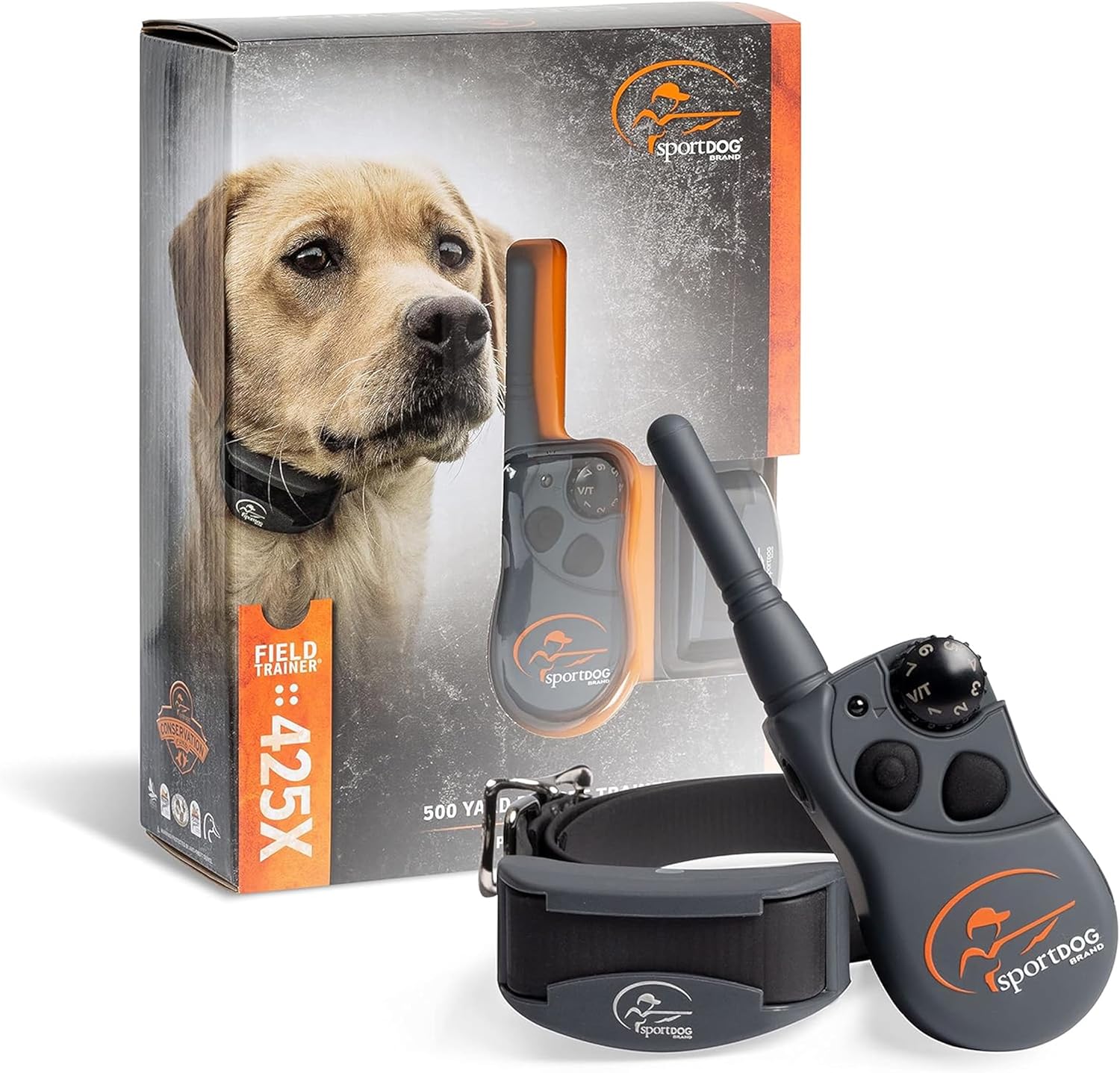
SportDOG FieldTrainer 425X
Best Remote Training Collar
| Range | 500 yards |
|---|---|
| Stimulation levels | 21 levels |
| Modes | Tone, vibration, static |
| Waterproof rating | Submersible to 25 ft |
| Battery | Rechargeable lithium‑ion, 50–70 hours |
The SportDOG FieldTrainer 425X is a compact remote trainer built for off-leash control and field work where reliable, no-look operation matters. The handheld transmitter dials through 21 static-stimulation levels and can also deliver tone or vibration, letting you tailor corrections while you recall or reinforce obedience. Its 500-yard range and expandability to control up to three dogs make it suitable for working dogs in open spaces, and DryTek waterproofing makes both remote and receiver submersible to 25 feet for water training. Rechargeable lithium-ion batteries promise long runtime and a two-hour quick charge, and the included longer contact points help ensure skin contact on thick-coated dogs. On the flip side, the unit is SportDOG's smallest receiver so very large mastiff-type necks may find the housing compact, and advanced users who need half-mile-plus range or OLED-screen feedback might prefer larger models. For Cane Corso owners focused on rugged, repeatable off-leash recall and obedience work, the 425X provides a tough, field-ready baseline with proven durability and customizable stimulation.
Best for: Buyers who need a durable, field-ready e‑collar to reinforce off-leash control and recall for strong, active working dogs and who prioritize waterproofing and consistent, no-look operation.
Less Ideal for: Owners seeking the longest possible range, a larger receiver housing for very wide necks, or a display-equipped transmitter for fine-grained telemetry should consider larger SportDOG models.
- Multiple stimulus modes (tone, vibration, 21 levels of static) for flexible training.
- 500-yard range suitable for most yard and field training scenarios.
- Waterproof DryTek design submersible to 25 feet for wet conditions and water work.
- Rechargeable Li‑ion batteries with long 50–70 hour runtime and quick 2-hour charge.
- Expandable to control up to three dogs with add-on collars.
- Receiver is the brand’s smallest and may sit small on very large or thick-necked mastiff breeds.
- Range and feature set are less advanced than SportDOG’s higher-end half-mile models.
Verdict: The best remote training collar for owners who need reliable wireless range and precise, instant control during outdoor or off-leash training.
BLACKDOG Military Shock Collar OT9
Best Waterproof Training Collar

| Training modes | Beep, Vibration, Safe Shock, Strobe Light |
|---|---|
| Range | 4200ft |
| Waterproof rating | IP67 |
| Power | USB-C fast charge; 90-day claimed runtime (1 hr/day) |
The BLACKDOG OT9 is a rechargeable training collar system aimed at regular use in outdoor conditions. The remote and collar provide four user-selectable modes—beep, vibration, safe shock, and a strobe light—with multiple intensity levels, an LCD on the transmitter for clear mode and battery readouts, and tool-free removable prongs so you can switch to no-shock operation. Its rechargeable design (USB-C fast charge) and claimed 90-day battery life based on one hour of daily use make it convenient for owners who train often and want low running costs compared with disposable batteries. The unit is built to a rugged spec with an IP67 rating and reinforced casing for heavy-duty outdoor use, while the remote flashlight and collar strobe improve night safety. Practical limits: the shock mode is present so careful, informed use is required, and real-world range and battery life will vary with terrain and usage intensity. The system suits hands-on, consistent trainers who need a weatherproof rechargeable collar with visible lighting features.
Best for: Owners who train regularly and prioritize a rechargeable collar that is rugged enough for outdoor use and includes visibility features for night or low-light sessions.
Less Ideal for: People who want a purely positive-reinforcement tool without any static stimulation or those who need a collar-free solution for noise-only behavior control.
- Rechargeable USB-C system with fast charging and long claimed runtime
- Multiple training modes including beep, vibration, and adjustable safe shock levels
- IP67 waterproof build and reinforced casing for rugged outdoor use
- Integrated remote flashlight and collar-mounted strobe for night visibility
- Tool-free removable prongs allow switching to no-shock configuration
- Shock feature requires responsible use and may not suit sensitive or inexperienced handlers
- Real-world range and battery life depend on terrain and usage and may be lower than claims
Verdict: The best waterproof training collar for dogs that spend time outdoors or in wet conditions and for owners who want easy cleanup and durable electronics protection.
Choosing the Right Training Collar Large Stubborn Dog: Key Factors to Consider
Fit and Adjustability
A secure, properly adjusted collar is the foundation of safe and effective training. For large stubborn dogs you need a system that accommodates broader neck circumferences and thicker coats while preventing the collar from rotating or slipping under tension.
Look for wide straps, multiple adjustment points, and mechanisms that lock settings in place. Proper fit reduces pressure points and ensures corrections are delivered consistently to the intended contact area rather than sliding to an unsafe position. Ease of adjustment matters when you need to fit the collar quickly or switch between dogs or handlers.
Correction Type and Intensity Control
Different collars deliver different kinds of feedback, from vibration and tone to static or short remote-cued corrections. For large stubborn dogs it is critical that the device offers a range of intensities so you can find the minimal effective level and avoid unnecessary escalation.
Precise, incremental controls allow gradual progression during training and help you tune responses for a specific dog's sensitivity. Look for intuitive controls that can be adjusted on the fly, clear feedback so you know which intensity is active, and safety limits or automatic shutoffs to prevent prolonged correction.
Durability and Construction
Training collars for powerful dogs undergo heavy mechanical stress and exposure to outdoor conditions. Durable materials, reinforced stitching, and corrosion-resistant hardware lengthen the collar's service life and keep it reliable during long walks, field sessions, or wet conditions.
Consider strap materials that resist fraying, robust buckles or clasps that lock under load, and sealed electronic components if the unit uses remote or electronic features. A well-built collar reduces the chance of failure at a critical moment and supports consistent training outcomes.
Contact Design and Canine Comfort
How the collar contacts the dog's neck affects both comfort and signal clarity. Wide, padded contact areas help distribute pressure and reduce localized soreness, which is especially important for repeated sessions with large dogs.
For electronic contacts, spacing and surface shape influence how reliably signals reach through thick fur. Mechanical or pressure-based contact designs should avoid sharp edges and be shaped to follow the neck's curve. Comfort matters because a dog that tolerates the collar will respond better and show fewer stress behaviors unrelated to the training itself.
Control Interface and Range
If the collar uses a remote, the ergonomics and range of that remote matter. Handlers need responsive controls, unambiguous feedback, and sufficient communication range for the environments they train in. For large, stubborn dogs who may test distance boundaries, a longer reliable range reduces the need to chase or risk losing control.
Consider battery life, signal reliability in areas with interference, and how easily the remote can be operated with one hand or while managing a leash. Simple interfaces reduce error under stress and help you maintain clear timing during reinforcement.
Safety Features and Fail-safes
Training tools should reduce the risk of accidental harm. Look for built-in safeguards such as timed automatic cutoffs for electronic corrections, low-battery alerts, and locking adjustment points to prevent sudden loosening. Materials that minimize skin irritation and designs that prevent entanglement are also important for active dogs.
A clear safety protocol, whether in the product instructions or built into the device, supports humane use and helps you avoid common mistakes that can make a dog more resistant rather than receptive to training.
How Do I Choose the Right Correction Level for a Stubborn Dog?
Start with the lowest effective intensity and observe the dog's immediate reaction. The goal is to gain attention and interrupt unwanted behavior, not to frighten or escalate the dog. If the dog shows no reaction after a few controlled repetitions, increase gradually while watching body language and respiratory signs.
Combine collar corrections with consistent verbal cues and post-correction positive reinforcement so the dog learns the desired response. Keep sessions short and repeatable to avoid stress-related resistance. If you need consistently higher levels for control, re-evaluate whether adjustments in handling, leash management, or foundational obedience could reduce dependence on stronger corrections.
- Use one clear cue per behavior to avoid confusion
- Watch for signs of distress or avoidance and back off if observed
- Pair corrections with immediate handler cues and a follow-up reward when the dog responds correctly
Will Electronic Collars Work Through a Thick Coat?
Some electronic contact designs are better suited to thick coats because they use longer, rounded contact points that part fur without pinching. Adjustable contact lengths and well-spaced electrodes increase the chance of consistent transmission on dogs with dense undercoats.
If a collar struggles to reach the skin, consider trimming a small patch under supervision or choosing a contact design with longer probes. Always follow manufacturer guidance for contact length adjustments and monitor the skin for irritation during early sessions.
- Longer electrodes generally improve contact on dense fur
- Padded collars reduce rubbing even when trimming is necessary
- Test and inspect the contact area after initial uses
How to Make Sure a Collar Stays in Place on a Large Neck
A combination of correct sizing, wide straps, and locking adjustment points helps prevent rotation. Measure the neck while the dog is relaxed and add space only as needed for comfort; too loose a fit allows the collar to slide and delivers inconsistent signals.
For dogs that actively push or twist their way out of collars, auxiliary attachment points or harness-compatible link systems can help distribute forces and keep the training collar properly oriented without restricting breathing or movement.
- Re-measure regularly for weight changes
- Choose straps at least an inch wide for large dogs
- Look for designs that allow quick tightening without losing previously set adjustments
Can I Use a Training Collar During Recall and Off-leash Work?
Many handlers use collars with remote activation for recall practice because they allow reinforcement at distance. For off-leash work you need a device with reliable range, predictable correction, and quick, one-handed operation so you can reward the dog immediately after the correct response.
Always ensure the collar is set to a low, attention-getting level for cueing and combine it with positive reinforcement once the dog returns. Off-leash training also demands that the handler has practiced leash-based cues and boundary control before relying on remote corrections in open areas.
- Practice in a controlled area before generalizing to open spaces
- Keep sessions brief and always follow with a reward
- Prioritize predictable, consistent timing when rewarding recall
What Maintenance Keeps a Training Collar Reliable?
Regularly clean contact points and inspect straps and buckles for wear. If the device is electronic, check seals and charging ports to prevent moisture ingress and confirm the battery holds a charge under typical use. Replace worn straps or frayed stitching before it becomes a safety issue.
Store remotes and electronics in a dry, temperate place and keep firmware or software updated if the product supports updates. Routine maintenance prevents degradation in correction consistency and reduces the chance of mid-session failures.
- Wipe contacts after wet or muddy sessions
- Test battery and range before training outings
- Replace any component showing signs of wear
How to Introduce a Training Collar to a Resistant Dog
Introduce the collar gradually and in a low-distraction setting. Let the dog sniff and investigate the device while you offer treats and calm attention. Fit the collar for short intervals at first so the dog associates it with neutral or positive experiences rather than punishment.
Pair initial, very low-intensity cues with high-value rewards and praise when the dog responds. Increase wear time and training intensity slowly as the dog shows comfort, always monitoring for stress indicators and pausing when the animal appears overwhelmed.
- Begin with brief wearing sessions under supervision
- Use treats to build a positive association
- Increase cueing only after the dog tolerates the collar calmly
How We Chose the Best Training Collar Large Stubborn Dog
We narrowed candidates by focusing on attributes that matter most for large stubborn dogs: secure and adjustable fit for large necks, correction effectiveness across a range of behaviors, build quality that withstands strong pulls and outdoor use, and controls or interfaces that are intuitive under stress. We prioritized collars offering multiple, adjustable correction levels and clear feedback so handlers can scale intensity according to the dog and the training stage. We also evaluated safety features, such as fail-safe designs, padding on contact surfaces, and protocols that reduce the chance of accidental overcorrection. Excluded items included collars designed only for small or medium breeds, novelty devices without adjustable corrections, and units lacking documented safety controls. We checked materials and attachment points for durability, examined how well fit systems prevent rotation and slippage on large necks, and considered ergonomics for both dog and handler. Our final list reflects products that balance control, safety, and durability for the challenges of training strong-willed, large dogs.
Our full evaluation process is outlined in our review methodology.
FAQ
Are training collars safe for large dogs?
Training collars can be safe when used properly. Choose a collar with adjustable, humane correction levels, ensure a proper fit, and follow recommended session lengths. Supervision and correct technique reduce the risk of injury or stress.
How often should I use a training collar during sessions?
Use collars in short, focused sessions rather than as a constant wearable. Frequent, brief sessions with consistent cues produce better results than long continuous corrections. Adjust frequency based on the dog's responsiveness and stress signals.
Can a stubborn dog become desensitized to corrections?
Dogs can habituate to a stimulus if it is overused or lacks consistent timing. To avoid desensitization, use the minimal effective correction, vary training contexts, and always pair cues with reinforcement for the desired behavior.
Should I trim fur where the contact points sit?
Trimming a small patch of fur beneath contact points can improve reliability for electronic contacts on very thick coats. Trim conservatively and watch the skin for irritation. Trimming is optional and depends on how reliably the collar makes contact.
What if the collar rubs or irritates the skin?
If you notice rubbing or irritation, stop using the collar until the area heals and reassess fit and padding. Consider adjusting contact spacing, adding a padded cover, or shortening session duration. Persistent irritation warrants consultation with a veterinarian.
Final Verdict
For large stubborn dogs prioritize a collar that combines a secure, nonrotating fit with adjustable correction levels and robust construction. Comfort and contact reliability reduce false signals and keep your dog receptive to training, while intuitive controls and safety features protect both handler and animal. Balance correction intensity with positive reinforcement and progressively increase challenges only as the dog responds reliably. Focus on consistency, fit, and humane escalation so you can train effectively without creating avoidance or stress-related behaviors.

