

Training two dogs at once brings unique challenges: you need tools that let you manage both animals without confusing signals or compromised safety. Choosing the right training collars for two dogs matters because collars that pair reliably, offer distinct channeling, and keep stimulation levels safe make sessions more efficient and less stressful for you and your pets. This guide shortlists the top picks for two-dog setups and explains the practical features that matter most. Below you will find the best training collar options for two dogs along with the evaluation criteria we used to narrow the field.
Top Picks at a Glance
| Best Overall Training Collar for Two Dogs A balanced, reliable option designed to train two dogs together | HapTop AC131 Dog Shock Collar |  |
| Best Budget Training Collar for Two Dogs A low-cost two-dog solution that still covers core training needs | FWQEFVA Dog Shock Collar X12 |  |
| Best Long-Range Training Collar Extended remote reach for off-leash recall and distant training control | DeeWaves Shock Collar 2 Dogs |  |
| Best Lightweight Training Collar A low-profile, light collar designed for smaller or sensitive dogs | Jeyihka Small Shock Collar 704sh |  |
| Best Premium Training Collar A higher-end model with refined features and superior build quality | Dogtra 280X 2-Dog E-Collar |  |
HapTop AC131 Dog Shock Collar
Best Overall Training Collar for Two Dogs

| Training modes | Beep, Vibration, Safe Shock, Shock Boost |
|---|---|
| Range | 4500 ft |
| Fit neck | 7.8"-24.4" (10-120 lb) |
| Waterproof rating | IPX8 |
| Charging | USB-C |
The HapTop AC131 is a rechargeable e-collar kit designed for everyday obedience and distance work. It uses a 2-channel remote to control up to two dogs and offers four training modes: beep, vibration, safe shock (0–99 levels) and a shock boost, with the shock function optional for no-shock training. The remote's long 4500 foot range and memory for individual dog settings make it useful for off-leash recall, boundary training, and reinforcing commands across yards or trails. The receiver is IPX8 waterproof and the kit includes multiple prong lengths, silicone covers, a test light tool, and USB-C charging for practical field use. Safety-oriented features include an adjustable low-to-high stimulation range, a security lock to prevent accidental corrections, and a manufacturer guideline limiting continuous wear to 12 hours. Trade-offs are typical for this class: it relies on batteries and correct fitment to be effective, and some owners prefer vibration or beep-only methods before adding shock. The unit's feature set and range make it a strong daily trainer for owners willing to follow safe use guidelines.
Best for: Owners who want a versatile, safety-minded e-collar for regular obedience and distance work and who plan to use multiple training modes progressively.
Less Ideal for: People who want a purely non-aversive training tool or who are uncomfortable using shock-style corrections should choose vibration- or treat-based training alternatives.
- Very long 4500 ft remote range for off-leash training
- Multiple modes (beep, vibration, adjustable shock) for progressive training
- IPX8 waterproof receiver suitable for wet outdoor use
- Includes extra prongs, silicone covers, test light tool, and USB-C charging
- 2-channel remote controls two dogs and remembers individual settings
- Shock feature requires careful adjustment and responsible use to avoid misuse
- Not intended for continuous wear longer than 12 hours per day
Verdict: The best overall training collar for two dogs blends consistent stimulation, simple multi-dog pairing, dependable range, and durable controls for everyday training needs.
FWQEFVA Dog Shock Collar X12
Best Budget Training Collar for Two Dogs

| Training range | 2000 ft |
|---|---|
| Modes | Beep, Vibration, Flash, Static Correction |
| Waterproof rating | IPX7 |
| Suitable weight | 15–120 lb |
| Charge time | Approx. 2 hours |
The FWQEFVA X12 is a straightforward remote training collar aimed at everyday obedience and recall work for larger dogs. It pairs a compact handheld remote with a rechargeable receiver collar that claims a stable 2000 ft signal and four training modes: flash, beep, vibration, and a lower-intensity static correction. The receiver is IPX7 waterproof, so it stands up to rain, splashes, and wet-field work, and the kit includes multiple contact points and silicone caps to help fit different coat types. Charging is quick — about two hours — and the system advertises long standby times, which reduces the need for frequent recharging between sessions. Practical limitations are that the construction and materials are basic rather than premium, and the numeric intensity control details are not specified, so fine-tuning for very sensitive or very strong-headed dogs may require patience. For buyers who want a budget-friendly, no-frills solution that is waterproof and covers large-dog weights, this model delivers the essentials without extras like advanced app control or metal-bodied remotes.
Best for: Buyers who need a budget-friendly, water-resistant training collar for reliable basic obedience and recall work with larger dogs and who prioritize function over premium finish or advanced features.
Less Ideal for: Owners seeking high-end build quality, precise multi-level stimulation controls, or smartphone app integration should consider more advanced models.
- IPX7-rated receiver suitable for wet conditions and outdoor training
- Multiple training modes (beep, vibration, flash, safe static) for flexible responses
- Includes spare contact points and silicone caps to fit different coat types
- Fast two-hour charging and long standby times reduce downtime
- Basic plastic construction and components rather than premium materials
- Intensity/adjustment granularity for static correction is not detailed
Verdict: The best budget training collar for two dogs delivers essential multi-dog compatibility and effective basic training features at a wallet-friendly price.
DeeWaves Shock Collar 2 Dogs
Best Long-Range Training Collar

| Range | 5,249 ft |
|---|---|
| Dog weight | 5–150 lbs |
| Channels | 2 (dual-channel remote) |
| Waterproof rating | IPX7 |
| Charging | Type-C, 2–3 hours |
This DeeWaves kit is built for long-distance training and controlling two dogs from a single remote. The dual-channel remote lets you switch between two receivers for simultaneous training, and the stated maximum range of 5,249 feet is useful for open areas like fields, beaches, or large yards. It offers four modes — beep, vibration, momentary shock and continuous shock with 0–99 intensity levels — plus removable prongs and spring plates to adapt for coat length and comfort. Practical touches include an LCD on the remote with lockable shock level, reflective straps, an LED locator light on receivers, Type-C fast charging and IPX7 waterproofing for use in rain or water. Battery life claims are strong, with multi-day use per charge and long standby. Important limitations are that real-world range will be lower in wooded or built-up areas and that the shock option requires careful, responsible use starting at low intensity; interpreting the many accessories and switching prongs adds some setup time. For trainers who need reliable long-range control over two dogs, this kit covers the essentials well.
Best for: Owners who need dependable remote reach to manage two dogs at distance, such as on farms, large properties, or open recreation areas, and who prioritize range and multi-dog control.
Less Ideal for: People who train only indoors or in small yards where extreme range is unnecessary, or owners unwilling to invest time in learning intensity settings and proper, humane use.
- Very long stated remote range (up to 5,249 ft) for open-area training
- Dual-channel remote controls two receivers without extra transmitters
- Multiple stimulation modes plus removable prongs and spring plates for coat and comfort adjustments
- IPX7 waterproof receivers and remote suitable for wet or snowy conditions
- Type-C fast charging with long claimed runtime and standby
- Maximum range is idealized and will be reduced by obstacles or interference
- Shock mode requires cautious use and a learning curve to find effective, humane intensity
Verdict: The best long-range training collar suits owners who need consistent signal and control at greater distances for reliable off-leash training.
Jeyihka Small Shock Collar 704sh
Best Lightweight Training Collar

| Breed Recommendation | Small |
|---|---|
| Included Components | Remote Control |
| Range | 2000 ft |
| Water Resistance (Receiver) | IPX7 |
| Power | USB rechargeable |
This compact Jeyihka 704sh training collar is built for small dogs and travel use, pairing a tiny, lightweight receiver with a handheld remote. It provides beep, vibration and adjustable static stimulation across 0–99 levels plus a light mode, so you can escalate corrections gradually during sessions. The unit supports two receivers on one remote for training two dogs and claims a 2000 ft range for off-leash recall or boundary work. The receiver is IPX7 waterproof so it withstands wet conditions, while the remote is splash resistant and includes a built-in flashlight and a one-click safety lock to prevent accidental pulses. Battery life is strong for this class with fast USB charging and long standby times for both devices. Important limits are the collar sizing and intended breed focus: it is targeted at small dogs and the tiny receiver may not suit larger or heavy-chewing dogs, and the remote is not fully waterproof. Training benefits depend on responsible, graduated use of the adjustable levels rather than relying on high static settings.
Best for: Owners of small-breed dogs who need a travel-friendly, lightweight training collar that prioritizes adjustable, safety-focused correction options and easy outdoor use.
Less Ideal for: People with large or heavy-chewing dogs or owners who need a fully waterproof remote for frequent water exposure should consider more robust alternatives.
- Extremely lightweight and compact receiver suitable for small breeds
- Multiple correction modes (beep, vibration, static) with precise 0–99 level adjustment
- IPX7 waterproof receiver for use in rain or near water
- 2000 ft claimed range and dual-channel remote for training two dogs
- Fast USB charging and long standby battery life for remote and receiver
- Remote is only splash-proof rather than fully waterproof
- Receiver may be too small or fragile for larger or very active chewers
Verdict: The best lightweight training collar is ideal for smaller or easily bothered dogs, offering effective training with minimal bulk or weight on the neck.
Dogtra 280X 2-Dog E-Collar
Best Premium Training Collar
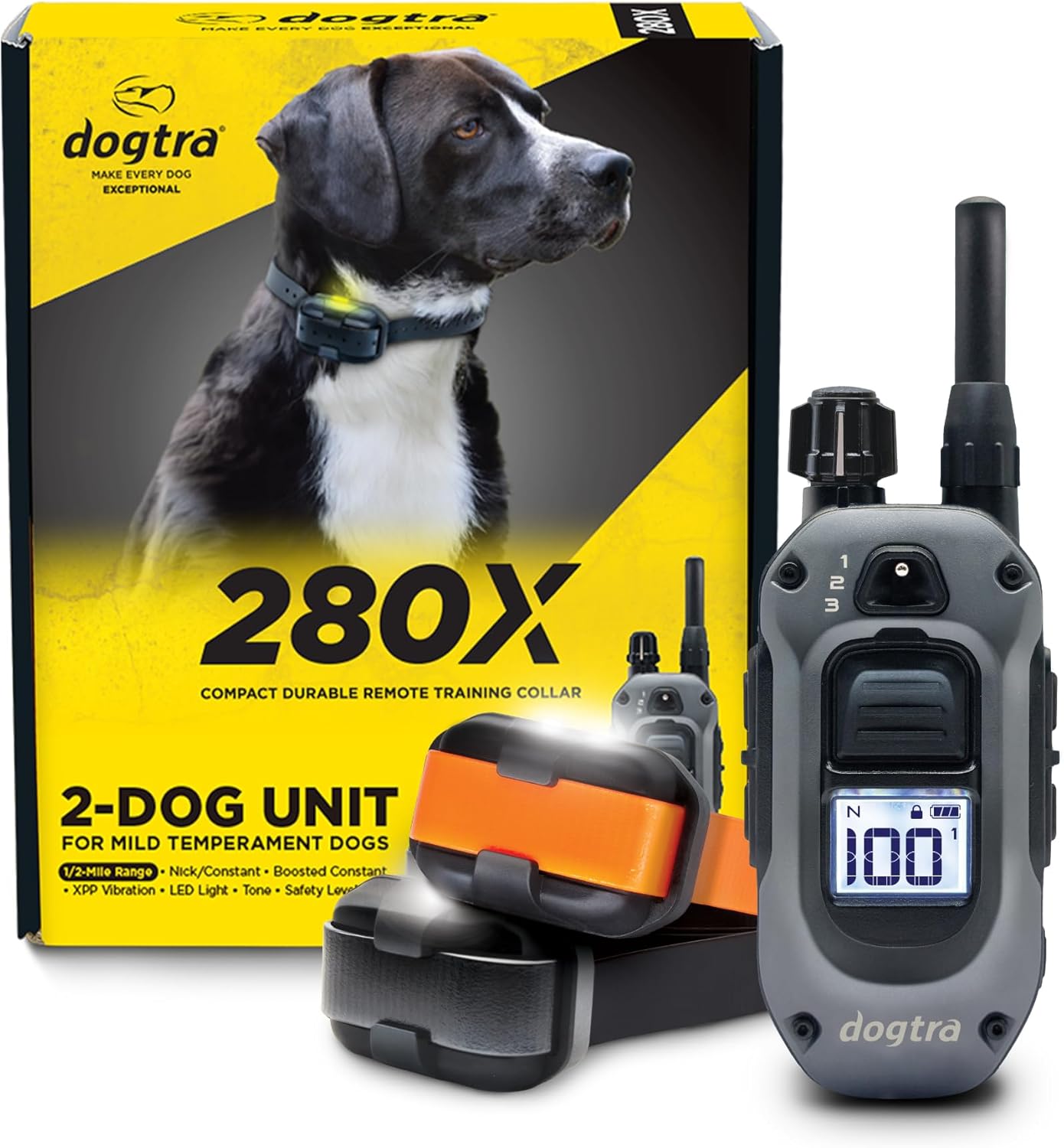
| Range | 1/2 Mile |
|---|---|
| Channels | 2-dog (expandable to 3) |
| Stimulation Levels | 100 levels |
| Modes | Static, Tone, XPP Vibration |
| Waterproof | Yes |
The Dogtra 280X is a rugged two-dog remote training system built for frequent outdoor use and progressive training plans. It pairs a single transmitter with two color-coded waterproof receivers and offers 100 discrete stimulation levels plus tone and XPP vibration so you can match corrections to a dog's sensitivity. The transmitter's large front button and BOOST feature let you deliver an instant higher-level correction for urgent recall without fumbling through menus, and the safety level lock reduces accidental activations. Expandability to a third receiver and a bright 1000-lux LED on the receiver make it practical for off-leash work and low-light sessions. Rechargeable receivers and removable contact points simplify maintenance and fit adjustments. Trade-offs are that the system is aimed at experienced trainers who can use fine-grained levels effectively and some buyers may prefer simpler single-button vibration/tone-only options for basic obedience; the unit also requires familiarization with settings before first use. For owners who plan regular off-leash training and need durable, precise control, the 280X delivers a professional-feel package.
Best for: Owners who want a durable, professional-grade two-dog system with long range and very fine control for regular off-leash or field training.
Less Ideal for: Casual pet owners seeking a minimal, entry-level trainer or those uncomfortable with learning detailed stimulation settings should consider simpler alternatives.
- Two-receiver kit lets you train two dogs from one transmitter
- Half-mile wireless range for wide-open or rural environments
- 100 stimulation levels plus tone and XPP vibration for precise, incremental corrections
- Waterproof, durable receivers with a 1000-lux LED for night visibility
- Front-mounted main button and BOOST provide fast access to corrections in urgent moments
- Complexity of 100 levels requires time to learn and dial in appropriate settings
- Designed for committed trainers rather than casual users preferring simple systems
Verdict: The best premium training collar is for owners willing to invest in advanced features, robust materials, and extra comfort for long-term training performance.
Choosing the Right Training Collar Two Dog: Key Factors to Consider
Independent Channel Control
When training two dogs you need a system that lets you address each dog independently. Independent channel control prevents accidental simultaneous corrections and lets you tailor timing and intensity to each dog's behavior and learning pace.
Without clearly separated channels you risk confusing the dogs or unintentionally reinforcing unwanted behaviors. Look for transmitters with distinct, labeled buttons and an obvious channel indicator so you can switch quickly mid-session without hesitation.
Range and Signal Reliability
Range determines how far apart you can work the dogs while still getting a reliable response. Signal reliability is equally important; intermittent dropouts or lag create inconsistent reinforcement and slow learning.
Consider realistic working distances for your usual training environment, whether a yard, park, or fields. Systems that advertise long ranges but lack real-world consistency are poor choices for two-dog work because a lost signal to either receiver breaks the session and can confuse both dogs.
Correction Modes and Safety Options
Multiple correction modes such as tone, vibration, and adjustable static allow you to use the least aversive effective method for each dog. Safety features like short-circuit protection, progressive stimulation, and auto-shutoff reduce the risk of overcorrection during longer sessions.
Dogs vary in sensitivity, so the ability to fine-tune levels and start with non-painful cues helps build reliable responses without stress. Systems that lock settings or lack visible level indicators make safe, repeatable training harder when working two dogs.
Receiver Fit and Collar Design
A well-fitted receiver keeps contact points aligned and prevents irritation that interferes with training. Consider receiver size, contact probe length, and available collar widths so the setup remains secure on different neck sizes and coat types.
Collar materials and fasteners should stand up to active dogs and be easy to adjust. Poorly fitting receivers can move, causing inconsistent contact and false triggers, which is especially problematic when managing two animals at once.
Battery Life and Charging Workflow
Long battery life and simple charging are particularly valuable when you maintain two collars. If each receiver needs frequent charging, you may find one dog out of service mid-training.
Prefer systems with multi-unit charging options, clear battery indicators, and realistic run-time claims. Fast charging or removable batteries can reduce downtime and keep both dogs available for planned sessions.
Ease of Use and Interface Clarity
Training two dogs requires quick, confident operation so your timing stays accurate. Controls should be intuitive, buttons distinct by feel, and receiver pairing straightforward to avoid confusion during sessions.
A clear, readable display or obvious tactile cues on the transmitter lets you confirm which dog you are addressing without looking down. Complicated menus or ambiguous button layouts increase the chance of operator error during fast-moving training moments.
How Do I Keep Signals and Corrections From Confusing Both Dogs?
Use distinct channel controls and consistent cues. Assign one channel per dog and always use the same button layout and hand position so your muscle memory aligns with the correct target. Begin sessions close to the dogs to establish the cue and reward pattern before increasing distance.
Also use different nonverbal cues during training—such as a colored leash or unique marker—so each dog learns which responses apply to them. If a system includes vibrate or tone modes, test those separately so dogs associate the right stimulus with the correct handler input.
- Start with low-intensity settings and verify response before raising levels.
- Practice switching channels while stationary to build confidence.
- Reward the targeted dog immediately after a correct response to avoid reinforcing the wrong animal.
What Are Safe Ways to Introduce Collars During Training?
Introduce collars gradually. Allow each dog to wear the receiver for short, supervised periods without activating corrections so they get used to the feel and weight. Pair wearing the collar with pleasant experiences such as play or treats.
When you begin using cues, start with warning signals like tones or vibration and pair them with rewards for correct behavior. Reserve higher-force corrections as a last resort and only after you have tried gentler methods and confirmed the receiver fit is correct.
- Check fit daily and inspect contact points for irritation.
- Use a marker and reward approach to associate signals with expected actions.
- Limit correction sessions to short, focused periods to avoid stress.
How Should I Manage Battery and Maintenance for Two Collars?
Establish a charging routine so both collars are ready when you train. Keep a visible battery-level plan so you know when a receiver needs charging and avoid training with a low battery that could fail mid-session. If the system supports simultaneous charging, use that to reduce downtime.
Regularly check for corrosion, loose contacts, and worn straps. Clean contact points according to the manufacturer's guidance and replace worn collars promptly to maintain consistent contact and signal integrity.
- Charge both receivers after heavier use days.
- Keep spare charging cables or a second charger in your training bag.
- Inspect collar fit and contact area every week during active training phases.
Can I Train Different Behaviors with Each Dog at the Same Time?
Yes. With separate channel control you can work on distinct behaviors concurrently, such as recall with one dog and leash manners with the other. Plan sessions so tasks do not conflict; for example, avoid teaching two dogs competing behaviors in the same physical space that could cause distraction.
Alternate short training drills and use clear cues so each dog understands when a command applies. Keep sessions short and focused to preserve attention across both animals and minimize crossover mistakes.
- Use concise, distinct verbal cues for different behaviors.
- Stagger repetitions to maintain high reward value for each dog.
- End sessions on a success for both dogs to reinforce progress.
What Features Most Reduce False Triggers and Accidental Corrections?
Look for transmitters with channel lock or confirmation steps before delivering stronger corrections. Progressive stimulation and momentary-only correction modes reduce the chance of unintended prolonged signals. Visible or tactile feedback on the transmitter helps you know when a signal was sent.
Also prioritize systems with good waterproofing and solid contact management. Moisture or loose probes can cause intermittent triggers that confuse training and undermine trust.
- Prefer systems with confirmation lights or sounds on transmit.
- Choose receivers with secure contact hardware to minimize movement.
- Use protective covers or position collars to limit exposure to mud and water when possible.
How We Chose the Best Training Collar Two Dog
We focused on features and performance that directly affect multi-dog training sessions. First, we prioritized collars and transmitters that support two simultaneous receivers with independent controls because the ability to address each dog separately is essential for predictable training. Second, we evaluated signal range and consistency to ensure reliable response at common working distances without frequent dropouts. Third, we considered adjustable stimulation or correction modes including vibration and tone, since multiple safe options reduce reliance on single correction types. Fourth, we looked at receiver fit and durability so collars remain comfortable and functional during repeated use. Fifth, battery life and charging convenience matter for two-dog households where simultaneous maintenance can be a hassle. We excluded units that only support single receivers, lack independent channel control, or have poor waterproofing and documented reliability issues. Our selections reflect products that satisfy those core requirements and perform consistently for paired training scenarios.
Our full evaluation process is outlined in our review methodology.
FAQ
Can I use one transmitter to control two collars at once?
Often you can. Many systems allow one transmitter to operate multiple receivers with independent channel selection. Confirm the unit supports separate channels and that you can switch quickly between dogs without menu delays.
Are vibration or tone modes effective alternatives to static correction?
Yes. Vibration and tone modes are useful non-painful cues that many dogs respond to, especially when paired with reward. They are good first options before using stronger corrections and are helpful for dogs sensitive to static stimulation.
How should I size the collars for different neck thicknesses?
Measure neck circumference and choose collars with appropriate adjustment ranges. Ensure contact probes still touch the skin on thicker coats and that the receiver does not rotate or chafe when the dog moves.
What range do I need when training two dogs together?
Range depends on your typical training environment. For yard-based work, moderate range is usually sufficient, but for open fields aim for longer reliable range. Prioritize consistent signal performance over advertised maximum distances.
How can I avoid confusing the dogs when working both at once?
Use clear, consistent cues, distinct channel assignment, and keep sessions short. Practice channel switching and keep rewards targeted so each dog knows when a command applies to them.
Final Verdict
Choosing a training collar system for two dogs is about predictable control and safety more than raw feature counts. Prioritize independent channel control, reliable signal range, and multiple humane correction modes so you can address each dog appropriately. Fit, battery life, and an intuitive transmitter layout reduce operator error and keep training sessions productive. Balance convenience against the specific needs of each dog: smaller, more sensitive dogs may need gentler cues while larger or higher-drive dogs might require different stimulation strategies. Focus on systems that let you tailor responses per dog and maintain regular maintenance and charging habits to avoid interruptions. With the right setup you can run efficient, low-stress training for both dogs at once.

