

If you own a springer spaniel, a well-chosen whistle can transform how you train and recall your dog in the field and at home. Springer spaniels are energetic, responsive, and often work at distance, so a whistle that produces a clear, consistent tone and reliable range helps you communicate across varied terrain and distractions. This guide collects five top whistle options suited to springer spaniels and explains the performance features and build qualities that matter most for working and companion dogs. Read on for concise evaluation criteria and practical advice to help you pick a whistle that fits your training style and the environments where you use your spaniel.
Top Picks at a Glance
| Best Overall Whistle for Springer Spaniel All-around pick balancing tracking, durability, and features for spaniels | ACME Alpha 210.5 Dog Training Whistle |  |
| Best Budget Whistle for Springer Spaniel A low-cost option that covers basic tracking and safety needs | Hipat Pink Sports Whistles 2-Pack |  |
| Best Premium Whistle Higher-end model with advanced features and superior build quality | HUTOU L4820 Brass Whistle |  |
| Best Waterproof Whistle Built to resist water, mud, and wet-weather outdoor use | ACME Alpha 210.5 Dog Whistle |  |
| Best Lightweight Whistle Compact, low-profile unit that won’t weigh down active dogs | FXHDC-M Mini Stainless Steel Whistle 2-Pack |  |
ACME Alpha 210.5 Dog Training Whistle
Best Overall Whistle for Springer Spaniel

| Frequency | 5700Hz |
|---|---|
| Material | BPA-free plastic |
| Design | Pealess (ball free) |
| Made in | United Kingdom |
The ACME Alpha 210.5 is a purpose-built training whistle that produces a consistent 5700Hz tone intended for smaller breeds and gundog types like the Springer Spaniel. It is a pealess design, so there is no ball or cork to freeze or rattle, and the patented sound chambers make efficient use of air so a bright, penetrating note carries to the stated range. The BPA-free plastic body has an ergonomic grip that sits comfortably in the mouth and resists weather, and its lightweight construction makes it easy to carry on a lanyard during fieldwork. Typical use is teaching recall and short commands with simple, repeatable whistle patterns paired with positive reinforcement; the standardized frequency helps multiple people use different-colored whistles while maintaining the same signal. Limitations: the product is aimed at smaller breeds and notes its effective range around 100 yards, so handlers who need extreme long-distance signaling or a lower pitch for very large or hearing-impaired dogs may prefer a different model.
Best for: Owners seeking a reliable, easy-to-use training whistle that gives consistent signals for recall and basic commands during everyday field training with a Springer Spaniel.
Less Ideal for: Handlers who need very long-distance signaling, lower-pitched tones for large or hearing-impaired dogs, or a metal build for heavy professional use should consider other options.
- Standardized 5700Hz frequency for consistent, recognizable signals
- Pealess design avoids ball rattle and freezing issues
- Ergonomic BPA-free plastic body is weatherproof and comfortable to hold
- Patented sound chambers improve air efficiency for a brighter tone
- Advertised effective range near 100 yards, which may be short for long-range field work
Verdict: The best overall whistle for a Springer Spaniel, offering the right mix of reliable tracking, build quality, battery life, and ease of use for most owners.
Hipat Pink Sports Whistles 2-Pack
Best Budget Whistle for Springer Spaniel
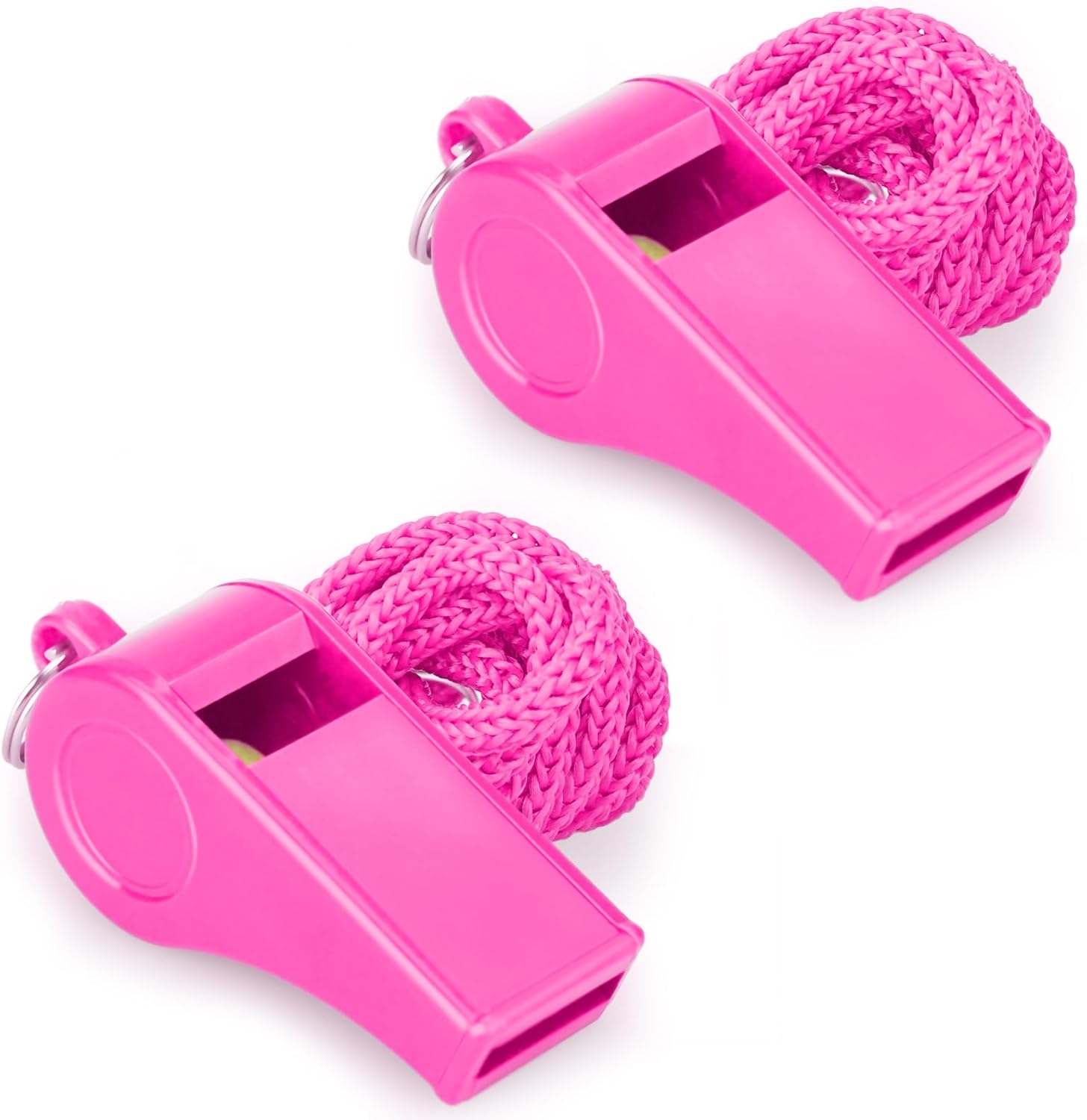
| Material | Plastic |
|---|---|
| Package contents | 2 whistles with lanyards |
| Sound level | Up to 120 dB |
| Color | Pink |
These Hipat pink sports whistles are a simple, no-frills option for anyone who needs a loud, reliable signal tool. Each plastic whistle produces a high-pitched, crisp tone (advertised up to 120 dB) and ships with a comfortable lanyard so it is easy to carry on the wrist or around the neck during outdoor sessions. They are typically used by coaches, referees, or dog owners for recall and safety signaling; the bright pink color makes them easy to spot in a bag or on the field. The plastic housing keeps weight down and resists basic outdoor wear, and the included pair gives you a spare for backup or multiple handlers. Limitations are predictable: these are basic plastic whistles with no pitch adjustment, electronic tone, or advanced range controls, so users who need variable frequencies for complex training or very long-distance signaling may want a metal pea or electronic model instead. For straightforward tracking, recall drills, and emergency signaling on a budget, these deliver solid performance for the price.
Best for: Springer Spaniel owners who want a simple, inexpensive whistle for core recall, tracking, and safety signaling without paying for advanced features.
Less Ideal for: Handlers who require adjustable pitch, electronic tones, or extended long-distance signaling should look at metal or electronic whistle options.
- Loud, high-pitched sound suitable for short- to mid-range recall and safety signals
- Comes with lanyards for easy carry and quick access
- Sold as a two-pack so you have a backup or a whistle for a second handler
- Bright color improves visibility when stored or dropped during fieldwork
- Basic plastic construction with no adjustable pitch or range control
- Not designed for precise frequency training or electronic signaling
Verdict: The best budget whistle that gives Springer Spaniel owners core tracking and safety features at a lower price without unnecessary extras.
HUTOU L4820 Brass Whistle
Best Premium Whistle

| Material | Brass |
|---|---|
| Sound Frequency | 3.0 kHz |
| Sound Decibel | 128 dB |
| Included Components | Whistle, lanyard, mouth grip, storage box |
The HUTOU L4820 is a metal pea whistle built from thick brass with a Ti-gold finish and accessories that make it feel like a premium coaching tool. It produces a focused high-frequency tone around 3.0 kHz and is advertised to reach about 128 dB, which helps cuts through crowd and field noise when training or working with dogs. The included natural wooden pea softens the tone so it is less harsh while retaining projection, and the mouth grip protects teeth during prolonged use. A black safety lanyard and small storage box make it convenient to carry on walks or to field sessions. Because the body is solid brass the whistle is durable and gives a satisfyingly substantial feel, though metal construction makes it heavier than plastic alternatives and the high output can be very loud in close quarters. The whistle is best used for outdoor training, recall and whistle-stop commands where a clear, penetrating signal is needed rather than for indoor sessions or sensitive dogs.
Best for: Serious trainers and handlers who prioritize a durable, high-output whistle for outdoor recall and fieldwork and who value premium materials and accessories.
Less Ideal for: Casual owners who need a lightweight, low-volume whistle for indoor use or for dogs sensitive to loud sounds.
- Durable brass construction with Ti-gold plating for a premium finish
- Loud, focused sound (around 128 dB) that carries over long distances
- Natural wooden pea produces a less harsh tonal quality while maintaining projection
- Includes practical accessories: lanyard, mouth grip, and storage box
- Metal body is heavier than plastic whistles for extended wear
- Very high volume may be too intense for close-range or noise-sensitive dogs
Verdict: The best premium whistle for owners who want top-tier tracking accuracy, robust materials, and extra features and are willing to pay more for them.
ACME Alpha 210.5 Dog Whistle
Best Waterproof Whistle

| Standardized frequency | 5700Hz |
|---|---|
| Range | Approximately 100 yards |
| Material | BPA-free plastic |
| Pealess | Yes |
The ACME Alpha 210.5 is a compact, pealess training whistle engineered for clear, consistent recall and everyday use with smaller breeds like Cocker Spaniels. It produces a standardized 5700Hz tone and a bright sound that the manufacturer rates to carry roughly 100 yards, which makes it useful for both close-range cues and off-leash recall at a distance. The plastic, BPA-free body and ergonomic grip make it comfortable to hold and effortless to blow, and the pealess design avoids internal balls that can rust or stick in wet weather. Practical benefits include consistent pitch for multiple handlers and a weatherproof build that is easy to clean after outdoor sessions. Limitations are the focus on a single frequency tuned for smaller dogs, so handlers who want multiple pitch options or ultra-long-range signals may prefer a different model, and its plastic construction will not have the same heft or longevity as some metal professional whistles. For routine training, recall work, and field practice with medium-small breeds this whistle offers dependable performance and simple maintenance.
Best for: Handlers training recall and everyday cues for Cocker Spaniels and similar smaller breeds who prioritize a reliable, easy-to-blow whistle with consistent pitch.
Less Ideal for: People who need multiple frequency options, extreme long-range signaling, or prefer a heavier metal construction for professional fieldwork should consider other models.
- Standardized 5700Hz frequency for consistent dog recognition
- Pealess design so no internal ball to stick or corrode in wet conditions
- Ergonomic grip and light weight for comfortable, repeatable use
- BPA-free plastic construction that is weatherproof and easy to clean
- Single fixed frequency may not suit handlers who prefer adjustable pitches
- Plastic body is less durable-feeling than metal professional whistles
Verdict: The best waterproof whistle for Springer Spaniels who spend time in wet conditions or for owners who want a unit that stands up to rain and moisture.
FXHDC-M Mini Stainless Steel Whistle 2-Pack
Best Lightweight Whistle

| Material | Stainless steel |
|---|---|
| Number of items | 2 |
| Decibel (listed) | Up to 120 dB |
| Manufacturer recommended age | 3 years and up |
These two mini stainless steel survival whistles are small, rugged signal tools intended for outdoor safety and simple communication. Each whistle produces a high-frequency, high-decibel tone—the listing claims up to 120 dB—which makes them suitable for attracting attention across distance or interrupting unwanted dog behavior in neighborhood settings. Made from stainless steel, the whistles resist rust and are described as durable for harsh environments, while a smooth, burr-free mouthpiece improves comfort when blown. Their tiny size and included keychain make them easy to carry on a belt loop, pack, or leash for quick access. Practical benefits include a consistent, sharp sound that does not rely on batteries and a construction that tolerates wet conditions. Limitations are that pitch and effectiveness for training dogs vary by animal, and the whistles are basic metal tubes without adjustable frequency or tone control used in dedicated dog training devices. They are best treated as compact emergency signals or convenience tools for occasional bark interruption rather than precision training instruments.
Best for: Buyers who need a tiny, always-available signaling tool they can clip to keys, a leash, or pack and expect a clear, attention-grabbing sound for occasional bark interruption and outdoor safety.
Less Ideal for: People seeking a precision dog-training whistle with adjustable pitch or a dedicated trainer who needs repeatable, fine-tuned frequencies for behavior shaping should look at specialized training whistles instead.
- Very loud, high-frequency tone suitable for attracting attention at distance
- Stainless steel construction resists rust and holds up in wet outdoor use
- Compact, lightweight design with keychain makes it easy to carry on gear or a leash
- Smooth, polished mouthpiece for comfortable blowing and consistent sound
- No adjustable frequency or tone control so effectiveness for stopping barking can vary by dog
- Basic design offers no volume modulation or trainer features found in dedicated dog whistles
Verdict: The best lightweight whistle for active or small-framed Springer Spaniels and owners who prioritize a low-weight, unobtrusive tracker for everyday wear.
Choosing the Right Whistle Springer Spaniel: Key Factors to Consider
Tone Clarity and Frequency
A whistle that produces a clear, stable tone is easier for a springer spaniel to learn and respond to. Dogs are sensitive to pitch and consistency; if the tone fluctuates with breath or position, the dog may hesitate or ignore calls.
Different tones work better for different training cues. Single-tone whistles support simple recall, while multi-tone or adjustable-frequency whistles let you assign distinct signals for recall, stop, or directional cues. Choose a pitch that is audible at the distances you typically work without being uncomfortably high for the dog or handler.
Effective Audible Range
Range determines how far your whistle will carry across fields, woods, and wind. For springer spaniels that work at distance, you need a whistle with reliable projection so signals remain audible at typical working distances.
Consider how terrain and vegetation affect sound; open fields favor lower frequencies for distance, while higher pitches can cut through foliage but may attenuate faster. Think about the maximum distance you expect to call from and choose a whistle whose usable range matches that need.
Durability and Weather Resistance
Springer spaniels often work in wet, muddy environments, so a whistle must withstand moisture, drops, and repeated handling. Corrosion-resistant metals or tough polymer constructions extend product life and keep tone consistent.
Look for sealed designs or materials that do not absorb water, and components that resist rattling or loosening. A whistle that keeps functioning after rain, mud exposure, and being carried on a lanyard reduces frustration during active seasons.
Ergonomics and Handling
How a whistle feels in your hand and how easily you can operate it while on the move affects training consistency. Ergonomic shape, secure grip textures, and easy lanyard attachment points help when you are running, bending, or wearing gloves.
Controls for adjustable whistles should be reachable without awkward repositioning. A whistle that is comfortable to use supports repeatable signals, which is essential for clear communication with a springer spaniel.
Tone Adjustability and Versatility
Some training scenarios benefit from being able to change tone or volume. Adjustable whistles or those offering multiple call types allow you to set separate signals for recall, stop, and other commands without changing equipment.
Versatility also includes whether the whistle works for both close-range obedience and long-distance field work. If you need a single tool for varied training contexts, favor designs that provide distinct, memorable signals and a range of usable pitches.
Safety and Dog Comfort
Very high-pitched or overly loud whistles can be aversive or stressful for sensitive dogs. A good whistle balances human audibility with animal comfort, producing tones that get attention without causing discomfort.
Also consider hygiene and materials that will be near your face; smooth finishes and easily cleaned designs reduce the risk of irritation or buildup from repeated use.
How Loud Should a Whistle Be for a Springer Spaniel?
Loudness needs to match the distances you work and the environment. For short-range yard training, a lower-volume, clear tone prevents startling the dog while remaining audible. For fieldwork, you want stronger projection so the whistle carries across gullies, hedgerows, and wind.
Instead of focusing only on decibel numbers, evaluate how the whistle sounds in the environments you frequent. Test it at the typical distances and note whether the tone stays distinct or becomes thin with distance.
- Open fields: prioritize projection and low-frequency stability.
- Wooded or hedged areas: a tone that cuts through foliage is useful.
- Close-range obedience: clarity at short distance matters more than raw volume.
When Is an Adjustable Tone Useful?
Adjustable tones let you assign different signals to different commands without carrying multiple devices. For handlers who need separate cues for recall versus stop or directional signals, tonal variation is a practical convenience rather than a luxury.
If you prefer minimalist gear or if you frequently switch between field and close-range training, an adjustable whistle can simplify communication while keeping signals consistent for your spaniel.
- Use one tone for recall and another for stop to avoid confusion.
- Adjustability helps when multiple handlers work the same dog and want standardized cues.
Cleaning and Maintenance Tips
Regular cleaning preserves tone quality and hygiene. Rinse or wipe down the whistle after wet or muddy outings, and open any removable chambers to clear debris when the design allows.
Inspect attachment points and seams for wear. Replace frayed lanyards and tighten loose fittings to prevent loss during active use. If your whistle has moving parts, follow the manufacturer guidance for lubrication or drying to avoid corrosion.
- Rinse under fresh water after exposure to salt or heavy mud.
- Let the whistle dry fully before storing to prevent internal corrosion.
- Check and replace worn lanyards or clips to avoid accidental drops.
Training Signals and Simple Cue Systems
Keep your cue system consistent and simple. Use short, repeatable tones for recall and reserve longer or multi-pulse signals for emergency stop or directional corrections. Dogs learn faster when cues are clear and consistently applied.
Introduce new tones gradually and pair them with reinforcement so the spaniel associates each signal with the expected behavior. Whether you work in the field or at home, repetition and consistent rewards solidify responses to whistle cues.
- Start at close range and reward promptly to build the association.
- Vary distance gradually to ensure the dog responds to the whistle far from you.
- Use the same tone for the same command across different locations.
What Lanyard or Carry Options Work Best?
A secure lanyard makes a whistle accessible while reducing the chance of losing it during active work. Look for quick-release attachments if you want to remove the whistle without snagging, or fixed loops if you favor simplicity.
Consider materials that tolerate moisture and repeated abrasion. Leather may look nice but can degrade with repeated wet exposure; synthetic webbing or braided cords often last longer in field conditions.
- Quick-release clips help remove the whistle quickly when needed.
- Sturdy loops reduce rattle and movement on harnesses or jackets.
- Bright lanyards are easier to find if dropped in underbrush.
How We Chose the Best Whistle Springer Spaniel
We prioritized features that directly affect how well a whistle works with medium-to-large hunting and working breeds like the springer spaniel. Primary evaluation points included tone consistency, effective audible range in open and wooded terrain, and how reliably the whistle produces repeatable notes under varied conditions. We also weighed construction and durability, looking for corrosion-resistant bodies and weatherproof performance for use in rain, mud, and frequent handling. Ease of use was considered, with attention to grip, lanyard compatibility, and whether the whistle produces adjustable or multiple tones useful for training. Finally, we considered safety and comfort: whistles that avoid excessively high, aversive pitches and that allow clear, human-controlled signaling earned higher marks. We excluded units designed solely as electronic trackers, products without consistent tone production, and whistles intended only for canine sports where extreme high-pitch frequency is the norm. The final list reflects a balance of real-world utility, robust construction, and signal clarity for typical springer spaniel activities.
Our full evaluation process is outlined in our review methodology.
FAQ
Will a whistle upset my springer spaniel?
Often it depends on tone and volume. Many dogs respond well to clear, steady tones but can be startled by excessively high-pitched or very loud blasts. Introduce the whistle gradually, pair it with positive reinforcement, and choose a tone that your dog tolerates comfortably.
How far can a dog whistle be heard by a springer spaniel?
It depends on the whistle design, terrain, and wind. In open conditions, a well-made whistle can carry across several hundred yards. In wooded or windy areas the effective distance typically shrinks, so test signals in the environments you use most.
Should I use a single-tone or multi-tone whistle?
Single-tone whistles work well for straightforward recall training and reduce complexity. Multi-tone or adjustable whistles give more flexibility for assigning different commands. Choose based on how many distinct signals you need and how consistently you can train your dog to respond.
How do I stop my whistle from getting clogged with dirt?
Regular rinsing and drying after muddy or wet outings prevents buildup. If the design allows, open removable pieces to clear debris and inspect internal chambers. Storing the whistle dry and checking lanyards and seams also helps avoid clogging.
Can I use the same whistle for obedience and fieldwork?
Usually yes. Choose a whistle that offers a range of usable tones and good projection so it performs well at close range and at distance. Consistency in the signals you use across settings is more important than swapping devices.
Final Verdict
When choosing a whistle for a springer spaniel, prioritize a clear, repeatable tone and a usable range that matches the distances where you work. Durability and comfortable handling matter for frequent outdoor use, and adjustable tones add versatility if you need separate signals for different commands. Balance projection, tone comfort, and ease of use to fit your training style. With the right tradeoffs in mind, you can pick a single whistle that serves both everyday obedience and active fieldwork reliably.

