

Installing an underground dog fence depends as much on the wire you choose as on the transmitter or collar. The right cable preserves signal integrity, resists corrosion and damage, and reduces the need for repairs after winter freezes or heavy yard work. This guide covers seven top-performing wires suitable for buried perimeter systems and explains the practical tradeoffs buyers face. We shortlisted durable, low-resistance conductors with solid insulation and common connector compatibility. Ahead you will find concise criteria we used to evaluate each option and clear guidance on what to prioritize for reliable containment and long-term value.
Top Picks at a Glance
| Best Overall Wire A reliable all-around underground fencing wire for most installations | eXtreme Dog Fence 16 Gauge Wire 1000 ft |  |
| Best Budget Wire A low-cost option that still meets basic underground fence needs | Extreme Dog Fence 20 Gauge Wire 500 ft |  |
| Best Premium Wire Higher-end wire with longer life and superior materials and finish | eXtreme Dog Fence 14 Gauge 1500 ft |  |
| Best Heavy-Gauge Wire Thicker-gauge wire for lower resistance and improved durability | eXtreme Dog Fence Max 14 Gauge 500ft | |
| Best Direct-Burial Wire Wire specifically designed to be buried without additional conduit protection | Extreme Dog Fence 1000ft Wire |  |
| Best Low-Resistance Wire High-conductivity wire for long runs and consistent signal strength | IWC2 Underground Pet Fence Wire 14 AWG |  |
| Best Preterminated Wire Wire pre-cut and fitted for faster, simpler fence system hookup | Tellegloww 150 ft Dog Fence Wire |  |
eXtreme Dog Fence 16 Gauge Wire 1000 ft
Best Overall Wire

| Gauge | 16 Gauge |
|---|---|
| Length | 1000 ft |
| Jacket | 30-mil polyethylene |
| Coverage | Up to 1 acre |
This 16 gauge, 1000 ft spool from eXtreme Dog Fence is a straightforward heavy-duty boundary cable for underground pet fence systems. The thicker 16 gauge conductor with a 30-mil polyethylene jacket is intended to resist UV and moisture, which helps the line last longer when buried or run along foundations. It is sold as a continuous spool sized to cover roughly one acre, and the product description states universal compatibility with wired electric dog fence transmitters and receivers, so it can be used to replace or extend existing buried loops. In practice the gauge and jacket make the wire easier to handle during installation and less likely to break when pulling around corners or through conduit, though it is heavier than thin hobby wire. There are no special connectors included in the listing, so plan to use standard splices or waterproof crimps for joins. If you want a durable, factory-quality replacement cable that reduces the chance of future repairs, this spool is a sensible choice for most yards and DIY installations.
Best for: Buyers who want a long, durable replacement or primary boundary cable that balances robustness and ease of installation for typical residential yards.
Less Ideal for: People needing ultra-flexible, lightweight wire for very intricate or temporary installations should consider thinner gauge options or specialty low-profile cable.
- 16 gauge conductor offers better durability and conductivity than thinner hobby wire
- 30-mil polyethylene jacket resists UV and moisture for longer buried lifespan
- 1000 ft continuous spool covers about one acre without joins
- Made in the USA components and marketed as universally compatible with wired systems
- Sturdier cable is easier to pull around corners and through conduit during installation
- Heavier, stiffer cable can be less convenient for very tight or complex layouts
- Listing does not specify included connectors or splice hardware
Verdict: The best overall wire balances durability, conductivity, and ease of installation to suit most underground dog-fence systems and typical yard conditions.
Extreme Dog Fence 20 Gauge Wire 500 ft
Best Budget Wire
| Gauge | 20 |
|---|---|
| Strands | 1 |
| Material Type | Polyethylene jacket |
| Unit Count | 1 Count |
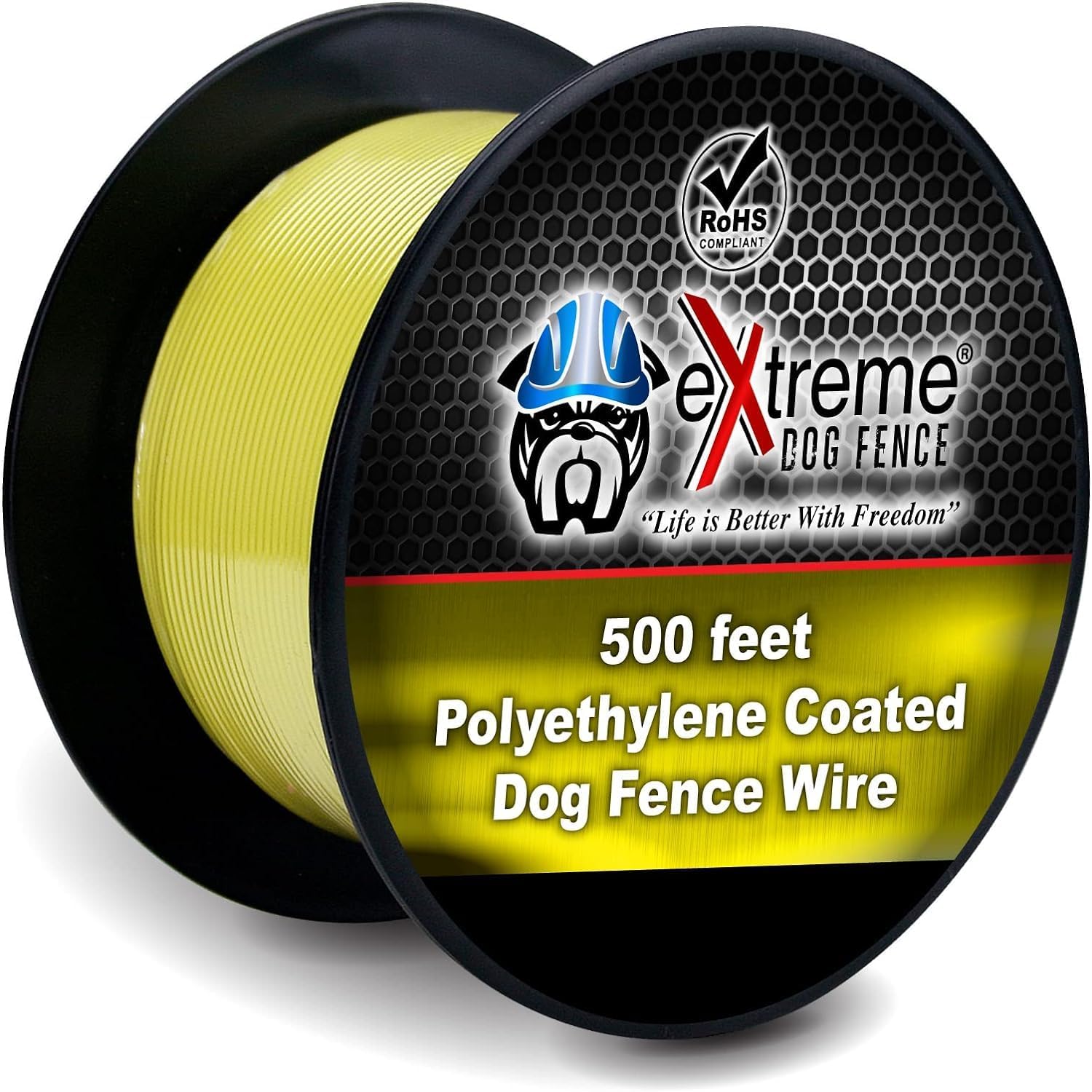
This 500-foot spool of 20 gauge underground dog-fence wire is a straightforward option for homeowners wiring or repairing a simple in-ground containment system. The solid-core copper conductor is covered with a polyethylene jacket rated for direct burial and UV exposure, so it withstands routine outdoor conditions and can be buried a few inches or stapled above ground for temporary runs. It is sold as a single continuous strand, which makes planning a one-acre or smaller layout easy without splices; the listing notes the spool will cover roughly one third of an acre. The wire is described as compatible with major brands of in-ground fences, so it will work with most transmitters and collars. Buyers should expect a basic, no-frills product: heavier duty 16 AWG options exist for extremely rocky or high-wear installations, and professional installers sometimes prefer thicker wire for long-term durability. For typical residential yards where cost matters, this wire offers acceptable conductivity and weather resistance for everyday containment use.
Best for: Buyers who prioritize low cost and a simple DIY installation for a typical residential yard and want a ready-to-install spool that works with common in-ground systems.
Less Ideal for: Users planning installations in extremely abrasive, rocky, or high-traffic areas or those seeking the most heavy-duty, long-term wire should choose a thicker gauge or professional-grade cable.
- 500-foot continuous spool suitable for covering a standard residential containment area
- Polyethylene insulation rated for direct burial and UV resistance
- Solid single-strand construction simplifies layout and reduces connection points
- Listed compatibility with major in-ground fence brands
- 20 AWG is thinner than some heavy-duty 16 AWG options and may wear faster in very rocky or high-traffic trenches
- Sold as a single strand so extensions require splicing or additional wire purchases
Verdict: The best budget wire is the most affordable choice that still provides acceptable durability and conductivity for homeowners installing a simple underground dog-fence on a budget.
eXtreme Dog Fence 14 Gauge 1500 ft
Best Premium Wire

| Gauge | 14 AWG |
|---|---|
| Jacket Thickness | 60 mil polyethylene |
| Length | 1500 ft |
| Core | Solid core |
| Manufactured | United States |
This is a heavy-duty 14 AWG solid-core wire with a 60 mil polyethylene jacket intended for buried or surface-run underground dog fence installations. It comes as a 1500 foot roll, long enough to cover roughly up to two acres depending on layout, and is built for durability in tough terrain and outdoor exposure. In practice the thick jacket makes the wire resistant to abrasion, moisture, and lawn equipment damage, which is important when you need a long-lasting boundary for strong or determined dogs. Because it is solid core and rated for burial it can also be stapled to existing fences or used for other low-voltage outdoor runs like robotic mower or landscape lighting circuits. The product is made in the United States and is presented as compatible with all common in-ground systems, which simplifies replacement and upgrades. The main limitations are that it is a raw roll of wire only, so buyers need to plan layout, connectors, and installation hardware themselves, and heavier gauge and thicker jacketing add stiffness that can make handling and splicing slightly more work on long runs.
Best for: Homeowners with large, strong, or highly motivated dogs who want a durable, long-lasting buried boundary and are prepared to handle a DIY installation and layout planning.
Less Ideal for: Buyers who prefer an all-in-one kit with transmitter, collars, and installation hardware included or those who need very flexible, lightweight wire for frequent reconfiguration.
- 60 mil high-density polyethylene jacket for strong abrasion and moisture resistance
- 14 gauge solid core provides robust conductivity and durability for heavy-duty containment
- 1500 ft roll covers up to about two acres, reducing the need for multiple spools
- Made in the United States and compatible with all common in-ground dog fence systems
- Can be used for other low-voltage outdoor applications such as robotic mowers or landscape lighting
- Sold as raw wire only so installation requires separate connectors, terminals, and planning
- Thicker jacket and solid core increase stiffness, making handling and splicing more work
Verdict: The best premium wire is for owners willing to pay more for thicker insulation, superior corrosion resistance, and longer expected service life in demanding environments.
eXtreme Dog Fence Max 14 Gauge 500ft
Best Heavy-Gauge Wire
| Gauge | 14 AWG |
|---|---|
| Length | 500 ft |
| Jacket Thickness | 60 mil polyethene |
| Material | Solid core conductor |
| Compatibility | Works with all in-ground dog fence systems |
This 14 gauge eXtreme Dog Fence Max wire is a heavy-duty roll intended for in-ground or above-ground perimeter installations. It comes as a continuous 500-foot spool with a thick 60 mil polyethylene jacket that improves abrasion and moisture resistance, and the solid core conductor gives lower resistance than thinner gauge wire for longer runs. Typical use is burying the wire around a yard, stapling it to an existing fence, or routing it above ground for temporary layouts; the insulation is rated for burial and outdoor exposure. The practical benefits are obvious: thicker conductor reduces voltage drop on extended loops, the robust jacket resists damage during installation and from soil movement, and the 500 ft length covers up to about one-third acre without splicing. Limitations are that a single 500 ft roll may not suit larger properties and the solid core is less flexible than stranded alternatives, making tight bends and frequent re-routing more difficult. It is explicitly marketed as compatible with common underground dog fence transmitters but does not include connectors or installation hardware in the roll itself.
Best for: Buyers who need a durable, lower-resistance feed wire for an underground dog fence installation and prioritize long run performance and mechanical strength.
Less Ideal for: Those planning many tight corners, frequent reconfigurations, or very large properties that require longer continuous runs without splices should consider more flexible or longer-length options.
- 14 AWG solid conductor reduces electrical resistance for longer runs
- 60 mil polyethylene jacket offers strong abrasion and moisture protection for burial
- 500 ft continuous roll is sufficient to fence roughly one-third acre without splices
- Made in the USA with heavy-duty construction suitable for rugged terrain
- Solid core is less flexible than stranded wire which can make tight routing harder
- Single-roll length may require splices for larger properties
Verdict: The best heavy-gauge wire is ideal for installations where lower electrical resistance, greater mechanical strength, and longer run lengths are priorities.
Extreme Dog Fence 1000ft Wire
Best Direct-Burial Wire

| Item Length | 1000 feet |
|---|---|
| Recommended Uses For Product | Underground electric dog fencing |
| Material | Metal |
| Grade Rating | Industrial |
This 1,000-foot spool of heavy duty direct-burial wire is designed to form the buried perimeter of an underground electric dog fence system. The polyethylene coating gives the cable extra protection from UV and moisture, so it holds up better than bare or lightly coated wire for long-term outdoor use. Installers use it to run a continuous loop around a yard without splicing, which simplifies layout and reduces connection points that can fail. The wire is described as industrial grade and compatible with any wired underground fence system, so it works with most transmitters and receiver collars. Practical benefits include a full acre of coverage per spool and reduced maintenance from the robust coating, but buyers should plan their route carefully because a single continuous spool means you will need to manage endpoints and connectors for tie-in to the transmitter. Also, this product is wire only, so you still need a compatible transmitter and collars to complete a working system.
Best for: Owners who need a durable, professional-grade buried perimeter wire for strong or persistent dogs and who are prepared to install a DIY underground fence system.
Less Ideal for: People looking for an all-in-one kit, a wireless solution, or those who do not want to handle burying and routing long cable runs.
- 1,000-foot continuous spool covers up to about 1 acre without splices
- Polyethylene coating resists UV and water for longer outdoor life
- Marketed as industrial/heavy duty for tougher installations
- Universally compatible with wired underground fence transmitters
- Wire only — requires a transmitter, receiver collars, and installation accessories
- Continuous spool means planning and handling a long run during installation
Verdict: The best direct-burial wire is formulated and insulated for long-term underground use so installers can bury it directly without extra conduit or frequent maintenance.
IWC2 Underground Pet Fence Wire 14 AWG
Best Low-Resistance Wire

| Gauge | 14 |
|---|---|
| Voltage | 75 volts |
| Wire Diameter | 0.05 inches |
| Material Type | Copper, HMWPE |
This 14 AWG solid bare copper wire is designed for buried pet containment loops and locating applications where low resistance and durability matter. The conductor is 100% solid copper, which keeps resistance low compared with stranded alternatives, and the heavy-wall HMWPE insulation is formulated for direct burial with good abrasion and environmental resistance. You would run this as the perimeter loop for an underground dog fence or as locating wire for long runs; the 1000 ft spool reduces joins and helps maintain consistent circuit resistance over extended lengths. The wire is rated for 75 C and 300 V and is RoHS compliant, and the heavier insulation wall improves mechanical protection when buried. Trade-offs are that solid wire is less flexible than stranded types so it is harder to route around tight corners and may be more susceptible to breakage if repeatedly flexed, and the product notes a Proposition 65 disclosure you should consider for local regulations.
Best for: Buyers installing long perimeter loops who prioritize minimizing voltage drop and want a durable, direct-burial factory-made wire to keep resistance low across extended runs.
Less Ideal for: People needing frequent reconfiguration, tight routing through conduit, or highly flexible cabling should consider stranded alternatives that are easier to handle.
- 100% solid copper conductor for lower DC resistance over long runs
- Heavy-wall HMWPE insulation formulated for direct burial and abrasion resistance
- Long 1000 ft length reduces number of splices and keeps loop resistance consistent
- Rated for 75 C and 300 V suitable for typical pet fence transmitters
- Solid single-strand construction is less flexible than stranded wire and harder to route around tight bends
- Manufacturer notes a Proposition 65 disclosure which may require local consideration
Verdict: The best low-resistance wire minimizes voltage drop over long distances, making it the right choice for large yards or installations with extended loop lengths.
Tellegloww 150 ft Dog Fence Wire
Best Preterminated Wire

| Length | 150 ft |
|---|---|
| Conductor | 16 AWG copper |
| Jacket | PVC, direct burial rated |
| Pair style | Pre-twisted neutral pair |
| Color | Black, Red |
This 150 ft pre-twisted dog fence wire is built from 16 AWG copper conductors with a black-and-red PVC jacket and is intended for underground pet containment systems. The pre-twisted pair saves time during installation by eliminating hand-twisting when running the neutral lead from the transmitter to the boundary loop, and the neutral twisted section can serve as a shock-free crossing for driveways and garden areas. The heavy 16 AWG conductors provide stable signal transmission across long runs, and the cable is marketed as direct burial and UV resistant so it stands up to soil moisture and routine lawn maintenance. It comes wound on a spool for neater handling during layout. Limitations to note are that this product is sold as bare wire rather than factory-fitted connectors or factory-terminated ends, so buyers who truly need preterminated connectors will need to add crimps or terminals on-site or choose a different product that ships with factory terminations.
Best for: Buyers who prioritize faster wiring layout and fewer on-site fiddly twists but are comfortable doing their own terminations or adding connectors during installation.
Less Ideal for: Do not choose this if you need a cable with factory-attached connectors or a fully preterminated assembly ready to plug in out of the box.
- Pre-twisted neutral pair speeds installation and reduces manual twisting time
- 16 AWG copper conductors for consistent signal over long runs
- Direct burial rated PVC jacket resists moisture and UV exposure
- 150 ft spool provides ample length for transmitter-to-loop runs and extensions
- Does not include factory-installed connectors or terminations
- Sold as bare cable so on-site splicing or terminals are required for final connections
Verdict: The best preterminated wire is for buyers who want a faster, easier installation with factory-made terminations or connectors that reduce on-site splicing and setup time.
Choosing the Right Wire Underground Dog Fence: Key Factors to Consider
Wire Gauge and Conductivity
Wire gauge directly affects how much signal is lost over long runs. Thicker conductors have lower electrical resistance, which helps maintain a reliable pulse from the transmitter to the entire boundary. For large properties or long perimeter loops, choosing a heavier gauge reduces voltage drop and preserves effective range.
Consider the expected run length when picking a gauge. Short runs can work fine with lighter gauge wire, but if you plan to run loops around a large yard, garages, or multiple zones, step up to a heavier gauge to keep the transmitter within its recommended load and to avoid weak spots along the loop.
Insulation Type and Durability
Insulation protects the conductor from moisture, abrasion, and root intrusion. Materials that resist cracking in cold weather and withstand repeated wet-dry cycles extend the life of a buried boundary. Look for jackets formulated for direct burial rather than indoor cord styles.
A robust outer jacket also makes installation less risky when you are hand-digging or using a trencher. Thicker insulation tolerates accidental rocks and shovel strikes better and reduces the chance of future shorts that could cause intermittent containment failures.
Single Vs. Double Conductor Options
Boundary loops typically use a single conductor run, but some installations benefit from twin conductor cable for connecting multiple zones or simplifying hookups to the transmitter. Double conductor cable combines two insulated wires in one jacket, which can speed installation and protect conductors from rubbing against each other.
Decide based on your system layout. Twin conductor cable is convenient for multi-zone installations or when running to remote transmitter locations, while single-conductor spools are flexible for custom loop configurations and repairs.
Corrosion and Moisture Resistance
Buried wiring is constantly exposed to moisture and soil chemistry that can corrode conductors and degrade insulation. Conductors plated to resist corrosion or made from corrosion-resistant alloys will maintain signal integrity longer. Likewise, jackets rated for wet locations and direct burial deter water wicking and shrinkage around the conductor.
Check for construction features that indicate water resistance such as bonded jackets, moisture-blocking core fills or sealants. These features reduce the risk of shorts and loss of conductivity over seasons.
Flexibility and Ease of Installation
Stiffer cable can make routing around landscape features and threading through conduit harder, while overly thin cable can tangle and be fragile during long runs. An ideal wire balances flexibility for installation with enough stiffness to lay neatly in a trench.
Also consider spool size and packaging that match how you intend to install. Smaller reels are easier to handle for short runs; large spools are convenient for complete property installs. Good labeling and clear conductor identification speed up connections at the transmitter.
Repairability and Connector Compatibility
Even well-installed wire can be damaged by digging or landscaping later. Choosing wire that is straightforward to splice and that accepts common connectors simplifies future repairs. Insulation that strips cleanly and conductors that solder or crimp reliably will reduce field headaches.
Evaluate whether the cable works with the terminal types on your transmitter and with standard waterproof splices. Ease of making a secure, weatherproof joint is an important factor for long-term reliability.
How Long Will Buried Fence Wire Typically Last?
Lifespan depends on conductor and jacket materials and on local soil and climate conditions. In well-drained soils with a good burial depth and proper insulation, expect many years of service. Poorly drained sites, frequent freeze-thaw cycles, or acidic soils accelerate deterioration.
Routine inspections of exposed terminal points and periodic testing of loop continuity are the best ways to detect early problems. When corrosion or jacket cracking appears, plan repairs before containment becomes unreliable.
- Shallow burial near the surface experiences more temperature extremes and potential for mechanical damage.
- Areas with heavy clay or standing water are higher risk for accelerated corrosion.
- Mechanical damage from digging is a common cause of failures even with durable wire.
Can I Run the Wire Under Driveways and Patios?
Running wire under hard surfaces is possible but requires proper installation to prevent future damage. Use conduit where feasible to protect the cable from pressure and movement and to allow future replacement without excavation.
If conduit is not an option, bury the wire deeper under driveways and patios and choose a jacket rated for abrasion and compression resistance. Keep a detailed map of buried runs so future work in the area avoids accidental cuts.
- Conduit creates a replaceable conduit path and protects against ground shift.
- Where conduit is impractical, deeper burial and robust jackets are the next best measures.
What Backup or Protective Measures Improve Reliability?
Simple precautions multiply longevity. Use tracer wire or mark the perimeter location with landscape markers so maintenance and future digging avoid accidental cuts. Installing loop testers or voltage monitors can warn you to weakening conductivity before a full failure occurs.
Consider using a split-rail or brightly visible temporary barrier during landscaping projects and communicate the cable location to anyone working on the yard. Regularly check exposed connections at the transmitter for corrosion and tighten terminals as needed.
- Label both ends of the loop at the transmitter for easy identification.
- Use waterproof heat-shrink or crimp-style splices for field repairs.
- Keep a record of where splices or repairs were made for future reference.
How to Estimate How Much Wire You Need
Measure the perimeter you intend to protect, accounting for gates, islands and any interior zones you plan to create. Add extra length for routing from the transmitter to the loop and for slack to reach terminals and make splices. A good rule of thumb is to add 10 to 20 percent more than the measured perimeter to cover routing and mistakes.
If using split or twin conductor cable, confirm whether the measurement counts single conductors or the combined jacket length. Purchasing in continuous runs reduces the number of splices and simplifies testing.
- Include the distance from the transmitter to the nearest loop point when calculating total required length.
- Plan for an access loop with extra slack at the transmitter to ease future repairs.
Should You Bury Wire at a Uniform Depth or Vary It?
Uniform depth simplifies installation and performance expectations. For most yards a burial depth of several inches is sufficient to prevent casual damage and preserve signal strength. In high-traffic areas, under driveways or near heavy equipment paths, increasing the depth or using conduit is wise.
Varying depth to avoid tree roots or rock may be necessary; when you deviate, protect the conductor with conduit or thicker jacket material. Keep notes of any deviations so future repairs are not surprised by atypical locations.
- Standard shallow burial is usually fine for lawns with minimal digging activity.
- Deeper burial or conduit should be used where mechanical stress is expected.
How We Chose the Best Wire Underground Dog Fence
We evaluated candidate wires using criteria that matter most for buried containment systems. Conductivity and wire gauge were primary filters because lower resistance improves signal strength and ensures consistent boundary coverage over long runs. Durable insulation and jacket construction were assessed for abrasion resistance and long-term burial, including performance against moisture, root pressure and temperature cycling. We also considered corrosion resistance of the conductor and the jacket, looking for materials and plating that limit signal degradation in wet soil. Ease of installation was factored in, including flexibility for trenching, availability of single- and double-conductor options, and compatibility with common connectors and splices. Finally, we reviewed longevity indicators such as UV-resistant outer sheaths for shallow burial and manufacturer specifications for burial depth when available. Excluded items included low-gauge lamp cord or indoor-only cables that lack burial ratings, as well as multi-conductor communication cables that are not intended for simple boundary loops. Our selections reflect wires that meet practical endurance, electrical, and installation needs for underground dog fence systems.
Our full evaluation process is outlined in our review methodology.
FAQ
What gauge wire is best for a large property perimeter?
For large perimeters a heavier gauge wire is usually better because it reduces voltage drop over long runs. Going up one or two gauge sizes relative to short-run recommendations improves signal consistency and reduces strain on the transmitter.
Can I reuse existing buried wire when upgrading my system?
Reusing existing wire is sometimes possible if the conductor and insulation are in good condition. Inspect for corrosion, nicks and brittle sections. If the jacket shows significant wear or the conductor continuity is unstable, replacing the run reduces the chance of intermittent failures.
How do I repair a cut in buried fence wire?
Excavate carefully to expose a clean section of the cut and trim back to solid conductor. Use waterproof crimp splices or solder joints with heat-shrink and waterproof sealing, then test loop continuity before reburial. Record the repair location for future reference.
Is special training required to install buried boundary wire?
No formal training is required for basic installations, but following best practices is important for safety and reliability. Read the system documentation, plan your route, use proper burial depth and protective measures, and test continuity as you go. For complex multi-zone installations or runs under hard surfaces, professional assistance can be helpful.
Will soil type affect which wire I should buy?
Yes, soil characteristics influence longevity. Wet, acidic or clay-heavy soils increase corrosion risk and can shorten jacket life. In such conditions choose cables with strong moisture resistance and consider additional sealing or conduit in problem areas.
Final Verdict
Choose wire for an underground dog fence by prioritizing the right gauge for your perimeter length, a durable jacket rated for burial, and conductor materials that resist corrosion. Think through installation details such as conduit under hard surfaces, slack for splices and tracer marking to avoid accidental damage. Balance flexibility for installation with long-term durability. When in doubt, a heavier-gauge, direct-burial-rated cable that accepts standard waterproof splices offers the most reliable path to consistent containment and fewer repairs over time.

