

If you need a solution that keeps two or more dogs safely contained without digging or running wire, a wireless fence can be a practical option. You want a system that maintains a stable signal around your yard, supports multiple collars, and offers customization so each dog gets the right level of correction. This guide shortlists the top wireless fence options for multiple-dog households and explains how they differ on the most important user-facing points. The selections focus on real-world usability: range and coverage, collar compatibility and number supported, plus battery life and ease of setup. Read on to see which features matter most and how to match a system to your yard and dogs.
Top Picks at a Glance
| Best Overall Wireless Fence The best all-around wireless fence for most multi-dog households | PetSafe Stay & Play Compact Wireless Fence |  |
| Best Budget Wireless Fence A low-cost wireless fence that covers essential containment features | DOGOITM Wireless Dog Fence GM08 |  |
| Best Premium Wireless Fence A higher-end system with advanced features and stronger components | Halo Collar 5 Wireless Dog Fence |  |
| Best Long-Range Wireless Fence Designed for larger yards and extended coverage without wired boundaries | Htcuto X3 Wireless Dog Fence |  |
| Best Multi-Dog Wireless Fence Supports several receivers and configurable settings for multiple pets | BNDHDEH Wireless Dog Fence for 4 Dogs |  |
PetSafe Stay & Play Compact Wireless Fence
Best Overall Wireless Fence

| Coverage | Up to 3/4 acre (22–105 ft radius) |
|---|---|
| Receiver fit range | Fits necks 6–28 in; dogs 5 lb and up |
| Power | Transmitter plugs into indoor outlet; collar rechargeable (2–3 hr charge) |
| Collar features | Waterproof, tone plus adjustable static correction levels (1–6) |
The PetSafe Stay & Play Compact Wireless Fence sets up quickly using an indoor transmitter to create an adjustable circular boundary up to 3/4 acre without digging or buried wire. You plug the transmitter into an indoor outlet, set the radius on the LCD, and train dogs with the included waterproof, rechargeable receiver collar that charges in 2–3 hours and can last up to three weeks per charge. The system is portable for travel or RV use and supports adding extra collars so multiple dogs can share the same transmitter. Notable features include an LCD that shows radius and warnings, tone plus adjustable static correction levels on the collar, and visual training flags to speed learning. Limitations are the circular-only boundary shape and the need to place the transmitter indoors away from large metal objects to avoid range reduction; covering larger or irregular yards requires a second transmitter or a different system. For households wanting a no-dig, easy-to-move solution that can contain more than one dog, this system delivers practical containment with simple setup and long collar runtimes.
Best for: Owners with two or more dogs who want a portable, no-dig containment solution that can be expanded with extra collars and tuned per collar during training.
Less Ideal for: Homes that need a rectangular or highly customized boundary or very large properties where a single circular transmitter cannot cover the usable area.
- Quick, no-dig setup with adjustable circular boundary up to 3/4 acre
- Rechargeable waterproof receiver with long runtime and fast 2–3 hour charge
- LCD transmitter that displays radius and warning indicators for easier setup
- Expandable to contain multiple dogs by purchasing additional receiver collars
- Portable design suitable for travel, RVs, and temporary installations
- Boundary is circular only so it cannot match irregular yard shapes
- Transmitter must be kept indoors and away from metal which can reduce effective range
Verdict: The best overall wireless fence balances reliable boundary performance, ease of setup, and multi-dog support for everyday pet containment needs.
DOGOITM Wireless Dog Fence GM08
Best Budget Wireless Fence
| Model | GM08 |
|---|---|
| Adjustable range | 65–3,290 ft radius |
| Correction modes | Beep, vibration, shock |
| Battery | Rechargeable, 50+ hours claimed |
| Water resistance | IPX6 |
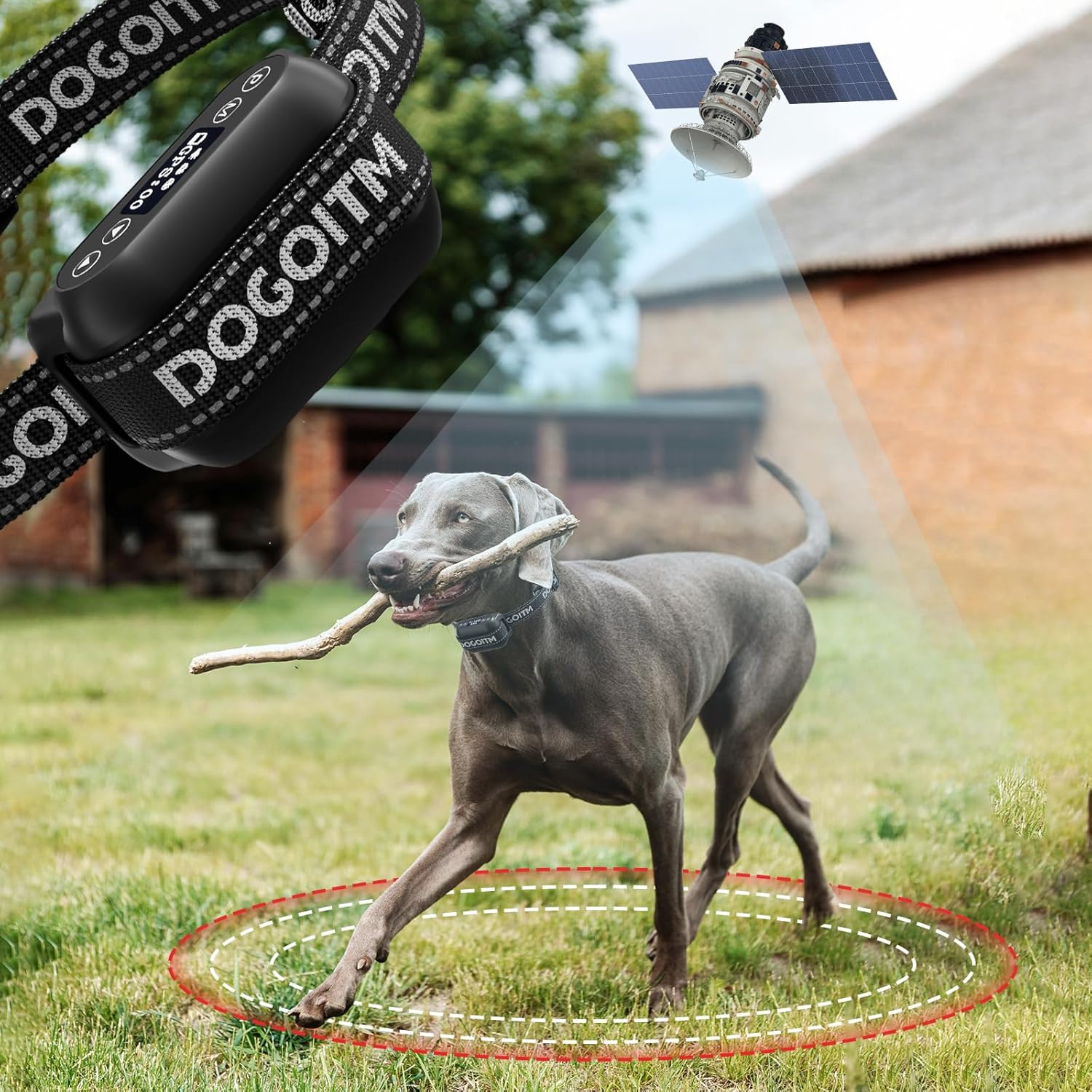
The DOGOITM GM08 is a GPS wireless containment system that creates an adjustable invisible boundary (65 to 3,290 ft radius) and corrects a dog with beep, vibration, or static stimulation when it crosses the set limit. Setup is simple because there is no buried wire, no app or subscription, and the boundary is changed in 10 ft steps from the base unit. The collar is rechargeable and rated IPX6 for water resistance, and the manufacturer claims 50+ hours per charge, making it usable for several days between charges. Practical benefits include rapid installation for yards larger than about 0.3 acre, a compact collar with multiple contact points and silicone covers, and a U-BLOX GPS chipset that reduces interference. Limits to expect are typical of GPS systems: boundary accuracy can vary with satellite reception and is not suitable for very small yards, and static correction requires careful adjustment and training to be effective and humane. The package is designed for one or two dogs depending on the variant and is labeled not for small dogs, so confirm fit and weight recommendations before buying.
Best for: Buyers who want an inexpensive, easy-to-install outdoor containment system that delivers basic, dependable boundary control without wiring or subscriptions.
Less Ideal for: Owners needing pinpoint, wire-style precision for small yards or those who prefer app-driven, feature-rich systems with advanced geofencing controls.
- Wide adjustable GPS radius from 65 to 3,290 ft to match different yard sizes
- Three correction modes (beep, vibration, shock) with adjustable intensity for flexible training
- Rechargeable collar with claimed 50+ hour runtime reduces battery replacement
- IPX6 water resistance suitable for rainy or wet outdoor use
- No buried wire, app, or subscription required so setup is fast and low-maintenance
- Not intended for very small yards under about 0.3 acre where GPS gating is less reliable
- GPS-based boundaries can shift with poor satellite reception or local interference
- Product notes advise it is not for small dogs which limits very small-breed use
Verdict: The best budget wireless fence provides basic, dependable boundary control and minimal extras for owners who need affordable containment for one or more dogs.
Halo Collar 5 Wireless Dog Fence
Best Premium Wireless Fence

| Batteries | 1 Lithium Ion battery required (included) |
|---|---|
| Material Type | Waterproof Housing (IP67) |
| Included Components | Contact Tips, Halo Collar 5, Magnetic Charger, Perfect Fit Kit, Pro Case + Strap |
| Breed Recommendation | Sporting, Herding, Working, Hound, Non-sporting, Terrier (Over 10 lbs) |
| Activity Tracking | Included |
The Halo Collar 5 is a premium GPS wireless fence system built to keep dogs contained without digging or buried wires. You create virtual fences in the Halo app and the collar provides layered feedback—sound, vibration, and optional static—while sending instant alerts and real-time location so you can track a dog that leaves the boundary. The unit emphasizes accuracy with dual-frequency Precision+ GPS, AI drift prevention, and frequent position updates for tighter containment in large yards and rural areas. It also includes activity tracking and guided training content to help dogs learn the boundaries. Practical benefits include fast setup, no-property-modification containment, and robust tracking on wide-open or remote properties. Important limitations are the required subscription to enable GPS, fence, and cellular features and the need for nightly charging to maintain optimal performance, which may be inconvenient for some owners. Expect strong build quality and advanced safety features, but plan for ongoing subscription and charging needs.
Best for: Owners who prioritize a factory-quality, high-accuracy containment system with professional-level safety features for large yards or rural properties and who are willing to maintain a subscription and charging routine.
Less Ideal for: People seeking a one-time purchase without ongoing fees or those who cannot commit to nightly charging and app-based management.
- Dual-frequency Precision+ GPS with AI drift prevention for high location accuracy
- Real-time tracking and instant alerts when a dog approaches or crosses boundaries
- Multiple feedback modes (sound, vibration, optional static) plus guided training
- No wires or installation required, suitable for large yards and remote properties
- Waterproof housing (IP67) and included fitting accessories for durable everyday use
- Subscription required to activate GPS, fence, and cellular features
- Requires nightly charging for best performance
Verdict: The best premium wireless fence is for owners willing to pay more for superior range options, build quality, feature-rich receivers, and longer-lasting components.
Htcuto X3 Wireless Dog Fence
Best Long-Range Wireless Fence

| Containment range | Up to 3,500 ft |
|---|---|
| Remote range | Up to 6,100 ft |
| Correction modes | Beep, vibration, static stimulation |
| Water resistance | IPX7 |
| Battery life (receiver) | Up to 85 hours working / 185 days standby |
The Htcuto X3 combines a wireless containment transmitter with two rechargeable receiver collars and a remote for on‑the‑go training. You set a circular boundary up to 3,500 ft and the collar gives a warning then correction when a dog nears the perimeter, and the included remote reaches up to 6,100 ft for reinforcing recall or commands at distance. The system offers three correction modes — audible beep, multiple vibration levels, and adjustable static stimulation — and 14 fence intensity levels so you can tune the boundary sensitivity for a timid small dog or a more stubborn pet. Practical features include IPX7 waterproof receivers for wet conditions, a keypad lock to avoid accidental signals, an LED flashlight for low‑light use, and long receiver standby life. Setup is quick and portable for yards, parks, and campsites, but the circular boundary is best suited to open areas and may not match odd-shaped property lines without manual placement work. Battery runtime is solid for outings but plan regular recharges for heavy daily use.
Best for: Buyers who need a portable, finely adjustable containment system to dial in a precise roaming radius for small to medium dogs and who plan to supervise training while using the remote.
Less Ideal for: Owners who require a fence that conforms to irregular property boundaries or who prefer a physical or buried‑wire perimeter solution.
- Adjustable containment radius up to 3,500 ft with 14 intensity levels for precise boundary tuning
- Includes two rechargeable receiver collars plus a long‑range remote with a 6,100 ft range
- Three correction modes (beep, multiple vibration levels, up to 30 static levels) to match dog temperament
- IPX7 waterproof receivers and LED light for use in wet or low‑light conditions
- Keypad lock and long standby life increase safety and convenience
- Circular wireless boundary cannot be shaped to match irregular property lines without repositioning the transmitter
- Static correction may be unsuitable for very small or sensitive dogs without careful testing
Verdict: The best long-range wireless fence offers expanded signal radius and consistent boundary integrity for properties that need broader outdoor coverage.
BNDHDEH Wireless Dog Fence for 4 Dogs
Best Multi-Dog Wireless Fence

| Suitable dog weight | 15 – 120 LBS |
|---|---|
| Receiver battery | 3.7V 500MAH |
| Transmitter battery | 3.7V 2500mah |
| Stimulation levels | 0 – 9 adjustable |
| Waterproof rating | IP65 |
This is a two-in-one wireless fence and remote training collar designed to contain and train up to four dogs without buried wiring. The transmitter creates an adjustable boundary and pairs with up to four rechargeable receiver collars; each receiver offers nine adjustable levels across sound, vibration, and static stimulation so you can tailor corrections for different dog sizes and temperaments. The transmitter uses a 2.4GHz signal and a color display for simpler setup and mode switching between fence and remote training. In practice the system is convenient for multi-dog households because collars are rechargeable, waterproof to IP65, and the unit includes spare silicone posts and test lights for setup. Important limitations are that usable range is listed as 8 to 350 meters and stimulation sequencing is automatic when a dog crosses the boundary, which may require careful level testing and supervision for particularly sensitive pets. The system is best used as a remote-containment and training aid with adult supervision and gradual conditioning rather than a substitute for supervision or physical barriers.
Best for: Owners who need a single system to contain and train several dogs with different sensitivity levels and want independent, adjustable corrections per collar.
Less Ideal for: People seeking a buried-wire perimeter or unlimited long-range containment for very large acreage should consider other containment methods.
- Supports up to four receiver collars for multiple dogs
- Nine adjustable levels across sound, vibration, and shock for tailored training
- Rechargeable transmitter and receivers with relatively short charge times
- IP65 waterproof receivers allow use in wet conditions
- 2.4GHz signal and color display simplify setup and mode switching
- Maximum stated controllable range tops out at 350 meters which may be limiting for very large properties
- Automatic correction sequencing when a dog crosses the boundary requires careful level testing and monitoring
Verdict: The best multi-dog wireless fence accommodates multiple collars with independent settings so owners can safely contain several dogs with different size or temperament needs.
Choosing the Right Wireless Dog Fence Multiple Dog: Key Factors to Consider
Coverage and Range
Range determines how large an area a single transmitter can cover and how much yard you can include without altering the system. For households with multiple dogs you will likely need a signal that holds a uniform perimeter at the distances your pets use most. Signal shape is also relevant: some transmitters emit a near-circular field while others can be adjusted to better match rectangular lots.
Consider obstacles that might affect signal strength, such as dense trees, metal structures, or tall landscaping. Those features can create weak spots where a collar may fail to detect the boundary consistently. For multiple dogs that explore different parts of the yard, aim for a transmitter and placement that provide overlap and stable reception throughout the area each dog frequents.
Number of Collars Supported and Expandability
Check how many receiver collars a system supports out of the box and whether additional collars can be added later. Multi-dog households need enough collars to cover every dog, plus spares for replacements or temporary use. Some systems charge extra for additional receivers or limit the total number supported, which affects long-term flexibility.
Also confirm whether each collar can be programmed independently. The ability to set different correction levels and training modes per collar is important when dogs vary in size, temperament, or training history. Independent settings let you give a shy small dog gentler cues while keeping a more stubborn dog contained with firmer feedback.
Adjustable Correction and Training Options
Correction modes and adjustability determine how humane and effective the system will be for different dogs. Look for multiple stimulation levels and at least one non-shock option such as tone or vibration. Progressive correction that increases with repeated boundary approaches can reduce false triggers and give dogs a chance to respond to gentler cues.
Training features like test modes, boundary warning beeps, and compatibility with visual or flag markers make it easier to teach multiple dogs the limits of the yard. When handling several dogs at once, clear, repeatable training signals speed learning and reduce confusion between animals.
Collar Fit, Size, and Battery Life
Collar fit matters for both comfort and reliable detection. Ensure the receiver collar sizes accommodate the smallest and largest dogs in your household and that contact points maintain consistent skin contact without causing chafing. Removable or adjustable straps help tailor fit across a range of neck circumferences.
Battery type affects maintenance: rechargeable collars are convenient for frequent use but require charging rotation, while replaceable batteries can be swapped quickly but add recurring purchases. Consider expected run time per charge or per battery and whether the system supports low-battery alerts so you do not lose containment unexpectedly.
Installation, Placement, and Yard Suitability
Wireless systems are often advertised as simple to set up, but placement of the transmitter and any orientation controls strongly affects performance. A central, elevated transmitter tends to produce the most uniform field. For multi-dog yards with irregular shapes, planning the transmitter location and testing the perimeter before training will save time.
Some yards may have known interference sources that require moving the transmitter or adjusting range. Pay attention to manufacturer guidance on placement relative to metal sheds, underground utilities, or other electronics. A practical installation plan reduces blind spots and helps all dogs learn the boundary quickly.
Durability and Weather Resistance
Receiver collars will be exposed to dirt, moisture, and rough play, so look for water resistance and rugged construction. Durable collars reduce the likelihood of failure from field use and minimize downtime in multi-dog homes. Transmitters should also have basic weather protection if they will be used outdoors or placed in an unconditioned area.
Consider warranty coverage and available replacement parts. With multiple dogs, the wear rate is higher, so units designed for tougher use or with easily replaceable straps and contacts will be more practical in the long run.
How Do I Size a Wireless Boundary for an Irregular Yard?
Start by identifying the area you want to include and any exclusion zones. Measure from the proposed transmitter location to the farthest points you need covered and compare that to the system's maximum range. If the yard is long and narrow, center placement may produce significant spillover; in those cases plan for a reduced radius and accept that some peripheral space will be outside the field.
Walk the perimeter with a test collar or a boundary tester if available to mark where the signal weakens. Use temporary flags during training so dogs can associate the visual cue with the boundary. If a single transmitter cannot cover the desired area cleanly, consider whether rearranging usage patterns or restricting certain areas is a better solution than trying to force coverage beyond the system's intended limits.
- Measure before you buy and after placing the transmitter
- Use flags or markers to teach dogs the limits
- Avoid transmitter placement near large metal objects
What Training Approach Works Best for Multiple Dogs?
Train dogs individually at first so each animal can focus on learning the boundary without distractions. Use short, consistent sessions and reward successful behavior. Once each dog reliably responds to warning tones or vibration, begin supervised group sessions so they learn to respect the boundary with other dogs present.
Maintain consistent commands and signals. Because dogs can influence one another, reinforce training frequently and watch for social facilitation where an untrained dog follows a trained dog past the boundary. If that happens, return to more one-on-one sessions with the problem dog until it is reliable.
- Start single-dog sessions, then progress to group practice
- Use clear rewards and consistent cues for each dog
- Supervise initial group outings until behavior is stable
How to Manage Collars and Battery Rotations for Several Dogs
Establish a simple charging or replacement routine so at least one collar is always charged and ready. For rechargeable systems, stagger charging times across dogs to avoid simultaneous downtime. For replaceable batteries, keep a small stock of fresh batteries and check levels regularly using the system's low-battery indicators.
Label collars if you have multiple receivers so you can match each to its dog and settings easily. Regularly inspect contact points and straps for wear and replace components proactively to prevent failures during outdoor time.
- Stagger charging or battery replacement to ensure continuous coverage
- Label and maintain collars to match settings per dog
- Inspect contact points weekly during heavy use seasons
What if One Dog Is More Escape-prone than the Others?
Assign that dog the most reliable collar and the most conservative settings that still ensure a clear deterrent. Use the system's higher correction levels only after the dog has had adequate training and lower-level cues have proven ineffective. Combine the wireless fence with behavioral strategies: reinforce recall, reduce opportunities for unsupervised boundary testing, and consider temporary supervised time outdoors while retraining.
If a dog repeatedly tests the boundary, increase supervision and revisit individual training sessions. Sometimes adjustments to collar fit, contact point placement, or collar sensitivity can resolve erratic behavior without raising correction intensity.
- Give the escape-prone dog the best-fit collar and individualized settings
- Increase supervision and training frequency for that dog
- Adjust collar contact points and sensitivity before increasing correction intensity
Maintenance Tips to Keep a Multi-dog System Reliable
Create a simple checklist for weekly and monthly checks: battery status, strap condition, contact cleanliness, and transmitter placement. Clean contacts with a soft brush or cloth and replace straps that show heavy wear. Keep a log of battery changes so you can spot trends in runtime and anticipate replacements.
Test the boundary periodically, especially after storms or property changes that could affect signal. Re-run training with newly introduced dogs and revisit settings when a dog's weight or coat condition changes significantly, since those factors can affect collar contact reliability.
- Weekly battery and strap checks, monthly deeper inspections
- Clean contact points to maintain reliable detection
- Retest boundaries after major yard changes or weather events
How We Chose the Best Wireless Dog Fence Multiple Dog
We prioritized systems that are proven to support more than one receiver collar reliably and that let owners tailor containment settings per dog. Our evaluation emphasized practical performance over marketing claims, focusing on measurable items a buyer can verify before and after installation. Key criteria included signal range and consistency around typical yard shapes, the maximum number of collars supported and whether each collar is adjustable independently, collar battery type and runtime, and the quality of boundary indicators such as visual markers or test modes. We also considered ease of setup and ongoing maintenance because multi-dog households benefit from straightforward operation. We excluded systems that require extensive permanent wiring or that only support a single collar without documented upgrade paths. We also filtered out units lacking clear instructions or that depend on proprietary accessories that limit expandability. The result is a shortlist of practical wireless fence options that balance coverage, multi-collar support, and day-to-day reliability.
Our full evaluation process is outlined in our review methodology.
FAQ
Can one transmitter reliably control more than one collar?
Often yes. Many wireless systems are designed to support multiple receiver collars from a single transmitter, but performance depends on the unit's maximum supported number of collars and whether each collar can be configured independently. Confirm the collar limit and test signal uniformity across the yard before committing.
Will a thick coat or small neck affect collar performance?
Yes. Thick coats and small neck sizes can prevent consistent contact between the electrodes and the skin. Trim a small area under the collar contact or use adjustable contact lengths to ensure reliable detection. Check fit regularly as dogs gain or lose weight.
Are vibration or tone-only modes adequate for training multiple dogs?
For many dogs, vibration or tone combined with consistent training is sufficient. However, some dogs may require stronger stimuli to respect the boundary. Start with non-physical cues and only consider stronger correction after appropriate training and fit adjustments.
How do I troubleshoot inconsistent boundary detection?
First verify transmitter placement and that there are no nearby interference sources like large metal structures. Walk the perimeter with a test collar to map weak spots, then adjust transmitter location or reduce range to eliminate blind areas. Also inspect collar contacts and batteries for proper function.
Can I use different collar models with the same transmitter?
Compatibility varies by system. Some manufacturers design their transmitters to work only with their own receivers, while others allow add-on collars. Confirm compatibility and whether additional collars require specific programming before assuming cross-compatibility.
Final Verdict
For households with more than one dog, prioritize systems that offer stable coverage, enough collars with independent settings, and easy maintenance. The tradeoffs are usually between coverage radius and signal uniformity, so match the transmitter placement and range to your yard shape rather than forcing coverage beyond the unit's capability. Focus on collar fit, battery management, and staggered training to keep all dogs safe and comfortable. A well-planned installation and consistent training routine will make multi-dog containment reliable without constant intervention.

