

If you want to give your dog more freedom without losing control, a wireless electric dog fence system can be a practical solution. The right system keeps pets safely inside a defined boundary, reduces the chance of accidental escapes, and makes everyday outdoor time calmer for both you and your dog. This guide shortlists the top wireless electric fence systems and explains the evaluation criteria we used, including range, signal stability, collar battery life, and ease of setup. Read on for straightforward guidance to match a system to your yard size, your dog's temperament, and your maintenance preferences.
Top Picks at a Glance
| Best Overall Wireless Electric Fence System The best all-around wireless electric fence that suits most homes | PetSafe Stay & Play Wireless Fence |  |
| Best Budget Wireless Electric Fence System A low-cost system that provides basic reliable containment features | DOGOITM Wireless Dog Fence GM08 |  |
| Best Long-Range Wireless Electric Fence System Higher maximum coverage for larger yards and sprawling properties | FOCUSER GPS Wireless Dog Fence |  |
| Best Compact Wireless Electric Fence System Smaller, space-saving units that are easy to store and transport | PetSafe Stay & Play Compact Wireless Fence |  |
| Best Heavy-Duty Wireless Electric Fence System Robust build and components designed to handle strong or persistent pets | MIMOFPET Wireless Dog Fence X3 |  |
| Best Premium Wireless Electric Fence System Higher-end features, durability, and performance for demanding users | Halo Collar 5 |  |
PetSafe Stay & Play Wireless Fence
Best Overall Wireless Electric Fence System

| Boundary coverage | Up to 3/4 acre |
|---|---|
| Correction levels | 5 adjustable levels + tone-only |
| Receiver fit | Fits necks 6-28 inches |
| Battery type | Replaceable 6-Volt (RFA-67D-11) |
The PetSafe Stay & Play Wireless Fence provides a no-dig, collar-based containment solution that sets up quickly by plugging the transmitter into an indoor outlet and adjusting the radius to create a circular boundary up to 3/4 acre. It is typically used to give dogs supervised outdoor freedom at home or when traveling with RVs and cabins; training flags and a test light tool are included to guide the dog through short training sessions. The waterproof receiver collar offers adjustable static correction with five intensities plus a tone-only option, and the replaceable 6-Volt battery can last up to about two months depending on use. Practical benefits include portability, simple installation without burying wire, and the ability to add extra collars for multiple dogs. Important limitations are the fixed circular boundary shape that cannot be customized into rectangles, the need to place the transmitter indoors in a climate-controlled location, and reliance on replaceable batteries rather than a rechargeable receiver. For owners looking for a straightforward, portable wireless fence the system is effective, but yards larger than the stated coverage or users wanting custom-shaped perimeters should consider other solutions.
Best for: Owners who want a simple, collar-based containment system they can set up quickly without burying wire and who value portability for home and travel use.
Less Ideal for: People who need custom-shaped boundaries, coverage for much larger properties, or a rechargeable receiver solution should consider wired or GPS-based alternatives.
- Easy, no-dig setup using a plug-in transmitter for quick installation
- Portable design suitable for travel, rentals, and RVs
- Waterproof receiver collar with adjustable correction levels and tone-only mode
- Includes training flags, test light tool, and replaceable battery for straightforward training
- Boundary is strictly circular and cannot be reshaped to fit irregular yards
- Transmitter must remain indoors in climate-controlled conditions
- Receiver uses a replaceable battery rather than an internal rechargeable pack
Verdict: The best all-around wireless electric fence system that balances range, containment accuracy, reliability, and ease of setup for typical pet owners.
DOGOITM Wireless Dog Fence GM08
Best Budget Wireless Electric Fence System
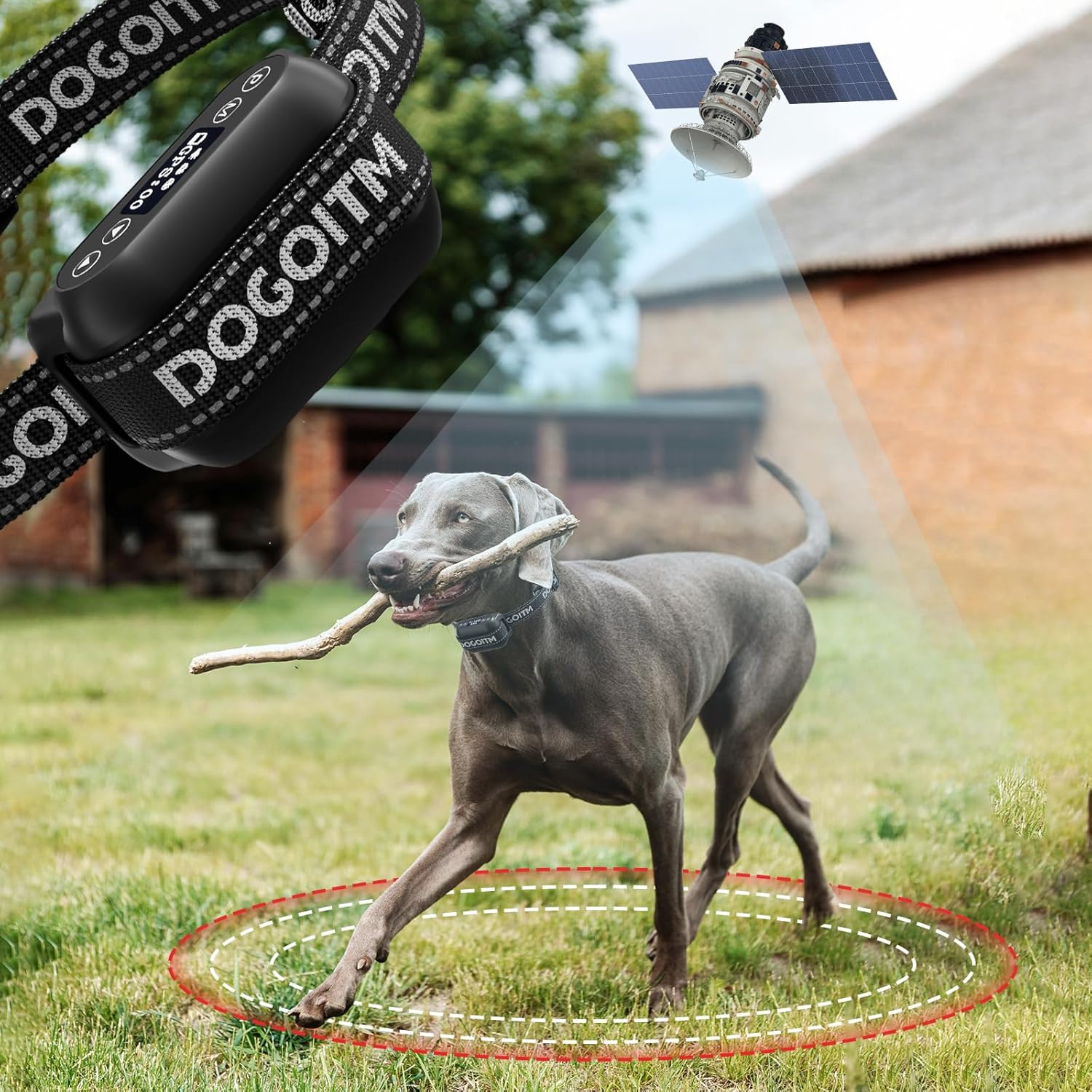
| Model | GM08 |
|---|---|
| Adjustable range | 65–3,290 ft radius |
| Correction modes | Beep, vibration, shock |
| Battery | Rechargeable, 50+ hours claimed |
| Water resistance | IPX6 |
The DOGOITM GM08 is a GPS wireless containment system that creates an adjustable invisible boundary (65 to 3,290 ft radius) and corrects a dog with beep, vibration, or static stimulation when it crosses the set limit. Setup is simple because there is no buried wire, no app or subscription, and the boundary is changed in 10 ft steps from the base unit. The collar is rechargeable and rated IPX6 for water resistance, and the manufacturer claims 50+ hours per charge, making it usable for several days between charges. Practical benefits include rapid installation for yards larger than about 0.3 acre, a compact collar with multiple contact points and silicone covers, and a U-BLOX GPS chipset that reduces interference. Limits to expect are typical of GPS systems: boundary accuracy can vary with satellite reception and is not suitable for very small yards, and static correction requires careful adjustment and training to be effective and humane. The package is designed for one or two dogs depending on the variant and is labeled not for small dogs, so confirm fit and weight recommendations before buying.
Best for: Buyers who want an inexpensive, easy-to-install outdoor containment system that delivers basic, dependable boundary control without wiring or subscriptions.
Less Ideal for: Owners needing pinpoint, wire-style precision for small yards or those who prefer app-driven, feature-rich systems with advanced geofencing controls.
- Wide adjustable GPS radius from 65 to 3,290 ft to match different yard sizes
- Three correction modes (beep, vibration, shock) with adjustable intensity for flexible training
- Rechargeable collar with claimed 50+ hour runtime reduces battery replacement
- IPX6 water resistance suitable for rainy or wet outdoor use
- No buried wire, app, or subscription required so setup is fast and low-maintenance
- Not intended for very small yards under about 0.3 acre where GPS gating is less reliable
- GPS-based boundaries can shift with poor satellite reception or local interference
- Product notes advise it is not for small dogs which limits very small-breed use
Verdict: The best budget wireless electric fence system for owners who need effective pet containment on a tight budget without advanced extras.
FOCUSER GPS Wireless Dog Fence
Best Long-Range Wireless Electric Fence System

| Supports dogs | Up to 10 dogs |
|---|---|
| Boundary range | 10 m to 990 m |
| Collar rating | IP67 waterproof |
| Battery | Rechargeable, 3.7V collar |
This FOCUSER system uses GPS satellite technology to create an invisible containment area without digging or wiring, letting you set a radius from about 10 meters up to 990 meters and adjust sensitivity across 99 levels. Setup is mainly placing the base and configuring the virtual boundary, then fitting the included IP67-rated rechargeable collar receivers to your dogs. The collars offer vibration plus static stimulation modes and are advertised as safe with low-voltage output, and the kit supports up to 10 dogs at once with no monthly fees or subscriptions. Practical benefits include quick installation, true long-range coverage for large or irregular yards, and waterproof receivers that stand up to sprinklers and rain. Limits to be aware of are typical GPS-based boundary variability near tall buildings or heavy tree cover and that training flags and adjustable settings will be needed to teach dogs the limits; small positional shifts are normal compared with buried-wire systems. Batteries are rechargeable so you avoid ongoing battery purchases but you should monitor charge for working reliability.
Best for: Homeowners with large or irregular yards who need a long-range, noninvasive containment solution and value quick setup and flexible boundary sizing.
Less Ideal for: People who need perfectly repeatable, fence-line-accurate containment in dense urban settings or heavily obstructed terrain should consider buried-wire or GPS-plus-wire hybrid systems instead.
- GPS satellite boundary removes need to dig or bury wire
- Adjustable radius up to 990 meters for large yards and flexible property shapes
- Supports up to 10 dogs simultaneously without subscription fees
- IP67-rated waterproof collar receivers suitable for rain and sprinklers
- Rechargeable collars reduce ongoing battery expense
- GPS boundaries can shift slightly near heavy tree cover or tall structures
- Uses vibration and static stimulation which requires training and monitoring for effectiveness
Verdict: The best long-range wireless electric fence system for homes with large yards or irregular property lines that need extended coverage.
PetSafe Stay & Play Compact Wireless Fence
Best Compact Wireless Electric Fence System

| Coverage | Up to 3/4 acre (22–105 ft radius) |
|---|---|
| Receiver fit range | Fits necks 6–28 in; dogs 5 lb and up |
| Power | Transmitter plugs into indoor outlet; collar rechargeable (2–3 hr charge) |
| Collar features | Waterproof, tone plus adjustable static correction levels (1–6) |
The PetSafe Stay & Play Compact Wireless Fence sets up quickly using an indoor transmitter to create an adjustable circular boundary up to 3/4 acre without digging or buried wire. You plug the transmitter into an indoor outlet, set the radius on the LCD, and train dogs with the included waterproof, rechargeable receiver collar that charges in 2–3 hours and can last up to three weeks per charge. The system is portable for travel or RV use and supports adding extra collars so multiple dogs can share the same transmitter. Notable features include an LCD that shows radius and warnings, tone plus adjustable static correction levels on the collar, and visual training flags to speed learning. Limitations are the circular-only boundary shape and the need to place the transmitter indoors away from large metal objects to avoid range reduction; covering larger or irregular yards requires a second transmitter or a different system. For households wanting a no-dig, easy-to-move solution that can contain more than one dog, this system delivers practical containment with simple setup and long collar runtimes.
Best for: Owners with two or more dogs who want a portable, no-dig containment solution that can be expanded with extra collars and tuned per collar during training.
Less Ideal for: Homes that need a rectangular or highly customized boundary or very large properties where a single circular transmitter cannot cover the usable area.
- Quick, no-dig setup with adjustable circular boundary up to 3/4 acre
- Rechargeable waterproof receiver with long runtime and fast 2–3 hour charge
- LCD transmitter that displays radius and warning indicators for easier setup
- Expandable to contain multiple dogs by purchasing additional receiver collars
- Portable design suitable for travel, RVs, and temporary installations
- Boundary is circular only so it cannot match irregular yard shapes
- Transmitter must be kept indoors and away from metal which can reduce effective range
Verdict: The best compact wireless electric fence system for owners who want a portable, low-footprint solution for travel or limited storage space.
MIMOFPET Wireless Dog Fence X3
Best Heavy-Duty Wireless Electric Fence System

| Range (fence) | 25–3,500 ft adjustable |
|---|---|
| Range (remote) | Up to 5,900 ft |
| Modes | Beep, Vibrate, Static |
| Waterproof rating | IPX7 |
| Battery | Rechargeable (included) |
This MIMOFPET X3 system combines a portable wireless perimeter transmitter with two rechargeable receiver collars and a handheld training remote so you can both contain and train dogs while away from home. Setup is simple: power the compact transmitter, select a radius (adjustable up to the system limit), and the collars will warn with a beep, vibrate, or deliver a low static correction when your dog crosses the boundary. The kit supports long distances with range adjustment from 25 feet up to 3,500 feet for the fence and claims up to 5,900 feet for remote training, making it suited to large yards and open spaces. Practical features include multiple vibration and static levels, a keypad lock to prevent accidental inputs, LED lights on the remote for locating collars in low light, and IPX7 waterproofing so collars hold up in rain. Battery life is strong in standby and usable for extended trips, though battery runtime drops when the fence mode is active. The system is versatile for on-the-go use but requires careful level testing per dog and regular charging to maintain maximum range and feature availability.
Best for: Owners who need a portable containment solution for large outdoor spaces and want combined remote training capability while traveling or using open properties.
Less Ideal for: People who need a permanent, buried boundary system or those who prefer a completely hands-off containment method without remote corrections.
- Very long adjustable containment range up to 3,500 feet for flexible large-area coverage
- Separate training remote with up to 5,900 feet range for off-leash recall and correction
- Multiple modes and level settings (beep, vibration, adjustable static) for tailored training
- IPX7 waterproof receiver collars suitable for wet conditions
- Keypad lock and LED light on remote reduce accidental corrections and help locate dogs in the dark
- Actual runtime is much shorter when the wireless fence is active versus standby
- No detailed spec for maximum number of collars supported beyond the included two
Verdict: The best heavy-duty wireless electric fence system for owners of strong, determined, or frequently testing pets who need tougher containment hardware.
Halo Collar 5
Best Premium Wireless Electric Fence System

| Batteries | 1 Lithium Ion (included) |
|---|---|
| Material Type | Waterproof Housing (IP67) |
| Included Components | Contact Tips, Magnetic Charger, Perfect Fit Kit, Pro Case + Strap |
| Breed Recommendation | Dogs over 10 lbs (various groups) |
The Halo Collar 5 is a premium GPS wireless containment and tracking collar that creates virtual fences without wires or installation. You set one or more fence perimeters in the Halo app and the collar delivers sound, vibration, or optional static feedback as your dog approaches the boundary while sending instant alerts to your phone. It uses dual-frequency Precision+ GPS, AI drift prevention, and real-time ground-station corrections to improve location accuracy and updates location frequently for near real-time tracking. The package includes contact tips, a magnetic charger, a fit kit, and a pro case and the device is rated IP67 for waterproofing. Expect daily charging for best performance and a required Halo subscription to enable GPS, unlimited cellular data, fence creation, training guidance, and live support. The system is strong where accurate, installation-free containment and built-in training matter, but buyers should plan for the ongoing subscription cost and nightly charging as part of ownership.
Best for: Owners who prioritize top-tier tracking accuracy, built-in training support, and a polished, durable collar experience and are willing to invest in ongoing subscription service and premium hardware.
Less Ideal for: Buyers who want a one-time purchase without recurring fees or who cannot commit to daily charging and app-based setup and training.
- Precision+ dual-frequency GPS with ground-station corrections for improved location accuracy
- Instant fence creation and wireless containment with no digging or hardware installation
- Multiple feedback modes (sound, vibration, optional static) plus built-in training guidance
- IP67 waterproof housing and included accessories for fit and charging
- Requires a subscription to activate GPS, fence, and tracking features
- Needs nightly charging for best performance
Verdict: The best premium wireless electric fence system for owners willing to pay more for top-tier range control, advanced features, and superior build quality.
Choosing the Right Wireless Electric Dog Fence System: Key Factors to Consider
Signal Range and Coverage
Range determines the maximum size of the area you can contain without additional hardware. Wireless systems emit a circular or adjustable-radius perimeter from a central transmitter, so knowing the advertised and real-world signal radius is critical.
Consider overhead obstructions, dense vegetation, and nearby radio interference, all of which can reduce effective coverage compared with the manufacturer's rating. Also verify whether the transmitter allows incremental range adjustments so you can fine-tune the perimeter to match irregular yard shapes. For multi-acre properties, confirm the system's maximum radius and whether multiple transmitters are supported or recommended by the manufacturer.
Signal Stability and Interference Resistance
A clear, consistent signal prevents dead zones and unexpected escapes. Stability depends on transmitter quality, antenna design, and how the system handles competing radio frequencies.
Look for systems with auto-calibration or adaptive signal management to reduce variation over time and in different weather. Systems that provide visual or audible alerts for transmitter faults or low signal are useful for proactive maintenance. If you live in an area with many wireless devices, check for user reports or specs that mention frequency hopping or interference mitigation.
Collar Power and Battery Life
Collar battery life affects how often you must recharge or replace batteries, which impacts day-to-day convenience and continuity of containment. Consider whether the collar uses rechargeable packs, replaceable batteries, or a combination.
Also check charging time and whether the collar can be used with the receiver still attached. Longer runtimes are preferable for families who leave dogs outside frequently; however, heavier battery systems can add weight to the collar, which matters for small dogs. Battery status indicators and low-battery alerts help avoid unexpected downtime.
Adjustability of Correction and Training Features
Adjustable correction levels, tone-only warnings, and progressive correction modes let you match the system to your dog's size and temperament. A system that offers both audible warnings and graduated stimulation gives you training options that do not rely solely on static correction.
Training features matter because a properly trained dog will respond to boundary cues more reliably than one that only receives correction. Look for collars with multiple intensity settings, a tone-only or vibration mode, and a clear user interface for changing modes. Safety cutoffs and timed limits on continuous correction are also important safeguards.
Collar Fit and Durability
Comfortable, secure collar fit prevents chafing and ensures consistent contact with the dog's skin for reliable stimulation or tone detection. Check collar adjustability ranges and whether extra strap sizes are available for very small or large necks.
Durability includes water resistance, robust buckles or clasps, and corrosion-resistant contact points. Collars used outdoors need to be able to handle rain, mud, and active dogs that run through brush. Replaceable contact probes and a straightforward repair or parts policy extend the usable life of the system.
Ease of Setup and Daily Maintenance
A system that is quick to install and simple to maintain reduces owner frustration and improves long-term compliance. Wireless transmitters should have straightforward placement instructions and simple power requirements.
Daily maintenance includes charging collars, checking battery indicators, inspecting contact points for corrosion, and occasionally trimming collar straps. Systems with clear user manuals, intuitive controls, and straightforward error indicators make it easier to keep containment reliable with minimal technical skill.
How Do I Choose the Right Radius for My Yard?
Measure the usable outdoor area where you want the dog contained and compare that to the system's maximum radius. Remember that wireless transmitters create circular coverage, so cornered or long, narrow yards may require compromise or creative placement.
If your yard has significant dead space or irregular shape, consider placing the transmitter off-center to shift the circle toward where you need coverage most. Always leave a safety buffer from roads and neighboring properties when setting the perimeter.
- Start with a rough measurement of the furthest point you want included in the boundary
- Account for obstacles like sheds and dense trees that may reduce signal
- Use a temporary flag or marker during training to show the effective edge
Can Small Dogs Wear Typical Wireless Collars Safely?
Many wireless electric fence collars are adjustable for different dog sizes, but weight, contact probe length, and minimal correction settings must be compatible with smaller animals. Check the minimum recommended dog weight and verify that the collar allows low-intensity options or tone-only modes.
For very small or toy breeds, look for lightweight collars with short contact points and a snug fit to avoid wobble that reduces signal contact. Regularly check the dog during initial training sessions to ensure the collar sits correctly and the dog shows no signs of distress.
- Confirm minimum weight and collar dimensions before use
- Prefer collars with tone or vibration-only modes for sensitive dogs
- Inspect the fit weekly and adjust as the dog grows or changes weight
What Training Steps Help Dogs Learn the Boundary Quickly?
Start with supervised training walks along the perimeter while using visual markers like flags to indicate the boundary edge. Pair the approach to the boundary with an audible cue, and practice retreating into the safe zone with a reward when your dog responds appropriately.
Gradually reduce human supervision as your dog reliably responds to tone or collar cues. Keep training sessions short and positive, repeating the exercises over several days until the dog understands the perimeter.
- Use consistent cues: same tone, same retreat behavior, same reward
- Begin with low-intensity corrections and increase only if needed
- Reinforce training after long absences or seasonal changes in outdoor routine
How to Handle Areas Where a Circular Signal Does Not Fit the Yard Shape
Position the transmitter strategically to include the most critical areas, such as the yard center or a side with direct street access. If the circular coverage cannot match the shape of your property, consider restricting access to problem zones with physical fencing or use training to keep the dog away from those areas.
Some owners place the transmitter outside the yard boundary to shift the circle, but this must be done carefully to avoid inadvertently excluding necessary space. Always test the effective boundary with the collar and flags before leaving the dog unsupervised.
- Test multiple transmitter locations before finalizing placement
- Use temporary markers and a helper to walk the effective edge
- Combine with simple physical barriers for small exclusion zones
Maintenance Checklist for Long-term Reliability
Create a short routine to inspect the transmitter and collar once a week. Check collar contacts for corrosion, confirm battery charge levels, and verify that the transmitter's power indicator and range settings are unchanged.
Keep a spare set of batteries or a charging schedule, and store the transmitter in a dry, sheltered location. Replace worn straps and contact points promptly to maintain consistent containment behavior.
- Weekly: check collar fit, battery indicator, and contact cleanliness
- Monthly: verify transmitter placement and range with flag markers
- Seasonally: inspect for water damage or corrosion after heavy weather
How We Chose the Best Wireless Electric Dog Fence System
To assemble this list we applied practical, owner-focused filters and tested products conceptually against real-world requirements for containment systems. We prioritized signal range and consistency because a stable perimeter is the foundational safety feature of any wireless system. Collar power and runtime came next since frequent recharging reduces convenience and may interrupt containment. Build quality and water resistance were considered to ensure the collar and transmitter tolerate typical outdoor conditions. Ease of setup and user controls were evaluated for owners who prefer a quick install or need accessible customization of boundary radius and tone levels. We also considered supported dog weight and adjustable correction levels so the system can be tuned for small and large dogs. Exclusions: we excluded systems that rely on buried wiring or hybrid solutions; only fully wireless electric fence systems were considered. We also excluded models with insufficient specification detail about range or collar power. The final shortlist reflects systems that balance dependable perimeter performance, practical collar battery life, and straightforward setup for everyday pet owners.
Our full evaluation process is outlined in our review methodology.
FAQ
Will a wireless electric fence system work on a sloped property?
Usually, yes. Signal propagation is not strongly affected by moderate slopes, but dense vegetation and metal structures on slopes can alter the effective perimeter. Test the boundary with the collar and markers and adjust transmitter placement if you find inconsistent coverage.
How long does a collar battery typically last between charges?
Battery life varies widely by model and usage but often ranges from several days to a few weeks. Heavy use of correction features shortens runtime, so look for clear battery indicators and plan a regular charging schedule to avoid unexpected downtime.
Can the correction be disabled so the system only uses an audible warning?
Many systems include a tone-only or vibration mode that lets you warn the dog without delivering electrical stimulation. This is useful during training or for dogs that respond well to audible cues, but verify that the specific system you choose includes those modes.
How should I introduce my dog to a new wireless boundary?
Begin with short, supervised sessions using visible boundary markers and positive reinforcement. Walk the dog along the edge, let them hear the warning tone, and reward them for returning to the safe area. Gradually increase unsupervised time only after consistent compliance.
Are wireless systems affected by nearby electronic devices?
They can be. Nearby radio transmitters, heavy-duty power equipment, or dense Wi-Fi interference may affect signal stability. Choose a transmitter location away from large electronic sources and test the system under typical household and yard conditions.
Final Verdict
A wireless electric dog fence system can be an effective tool to contain dogs and increase off-leash freedom when you choose a system that matches your yard shape, signal needs, and your dog's temperament. Prioritize reliable signal coverage, collar battery life, and adjustable training modes to balance safety with humane training. Accept that tradeoffs exist: circular coverage sometimes means strategic transmitter placement or supplementary physical barriers, and stronger correction options are not always necessary if the dog responds to tone. Focus on systems that offer clear controls, predictable performance, and straightforward maintenance so you can contain your dog confidently and with minimal daily hassle.

