

If your dog has persistent halitosis, choosing the right dental treat can make daily oral care easier and more effective. The right dental treats can reduce surface tartar, mechanically scrub teeth, and deliver breath-freshening ingredients you can use between brushings. This guide shortlists seven top dental treats specifically for bad breath, focusing on proven cleaning action, palatability, and safety for regular use. Below you will find our top picks followed by practical buying advice and answers to common questions to help you choose the best option for your dog and routine.
Top Picks at a Glance
| Best Overall Dental Treat A balanced pick that reduces breath odor and cleans teeth effectively | Greenies Original Regular Dental Dog Treats |  |
| Best Budget Dental Treat An affordable option that still helps control bad breath and tartar | Dingo Dental Sticks Chicken 20-Count |  |
| Best Premium Dental Treat A higher-end formulation with superior ingredients or clinical claims | OraVet Dental Chews Small Dogs |  |
| Best Natural Ingredient Dental Treat Limited-ingredient or natural recipes focused on gentle breath support | Pet Naturals Breath Bites 60ct |  |
| Best Crunchy Dental Treat A firm, abrasive texture designed to scrape plaque and reduce tartar | Blue Buffalo Dental Chews Medium |  |
| Best Soft Dental Treat Easier-to-chew treats for seniors, small mouths, or sensitive teeth | Bocce's Bakery Brushy Bites 6 oz |  |
| Best Small-Dog Dental Treat Bite-sized or scaled treats made for smaller mouths and metabolisms | Greenies Teenie Dental Treats 43ct |  |
Greenies Original Regular Dental Dog Treats
Best Overall Dental Treat

| Flavor | Original |
|---|---|
| Age Range Description | Adult |
| Item Form | Bone |
| Unit Count | 12 Count |
Greenies Regular Dental Dog Treats are chewy dental chews made for daily use to help reduce plaque and tartar and freshen breath in dogs weighing about 25–50 lb. The textured, bendable chew is designed to work down to the gumline like a toothbrush while being soft enough to avoid snapping, and the formula includes vitamins and minerals to complement a pet's diet. In practice you feed one chew per day and monitor chewing; the manufacturer cites studies showing reduced tartar and plaque accumulation over 28 days. The chews are rawhide-free and come in a pouch of 12 treats, which makes them convenient for training or daily routine but not ideal for stocking up. They are widely recommended by veterinarians and approved by the Veterinary Oral Health Council for plaque and tartar control, so they suit owners prioritizing breath improvement and routine oral maintenance. Limitations are that size selection matters—these Regular chews are intended for 25–50 lb dogs—and owners should supervise any dog that gulps treats or has specific dietary sensitivities.
Best for: Buyers who want a veterinarian-recommended, easy daily dental routine to noticeably improve breath and oral hygiene for a medium-size dog.
Less Ideal for: Owners looking for bulk supply packs or a treat sized for very small or very large dogs should consider other size variants or different products.
- Clinically shown by manufacturer data to reduce tartar and plaque with daily use
- VOHC-accepted and veterinarian-recommended for dental care
- Bendable, chewy texture that cleans toward the gumline without snapping like rawhide
- Contains added vitamins and minerals to complement nutrition
- Single-chew daily dosing is simple to incorporate into a routine
- Small package size (12-count pouch) may require frequent repurchasing
- Formulated for a specific weight range so you must choose the correct size for your dog
Verdict: The best overall dental treat is the all-around choice for most dog owners, offering measurable breath-improving benefits, good texture for plaque reduction, and wide appeal across ages and sizes.
Dingo Dental Sticks Chicken 20-Count
Best Budget Dental Treat

| Flavor | Chicken |
|---|---|
| Item Form | Stick |
| Unit Count | 6.3 Ounce |
| Number of Items | 1 |
| Target Species | Dog |
Dingo Dental Sticks are daily chew treats built to scrub plaque and help control bad breath through the abrasive action of chewing and included ingredients like baking soda and parsley oil. They are given as a once-a-day treat and feature a soft, long stick shape with a real chicken center that most dogs find palatable, so they work well as a regular reward without being hard to break down. In practice these treats brush teeth mechanically as the dog chews, which can reduce tartar buildup over time and leave breath fresher than standard soft treats. Ingredients include rawhide and common additives, so they are not a premium, single-protein formula and may not suit dogs with sensitive diets. Packaging is a simple bag of 20 sticks sized for all breeds, making them convenient for daily use but not intended as a veterinary dental replacement for professional cleaning. If you want an inexpensive, tasty daily chew that helps with breath between cleanings, these are a practical choice.
Best for: Buyers who prioritize an affordable, easy-to-feed daily chew that improves breath between dental cleanings and whose dogs accept rawhide-based treats.
Less Ideal for: Owners seeking limited-ingredient, single-protein treats or clinical dental therapy should look at veterinary formulas or specialty options instead.
- Designed for daily use to help reduce tartar and plaque through chewing action
- Real chicken center increases palatability for most dogs
- Contains breath-freshening ingredients like baking soda and parsley oil
- Soft long-stick shape suitable for easy chewing by many dogs
- Sold as a 20-count bag convenient for regular once-a-day feeding
- Contains rawhide and multiple additives so not ideal for dogs with dietary sensitivities
- Not a replacement for professional dental cleaning or targeted veterinary dental products
Verdict: The best budget dental treat gives owners a low-cost way to improve breath and support basic oral hygiene without sacrificing safety or palatability.
OraVet Dental Chews Small Dogs
Best Premium Dental Treat

| Flavor | Chicken |
|---|---|
| Special Ingredients | delmopinol |
| Unit Count | 30 Count |
| Breed Recommendation | Small Dogs |
OraVet Dental Chews are daily, individually wrapped sticks sized for small dogs (10–24 lb) that combine mechanical cleaning from chewing with the active ingredient delmopinol to help reduce plaque and tartar. You give one chew per day as part of an at-home oral care routine; the chew is designed to be highly dissolvable and palatable with a poultry flavor and vanilla aroma so most small dogs will accept it. The delmopinol coating forms a protective barrier on teeth to limit bacterial buildup, which complements the physical abrasion as the dog chews down to the gumline. Practical benefits include easy single-serve dosing, a month-long supply in a 30-count bag, and formulation choices targeted to breed sizes so the pieces are appropriately scaled. Important limitations are that this is an adjunct to professional dental care rather than a replacement, dogs with sensitivities to listed ingredients like pork, wheat, or soy may react, and owners should monitor consumption to avoid any choking risk even with small-breed sizing.
Best for: Owners of small-breed dogs who want a daily, vet-formulated chew that is sized and textured to clean teeth gently while fitting into an easy at-home oral care routine.
Less Ideal for: Pet owners seeking a complete dental treatment in place of veterinary cleanings or those whose dogs have allergies to pork, wheat, or soy should consider alternatives or consult a vet.
- Contains delmopinol, an ingredient that helps form a barrier against plaque-forming bacteria
- Sized and formulated specifically for small dogs with individually wrapped chews for easy daily dosing
- Clinically shown to reduce plaque and tartar when used as directed
- Palatable poultry flavor with vanilla aroma increases acceptance in picky eaters
- Contains common allergens such as pork protein, wheat, and soy which may not suit dogs with sensitivities
- Not a substitute for professional dental cleanings and veterinary care
Verdict: The best premium dental treat is for owners willing to pay more for advanced oral-health ingredients, clinical study backing, or enhanced formulation for long-term dental care.
Pet Naturals Breath Bites 60ct
Best Natural Ingredient Dental Treat

| Flavor | Chicken |
|---|---|
| Item Form | Soft Chew |
| Product Benefits | Oral Health |
| Specific Uses For Product | Breath Care, Digestive Health |
| Directions | Give 1 chew per 50 lbs daily |
Pet Naturals Breath Bites are soft chew supplements designed to address bad breath from the inside out rather than just masking odors. You give one soft chew per 50 pounds daily as a treat; the formula combines spirulina and parsley to neutralize mouth odors, champignon mushroom extract to reduce odor-causing chemicals in the gut, cinnamon for mouth bacterial balance and flavor, and yucca to help reduce fecal odors. The soft texture and chicken liver flavor make them easy to hand out or mix into a daily routine, and the product is formulated without artificial flavors or colors, corn, or wheat. These chews can complement regular dental care by supporting a healthier oral and digestive environment, but they are a supplement not a replacement for brushing or professional cleanings. Also, dosing is weight-based so very small dogs require only fractional portions and larger dogs will need multiple chews per day if over dosing guidance, which may affect pouch longevity.
Best for: Owners who prioritize simple, recognizable natural ingredients and want a tasty daily chew that supports fresher breath by targeting both mouth and gut.
Less Ideal for: People seeking an abrasive chew to mechanically remove tartar or those wanting an all-in-one replacement for brushing and veterinary dental treatments.
- Uses recognizable natural ingredients (spirulina, parsley, mushroom extract, cinnamon) aimed at neutralizing odors rather than masking them
- Soft, chicken liver-flavored texture that dogs accept easily as a daily treat
- Formulated without artificial flavors, colors, corn, or wheat
- Addresses both oral and digestive sources of bad breath with targeted ingredients
- Intended as a supplement so it does not replace tooth brushing or professional dental care
- Weight-based dosing means very small or very large dogs may need adjusted portions which can be inconvenient
Verdict: The best natural-ingredient dental treat is aimed at owners who prefer simple, recognizable components that freshen breath and clean teeth while avoiding artificial additives.
Blue Buffalo Dental Chews Medium
Best Crunchy Dental Treat
| Flavor | Chicken & Spearmint |
|---|---|
| Item Form | Stick |
| Breed Recommendation | Medium Breeds |
| VOHC Accepted | Yes |
| Feed Frequency | One per day |
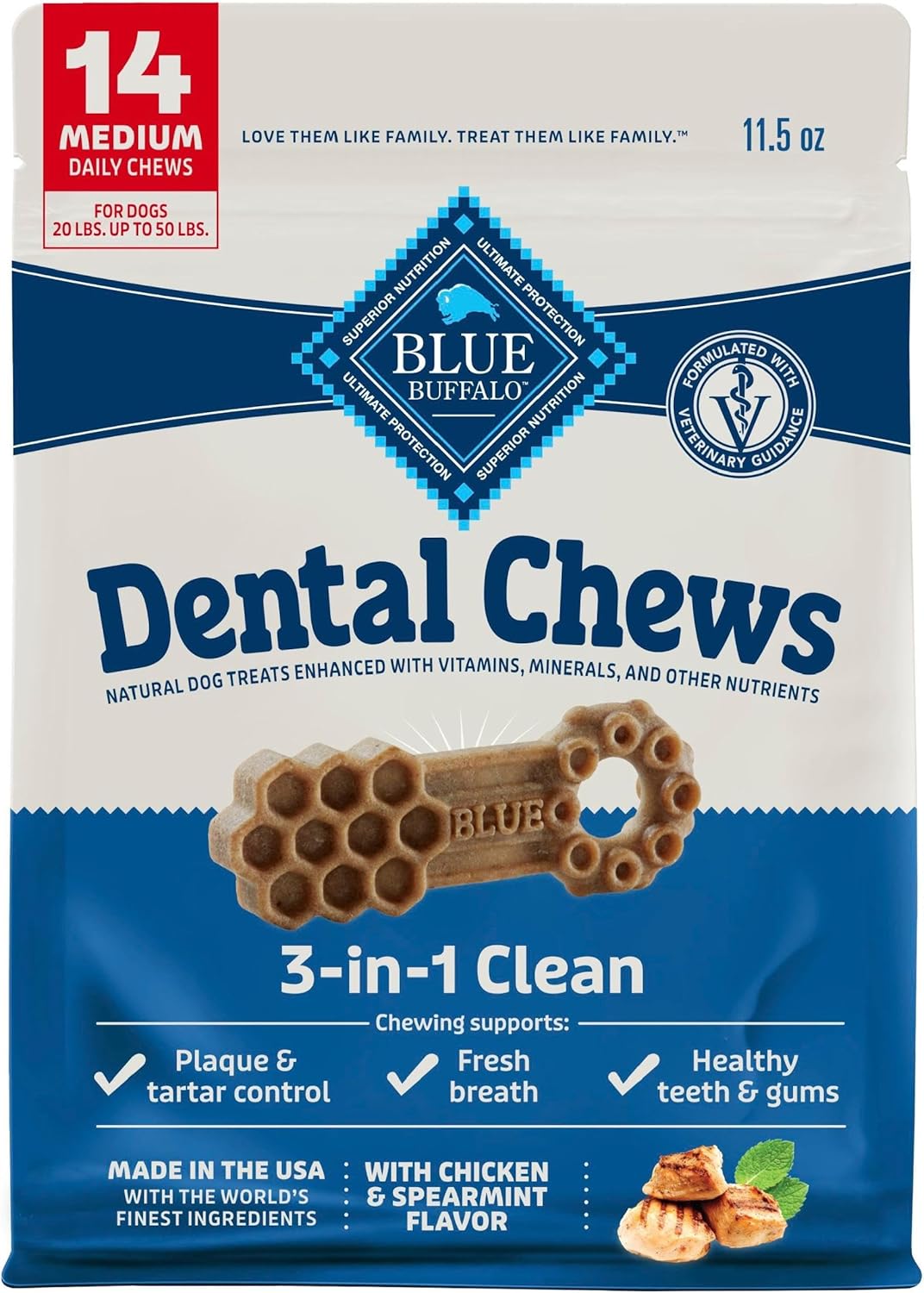
Blue Buffalo Medium Dental Chews are daily crunchy treats made to provide mechanical cleaning for medium-breed dogs. The uniquely shaped sticks have about 50 ridges and grooves and a firm but pliable texture that encourages chewing to scrape plaque and tartar from teeth while delivering spearmint to freshen breath. They are intended to be given once per day and are formulated with real dried chicken and a limited-ingredient style recipe that omits corn, wheat, soy, artificial flavors, and preservatives. Practical benefits include VOHC-accepted effectiveness for dental care, a palatable chicken flavor most dogs enjoy, and packaging sizes suited for daily use. Important limitations are that they are sized for medium dogs (20–50 lb) so smaller or very large chewers may need a different size, and owners should account for the extra calories by reducing a regular meal as directed. Dogs that swallow treats whole or have dietary sensitivities should be supervised or consult a vet before daily use.
Best for: Buyers wanting a crunchy, chew-first dental treat to mechanically reduce plaque and improve breath for medium-breed dogs that can chew firmly and enjoy daily rewards.
Less Ideal for: Dogs that gulp treats, have fragile teeth, are toy or power chewers that destroy treats quickly, or owners seeking a soft or paste-style dental product should consider alternatives.
- Designed with 50 ridges and grooves to provide mechanical abrasion against plaque and tartar
- VOHC-accepted formula indicating proven dental effectiveness
- Spearmint flavor helps freshen breath in addition to cleaning action
- Made without corn, wheat, soy, artificial flavors, or preservatives
- Formulated and portioned for medium dogs so it is not sized for very small or very large breeds
- Contains barley and calories that require adjusting the dog’s daily food intake
Verdict: The best crunchy dental treat is ideal for dogs that can chew firmly and need mechanical abrasion to help remove plaque and improve breath.
Bocce's Bakery Brushy Bites 6 oz
Best Soft Dental Treat

| Flavor | Brushy Bites (Apple Mint) |
|---|---|
| Unit Count | 6 Ounce |
| Calories per Treat | 9 cal |
| Allergen Information | Wheat Free |
| Item Form | Treats |
Bocce's Bakery Brushy Bites are soft, chewable treats designed to be an everyday reward that also supports fresher breath. They come as bite-sized 'B' shaped soft cookies made from a short ingredient list—oat flour, flaxseed, apples, molasses and mint—so they are easy for seniors or dogs with sensitive mouths to chew. At about 9 calories per treat and baked in small batches in the USA, these are practical for frequent rewarding and training without adding many calories. The mint and unique texture are intended to help with breath, while the limited-ingredient, wheat-free formula reduces the chance of tummy upset for dogs with sensitivities. Because they are soft rather than abrasive, they help refresh breath but will not replace dental chews or brushing for tartar control. Also the bag format means treats stay convenient for home or on-the-go use but may soften further in humid conditions. For owners prioritizing gentle texture and breath support, these are an easy everyday option.
Best for: Buyers seeking a gentle-textured treat to reward older dogs or dogs with dental issues while giving a breath-freshening boost.
Less Ideal for: Owners looking for a single product to clean teeth or remove tartar should choose enzymatic dental chews or vet-recommended dental tools instead.
- Soft, easy-to-chew texture suitable for seniors and dogs with dental sensitivity
- Contains mint and a crisp apple flavor to help freshen breath
- Limited, natural ingredient list reduces exposure to common fillers and additives
- Low calories per treat (about 9 cal) make them suitable for frequent rewarding
- Soft texture does not provide the abrasive action needed to remove tartar or plaque
- Bag form may lose crispness or soften in humid conditions
Verdict: The best soft dental treat suits older dogs, puppies, or pets with dental sensitivity who need breath-improving benefits without hard chewing.
Greenies Teenie Dental Treats 43ct
Best Small-Dog Dental Treat

| Flavor | Original |
|---|---|
| Unit Count | 43 Count |
| Age Range Description | Adult |
| Breed Recommendation | Extra Small |
Greenies Teenie are daily dental chews designed for small dogs (5–15 lb) that combine a chewy, toothbrush-like texture with a recipe of natural ingredients, vitamins, and minerals. You give one chew per day from the tub; the flexible bone-shaped stick is made to bend instead of snap so it is easier for small mouths to chew and less likely to create sharp fragments. The manufacturer cites clinical data showing reduced tartar and plaque in 28 days, and the treat is accepted by veterinary groups for plaque and tartar control. Practical benefits include a treat dogs usually find palatable, clear feeding guidance by weight, and a convenient tub for storage. Important limitations are that these are sized for small breeds only, contain wheat and other common ingredients some dogs may be sensitive to, and owners must supervise chewing because any edible chew can pose a choking risk if swallowed whole. Overall this is a straightforward, vet-recommended daily option if you want a palatable chew that supports routine oral care for small adult dogs.
Best for: Owners of small adult dogs who want an easy, daily chew that actively supports plaque and tartar control and is likely to be eaten willingly as a regular part of oral care.
Less Ideal for: People with dogs that have wheat allergies, known ingredient sensitivities, or dogs that gulp treats whole rather than chew them thoroughly.
- Designed to clean down to the gumline with a toothbrush-like texture
- Clinically supported reduction in tartar and plaque with daily use
- Formulated for small dogs with a bendable, rawhide-free texture
- Vet recommended and accepted by veterinary dental authorities
- Comes in a resealable tub with clear daily-feeding guidance by weight
- Contains wheat and other common ingredients that may trigger sensitivities
- Sized only for dogs 5–15 lb so not appropriate for larger dogs
- Requires supervision while feeding to ensure the chew is adequately chewed
Verdict: The best small-dog dental treat is portioned and textured for small breeds, delivering breath control and plaque reduction in a size and hardness small dogs can manage.
Choosing the Right Dental Dog Treat Bad Breath: Key Factors to Consider
Cleaning Mechanism and Texture
How a dental treat physically interacts with teeth matters more than packaging claims. Chewing action that creates friction against the tooth surface helps lift soft plaque before it mineralizes into tartar. Look for ridged surfaces, grooved shapes, or chew matrices designed to flex and scrub teeth as the dog chews.
Treats that are too soft will compress without abrasive action, while extremely hard treats can risk tooth damage in aggressive chewers. Consider your dog's chewing style and choose a texture that balances effective scraping with a reduced risk of fracture or excessive wear.
Breath-freshening Ingredients
Ingredients that address the biochemical causes of bad breath are valuable in addition to mechanical cleaning. Enzymes such as glucose oxidase and compounds like zinc or natural odor-neutralizing agents can reduce the volatile sulfur compounds responsible for halitosis. Mint- or parsley-flavored treats can mask scents but are most effective when paired with active ingredients that reduce odor at the source.
Avoid relying solely on strong flavors to hide smell; focus on treats that list breath-control or enzyme support on the ingredient panel, and check that those components are listed in meaningful positions rather than trace additives.
Size, Portioning, and Daily Use Guidance
Effective breath control often requires consistent use, so portion size and clear feeding guidance are important. Treats intended for daily use should offer recommended serving sizes by weight or life stage so you can maintain balanced caloric intake. Single-piece treats sized for different weight classes are easier to control than unspecified chew blocks.
Excessive calories from treats can contribute to weight gain, which creates other health problems. Choose options with transparent calorie information and adjust the rest of your dog's feeding plan accordingly if you plan on daily administration.
Palatability and Individual Tolerance
A treat must be tasty enough that the dog will chew it thoroughly rather than swallow it whole. Good palatability encourages proper chewing time, which increases mechanical cleaning. However, flavorings and additives can cause gastrointestinal upset in sensitive dogs, so look for formulations with simple ingredient lists or limited novel proteins if your dog has food sensitivities.
If your dog is a picky eater or has a history of food reactions, introduce a new dental treat slowly and monitor stool quality, appetite, and any signs of upset for several days.
Safety for Teeth and Digestion
Not all hard chews are safe for every dog. Very hard treats can chip or fracture teeth, particularly in dogs that crush rather than chew. Conversely, excessively soft or brittle treats can break into large, sharp pieces. Choose treats with a history of being safe for the breed size and chewing style you own, and always supervise initial use until you confirm your dog's chewing behavior.
Also consider digestibility: ingredients that do not break down well can contribute to vomiting or blockages. Check for clear manufacturing standards and readable ingredient lists to assess likely digestibility for your dog.
Ingredient Transparency and Manufacturing Standards
Clear labeling helps you make an informed choice. Treats with full ingredient panels, manufacturing origin statements, and claims backed by third-party testing or veterinary guidance are preferable. Transparency about source proteins, preservatives, and preservatives alternatives helps identify potential allergens and quality indicators.
Avoid products with vague descriptors like "natural flavoring" without further detail, and favor options that explain why specific ingredients are included for breath control or dental benefit.
How Often Should I Give a Dental Treat to Control Bad Breath?
Frequency depends on the treat's intended use and calorie load. Many dental treats are formulated for daily administration, but always follow the manufacturer's feeding guidelines tied to your dog's weight. Daily use is most effective for breath control because it provides continual mechanical cleaning between brushings.
If a treat is higher in calories or intended as an occasional deep-clean chew, use it less frequently and supplement with routine tooth brushing or dental wipes. Monitor breath improvement over several weeks to judge whether the chosen schedule is helping.
- Daily low-calorie treats are ideal for maintenance.
- Higher-calorie or intense chews should be occasional.
- Combine treats with brushing for best results.
Will Dental Treats Replace Brushing?
Dental treats are a helpful supplement but not a complete substitute for brushing. Brushing remains the gold standard for removing plaque from all tooth surfaces, including at the gumline where treats have limited reach. Treats are most useful as an adjunct to reduce tartar formation and to freshen breath between brushings.
For dogs that resist brushing, dental treats can still provide measurable benefit, but owners should aim for at least periodic brushing and veterinary dental checks to maintain oral health.
- Treats supplement daily care.
- Brushing reaches areas treats cannot.
- Use both approaches for best oral health.
How to Choose a Treat for a Small or Toy Dog with Bad Breath?
Small dogs often have tighter mouths and different chewing styles than larger dogs, so choose treats sized appropriately for their jaw and designed to encourage chewing rather than swallowing. Smaller, pliable textures that still offer surface abrasion are usually preferable to oversized hard chews. Check portion guidance and opt for products labeled for small breeds or specific weight ranges.
Because small breeds can be prone to dental disease, focus on breath-freshening ingredients and daily-use formats that fit into the dog's calorie budget.
- Select bite-sized treats for thorough chewing.
- Prefer textures that balance abrasion with safety.
- Watch calories closely for small dogs.
What Should I Do if My Dog Has Sensitive Stomach or Allergies?
If your dog has gastrointestinal sensitivity or known allergies, choose dental treats with limited and familiar ingredients. Single-protein options, grain-free formats if you suspect grain sensitivity, or recipes that use simple carbohydrate sources can reduce the chance of a reaction. Introduce new treats slowly and watch for changes in stool, vomiting, or skin issues.
Consult your veterinarian before adding a new daily treat if your dog has a complex medical history, and prioritize products with transparent ingredient lists and minimal artificial additives.
- Introduce gradually and monitor for reactions.
- Choose limited-ingredient formulas when needed.
- Seek vet advice for dogs with medical histories.
Can Dental Treats Help with Gingivitis or Advanced Dental Disease?
Dental treats can slow plaque accumulation and help with mild gingivitis but are not a treatment for advanced dental disease. Once periodontal disease is present, professional cleaning and a veterinarian-directed treatment plan are necessary. Dental treats can be part of an ongoing maintenance program after a vet has addressed active disease, but they should not be relied on as primary therapy for established infections or severe tartar.
Regular veterinary dental checks are essential to identify disease early and determine whether treats are appropriate as part of a maintenance strategy.
- Treats help prevent but do not reverse severe disease.
- See a vet for gingivitis and periodontal treatment.
- Use treats as part of a vet-approved maintenance plan.
How to Introduce a New Dental Treat to Encourage Proper Chewing
Start by offering the treat under supervision to ensure your dog chews it rather than gulping it whole. If the treat is dense, consider breaking it into a portion-sized piece to encourage initial chewing. Combine the first few sessions with positive reinforcement, and place the treat where your dog feels comfortable to settle and chew slowly.
If your dog immediately swallows large pieces, switch to a smaller or softer format designed for your dog's weight class. Over time, you can increase portion size to the recommended level as chewing improves.
- Supervise the first uses to ensure safe chewing.
- Break dense treats into smaller pieces if needed.
- Use praise to encourage slower chewing behavior.
How We Chose the Best Dental Dog Treat Bad Breath
We focused on criteria that matter for controlling bad breath and maintaining oral health with treat-based solutions. We prioritized mechanical cleaning action, looking for textures and shapes designed to reduce plaque and tartar buildup through chewing. We evaluated breath-control ingredients such as natural breath fresheners, enzymes, and safe flavorings that target volatile sulfur compounds without relying on masking scents alone. Palatability and repeat use were important; a treat that a dog refuses offers no benefit. We also considered ingredient safety and digestibility, avoiding treats with excessive fillers or components commonly associated with GI upset. Durability and portion sizing were factored in to ensure the treats suit common weight classes and chewing strength, and we checked for clear feeding guidelines that support safe daily use. We excluded treats marketed primarily as snacks with no documented oral benefit or vague claims about "cleansing" without mechanical or enzyme-based mechanisms. Overall, items that combined cleaning mechanics, breath-focused ingredients, repeatability, and clear safety information were advanced to the final shortlist.
Our full evaluation process is outlined in our review methodology.
FAQ
How long before I should expect breath improvement?
Many dogs show noticeable breath improvement within one to four weeks of regular use, depending on the severity of existing tartar and oral disease. Consistent daily use yields faster results than intermittent administration, and combining treats with brushing speeds improvement.
Are there any risks to giving dental treats every day?
Daily use is safe for many formulations, but risks include added calories, potential GI upset in sensitive dogs, and tooth damage if the treat is too hard for the dog's chewing style. Follow feeding guidelines and monitor your dog's weight and oral behavior.
Can puppies use the same dental treats as adult dogs?
Not always. Puppies have developing teeth and jaws and may need softer, smaller treats designed for their age and bite strength. Check product age recommendations and choose formulas explicitly labeled safe for puppies if you plan to use them.
Do natural breath-freshening ingredients really work?
Some natural ingredients, like parsley or certain enzymes, can reduce odor-causing compounds when present in effective amounts. However, these ingredients work best alongside mechanical cleaning. Relying solely on natural flavors without abrasive action is less likely to yield lasting breath improvement.
What signs indicate a dental treat is not right for my dog?
Watch for immediate swallowing without chewing, persistent vomiting or diarrhea after introduction, changes in appetite, or visible tooth chipping. Any of these signs suggest the treat may be unsuitable and you should discontinue use and consult your veterinarian if necessary.
Final Verdict
Treats formulated to improve bad breath can be a practical and effective part of a daily oral care routine when chosen with your dog's size, chewing style, and health in mind. Prioritize treats that combine mechanical cleaning action with breath-specific ingredients, clear feeding guidance, and ingredient transparency. Balance daily use against calories and monitor for tolerance. For persistent or severe halitosis, seek a veterinary examination to rule out underlying disease; otherwise, selecting a treat that fits your dog's chewing behavior and using it consistently will deliver the best breath-control results over time.

