

If your large dog is slowing down because of weakness, injury, or arthritis, the right wheelchair can restore mobility and improve quality of life. You need a solution that supports a heavier weight class, fits broad body shapes, and stays stable during daily walks and play. This guide shortlists six top wheelchairs for large dogs, focusing on reliable fit, sturdy construction, and user-friendly adjustments. We'll explain the features that matter, so you can pick a wheelchair that helps your dog move more confidently and comfortably.
Top Picks at a Glance
| Best Overall Wheelchair for Large Dogs A reliable all‑around wheelchair that suits most large‑dog mobility needs | Best Friend Mobility Dog Wheelchair Large |  |
| Best Budget Wheelchair for Large Dogs A low‑cost option that still provides safe mobility support for large dogs | LetPetRun Dog Wheelchair |  |
| Best Adjustable Wheelchair Extensive adjustability for height, length, and wheel positioning | TianfuSpanda Dog Wheelchair XL |  |
| Best Foldable Wheelchair Collapsible design for easier storage and travel with pets | Generic Foldable 4-Wheel Dog Wheelchair Large |  |
| Best Lightweight Wheelchair A lighter-frame option that improves portability without sacrificing support | Tapischion Adjustable Large Dog Wheelchair |  |
| Best Premium Wheelchair Higher-end materials and features for durability and extra comfort | Walkin' Wheels Dog Wheelchair Large |  |
Best Friend Mobility Dog Wheelchair Large
Best Overall Wheelchair for Large Dogs

| Frame material | Aircraft-grade 6061 aluminum |
|---|---|
| Support modes | Full suspension or partial ground contact |
| Intended use | Rear leg mobility support |
| Sizing range | XX-Small to X-Large (hindquarters 8"–29") |
This Best Friend Mobility rear-support wheelchair is designed to restore mobility for dogs with partial or full hind-leg weakness by supporting the rear of the body while allowing the dog to walk, run, or relieve itself normally. It uses an aircraft-grade 6061 aluminum frame with sealed bearings and stainless hardware to keep the unit lightweight, rust-resistant, and easy to push across pavement or rougher surfaces. Height, width, and length adjustments plus an adjustable harness and two rear-leg modes let you fit the cart for dogs that need their hind legs fully suspended or only partially supported so they can use their feet. The frame folds flat for transport or storage and the included all-terrain tires handle grass, gravel, and sidewalks. Important practical limits are that sizing requires accurate hindquarter measurements to get a good fit and this is a rear-support design only, so it does not address front-leg weakness or more complex gait issues without veterinary guidance.
Best for: Owners who need a durable, adjustable rear-support cart to help dogs recover mobility or live comfortably with chronic hind-leg weakness and who prioritize fit and build quality.
Less Ideal for: Pets that primarily need front-leg support or owners seeking a minimal, one-size-fits-all solution should consider alternate designs.
- Aircraft-grade 6061 aluminum frame keeps the cart lightweight and corrosion resistant
- Fully adjustable height, width, and length for a customizable fit
- Two rear-leg support modes for paralyzed or partially mobile hind legs
- Sealed bearings and all-terrain tires for smoother rolling over varied surfaces
- Folds flat for easier transport and storage
- Requires accurate hindquarter measurement to choose the correct size
- Only provides rear support and does not address front-limb mobility issues
Verdict: The best overall wheelchair for large dogs, balancing weight capacity, adjustability, durability, and comfort to handle everyday mobility support for bigger breeds.
LetPetRun Dog Wheelchair
Best Budget Wheelchair for Large Dogs

| Maximum weight recommendation | 20 pounds |
|---|---|
| Maximum height recommendation | 13.8 inches |
| Frame material type | Aluminum |
This LetPetRun dog wheelchair is a lightweight, adjustable mobility cart intended for dogs with impaired back legs but healthy front limbs. It assembles from an aluminum frame with straps and two wheels that support the rear of the dog while the front legs provide steering and propulsion. Height, width, and length adjustments let you dial in fit for smaller pets, and the foldable design makes storage and transport straightforward. In practice it lets dogs walk, trot, and play again while reducing strain on injured hindquarters, and the included leash buckle adds a simple safety anchor for outings. The frame material keeps the unit low weight yet reasonably durable for occasional use, and the product includes sizing guidance to help pick the correct fit. Limitations are the 20 pound maximum and compact maximum height, which restrict this to small breeds and short-term or supplemental mobility use rather than heavy daily duty for larger dogs.
Best for: Owners seeking an affordable, practical mobility aid to restore short-term or occasional walking and play for small dogs with hind-leg weakness.
Less Ideal for: People needing a heavy-duty or long-term mobility solution for medium or large breeds or for dogs with complex medical conditions.
- Adjustable height, width, and length for a better fit on small dogs
- Lightweight aluminum frame that is easy to carry and store
- Foldable design improves portability and space-saving storage
- Built-in leash buckle adds a simple safety attachment for walks
- Maximum weight recommendation of 20 pounds limits use to small dogs
- Not intended for severe hind-leg injuries without veterinary guidance
Verdict: The best budget wheelchair for large dogs that delivers necessary support and stability at a lower price while maintaining acceptable build quality and fit options.
TianfuSpanda Dog Wheelchair XL
Best Adjustable Wheelchair

| Size | XL (Chest 28.3-33.9in) |
|---|---|
| Item model number | Dog Wheelchair for Back Legs |
| Batteries required | 3 × 12V (included) |
| Item weight | 7.13 pounds |
This adjustable rear-leg wheelchair is built for large dogs that need support for hind-limb weakness, using an aluminum frame, a garment harness, and upgraded wheels to help pets walk and play again. You assemble the rear frame, attach the cover garment, and fine-tune multiple adjustment points for height and length so the fit can be customized to your dog's six key measurements; the listing recommends sharing photos and measurements if you need sizing help. The lightweight 7-pound frame and upgraded wheels aim to provide smoother steering and stable running on grass or pavement, while the included batteries suggest it may have powered components or lights. Practical benefits include easier rehabilitation sessions and extended outdoor mobility for older or disabled dogs, plus straightforward stepwise introduction guidance for getting a dog accustomed to the device. Limitations are that correct sizing is essential for comfort and performance, it is targeted at dogs with functioning front legs (not full-body paralysis), and very severe injuries should be evaluated by a veterinarian before use.
Best for: Owners who prioritize precise, customizable fit and multiple adjustment points to keep a large dog comfortable while regaining mobility and participating in outdoor activity.
Less Ideal for: Owners seeking a simple one-size solution or those whose pets have full paralysis or complex medical conditions that require veterinary-grade rehabilitation equipment.
- Multi-directional adjustments for height and length to achieve a tailored fit
- Lightweight 7-pound frame that is easier to handle and put on a dog
- Upgraded wheels designed for smoother steering and better stability on grass
- Seller offers sizing help using six measurements and photo guidance
- Requires precise measurement and fit — incorrect sizing can reduce effectiveness
- Intended only for dogs with usable front legs and not suitable for severe hindquarter injuries
Verdict: The best adjustable wheelchair for owners who need precise sizing and customizable fit to accommodate growth, unique body shapes, or changing mobility needs.
Generic Foldable 4-Wheel Dog Wheelchair Large
Best Foldable Wheelchair
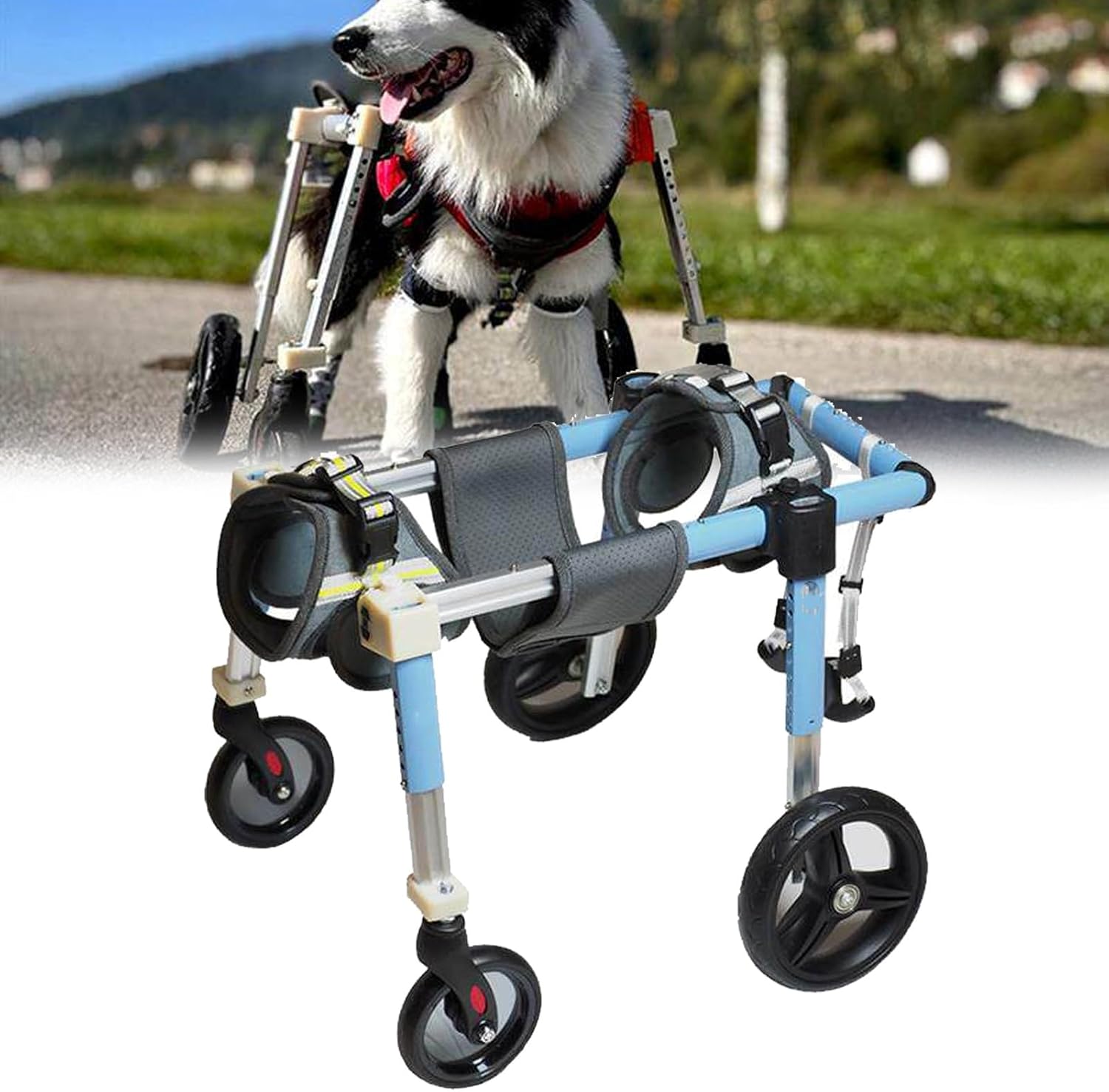
| Number of Wheels | 4 |
|---|---|
| Harness Feature | anti-abrasion, breathable, padded |
| Frame Material | Aluminum |
This foldable dog wheelchair is built to restore mobility for pets with hind leg weakness or injury while staying compact enough for indoor use. The aviation-grade aluminum frame keeps the unit lightweight yet sturdy, and tool-free length, width, and height adjustments let you fine-tune the fit quickly without tools. The design converts between 4-wheel full support and 2-wheel partial support as a dog recovers, and outward-tilted, double-bearing wheels plus shock-absorbing tires improve lateral stability and smoothness on sidewalks, grass, and indoor floors. The padded, breathable harness includes anti-abrasion ear-shaped covers and a rear groove that allows urination without removing the cart, which helps with comfort and hygiene during longer sessions. It folds and disassembles for storage and travel, and aluminum parts resist rust for easier cleaning. Limitations include the generic sizing claim of one-size-fits-most, which may still require careful measurement for larger or atypical body shapes, and the product relies on user adjustment rather than custom fitting for specific mobility needs.
Best for: Households that need a mobility aid with a smaller footprint and easier indoor maneuvering while still supporting large dogs during recovery or age-related weakness.
Less Ideal for: Owners who require a custom-fitted mobility device or have dogs with unusual body proportions that need veterinary-prescribed orthotics.
- Tool-free length, width, and height adjustment for quick fitting
- Aviation aluminum frame offers a lightweight yet durable structure
- Convertible 2-wheel/4-wheel setup supports different recovery stages
- Outward-tilted, double-bearing shock-absorbing wheels for stable, smoother movement
- Breathable padded harness with anti-abrasion covers and a rear groove for hygiene
- One-size-fits-most approach may not provide an ideal fit for every large dog body shape
- Some buyers may need to fine-tune adjustments frequently for optimal comfort
Verdict: The best foldable wheelchair for owners who prioritize portability and easy storage when transporting a large dog or stowing the wheelchair at home.
Tapischion Adjustable Large Dog Wheelchair
Best Lightweight Wheelchair

| Maximum Weight Recommendation | 143.3 pounds |
|---|---|
| Frame Material Type | Aluminum |
| Included Components | Manual, Pet Rehabilitation Walking Aid, 2 Wheels |
| Mounting Type | Floorstanding |
This wheelchair is a mobility aid for large dogs with hind-leg weakness, injury, or age-related decline that lets pets stand and move with rear support. The aluminum alloy frame keeps the unit relatively light for its load capacity while reinforced corners and quick-lock buckles provide a stable, adjustable fit by changing height, body length, and hip width. A breathable mesh harness and open-crotch layout improve comfort and allow easy potty breaks without full removal, and the large rubber, dual-bearing wheels smooth motion across indoor floors, grass, and sidewalks. Setup requires basic adjustments and proper fitting to avoid chafing, and the harness and straps will need periodic checks for wear. The frame supports dogs up to about 143 pounds, so it is suitable for many large-breed rehab cases, but it does not include extensive padding or advanced suspension beyond the shock-absorbing wheels. For owners who need a lightweight, adjustable support that still carries a high weight recommendation, this model balances portability and sturdy load capacity.
Best for: Owners of large dogs who want a lighter, easier-to-handle rehab aid that still supports substantial weight and can be adjusted for a close, secure fit.
Less Ideal for: Those who need heavy-duty industrial suspension or extensive built-in padding for continuous all-day use should consider more specialized medical carts.
- Aluminum alloy frame offers lower weight while supporting large dogs
- Adjustable height, body length, and hip width for a personalized fit
- Large rubber dual-bearing wheels provide smooth maneuvering on varied terrain
- Breathable mesh harness with open-crotch design for comfort and easy potty access
- Limited padding and basic harness may require aftermarket cushioning for long sessions
- Setup and fit tuning can be time consuming to avoid rubbing
Verdict: The best lightweight wheelchair for owners who need a lower‑weight frame to make lifting and daily handling easier while still supporting a large dog's mobility.
Walkin' Wheels Dog Wheelchair Large
Best Premium Wheelchair

| Maximum Weight Recommendation | 137 pounds |
|---|---|
| Frame Material Type | Aluminum |
The Walkin' Wheels Large dog wheelchair is a four-wheel rear-support cart intended to help large dogs with hind-leg injuries, age-related weakness, or disabilities stay active. It uses a lightweight aluminum frame that folds flat for storage and transport, and the patented three-way adjustable system lets you set height, length, and width for a custom fit as your dog's needs change. In practice the frame gives stable rear support while allowing dogs to run and play without added strain, and the folding design makes it straightforward to load into a car or tuck away at home. The wheelchair is veterinarian approved and rated to support up to about 137 pounds on the largest size, but fitting does require careful measurement and some time with adjustments to get straps and posture right. Wheels and frame look durable for regular outdoor use, though assembly and fine-tuning are needed before long walks. For owners prioritizing build quality and a configurable, long-term mobility solution, this model delivers reliable support and convenience.
Best for: Owners who are willing to invest in a durable, configurable mobility solution to keep a large dog active and comfortable over the long term.
Less Ideal for: People looking for a minimal or temporary mobility aid for small dogs or owners who need a plug-and-play product with no setup.
- Lightweight aluminum frame offers stable rear support without heavy added weight
- Patented adjustable design allows height, length, and width customization for a precise fit
- Folds flat for easier storage and transport
- Veterinarian approved and rated for large dogs up to the listed maximum weight
- Requires careful measurement and adjustment to achieve a proper, comfortable fit
- Assembly and fine-tuning can be time consuming for first-time users
Verdict: The best premium wheelchair for owners willing to pay more for superior materials, refined fit, enhanced comfort features, and longer-lasting construction for a large dog.
Choosing the Right Dog Wheelchair Large Dog: Key Factors to Consider
Weight Capacity and Frame Strength
For large dogs, the wheelchair frame must support sustained loads without bending or wobbling. A higher rated weight capacity provides a safety margin for active dogs and prevents metal fatigue over time.
Look for frames made from thicker-gauge aluminum or reinforced steel and check how the manufacturer defines safe working load. Stronger frames often weigh more, but they reduce flex during movement, which improves handling and reduces the risk of hardware failure.
Adjustability and Sizing Range
Large dogs come in many body shapes, so a wheelchair with wide adjustability is essential. Adjustable height, length, and wheelbase let you position the wheels under the center of mass and support either the hindquarters or forelimbs as needed.
A broad sizing range and multiple strap locations let you customize support points to avoid chafing and distribute weight evenly. Tool-free adjustments are especially helpful for frequent tuning during recovery or weight changes.
Wheel Size and Terrain Performance
Wheel diameter, tread, and axle design determine how well a wheelchair handles grass, gravel, pavement, or trails. Larger wheels roll over obstacles more easily and reduce the effort a dog must exert.
Consider sealed bearings and puncture-resistant tires for lower maintenance. If your dog will be active outdoors, choose wheels that provide stability and predictable steering rather than very narrow or slick designs.
Harnessing and Comfort Features
The connection between dog and frame is where comfort matters most. Padded harnesses, wide straps, and breathable materials reduce pressure points and rubbing during longer outings.
Look for designs that allow hip support, belly straps, and optional limb slings to match the dog's condition. Good padding and soft-edge finishes prevent skin irritation and encourage the dog to accept the device more quickly.
Stability and Maneuverability
A wheelchair must balance stability with the ability to turn and navigate daily environments. Wider wheelbase and lower center of gravity increase stability but can make tight turns harder.
Adjustable wheel offset and placement help tune tracking and turning radius. Check whether the design allows for toe-in/toe-out adjustments and whether the caster setup supports predictable steering without excessive resistance.
Ease of Use and Maintenance
Caregivers need a wheelchair that is straightforward to assemble, fit, and maintain. Quick-release wheels, washable pads, and corrosion-resistant finishes reduce time spent on upkeep.
Consider how often straps and pads will need cleaning and whether replacement parts are straightforward to install. A design that requires frequent tool use for daily adjustments will be harder to live with over months of use.
How Do I Measure My Large Dog for a Wheelchair?
Measure three key areas: chest girth at the widest point, distance from the floor to the top of the hip or shoulder (depending on whether you need hind or front support), and the length from chest to tail base for frame length. Record the dog's weight and note any asymmetry or limb contractures that affect posture.
Compare those numbers to the wheelchair manufacturer's sizing chart and choose a size that allows adjustment rather than one that barely fits. If a dog sits or stands differently due to weakness, measure in the posture they will use most when wearing the wheelchair.
- Chest girth determines strap placement and harness sizing
- Height measurement sets wheel axle height for proper weight distribution
- Frame length ensures the wheels are under the center of mass
What Types of Wheel Setups Work Best for Outdoor Walks?
For outdoor use, prioritize larger, pneumatic or foam-filled tires with a grippy tread. These absorb shock and roll over uneven ground with less effort from your dog. Solid rubber or foam tires reduce puncture worries but offer less cushioning.
Also check whether the wheelchair has a suspension or flexible axle system. Those features smooth motion and reduce stress on joints during active walks on longer routes.
- Pneumatic tires: best cushioning and traction
- Foam-filled: lower maintenance, reasonable cushioning
- Solid rubber: durable but harsher ride
How to Introduce a Large Dog to Wearing a Wheelchair
Start slowly with short, positive sessions. Fit the wheelchair off the dog first so it is familiar, then add the harness without wheels for a moment. Reward calm behavior and gradually increase the time wearing the device.
Use high-value treats and go at the dog's pace. Expect an adaptation period of days to weeks depending on temperament and prior mobility. Adjust straps for comfort after the first short walk to eliminate pressure points.
- Begin in a quiet, familiar area
- Keep initial sessions under five minutes
- Increase walking time gradually
Common Fit Problems and Simple Fixes
If the dog leans excessively forward or backward, recheck wheel axle height and fore-aft wheel placement. Shorten or lengthen the frame incrementally until the dog's back is level and the paws contact the ground naturally.
Chafing usually signals strap placement or insufficient padding. Reposition straps, add soft covers, or use breathable padding to protect skin. For tracking issues, small wheel toe adjustments or shimming the axle can improve straight-line walking.
- Level the back by adjusting wheel height
- Prevent rubbing with padding and correct strap angles
- Tune tracking with wheel alignment tweaks
When Is a Wheelchair Not the Right Option?
A wheelchair can greatly help many large dogs, but it may not be appropriate for animals with severe neurologic deficits that affect coordination or for dogs who cannot bear any weight safely. If pain, uncontrolled seizures, or serious systemic illness are present, consult a veterinarian before continuing.
Also consider behavior and temperament. Dogs that are highly fearful or aggressive may need desensitization or alternative rehabilitation approaches. In some cases, targeted physical therapy or assistive slings used by a caregiver are better short-term options.
- Not suitable for uncontrolled neurologic conditions without vet input
- Behavioral intolerance can limit wheelchair use
- Short-term slings may be preferable during acute recovery
How We Chose the Best Dog Wheelchair Large Dog
We prioritized features that matter most for supporting large dogs while balancing practical user needs. Key evaluation criteria included load capacity and frame strength to ensure the wheelchair can safely support larger weights, adjustability and sizing range to fit broad chest and hip dimensions, and wheel quality and suspension for stable motion over common outdoor surfaces. We also weighed harness and support design for comfort and to reduce rubbing, plus ease of setup and tool-free adjustments so caregivers can fine-tune fit quickly. Products were excluded if they lacked clear weight capacity ratings or offered limited adjustability for large breeds. We also filtered out designs that relied on thin frames or small wheels that reduce stability under heavier loads. The final list focuses on durable materials, realistic sizing ranges, and features that reduce maintenance and improve everyday usability for larger dogs.
Our full evaluation process is outlined in our review methodology.
FAQ
How long does it take a large dog to get used to a wheelchair?
Adaptation varies with temperament and prior mobility. Many dogs accept the device within a few days of short, positive sessions, while others may take several weeks. Gradual exposure and consistent rewards speed the process.
Can wheelchairs help with arthritis in large dogs?
Wheelchairs can reduce load on painful limbs and allow continued activity, which often helps joint health indirectly. They are usually part of a broader plan that includes veterinary guidance and pain management.
What maintenance do large-dog wheelchairs typically need?
Routine checks include inspecting fasteners, cleaning straps and padding, and keeping wheels and bearings free of debris. Inflatable tires need pressure checks; solid wheels require less frequent attention but should be examined for wear.
Will a wheelchair cause my dog to lose muscle tone?
Used properly, wheelchairs enable movement rather than replace it, so they tend to preserve or improve muscle use. However, relying solely on a wheelchair without guided activity may limit targeted muscle rehabilitation.
Can a single wheelchair size fit multiple large dogs in a household?
Some designs offer a broad sizing range and adjustable features that allow one frame to be shared between dogs with similar dimensions. Frequent resizing is possible but may be time consuming; measure each dog to confirm compatibility.
Final Verdict
When choosing a wheelchair for a large dog, prioritize safe load capacity, broad adjustability, and robust wheel design. Fit and comfort determine whether a dog will accept the device, while durable materials and low-maintenance wheels determine long-term usefulness. Balance stability and maneuverability for your typical walking environment, and plan for a gradual fitting process that includes padding adjustments and short practice walks. Focus on features that match your dog's size and activity level to make a confident, durable choice.

