

When you hunt with gun dogs, having a dedicated first aid kit tailored to field injuries makes a real difference in outcomes. A well-stocked kit helps you manage bleeding, lacerations, punctures, and minor fractures long enough to get professional care. This guide shortlists the top choices for gun dog first aid kits, focusing on durable construction and the supplies most often needed on hunts. Below you will find concise product overviews and clear notes on what each kit contains. Our evaluation emphasizes the types of supplies, ease of use under pressure, and how well kits suit fast-paced field work.
Top Picks at a Glance
| Best Overall Gun First Aid Kit Reliable, well-rounded kit covering common hunting and range emergencies | EVERLIT Advanced Trauma Kit |  |
| Best Budget Gun First Aid Kit Cost-conscious kit with core supplies for basic emergency response | GHFY Tactical First Aid Kit |  |
| Best Compact Gun First Aid Kit Small, low-profile kit that fits in packs or range bags | North American Rescue IPOK Compact First Aid Kit |  |
| Best Comprehensive Gun First Aid Kit Larger kit with an expanded selection of trauma and wound supplies | Homestockplus Hard Case First Aid Kit Large |  |
| Best Weatherproof Gun First Aid Kit Rugged, water- and dust-resistant case built for outdoor conditions | RHINO RESCUE Pet First Aid Kit |  |
| Best Tactical Gun First Aid Kit Durable, mission-focused kit with quick-access layout and heavy-duty gear | Scherber IFAK Trauma Kit Camouflage |  |
| Best Premium Gun First Aid Kit Higher-end kit with top-quality supplies and thoughtful organization | Rescue Essentials K9 Personal Carry Kit |  |
EVERLIT Advanced Trauma Kit
Best Overall Gun First Aid Kit
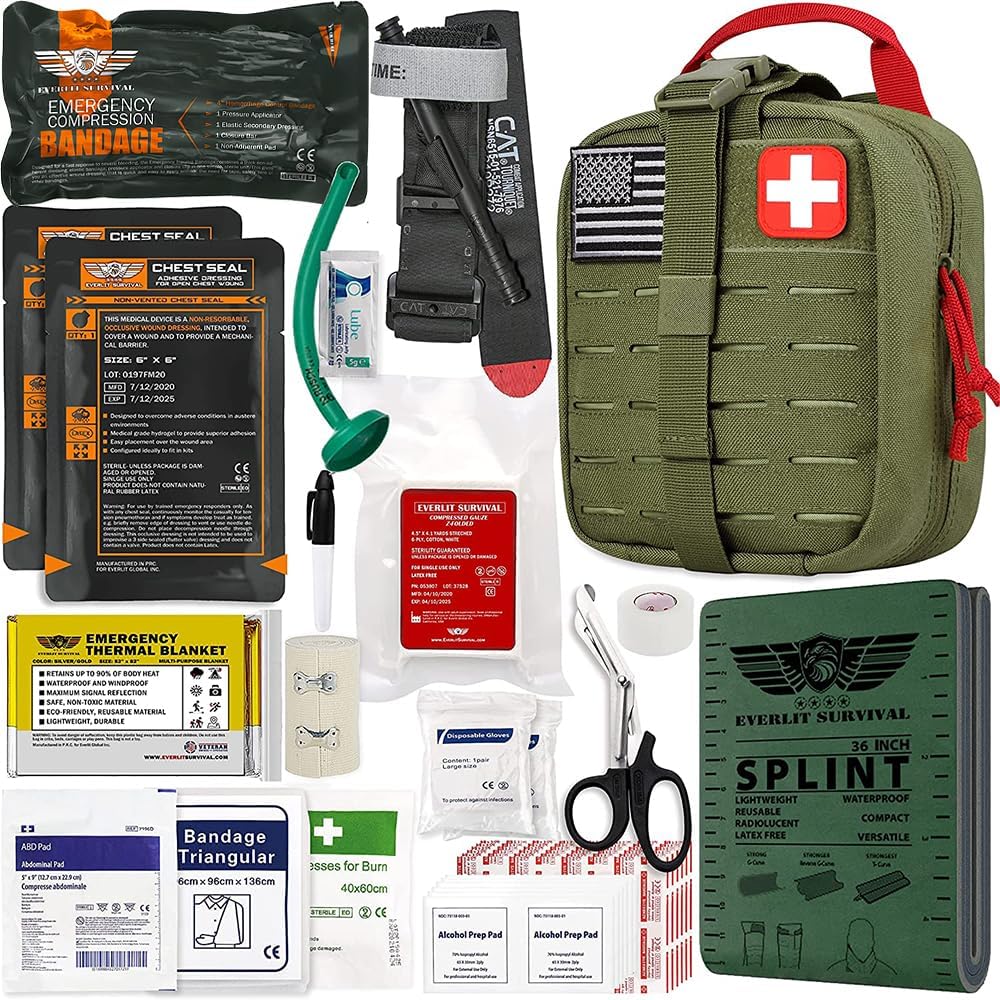
| Included Components | Chest Seal, Compressed Gauze, Compression Bandage, Naso Airway, Tourniquet |
|---|---|
| Number of Pieces | 5 |
| Manufacturer | EVERLIT |
| Manufacturer Part Number | TK-104 |
This kit is built as a compact, field-ready trauma pack focused on stopping life threatening bleeding and stabilizing casualties until further care. It includes a Combat Application Tourniquet GEN-7, an Israeli style compression bandage, z-fold compressed gauze, non-vented chest seals, a nasopharyngeal airway, a 36" combat splint, thermal blanket and a range of dressings and gloves organized inside a laser-cut mil-spec nylon IFAK pouch. In practical use the kit works well for hunters and shooters who need fast access to tourniquet and chest-seal supplies without bulky cases; the pouch's MOLLE/laser-cut layout keeps items visible and reachable in low-light or cold conditions. The curated contents prioritize hemorrhage control and basic airway management rather than broader household first aid, so it excels on the trail, at ranges, or in vehicle trauma scenarios. The kit is light and compact for carrying on a pack or chest rig, but buyers who want large quantities of consumables or advanced airway/IV gear will need to supplement it.
Best for: Hunters, shooters, and gun dogs handlers who want a compact, trauma-focused kit that prioritizes rapid hemorrhage control and simple stabilization in the field.
Less Ideal for: People who need a full household first aid kit or extended-stay wilderness packs that require large supplies and advanced medical tools.
- Includes proven CAT GEN-7 tourniquet for reliable one-handed application
- Focused hemorrhage control set: compression bandage, compressed gauze, and chest seals
- Nasopharyngeal airway and thermal blanket address airway and hypothermia concerns
- Durable laser-cut mil-spec nylon pouch with MOLLE compatibility for easy mounting
- Compact, organized layout suitable for quick access in field conditions
- Not stocked for prolonged care—limited quantities of consumables
- Does not include advanced airway or IV equipment
Verdict: The best overall gun first aid kit balances essential trauma supplies, durable packaging, and straightforward organization for most hunters and shooters.
GHFY Tactical First Aid Kit
Best Budget Gun First Aid Kit

| Pieces included | Approximately 180 pieces |
|---|---|
| Pouch material | 1000D nylon |
| Attachment system | MOLLE straps with snaps |
| Closure | Full clamshell zipper |
This compact MOLLE-style first aid kit is built as a basic IFAK for immediate care in outdoor, range, or tactical settings. The clamshell zipper opens to reveal a single pocket with multiple elastic loops that keep bandages, dressings, gloves, and small tools visible and organized, and the kit includes about 30 sets totaling 180 pieces of common supplies plus a simple first aid guide. The 1000D nylon exterior and water-resistant construction make it reasonably durable for a pouch you clip to a pack or vest via MOLLE straps and snaps, and the rivet at the base helps with airflow and drainage. Because the kit focuses on fundamentals it is light and leaves space to add a few personal items, but it does not include advanced hemorrhage control gear or specialized trauma items, and the single-pocket interior limits separation of supplies during frantic use. For straightforward, budget-minded preparedness this pouch delivers core bandages and tools in a rugged, attachable format, though users who need tourniquets, hemostatic agents, or a more compartmentalized layout should look elsewhere.
Best for: Buyers who want a no-frills, attachable kit that supplies essential bandages and basic tools for immediate on-site care during range trips, hunting, or day hikes.
Less Ideal for: Users who require a comprehensive trauma kit with specialized bleeding control items or a multi-compartment organizer for professional or high-risk situations should choose a different kit.
- Includes ~180-piece assortment of basic first aid supplies suitable for common cuts, scrapes, and minor injuries
- MOLLE straps and strong snaps let you attach the pouch to packs, vests, or belts for quick access
- Durable 1000D water-resistant nylon exterior stands up to outdoor use
- Clamshell zipper and internal elastic loops keep items visible and generally organized
- Single internal pocket limits separation of items during high-stress use
- Does not include advanced trauma items such as tourniquets or hemostatic dressings
Verdict: The best budget gun first aid kit gives owners the essential bandages, dressings, and tools needed for immediate care without extra frills.
North American Rescue IPOK Compact First Aid Kit
Best Compact Gun First Aid Kit
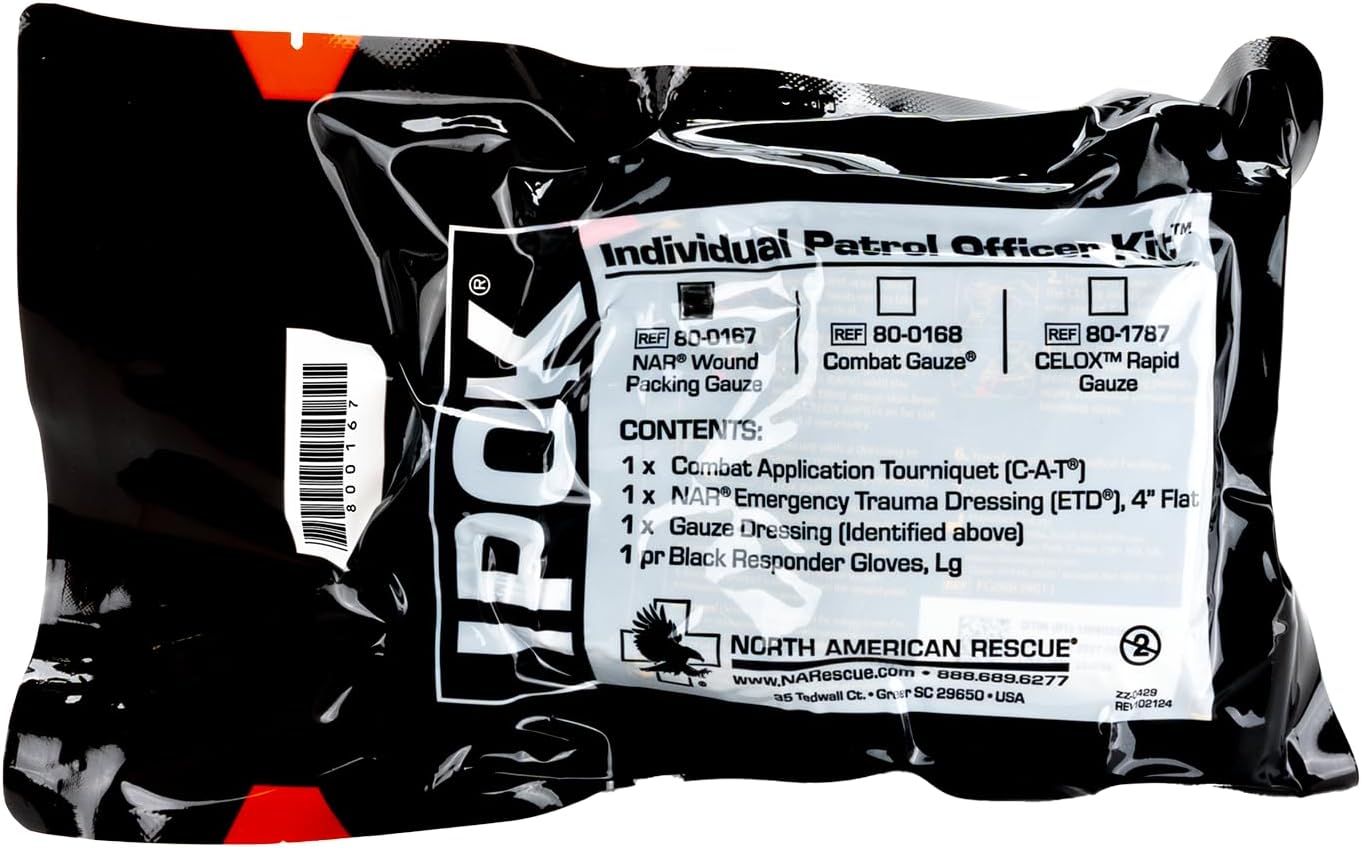
| Contents | CAT tourniquet, S-rolled gauze, 4" trauma dressing, 2 nitrile gloves |
|---|---|
| Packaging | Vacuum-sealed rugged pouch with red tear notch |
| Item model number | 80-0167 |
| Batteries | 1 Nonstandard Battery batteries required |
The North American Rescue IPOK is a pocket-sized hemorrhage control kit meant to be carried on a person, vest, or in a small pouch for rapid response to penetrating or traumatic injuries. It includes a CAT tourniquet, S-rolled gauze, a 4-inch emergency trauma dressing, and two pairs of nitrile trauma gloves, all vacuum-sealed in a rugged, easy-open pouch with a red tear notch. In real-world use the kit excels at providing the core items needed to stop severe bleeding quickly and to pack wounds until professional care is available. Its small footprint and durable packaging make it ideal for hunters, field handlers, or dog handlers who need something lightweight that fits in a vest or BDU pocket. The kit is limited to immediate hemorrhage control and wound packing and does not include additional items like analgesics, bandage scissors, or airway tools, so it should be paired with other supplies for extended field care or multi-casualty situations.
Best for: Buyers who need a minimal, highly portable bleeding control kit to keep on their person during field work, hunting, or when handling dogs in remote areas.
Less Ideal for: People seeking a full-featured or multi-day field medical kit for extended care or teams managing multiple casualties should choose a larger, more comprehensive kit.
- Includes a proven CAT tourniquet for rapid hemorrhage control
- Compact, vacuum-sealed pouch sized to fit a pocket or vest
- Includes S-rolled gauze and a 4" emergency trauma dressing for wound packing
- Two pairs of nitrile trauma gloves for basic provider protection
- Rugged, easy-open packaging with tear notches for fast access
- Contains only core hemorrhage and wound packing supplies and lacks extended first aid items
- No airway, splinting, or multi-use tools included
Verdict: The best compact gun first aid kit is optimized for minimal footprint and portability while still carrying key items for quick response.
Homestockplus Hard Case First Aid Kit Large
Best Comprehensive Gun First Aid Kit

| Contents quantity | 409 pcs |
|---|---|
| Attachment system | Wall mounted; straps; MOLLE; top handle |
| Material | 600D Polyester; heavy duty plastics |
| Case closure | Slide latch |
This Homestockplus hard case kit is a heavy-duty, portable first aid box built for quick access and organized response to serious injuries. It ships in a rigid plastic case with a slide latch, top handle, and options for wall mounting or removable MOLLE/straps depending on the variant, which makes it easy to station in a vehicle, garage, or range house and carry to a casualty. Inside, color-coded, labeled compartments separate dressings, bandages, and emergency tools so you can find hemostatic dressings and larger supplies fast under stress. The kit lists several hundred pieces across its configurations, so it covers more than basic cuts and sprains and suits incidents requiring larger dressings and multi-item responses. The hard shell and secure latch keep contents contained during transport but add bulk compared with soft pouches, and there is limited detail about specific hemostatic brands or quantities on the listing, so users wanting defined commercial hemostatic products should verify contents before relying on it for high-risk environments.
Best for: Buyers who need a single, well-organized kit stocked beyond basic supplies for treating significant bleeding and other serious field injuries at a range, vehicle, or workshop.
Less Ideal for: If you want a lightweight, minimalist kit for day trips or concealed carry, this larger, bulkier hard case will be more than you need.
- Rigid hard-shell case protects contents during transport and storage
- Color-coded, labeled internal compartments for fast retrieval
- Multiple attachment options including wall-mount and top handle for flexible placement
- Large contents count suitable for more severe incidents rather than just basic cuts
- Listing does not specify brands or exact quantities for specialized items like hemostatic agents
- Hard case is bulkier than compact soft trauma pouches
Verdict: The best comprehensive gun first aid kit is intended for users who want a wider range of dressings, hemostatic agents, and tools for more severe incidents.
RHINO RESCUE Pet First Aid Kit
Best Weatherproof Gun First Aid Kit

| Item count | 105 pieces |
|---|---|
| Material | TPU waterproof fabric |
| Closure | Roll-top with two-way zippers |
| Includes | Thermometer, muzzle, feeding kit, emergency blanket |
The RHINO RESCUE Pet First Aid Kit is a compact emergency pack designed to keep pet medical and survival supplies organized and protected in wet or rough conditions. Packaged in a TPU waterproof roll-top dry bag with abrasion-resistant fabric and two-way zippers, the kit stores 105 items including gauze, self-adhesive bandages, waterproof bandages, an ice pack, emergency blanket, thermometer, feeding kit, muzzle, pill bag, disposable booties, and basic outdoor tools like a compass. Transparent interior dividers make it quick to find what you need during a stressful situation, and the waterproof construction plus roll-top closure help keep contents dry if you are dealing with rain, puddles, or mud. The inclusion of both daily-care items (feeding kit, pill bag) and true first-aid supplies makes this a versatile pack for gun dog handlers who spend long days outdoors. Limitations are that the kit is a general pet medical set rather than a trauma-focused gunshot or major-bleeding specific kit, and you may want to supplement it with larger hemorrhage control gear and model-specific medication for prolonged expeditions.
Best for: Handlers and hunters who need a weatherproof, all-in-one pet medical pack for day trips and fieldwork and who value dry, organized access to both first aid and routine-care items.
Less Ideal for: Users seeking a dedicated tactical trauma kit for catastrophic bleeding or those who need a medically certified veterinary trauma system for professional use.
- Waterproof TPU roll-top dry bag and abrasion-resistant fabric protect supplies from rain and mud
- Transparent interior dividers and two-way zippers for quick access and organized storage
- Comprehensive 105-piece kit covers both first aid and daily-care needs like feeding and medication
- Includes outdoor survival items (emergency blanket, compass) useful during remote fieldwork
- Not configured as a tactical trauma kit for major hemorrhage control or gunshot-specific injuries
- May require additional specialized supplies for extended backcountry or tactical operations
Verdict: The best weatherproof gun first aid kit protects contents from rain, mud, and rough handling so supplies stay usable in harsh environments.
Scherber IFAK Trauma Kit Camouflage
Best Tactical Gun First Aid Kit

| Pouch material | 600D nylon |
|---|---|
| Included tourniquet | Combat Application Tourniquet (CAT) |
| Included chest care | HyFin chest seal |
| Pack style | MOLLE pouch with hook-and-loop panels |
This Scherber IFAK is a field-focused trauma pack built for rapid response to major bleeding and penetrating chest injuries. Packaged in a MOLLE-compatible 600D nylon pouch, it organizes contents across three tiers with hook-and-loop panels and rip-away attachments for fast grab-and-go deployment. The kit includes genuine North American Rescue items such as a CAT tourniquet and HyFin chest seal plus Israeli bandage and breathing airway tools, so you get professional-grade components rather than generic knockoffs. The rugged pouch and intuitive layout make it suitable to mount on kit rigs or carry on a patrol vest, and the zippered enclosure keeps supplies secure while still allowing quick access when needed. Limitations: it is a dedicated trauma kit rather than an all-purpose first aid pack, so it lacks bulk minor-care items like extensive antiseptics or OTC meds, and the camo exterior may be less visible in low-light retrieval. For anyone focused on rapid hemorrhage control and chest wound management in tactical or field situations, this kit delivers the core gear in a durable, mission-ready package.
Best for: Buyers who need a compact, mission-ready trauma kit for fast hemorrhage and chest-wound response in tactical, hunting, or field settings where durability and professional components matter.
Less Ideal for: Users looking for a general household first-aid kit or a complete minor-injury kit should choose a broader supplies set rather than this focused trauma pack.
- Includes genuine professional-grade components (CAT tourniquet, HyFin chest seal, Israeli bandage).
- Durable 600D nylon MOLLE pouch built for mounting and rough field use.
- Organized three-tier layout with hook-and-loop and rip-away attachments for fast access.
- Zippered enclosure and secure pockets keep gear in place while remaining reachable.
- Focused on major trauma care and omits many general first-aid items for minor injuries.
- Camouflage exterior can make the pouch harder to spot in low-light or cluttered environments.
Verdict: The best tactical gun first aid kit prioritizes fast access, reinforced materials, and professional-grade components for high-stress or field use.
Rescue Essentials K9 Personal Carry Kit
Best Premium Gun First Aid Kit

| Kit type | K9 Personal Carry Kit |
|---|---|
| Includes | Tourniquets, compressed gauze, SAM splint, chest seals, burn dressing, muzzle |
| Weight | 2.3 pounds |
| Dimensions | 4.5 x 7.25 x 7.5 inches |
The Rescue Essentials K9 Personal Carry Kit is a small, field-ready IFAK built to support both K9s and human handlers in emergency situations. Packaged in a compact carry case, it is typically carried on a handler's belt or stored in a vehicle for rapid access. The kit includes tourniquets (CAT and SWAT-T), compressed gauze, an ABD combine pad, a SAM splint, chest seals, burn dressing, cohesive wrap, gloves, shears, forceps, a muzzle, and basic ancillary items like a thermometer and rescue blanket. Those contents translate to practical capability for controlling life-threatening bleeding, stabilizing fractures, sealing chest wounds, and managing burns or shock until evacuation. A veterinary information card adds quick-reference guidance specific to K9 care. Because the kit focuses on core trauma and immediate stabilization, it does not include extensive medications, IV supplies, or veterinary-only surgical tools, so it is best used as an initial response pack rather than definitive treatment during prolonged care situations.
Best for: Buyers who prioritize a premium, ready-to-carry trauma kit that covers immediate life-saving interventions for working gun dogs and their handlers in the field.
Less Ideal for: Not a fit for teams needing extended veterinary treatment kits, mass-casualty response supplies, or an all-in-one long-term medical solution.
- Dual-purpose design with supplies applicable to both K9s and humans for flexible field response
- Includes multiple tourniquet options and compressed gauze for effective hemorrhage control
- Compact, lightweight carry size suitable for belt or vehicle storage
- Contains practical tools like EMT shears, forceps, a SAM splint, and chest seals for common traumatic injuries
- Includes a veterinary information card to guide care decisions for working dogs
- Does not include advanced veterinary medications or IV/infusion supplies for prolonged treatment
- Limited quantity of consumables may be insufficient for multiple or large-animal casualties
Verdict: The best premium gun first aid kit suits owners who want superior materials, comprehensive contents, and refined organization for long-term reliability.
Choosing the Right Gun Dog First Aid Kit: Key Factors to Consider
Wound Care Supplies
A gun dog first aid kit should prioritize basic wound care because lacerations and punctures are the most frequent field injuries. That means having sterile gauze of multiple sizes, nonstick dressings, wound cleansers, antiseptic wipes, and adhesive materials that work on fur and skin. Proper wound packing material and adhesive tape help control oozing until definitive care is available.
Also consider whether the kit contains supplies for both small abrasions and larger wounds. Items like adhesive wound closures or suturing alternatives are useful for temporarily approximating edges on deeper cuts. The goal is to limit contamination, control bleeding, and reduce further tissue damage while you get professional treatment.
Bleeding Control and Tourniquet Options
Uncontrolled bleeding can become life-threatening quickly, so a kit needs targeted bleeding-control tools. Include combat-style gauze designed for pressure packing, multiple sizes of compression dressings, and a compact, reliable tourniquet or an improvised-tourniquet system. Hemostatic dressings that accelerate clotting are particularly valuable in the field when veterinary care is hours away.
Know how to apply these items under stress: clear labeling and simple instructions in the kit improve the chances of effective use. Also check for redundant options—more than one compression dressing and extra gauze—since severe bleeding may require multiple layers.
Immobilization and Splinting
Fractures and severe sprains are possible when dogs run over uneven terrain. A good kit contains lightweight splinting materials such as foldable aluminum splints, padded wraps, and vet-wrap-style cohesive bandages. These items let you immobilize a limb to reduce pain, prevent further injury, and ease transport to a vet.
Include padding to protect pressure points and straps or tape to secure the splint without cutting off circulation. The ability to improvise a splint from available materials is useful, so a kit that includes multipurpose padding and secure fasteners is advantageous.
Medication and Topical Care
Topical antiseptics, wound gels, and sterile lubricating ointments help manage contamination and support temporary wound protection. Some kits include oral electrolyte solutions, activated charcoal, or basic analgesics intended for animal use. Because medication use depends on veterinarian guidance, kits should focus on safe, broadly appropriate topicals and clearly label any medicinal items with dosing cautions.
Avoid relying on human-only medications without veterinary approval. A practical kit contains items that support immediate stabilization—cleaning wounds, reducing swelling, and controlling infection risk—until professional care is possible.
Durability and Weather Resistance
Hunting conditions expose gear to moisture, dirt, and rough handling. The kit container should be water-resistant or waterproof and sturdy enough to survive being packed in a vest or bag. Internal organization that secures supplies prevents items from getting crushed or contaminated.
Look for reinforced zippers, TPU-lined bags, or hard cases with foam inserts. Weather resistance protects sterile items and preserves medications and dressings in cold, wet, or dusty conditions.
Organization, Labeling, and Ease of Use
In an urgent situation, you need fast access to the right item. Clear internal layout, labeled compartments, and color-coded items reduce hesitation. Kits that separate wound-care, bleeding control, splinting, and medication items help users find what they need quickly.
Consider whether the kit includes simple instructions or quick-reference cards and whether components are sized and packaged for single use. Removable pouches that attach to a pack or can be handed to a helper speed treatment when time is critical.
What Should I Do First when My Gun Dog Is Injured in the Field?
The first step is to ensure the scene is safe for you and the dog. Move the dog out of immediate danger if possible, then assess consciousness, breathing, and major bleeding. Calm the dog using a soft voice and steady approach to reduce stress and prevent defensive reactions.
Control heavy bleeding first using direct pressure with a clean dressing. If bleeding is severe and does not respond to pressure, apply a tourniquet proximal to the wound according to the kit instructions. Keep the dog warm and still while preparing for transport to veterinary care.
- Check airway, breathing, circulation quickly
- Apply direct pressure to bleeding wounds
- Use a tourniquet only for life-threatening limb hemorrhage
- Stabilize fractures with padding and splints before moving
How Can I Tell if a Wound Needs Immediate Veterinary Attention?
Seek veterinary care for deep punctures, wounds with heavy or spurting bleeding, wounds exposing bone or tendon, or injuries that impair mobility. Signs of infection such as swelling, foul odor, or increasing redness within 24 hours also require prompt attention.
Even small wounds on hunting trips can become contaminated by debris and bacteria, so when in doubt, prioritize professional evaluation. Use the kit to stabilize and clean the wound en route to care.
- Deep or gaping wounds
- Persistent heavy bleeding
- Limping or inability to bear weight
- Signs of shock: pale gums, rapid breathing, weakness
How Should I Store and Maintain a Gun Dog First Aid Kit?
Keep the kit in a water-resistant compartment of your hunting pack or attached to your vest so it is accessible but protected. Store it in a cool, dry place when not in use to preserve sterility and medication potency. After each use, restock single-use items promptly to maintain readiness.
Regularly inspect the kit for expired medications, compromised packaging, or damaged tools. Replace adhesive materials that have lost tack and reseal waterproof containers to ensure future protection.
- Inspect kit before each season
- Replace expired or single-use items immediately
- Keep a checklist inside the kit for quick restocking
Should I Take Any Training Before Using Field First Aid on My Dog?
Yes. A basic hands-on course in pet first aid builds confidence and teaches practical techniques like wound packing, tourniquet application, and safe transport. Many courses include simulations that mirror hunting environments and help you practice under realistic conditions.
Even a short certification course can reduce mistakes and improve your ability to triage injuries in the field. Complement training by practicing with your kit at home so you can open compartments and identify items by touch in low visibility.
- Consider a pet first aid course with hands-on practice
- Practice kit use in daylight and with a headlamp
- Review veterinary emergency procedures for your area
What Compact Extras Make a First Aid Kit More Useful on Hunts?
Small items that add versatility include a headlamp for night treatment, nitrile gloves, extra zip bags for contaminated dressings, and a lightweight thermal blanket to prevent hypothermia. A digital thermometer and a pair of blunt-tipped scissors are compact but highly useful.
Include a simple waterproof notepad and pen to record treatment times, medications given, and observations to share with the veterinarian. These extras add little weight but improve the quality of care you can provide before reaching professional help.
- Headlamp and gloves
- Blunt-tipped scissors and forceps
- Waterproof notepad for treatment records
How We Chose the Best Gun Dog First Aid Kit
We evaluated kits based on practical field needs for gun dogs and hunting scenarios. Key evaluation criteria included: the completeness of wound-care supplies for common hunting injuries, presence of bleeding-control items and tourniquet-compatible solutions, durability and weather resistance of the case, organization and labeling for quick access in low-light conditions, and portability including attachment points or compact footprints suitable for packs and vests. We also considered whether kits included species-appropriate items such as supplies sized for dogs rather than humans and whether instructions were clear for nonmedical users. Kits were excluded if they were general household kits without specific dog-care items or if the contents focused mainly on human use without adaptations for common canine injuries. We focused on practical, repeatable components rather than novelty items, and we prioritized kits that supported quick treatment and safe transport to a veterinarian.
Our full evaluation process is outlined in our review methodology.
FAQ
Can I use human first aid supplies on my dog?
Many basic supplies such as sterile gauze, adhesive tape, and antiseptic wipes are usable on dogs. However, dosing of medications and some topical agents differs between humans and animals. Use human medications only under veterinary guidance and prioritize canine-appropriate items where available.
How often should I check or restock the kit?
Check the kit before each hunting season and after any use. Replace single-use items immediately and review expiration dates every six months to ensure dressings remain sterile and any medications remain effective.
Is a tourniquet safe to use on a dog?
A tourniquet can be lifesaving for severe limb hemorrhage but should be used only when direct pressure fails and the bleeding is life-threatening. Apply it proximal to the wound and note the time applied so the veterinarian knows how long it was in place.
What should I do if my dog swallows a foreign object in the field?
If you suspect ingestion, do not induce vomiting unless instructed by a veterinarian. Contain any sample of the object or packaging, keep the dog calm, and seek veterinary advice promptly. Use supportive care from the kit—fluids and warming—while preparing for transport.
Can cleaning a wound in the field prevent infection?
Cleaning a wound with sterile saline or antiseptic wipes reduces surface contamination and lowers infection risk. Complete elimination of bacteria is unlikely in the field, so cleaning is a first step that should be followed by professional veterinary evaluation when possible.
Final Verdict
Choose a gun dog first aid kit that matches the type of hunting you do and the likely injuries you may encounter. Prioritize bleeding-control supplies, durable weatherproof storage, clear organization, and compact immobilization materials. Balance completeness with portability so you can carry the kit where you need it and use it quickly under stress. With basic training and routine maintenance, the right kit helps you stabilize injuries and reduce complications until a veterinarian can provide definitive care. Focus on the practical items and skills that matter most in your field conditions to make the best selection.

